Golf Club Lead Generation That Converts Enquiries
Most advice on golf club lead generation starts in the wrong place. It tells clubs to buy more traffic, post more on social, run another open day, or add another enquiry form. That sounds sensible, but it misses the core issue. Most clubs don't have a pure demand problem. They have a conversion system problem.
In the UK, the market is far larger than club membership alone. The 2023 Satellite Account for Golf in the UK estimated 5.356 million adults play golf at least once per year, including 2.357 million who play at least once every four weeks, while only 889,000 were club members, according to the R&A Satellite Account for Golf in the UK 2023. The opportunity is obvious. The mistake is assuming that more enquiries alone will capture it.
At GolfRep, we see the same pattern repeatedly. Clubs invest in generating interest, then leave follow-up to a busy manager, a generic inbox, a contact page, or a committee process that nobody really owns. Enquiries come in. Some get answered quickly. Some don't. Some get logged. Some vanish. That isn't lead generation. That's leakage.
Why Most Golf Clubs Lose Leads After the Enquiry
The popular assumption is simple. If membership growth feels slow, the answer must be more leads. In practice, that's often wrong.
UK club data already shows that clubs can grow membership when acquisition works. In Hillier Hopkins' 2023/24 survey, 76% of member clubs reported more joiners than leavers, while 24% reported more leavers than joiners. The same industry summary reported clubs welcomed an average of 94 new members in 2023, while the proportion of clubs with waiting lists fell to 46% from 52%, and the average waiting list shrank to 51 people from 61. It also found 95% of clubs planned to increase fees in 2024, according to the Hillier Hopkins Golf Clubs Report 2023/24. That tells you something important. Clubs aren't operating in a market with no appetite. They're operating in a market where handling demand properly matters more than ever.
The enquiry is not the win
An enquiry is only a raised hand. It is not a visit, not a tour, not a joining fee, and not recurring subscription revenue.
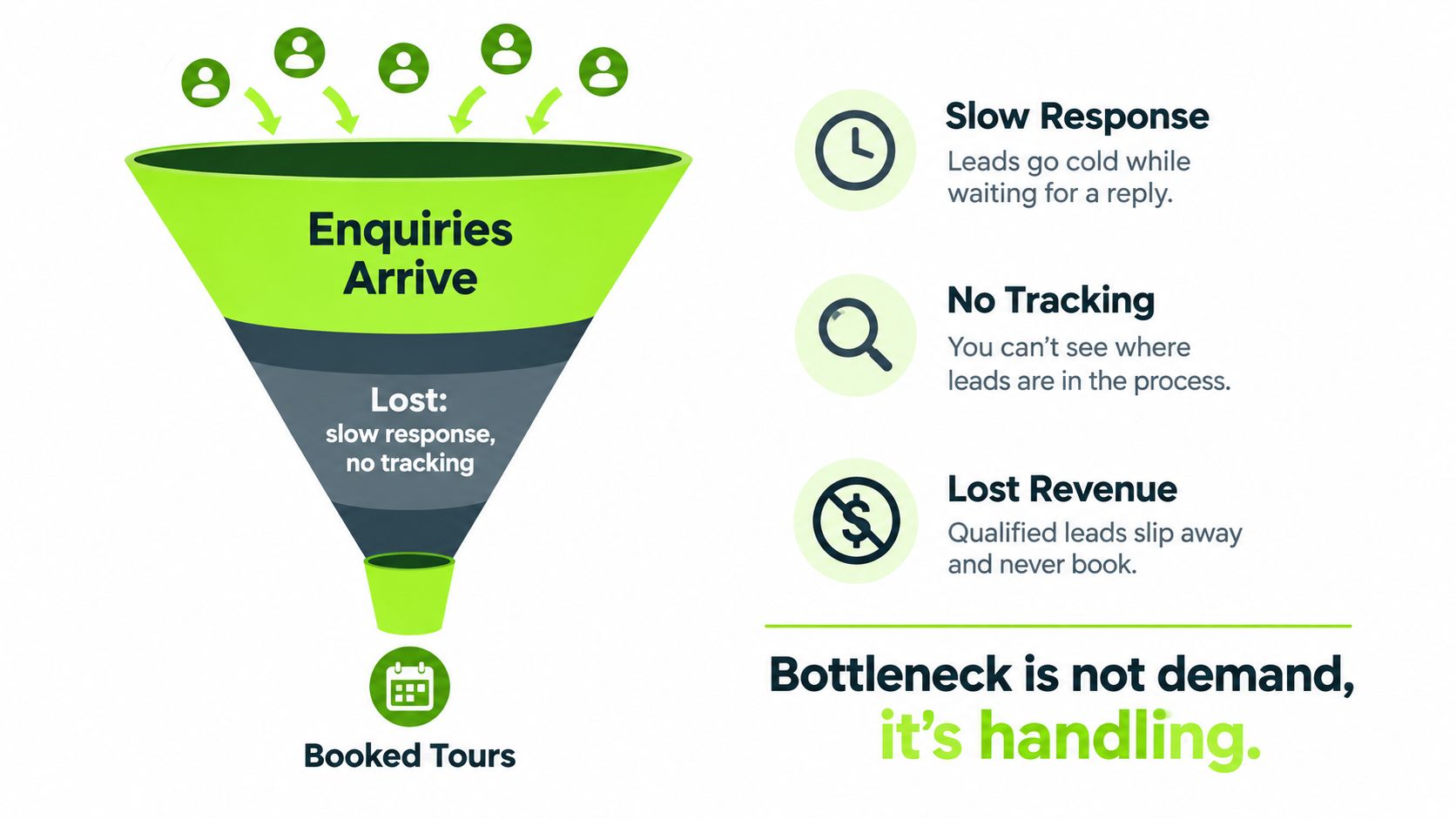
Clubs lose momentum in three places:
- Slow response: Staff see the message too late, reply the next day, or wait until they have time to write a perfect email.
- Poor visibility: Enquiries sit across inboxes, phone logs, Facebook messages, website forms, and handwritten notes.
- No conversion tracking: The club can't tell which campaigns, pages, or channels are producing actual members.
Practical rule: If you can't see every enquiry in one place and assign ownership immediately, you are losing leads without realising it.
That's especially common in committee-led clubs. Nobody thinks they have a process gap because everyone assumes somebody replied. In single-site owner-operated clubs, the opposite problem shows up. One person knows everything, but only while they're available. In multi-site groups, the issue becomes inconsistency. One club responds well, another doesn't, and head office still can't compare outcomes properly.
Manual follow-up is the bottleneck
Manual chasing feels personal, but it rarely scales. If your process depends on someone checking the office inbox between meetings, listening to voicemail after lunch, or remembering to call back after a competition briefing, your pipeline is fragile.
That's why we keep pushing clubs to inspect their own leaks before spending another pound on awareness. A simple audit usually exposes the problem. Track what happens after a prospect clicks submit. Who sees it first? How fast does the club respond? How is the lead categorised? What happens if that person is off site?
A good starting point is this breakdown of how most golf clubs lose enquiries without realising. The exact percentage will vary by club. The pattern doesn't.
Slow follow-up tells a prospect your service will be slow after they join too.
The clubs that build predictable pipelines don't just collect names. They run a system that captures, routes, tracks, and nurtures every enquiry until it becomes a booked visit or a clear no.
Choosing Channels That Fill Your Pipeline Predictably
Most clubs don't need more channels. They need a smarter channel mix.
The wrong approach is to jump between tactics. A few Facebook posts this month, an open day next month, some Google Ads when the committee approves budget, then silence. That creates spikes, not pipeline. Better golf club lead generation comes from choosing channels by intent, control, and how well they fit your club's sales process.
Start with what clubs already use
UK clubs still lean heavily on member recommendation. In the Hillier Hopkins 2024/25 report, 71% of members' clubs used referrals, up from 64% in 2023/24, while social media was used by 60%, advertising by 38%, special offers by 17%, and email campaigns by 14%, according to the Hillier Hopkins Golf Clubs Report 2024/25. That mix makes sense. Referrals convert trust faster. Social widens reach. Paid activity creates control. Email remains underused by many clubs.
But don't misread that data. It doesn't mean referrals are enough. It means referrals should be your baseline, not your whole strategy.
Channel Mix Decision Matrix for Golf Clubs
| Channel | Best For | Lead Intent | Control and Scalability |
|---|---|---|---|
| Referrals | Clubs with happy members and strong local reputation | High | Lower control, strong quality, limited scale |
| Paid search | Capturing active membership intent | High | High control, scalable if tracking is in place |
| Paid social | Creating demand among local golfers not yet considering membership | Medium | Strong targeting, useful for segment campaigns |
| Organic search and local SEO | Steady long-term visibility | Medium to high | Slower build, durable once established |
| Open days and taster events | Clubs needing face-to-face trust and experience-led selling | Medium to high | Good local impact, limited by staff time |
| Partnerships | Reaching corporate groups, hotels, academies, schools, and community networks | Mixed | Variable control, strong for niche audiences |
Match channel to club type
A single-site private members' club usually does best with a blend of referrals, paid search, local SEO, and occasional events. That gives you both immediate intent and longer-term visibility.
A resort or multi-site operator often needs a broader mix. Central paid campaigns can create scale, but each site still needs local landing pages, local follow-up, and local accountability. If head office drives traffic but the site team doesn't respond properly, you've just centralised waste.
For clubs comparing ad platforms and campaign structures, Sarra Pro industry ad solutions offer a useful example of how lead generation tools can be organised by use case rather than by channel hype.
Don't overcommit to one source
Overreliance is risky. If all your leads come from referrals, growth stalls when member advocacy slows. If everything depends on paid ads, rising costs or weak landing pages will expose you quickly. If you only run open days, you create bursts of activity followed by dead periods.
A more stable mix looks like this:
- Referrals for trust: Give members a simple, repeatable route to introduce guests and prospects.
- Paid search for intent: Show up when local golfers actively look for membership options.
- Social for reach: Put your club in front of segments who aren't searching yet.
- Events for conversion: Use open days and trial experiences to move interested golfers into visits.
- SEO for compounding visibility: Build pages that answer real joining questions.
If you're reviewing your paid activity, this guide to golf club advertising is a sensible place to tighten the basics.
Capturing and Qualifying Every Enquiry Without Leaks
Many clubs still send membership prospects to a page with a phone number, a generic email address, and a basic contact form. That's not a lead capture system. It's a dead end dressed as a website.
England Golf reported 750,071 club members in 2025, up 2.66% year on year, while junior membership rose by more than 34%, according to The Golf Business reporting on England Golf membership growth. The message is clear. Different member segments are growing at different rates. If your enquiry process treats every prospect exactly the same, you're missing obvious opportunities.
Build pages for the prospect, not for the club
A good membership landing page does one job. It helps the right person take the next step.
That means separate pages or sections for different offers and audiences. Junior membership is not the same conversation as a full seven-day category. A younger adult considering flexible membership does not want to read committee history before seeing price range, benefits, or how to arrange a visit.
Your page should answer practical questions fast:
- Who it's for: Full, midweek, flexible, junior, academy, women's beginner pathway, or trial route.
- What happens next: Tour, callback, information pack, taster round, or meeting.
- Why this option exists: Lifestyle fit, playing frequency, family appeal, coaching access, or work schedule suitability.
Ask better qualifying questions
Most forms ask for name, email, phone, and a blank message box. That creates admin, not insight.
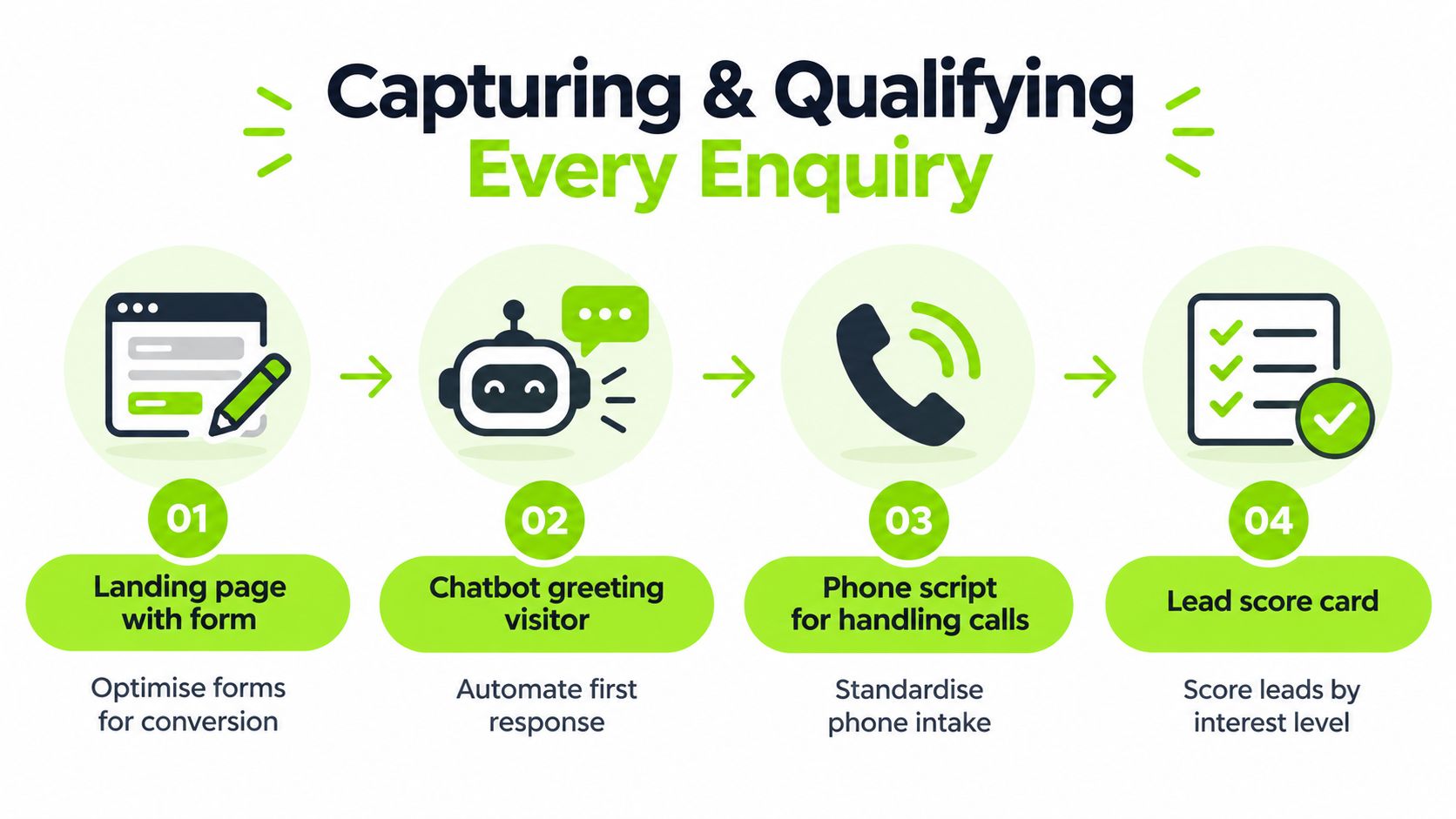
Use short form fields that help your team respond properly. Ask what type of membership the prospect is interested in. Ask whether they currently play elsewhere. Ask preferred callback time. Ask whether they want a visit, a price guide, or a conversation first.
Don't turn the form into an interrogation. Keep it short. Just ask enough to route the enquiry well.
A practical framework is to build a lead scoring process that gives staff a simple way to identify high-intent prospects versus early-stage interest.
The best qualification question is the one that changes what your team does next.
Standardise calls, chat, and routing
Website forms aren't the whole picture. Clubs also lose leads on the phone. Staff answer one call brilliantly and another with no structure at all.
Use a simple call intake script. Confirm the prospect's name, interest, preferred membership route, timescale, and whether they'd like a visit. Then log it in the same system as digital leads.
Chat tools can also help if they're used sensibly. A chatbot shouldn't pretend to be a salesperson. It should greet, answer basic joining questions, and collect details when the prospect is ready.
Here's the minimum standard:
- One destination: Every form, call, and message should end up in the same lead record.
- Segment at source: Tag by membership type, age stage, gender pathway, or playing frequency where relevant.
- Trigger the next step: Each enquiry should automatically prompt the right response and owner.
If you want a practical model for automation and routing, this article on lead qualification automation shows what a structured intake process looks like in golf.
Building Your CRM and Automation System for Speed
Most clubs don't need more spreadsheets. They need one operational view of every prospect.
The strongest argument for a CRM is not reporting. It's speed and accountability. If an enquiry arrives and nobody sees it quickly, your marketing spend is already underperforming. If three people see it and all assume someone else replied, your process is underperforming too.
UK lead-response evidence is blunt. One UK source notes that enquiries contacted within 5 minutes can convert at about 9x the rate of those contacted after 60 minutes, according to Squirrel AI on speed to lead. Another UK advisory source recommends contacting an accepted enquiry within the first hour, ideally within 30 minutes to an hour, and reports 80% lead-to-first-appointment rates in high-performing firms with same-day follow-up versus 25% when the wait is 24 hours, according to Unbiased on the quick response advantage. Those aren't golf-specific numbers, but the operational lesson absolutely applies to golf clubs.
What the system must do
A CRM setup for golf club lead generation doesn't need to be complicated. It needs to be disciplined.
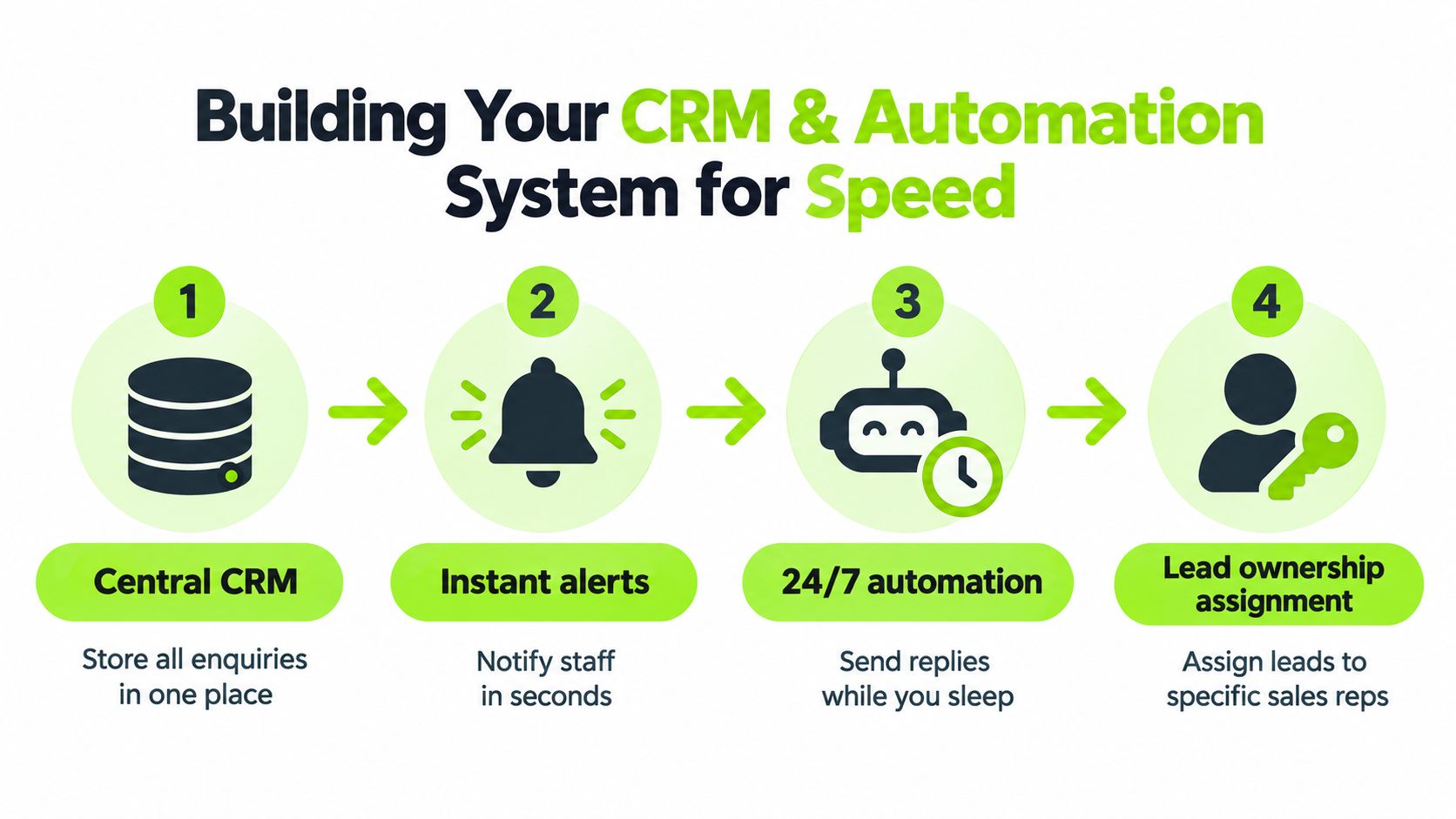
The core functions are straightforward:
- Capture everything centrally: Website forms, paid campaign leads, calls, email replies, and referral submissions.
- Alert instantly: Staff should know within seconds that a new prospect is waiting.
- Automate first response: Send an immediate acknowledgement and next-step message, even out of hours.
- Assign ownership: One named person owns the follow-up until the lead is qualified, booked, or closed.
Operational test: If a mystery enquiry arrives at 8.15 pm on Friday, can your club acknowledge it, log it, and route it before Saturday morning?
If the answer is no, your pipeline has a timing problem.
Replace inbox habits with workflow discipline
A shared inbox is not a CRM. A notebook at reception is not a CRM. A monthly spreadsheet update for the committee is not a CRM.
Clubs need stage-based workflow. New enquiry. Contact attempted. Contact made. Visit booked. Visit attended. Follow-up sent. Joined. Lost. That structure gives managers visibility and gives teams a clear next action.
A system like GolfRep can fit for clubs that want one setup combining lead capture, automated follow-up, CRM visibility, and conversion tracking in a golf-specific workflow. It's one option. The bigger point is that any club serious about growth needs this kind of operational backbone.
Single-site and multi-site setups
Single-site clubs often worry a CRM will feel too corporate. It won't, if you keep it simple and local. The point isn't to script every conversation. The point is to stop relying on memory.
Group operators have a different challenge. They need central oversight without stripping local personality from follow-up. A central CRM with local assignment solves that. Head office can see source, response, and conversion. Site teams can still handle conversations in their own voice.
If you're comparing systems and want a broader view of how CRMs can capture and nurture more leads, that resource is a useful primer.
Nurture Flows and KPIs That Turn Interest Into Members
Not every prospect is ready to join on day one. That doesn't make them a weak lead. It means your club needs a proper nurture process.
This matters even more in a market where many clubs can hold premium positioning. In 2025, 39% of golfers said their club charges a joining fee and 30% said their club has a waiting list, while membership growth improved year on year and female membership continued to rise, according to Golfshake on the health of golf club membership in 2025. Clubs don't need to default to discounting. They need to communicate value, access, fit, and timing better.
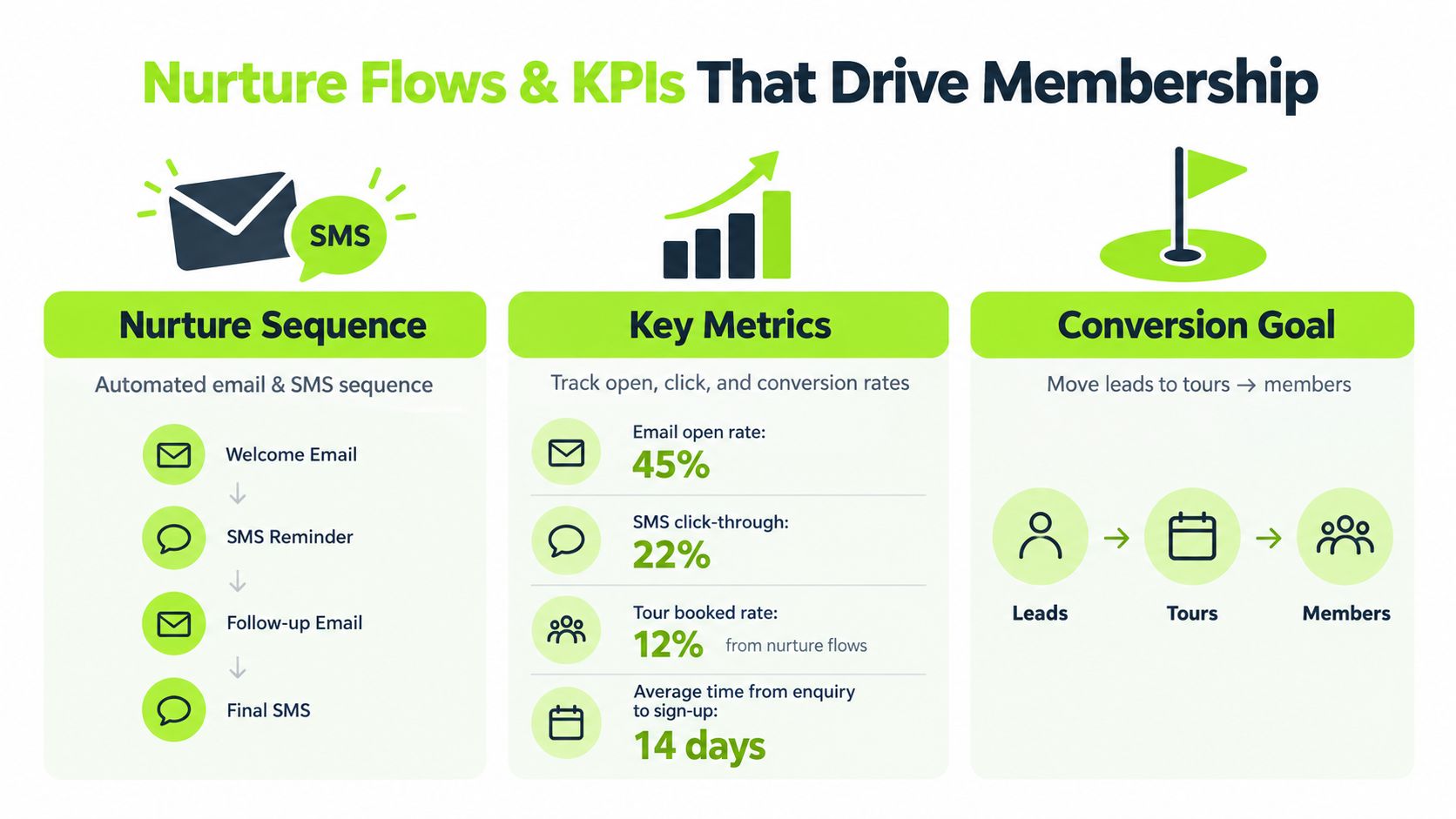
Nurture with purpose
A good nurture flow isn't a stream of generic newsletters. It's a sequence that helps someone move to a decision.
That usually means mixing channels:
- Immediate confirmation: A fast acknowledgement with a clear next step.
- Follow-up email: Membership option, benefits, and who will contact them.
- Call attempt: Personal contact to answer questions and offer a visit.
- Reminder sequence: Useful follow-up if the prospect hasn't booked yet.
- Visit follow-up: Custom message after a tour or meeting.
Each message should reduce uncertainty. Don't flood the prospect with brochures and committee updates. Give them what they need to decide.
A nurture flow should answer the question the prospect is already asking, not the one the club wants to broadcast.
Track the KPIs that affect membership
Most clubs either track nothing or track the wrong things. Vanity metrics don't build membership.
Focus on a short list:
| KPI | Why it matters |
|---|---|
| Response time | Shows whether your process protects early intent |
| Contact rate | Reveals whether staff actually connect with prospects |
| Visit booking rate | Measures movement from enquiry to meaningful sales step |
| Visit attendance rate | Exposes no-shows and weak confirmation processes |
| Join conversion rate | Tells you whether the whole system is working |
| Source-to-member tracking | Shows which channels produce revenue, not just leads |
Review those measures consistently. If response time is poor, fix routing. If contact rate is low, improve call handling and first messages. If visits happen but conversions lag, improve the on-site sales experience and post-visit follow-up.
Optimise without discounting
Too many clubs reach for a price offer when conversion dips. That's lazy.
Improve the journey first. Sharpen your membership pages. Tighten call scripts. Personalise follow-up by segment. Use scarcity where it exists, such as limited categories, joining processes, or demand for specific pathways. If your club delivers genuine quality, market that clearly instead of eroding it with broad discounts.
Your Action Plan for Predictable Membership Growth
If your club wants better golf club lead generation, stop asking only how to get more enquiries. Ask how many of your current enquiries become real conversations, visits, and members.
That shift matters because growth rarely breaks at the top of the funnel first. It usually breaks in the handoff. A prospect submits a form. Nobody responds quickly enough. A call comes in. Nobody logs it. A manager speaks to an interested golfer, then the trail goes cold because there's no follow-up system. None of that is a marketing problem on its own. It's an operating problem.
What to do in the next 30, 60, and 90 days
First 30 days
- Audit your current lead flow: Check every route a prospect can use to contact the club.
- Measure response reality: Time how long it takes to acknowledge and follow up.
- Remove dead ends: Replace generic contact pages with clear membership next steps.
Next 60 days
- Build segmented capture points: Create forms and landing pages for your key membership categories.
- Standardise intake: Give reception, admin, and membership staff a simple call and follow-up process.
- Set ownership rules: Every enquiry must have one named person responsible.
By 90 days
- Implement CRM tracking: Move enquiries out of scattered inboxes and into one visible pipeline.
- Automate first-touch follow-up: Acknowledge and route interest immediately, even outside office hours.
- Review conversion by source: Keep the channels that produce visits and members. Cut the rest.
The mistakes to avoid
Some problems keep repeating because clubs normalise them.
- Slow responses: This is the fastest way to waste good demand.
- No lead visibility: If managers can't see the pipeline, they can't improve it.
- One-size-fits-all follow-up: Junior, flexible, female beginner, and full-member prospects shouldn't all receive the same message.
- Channel-first thinking: More traffic won't fix a weak conversion process.
- Manual-only systems: Personal service matters, but memory is not a system.
Clubs that grow predictably don't just market harder. They respond faster, track better, and follow up with more discipline.
That's the playbook. Generate demand, yes. But build the machinery behind it. When clubs combine lead generation with visibility, speed, and structured nurture, they stop guessing and start building a reliable membership pipeline.
GolfRep helps UK golf clubs build that pipeline properly, with lead generation, CRM setup, automated follow-up, and conversion tracking designed around how clubs sell membership. If you want a clearer view of where your enquiries are leaking and what to fix first, visit GolfRep.
Ready to tap into our proven growth system?