How to Increase Golf Club Revenue: A Practical Playbook
A membership campaign has generated a healthy stream of enquiries. The website form is working, the phone is ringing, and prospective members are asking sensible questions about fees, access and playing rights. Yet the club still struggles to explain why revenue hasn't moved in line with demand.
That situation is common across UK golf. The problem usually isn't a complete lack of interest. It's the gap between an enquiry arriving and a membership being signed. GolfRep approaches growth from that operating reality. Advertising matters, but predictable revenue comes from combining qualified demand with fast responses, visible pipelines, structured follow-up, sensible pricing and a membership offer that reflects how people play today.
The Real Bottleneck in Golf Club Revenue
Most clubs assume they need more enquiries. In practice, many need to handle the enquiries they already receive far better.
UK golf clubs take an average of 47 hours and 32 minutes to respond to membership enquiries, according to GolfRep's analysis of the golf club sales process. The same source states that leads contacted within one hour are five times more likely to convert than leads left for 24 hours. A delayed response isn't a minor service flaw. It gives the prospective member time to lose interest, contact another club or decide that joining is too much effort.
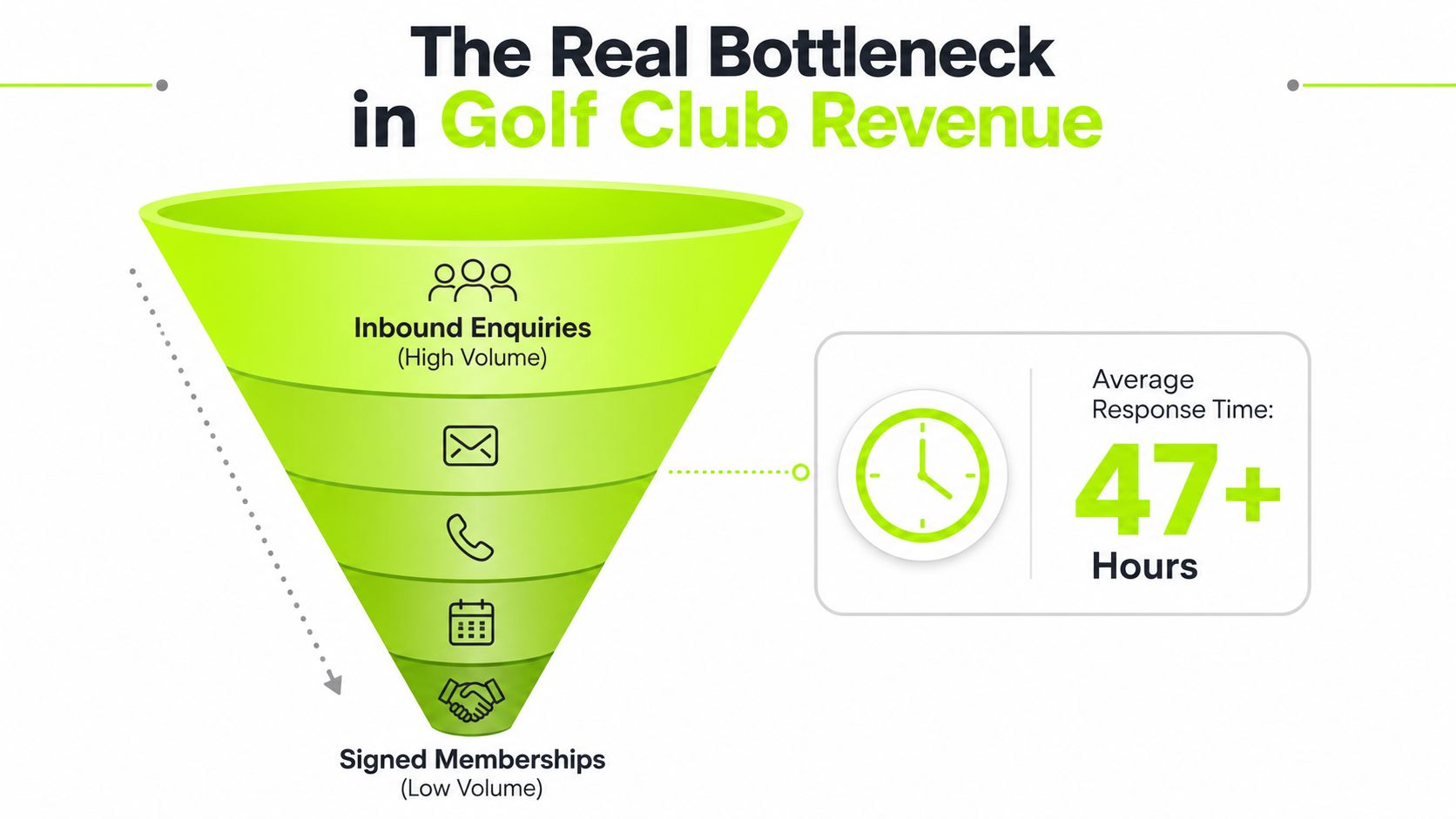
A separate GolfRep guide to golf club marketing automation reports that clubs can lose around 30% of membership enquiries before a proper discussion begins when handling is slow, inconsistent or invisible after arrival. That points to a revenue leak in the middle of the funnel. Increasing advertising spend before fixing that leak often means paying to create more opportunities for the same poor process.
Practical rule: Treat every enquiry as a sales opportunity with an owner, a next action and a recorded outcome.
Replace inbox management with ownership
A prospective member shouldn't have to guess whether anyone has seen their message. Every enquiry needs to enter one visible system, whether it arrives through a landing page, telephone call, social media message, email or a referral. A named staff member should own the next step, even when several people contribute to the sale.
The first response doesn't need to answer every possible question. It needs to acknowledge the enquiry, confirm what happens next and make it easy to continue the conversation. A short call, a relevant membership summary or an invitation to visit will usually outperform a generic attachment sent without context.
Measure the gap before buying more traffic
Start with a simple baseline. Count enquiries received, enquiries contacted, tours or visits booked, applications started and memberships signed. Then record response time and the reason each opportunity stopped progressing.
That exercise often changes the management conversation. Instead of asking whether an advert generated enough leads, the club can ask whether the team contacted them promptly, whether the offer matched their needs and whether follow-up continued after the first conversation. This is the operating principle behind why most golf club marketing fails, where lead handling matters as much as lead generation.
Predictable revenue starts with a predictable response process. Bigger ad spend comes later, once the club can demonstrate that it handles demand consistently.
Building a Membership Engine, Not Just a Campaign
A membership campaign has a clear launch date. A membership engine keeps working after the campaign ends.
The first step is to define the offer in terms a golfer can understand quickly. “Membership available” is too broad. A stronger proposition might focus on a practical need, such as weekday access, a welcoming route back into the game, a junior development pathway or a flexible option for someone who can't commit to full seven-day play.
The promise must be commercially honest. If a category has restrictions, explain them clearly. If a visitor needs a handicap, playing assessment or induction, show the process rather than hiding it. Clarity filters out poor-fit enquiries and gives suitable prospects confidence.
Build separate routes for different golfers
One landing page rarely serves every audience well. Create distinct routes for:
- Juniors: Explain coaching, supervision, family involvement and how a young golfer progresses.
- Returning players: Remove embarrassment and uncertainty by showing how the club welcomes golfers who haven't played regularly.
- Weekday golfers: Lead with access, pace and value during the times they can use.
- Corporate and social golfers: Present the club experience, hospitality options and practical arrangements for groups.
Each route should collect enough information to guide the next conversation without turning the form into an obstacle. Ask what the golfer wants to play, when they normally play and what type of membership interests them. A staff member can then respond with relevance instead of sending the same brochure to everyone.
GolfRep's modern golf club membership growth strategy follows this principle by connecting demand generation with structured nurture rather than treating the campaign as finished when a form is submitted.
Make the first touchpoint useful
Assign enquiry ownership before launch. Decide who responds during office hours, who covers evenings and weekends, and what happens when the usual contact is away. The system should alert the owner immediately and record whether the response happened.
The first acknowledgement should confirm receipt and offer a clear next step. A follow-up call can establish fit, answer questions and invite the golfer to see the club. If the prospect doesn't respond, the club should continue with useful information, such as a membership comparison, a tour invitation or details of a relevant coaching pathway.
The campaign ends when the enquiry arrives. The membership engine begins there.
This approach improves the economics of every pound spent on acquisition because the club isn't measuring success solely by form submissions. It's building a repeatable path from interest to conversation, visit, application and membership.
Retention belongs inside the same engine. A new member should receive a planned welcome, an introduction to the club and prompts to use relevant facilities. That reduces the risk of selling a membership that remains underused and gives staff earlier visibility when engagement starts to weaken.
Pricing, Packaging and the FME Mix-Shift
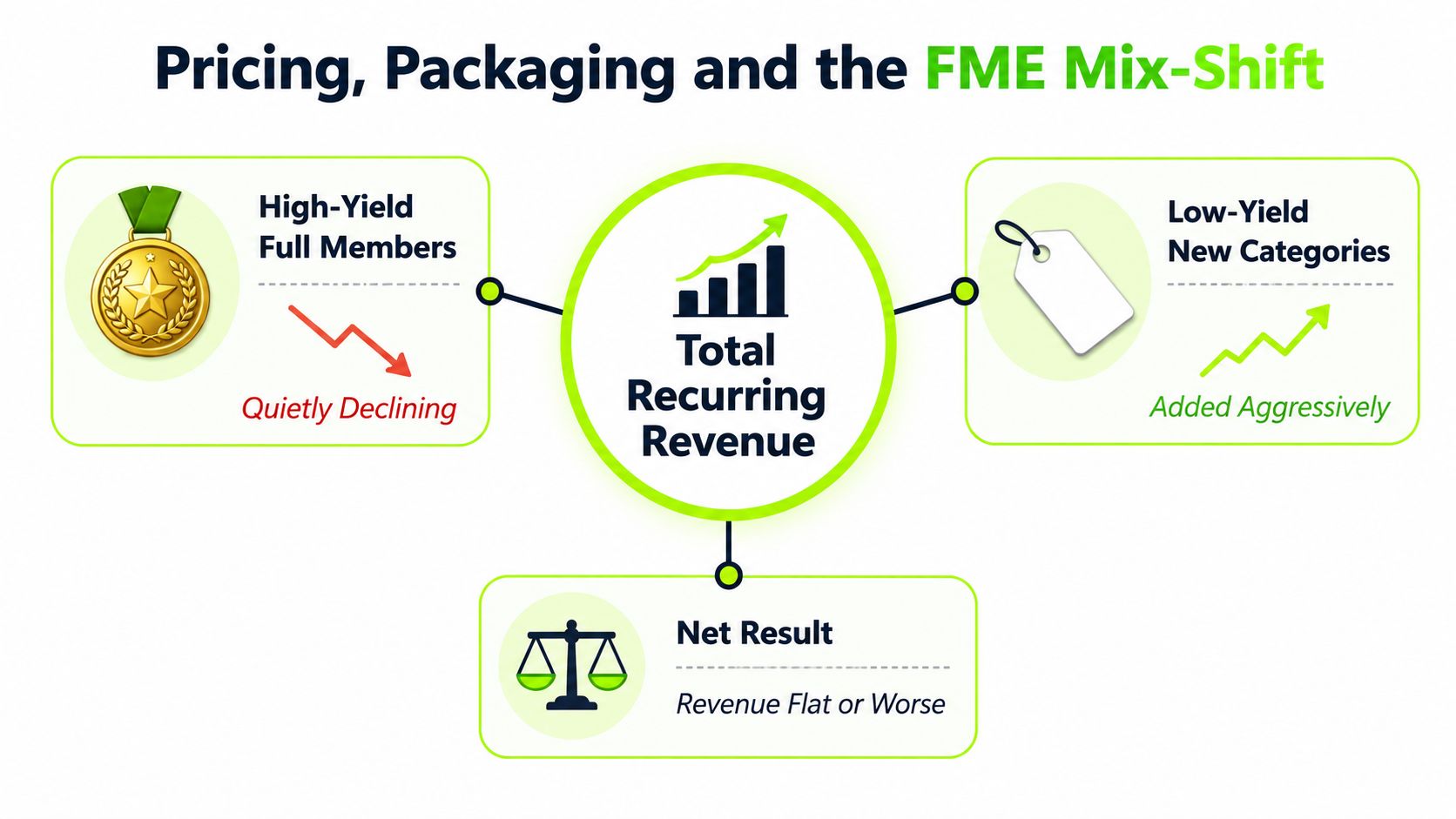
A club can add members while recurring revenue weakens. The usual reason is category mix. Lower-yield memberships grow as higher-value full memberships decline, leaving the club with more names but little improvement in dues income. That is a revenue system problem, not an advertising problem. It also matters when campaigns reach active non-member golfers, because converting that audience into the right category is more valuable than increasing enquiry volume.
The full-member equivalent, or FME, gives management a clearer measure. It converts different categories into a common view of recurring membership value, allowing the committee to compare revenue-producing mix year on year instead of relying on headline headcount.
Audit the mix before changing the fee
List every category with its annual dues, playing rights, restrictions and typical ancillary spend. Assign each one an FME value based on its relationship to full membership. The weighting should reflect the club's own pricing and access structure, not an arbitrary industry formula.
Compare current FME with the previous year. More members alongside flat or falling FME means the club has acquired volume without improving revenue quality. The next response might be a revised category structure, a retention intervention or a better-positioned full membership. The choice should follow the evidence.
The Hillier Hopkins Golf Clubs Report 2024/25 found that 59% of members' clubs and 55% of proprietary clubs had more than 600 members, while 77% of members' clubs and 73% of proprietary clubs reported stable or growing membership. The commercial implication is practical. Many clubs do not need to pursue every possible sign-up. They need to identify which categories produce dependable income and which create a realistic route to upgrade.
Charge for value, not as a reflex
UK fees have moved upwards. A Hillier Hopkins survey found that 74% of clubs charged annual membership fees above £1,000, the share charging above £1,600 rose by 36%, and 95% planned to increase fees in 2024. Average member green fees rose from £36 in 2021 to £43.50 in 2022, while non-member fees rose from £84 to £108.
Those figures do not justify an automatic increase. They show that clubs can charge more when demand, access and experience support the decision. A higher fee is easier to defend when the club can explain course condition, playing rights, competitions, coaching, social activity and service in concrete terms.
Packaging should address a genuine access need. Weekday, young adult, family, country, flexible and introductory categories can all have a role, but each should be tested against FME and retention rather than sign-up volume alone. A lower-commitment category may work if it develops into higher-value participation. It becomes damaging when it permanently replaces full membership without producing comparable recurring income.
For variable visitor pricing and time-based offers, the dynamic price strategy guide provides useful commercial context. The same discipline applies to golf. Price should reflect demand, available capacity and the experience delivered, without teaching members to wait for discounts.
A practical golf club pricing strategy starts with revenue quality. Count members, then manage FMEs, dues, usage and movement between categories as one commercial system.
Ancillary Revenue Without Discounting the Core
Ancillary revenue grows fastest when it solves a clear gap in a golfer's visit. A midweek corporate group may need a simple, bookable package, while a member may want coaching before a competition or somewhere to meet after a round. Start with those behaviours, then build the offer around them.
Membership fees typically contribute between 50% and 60% of a golf club's budget, according to the GCMA figures cited earlier. That leaves meaningful commercial opportunity in food and beverage, coaching, fitting, events, society days, corporate hospitality and practice facilities.
The commercial test is straightforward. An ancillary product should fit an existing visit, fill underused capacity or give golfers a reason to spend more time at the club. Products that do none of these usually create operational work without enough incremental revenue.
Start with the diary, not the product list
Review when the clubhouse, coaching team, practice areas and event spaces are busy or quiet. Use those patterns to design offers for specific gaps rather than adding products because another club offers them.
A society day can be built around a minimum food and beverage spend instead of a heavily discounted round. The course keeps its value, while the organiser receives a package that is easy to understand and buy. A midweek corporate arrangement could combine short-format play, a lesson with the professional and a simple food option, giving time-pressed groups a practical reason to book.
Quiet periods can support simulator sessions, winter coaching, family activities and informal social events. Price each offer according to the time, staffing and facilities it uses. Protect the terms and access that core members already pay for.
Increase yield per visit
Coaching is often the simplest ancillary line to connect to membership. Member-only programmes, small-group clinics, beginner sessions and junior pathways can each have a defined outcome, such as building confidence, preparing for course play or helping a junior progress through the club.
Custom fitting and equipment support can sit alongside coaching. The value extends beyond the transaction. A fitting brings the golfer into the pro shop, creates a reason to speak with the professional and can strengthen the relationship between golfer and club.
Food and beverage needs the same operational discipline. A short menu, reliable service and offers based on actual playing patterns will usually outperform a broad menu that staff cannot deliver consistently. Encourage golfers to arrive earlier, stay after a lesson or use the clubhouse between activities. Avoid attaching discounts to every purchase, because that can make the core membership feel less valuable.
Use adjacent formats as pathways
England Golf reported that 12.6 million adults played some form of golf in the past year, while 5.3 million used off-course formats, including ranges, simulators, adventure golf and Topgolf, according to Golf Business News coverage of England Golf participation. Traditional membership reached 750,071 in 2025, leaving a substantial audience of active golfers who are not yet in the conventional club model.
That audience deserves a defined route into the club. A simulator evening, beginner coaching block or short-format event can generate revenue without asking an active non-member golfer to make an immediate full-membership decision.
The follow-up determines whether the visit becomes a transaction or a sales opportunity. Capture consent, record what the golfer used and offer the next relevant step, such as a trial category, coached visit or invitation to meet members. Keep the message tied to their activity, not a generic membership pitch.
Ancillary revenue becomes durable when each offer has both a margin and a progression route. A club should know what the golfer buys next, who owns that follow-up and how the experience can lead to deeper participation.
CRM, Automation and the 47-Day Sales Window
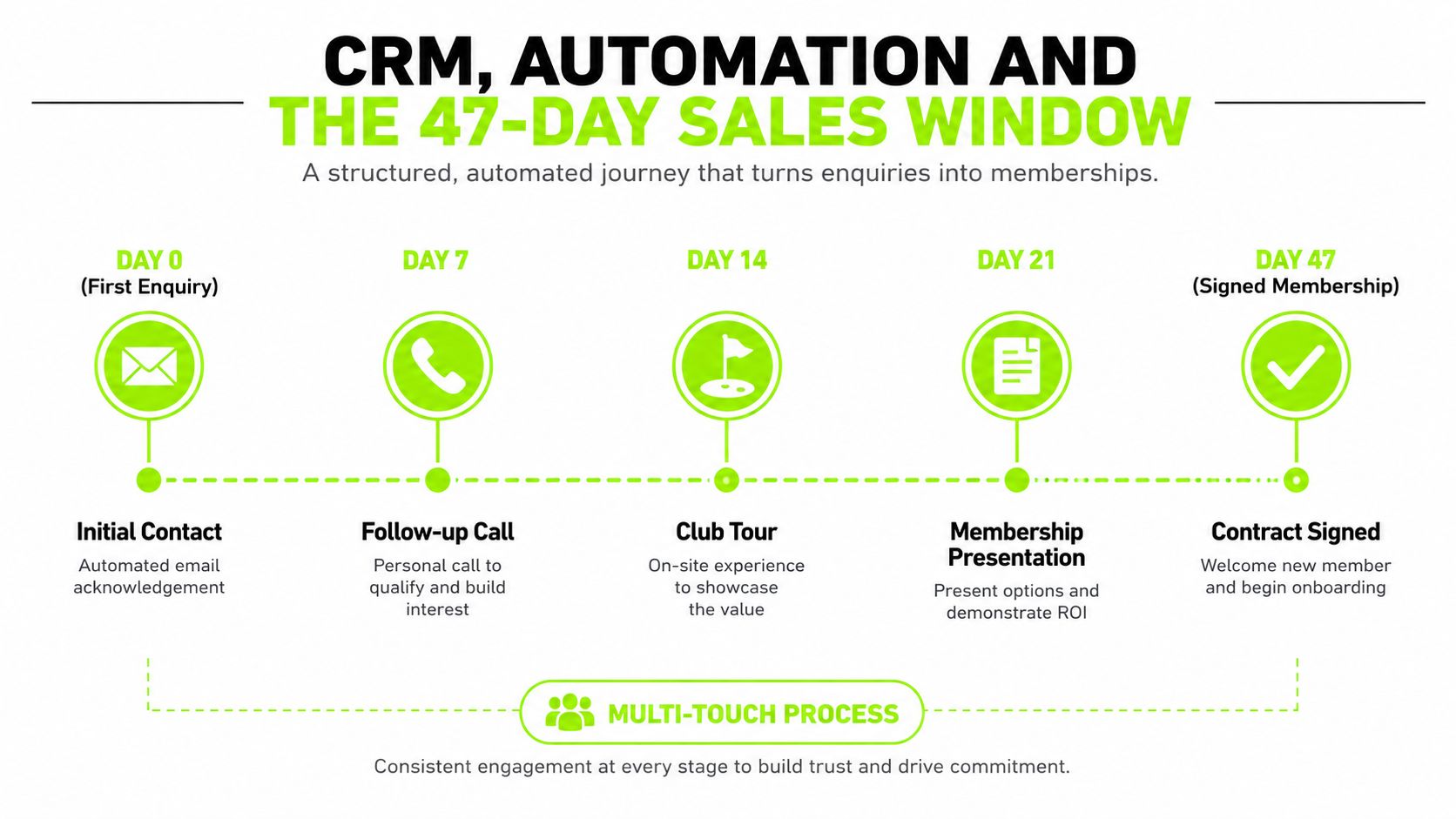
A membership decision rarely happens in one conversation. The average time from first enquiry to signed membership is 47 days, according to GolfRep's UK golf club sales-process guidance. That window may include questions about access, a visit, discussions with family, comparisons with other clubs and internal hesitation about cost.
Manual handling fails because staff can't reliably remember every next action across inboxes, spreadsheets and personal notes. A CRM gives the club one view of the pipeline and makes follow-up a managed process rather than an act of memory.
Build the minimum useful pipeline
Every enquiry should show:
- Source: Record whether it came from the website, telephone, social media, referral, event or another channel.
- Owner: Assign one person responsible for the next contact.
- Stage: Use clear stages such as new enquiry, contacted, visit booked, application started and signed.
- Next action: Add a date and task, not a vague note to follow up later.
- Outcome: Record why the prospect joined, deferred, declined or became uncontactable.
The system should send a same-day acknowledgement. If there's no reply, industry guidance recommends a three-email sequence: an initial confirmation, a second message 24 hours later with added value and a third reminder 72 hours after that, as outlined by CRM guidance on lost golf club enquiries.
Automation should handle consistency, not impersonate the club. A useful message can confirm the next step, answer the most likely question or offer a booking link. A staff member still needs to take over when the prospect asks about playing rights, family circumstances, competition access or anything that requires judgement.
Track conversion, not activity
A large number of enquiries can hide a weak sales process. Track the movement between stages and review where prospects stop progressing. If visits are strong but applications are weak, the offer or tour may need attention. If applications start but don't complete, the paperwork, payment process or decision support may be creating friction.
GolfRep helps clubs connect lead generation with CRM visibility and structured nurture, so the path from first contact to booked visit and membership can be measured in one system. That model is more useful than buying disconnected marketing activity because management can see whether demand is turning into recurring revenue.
Automation isn't a replacement for hospitality. It makes prompt, organised hospitality possible when the team is busy.
The sales window needs planned contact throughout, with messages adapted to the prospect's stage. A person who has toured the club shouldn't receive the same message as someone who has only downloaded membership information. Relevance protects the relationship while the decision develops.
Segmenting the Market by Region, Age, and Lifecycle
A club near Birmingham shouldn't assume that demand behaves like a club in the South East. England recorded 12.53 million rounds in 2023 across the UK and Ireland data set, with England North flat year on year, England South down 1% and the Midlands up 6%, according to the Hillier Hopkins Golf Clubs Report 2023/24.
Those regional differences don't tell a club exactly what to spend. They do show why national messaging can waste budget when local capacity, competition and playing habits differ.
| Region | Round Change YoY | Implication for Spend |
|---|---|---|
| England North | Flat | Prioritise conversion efficiency and local retention before broad expansion. |
| England South | Down 1% | Test carefully by catchment and focus on qualified, higher-intent demand. |
| Midlands | Up 6% | Assess capacity and increase targeted acquisition where the club can serve demand. |
Build three practical funnels
Consider a representative Midlands club with strong junior interest, a lapsed adult database and quiet weekday capacity. It shouldn't send one membership advert to everyone.
The junior funnel needs parent-focused information, coaching details, safe supervision and a clear progression route. England Golf reported junior membership rising 34%, from 46,028 to 61,483, while the average member age fell to 54.99, as reported in the Hillier Hopkins 2023/24 report. That supports a dedicated journey rather than a small junior paragraph on a general membership page.
The returning-player funnel should address confidence, playing partners and the practical steps needed to rejoin club golf. The weekday funnel can focus on availability, pace and the times the club needs to fill. Lapsed members deserve a different message again. Ask why they left, identify what has changed and offer a conversation before presenting a price.
For clubs reviewing how audience characteristics should shape campaign choices, analyse your merch audience in 2026 offers useful broader guidance on demographic analysis. Golf clubs should apply that thinking to their own enquiry and member data, not borrow generic audience assumptions.
Localise the creative and the budget
Use catchment areas, travel time, existing membership gaps and tee-sheet capacity to decide where to promote. A club with limited weekend availability may direct acquisition towards weekday categories. A club with underused coaching facilities may promote junior or beginner pathways locally.
The CRM should preserve these segments after the enquiry arrives. The same source that generated the lead should inform the follow-up, so a junior enquiry doesn't receive adult full-membership messaging and a lapsed member isn't treated like a first-time visitor.
Segmentation doesn't mean creating unnecessary complexity. It means giving different golfers a relevant reason to speak with the club, then routing each conversation to the offer most likely to produce a healthy, lasting relationship.
KPIs, Roadmap and a 90-Day Implementation Plan
A practical revenue dashboard should include enquiry response time, tour-to-application rate, application-to-signed rate, FME growth, ancillary revenue per member and member retention. Clubs can use KPI tracking for revenue teams as a useful reference when building a simple measurement routine.
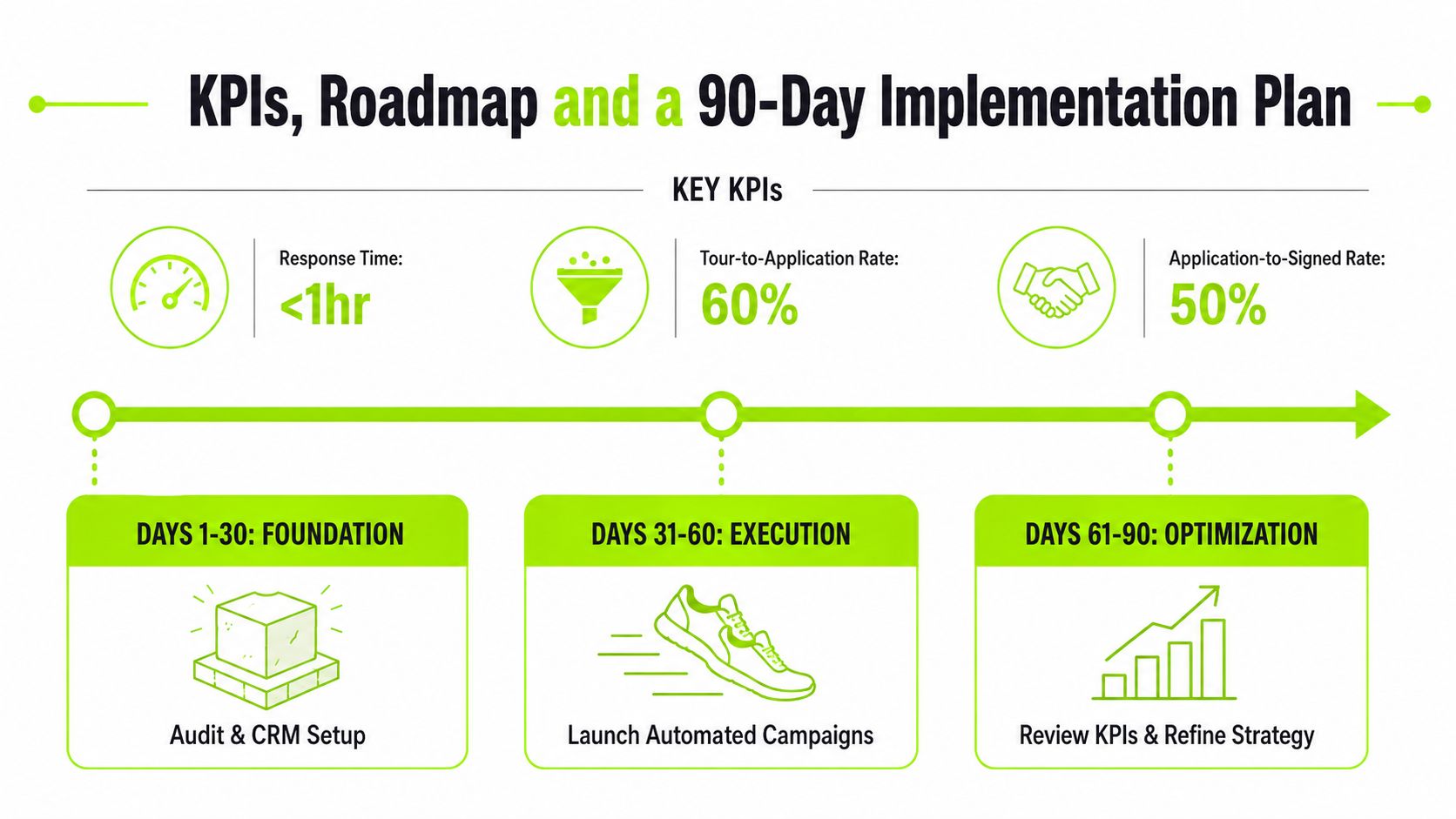
- Days 1-30: Audit categories, configure CRM routing, assign owners, automate acknowledgements and establish baselines.
- Days 31-60: Launch segmented campaigns, review pricing, and package coaching, corporate or off-peak products.
- Days 61-90: Diagnose conversion gaps, strengthen retention, and develop society and corporate outreach.
The committee or board must agree the membership promise, category rules, pricing boundaries and reporting owner. Staff need time to respond, follow up and record outcomes. Revenue growth is a sequence of measurable operating decisions, not a single advertising burst.
GolfRep helps UK golf clubs build predictable pipelines by combining demand generation with CRM visibility, fast enquiry handling and structured follow-up that turns interest into visits and memberships. Visit GolfRep to see how a practical revenue system can help your club increase golf club revenue without relying on indiscriminate discounting.
Ready to tap into our proven growth system?