Golf Course CRM Systems: What Clubs Need to Know

A membership enquiry arrives while the club office is closed for a bank holiday. By the time someone checks the shared inbox, the prospect has already visited another club, or stopped replying. Nobody deliberately lost that opportunity. The club had demand, a credible membership proposition and staff who would have followed up, but it lacked a system that assigned ownership and protected the next action.
That's the commercial question behind a golf course CRM. It isn't whether the club needs another software subscription. It's whether the current operation can respond quickly, convert interest into visits and memberships, and keep members engaged after they join. UK golf has a substantial repeat-contact audience, with England Golf reporting more than 730,000 golf-club members across 1,735 clubs in England. The Golf Business also reports that the average member age has fallen, while many clubs now operate with a sizeable playing membership.
A well-designed CRM should therefore deliver three commercial outcomes: faster lead response, higher membership conversion and lower member churn. The recommendations below focus on the features, vendor questions, implementation steps and performance measures that make those outcomes visible.
The Commercial Case for a Golf Course CRM
A club committee is deciding where to invest: more marketing, another membership administrator or a golf course CRM. The right choice depends on the constraint limiting commercial performance. If enquiries are arriving but follow-up is inconsistent, more traffic will increase workload without improving membership conversion. If members are joining but engagement falls after onboarding, acquisition spend will not solve the retention problem.
A CRM addresses the gaps between systems that each handle only part of the relationship. A website may capture an enquiry, a tee-sheet platform may record a round, and a membership system may hold renewal details. Without a connected commercial record, managers still cannot see who needs a call, what the prospect requested, whether the visit happened or which members are becoming less engaged.
Response time is an obvious constraint. Prospective members can compare clubs quickly, and the first club to provide a relevant answer often controls the next conversation. UK golf-club research reported an average membership-enquiry response time of 47 hours and 32 minutes, and cited research that a lead answered within one hour is five times more likely to convert than one left for 24 hours. The golf-club membership marketing research supports a clear recommendation: measure response time beside enquiry volume and conversion rate.
Commercial rule: Give every enquiry a value, an owner and a dated next action.
Retention needs the same discipline. A CRM should show whether new members complete onboarding, use the facilities and receive timely renewal contact. It should give staff a practical prompt before disengagement becomes resignation, while recording the reason for churn so the club can address recurring problems.
The wider golf club revenue system should connect demand, conversion and retention. Choose CRM investment according to the weakest commercial link, then measure whether response time, conversion rate or member retention improves.
What a Golf Course CRM Actually Does
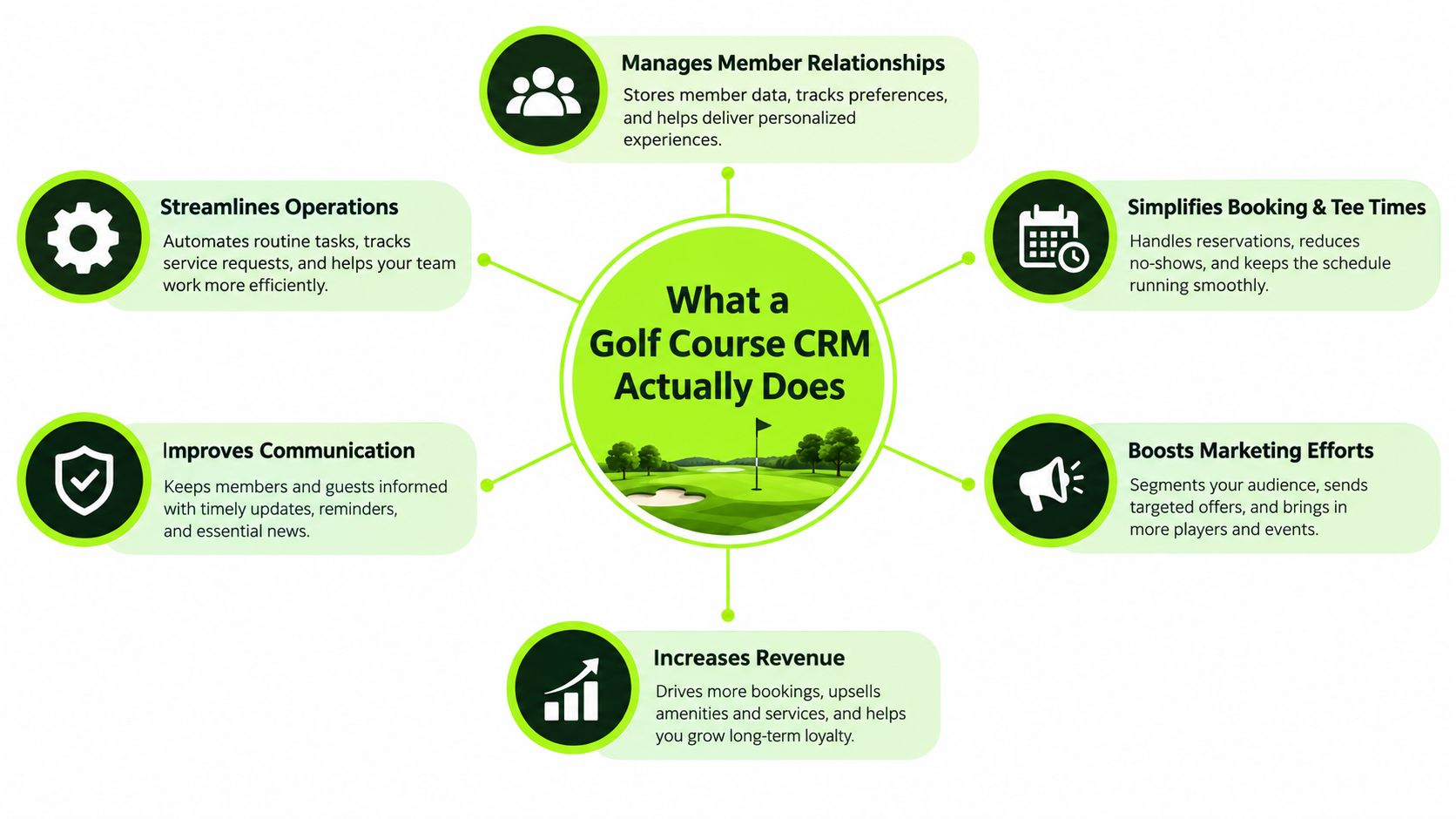
A golf course CRM is the operational record of the relationship between the facility and its customers. It should connect the first enquiry to the eventual commercial outcome, rather than treating a form submission, a round of golf and a renewal as unrelated events.
The core lifecycle normally includes:
- New enquiry: Record what the person wants, where they came from and who owns the response.
- Qualified: Confirm suitability, timing, playing needs, budget and any relevant household details.
- Visit or trial booked: Log the date, staff member, experience and agreed follow-up.
- Membership decision: Record the offer discussed, objections, timing and next action.
- Member: Trigger welcome, onboarding and usage communications.
- Renewal or win-back: Identify engagement, risk, resignation and reactivation opportunities.
The record needs more than a name and email address. Store contact details, marketing consent, enquiry source, communication history, visit history, membership status, relevant interests, complaints, feedback and the next action. Where the systems can support it lawfully and accurately, the club can also connect playing frequency, handicap trend, spend and household relationships to the customer record.
CRM and club management software are different
A club management system or PMS usually runs the operational day. It handles tee times, member access, bookings, competitions, payments or other facility functions. The CRM sits around the commercial journey, bringing together marketing sources, sales activity, conversations, visits, outcomes and retention actions.
Integration matters because the two systems answer different questions. The PMS can show that someone played. The CRM should help the team understand whether that round followed an enquiry, whether the visitor was invited to join, and whether a follow-up task is overdue.
A CRM isn't an email blast tool, a spreadsheet or a website form. Email may be one channel inside it, and a form may feed it, but the system earns its keep by organising decisions and accountability. If staff still need to search inboxes, reconcile lists manually and remember who should call whom, the club has bought a database rather than built a commercial process.
Must-Have Features That Drive Revenue
A golf course CRM should earn its place in the operating budget by improving a measurable commercial constraint. If response times stay slow, enquiries remain unassigned or renewal risks appear too late, a long feature list has no value. Assess every function by the decision it improves and the result management can track.
Lead capture and attribution
Every enquiry from the website, social campaigns, referral partners, listing platforms and telephone calls should enter one shared queue with its original source retained. The team can then compare lead quality, not just lead volume, across visits, memberships and retained members. Set a response-time target and report conversion by source.
Behaviour-led nurture
Automation should follow customer behaviour. A prospect who has read membership information but has not booked a visit needs a different prompt from someone who completed a trial round. Build workflows around actions, inactivity and lifecycle stage. Calendar-based broadcast emails alone will miss the buying signal and create unnecessary contact.
Tee-sheet and membership integration
The CRM should receive relevant booking and playing data when the integration and data governance permit it. A prospect who has played can then receive a timely membership invitation, while staff can prepare for the conversation with the right context. Track visit-to-membership conversion and the time between a round and the follow-up.
Segmentation
Useful segments cover lifecycle stage, playing frequency, spend, household relationship, membership type, interests and engagement. These fields support targeted renewal preparation, lapsed-member reactivation and visitor-to-member journeys. Apply clear consent rules and give staff usable filters, so relevance improves without making communications intrusive.
Pipeline and task management
A visible pipeline must show the opportunity owner, current stage, next action and due date. The membership manager should be able to open the system at the start of the day and see a prioritised call list without maintaining a second spreadsheet. Measure overdue tasks, stage ageing and enquiry-to-join conversion.
Commercial reporting
Management needs reporting that connects activity with income and retention. The dashboard should show response time, stage conversion, source performance, first-year retention, revenue per member and overdue tasks. Clubs facing pressure from member departures need retention reporting alongside acquisition reporting. A CRM that only reports email delivery and opens cannot support that decision.
| Feature | What it does | Commercial outcome | KPI to track |
|---|---|---|---|
| Lead capture and attribution | Brings enquiries into one queue and preserves the source | Better allocation of acquisition effort | Source-to-membership conversion |
| Behaviour-led nurture | Sends the next relevant prompt after an action or inactivity | More consistent progression | Enquiry-to-visit conversion |
| Tee-sheet integration | Connects commercial activity with actual visits | Better timing of membership conversations | Visit-to-membership conversion |
| Segmentation | Groups contacts by value, behaviour and lifecycle | More relevant retention and reactivation | Renewal and re-engagement outcomes |
| Pipeline management | Assigns stages, owners and next actions | Fewer stalled opportunities | Overdue tasks and stage ageing |
| Reporting | Connects activity with commercial results | Better management decisions | Response time, conversion and revenue per member |
How to Evaluate Vendors and Ask the Right Questions
Choose the system that fits the club's operating model, not the platform with the most impressive demonstration. Ask vendors to show your actual journey, from a membership enquiry through a visit, a joining decision, onboarding and renewal. If they can't demonstrate that path with realistic records, the product may not suit the way a golf business works.
Use these filters before discussing individual features:
- Integration depth: Does the CRM exchange useful data with the tee sheet, membership platform, website, email system and payment or POS tools?
- Data ownership: Can the club export contacts, activity, consent records, pipeline history and campaign data in a usable format?
- Segmentation: Can staff create practical audiences without asking a developer for every change?
- Reporting granularity: Can management separate course, membership type, campaign, source and site performance?
- Long-term cost: Include implementation, licences, integrations, training, support and future migration over the full contract period.
- Support and roadmap: Ask who handles urgent issues, how support commitments are measured and how roadmap changes are communicated.
- Ease of use: A platform that staff avoid will underperform a simpler system used consistently.
Questions to send to vendors
- How does every web, telephone and campaign enquiry enter the CRM, and how is its source retained?
- Can the system assign an owner and create a response task automatically?
- Can automation change when a prospect books, visits, joins or stops engaging?
- Which tee-sheet and membership platforms can you integrate with directly?
- How do you record and manage marketing consent, suppression and data-subject requests?
- What data can we migrate from spreadsheets and legacy systems, and how will duplicates be handled?
- Can we export the complete database and activity history if we leave?
- What uptime, support response and incident communication commitments are included?
- Can we report by course, campaign, membership type, owner and lifecycle stage?
- Can you provide references from UK golf operators with a similar structure?
Run reference calls with comparable clubs. Then give shortlisted vendors a controlled test using anonymised versions of your own pipeline, including an enquiry with incomplete information, a duplicate contact, a lapsed member and a prospect who has visited but hasn't joined.
| Criterion | Why it matters | Weight | Vendor A score | Vendor B score |
|---|---|---|---|---|
| Operational integration | Prevents disconnected customer records | High | Record after testing | Record after testing |
| Data portability | Protects the club's future options | High | Record after contract review | Record after contract review |
| Automation control | Supports timely, relevant nurture | High | Record after workflow test | Record after workflow test |
| Reporting detail | Links activity to commercial decisions | High | Record after dashboard test | Record after dashboard test |
| Total cost of ownership | Reveals the real investment | Medium | Record after full-cost model | Record after full-cost model |
| Support and roadmap | Reduces operational risk | Medium | Record after reference calls | Record after reference calls |
| Staff usability | Determines adoption | High | Record after team trial | Record after team trial |
For a broader comparison of platform types and trade-offs, use this golf-club CRM buying guide, then challenge every recommendation against your own data, staffing and integrations.
Implementation Roadmap and Sample Nurture Flows
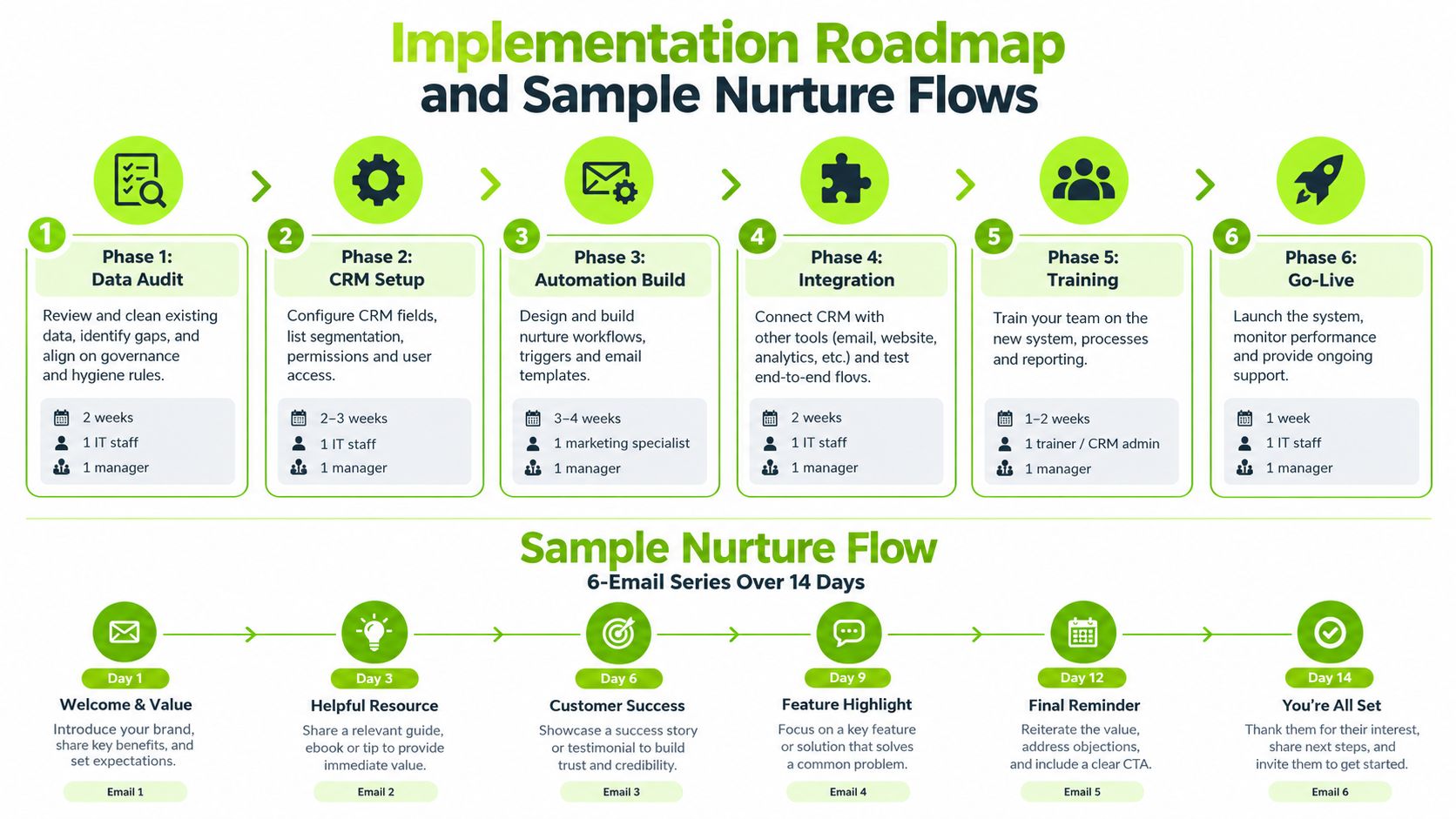
A club can move from scattered spreadsheets to a working pipeline in roughly twelve weeks, provided a manager owns the project and staff contribute practical knowledge. The timeline isn't the difficult part. Agreeing definitions, cleaning records and deciding who owns each stage usually takes more discipline than the software configuration.
Phase one and data control
Start with a data audit. List every source, identify duplicates, review consent, document essential fields and decide which record becomes authoritative. Agree the lifecycle stages before importing data. A useful minimum is New Enquiry, Qualified, Visit Booked, Trial or Membership Decision and Member, with ownership and next action recorded at every stage.
Phase two and workflow design
Configure lead capture, fields, permissions, segments and integrations. Keep the first version narrow. Membership enquiries and member onboarding are usually better starting points than trying to automate membership, visitors, societies, events and food and beverage at once.
Phase three and adoption
Build the first workflows, test with a small audience and train the people who will use the system daily. Review exceptions manually. A workflow that sends the wrong message after a resignation or duplicate booking can damage trust faster than no automation at all.
Sample flow for a new membership enquiry
- Trigger: A completed membership form or manually logged enquiry.
- Immediate action: Create the contact, preserve the source, assign the owner and send an acknowledgement.
- First wait step: If no visit is booked, create a staff task and send useful information about the club, membership options and available next steps.
- Behaviour branch: If the prospect clicks or replies, prioritise a personal call. If there's no engagement, send a shorter reminder focused on arranging a conversation.
- Visit stage: After a visit, send a personal follow-up that reflects the prospect's stated interests and records the next action.
- Goal: Move the record to a clear membership decision, not merely deliver more emails.
Sample flow for a lapsed member
- Trigger: A member reaches the club's agreed inactive or resignation-risk condition.
- First contact: A personal message asks whether anything has changed and invites honest feedback.
- Wait step: If there's no response, send a relevant club update or invitation based on the member's previous interests.
- Staff action: Create a call task for higher-value or higher-risk records, with the complaint or reason for disengagement visible.
- Response branch: Route positive replies to a membership conversation and negative replies to the appropriate manager.
- Goal: Rebuild the relationship or capture the reason for leaving so the club can improve.
The team should approve every message, test suppression rules and monitor replies during the initial rollout. Automation should protect the personal feel of a members' club, not replace human judgement.
Measuring ROI and Learning from Real Clubs
A CRM dashboard should answer management questions. If response time is poor, improve routing and ownership. If visits happen but memberships don't follow, review the proposition, tour experience and sales conversation. If first-year retention is weak, inspect onboarding and early engagement rather than buying more leads.
Track a baseline before launch:
- Enquiry response time: How quickly does a named person make the first meaningful contact?
- Enquiry-to-visit conversion: How many qualified prospects book or attend a visit?
- Visit-to-member conversion: How many visitors progress to a membership?
- First-year retention: Which new members renew, and which cohorts leave early?
- Average revenue per member: Include the revenue categories the club can measure consistently.
- Source-level performance: Which channels produce members who stay, not just enquiries?
One UK multi-site case study reported HubSpot CRM operating across nine golf courses, managing 160,000 contacts and 5,500 members, while supporting more than £14 million in revenue and nearly four million marketing emails in 2022. The UK golf-club CRM case study illustrates the governance challenge at scale: the database must support segmentation, consent-aware communication and cross-site attribution rather than becoming several disconnected contact lists.
A separate UK implementation recorded 86 enquiries, a £99,430 pipeline, 23 deals worth £23,410, and a membership campaign with 53 leads, nine new members, a 17% conversion rate and 1,065% ROAS. Those figures are useful because they connect acquisition activity to pipeline and closed outcomes. They don't prove that every club will achieve the same result. They show what the reporting chain should look like.
| KPI | Pre-CRM baseline | Target after 12 months | Commercial impact |
|---|---|---|---|
| Enquiry response time | Record the current average and slowest cases | Set a club-approved response SLA | Protects early conversion |
| Enquiry-to-visit conversion | Measure by source and owner | Improve through routing and nurture | Creates more qualified conversations |
| Visit-to-member conversion | Record outcome by membership type | Improve sales process and proposition fit | Increases membership yield |
| First-year retention | Track new-member cohorts | Identify and reduce early disengagement | Protects recurring revenue |
| Average revenue per member | Define included revenue categories | Improve through engagement and relevant offers | Shows customer value |
| Source-to-retained-member conversion | Connect source to renewal status | Shift budget towards quality channels | Improves acquisition economics |
Use a straightforward calculation: CRM return equals attributable incremental gross profit, less CRM, implementation and operating costs. Review the dashboard monthly with the management committee, but make one person responsible for turning each finding into an operational action.
Multi-Site Operations and Integration with GolfRep
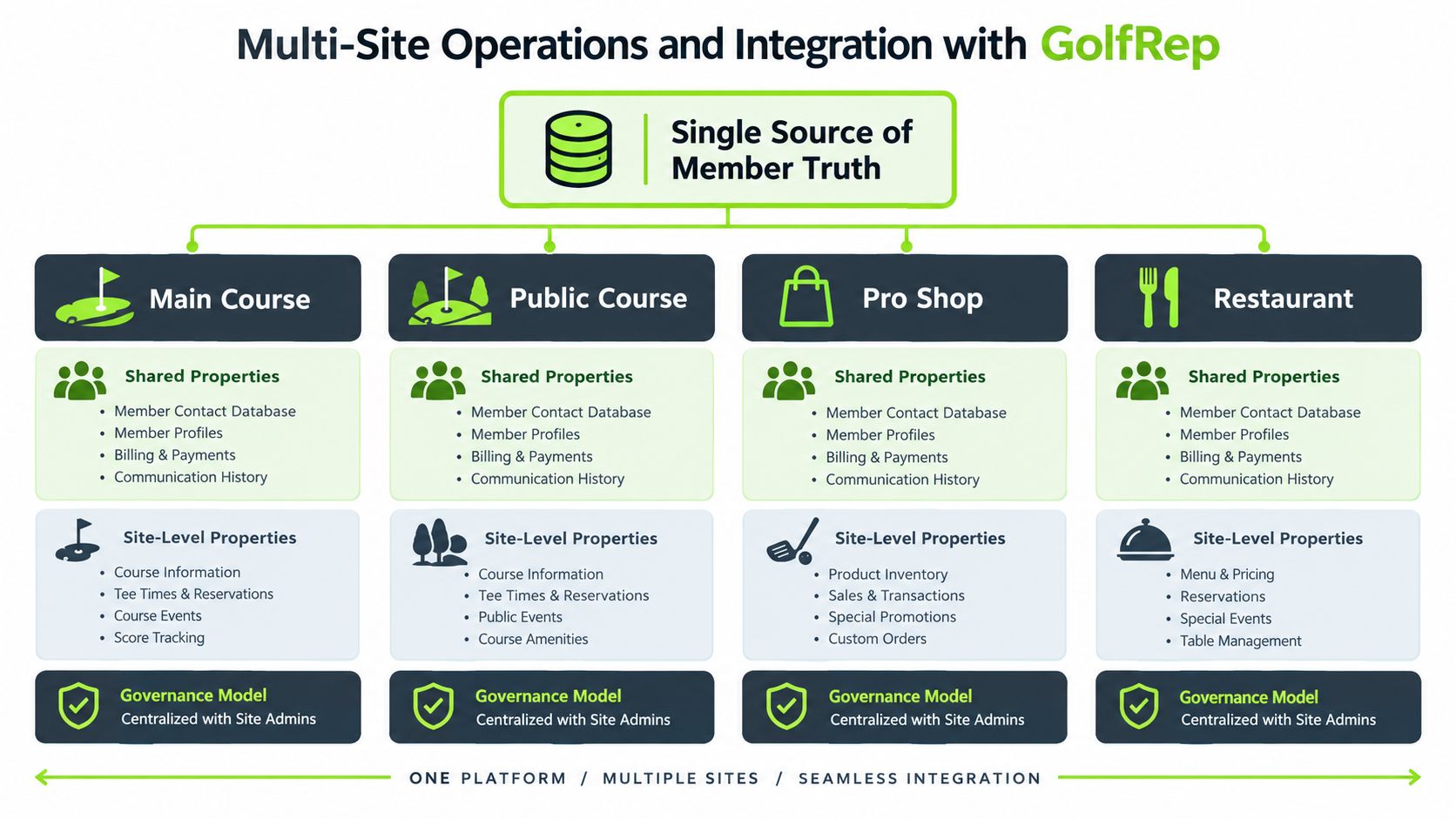
A group operator needs one source of member truth, not a copy of every club's spreadsheet. The shared database should hold the person, consent and relationship history, while site-level properties identify the course, manager, membership pricing, events and local communications that apply.
Set governance before connecting systems:
- Contact ownership: Decide whether the group, site or named manager owns the relationship.
- Site attribution: Store the relevant course or venue on every lead, visit, membership and campaign.
- Access controls: Give teams access to what they need without exposing unrelated site data.
- Reporting rules: Define which results roll up to the group and which remain site-specific.
- Integration ownership: Name one person responsible for the map between CRM, tee sheet, website, advertising and automation tools.
The failure mode is predictable. Each venue creates its own record, members appear more than once, renewal pricing differs between lists and management can't tell whether a campaign generated a retained member or merely duplicated an existing contact. A central model prevents that, but only if teams agree on field definitions and data stewardship.
For operators designing communication workflows across different teams, this practical guide to phone integration for tradespeople is also useful because it highlights the importance of linking calls and ownership to the customer record, rather than leaving conversations in personal devices.
GolfRep can sit within that broader operating model as an acquisition and nurture layer, provided web forms, paid social leads and tee-time enquiries resolve to the same contact record. The GolfRep OS CRM overview is relevant for groups assessing how lead qualification and follow-up should connect with centralised reporting.
Turning Your CRM into a Commercial System
The CRM becomes valuable when the club treats it as a management discipline. Define the lifecycle, name an owner for every stage, set response-time standards, segment by customer value and review pipeline, conversion and retention against the club's previous performance.
Before launch, use this meeting checklist:
- Data quality: Are duplicates, consent and mandatory fields under control?
- Lifecycle stages: Can every enquiry move from first contact to a clear outcome?
- Ownership: Does each stage have a named person and escalation route?
- Dashboard: Can management see response, conversion, retention and source performance?
- Live workflow: Is at least one tested nurture journey running with the right suppression rules?
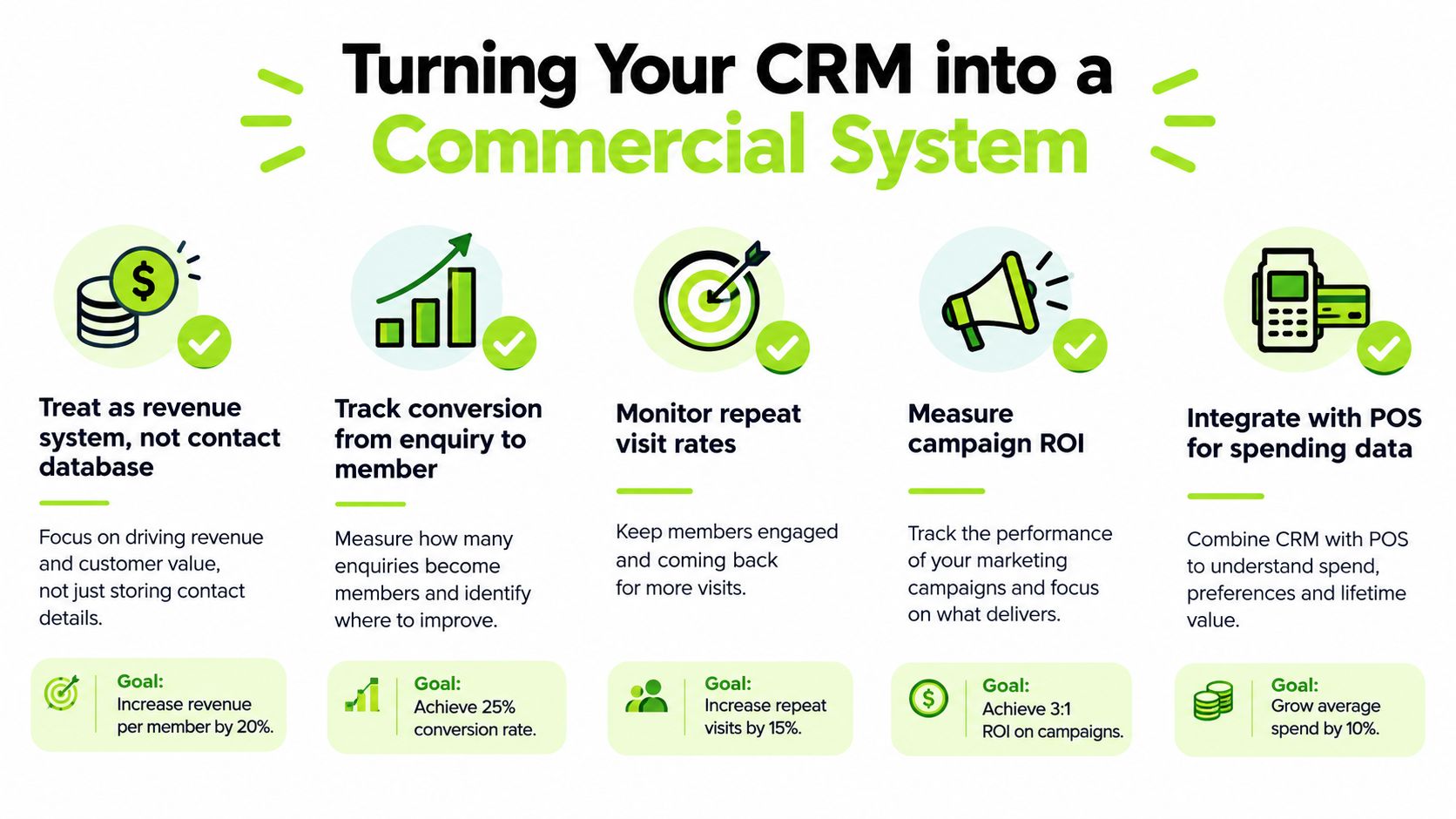
A golf course CRM isn't a substitute for a strong membership proposition, good golf or a welcoming club team. It gives those strengths a repeatable commercial process, so the club can attract, nurture, convert and retain customers without relying on memory.
GolfRep helps golf clubs map their enquiry-to-renewal pipeline, connect CRM and tee-sheet data, and launch practical nurture workflows that staff can manage. If you want to identify the biggest commercial constraint in your club, visit GolfRep to discuss the next step.
Ready to tap into our proven growth system?