Golf Club Pricing Strategy: A Practical UK Playbook

Most golf club pricing advice starts in the wrong place. Committees reach for the green fee, shave a few pounds off, and call it a strategy. That usually just masks a deeper problem, because pricing only works when the club can see demand clearly, respond quickly, and convert enquiries without relying on luck or whoever happens to check the inbox that morning.
At GolfRep, I'd say it bluntly. A golf club pricing strategy is not a price card discussion, it's a revenue system. If your enquiries sit unanswered, your leads aren't tagged by intent, and your follow-up depends on memory, you're not protecting margin. You're leaking it.

Why Most Golf Club Pricing Strategies Fail Before They Begin
The first mistake is treating discounting like a fix. It isn't. In the UK golf retail market, pricing is already tightly tiered, with complete sets, premium irons, and flagship drivers all sitting in clearly differentiated bands, while minimum advertised price policies limit promotional discounts to 10–20% in seasonal clearance periods. That matters because the market is already telling you something important, margin is protected by discipline, not by chasing the lowest headline.
Pricing fails when the club has no conversion engine
A club can have a sensible fee card and still underperform if enquiries go cold. If a visitor asks about a society day and nobody follows up for two days, the price point becomes irrelevant. The same applies to membership leads, especially when someone has already shown intent and is now deciding between you and the club down the road.
Practical rule: if the enquiry process is slow, don't cut the price first. Fix the response process first.
That's the bit too many committees skip. They debate whether a weekday round should be £3 higher or lower, while the core problem is that nobody knows which enquiries came in, who handled them, or whether the prospect ever received a proper answer. A golf club pricing strategy only works if the club can see the pipeline, not just the tariff.
Margin is usually lost through habit, not demand
For club operators and pro shops, custom fitting adds £50–£200 per club or set and accounts for around 10–15% of total market value according to IndexBox's UK golf club market analysis. That's the point. Revenue doesn't have to come from a lower posted price. It can come from better packaging, better service, and better conversion.
If your club is still pricing as if every pound must be won from the green fee itself, you're leaving the operational side untouched. The better question is, where is the price card being supported by systems, and where is it being undermined by manual follow-up and unclear ownership?
Mapping Your Market, Segments and Price Elasticity
Before anyone changes a fee, the club needs to be clear about who it is selling to. Not every golfer behaves the same way, and not every round has the same value. Visitor day rounds, society bookings, county card holders, weekday retirees, young professionals, families, and resort guests all react differently to price, timing, and convenience.
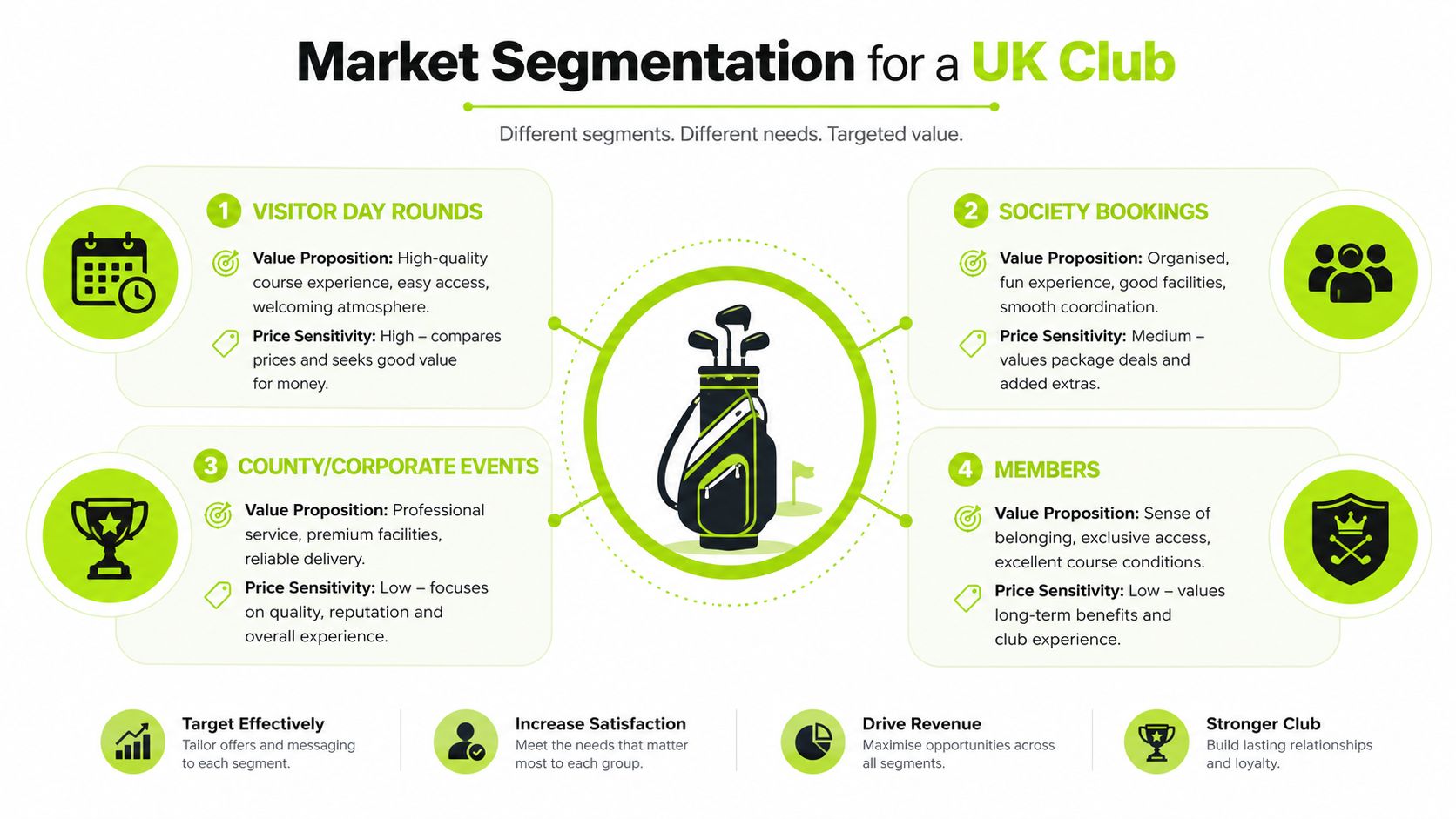
Build the segment map before you touch the tariff
A useful club-level matrix is simple. Put each segment on one axis, then note how they book, what they value, and how sensitive they are to price movement. A society organiser might care more about certainty, food options, and tee-time grouping than a small price rise. A weekday retiree may care more about access and routine. A young professional may care about flexibility and speed of booking.
That's why blanket pricing usually fails. It ignores the fact that some groups are responding to value, while others are responding to availability or social fit. If you price all of them as though they're the same buyer, you end up overcharging some and undercharging others.
Operational truth: price elasticity isn't a theory exercise. It shows up in booking pace, cancellation behaviour, and whether a prospect replies after the first quote.
Use data that already exists
Start with booking data, member surveys, and CRM tags. If your system can show whether a lead came in as a visitor enquiry, a society lead, or a membership prospect, you can compare how each group behaves after the first response. That's where the useful work starts. The club that understands intent can spot which segments are price-led and which ones are reassurance-led.
GolfRep's own market segmentation guide is worth reading if you want to sharpen the internal thinking around who belongs in each bucket and why. The point isn't to build a fancy spreadsheet. It's to stop committee members arguing from instinct.
A simple working model looks like this, on one page next to the price card:
| Segment | What they usually want | Price sensitivity | What to watch |
|---|---|---|---|
| Visitor day rounds | Access and a clean booking process | Often high at the margin | Enquiry response time |
| Society bookings | Certainty and group handling | Moderate | Quote-to-visit rate |
| County or corporate events | Status and service consistency | Lower on peak dates | Conversion by named contact |
| Members | Fairness and reliability | Low on core value, higher on change communication | Churn by tier |
Once that matrix exists, the committee can separate price lines that deserve movement from price lines that need protection. That's how you stop pricing from becoming a guessing game.
Designing Membership Tiers and the Wider Pricing Model
A membership structure should be easy to explain in the bar and easy to defend in a committee meeting. If you need a diagram to understand your own categories, you've probably overbuilt them. Three or four tiers are usually enough, provided each one maps to a real usage pattern and a real promise.
Keep tiers simple and tied to behaviour
A flat all-access offer sounds neat until it starts masking demand differences across the week. A better model is to separate peak access, midweek access, and any genuine concessionary offer by age, family structure, or limited play. That gives the club room to price around utilisation rather than pretending every member uses the course the same way.
A midweek tier is often the cleanest lever. It gives price-sensitive golfers a route in, without forcing the club to cheapen the headline product. The worked pattern I'd encourage is simple, keep the top tier intact, create a flexible midweek offer, and make the value difference obvious in the wording, not just the fee.
Set the headline, then protect the logic around it
Join fees should support the overall positioning, not confuse it. If the club wants to signal exclusivity, the join fee needs to sit logically with the membership ladder and the visitor tariff. If the club wants volume, the structure should make lower-intensity play feel like a fair trade, not a bargain bin solution.
Visitor pricing has to sit in the same system. Society rates, county card rules, twilight windows, and resort packages should all follow one demand-led logic, not separate spreadsheets owned by different people. If the visitor offer is cut to chase volume while members are asked to absorb rising costs, you create a fairness problem as well as a commercial one.
For a broader pricing analogy outside golf, Quikly's guide to Shopify pricing growth is useful because it makes the same basic point, pricing works when the structure matches the customer's behaviour, not when the team keeps tweaking numbers in isolation.
Here's a practical comparison of common structures:
| Tier Structure | Headline Price Logic | Included Play | Primary Segment |
|---|---|---|---|
| Flat annual membership | One price, one promise | Broad access | Traditional full members |
| Peak plus midweek split | Higher price for high-demand access, lower for quieter use | Varied by tier | Mixed-use local golfers |
| Family and concession model | Price reflects household or life-stage value | Defined by household or age band | Families, juniors, retirees |
Golf clubs often look at package pricing as a side issue. It isn't. GolfRep's package deals guide is a good reminder that bundles can protect value if they're built around usage patterns rather than arbitrary discounts.
The key discipline is restraint. If every tier feels special, none of them do.
Running Pricing Pilots and A/B Tests Without Fooling Yourself
Pricing should be tested, not debated to death. Committee conversations tend to drift into opinion, history, and anecdote. A controlled pilot keeps the argument grounded in what happened.
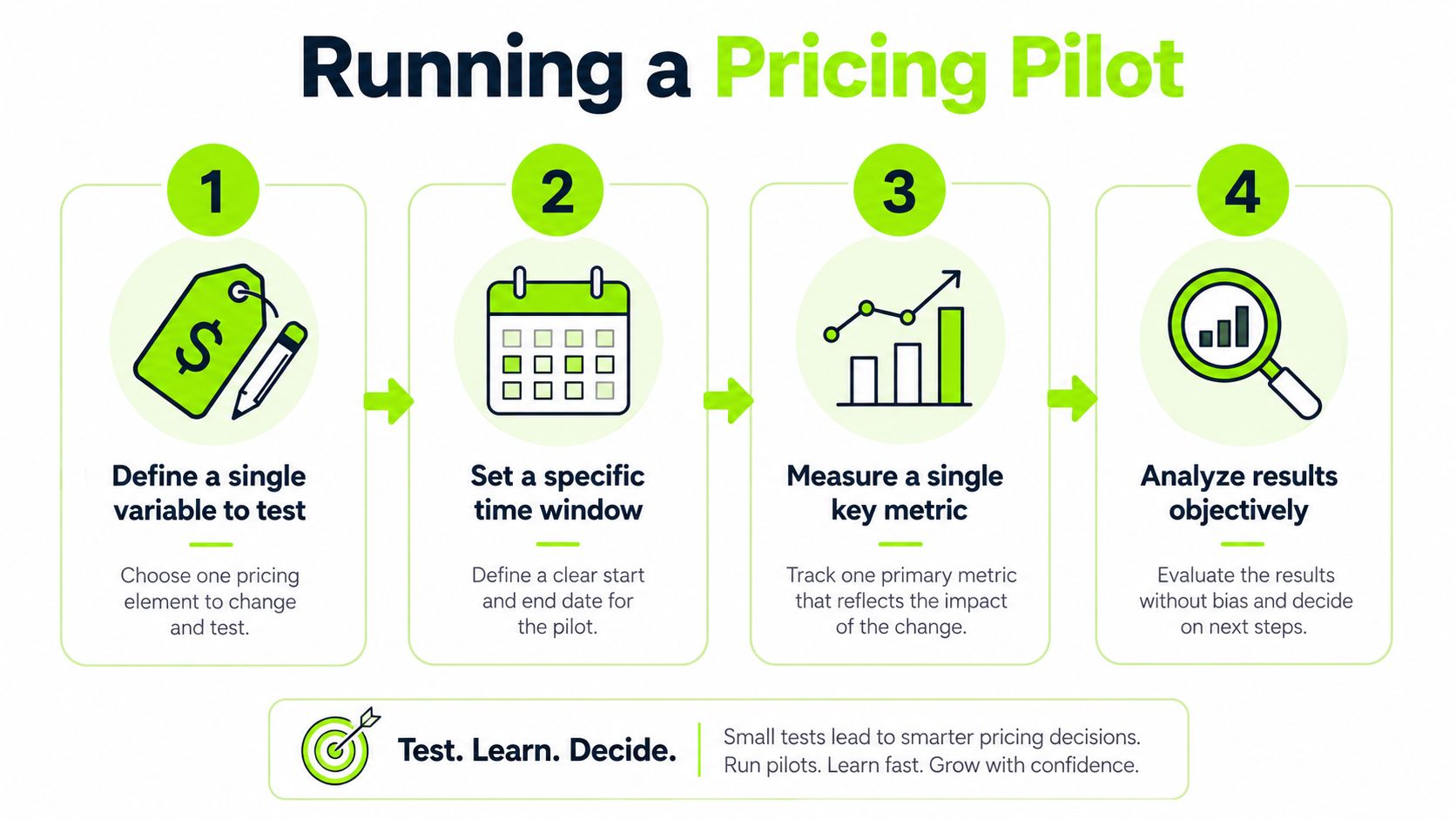
Test one thing, not five
Pick a single fee line, a single time window, or a single booking channel. Hold everything else steady. If you change the price, the tee-time window, and the messaging at the same time, you won't know what caused the result.
Don't run a bank-holiday promotion and then pretend it proves the new price is better. It only proves that bank holidays behave differently.
That's the main trap. Clubs often confuse occupancy with pricing success, then celebrate a fuller sheet while ignoring the revenue per tee time. That's the wrong scorecard. A busy day at the wrong rate is still a weak outcome.
Judge the test on revenue, not just volume
If a club wants the test to mean something, it needs a small scorecard. Track conversion rate, revenue per slot, occupancy, and enquiry quality. Then add a stop-loss rule before the pilot starts, so the price can be reversed quickly if the numbers go the wrong way.
A pilot also needs a clean time window. Run it long enough to cover normal booking behaviour, but not so long that nobody can tell whether the change helped. If the committee can't agree the rules in advance, don't launch the pilot yet.
For clubs that want the operational side tightened up, the automating accounts receivable guide is relevant because it reinforces a simple truth, money follows systems, not manual chasing. That thinking applies just as much to tee-time pricing as it does to payment collection.
Not every pricing question needs an A/B test. Some need a forecast. Some need a member conversation. A few need a committee decision based on risk, not data theatre.
Connecting Pricing to CRM, Automation and Enquiry Handling
A good price card can still lose money if the enquiry lands in an inbox and nobody touches it. That's where clubs underperform. The issue isn't always demand, it's what happens after the lead arrives.
Tag the enquiry by intent and value
If your CRM can separate membership prospects from visitor enquiries, society leads, and corporate bookings, you can route them differently. High-value leads should go straight to a named contact within minutes. Lower-value or lower-urgency enquiries should enter an automated follow-up sequence so they don't disappear.
A secretary can't be expected to remember every lead, every callback, and every quote chase. A CRM can. Golf clubs that treat all enquiries the same end up treating none of them well enough.
The four numbers that matter are straightforward, and they should sit on one monthly dashboard:
- Response time, how fast the club replies.
- Quote-to-visit rate, how often a quoted lead turns up.
- Visit-to-sign rate, how many visits convert into members or bookings.
- Time to first payment, how quickly money reaches the club after interest appears.
Build follow-up around the price, not around optimism
When the price is higher, the follow-up has to be stronger. That doesn't mean pressure selling. It means clarity, timing, and a named person who takes ownership. If a visitor asks about a premium tee time or a membership tier, they should get a response that matches the value being offered.
GolfRep's CRM software guide fits neatly here because the point of CRM is visibility. You need to know who enquired, what they asked for, which price point they saw, and whether they moved on. Without that, the club is guessing about the effectiveness of its own pricing.
A pricing strategy only converts when the back end works. That includes the first response, the reminders, the handoff to the right person, and the recorded outcome. If the club can't see that flow, it can't manage margin properly.
Promotions, Retention Tactics and When a Discount Is the Right Call
Discounts get too much credit because they're easy to understand. They're also easy to overuse. A tactical discount can be sensible, but only when it supports a specific behaviour the club wants.
Use promotions to shape behaviour, not to hide weak thinking
A join-fee waiver for a defined cohort can work if the club wants to lower the barrier for a clear target group. A refer-a-friend structure can work if the club already has members willing to advocate for it. Loyalty rewards for long-standing members can help retention if they're framed as appreciation, not just price relief.
The danger is precedent. Once members learn the club will cut prices whenever pressure builds, they start waiting for the next concession. That damages the pricing structure more than the temporary revenue loss.
A better rule is simple, discounts should be short, specific, and tied to a defined outcome. Off-peak society deals can be useful because they protect the peak product while filling empty inventory. Broad headline discounts usually do the opposite, they train buyers to wait.
Use discounts only as a short-term tactical tool to drive specific behaviour, not as a substitute for strategy.
Communicate rises before you announce them
If prices have to move, members need the reason, the timing, and the scope. Silence creates more backlash than a clear explanation does. Clubs that explain rising operating pressure, fairness across tiers, and the link between fees and course standards usually handle the change better than clubs that hide behind generic wording.
For a useful lens on member value over time, the customer lifetime value implementation guide is worth a look because it reinforces a practical point, the cheapest member is not always the most valuable one. Clubs should think about the full relationship, not just this year's fee.
The clubs that do this well rarely talk like they're discounting. They talk about access, fairness, and the right balance between peak demand and member value. That's a stronger position, and it ages far better.
KPIs, Rollout Cadence and Common Pricing Questions
If the committee wants the pricing review to stick, it needs a small set of numbers and a clear rollout. Anything more complicated will end up in a drawer.
The monthly dashboard
The five figures I'd insist on are revenue per available tee time, realised rate versus posted rate, conversion from enquiry to visit, member churn by tier, and average time to first payment. Those numbers show whether the club is pricing well and whether the system behind the pricing is working.
A 90 day rollout that doesn't create chaos
In the first 30 days, define the segments and the price rules. In the second 30 days, pilot the changes and watch the response. In the final 30 days, communicate clearly, train staff, and roll the new structure out properly.
That sequence matters because clubs often announce pricing before they've built the process around it. Then the front desk gets questions no one prepared for, the members hear half the story, and the committee ends up defending a decision that was never operationally ready.
Three questions committees always ask
How often should fees rise? When the cost base has moved and the market can absorb it, not on an arbitrary calendar alone.
How should negative feedback be handled? Directly, with a clear explanation of what changed and why.
How do we know a discount worked? By looking at revenue, conversion, and follow-on behaviour, not just the brief lift in bookings.
If you want a pricing system that holds up in the real world, you need the data, the follow-up, and the discipline to stop treating discounting as a shortcut. GolfRep helps clubs build that structure, from enquiry handling through to CRM tracking and conversion visibility, so the price card turns into revenue. If you want to tighten your own golf club pricing strategy, visit GolfRep and start with the systems behind the numbers.
Ready to tap into our proven growth system?