How to Increase Golf Club Membership: A 2026 Playbook

Most advice on how to increase golf club membership starts in the wrong place. Clubs do need enquiries, but enquiries aren't the bottleneck if nobody owns the lead, replies slowly, or forgets to follow up properly. The GCMA is blunt on this point, saying the way clubs respond to enquiries can make or break recruitment and recommending solid processes instead of ad hoc handling, which is exactly where many clubs leak sign-ups GCMA guidance on enquiry handling.
That's why the actual job is not “get more leads”, it's build a pipeline that turns interest into visits and visits into members. If your club wants better membership growth, start by looking at response time, ownership, lead visibility and the quality of follow-up, not just advertising spend. For clubs also trying to sharpen their wider digital acquisition, UK service business SEO is a useful reference point because search visibility only matters when the enquiry is handled well enough to convert.
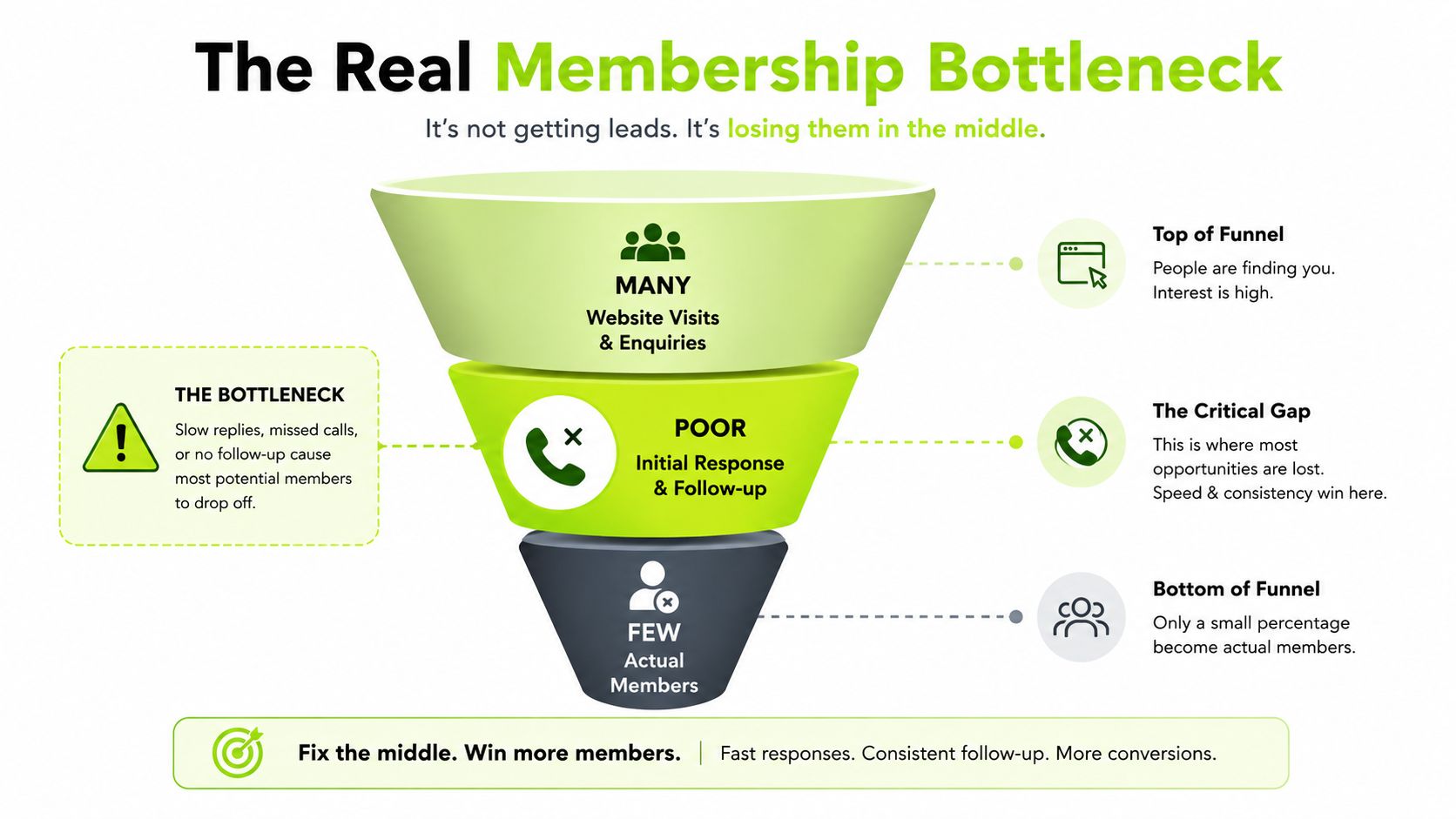
The clubs that grow steadily don't rely on luck. They build a process where every enquiry lands somewhere visible, gets a named owner and receives a timely response before interest goes cold.
For a deeper look at why campaigns fail even when the offer looks strong, see why most golf club marketing fails.
Why Enquiries Are Not the Real Bottleneck
A lot of clubs assume the answer is more advertising, a brighter website or another open day. Those things can help, but they don't fix a broken handover. If an enquiry sits untouched, gets passed around, or receives a vague reply days later, the club has already lost the momentum that made the prospect ask in the first place.
Lead generation and pipeline building are not the same thing
Lead generation creates interest. Pipeline building turns that interest into a booked visit, a conversation and, eventually, a membership. The difference sounds subtle until you look at the internal process, where so many clubs have no clear owner for a new lead, no audit trail, and no consistent next step.
Practical rule: if a lead can't be seen in a CRM, assigned to a person and progressed through a stage, it isn't being managed, it's being hoped for.
The GCMA's point about enquiry handling matters because private clubs often underestimate how fast intent fades once someone has filled out a form or made a call. A well-run club doesn't treat that as “marketing finished”. It treats it as the start of a commercial process. That's also why structured lead handling sits at the heart of good membership growth, not as an admin afterthought but as the main conversion mechanism.
What to inspect first
If you're diagnosing your own club, start with three questions. Who sees the enquiry first? How long does it sit before a human reply? What happens after the first response if the prospect doesn't answer immediately?
- Lead visibility: every enquiry should appear in one place, not be scattered across inboxes and phone messages.
- Named ownership: someone specific needs responsibility for the next action, not “the office” in general.
- Timed follow-up: the first reply should not depend on whoever happens to be free.
This is why many clubs benefit from learning from structured digital lead handling outside golf too. The principles are similar, and good operators in other sectors have already proven that search traffic is wasted if the response process is weak. The same logic applies here, only the product is more personal and the buying cycle is often slower.
Mapping the Membership Prospect Journey
A prospect journey should be visible in plain language. If a secretary, general manager or committee chair can't point to each stage in the CRM, the system is probably too loose to convert enquiries reliably. GolfRep's funnel model uses a simple minimum stack, capture, ownership, immediate acknowledgement and stage visibility, then extends it with an instant auto-reply, a substantive response within hours, an invitation to visit, a three-day chase and a final check-in GolfRep funnel model.
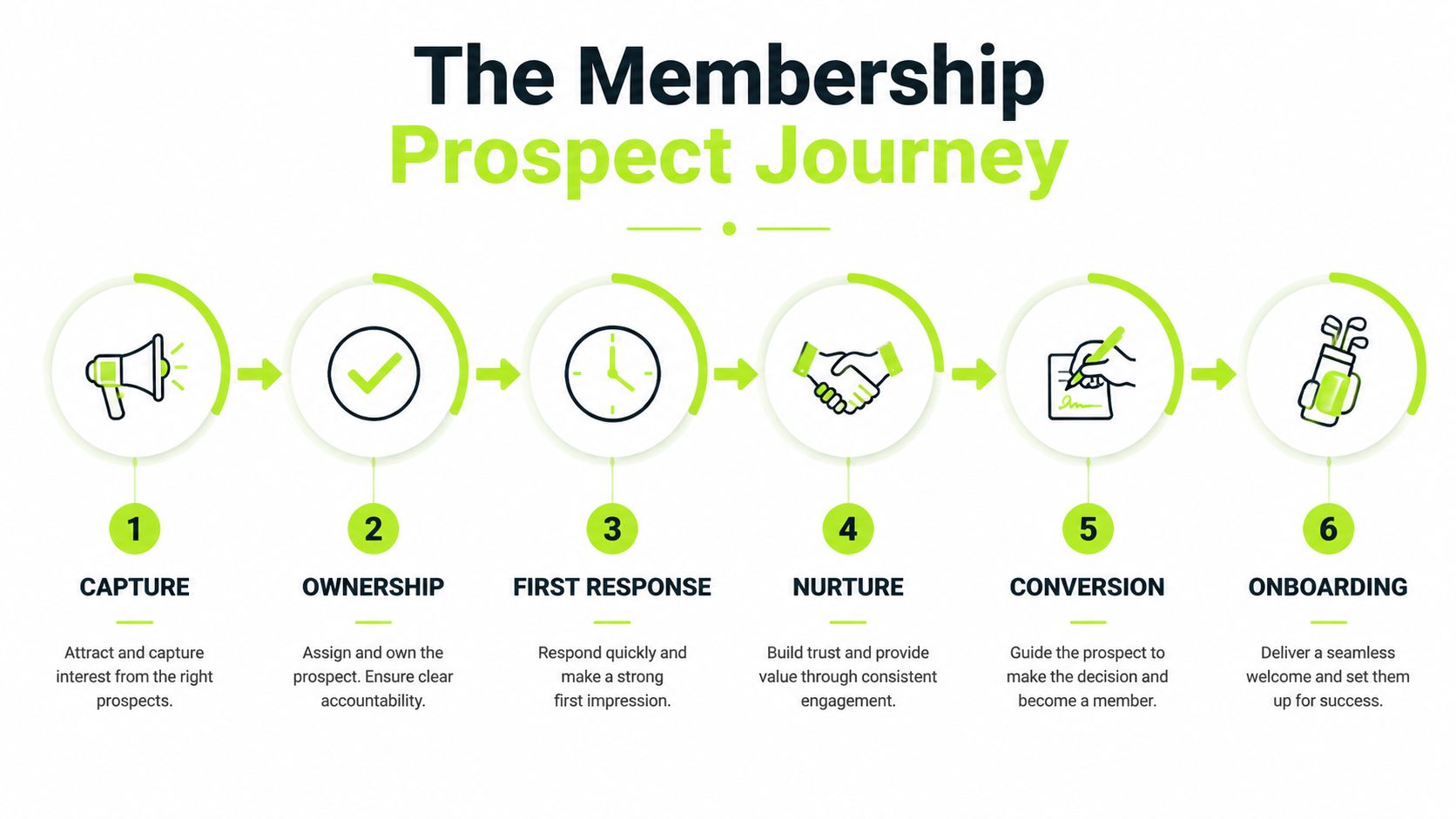
1. Capture
Every enquiry needs to land in one system, whether it comes from the website, phone, social media or a referral. The minimum standard is simple, nothing gets left in personal inboxes. If the club can't see every lead, it can't manage conversion.
2. Ownership
A lead without an owner tends to stall. Ownership should be assigned immediately, and the CRM should show who is responsible for the next step. That's not bureaucracy, it's accountability.
3. First response
The first response should be immediate in automated form, then followed by a substantive human reply within hours. The first message doesn't need to be long, but it does need to confirm receipt and explain what happens next.
4. Qualification
Not every prospect is after the same thing. A family, a corporate contact and a guest golfer need different routes. Simple qualification questions help staff understand intent before they spend time on a call or tour.
5. Nurture
If the lead isn't ready to visit straight away, the club should stay visible without becoming repetitive. That means a structured follow-up sequence, not a string of generic newsletters.
6. Visit booking
The visit is the commercial hinge point. A good process makes it easy to choose a time, confirms it properly and follows up if the booking stalls.
A club can audit this journey in one afternoon. If the answer to any stage is “we usually just chase it when we can”, the process is already leaking members.
Targeting the Right Members, Not Just More of Them
Generic membership growth advice tends to assume every new enquiry is equally valuable. It isn't. Clubs need to decide which categories they want more of, because the right mix shapes pricing, messaging, onboarding and long-term retention. GolfRep's strategy work focuses on category mix, demographic shape, usage patterns, churn points and upgrade paths, and recommends deciding who you want more of before shaping the offer and follow-up around those people GolfRep strategy brief.
Start with the member base you already have
A useful review begins with the obvious questions. Which categories are growing? Which are shrinking? Where do people tend to drop out? Which prospects convert from trial or flexible access into full membership, and which never do?
That matters because many clubs say they want growth, but what they really need is healthier growth. If the club is attracting people who use the course once a month and never progress, the acquisition system may be working against the business model. If younger or more active categories are underrepresented, broad-brush promotions may just pull in more of the same.
Practical rule: grow the segment that fits the club's long-term economics, not the segment that is easiest to sell this week.
Qualify before staff time is spent
Speed and segmentation meet here. A fast first reply is useful, but it becomes much more effective when the lead is qualified properly. Three or four short questions are usually enough to separate serious prospects from casual browsers without making the form feel heavy.
Useful prompts include handicap, playing frequency, preferred membership type and timeline to join. Those questions should mirror the categories the club wants to grow. If the club is trying to fill a specific membership type, the qualification flow should point people there instead of forcing everyone through the same generic route.
Route people by segment
Conditional routing is where the process starts to feel personal. A corporate enquiry should not receive the same follow-up as a family looking for weekend flexibility. A 7-day prospect may need different reassurance from someone comparing a guest-golfer route with a fuller category. GolfRep's guidance is straightforward on this point, segment-specific messaging converts better than broad promotional blasts GolfRep growth strategies.
The useful test is simple. Can the club look at the CRM and see, at a glance, which segment the lead belongs to, who owns it, what they asked for and what happens next? If not, the club is still managing members as a list rather than as a commercial journey.
Build ownership into the CRM
Ownership needs to be visible before the weekend arrives, not discovered on Monday morning. If a lead comes in on Friday afternoon and nobody knows who owns it, the club has already made conversion harder. Structured ownership, even in a small club, prevents this kind of drift.
If your club wants a practical benchmark, start by mapping category priorities first, then tighten the enquiry form, then set the CRM so every lead shows a person, a segment and a next action. That sequence is more effective than launching another campaign and hoping the inbox keeps up.
Nurture Sequences and the Visit Booking Funnel
Once a prospect is qualified, the next job is to make visiting feel easy. The strongest clubs don't rely on a single follow-up email and a polite hope. They use a short, clear sequence that keeps the lead moving until a visit is booked or the person is properly recycled into a longer nurture list. GolfRep's lead nurture guidance takes the same view, using one clear CTA per message and category-specific messaging instead of broad newsletters GolfRep lead nurture.
What the sequence should look like
A good sequence starts with a welcome message within minutes. That should be followed by a substantive response from a named person within hours, then a personalized invitation to visit the club, a three-day chase and a final check-in.
Each touchpoint should do one job. The welcome note confirms receipt. The human reply adds reassurance and a real name. The invitation makes the next step concrete. The chase keeps the enquiry warm without becoming pushy. The final check-in closes the loop cleanly.
Keep the message specific
The best-performing follow-up is rarely the longest. It is the clearest. A family prospect needs to know what happens for children and partners. A corporate lead wants to understand convenience, presentation and practical access. A guest golfer is usually assessing atmosphere and flexibility. The club should answer the question the prospect is asking, not the one the brochure was written for.
Good follow-up sounds like a helpful organiser, not a campaign blast.
That principle also applies to channel choice. Email is often enough for the core sequence, while SMS can help with reminders when a visit is booked or a reply is overdue. The point is not to bombard people. The point is to avoid silence.
What not to do
Do not send one big promotional newsletter and call that nurture. Do not bury the booking link in a long paragraph. Do not ask the same person to read three different offers when all they want is to arrange a visit. Most clubs lose momentum because they make the prospect work too hard.
The booking funnel should feel tidy from the outside. If it doesn't, the issue is usually internal process rather than market demand. A club that follows up consistently will usually book more visits than a club that waits for the prospect to chase back.
Onboarding and First 90 Days as a Member
Signing someone up is the start of the work. The club has to prove the promise was real, because a paid member who receives a welcome pack and then disappears has not joined the club in any meaningful sense. Retention carries the weight here. Clubs do lose members each year, so every new sign-up has to be treated as someone who still needs to be earned, not just processed.

Treat onboarding as a commercial process
The first 90 days should turn a new joiner into an active member. That needs welcome messages, a personal introduction, a clear route into the course, and a reason to come back before the early enthusiasm fades. Leave people to “find their feet” and many of them never really settle into the club at all.
A member buddy scheme helps because it closes the social gap quickly. So does a simple induction that explains where to book, how competitions work, and how to get involved with societies or coaching. The point is not ceremony, it is usage.
A short checklist for the first few weeks is often more useful than another glossy pack. If the member knows who to contact, where to book, and what to try first, the club reduces friction at exactly the moment where habit is formed.
Watch for early engagement signals
Healthy onboarding shows up in practical actions. A booked tee time, attendance at an event, use of a coaching credit, or a reply to a welcome note all show the person is joining the life of the club rather than sitting in the database.
If those signals do not appear, act quickly. Early inactivity usually turns into silence, then dissatisfaction, then renewal risk. A structured check-in during the first few weeks catches that pattern while there is still time to fix it.
That check-in should be specific. Ask whether they have found their way around, whether they understand how to book, and whether they have been introduced to the right people. A vague “hope all is well” message does very little.
Retention pays for growth
The sensible commercial view is simple, understand why members leave, then use joining-fee schemes, taster periods and annual open days to bring in new people without creating churn that has to be replaced again later. Acquisition and retention sit on the same ledger. If churn stays high, the club keeps running to stand still.
A club that protects value while improving the member journey also has more room to invest in growth. That includes onboarding, communication, coaching, and the follow-up systems that stop good enquiries going cold. For pricing decisions that support this work, see this golf club pricing strategy guide.
Make the first renewal feel inevitable
By the time a member is approaching renewal, the club should already have built habit. If they have played, met people, understood the format of the club and found a reason to return, renewal stops being a leap of faith. That is the purpose of onboarding. It is about predictable engagement that supports retention, not friendliness for its own sake.
Pricing and Packaging Without Discounting
Discounting is usually the fastest way to weaken a club's positioning. It also tends to attract the wrong enquiry, people buying on price rather than people who want to join the club. A better route is to use packaging, flexibility and category design to reduce friction without lowering the value of full membership.
Use the pricing lever carefully
GolfRep's pricing strategy guidance is useful here because the question is not whether price matters, it clearly does, but whether the club is using price in a controlled way or reacting out of fear. Many clubs assume any increase will trigger churn. In practice, the bigger risk is often underpricing a product that already has waiting-room value, then starving the club of the cash needed to improve the experience.
The money matters because it funds the systems that support growth, coaching, onboarding, communications and proper lead handling. If the club is losing members each year, then even modest pricing discipline helps offset the replacement burden without forcing a race to the bottom.
Package the offer, don't cheapen it
Flexible categories often do more for conversion than outright discounts. Joining-fee structures, trial periods and well-framed introductory memberships let a prospect test the club without undermining the headline offer. The key is to design these routes so they feel like a bridge into full membership, not a permanent second-tier product.
A strong offer gives people a way in, while still protecting the value of the main membership. That usually means being clear about who each category is for, what happens after the trial period, and how the club moves someone towards the standard product once they are engaged.
Make the increase explain itself
Members usually accept fee changes more easily when they can see where the money goes. If the club is investing in better onboarding, clearer communications and a more responsive enquiry process, that should be stated plainly. Members may not care about the CRM by name, but they do care that new joiners are being looked after and the club is run properly.
A modest increase tied to a visible improvement in service is easier to defend than a discount-led plan that creates volume without quality. In private clubs, perceived value matters as much as headline price.
Real UK Club Examples and Where to Start This Month
Theory only goes so far. Clubs want to know what happened when the process was fixed. GolfRep's own work has included Bidston Golf Club, which moved from near-closure to more than doubled membership and six-figure recurring revenue, Addington Palace, where steady pipeline growth came from a structured enquiry-to-visit process, Downes Crediton, where a rapid profitable membership campaign was launched, and Macdonald Hotels & Resorts, where a multi-site operator centralised CRM and automated follow-ups at scale.
What those examples have in common
The pattern is more important than the headline. In each case, the club or operator stopped relying on informal chasing and replaced it with a visible process. They made the lead journey easier to manage, clearer to monitor and less dependent on one busy person remembering to reply.
The lesson for a smaller UK club is not to copy the scale. It is to copy the discipline. A modest club with a tidy CRM, a named owner for every enquiry and a clear nurture sequence will usually outperform a club with a better-looking ad campaign and no follow-up system.
Where to start this month
- Audit your enquiry handling: check how many leads are captured, who owns them and how quickly they get a real reply.
- Tighten the qualification step: ask fewer, better questions that match the categories you want to grow.
- Rewrite the follow-up: make every message point to one next action, usually a visit or a call.
- Fix onboarding before you add spend: if new members aren't sticking, more leads will only expose the same leak faster.
The fastest wins usually come from boring operational fixes. That's the point. Clubs often don't need more noise, they need a process that makes the right prospect easier to recognise, easier to book and easier to keep.
If your club wants a more predictable way to turn enquiries into members, GolfRep builds the enquiry handling, CRM follow-up and onboarding systems behind that result. Visit GolfRep to see how we help clubs create a cleaner pipeline, stronger conversion and better retention without relying on discounting.
Ready to tap into our proven growth system?