Golf Society Marketing: A Commercial Growth Guide

A society organiser calls at 10.30 on a Monday morning. The club's secretary is dealing with a staffing issue, the PGA professional is on the course and the manager is in a committee meeting. The enquiry is noted, but the reply waits until someone has time to find the current brochure, check available dates and work out whether the quoted package still makes commercial sense.
By then, the organiser may have contacted several other venues. The club generated an opportunity, but it didn't operate a process capable of securing it.
Golf society marketing works best when it connects demand generation with pricing discipline, fast qualification, consistent proposals and deliberate rebooking. A society day isn't just another booking on the diary. It uses a block of tee-time inventory, creates food and beverage demand, occupies staff time and can become a valuable annual relationship if the club manages the whole commercial journey.
The Commercial Reality of Society Bookings
A society organiser may be ready to confirm a date while the club is still checking availability, catering capacity and the current package. If those answers depend on several staff members, the enquiry can stall before anyone has judged its commercial value.
The UK market is large enough to support sustained society activity beyond existing membership. The R&A's 2023 Satellite Account for Golf in the UK estimated that 5.356 million adults played golf at least once per year, while 2.357 million played at least once every four weeks. Annual participation was 9.9%, with four-week participation at 4.3%.
Those figures do not identify how many societies a particular club can win. They do confirm a broad addressable audience, including casual golfers, returning players, independent golfers and people who play through off-course formats. The commercial test is whether the club can turn that audience into profitable group bookings without creating unnecessary work for the team.
A PDF with a green fee and meal is only a starting point. Organisers also need available dates, package suitability, rules for changing player numbers, deposit terms and options for presentations or prize-giving. The club should answer those questions before the organiser has to chase them.
Response time is a commercial variable
GolfRep's review of UK golf membership enquiries reported an average response time of 47 hours and 32 minutes for clubs, as documented in its golf membership marketing analysis. Society enquiries often follow the same slow-response pattern, even when organisers plan well ahead. A complete, credible reply can establish confidence before another venue has supplied basic information.
Practical rule: Treat response time as part of the product. A good course with an uncertain booking process feels riskier than a comparable course that gives the organiser a clear answer.
Separate lead generation, qualification and booking administration. The enquiry form should capture the proposed date, group size, format, catering needs, budget range and organiser details. Ownership then needs to be clear, availability confirmed and a proposal issued from a template that staff can adjust quickly.
Use capacity selectively
A society booking can fill quiet weekday capacity without displacing member play. The same package may produce less value on a popular Saturday morning, when visitor pricing or member access may justify the tee times more effectively.
Society marketing therefore requires yield management. Set an availability policy around demand periods, then decide which dates receive a full package, a higher minimum spend or no society allocation. The GolfRep guide to society bookings helps structure the information and commercial questions to resolve before a proposal is prepared. That discipline gives staff a repeatable system for qualifying demand, protecting inventory and setting up follow-up for future bookings.
Designing Packages That Protect Tee Sheet Yield
A package should help the club sell the right inventory to the right organiser. Start with the tee sheet, not the brochure. Review where society play can add revenue without creating member friction, then design the offer around those periods.
Segment the organiser before setting the price
A corporate group may value punctual service, room hire, branding and a reliable meal more than the lowest green fee. A local league may need a repeatable format and predictable dates. A social group may respond to simplicity, clear inclusions and an organiser who can manage the whole day from one proposal.
Create separate commercial assumptions for each audience:
- Corporate teams need a polished arrival, dependable timings, catering flexibility and optional branding or meeting space.
- Local amateur leagues need consistency, useful repeat-booking terms and dates that work across a season.
- Casual social groups need straightforward packages, transparent deposits and a clear explanation of what happens on the day.
Don't offer every inclusion to every group. A meal, halfway provision, buggy allocation, competition administration or clubhouse hire should have a commercial purpose. If an item doesn't help conversion, increase spend or improve delivery, remove it from the standard package.
Build tiers around demand, not arbitrary discounting
Use an off-peak package to make quieter dates attractive without training organisers to wait for a reduction. The price can remain disciplined while the value changes through catering, flexibility, practice facilities or a better organiser experience.
A useful matrix might look like this:
| Package Type | Target Audience | Ideal Tee Time | Commercial Objective |
|---|---|---|---|
| Corporate day | Local businesses, clients and staff teams | Midweek morning or afternoon | Maximise total spend across golf, catering and facilities |
| League package | Established local groups and regular competitions | Recurring midweek slot | Secure predictable repeat bookings |
| Social day | Informal clubs, friends and community groups | Off-peak weekday or selected shoulder period | Fill underused capacity with simple administration |
| Premium event | Higher-value corporate or society organisers | Controlled high-demand period | Protect yield through a higher minimum spend |
The terms need equal attention. Set a deposit requirement, a final player-number deadline and a cancellation policy before promotion begins. Record these conditions in the proposal and confirmation email, rather than relying on a conversation that may be remembered differently by the organiser and the club.
For package development ideas, the GolfRep guide to golf club package deals offers a useful commercial reference point. The important principle is local: compare each package against the tee-time value, staffing requirement and likely food and beverage contribution.
Commercial test: If a society package fills a desirable period but produces less contribution than the club's realistic alternative, it isn't a growth product. It's an expensive use of capacity.
Acquisition Channels Beyond Member Referrals
Member referrals remain valuable because trust travels quickly through golf clubs. Hillier Hopkins reported that 71% of members' clubs used member referrals in 2024/25, while more than 70% utilized social media effectively, according to its 2024/25 golf clubs report. Referral activity should stay in the plan, but it shouldn't be the entire plan.
Referral-led acquisition is inexpensive and often produces a warm conversation. Its weakness is predictability. The club can't easily control when members know an organiser, how many suitable groups exist in the membership or whether members remember to make the introduction.
Digital outreach offers more control over audience and timing. A club can promote society packages to golfers in its catchment, create a landing page for organisers and direct enquiries into the same qualification process used for every other channel. The trade-off is that advertising costs money and requires a clear offer. Sending paid traffic to a generic homepage usually creates more browsing than booking.
Compare channels by role
| Channel | Strength | Limitation | Best use |
|---|---|---|---|
| Member referrals | Trust and low acquisition cost | Irregular volume and limited reach | Ask members to introduce organisers and corporate contacts |
| Email reactivation | Reaches known past organisers | Depends on clean permissioned data | Promote new dates and annual rebooking |
| Organic social media | Demonstrates atmosphere and experience | Requires regular, relevant content | Show meals, presentation areas and successful society days |
| Paid social or search | Extends local reach and controls targeting | Needs budget, tracking and a strong landing page | Test specific packages and periods |
| Corporate partnerships | Can create repeat team bookings | Takes time to establish | Approach local employers, networks and business groups |
The wider participation market matters here. England Golf data cited by National Club Golfer indicates that 12.6 million adults in England played some form of golf in the past 12 months, including 7.3 million on a nine or 18-hole course and 5.3 million through off-course formats such as ranges, simulators and adventure golf. A society proposition should therefore speak to organisers, not only traditional club members.
Use the channels together. A paid campaign can create the enquiry, an email sequence can nurture a previous organiser and a member can provide the introduction that removes doubt. The GolfRep approach to paid golf-club advertising provides further guidance on connecting targeted promotion with a measurable booking journey.
Automating the Enquiry and Follow-Up Process
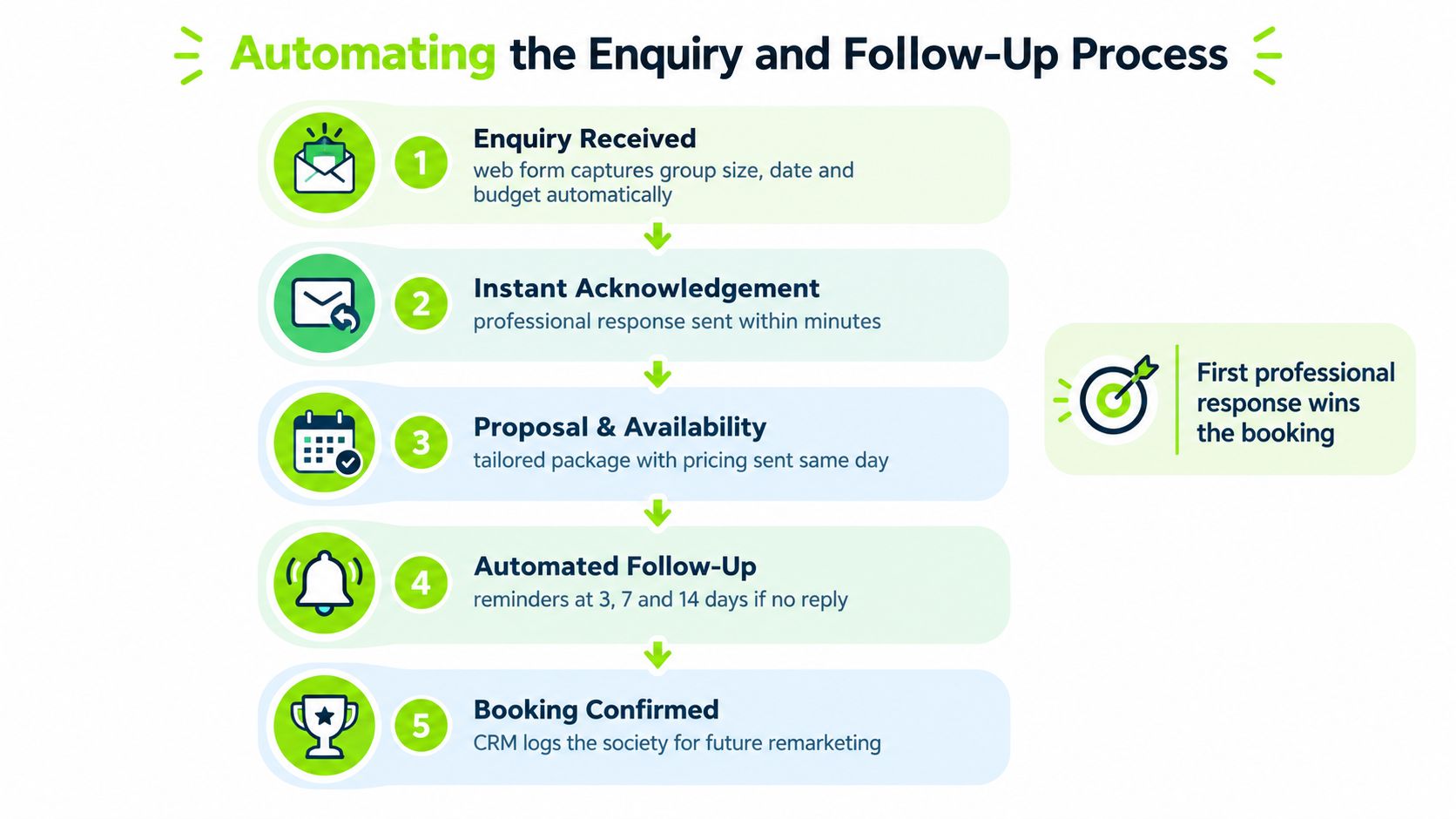
A society enquiry that sits untouched until someone has time to reply is a commercial risk. Automation should remove repetitive administration while keeping staff responsible for decisions involving unusual formats, valuable tee times, complex catering or higher-value events.
Start with one structured form. Capture the organiser's name, email address, telephone number, preferred date, flexibility, estimated player count, format, catering interest and budget indication. The system should create a record, assign an owner and place the opportunity in a visible stage: new, qualified, proposal sent, deposit requested, confirmed or lost.
Set the response sequence
The first message should acknowledge receipt, repeat the key details and explain what happens next. Set a realistic response expectation. Do not imply that availability has been checked when the team has not yet checked it.
The next step is a clear proposal. Recommend a suitable package, show available date options, list inclusions and exclusions, explain deposit terms, state when player numbers are due and provide a direct way to ask questions. Templates with editable fields are more reliable than asking staff to build every email from a blank page.
Build the follow-up around the organiser's buying cycle:
- After the proposal: Confirm receipt and invite one specific question.
- During consideration: Offer an alternative date or package if the first option does not work.
- Before the decision: Restate the date hold, deposit requirement and expiry point. Use genuine deadlines, not artificial pressure.
- After confirmation: Send payment instructions, player-list requirements and the operational timeline.
- Before arrival: Issue a checklist covering catering, competitions, prizes, arrival arrangements, scoring and final numbers.
Keep automation under ownership
Rules must identify exceptions. A large corporate group, charity event or request for a popular Saturday should trigger human review rather than pass through the standard sequence. Create an internal task when the form includes a high player count, premium date, unusual catering request or exclusive-use requirement.
A CRM is useful when the club can see who owns the next action, what the organiser is waiting for and when the opportunity should be reviewed.
The response gap identified earlier in this guide is a warning for society sales too. Agree the service level before promoting it, then build templates, test alerts and review exceptions at the weekly commercial meeting. A fast first reply has little value if proposals remain unanswered or date holds are allowed to expire without a clear decision.
GolfRep is one option for connecting society lead generation with CRM capture, automated follow-up and booking visibility. Any CRM, form tool, email platform and booking system can run the same workflow, provided data passes between them reliably and one named owner is accountable for each stage. Review the process regularly against response times, proposal conversion and lost enquiries, then adjust the rules without adding more manual work for the club team.
Converting Society Golfers Into Repeat Revenue
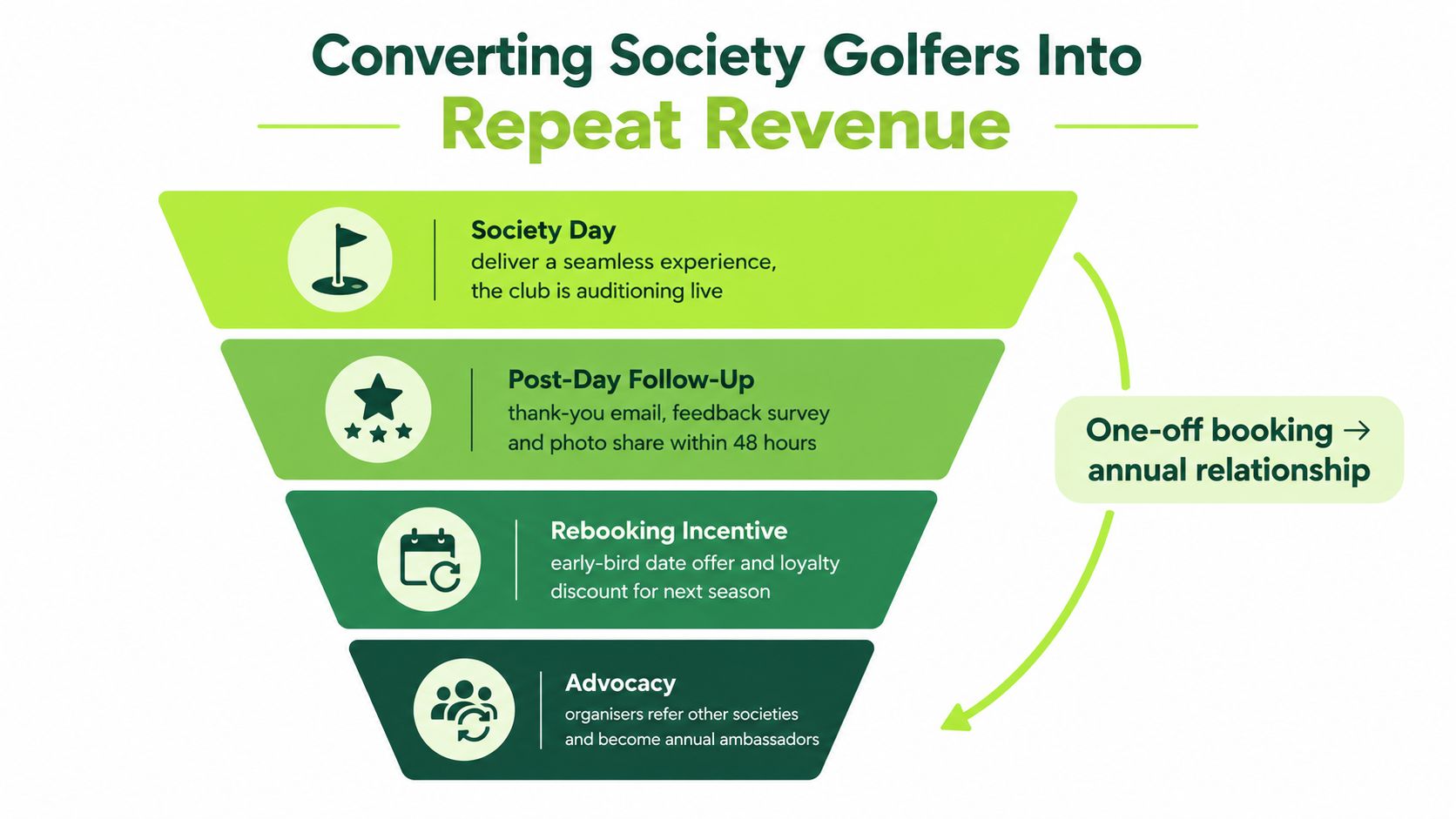
The society organiser is the immediate buyer, but the visiting players are future commercial opportunities. A well-run day gives the club direct evidence of what those golfers value, how they respond to the course and whether the venue could suit another visit or a membership conversation.
The first job is delivery. Arrival instructions should be clear, staff should know the group's name and the organiser shouldn't have to repeat information already supplied. A welcome briefing, visible event contact and properly timed catering can influence whether the organiser sees the club as dependable enough to rebook.
Upsells should support the event rather than interrupt it. Offer relevant additions such as a practice facility, buggy hire, enhanced catering, drinks packages, competition administration or a private presentation area. The right choice depends on the group and the venue. A low-cost add-on that complicates service can reduce satisfaction, while a well-managed addition can lift the day's total value.
Capture permissioned player data
Ask individual golfers whether they'd like to hear from the club, and explain what communication they'll receive. Don't add players to a general database only because they attended someone else's event. Record the organiser separately from opted-in players, then segment future messages by interest, visit type and likely next action.
Possible journeys include:
- Repeat visitor: Invite the player to selected visitor dates or another society event.
- Independent golfer: Present suitable club competitions, open events or flexible playing options.
- Membership prospect: Offer a relevant visit or conversation, without assuming the player wants a full membership.
- Organiser prospect: Ask whether the player arranges events for a company, society or charity.
The follow-up should begin while the experience is fresh. Send thanks, request feedback, share approved event photographs and make the next booking easy. An early rebooking conversation is often more valuable than a generic newsletter because it relates to a known occasion and a known organiser.
A club can monitor the journey from society day to repeat booking, player opt-in, visitor return and membership enquiry. That turns the event from a one-off transaction into a source of structured future demand.
The commercial shift: The society booking pays for the day. The organiser relationship and permissioned player data can create the next booking, a visitor return or a membership opportunity.
Executing a 90-Day Society Growth Campaign
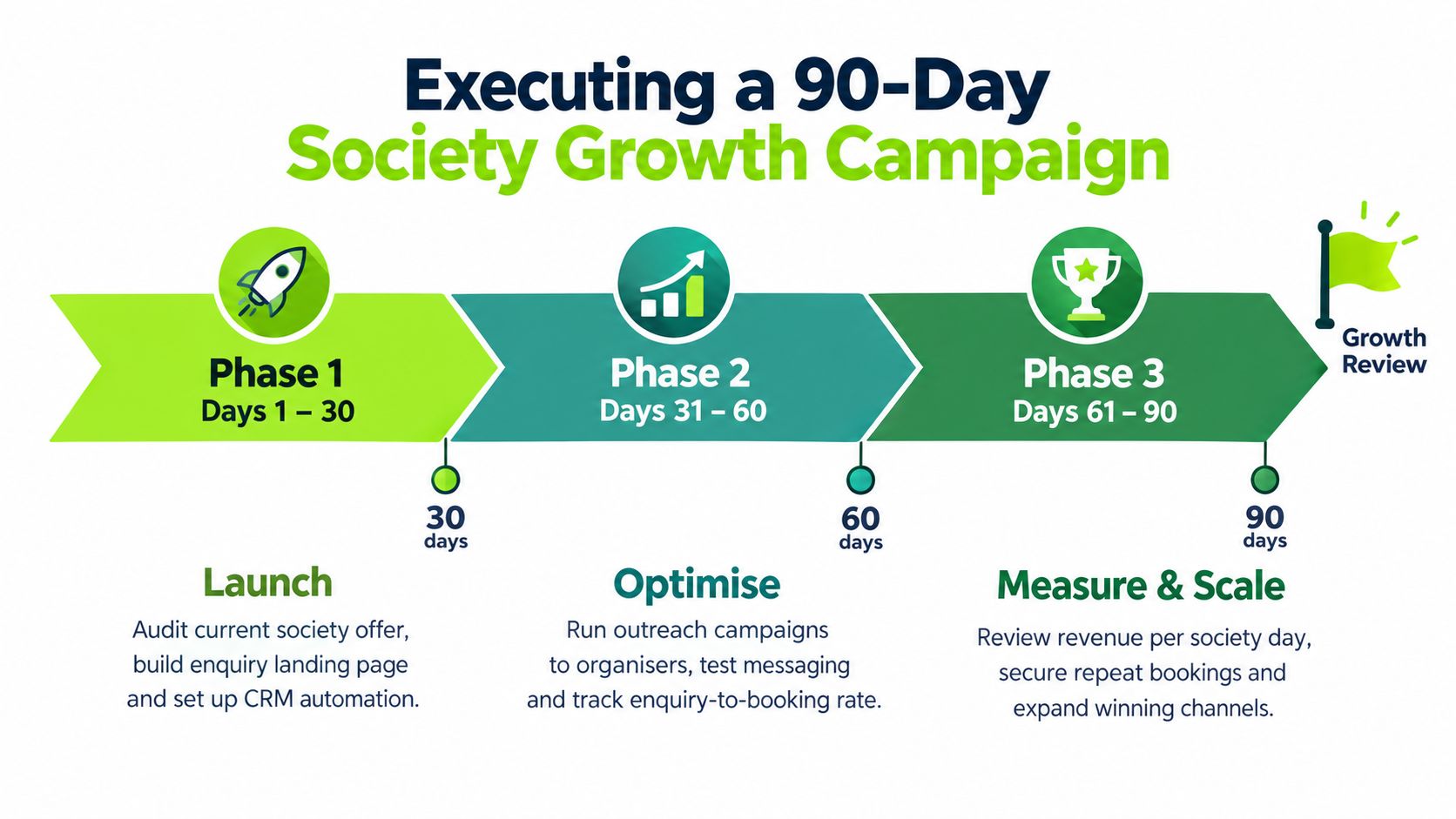
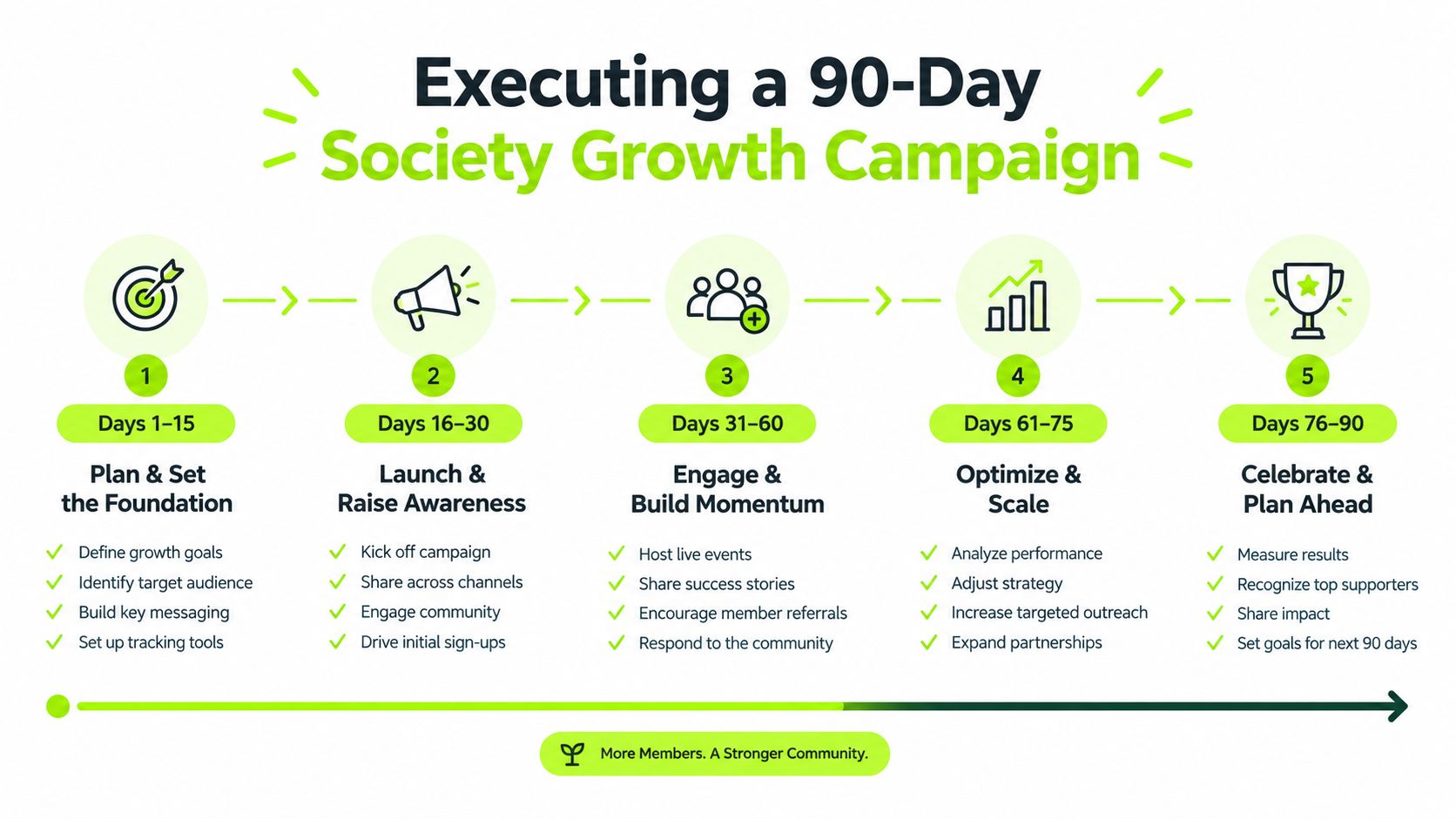
A club doesn't need a complicated launch. It needs a defined owner, a usable offer and a reporting rhythm. The following plan suits a club that has existing society experience but relies on inconsistent enquiries, manual proposals or informal rebooking.
Days 1 to 30, prepare the offer
Audit the previous society bookings and identify which dates, group types and packages produced worthwhile contribution. Review cancellations, no-decisions and lost enquiries. Build the landing page and form, create the package templates, agree deposit terms and connect every enquiry to a CRM record.
During this phase, establish the baseline. Track enquiries by source, qualified opportunities, proposals issued, deposits received, confirmed bookings, average revenue per society day and weekday tee-sheet utilisation. Revenue should include relevant food and beverage income where the club can attribute it consistently.
Days 31 to 60, activate demand
Contact previous organisers with a direct annual rebooking message. Ask local businesses, networks and partners about corporate golf requirements, then use social content to show the experience rather than only publishing a price. Test one audience and proposition at a time so the club can tell whether the response came from the channel, the package or the timing.
Review the pipeline weekly. A proposal with no recorded next action isn't being managed, even if the organiser remains interested. Staff should know which opportunities need a call, which need an alternative date and which should be marked lost with a reason.
Days 61 to 90, measure contribution
At the end of the period, compare channels by booked revenue, not enquiry volume alone. A low-volume corporate partnership may be more valuable than a high-volume campaign producing small, operationally awkward bookings.
Track:
- Enquiry-to-booking rate: Confirmed society bookings divided by qualified society enquiries.
- Average revenue per society day: Attributed golf, catering and agreed extras divided by confirmed society days.
- Weekday capacity utilisation: Society-held or society-played periods compared with the club's available weekday inventory.
- Deposit conversion: Deposits received compared with proposals accepted.
- Rebooking rate: Organisers who confirm a future date after the event.
- Lost-booking reasons: Price, date, response, package fit, course suitability or organiser cancellation.
The board should review the results with one question in mind: which constraint is limiting society revenue now? If demand is weak, improve the proposition and acquisition channels. If enquiries are healthy but bookings are poor, examine qualification, pricing and proposal quality. If bookings are strong but margins or member experience are suffering, refine date allocation, minimum spends and operational capacity.
Golf society marketing becomes commercially reliable when the club stops measuring activity as success. A full pipeline, prompt proposals, profitable dates, strong delivery and booked repeat business provide a more useful picture than social reach or brochure downloads.
GolfRep helps golf clubs build structured society growth systems across package design, targeted acquisition, CRM capture, automated follow-up and repeat-booking campaigns. If you want to identify the constraint in your society pipeline and turn it into a practical 90-day plan, visit GolfRep.
Ready to tap into our proven growth system?