A Modern Golf Club Membership Strategy for the UK
Most advice on golf club membership strategy starts in the wrong place.
It says the answer is more enquiries, more promotion, more reach. That sounds sensible until you look at the gap between participation and membership. In the UK, there were 2.6 million non-member golfers as of 2019, even while participation was rising, which shows the core issue isn't interest alone but converting that interest into club membership according to Club Insure's analysis of golf club diversification.
That changes how a club should think about growth.
At GolfRep, we see the same pattern repeatedly. Clubs run open days, boost posts, update membership pages, and celebrate a spike in enquiries. Then the momentum disappears into missed calls, slow email replies, no structured follow-up, and no visibility on who enquired, who visited, and who was never contacted again. The problem isn't always demand. It's the post-enquiry breakdown.
A modern golf club membership strategy has to do more than generate interest. It has to turn anonymous interest into a visible pipeline, move prospects through a defined process, and give the club a reliable way to track what converts. Without that, even a strong membership offer underperforms.
Why Your Club Needs More Than Just Enquiries
Clubs rarely suffer from a complete lack of demand. They suffer from unmanaged demand.
A prospect clicks an advert, fills in a form, emails the office, or calls reception. That should be the start of a process. In many clubs, it's treated as a one-off task. Someone replies when they can. Notes stay in inboxes. A follow-up depends on memory. By the time the club gets back in touch, the prospect has moved on.
The lead problem usually isn't a lead problem
The popular view is simple. If membership is flat, buy more leads.
That approach misses the operational reality. Enquiries only help if your club can see them, respond to them, qualify them, and move them forward. If you can't do that consistently, increasing lead volume just increases waste.
Practical rule: If your team can't tell you exactly how many membership enquiries came in last month, how many booked a visit, and how many joined, you don't have a lead generation problem. You have a pipeline problem.
Membership decisions are rarely instant. A golfer might enquire today, visit next week, compare options, speak to a partner, and only commit later. If your process relies on one reply and hope, you lose prospects who were still very much in play.
What managers should challenge first
Before approving another campaign, test the basics:
- Response handling: Who owns online enquiries, email enquiries, and phone enquiries?
- Lead visibility: Where does every prospect sit once they make contact?
- Follow-up discipline: What happens after the first reply if they don't book?
- Conversion tracking: Can the committee see enquiry-to-visit and visit-to-member movement?
The clubs that grow predictably don't just market harder. They build a system that makes follow-up routine rather than optional.
More demand won't fix a weak process. It usually exposes it.
That is the foundation of an effective golf club membership strategy in the UK today. Better offers matter. Better promotion matters. But if the club can't handle the handoff from enquiry to conversation, those improvements never reach the membership ledger.
Auditing Your Current Membership Reality
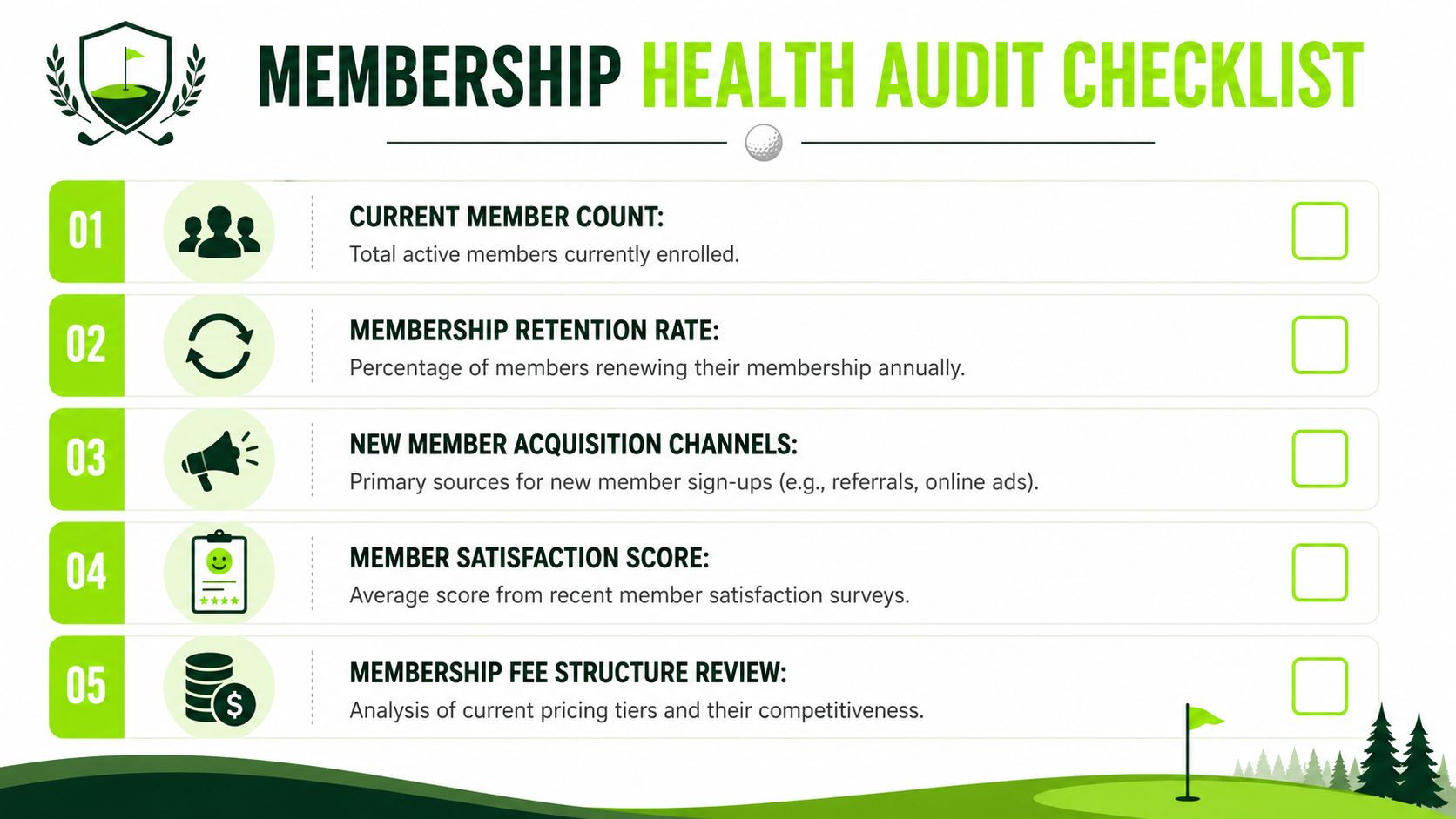
Most clubs audit membership by looking at one figure. Current member count.
That number matters, but it doesn't tell you why growth has stalled, which categories are fragile, or where your enquiry process is leaking. A useful audit looks at member behaviour and operational handling at the same time.
The quickest way to get honest answers is to review the last three years and compare pattern against process.
Start with the membership book
Pull your membership data into one working view, even if that means combining reports from your club software, spreadsheets, and accounting records.
Focus on these areas:
- Category mix: Which membership categories are growing, shrinking, or standing still?
- Demographic shape: Where are your juniors, women, families, and younger working-age members concentrated?
- Usage patterns: Which categories use the course and clubhouse regularly?
- Churn points: Which members leave after a short period, and which stay?
- Upgrade paths: Which trial, academy, or flexible members progress into fuller categories?
A club can look stable on paper while carrying hidden risk. If long-standing full members are carrying the total and newer categories aren't feeding the pipeline, the problem is deferred rather than solved.
Then audit the enquiry path
Many clubs encounter a significant obstacle at this stage.
Take a sample of recent enquiries and trace what happened. Not what should have happened. What happened.
| Audit question | What to check inside the club |
|---|---|
| First response | Was the prospect contacted quickly and clearly? |
| Ownership | Did one person take responsibility for the lead? |
| Next action | Was a visit, call, or trial step proposed? |
| Follow-up | Was there a second and third contact attempt? |
| Outcome | Was the final status recorded anywhere? |
If the answer to the last question is no, you can't manage conversion properly because you don't know where losses occur.
A missed enquiry isn't just a missed email. It's a prospective member who was interested enough to raise a hand.
Use the audit to expose trade-offs
Most clubs face a practical tension. The office team is busy serving current members, handling bookings, managing administration, and dealing with day-to-day operations. Membership sales gets squeezed into the gaps.
That creates predictable issues:
- Phone-first clubs often handle warm callers well but lose website enquiries.
- Email-first clubs reply politely but don't drive action.
- Committee-led clubs discuss strategy but lack day-to-day accountability.
- Volunteer-supported clubs depend too heavily on memory and goodwill.
An audit should end with a short list of failures you can fix, not a long report no one uses. If your golf club membership strategy doesn't begin with current reality, every later decision sits on guesswork.
Defining Your Ideal Future Member
A club that tries to appeal to everyone usually ends up sounding generic to everyone.
The stronger approach is to decide who the club wants more of, then shape the offer and follow-up around those people. England Golf participation data reported for 2025 showed overall membership rising 2.66%, from 730,602 to 750,071, with junior participation up by 10.5 percentage points and female membership continuing to rise according to this report on the latest England Golf membership figures. That tells managers something important. Growth isn't random. It is showing up in specific segments.
Build segments from club reality, not stereotypes
Most clubs already hold enough information to define two or three useful target member groups. The mistake is stopping at broad labels such as “new golfers” or “local professionals”.
A useful segment includes four things:
- Life stage: early-career professional, parent with juniors, returning golfer, retired player
- Constraint: limited time, budget sensitivity, confidence level, family logistics
- Value driver: convenience, community, competition, coaching, social belonging
- Likely objection: cost, commitment, intimidation, inflexible access
If you want a practical way to structure this thinking, GolfRep's guide to market segmentation for golf clubs is a good starting point for turning broad audiences into workable membership targets.
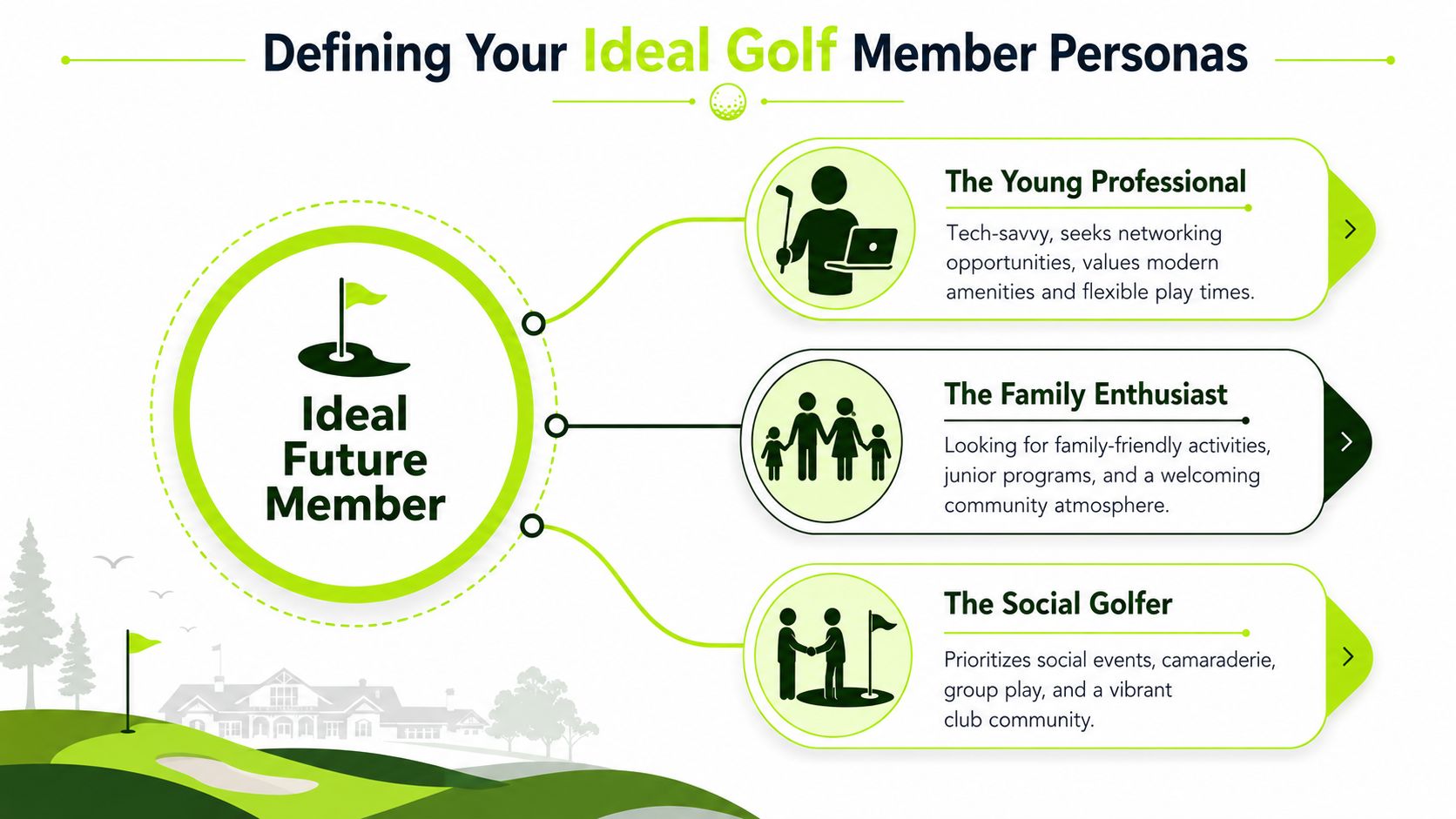
Three examples that matter in practice
Consider how differently these prospects behave:
- The young professional wants golf to fit around work and personal routine. They often value convenience, simple communication, and access that doesn't feel rigid.
- The family-focused member needs more than a tee time. They need junior pathways, a welcoming atmosphere, and a reason for the household to stay involved.
- The social golfer may care less about formal competition and more about belonging, regular games, and a club culture that feels easy to join.
These aren't marketing personas for a slide deck. They shape pricing, communication, onboarding, and retention.
Clubs don't win by having one message. They win by making the right people feel that the club was designed with them in mind.
Decide who not to build around
This is the harder part, but it's where a modern golf club membership strategy becomes clear.
If your course is busy at peak times, a significantly discounted unlimited category may create pressure rather than growth. If your clubhouse culture is traditional and quiet, promising a highly social scene creates mismatch and churn. If your staff can't support a complex junior programme yet, don't build your whole plan around it.
Good strategy isn't only about opportunity. It's about fit. The ideal future member is someone your club can attract, serve well, and retain without constant friction.
Designing Membership Tiers That Actually Sell
Traditional seven-day membership still has a place. It just can't be the only answer.
Clubs often talk about flexibility but keep a structure that asks every prospect to make the same commitment. That creates unnecessary resistance, especially for people who like golf but aren't ready to buy into a full, fixed model on day one.
A stronger product architecture uses a small number of clear categories with different levels of access, commitment, and progression.
Why rigid structures stall sales
The market has shifted. A tiered architecture with flexible options is described as effective for underserved groups, including the 84% of younger millennials aged 25 to 34 who view golf as personal wellness time, and that approach aligns with the same source's discussion of rising junior and female categories in England Golf's 2025 data in this analysis of membership marketing trends.
That doesn't mean every club should launch a dozen membership types. It means the category structure should reflect how people buy.
A practical setup often includes:
- A core full membership for committed regulars who want the traditional model.
- A flexible access option for golfers who play less frequently and want lower upfront commitment.
- A trial or introductory route that lowers the barrier for people still deciding.
- A junior or pathway category tied to coaching, family access, or progression.
- A pause or freeze policy so temporary life changes don't automatically become cancellations.
Match tiers to buying behaviour
The best-selling categories usually solve a specific hesitation.
| Prospect concern | Membership design response |
|---|---|
| “I won't play enough” | Flexible credits or limited-play access |
| “I'm not sure yet” | Trial period or starter pathway |
| “My child is interested, not me” | Junior-first programme with family connection |
| “I travel or work shifts” | Pause option or flexible playing windows |
What doesn't work is adding complexity without clarity. If prospects need a long verbal explanation to understand the difference between categories, the structure is too complicated.
Decision test: Every membership tier should answer one obvious question better than the others.
Protect value while reducing friction
Managers often worry that flexible categories will undermine full membership. Sometimes they can, if pricing and access are poorly designed.
The answer isn't to avoid flexibility. It's to set boundaries. Protect peak demand where needed, define upgrade routes, and make sure the value of fuller categories remains obvious. Introductory products should open the door, not replace your core membership base.
A golf club membership strategy works best when the product ladder feels natural. Someone can start with limited commitment, experience the club properly, then move into a stronger category without friction or confusion.
Building Your Member Acquisition Channels
Once you know who you want and what you want to sell, acquisition becomes much simpler.
Most clubs spread effort too thinly. They post a bit on social media, update the website occasionally, run an open day, and hope that broad activity produces serious prospects. It usually produces mixed-quality enquiries and inconsistent follow-up pressure on the office.
The better approach is to build a small set of channels that match the member segments you want.
Choose channels that fit the audience
A local family audience responds differently from a time-poor professional or a returning golfer who hasn't belonged anywhere for years.
The practical mix often looks like this:
- Google search demand capture: Useful for people actively looking for membership, golf clubs nearby, or beginner access.
- Meta audience targeting: Helpful for reaching local demographics based on interests, life stage, and surrounding geography.
- Referral prompts: Existing members can introduce the right kind of prospect if the process is easy and visible.
- Open days and taster sessions: Effective when the event has a clear next step instead of ending as a one-day experience.
- Local partnerships: Employers, schools, and community groups can introduce audiences your club wants more of.
GolfRep's overview of member acquisition for golf clubs outlines how clubs can combine these channels without turning marketing into a scattergun exercise.
Don't confuse activity with pipeline
Here, managers need discipline.
An open day is not a strategy. A Facebook campaign is not a strategy. A redesigned membership page is not a strategy. These are inputs. Their job is to create enquiries from the right people.
What happens next matters more.
For example, if your club targets families, the campaign should not only ask them to “contact us for membership”. It should direct them into a path that reflects their likely questions about juniors, confidence, and club atmosphere. If you target young professionals, your messaging should reflect convenience and flexible access, not a generic list of facilities.
The strongest acquisition channel is the one that sends the right prospect into a process your club is actually equipped to convert.
Build fewer channels, but run them properly
A practical rule for committee-led clubs is to simplify.
Use channels you can monitor. Use messaging tied to one or two segments. Send every enquiry into one central process. If each source creates a different manual workflow, staff time gets burned before the first visit is booked.
Acquisition should feed a system, not create admin. When the club starts with that mindset, marketing becomes easier to judge because every channel is measured by booked visits and memberships, not by noise.
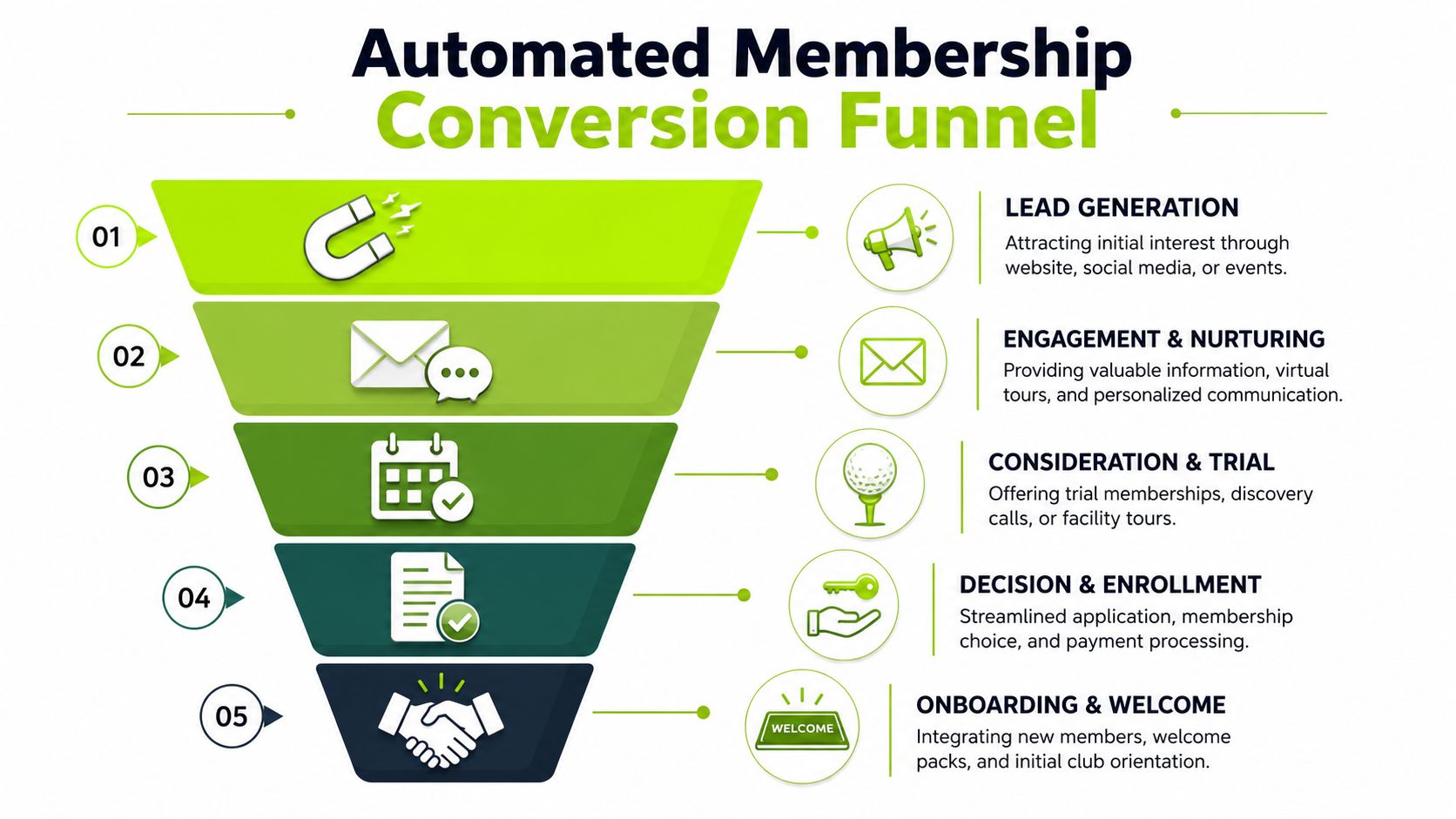
Implementing The Automated Conversion System
Clubs rarely have an enquiry problem. They have a handoff problem.
A prospect fills in a form on Sunday evening, gets no reply until Tuesday, receives a generic email, and then disappears into someone's inbox because the membership secretary is off that week. The marketing worked. The conversion process failed.
That post-enquiry breakdown is where membership growth stalls. Flexible categories and sharper campaigns help, but they do not fix delayed replies, inconsistent follow-up, poor lead ownership, or the lack of visibility once an enquiry comes in.
What the system needs to do
The job of the system is simple. Capture every enquiry, assign the next action, and keep the lead moving until there is a clear outcome.
In practice, that means three pieces working together:
- A CRM with one record for every prospect, including source, membership interest, notes, stage, and owner.
- An immediate automated reply that confirms receipt and gives the prospect a clear next step while interest is still high.
- A follow-up sequence using email, SMS, and staff tasks so no lead sits untouched after the first contact.
Without that structure, clubs end up relying on memory, spreadsheets, and whoever happens to be checking the shared inbox. That is where good enquiries go cold.
Build the pipeline around decisions, not messages
Many clubs set up follow-up as a string of emails. That is too shallow. The pipeline should be built around the decisions a prospect needs to make.
First, decide whether the enquiry is qualified. Is this person local? Are they looking for full membership, a trial, a family option, or something else? Are they ready now, or just researching for next season?
Second, decide the right next step. For one prospect, that is a tour. For another, it is a short call to explain weekday access, joining fees, or competition eligibility. For a parent asking about juniors, the next step may be a visit timed around coaching.
Third, decide who owns the lead. Shared responsibility usually means no responsibility. One named person should own the next action at every stage.
That is the difference between automation that helps and automation that just sends noise.
The practical flow from enquiry to visit
A useful conversion flow is not complicated, but it is specific.
- Enquiry enters the CRM: Website forms, ad responses, call-back requests, and event sign-ups all land in one place.
- Instant acknowledgement goes out: The prospect gets a prompt reply with a relevant next step, not a generic thank you.
- Qualification happens early: A short form, reply option, or staff call identifies fit, timing, and likely membership route.
- Visit or call is booked: The system pushes toward a concrete appointment instead of an open-ended conversation.
- Follow-up continues automatically: If the prospect does not respond, reminders and staff tasks keep the lead active until it is closed.
For a more detailed breakdown of timings, messaging, and task design, see this guide to automated follow-up for golf club membership enquiries.
Response speed matters, but relevance matters as well. An immediate reply that ignores the prospect's actual interest is only a faster way to lose trust.
Visibility changes how managers run membership
Once the process sits inside a CRM, management gets clearer fast.
You can see how many enquiries came in this week, how many were contacted, how many booked a visit, how many went quiet after the first reply, and which channels are producing people who join. That changes decision-making. Instead of arguing about whether the club needs more leads, you can see whether the primary problem is response time, poor qualification, weak visit booking, or a lack of persistence after first contact.
I have seen clubs with modest enquiry volume outperform clubs with bigger budgets because they ran a tighter conversion process. They responded faster, routed leads properly, and followed up for long enough to get a decision.
That is why GolfRep uses a system that combines advertising, CRM capture, and automated follow-up in one membership pipeline. The point is operational control. Staff still handle the human moments, tours, calls, objections, and closes. The system handles the repetition, the reminders, and the visibility.
Clubs should track retention signals inside the same operating rhythm as acquisition signals. DocsBot on customer loyalty metrics is a useful reference for the kind of measures that show whether short-term joins are turning into stable long-term value.
Measuring and Optimising for Long Term Growth
Growth gets unstable when clubs only measure joins.
That figure lands too late. By the time the committee sees a weak month for new members, the underlying issue has usually been building for weeks in response times, booking rates, no-shows, or poor follow-up. Long-term growth comes from managing the full membership pipeline and the retention side at the same time.
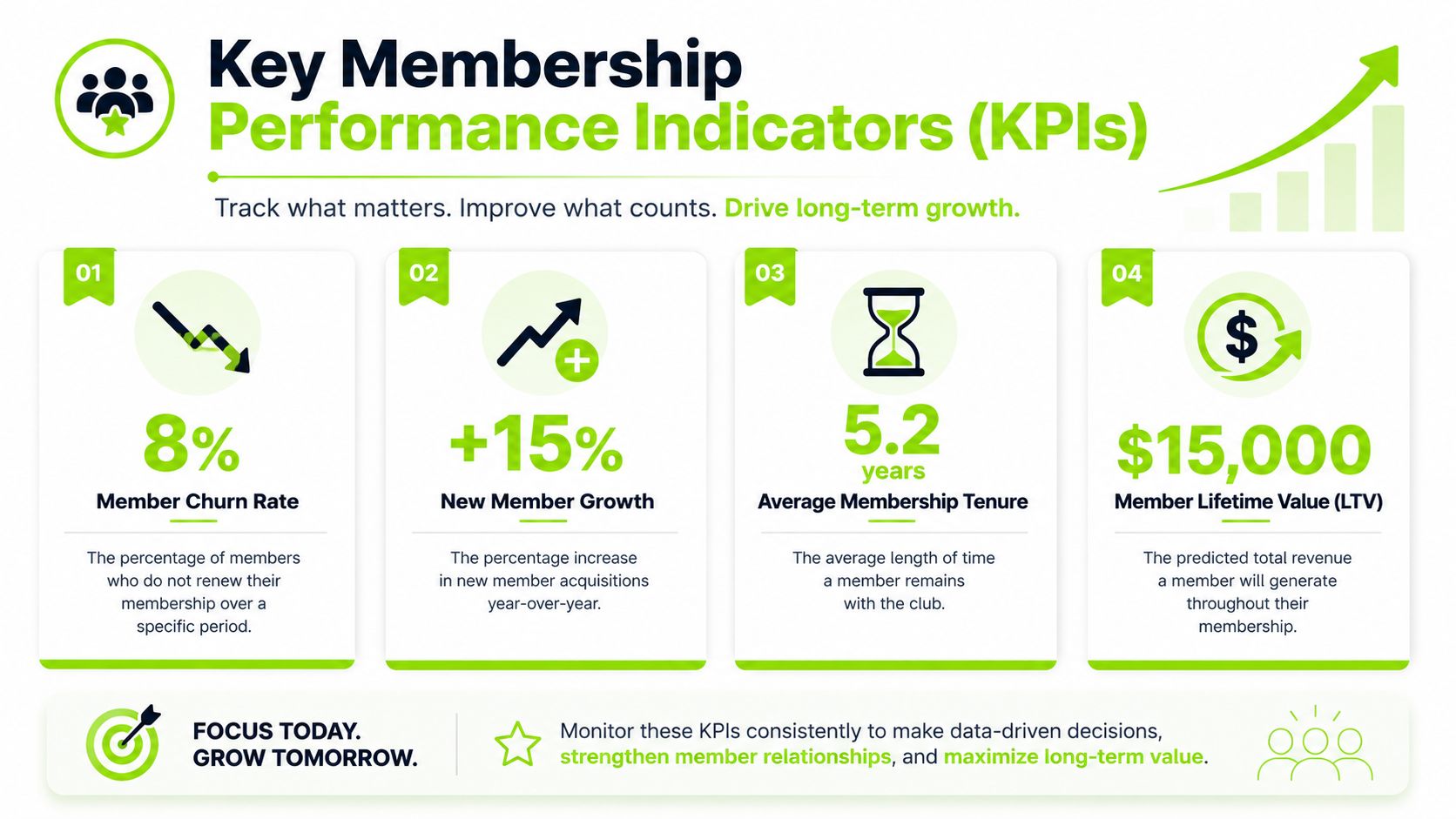
Recent 2025 data showed 77% of golfers plan to renew their membership next year, while only 4% explicitly said they would not renew, according to Golfshake's review of club membership health in 2025. That is why retention deserves as much attention as acquisition.
Track the metrics that change decisions
Every club should monitor a small set of numbers inside its CRM or reporting process. You don't need a complicated dashboard. You need measures that help staff act.
Start with:
- Enquiry-to-contact rate: Are prospects being reached?
- Contact-to-visit rate: Are conversations turning into booked visits or trials?
- Visit-to-member rate: Are visits being handled well enough to close?
- Renewal and churn patterns: Which categories stay, and which are fragile?
- Time in pipeline: How long does it take an enquiry to become a decision?
A useful companion resource is DocsBot on customer loyalty metrics, especially for clubs that want a clearer way to think about retention indicators beyond simple renewal totals.
Use reporting to fix process, not decorate meetings
A good monthly review should show where friction is happening.
| Pipeline area | What a manager should ask |
|---|---|
| New enquiries | Are we attracting the right prospects or the wrong ones? |
| Response handling | Where are delays happening and who owns them? |
| Visit stage | Are prospects getting a compelling club experience? |
| Membership close | Which offers convert cleanly and which create confusion? |
| Renewal cycle | Why do some members stay while others drift away? |
Long-term strategy finds practical application in these scenarios: If enquiries are healthy but visit rates are weak, improve qualification and booking. If visits are strong but joins are soft, revisit product fit and sales handling. If joining is healthy but churn is creeping in, focus on onboarding, communication, and member experience.
The most useful KPI is the one that tells your staff what to do next.
Keep the system live
A golf club membership strategy shouldn't sit in a committee pack and get revisited twice a year.
It should live in the weekly workflow. Staff should know which leads need action today, which member categories are slipping, and where the next improvement needs to happen. That is how clubs move from sporadic campaigns to predictable growth.
If your club has demand but not enough conversions, GolfRep helps build the system behind the strategy. That includes lead capture, structured follow-up, CRM visibility, and pipeline tracking so membership growth doesn't depend on memory, inboxes, or one busy member of staff. Explore how it works at GolfRep.
Ready to tap into our proven growth system?