Golf Club Tee Time Marketing Strategy

A Tuesday morning tee sheet can look healthy at the start of the week, then lose its commercial value as the hours pass. An unbooked slot at 10:30 on Tuesday can't be carried into Wednesday, and a late cancellation may leave too little time to resell it. That makes golf club tee time marketing a revenue-management discipline, not a traffic-generation exercise.
The practical question is straightforward: which golfer should see which tee time, at what price, through which channel, and with what booking conditions? Clubs that answer those questions can protect member access, attract incremental visitor play and turn more of their available capacity into committed revenue.
The Commercial Reality of Tee Sheet Inventory
A tee sheet is often managed like a diary. Staff open and close times, answer calls, process bookings and report the number of rounds played. Commercially, however, each slot is perishable inventory. Once a Tuesday morning has passed, that capacity has no resale value.
That changes the way promotion should work. A campaign for a popular Saturday morning slot may discount or subsidise demand that would have arrived anyway. A campaign for a quiet weekday period has a different purpose, particularly if it reaches golfers who can play at short notice and book without staff intervention.
Convenience is part of the product
UK golf has moved steadily away from phone-first administration towards centralised tee-sheet management, online booking and mobile access. One independent UK-facing provider says its tee-time management and online booking system is used by 3,500 golf clubs across 14 countries and more than 670,000 club members in the UK and Ireland. That scale is cited in the Hillier Hopkins Golf Clubs Report.
BRS Golf describes its members app as a fast and easy way to book tee times, reflecting a broader commercial reality. Golfers increasingly expect to see availability, select a suitable time and complete payment without waiting for a reply from the pro shop. If your promotion sends someone to a booking page that shows no suitable times, requires a phone call or creates uncertainty about payment, the campaign has done its job only halfway.
Commercial rule: Never promote tee-time inventory that the customer can't see and reserve immediately.
The booking journey therefore needs to sit inside the marketing proposition. “Book a round this week” is stronger when the golfer can choose a time, understand the price and receive confirmation in one sitting. Convenience isn't an operational extra. It helps determine whether a golfer chooses your course over another nearby option.
Start with the inventory, not the advert
Before spending on social media or search, map the tee sheet by day, time, customer type and booking lead time. Identify which periods are constrained and which need demand. Then assign an appropriate commercial objective:
- Protect premium periods: Keep popular member and visitor times available at a price that reflects demand.
- Build weekday occupancy: Use targeted messages, flexible packages or database activity for softer periods.
- Capture short-notice demand: Make live availability prominent and remove unnecessary booking restrictions.
- Support retention: Ensure visitor activity doesn't make members feel that access has been sold away.
For a practical framework on filling weaker periods without treating every slot alike, see GolfRep's guide to increasing tee-sheet occupancy. The central lesson is simple: the tee sheet should determine the campaign, not the other way around.
Segmenting Your Tee Sheet for Maximum Yield
A club shouldn't market every tee time with the same price, audience or booking rule. Start by separating inventory into premium, standard and soft periods, then decide how much access each customer group should receive.
The categories don't need to be complicated. A premium block might include sought-after weekend times. Standard inventory may cover regular weekday or shoulder-period demand. Soft inventory is the capacity most likely to remain unsold unless the club creates a specific reason to book.

Use booking windows as commercial controls
Advance-release rules can protect member value while giving visitors a clear opportunity to book. Paultons Golf Centre states that members can book tee times 21 days in advance, while non-members can book 14 days in advance. Hesketh Golf Club limits casual tee-time bookings to 14 days ahead. These examples are set out in Paultons Golf Centre's terms and conditions.
The principle is more important than copying a particular window. Ask what the club is trying to achieve:
- Member access: Should members receive priority for popular times?
- Visitor certainty: Is the release window long enough for golfers planning a visit?
- Yield control: Can the club hold some availability back and release it as demand becomes clearer?
- Operational simplicity: Can the team explain the rules consistently?
A booking window becomes counterproductive when it hides too much availability from people ready to buy. It becomes useful when it protects the right customer group and supports a deliberate release schedule.
Match conditions to the risk
A premium slot may need prepayment, a clear cancellation deadline and a defined no-show policy. A softer weekday slot might benefit from greater flexibility if the priority is filling capacity. The right policy depends on demand, not on a blanket preference for strictness.
South Shields Golf Club releases tee times at 20:30 five days in advance, requires each player to receive email confirmation and treats a booking as a no-show if it hasn't been cancelled before 9pm on the day before play. Its tee-time cancellation and no-show policy illustrates how a release schedule, confirmation process and cancellation cut-off can work together.
A booking rule should protect revenue and explain the customer experience. If staff can't state it clearly, customers won't follow it reliably.
Review the rules monthly against actual behaviour. If visitors book early and cancellations are rare, the club may have room to expand access. If premium times are released too broadly and members struggle to obtain them, tighten the relevant segment rather than restricting the entire tee sheet. For a broader explanation of customer grouping, GolfRep's guide to market segmentation provides useful context.
Building a High-Converting Digital Booking Funnel
A golfer who clicks an advert is expressing interest, not creating revenue. The booking engine must make the next decision easy: choose a date, find a suitable time, understand the price and complete the reservation.
The most damaging friction often comes from operational settings rather than website design. A short booking window, an unavailable block of times or an inflexible group-size rule can make a course appear unavailable when capacity exists.
Compare the customer journeys
A restricted journey might look like this:
- The golfer clicks a local search advert.
- The booking engine shows limited dates.
- Suitable times aren't visible.
- The golfer is told to phone the club.
- The enquiry waits until the team is free.
A more effective journey exposes relevant availability immediately, allows the golfer to select the number of players and confirms the reservation without a separate conversation. The club can still apply pricing, payment and cancellation rules, but it shouldn't force a ready-to-book customer into an avoidable enquiry.
A UK booking-funnel benchmark reported by the PGA showed booking-engine traffic converting at 1% where a club had a high green-fee rate and a four-day booking window. Opening additional availability blocks improved online conversion by 300%, according to the PGA-related booking funnel reporting. The lesson isn't that every club should copy one setting. It's that availability policy directly affects marketing efficiency.
Remove the obstacles that staff can't fix later
Check the booking path as a golfer would, on a mobile phone and outside office hours. Look for:
- Visible inventory: Can a visitor find an appropriate date and time without calling?
- Clear pricing: Does the price change by day, time or customer type make sense?
- Group flexibility: Can a smaller group book an available slot without unnecessary barriers?
- Payment clarity: Are deposits, prepayment and cancellation terms shown before purchase?
- Confirmation: Does the golfer receive an immediate email or SMS with the details?
The club should also measure where users leave. If traffic reaches the booking engine but reservations remain weak, increasing advertising spend is unlikely to solve the problem. Test availability blocks, booking windows and page clarity first. GolfRep's guidance on booking a visit online is relevant when reviewing that customer journey.
Channel Mix and Targeted Campaign Execution
The right channel depends on the inventory being sold. Social media can create awareness and display the course well, but local search and paid search often reach golfers who are already looking for a round. Email and SMS can be more efficient when the club already knows who can play on a weekday or who has visited before.
The Revenue Club's 2025 data shows that 67% of casual green fees were booked online, online bookings represented about 34% of total green-fee revenue, and 60% of online bookings were for weekday play. The same data identifies 11am to 3pm as peak booking times. These figures appear in the Hillier Hopkins Golf Clubs Survey Report 2025-26.
That points to a useful commercial distinction. Online booking is not just a convenience channel. It can be a way to capture weekday demand, particularly when messages and availability are built around the golfer's likely playing pattern.
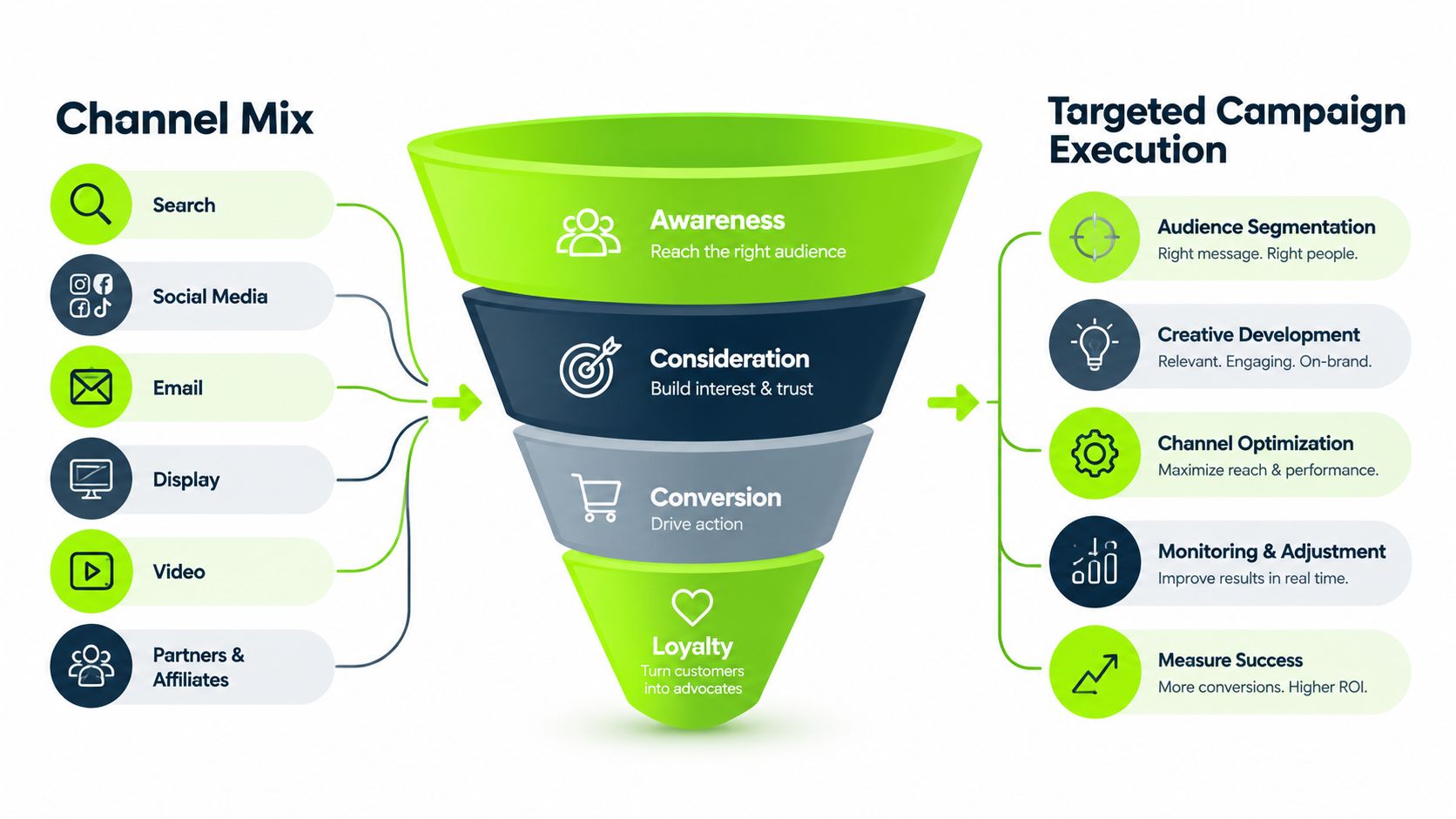
Give each audience a commercial job
A general “book now” advert is easy to produce but difficult to evaluate. Assign each audience a defined objective:
- Local casual golfers: Promote available weekday times with a direct booking link and a clear reason to play now.
- Previous visitors: Use reactivation messages based on past visit timing, course preference or playing frequency.
- Society organisers: Sell certainty, group handling and a simple route to discuss dates, rather than treating the organiser like an individual visitor.
- Members: Communicate access rules, late availability and booking reminders without making members compete with public campaigns.
The offer should match the slot. A weekday message might focus on convenient access, a shorter lead time or an appropriate package. A premium weekend campaign should avoid unnecessary discounting if the booking pace already indicates strong demand.
Test the message, not just the channel
Email subject lines deserve the same discipline as paid adverts. A PGA guide says database campaigns can move from around 15% open rates to 40%, so clubs should test messaging by segment and scale variants that improve opens, clicks and conversions. This recommendation is supported by the PGA guide to dynamic pricing and tee-sheet optimisation.
Test one meaningful variable at a time, such as:
- “Weekday tee times available”
- “Play this week at [club name]”
- “Your next round is ready to book”
Then judge the campaign by booked revenue and profitable occupancy, not opens alone. A subject line that attracts attention but fills times the club would have sold anyway isn't necessarily a commercial win.
Automating Follow-Up and Reducing No-Shows
A confirmed booking is stronger than an enquiry, but it still needs to become an actual arrival. Clubs lose revenue when customers forget dates, misunderstand cancellation terms or abandon a booking because nobody confirms the next step.
The operating model should distinguish between automated reservations and human-led enquiries. A booking engine can handle confirmation, payment reminders and basic cancellation information. A society or group enquiry still needs a named person who can discuss dates, numbers, food and other requirements.
Create one owner for every open opportunity
A simple handoff process is more valuable than a complicated automation stack:
- Capture: Record the source, requested date, preferred time and group size.
- Assign: Give the enquiry to a named staff member.
- Respond: Confirm availability or provide the next realistic option.
- Follow up: Use email, SMS or phone according to the customer's preference.
- Close: Mark the booking as won, lost or awaiting a decision.
A UK case study across more than 50 clubs found an average enquiry response time of 30 hours, with faster response consistently linked to higher conversion. The same analysis identified unavailable dates and inability to contact the lead among common reasons for lost enquiries. Those findings are reported by Paralo's golf enquiry analysis.
The commercial implication is clear. Don't create a campaign that generates more group enquiries than the team can handle. Route all enquiries into a shared CRM or agreed tracking system, then review response time and outcome by source.
Make commitment visible to the customer
East Devon Golf Club requires visitors to pay at booking, charges 50% of the green fee for cancellations within one week, and charges 100% where a booking isn't cancelled. Those terms are published through East Devon Golf Club's visitor booking information. Sunningdale Golf Club also requires payment in full, with unpaid bookings released and cancelled after 30 days, according to its published booking terms.
These policies aren't merely administrative. They tell customers that a tee time has been reserved for them and that failing to attend has a commercial consequence. The club should display the rules before payment, repeat them in the confirmation and send a reminder before the cancellation cut-off.
SMS and email reminders should contain the date, time, player count, arrival expectation and cancellation route. Keep the wording short. The purpose is to reduce uncertainty and create a clear action if plans change.
Measuring Performance and Optimising Revenue
Rounds played is an important operational measure, but it doesn't tell management whether the club filled capacity profitably. A busy tee sheet can still produce weak results if premium times were underpriced, public bookings displaced members or marketing filled only the slots that already had demand.
The core calculation is Revenue per Available Tee Time, or RevPATT:
RevPATT = total tee-time revenue ÷ all available tee times
Count every available slot in the chosen reporting period, not only the times that were booked. Then compare performance by day, time segment, customer type and channel. This separates growth created by more occupied slots from growth created by stronger yield per slot.
Use a weekly commercial scorecard
| Metric | Calculation | Commercial purpose |
|---|---|---|
| Revenue per Available Tee Time | Total tee-time revenue ÷ all available tee times | Measures yield across the full inventory |
| Occupancy by segment | Booked tee times ÷ available tee times for that segment | Shows where capacity remains soft |
| Average revenue per booked slot | Total tee-time revenue ÷ booked tee times | Separates price and mix from volume |
| Booking pace | Bookings received by a defined lead-time point | Indicates whether demand is arriving early or late |
| Cancellation rate | Cancelled bookings ÷ total bookings | Quantifies lost commitment |
| Channel revenue | Revenue attributed to each campaign or source | Identifies productive acquisition routes |
The table gives management a common language. Use the same definitions each week, and avoid reporting only total rounds. A committee can then see whether an apparent improvement came from filling more weekday capacity, increasing visitor yield or benefiting from a strong period of organic demand.
Test campaigns against commercial outcomes
Track booking pace by time segment. Premium times may approach 90% to 100% utilisation while softer periods remain lower, so a single course-wide occupancy figure can conceal the actual constraint. This benchmark and the RevPATT approach are described in the PGA guide to tee-sheet optimisation.
Run database tests by audience and message. Compare opens, clicks and completed bookings, but let booked revenue and incremental occupancy determine the winner. If one message fills weekday slots and another mainly reaches golfers who would have booked regardless, the first has greater commercial value even if its open rate is less impressive.
The weekly meeting should end with one decision: what will the club change next? That might be the release timing, visitor availability, price by segment, cancellation communication or campaign audience. GolfRep works with golf businesses across acquisition, conversion, retention and revenue management, using GolfRep to help clubs identify and improve the commercial constraint affecting their tee sheet.
Ready to tap into our proven growth system?