Your Golf Club Membership Funnel: A Step-by-Step Guide

If you're running a golf club, this scene is probably familiar. Membership enquiries come in through the website, Facebook, email, the phone, and sometimes through a member who says a friend is interested. Everyone feels busy. Yet when you look at signed memberships, the numbers don't seem to match the level of interest.
That gap is where most clubs lose growth.
At GolfRep, we see the same pattern across UK clubs. The issue usually isn't a total lack of demand. It's that the golf club membership funnel breaks down after the enquiry arrives. A prospect fills in a form on Sunday evening. The reply goes out on Tuesday. A tour gets mentioned but never booked. Notes sit in an inbox. By the time someone follows up properly, the prospect has cooled off or moved on.
The Problem Isnt Leads It Is Conversion
Most clubs assume the answer is more marketing. More adverts. More social posts. More website traffic. Sometimes that helps, but it often adds noise before the club has fixed the actual weak point.
The better question is simpler. What happens after somebody raises their hand?
In 2025, overall golf club membership growth in the UK rose by nearly 10 percentage points year-on-year, with 77% of golfers planning to renew their membership the following year, which shows demand is there if clubs capture it with the right process (Golfshake membership data). That matters because it changes the diagnosis. If the market still contains intent, the bottleneck is often operational, not promotional.
Busy inboxes don't create members
A lot of clubs still handle membership sales like general admin. An email comes in. Someone forwards it. A member of staff means to call later. A prospect gets a brochure PDF and nothing else. Nobody can say with confidence which enquiries are serious, which are booked for a visit, and which have gone cold.
That creates three problems fast:
- Response slows down: prospects wait while the club catches up
- Follow-up becomes inconsistent: one lead gets a proper reply, the next gets a one-line email
- Visibility disappears: managers can't see where conversion is failing
Practical rule: If your current process relies on memory, inbox flags, or handwritten notes, you don't have a funnel. You have a gamble.
Clubs often ask for more leads when what they really need is a better system for handling the leads already coming in. That's why we focus so heavily on post-enquiry process. If you're reviewing your current setup, this breakdown of why golf club leads don't convert is a useful starting point.
More volume can make the problem worse
Extra enquiries feel productive, but poor handling turns volume into waste. Staff spend time chasing casual interest while good prospects receive slow or generic replies. The funnel gets wider at the top and weaker in the middle.
That's where practical conversion discipline matters more than broad marketing theory. Good clubs borrow from proven data-driven CRO strategies because the principle is the same. Track the steps, remove friction, and fix the handoffs.
The clubs that grow predictably aren't always the clubs with the most enquiries. They're usually the clubs that respond quickly, qualify properly, and move prospects to a visit with a clear next step.
The Blueprint Mapping Your Membership Funnel Stages
A membership funnel only becomes useful when the club defines the stages clearly. If everyone uses different language, prospects drift between departments and nobody owns the next action.
In England, the affiliated membership base recently rose by 89,797 new players to 737,021 members, a 13% growth surge that makes the top of the funnel bigger than it has been for years (England Golf membership update). More interest at the top only helps if the journey underneath it is organised.
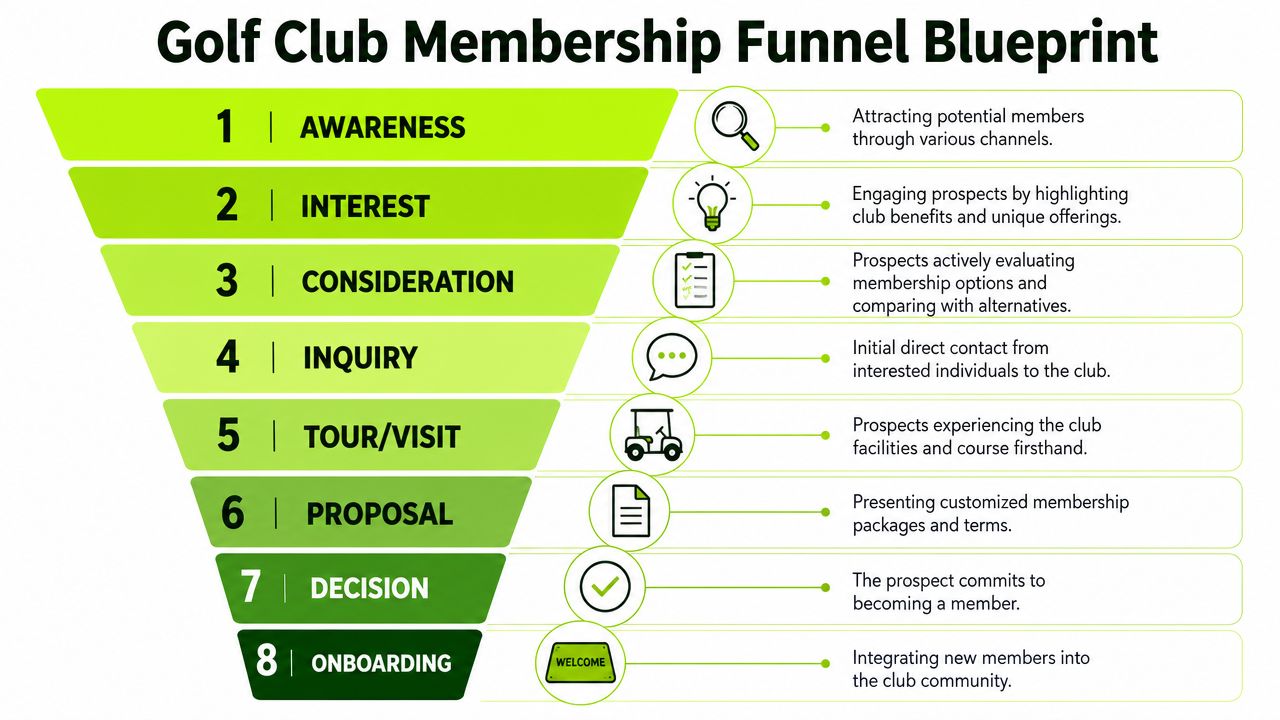
The eight stages that matter
The strongest golf club membership funnel has eight practical stages. Not theoretical stages. Operational ones that staff can follow and managers can inspect.
| Stage | What it means at a golf club | Main purpose | Key metric to watch |
|---|---|---|---|
| Awareness | A golfer sees your club through search, social media, local reputation, referrals, or a campaign | Create relevant visibility | Enquiry source quality |
| Lead Capture | The prospect fills in a form, sends a message, or calls the club | Turn attention into a trackable enquiry | Number of valid enquiries |
| Qualification | The club checks intent, timing, budget fit, playing habits, and membership interest | Separate serious prospects from browsers | Qualified lead rate |
| Nurture | Follow-up emails, texts, and calls keep momentum going | Move interest towards a booked visit | Lead-to-visit progression |
| Visit | The prospect tours the course, clubhouse, and practice areas or attends a taster session | Prove fit in person | Visit attendance |
| Sign-up | Membership options are presented and the joining decision is made | Convert the prospect | Visit-to-member conversion |
| Onboarding | The new member is welcomed properly and shown how to use the club | Reduce early drop-off and uncertainty | Early engagement |
| Retention | Ongoing experience, communication, and integration into club life | Keep members for the long term | Renewal outcome |
Two stages clubs usually blur together
Most clubs are reasonable at Awareness and Lead Capture. They can run adverts, post on social media, or collect an online form. The trouble starts when they treat every enquiry the same.
Qualification and nurture are where the funnel stops being passive. Staff need to know whether the person wants a 7-day membership, a flexible route in, or for pricing information. They also need a system that keeps moving even when the office is busy.
A pipeline should show what happens next, not just what happened already.
That is why a visible pipeline matters. When stages are clear, managers can spot whether the issue is poor qualification, weak tours, or missing follow-up. If you want a practical view of how clubs structure this, GolfRep's overview of a golf club sales pipeline is useful because it frames membership sales as a managed process, not a loose collection of enquiries.
Why this framework changes decisions
An eight-stage funnel changes how a club allocates time. Instead of asking, "How many leads did we get?", the team starts asking better questions:
- Where are leads stalling?
- Which prospects are qualified?
- How many visits are being booked from real interest?
- What reasons are appearing when prospects don't join?
That's the shift from hopeful marketing to controlled growth. Clubs don't need every prospect to join. They need a system that consistently moves the right prospects through the right steps.
Fuelling the Funnel With a Channel and Offer Strategy
Channel choice matters, but not in the way most clubs think. The aim isn't to be everywhere. It's to bring in prospects who are suitable for the club and likely to take the next step.
That means two decisions need to work together. First, where the enquiry comes from. Second, what offer gets the person to respond.
Meta versus Google for membership enquiries
For most clubs, paid social and paid search play different roles.
| Channel | Strength | Weakness | Best use |
|---|---|---|---|
| Meta ads | Lower-cost top-of-funnel reach and strong local targeting | Can attract casual curiosity if the offer is weak | Generating local interest around a clear first step |
| Google Ads | Captures active search intent | Usually more expensive per enquiry | Picking up bottom-of-funnel demand from people already searching |
For UK golf clubs, Meta leads average £17.60 while Google Ads cost £55 or more per enquiry, so Meta is roughly one-third of the cost for filling the top of the funnel. The same source notes that trial or taster day programmes can convert at 60–70% from trial to member, which is why lower-friction entry offers outperform a hard sell to annual membership in many cases (GolfRep membership ideas).
That doesn't mean Google is wrong. It means clubs should be realistic. If budget is limited, broad Google campaigns can become expensive admin generation. Meta often gives clubs more room to test messages, local audiences, and offers without forcing every prospect to decide on a full annual commitment immediately.
The offer usually matters more than the advert
A weak offer creates weak leads. If the ad asks someone to commit to a full annual membership before they've seen the club, many will hesitate or ask for price only.
Offers that tend to work better include:
- Taster days: lower commitment, easier first yes
- Hosted tours: useful for prospects comparing clubs locally
- Flexible starter routes: helpful for golfers unsure how often they'll play
- Experience-led invitations: course preview, clubhouse introduction, or beginner-friendly open sessions
The advert gets attention. The offer determines who replies.
Clubs frequently overspend and under-convert. They promote membership categories before they've built enough trust for the prospect to choose one.
Quality beats broad reach
A practical channel strategy should filter for fit, not just volume. The ad copy, form questions, and landing page should make it easier for the right prospect to enquire and easier for the wrong one to self-select out.
A sensible place to compare approaches is this guide to the best way to advertise golf club membership. The useful lesson isn't that one channel always wins. It's that clubs get better results when the channel and the first offer match the buyer's level of intent.
If somebody has never visited your club, "join now" is often too big a leap. "Come and experience the club properly" is usually a better first move.
Building Your Conversion Engine With Systems
Manual follow-up feels personal until the office gets busy. Then it becomes patchy, slow, and dependent on whoever happens to be available.
That is why conversion systems matter more than good intentions. A club can have strong demand and still lose memberships because nobody owns the process after the enquiry arrives.
The cost of handling leads manually
Clubs without a structured enquiry response system often see conversion rates 30–50% lower than clubs using CRM-powered workflows, and effective funnel management needs visibility across stages such as New, Contacted, Qualified, Booked Visit, and Joined so teams can see where prospects are dropping out (The Revenue Club case study).
That drop happens for ordinary reasons:
- Emails are missed: especially outside office hours
- Calls are delayed: the prospect's interest cools
- Notes stay with one person: others can't pick up the conversation properly
- No loss reason is recorded: the club keeps repeating the same mistakes
What a working system actually needs
A useful CRM for golf clubs doesn't need to be complicated. It needs to make the next action obvious and visible.
At minimum, the system should do four jobs:
- Capture every enquiry from forms, calls, and campaigns into one place.
- Assign ownership so one person is responsible for the next step.
- Trigger immediate acknowledgement so the prospect isn't left waiting.
- Show stage movement so managers can inspect performance without chasing staff for updates.
One operational tool can help. GolfRep offers a pipeline and automated follow-up system designed for golf club membership enquiries, with visible stages and instant first-response workflows. Used properly, that kind of setup reduces the reliance on inboxes and memory.
Speed and visibility are the real advantages
The value of a system isn't the software itself. It's what the software enforces.
If a lead has no next action scheduled, it is already slipping out of the funnel.
Clubs need staff to see, at a glance, which enquiries are new, which have been contacted, which are qualified, and which are waiting for a booked visit. When that view is missing, managers rely on anecdotes. When it's present, they can coach the process.
A lot of clubs still treat membership follow-up as a courtesy task. It isn't. It's a revenue process. The club either runs it with discipline or accepts unnecessary leakage in the middle of the funnel.
From Lead to Tour The Art of a Nurture Sequence
The strongest funnels don't rely on one phone call and a brochure. They use a sequence that keeps momentum alive until the prospect either books a visit or clearly opts out.
Many golf clubs underperform by responding once, then going quiet. The prospect is interested, but not ready to decide immediately. Without a proper nurture sequence, that interest fades.
A good example comes from Astbury Golf Club. A targeted campaign generated 71 leads and converted 21 into new members, a 29.6% conversion rate, showing that a structured mid-funnel process can push enquiry-to-member conversion close to 30% when the lead handling is organised (Astbury Golf Club case study).
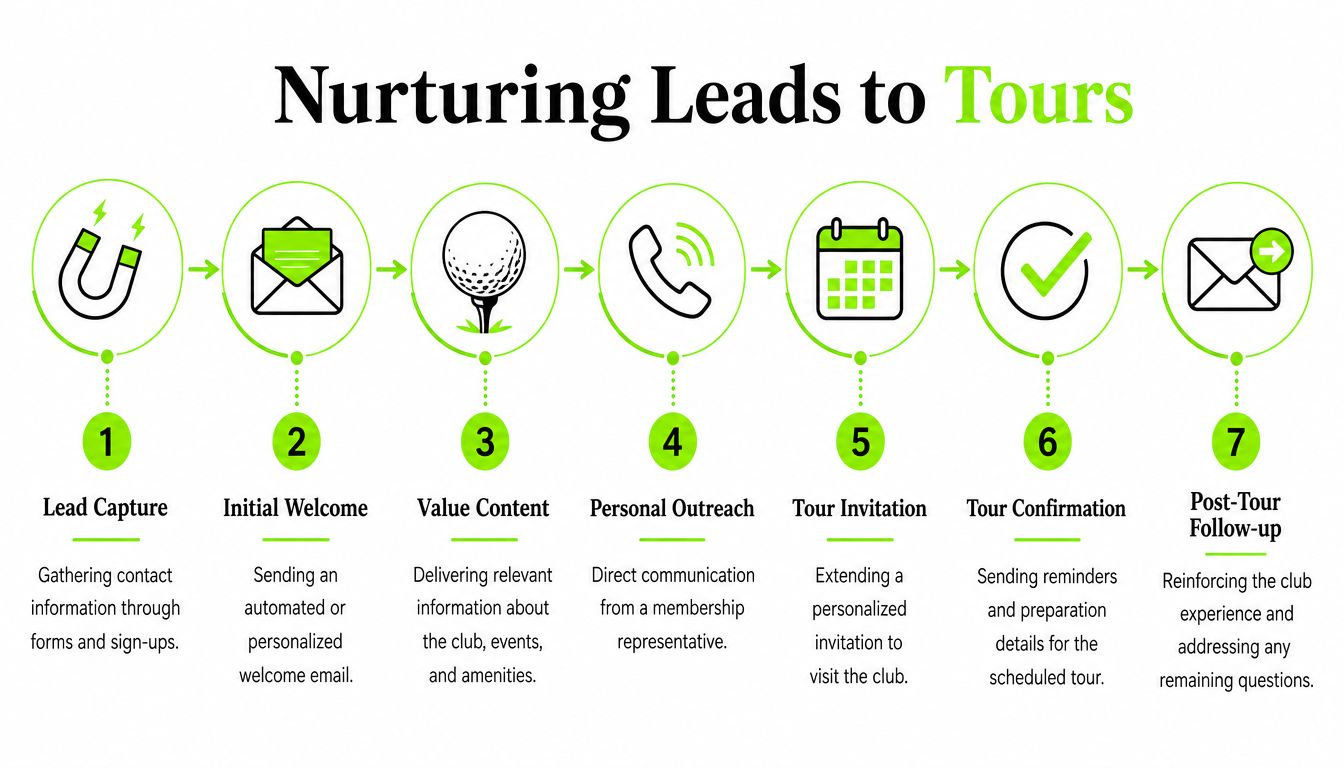
What a practical nurture sequence looks like
The purpose of nurture isn't to flood inboxes. It's to reduce uncertainty and keep the next step simple.
A straightforward sequence often includes:
- Immediate welcome email: confirms the enquiry and explains what happens next
- Short text message: gives a named contact and makes the club feel responsive
- Follow-up email with relevant membership information: adapted to the specific interest shown
- Personal call or message: invites the prospect to visit
- Reminder and confirmation: once a tour is booked
- Post-visit follow-up: answers final questions and helps the prospect decide
The messaging should change based on context. A golfer asking about 7-day membership needs a different conversation from someone who wants a first introduction to the club.
Example messages that move people forward
Here is the kind of tone that works.
"Thanks for your enquiry. I've received your details and I'll send over the most relevant membership options shortly. If you'd like, we can also arrange a visit so you can see the course and clubhouse properly."
A later follow-up might say:
"You mentioned you're comparing a few clubs locally. The easiest next step is to come in for a tour and talk through which category would suit how often you play."
And after a visit:
"It was good to meet you today. Based on how you described your playing habits, the option we discussed looks like the best fit. If you'd like, I can send the joining details and answer anything that came up after the visit."
That sequence works because it does three things well. It acknowledges interest quickly, keeps the communication relevant, and repeatedly points the prospect towards one clear action.
Automation helps, but relevance matters more
Some clubs worry that automation will feel robotic. It won't if the sequence is built properly. Automated timing with human-sounding messages is usually far better than no follow-up or inconsistent follow-up.
For clubs refining that approach, Voicedial.ai's lead conversion guide is worth reading because it focuses on timing, consistency, and practical follow-up discipline rather than vague nurture advice.
The aim isn't to pressure the prospect. It's to make the club easy to buy from.
Measurement and Mastery How to Optimise Your Funnel
Most clubs review the top of the funnel because that's what they can see. Enquiries in. Website forms in. Calls in. That isn't enough.
A golf club membership funnel improves when the club measures movement between stages, not just activity at the start.

The numbers that actually help managers
Not every metric deserves equal attention. A manager needs numbers that show where the process is leaking.
Track measures such as:
- Lead quality by source: which channels create serious conversations
- Lead-to-visit movement: whether qualified prospects are getting to a tour
- Visit-to-sign-up movement: whether staff are converting in-person interest properly
- Loss reasons: price, timing, category mismatch, or poor follow-up
- Pipeline ageing: which enquiries are sitting too long without action
Those measures help clubs diagnose the issue. If leads are coming in but visits are low, the offer, response speed, or qualification step may be weak. If visits happen but sign-ups stay soft, the tour experience or recommendation process may need work.
Where future gains are likely to come from
There is also a major measurement gap in the UK golf market. No specific funnel benchmarks exist for how juniors or women move from enquiry to signed member, which means clubs that start tracking those segments now will be in a better position to optimise for future growth (UK golf membership diversity gap).
That matters because clubs can no longer assume one membership journey fits everyone. A family enquiry, a junior pathway enquiry, and a woman returning to golf after time away may all need different messaging, different visit formats, and different onboarding.
The clubs that learn fastest are the clubs that tag leads properly and review conversion by segment, not just in aggregate.
A simple measurement framework also helps boards and committees make better decisions. Instead of debating whether "marketing is working", they can connect process data to outcomes and align marketing to revenue growth in a more disciplined way.
Mastery doesn't come from one campaign. It comes from repeated review, cleaner stage definitions, and a willingness to fix the part of the funnel that staff usually ignore.
If your club is generating interest but not turning enough of it into signed members, GolfRep helps build the systems behind the enquiry. That includes structured pipelines, faster follow-up, and practical nurture processes that give managers clear visibility from first contact to joined member.
Ready to tap into our proven growth system?