Growing Indoor Golf Membership: A Practical Playbook

Most advice on growing indoor golf membership starts in the wrong place. It tells venue owners to buy more advertising, widen their audience and create more awareness. That can help, but it doesn't solve the leak that usually sits between a simulator booking, an enquiry and a signed membership.
The UK already has a sizeable golf audience beyond traditional club golfers. A PGA-commissioned study reported that more than 16 million adults in the UK and Ireland played some form of golf in the past 12 months, including simulator golf, driving ranges, pitch-and-putt, adventure golf and full courses. The same source identifies an off-course audience of more than 11.4 million people, a much closer fit for indoor membership products than messaging aimed only at established 18-hole members. The indoor facilities strategy assessment provides that market context.
GolfRep works with clubs and venues on the practical part that follows demand generation, response speed, lead visibility, qualification, booked visits and retention. A venue can have a strong offer and still lose prospects if nobody owns the next action. This playbook treats growing indoor golf membership as a conversion system, not an advertising contest.
The Real Bottleneck in Indoor Golf Membership Growth
The popular diagnosis is that indoor golf venues need more golfers. The more useful question is what happens to the golfers who have already shown interest.
UK golf clubs take an average of 47 hours and 32 minutes to respond to membership enquiries, according to GolfRep's analysis of the golf club sales process. That delay creates a serious operational disadvantage. A prospect who enquires during an evening session may be comparing several venues before the next working day begins.
The first five minutes deserve different treatment. GolfRep's enquiry management playbook calls this the “golden window” and recommends service-level clocks, alerts when an enquiry has no owner, same-day calls and timed reminders. The principle applies directly to indoor venues, where the initial enquiry often concerns a specific bay, technology platform, taster session or membership option.
Find the leak before buying more traffic
A venue receiving 200 enquiries each month doesn't have one pipeline. It has a sequence of handovers, and every handover can lose intent.
| Pipeline Stage | Typical Conversion Rate | Main Leakage Cause |
|---|---|---|
| Enquiry received | Not established until tracked | Web forms, calls or walk-ins aren't recorded consistently |
| First response | Not established until tracked | No owner, slow reply or missed evening contact |
| Visit or taster booked | Not established until tracked | No available slot options or unclear next step |
| Visit attended | Not established until tracked | Weak reminders, inconvenient timing or poor handover |
| Membership joined | Not established until tracked | Offer doesn't match usage, price-led conversation |
| First repeat visit | Not established until tracked | Welcome email replaces a proper onboarding process |
The table deliberately avoids invented conversion assumptions. A venue should measure its own rates rather than copy a benchmark that may describe a different location, offer or audience.
Practical rule: If the team can't identify the source, owner, last contact and next action for every open enquiry, more advertising will usually make the problem harder to manage.
Retention reinforces the point. Players 1st survey analysis found that 57% of golfers in their first year of membership were likely to still be members, compared with 67% of those who had belonged to a club for more than six years. Younger golfers were harder to retain, with 43% of 18 to 30 year olds expecting to remain members in two years, compared with 67% of those over 66. Bioy Research summarises that evidence. The first 700 days aren't an afterthought. They're where the venue earns the right to keep the member.
Defining Your Local Indoor Golf Audience
Demand is rarely the first constraint on indoor golf membership. The harder problem is converting existing interest into a relevant conversation, then following up with an offer that fits how people play. A 15-minute drive radius can contain several distinct audiences, each with its own trigger, objection and route to membership.
Start with evidence already held by the venue. Review ClubV1 records, postcode data, simulator booking history, lesson enquiries, event bookings and membership cancellations. The aim is not a perfect market model. It is to identify local people who already have a relationship with golf, then find behaviours that suggest they would value recurring indoor access.
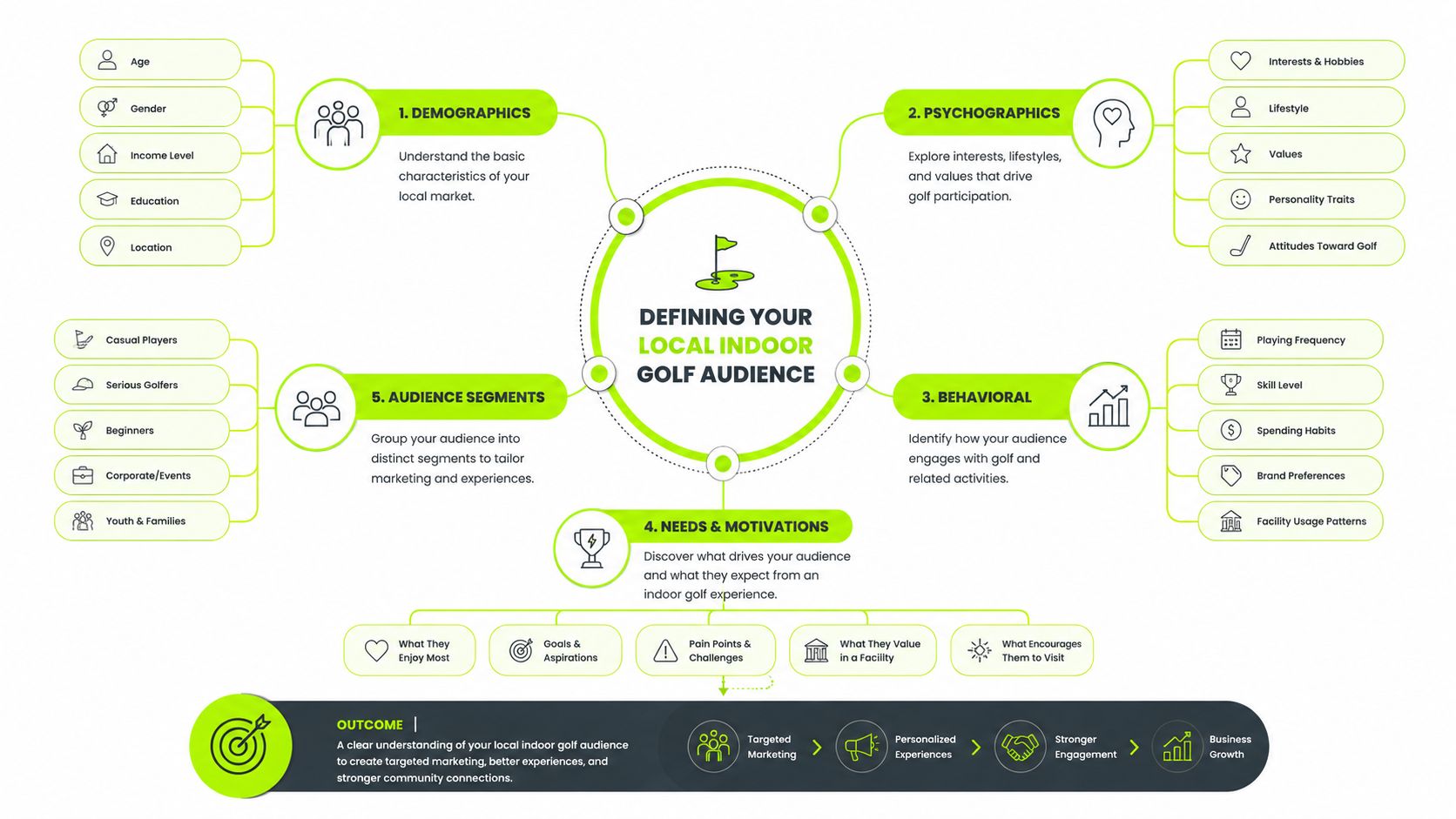
Three audiences deserve separate treatment
Ex-club golfers may have left because traditional membership no longer fits their schedule, budget or playing habits. Lead with reliable access, consistent practice, handicap maintenance where relevant and off-peak value. Indoor membership should be positioned as a format that removes friction, not as a cheaper imitation of a full club.
Simulator-first casual players usually respond to convenience, social play and technology. TrackMan or Foresight sessions, virtual course play, leagues and booking around work can give them a clear reason to return. Their first conversion step should generally be a session or taster, followed by a specific membership recommendation once staff understand their usage.
Corporate and social bookers already see the venue as an experience. A team event, league invitation or member-led taster can introduce recurring play. The individual conversion often follows when they see indoor golf fitting a weekly routine rather than remaining an occasional group activity.
Create a one-page profile for each segment. Record the trigger event, likely objection, preferred channel, qualifying offer and next action. Useful triggers include relocation, a new job, a partner taking up golf or reduced outdoor playing availability. This makes follow-up more precise and shows staff which prospects deserve a call first.
Teams building a more disciplined audience model can use this guide to market segmentation as a practical framework. Broad targeting puts mixed intent into the same queue, so staff spend time qualifying people who need different offers.
Match the channel to the behaviour
Use Google Ads for active searches such as simulator sessions, indoor golf, launch monitor practice or local golf experiences. Meta Ads suit defined local groups when the creative centres on a taster, league or social session. Local press and community partnerships can reach family, corporate and new-player audiences, provided each activity has a trackable landing page or named booking route.
Then compare channels by the quality of the resulting pipeline. The useful question is which source produces prospects who book, attend and return, not which one delivers the cheapest click.
Building Campaigns That Send Qualified Indoor Golf Enquiries
A good indoor campaign qualifies through the offer. A weak campaign collects attention and leaves staff to work out what the person wants.
Begin with one audience, one promise and one action. An ex-club golfer might see an offer centred on handicap maintenance and off-peak range access. A simulator user may respond to TrackMan or Foresight play. A corporate booker needs a team event package with clear group logistics, not a generic membership brochure.
Build the campaign around a useful first step
Lead form advertising should invite a simulator taster session or a free first-month trial only when the economics and eligibility are clear. A brochure download creates a soft enquiry that often needs significant qualification. A bookable experience gives the venue a reason to call, a time to discuss and a way to observe intent.
Build a dedicated landing page for each audience. Keep the form short, with one qualifying field beyond contact details, such as preferred playing time, current golf format or whether the visitor is enquiring for a group. Send every submission into the CRM with a source tag, campaign name and audience label.

Judge quality, not volume
Meta Ads can be useful for local awareness and defined audience testing, while Google Ads captures existing intent. Local press is more difficult to optimise, so use a dedicated landing page, phone number or offer code and record the resulting visits.
Campaign teams that need a broader framework for data-driven lead generation should focus on the complete path from source to outcome. The relevant measure isn't how many people clicked. It's whether the source produced a qualified conversation, a booked visit and a member who uses the venue.
Use GolfRep's guide to golf club Facebook Ads when planning Meta campaigns, but don't let platform setup become the project. The landing page, CRM routing and response ownership matter just as much as the creative.
A simple campaign structure might include:
- Ex-club golfer campaign: Promote flexible access, practice consistency and off-peak availability.
- Simulator player campaign: Show the technology, booking experience and social formats available.
- Corporate campaign: Present a straightforward event package with capacity, timings and follow-up options.
The venue should know what happens after every form submission before the campaign launches. If the answer is “someone will check the inbox when they can”, the campaign isn't ready.
Speed to Lead at an Indoor Golf Venue
It was a Friday evening at a six-bay venue. Four TrackMan enquiries arrived between 18:00 and 21:30 while one staff member managed the bar, checked bookings and helped customers in the bays.
In the manual version of the evening, the enquiries sat in an inbox. The first reply went out after the shift, another the next morning and the remaining two after the weekend. The messages were polite, but they didn't offer specific slots, explain the membership route or create a clear reason to visit.
In the structured version, a shared inbox created an owner and a 15-minute response SLA for every new lead. A templated first reply offered suitable booking windows, explained what a taster included and asked one qualifying question. If the prospect didn't respond, the system created the next task instead of relying on memory.
The first message should remove uncertainty
A useful first response answers three questions:
- What can I book? Offer specific slot options rather than asking the prospect to suggest a time.
- What will it cost? Present the relevant pricing tier or explain how the taster leads into membership.
- What happens when I arrive? Describe the bay, technology, session length and who will meet them.
Move from SMS or email to a phone call when the prospect has shown buying intent, has asked a detailed question or has opened several messages without booking. The call shouldn't repeat the brochure. It should resolve the remaining barrier and secure the visit.
| First Response Time | Booking Conversion Rate | Lost Enquiries |
|---|---|---|
| Within 15 minutes | Track venue baseline | Track venue baseline |
| Same operating hour | Track venue baseline | Track venue baseline |
| Four hours or more | Track venue baseline | Track venue baseline |
| Next working day | Track venue baseline | Track venue baseline |
The table is a measurement structure, not a fabricated performance claim. GolfRep's UK analysis records the average response delay cited earlier, while its enquiry management guidance sets out the practical controls needed to shorten it.
Part-time staffing doesn't remove the need for coverage. An out-of-hours rota, shared inbox and approved reply templates can protect the first response without asking one person to be permanently available. Operators exploring how to monitor customer intent across channels may also find local social listening for contractors useful as a broader example of structured local enquiry monitoring.
CRM and Automations for Indoor Membership Pipelines
Indoor membership growth often stalls after the enquiry arrives. A CRM should make the next action obvious: where the contact came from, who owns it, what decision is pending, and whether the person booked a visit or joined.
Put every route into one pipeline, including website forms, Meta lead ads, phone calls, walk-ins and questions raised during simulator bookings. Tag the source at capture. Reconstructing campaign details later creates unreliable reporting and weak follow-up.
Build the nurture flow around decisions
A practical sequence can follow the prospect's likely buying questions:
- Within five minutes: Confirm the venue received the enquiry and offer the next available action.
- At hour one: Ask the question that determines the suitable package or session.
- At hour four: Suggest relevant slots and provide a direct booking route.
- At day two: Explain a useful detail, such as how a launch monitor session works, what leagues involve or how indoor access supports practice.
- At day seven: Make a final personal follow-up before moving the contact to a longer-term list.
Use an SMS prompt when an important email remains unopened, but set clear stop rules. End the sequence when the prospect books, replies, opts out or becomes a member. Create a staff task when the contact shows buying intent, for example by choosing a preferred slot or asking about recurring access.
The CRM should record the reason for each follow-up, not merely send messages. A prospect asking about evening access needs a different response from someone comparing casual sessions with membership.
Make the CRM useful during quiet hours
Part-time cover still needs a defined process. Outside staffed hours, an automatic acknowledgement can confirm receipt, offer a booking link and assign the enquiry to the next available colleague. A second rule can flag any contact that has not received a human response within the venue's agreed SLA.
Bookings should be possible from the CRM where the systems allow it. Copying information between a form, spreadsheet, inbox and booking calendar creates avoidable errors and makes delayed responses routine.
Teams reviewing the wider role of these workflows can read this explanation of marketing automation in 2026. The technology supports follow-up discipline. It does not persuade someone to join or replace a well-run first visit.
GolfRep can fit this operating model through its CRM-enabled growth system, which receives, qualifies, assigns and progresses membership enquiries from first contact to booked visit and membership outcome. The venue still needs clear ownership, suitable packages and staff who deliver a good first experience.
Membership Packages That Convert Simulator Users
Indoor venues rarely lose simulator users because demand is absent. They lose them because the offer does not match how people play, or because the first purchase has no clear next step. Membership packaging should make the decision easy without creating a price list that staff cannot explain.
| Package Type | Best For | Conversion Strength | Margin Risk |
|---|---|---|---|
| Off-peak hours only | Flexible players and ex-club golfers | Strong where quiet capacity is available | Unclear rules can push demand into busy periods |
| Peak-inclusive | Dedicated players and regular groups | High for frequent users | Greater access cost and bay-utilisation pressure |
| Simulator-credit bundle | Casual and technology-led users | Connects payment directly to usage | Unused credits complicate forecasting |
| Pay-and-play with member rates | Hesitant prospects | Low-friction route into recurring value | Weak if the saving is too small |
| Family or couples tier | Shared households and social players | Works where visits are naturally shared | Booking and capacity rules need control |
Choose structure before discount
Off-peak membership can convert better than a blanket reduction because it protects peak capacity while giving the prospect a specific reason to join. Credit packages suit users who want recurring access but do not yet know whether they will visit every week. A pay-and-play member rate can bridge that gap, provided the difference between member and non-member pricing is obvious at the point of booking.
Rolling monthly options reduce commitment anxiety. A three-month trial tier can help hesitant users judge the product through real visits. Set a defined outcome before the trial starts, such as a review conversation or upgrade route. Otherwise, the trial becomes an indefinite discounted state and gives the venue little evidence about likely membership value.
Flexible packaging is becoming more common across UK golf. Hillier Hopkins' 2024/25 report says 40% of members' clubs and 64% of proprietary clubs offered flexible membership options, while 75% of members' clubs reported growth. The The Hillier Hopkins Golf Clubs Report provides the relevant market context.
The earlier Hillier Hopkins' survey coverage also shows an uneven market. Some clubs have strong demand and waiting lists, while others still need to replace leavers. Indoor venues should take the practical lesson rather than copy a club model: build packages around available bay capacity, local playing habits and the times the venue needs to fill.
Retention starts before the second booking
A welcome email is only one touchpoint. During the first visit, staff should set up the launch monitor profile, enter a handicap where relevant, explain the booking rules and secure a second visit before the member leaves. That booking gives the team a real usage signal and reduces the chance that the membership becomes an unused purchase.
Use behaviour to shape the follow-up:
- Day 7: The membership manager checks which simulator features the member used and answers a specific question.
- Day 30: The venue introduces a suitable playing group, league night or coaching pathway.
- Day 90: The team reviews visit frequency against package entitlement and discusses whether the package still fits.
- Quarterly thereafter: Contact reflects actual usage, not a generic newsletter.
The package should also make the next action visible. A member who uses credits quickly may need a larger bundle or peak access. Someone who books only quiet weekday slots may need an off-peak plan rather than a discount on a broader package. Someone who has not returned needs a personal call that addresses the barrier, not an automated promotion.
Avoid joining fees that hide the full commitment, confusing tier names and generous access that leaves no margin. Name packages by benefit and usage pattern, then show exactly when each one works. A prospect should be able to answer, “Which membership fits how I play?” without asking three staff members.
For the commercial design, this guide to creating golf club package deals offers a useful reference. The venue still has to test the structure against capacity, booking behaviour and staff workload. A package converts when its value is clear at purchase and its promised access remains practical after joining.
KPIs Every Indoor Golf Membership Team Should Track
A membership dashboard should reveal where enquiries stall, where visits fail to happen and where members stop using what they bought. Track the full route from first enquiry to attended visit, then connect it to package usage and renewal behaviour. Indoor venues often have enough demand. The commercial loss sits in slow follow-up, unclear qualification and poor visibility after the sale.
Targets must come from the venue's own baseline, capacity and package design. The table is an operating framework, not a set of verified market averages.
| KPI | Benchmark Target | Review Cadence |
|---|---|---|
| Enquiry-to-tour rate | 60% to 70% operating target | Weekly |
| Tour-to-join rate for qualified leads | 35% to 45% operating target | Weekly |
| Average response time on new web enquiries | Under five minutes during operating hours | Daily and weekly |
| Cost per qualified enquiry by channel | Establish baseline, then improve | Weekly |
| 12-month membership retention rate | Establish cohort baseline | Monthly |
| Visit frequency distribution | Track by package and cohort | Monthly |
| Package utilisation | Compare usage with entitlement | Monthly |
| Members flagged at risk before renewal | Increase early identification | Monthly |
GolfRep's CRM guidance recommends tracking lead visibility, communication history, pipeline management, average response time, enquiry-to-visit conversion and open pipeline value. The GolfRep CRM guide sets out how these measures show whether follow-up is timely and whether enquiries are progressing.
Assign one owner to each number
A metric without an owner becomes a report nobody acts on. The membership manager should own response time and joining conversion. The venue manager may own attended visits and package utilisation. A club secretary, finance lead or membership administrator can own retention reporting, provided the underlying data is complete and reviewed on a fixed schedule.
Weekly reviews should cover new enquiries, source quality, response time, visits booked, visits attended and memberships joined. Monthly reviews should examine visit frequency, package fit, early disengagement and renewal risk. Keep a reason code for lost enquiries and cancellations, such as price, timing, access or lack of confidence. That turns a disappointing result into a change the team can test.
The dashboard exists to direct attention. It does not exist to produce more charts.
A practical 90-day implementation
Days 1 to 14 are diagnostic. Audit enquiry sources, response times, conversion records and retention by cohort. Match every open lead to an owner and a next action. If the venue cannot reconstruct its pipeline, correct that before changing the website or increasing advertising.
Days 15 to 45 build the foundation. Connect lead-capture forms to the CRM, configure speed-to-lead alerts, write three nurture sequences and redesign the membership page around qualifying offers rather than a price list. One full-time owner should remain accountable for implementation, even when several departments contribute.
Days 46 to 75 are for controlled testing. Run two local audience tests in parallel. Review cost per qualified enquiry, response time, booked visits and attendance each week. Change the offer, audience or follow-up sequence before increasing spend. A low enquiry cost is not useful if the leads do not attend or join.
Days 76 to 90 consolidate what worked. Package the strongest offer, brief the front-of-house team on the tour script and set the retention rhythm from day seven through day 700. Record changes at the day 30, day 60 and day 90 checkpoints, including conversion, response time and member visit frequency.
England's affiliated golf-club membership rose by 89,797 in 2022 to 737,021, a 13.9% year-on-year increase from the February 2021 total of 647,224. England Golf also said membership had increased by about 100,000 since March 2020. England Golf membership reporting provides useful UK context. Interest exists, but an indoor venue still needs a quick, visible route from enquiry to attended session and membership decision.
A 2025 Golfshake survey found 86% of golfers were already club members, 30% said their club had a waiting list, and overall membership growth was up nearly 10 percentage points year on year. England Golf reported membership rising from 730,602 in 2024 to 750,071 in 2025, a 2.66% increase. Golfshake's 2025 membership analysis reinforces the practical priority for indoor venues: improve conversion among people already showing intent, including simulator users, instead of depending only on broad awareness campaigns.
GolfRep helps UK golf clubs and indoor venues connect lead generation with structured follow-up, CRM visibility and revenue tracking. Visit GolfRep to discuss how an indoor golf membership pipeline could work for your venue.
Ready to tap into our proven growth system?