Golf Club CRM: A Guide to Predictable Growth
Most golf clubs do not have an enquiry problem. They have a follow-up problem.
That distinction matters, because more traffic rarely fixes a broken response process. A club can run ads, collect forms, and post promotions all month, then still lose good prospects because nobody owns the next step, no one can see the pipeline clearly, and the details live in too many places.
A proper golf club CRM closes that gap. It gives managers, secretaries, and membership teams one place to see who enquired, what happened next, what still needs action, and which conversations are moving towards a visit or a join.
Why Most Golf Clubs Waste Their Enquiries
The biggest mistake clubs make is assuming the answer to slow membership growth is more enquiry volume. In practice, many clubs already get enough interest to move the needle, but they leak prospects through delay, handovers, and inconsistent follow-up.
A missed call, an unanswered email, or a form submission that sits in someone's inbox for two days can be enough to lose a warm lead. The problem is rarely that the golfer never cared. It is usually that the club made it too hard to respond quickly and keep the conversation alive.
The real leak is operational, not promotional
Practical rule: if a prospect has to wait for a reply, the club is already competing on weaker terms.
That is why enquiry tracking matters so much. A club can read more about that workflow in GolfRep's enquiry tracking guide, but the principle is simple. Every enquiry should have an owner, a status, and a visible next action.
Manual systems struggle here because they depend on memory. A secretary remembers one lead, the pro shop remembers another, and the committee member who forwarded the email thinks someone else handled it. By the time anyone notices the gap, the prospect has moved on.
The clubs that convert more enquiries usually do three things well. They respond fast, they keep all activity attached to one record, and they stop treating follow-up as an informal favour. That is not glamorous work, but it is where revenue leaks are plugged.
A golf club CRM is valuable because it turns enquiry handling into a repeatable process. It does not create demand out of thin air. It makes sure demand does not disappear between first contact and booked visit.
What a Golf Club CRM Does
A golf club CRM is a working record of every club relationship, not just a list of names. Used well, it gives staff one place to see the enquiry, calls, emails, agreements, and the full history without jumping between inboxes, spreadsheets, and handwritten notes.
Golfmanager describes that kind of record clearly, with calls, issues, agreements, booking or sale history, custom fields such as preferences, and attached documents stored in one profile, plus filtering by customer, author, or date range. That matters because it makes each step of the journey traceable instead of scattered across different systems.
What changes in the day-to-day workflow
Staff stop asking, “Has anyone dealt with this?” They can see it. A prospect who asked about membership yesterday can be flagged as waiting for a call. A society enquiry can sit in a pipeline with the latest email attached. A returning visitor can be identified before the conversation starts.
That visibility shifts the work from memory-based to task-based. If a lead is uncontacted, the CRM should make that obvious. If an enquiry has gone quiet, the file should show who last replied, when they replied, and what the next prompt should be.
For clubs that want to see how different organisations use CRM structure in practice, all Acrm customer stories is a useful place to study the variation. The stronger examples show that the goal is not a shared template. The goal is a clean record of what happened and what happens next.
A good CRM also supports segmentation without confusion. Staff can separate visitors from members, active enquirers from dormant contacts, and people who need a direct call from people who should receive a campaign. Done properly, that keeps response sharper and follow-up cleaner.
The useful test is simple. If a system helps the club see who needs action next, it is doing real work. If it merely stores names, it is a digital filing cabinet. For a wider view of why that matters commercially, see the real ROI of golf club marketing.
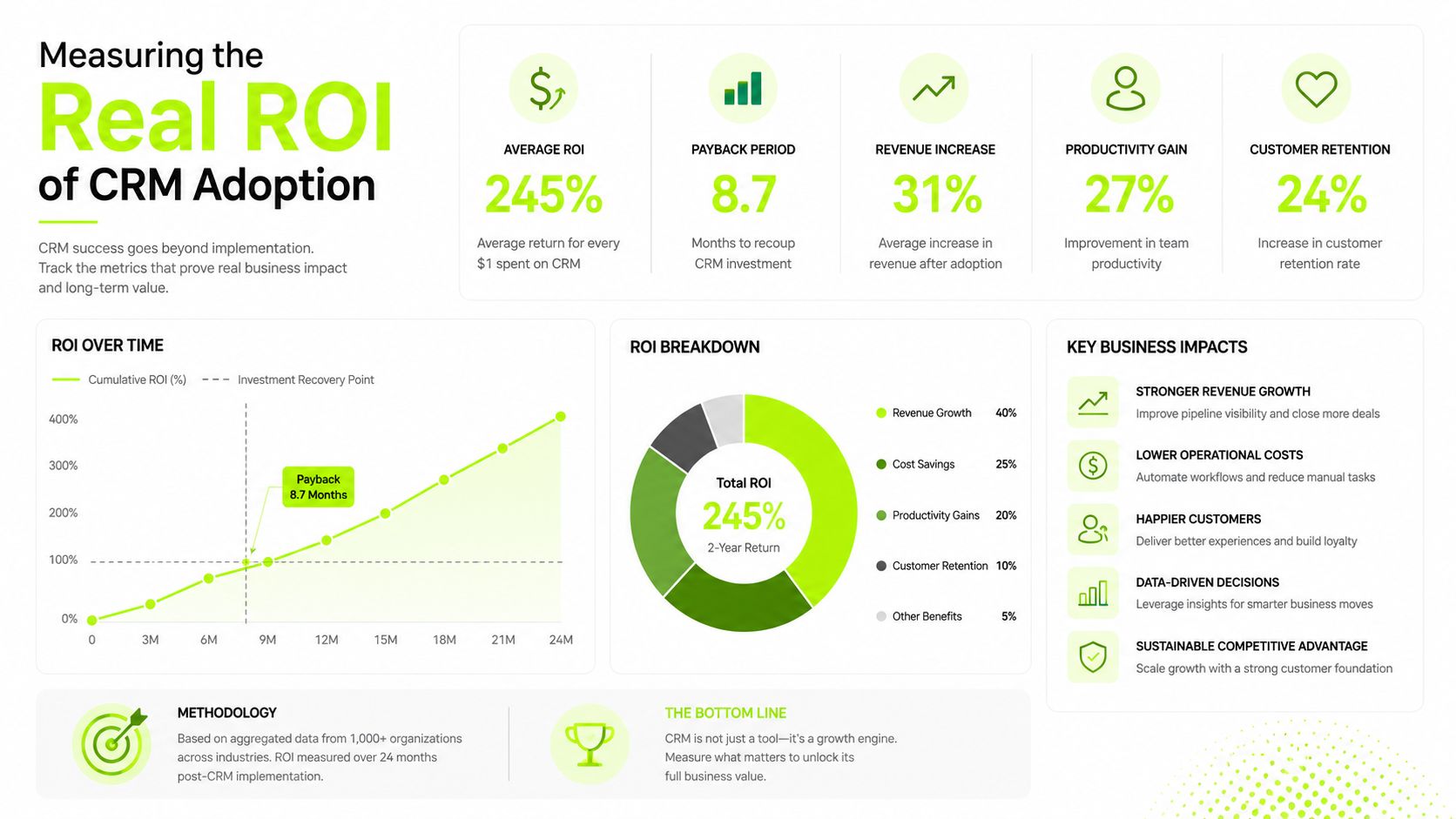
Measuring the Real ROI of CRM Adoption
The strongest UK evidence for CRM comes from clubs that treat it as an operating system, not a mailing tool. Get Golfing adopted HubSpot CRM in 2018 and, within four years, had built 160,000 contacts across 9 golf courses, while also reaching 5,500 members, over 100,000 unique visitors a year, £14 million+ in revenue, and nearly 4 million marketing emails sent in 2022. That case shows what centralised relationship management can support when membership, visitors, and campaigns are all managed together. It also used 30 HubSpot Sales Seats, which underlines that CRM only works when staff use it in day-to-day operations. Get Golfing case study
A second UK implementation shows the conversion side even more clearly. One club reported 86 enquiries, a £99,430 pipeline, and 23 deals worth £23,410 from January to August 2025. The same source also recorded a membership campaign that generated 53 leads, 9 new members, a 17% conversion rate, and 1,065% ROAS, plus a Meta campaign launched in August 2024 that delivered 415% ROAS. CRM campaign case study
What the numbers tell a committee
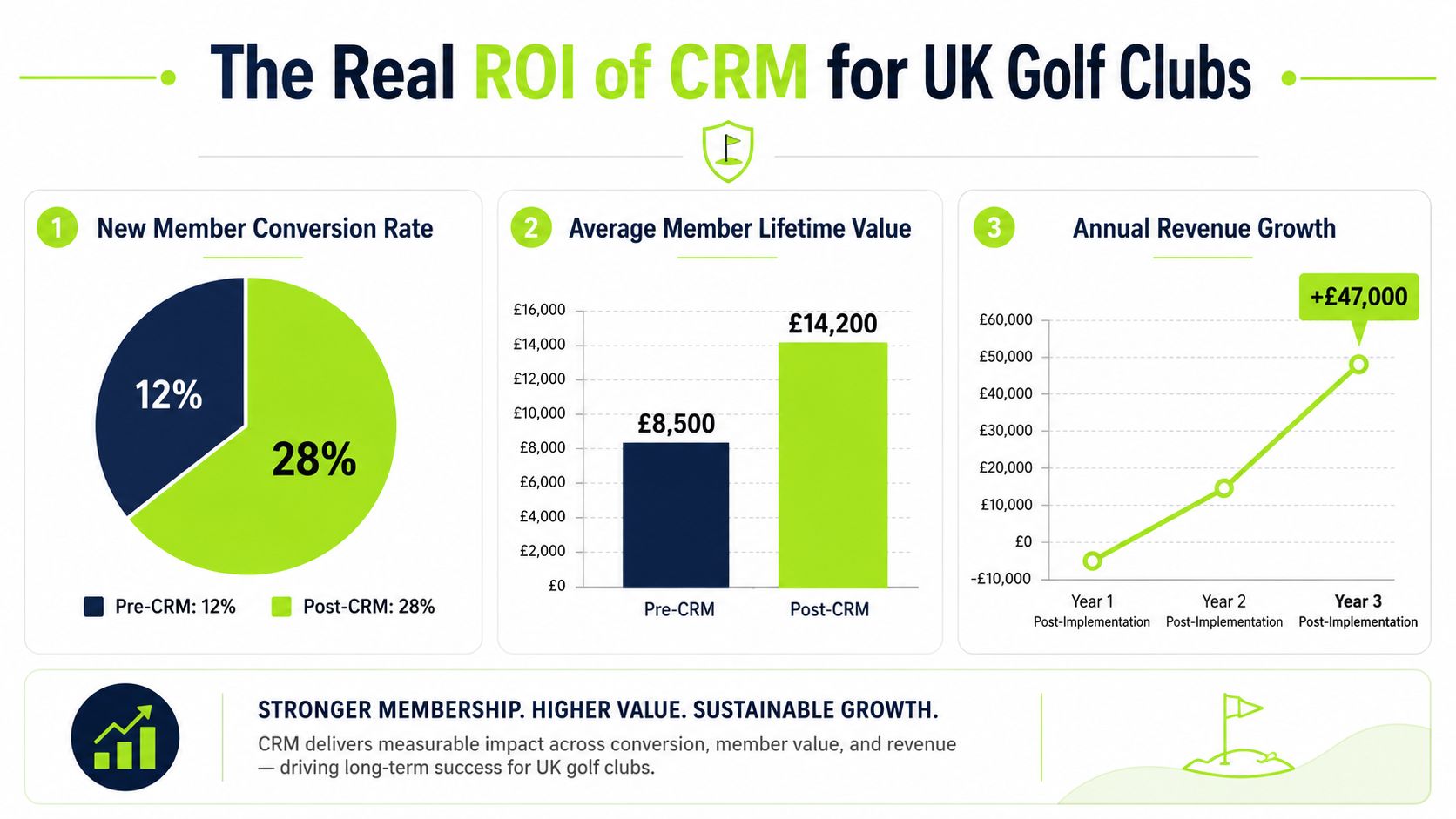
These figures do not mean every club should expect the same result. They do show that the return comes from better handling, better segmentation, and better follow-up, not just from more traffic. That is why the right comparison is not “did we get more enquiries?” but “did we convert more of the enquiries we already paid for?”
If you want a broader framework for evaluating payback, what is sales tech ROI is a useful reference point, because the same logic applies here. CRM spend should be judged against conversion uplift, pipeline clarity, and the time saved by staff.
For a club that wants a closer look at how marketing and CRM connect in practice, GolfRep's ROI article is relevant reading. The key point is that CRM earns its place when it turns enquiries into measurable revenue paths, not when it merely stores contacts.
Must-Have Features Versus Nice-to-Have Additions
Not every CRM feature is worth paying for. Clubs should start with the mechanics that move enquiries through the funnel, then ignore the extras that look impressive in a demo but rarely get used on a busy day.
Prioritise the functions that protect conversion
The essentials are straightforward. Lead tracking, immediate lead visibility, communication history, pipeline management, and reporting on response time and conversion rate. GolfRep's own CRM guidance says clubs need the enquiry, the stage, the messages sent, and the next action all in one place, because that is what makes follow-up consistent. GolfRep CRM guide
Other useful guidance from the PGA says CRM tools can track calls, email opens, website visits, and sales opportunities so staff can manage enquiries more efficiently. That matters because it turns response speed into a measurable operational issue, not a vague sales preference. PGA CRM guidance
Here is the practical rule. If a feature doesn't help a club respond faster, follow up cleaner, or see pipeline more clearly, it is probably secondary.
| CRM Feature Priority Matrix | Conversion Impact | Priority Level |
|---|---|---|
| Lead tracking | High, because every enquiry needs a visible owner and stage | Essential |
| Immediate lead visibility | High, because fast first response protects conversion | Essential |
| Communication history | High, because staff need context before replying | Essential |
| Pipeline management | High, because managers need to see where deals stall | Essential |
| Response time reporting | High, because it exposes delays and bottlenecks | Essential |
| Conversion reporting | High, because it shows whether follow-up is working | Essential |
| Email templates | Medium, because they help consistency once the process exists | Useful |
| Booking system integration | Medium, because it reduces duplicate entry and missed context | Useful |
| Payment processor integration | Medium, because it can connect sales to revenue collection | Useful |
| Social media dashboards | Low, because they rarely help with day-to-day conversion | Nice to have |
| Advanced AI scoring | Low to medium, unless the team actually uses it | Nice to have |
Integrations should be judged by operational value, not novelty. Booking systems matter because they stop staff retyping the same information. Email platforms matter because they keep communication attached to the record. Payment processors matter if they help tie an enquiry to a transaction without extra admin.
Choosing the Right CRM for Your Club
The right vendor for a golf club is rarely the one with the longest feature list. It is the one that handles GDPR, supports multi-site operations, fits the club's current systems, and gives staff enough structure to use it properly.
Ask about consent, data capture, and ownership
The PGA's customer segmentation guidance makes the expectation clear, clubs should use permissioned data, offer clear opt-ins, give customers control, and stay within privacy rules. That means the first vendor question is not “what can it store?” It is “how does it record consent, and who can see what?” PGA segmentation guidance
Committee-led clubs should also ask what gets captured at enquiry stage. Keep it practical. Name, contact details, source, interest type, and permission status usually matter more than an overly long form that puts people off. If the club cannot use the data in follow-up, it should not be collected at all.
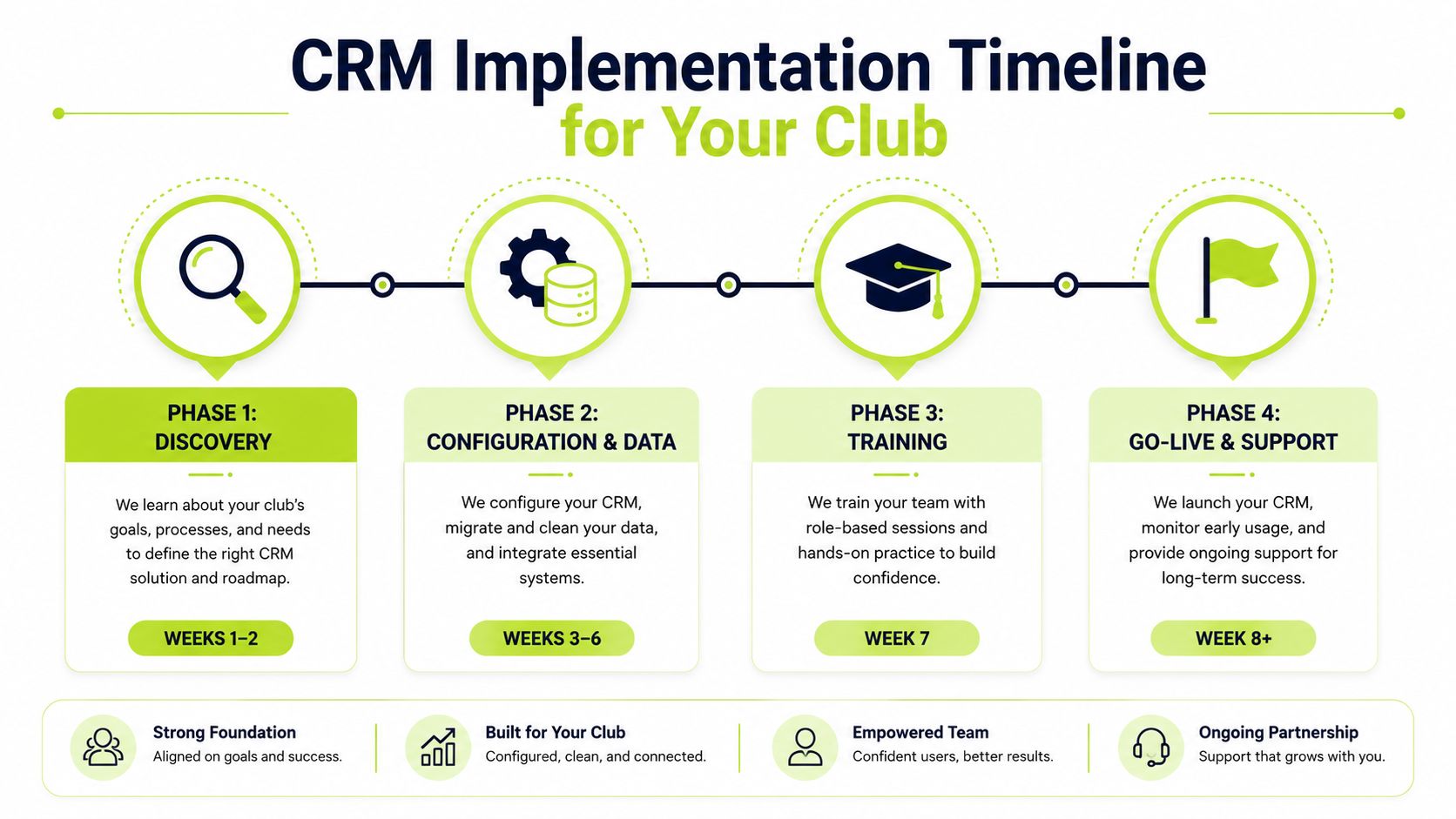
Multi-site operators need a different lens. Intelligent Golf CCL's onboarding flow starts with requirements discovery and configuration, then secure migration of members, handicaps, bookings, and competitions, followed by role-specific remote training and testing before go-live. That sequence protects data integrity while the live club keeps running. Intelligent Golf onboarding flow
Practical rule: choose the system that your team will adopt, not the one that looks most advanced in a sales call.
Cost also needs to be judged over 12 months, not just at signing. Clubs should ask about setup, training, support, user seats, and whether the provider helps with migration and ongoing process design. A cheaper tool that no one uses ends up being far more expensive than a well-supported one that gets embedded properly.
Implementing Your CRM Without Disrupting Operations
A sensible rollout starts with the club's live workflow, not the software interface. The discovery stage should map how enquiries arrive, who handles them, which data fields matter, and where follow-up currently breaks down. Once that is clear, configuration can match the way the club operates instead of forcing everyone into a generic sales process.
Migration should be controlled, not rushed
The strongest multi-site deployments treat data migration as a separate discipline. Members, handicaps, bookings, and competitions need to move securely, and permissions must be tested before anyone is asked to rely on the new system. That is how clubs preserve service quality during change.
Training matters just as much as migration. If front-of-house, membership, and management teams all see the same screen but use it differently, the club ends up with partial adoption and inconsistent records. Role-specific training solves that by showing each user what they need to do, nothing more.
Get Golfing's HubSpot rollout is a good example of what centralised CRM can support across multiple courses. The system became part of the operating layer, with sales activity, membership activity, campaigns, and contact management all running in one place rather than being split between branches. Get Golfing case study
A second useful implementation pattern comes from the Revenue Club's broader CRM case work, where clubs used CRM not just to store contacts but to manage enquiries, pipeline, and campaign follow-up. That shows why implementation should focus on habits, ownership, and reporting from the start, not on a long list of features. CRM case study
What good go-live support looks like
The club should expect live support during the first weeks, because small issues appear fast once real enquiries start moving through the system. Missing fields, broken automations, and unclear ownership are normal early risks. The difference is whether someone is there to fix them before staff go back to old habits.
GolfRep is one option that supports this kind of structured rollout, combining lead capture, pipeline tracking, and automated follow-up inside a single operating process. The important point is not the tool name. It is that the club gets a working process, not just a login.
Using CRM to Prevent Member Resignations
Most clubs focus on the moment someone enquires. Fewer clubs focus on the months before a member decides not to renew. That is where CRM becomes a retention tool rather than just an acquisition tool.
The simplest leading indicator is usage. One independent golf-industry source argues that clubs should track rounds-per-member and trigger re-engagement when activity drops, because lower play frequency often comes before resignation. That is a better retention lens than waiting for the cancellation email to arrive. Member engagement guidance
Re-engagement should start before frustration becomes resignation
A sensible CRM setup can flag members whose booking patterns fall away, then place them into a re-engagement flow. That might mean a personal call, a short check-in email, or a campaign that reminds them about booking options, competitions, or social golf. The point is to intervene while the relationship is still recoverable.
Segmentation matters again. A member who has not played much because of seasonal weather may need a different message from someone whose engagement has been declining for months. If the CRM cannot separate those cases, the club will send generic messages that miss the mark.
For a deeper retention framework, GolfRep's churn article is relevant because it treats inactivity as a signal, not a surprise. Clubs do not need perfect prediction to improve retention. They need a clear trigger and a process for acting on it.
The commercial logic is straightforward. Retention protects lifetime value, reduces the pressure to over-rely on new leads, and gives staff more time to work the right contacts. That is especially important in clubs with seasonal demand, where engagement naturally rises and falls across the year.
Tracking the KPIs That Matter
A CRM only helps if the club measures the right things each month. Vanity metrics such as total contact count tell you very little. The useful measures show whether enquiries are being handled properly and whether membership conversations are moving forward.
The dashboard should answer three questions
First, how fast are we responding? Second, how many enquiries move into visits or serious conversations? Third, what pipeline value is sitting open right now? Those are the figures that show whether the system is creating movement or just collecting data.
The PGA notes that CRM can monitor activity such as call connections, email opens, and website visits, which helps staff prioritise follow-up and time it better. That makes response visibility a management issue, not just a sales detail. PGA revenue guidance
A useful dashboard should also include average response time, enquiry-to-visit conversion, and total pipeline value, because those mechanics reveal whether follow-up is working. GolfRep's reporting approach focuses on those same measures, since they show managers where the process is healthy and where it is stalling. GolfRep CRM system guide
What committees should ask for each month
- Response speed: Are new enquiries being answered quickly enough, or are they sitting untouched?
- Pipeline value: How much membership revenue is currently in play?
- Conversion rate: Which enquiry sources produce real visits and sign-ups?
- Engagement flags: Which members or prospects have gone quiet and need a prompt?
- Task completion: Are agreed follow-ups being done?
A simple reporting pack is often enough if it is consistent. The club does not need a wall of charts. It needs a clear view of what happened, what is stuck, and who owns the next step.
For clubs that want the reporting side handled more systematically, automated reporting for agencies is a useful adjacent example of how regular performance visibility keeps teams accountable. The same idea applies here. If the committee sees the numbers every month, the CRM stops being a software purchase and becomes part of management discipline.
If your club wants enquiries turned into a predictable pipeline instead of a pile of missed chances, GolfRep can help you build the follow-up system behind it. Visit GolfRep to see how we combine lead generation, CRM structure, and automated nurture for UK golf clubs.
Ready to tap into our proven growth system?