Golf Simulator Franchise vs Independent: Which to Choose
A 2023 Golf IT Survey estimate put indoor-simulator provision at approximately 13% of UK golf courses, so about 87% did not offer one when that figure was taken. Participation sits well beyond the member roll. England Golf figures used in indoor-facility planning counted 12.6 million adults who played some form of golf in the previous 12 months, including 5.3 million on off-course formats such as ranges, adventure golf, simulators and Topgolf-style venues.
Treat the 13% as a course-level adoption signal, not a census of every commercial bay in the country. Plenty of demand can sit in a town whose clubs still have nothing indoors.
For a general manager, owner or PGA professional, golf simulator franchise vs independent is a utilisation and control decision. The same booked hours can clear their costs in one structure and miss them in the other once a royalty comes off every sale. We look at who sets the kit, who keeps the margin, and how many bay-hours you must sell before rent, staff and finance are covered. Neither model wins on every site.
Side-by-Side Comparison of Franchise and Independent Models
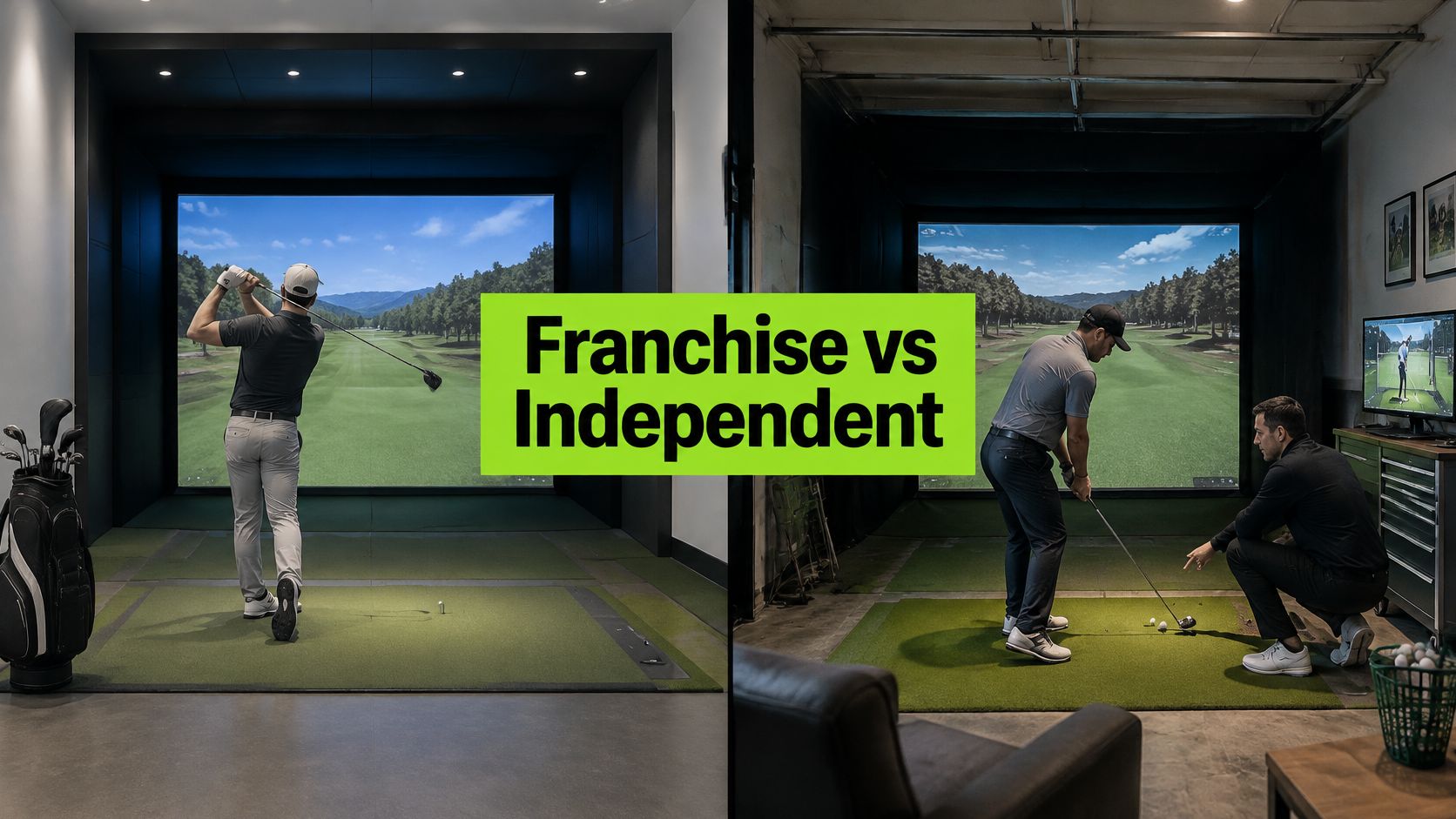
The models split on control, not on how accurately a launch monitor reads a seven-iron. A franchise sells a repeatable format. An independent operator builds one format for one catchment.
Credence Research valued the UK golf-simulator market at USD 157.58 million in 2024, and reported that indoor simulators represented more than 70% of UK installations that year. Indoor supply is already the larger slice. What is scarce is a site whose hours, price and local offer match the people who will book.
Before a national name is treated as the safer route, take time to weigh the risks of buying franchises as a buyer, not as a recruit. Fees, supplier lock-in and exit terms decide whether extra occupancy is yours to keep.
| Criterion | Franchise model | Independent model |
|---|---|---|
| Startup investment | Franchise fee plus fit-out to the franchisor's specification | Set by the operator; a quality commercial bay about £40,000–£70,000 all-in |
| Ongoing fees | Royalties and mandated supplier costs; obtain the fee schedule in writing | No royalty; software, support and maintenance chosen by the operator |
| Equipment and technology | Standard specification from approved suppliers | Free choice of launch monitor, software, layout and acoustics |
| Brand recognition | National awareness from opening day | Built locally through reviews, coaching, partnerships and word of mouth |
| Operational support | Training, opening procedures and a booking platform | Self-built rotas, staff training and processes |
| Marketing | Central campaigns and templates, with limited local freedom | Full control of local targeting; the operator funds and runs it |
| Flexibility | Bound by brand standards, territory rules and pricing guidance | High; pricing, formats, membership and layout can change |
| Break-even utilisation | Rises above the bare-hire band once royalties are taken on each sold hour | About 40%–50% for bare bay hire; about 18% for memberships, events and food and beverage |
Mark the rows that would change your plan. A club with a trusted local name may not need the brand row. A first-time operator may not cope without the support row. The next sections test cost and hours, not the brochure.
Costs, Royalties and Break-even Utilisation
Utilisation, the share of available bay-hours you sell, separates the two models more than simulator accuracy does. A venue that lives on bare bay hire needs a high share of those hours before it covers its costs. A venue that also sells memberships, corporate events and food and beverage can cover costs on a much smaller share of hours, because each visit throws off more than the hire fee.
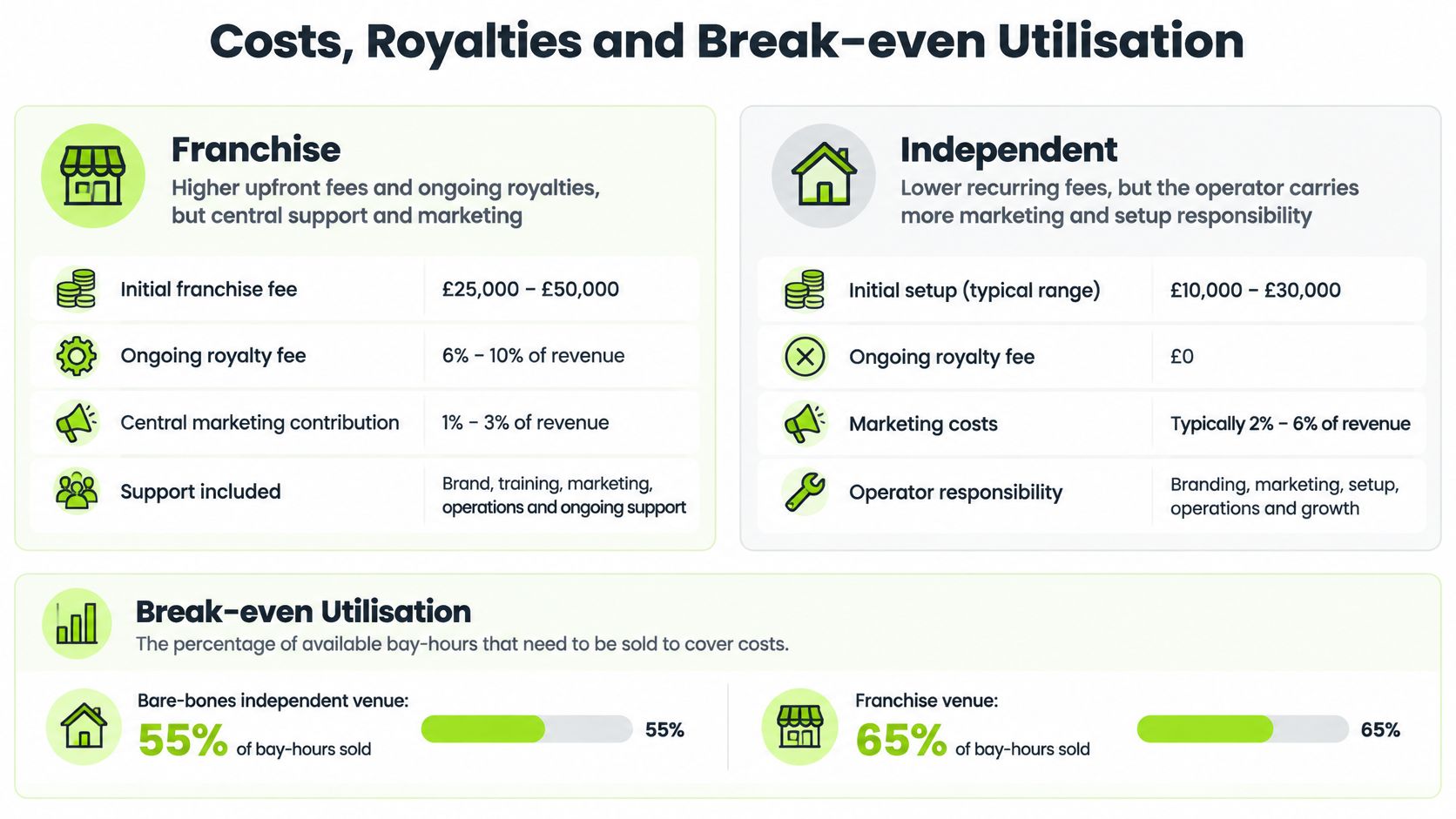
That split is why a royalty matters. It does not change how many hours the diary shows. It changes how much of each hour is left after the franchisor is paid. Two sites with identical bookings can sit on different sides of break-even.
The independent cost base
An independent venue's advantage is configurability. You pick the launch monitor, bay layout, software, acoustics, lighting and booking system for local demand, rather than taking a franchisor's standard specification. UK planning benchmarks published by GolfBays put a quality commercial bay at approximately £40,000–£70,000 all-in, covering launch monitor, enclosure, impact screen, projector, gaming PC, turf, installation and room preparation. The same benchmarks put premium commercial systems at £35,000–£60,000 per bay before broader construction.
That is a real capital hurdle, and it is also why staged expansion is available to an independent and often closed to a franchisee. Open two bays, prove the diary, then add a third. You are not obliged to fit a six-bay template on day one.
At a blended rate of roughly £40 per hour, one bay at 60% utilisation generating about £1,920 per week produces approximately £100,000 annual gross revenue before rent, staffing, software, maintenance, finance and VAT. Gross is not contribution. Rent and wages still have to come out.
The worked table below uses an illustrative 80 bookable hours per bay per week (about 11 to 12 hours a day). It is bay hire only, before any cost.
| Utilisation | Hours sold per week | Weekly bay-hire revenue |
|---|---|---|
| 18% | 14.4 | £576 |
| 40% | 32 | £1,280 |
| 50% | 40 | £1,600 |
| 60% | 48 | £1,920 |
How a royalty changes the same hours
Say a four-bay site hits the 60% row. Hire gross is 4 × £1,920, or £7,680 a week, before costs. A royalty, whether a percentage of revenue or a fixed fee, is then deducted from that gross, and mandated supplier pricing can lift the cost of screens, software and mats as well.
Practical rule: Divide total one-off cost by annual contribution per bay, then run the sum again with the franchise fee and the royalty included. If the second payback is the one you cannot live with, the brand has not earned its place.
Request the full fee schedule in writing before you compare quotes. A clear primer on franchise disclosure essentials for buyers shows the headings a proper disclosure should cover, including fees, supplier obligations and what you are buying. Do not model from a sales deck.
A franchise can shorten set-up uncertainty through a repeatable format. The independent keeps more pricing freedom, and more of the contribution, if local membership, coaching, corporate events and food and beverage are built properly. Price the hour for your own peaks and troughs first. Our notes on golf simulator bay pricing set out how a blended rate is built, which is the £40 in the example above, not a rate you should copy blindly.
The monthly numbers worth tracking
Independent ownership is sensitive to a local forecast. Each month, record:
- Booked bay-hours: Hours sold against hours available, split by weekday daytime, evening, weekend and winter.
- Realised hourly rate: Money taken divided by hours sold, after discounts, not the rate on the wall.
- Peak and off-peak mix: Whether the diary is only full from 5pm, which is where rent gets dangerous.
- Cancellation rate: Paid hours that never happen, because they still occupy the plan.
- Revenue per available bay-hour: Hire plus coaching, events and food, divided by hours you could have sold.
Add membership retention, coaching and fitting conversion, event revenue share, maintenance downtime, and payback after every franchise or software subscription. If a royalty means you need occupancy you have never seen in that postcode, cut the bay count or test demand before you sign.
Equipment, Technology and Brand Recognition Compared
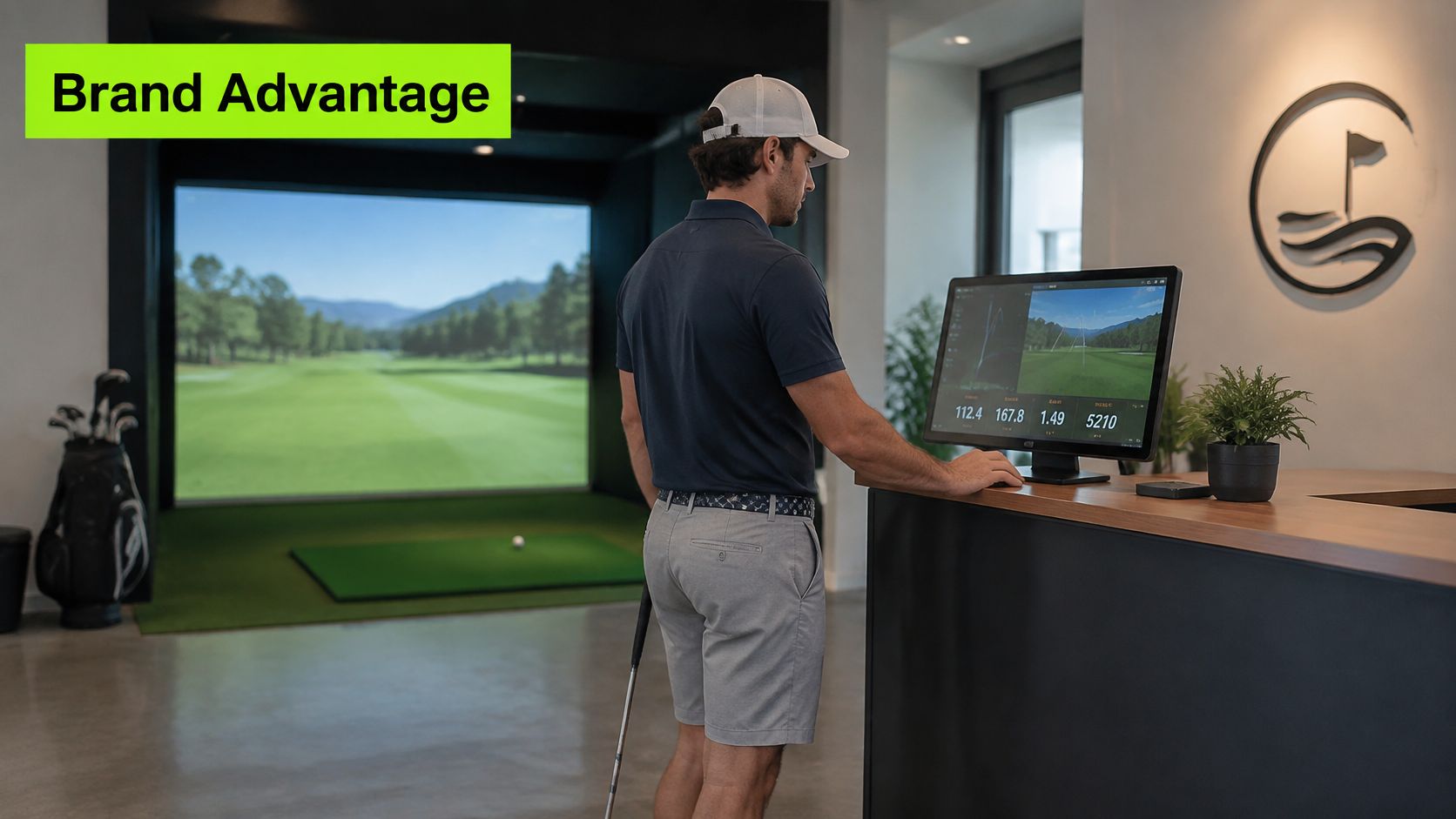
Brand recognition buys trial, not utilisation. A recognised franchise name can shorten the wait for a first booking in a town where nobody knows the site. Where golfers already trust the club on the door, the same name contributes little and still carries a royalty.
The simulator itself matters less than the job you give it. An independent can choose camera-based or radar launch monitors and run fitting-led sessions that record ball speed, launch angle, spin rate, spin axis, carry distance, club speed and club path. A generic franchise package may not be specified for that work, and an approved supplier list can block the unit your coach wants.
What you must run yourself
Choice only pays if someone on the team can use it. The operator has to validate calibration, train staff to deliver a fitting rather than press start, and store session data against each golfer's name. Without that record you cannot tell whether fittings become lesson blocks or memberships, so the hardware advantage never reaches the accounts.
Run a simple brand test before paying for awareness you may already hold. Search the catchment for the franchise name and for your own club or venue name, then check whether local golfers already book with you. A strong local name often gains more from an independent bay, priced as a member benefit, than from a second brand on the building.
Awareness can bring the first visit. The session, and what you do with the golfer afterwards, brings the second.
Whether the visit leads anywhere
Current industry thinking treats indoor golf, short courses and driving ranges as part of mainstream provision rather than a separate product, with pay-and-play visits measured as a pathway into longer-term play. Occupancy in month one is not the commercial test. The test is whether you hold first-party data, can separate golfers who came to practise from those who came for a night out, and can turn each visit into a lesson, a repeat booking or a membership.
Reporting supplied to the BBC by The R&A found that 82% of traditional golfers in Britain and Ireland had tried an alternative format, including simulators, pitch-and-putt and adventure golf, and that many simulator users mainly analyse swings, take lessons or play socially rather than complete virtual rounds. A franchise template built around full simulated rounds can miss that visit entirely. An independent club-linked bay can be aimed at lessons and practice, then judged on how many of those golfers go on to play the course.
Standard procedures help a franchise open consistently. They can also fix the session format and the supplier list before you have seen your own demand. Independents hold the freedom but often lack the follow-up habit. Whichever model you pick, judge the technology on repeat bookings and visits that convert to lessons, not on the launch monitor badge.
Operational Support, Marketing and Day-to-Day Control
Support is work. A franchise sells you someone else's version of that work. An independent has to do it with the people already on the rota. The better model is the one those people can run on a wet Tuesday in February.
What arrives with the brand
A typical franchise package includes staff training, opening procedures, a booking platform, central campaigns and brand templates. That package is useful when nobody on site has opened a simulator business before. The trade-off is that local action slows down. A society rate, a deal with a nearby employer, or a junior night with the county coach can need franchisor approval, and the national campaign may not mention your catchment at all.
Marketing funds deserve the same scrutiny as royalties. Ask what the fund buys, whether your own local spend counts towards it, and who signs off a Facebook post that names a rival club. Central creative is not the same thing as a full diary.
What you build if you stay independent
An independent site needs four systems before the first paid hour, not after the opening offers dry up.
- Booking and payment: One platform that takes the fee, blocks the bay and shows the daypart, so staff are not reconciling two diaries.
- A customer record: Every visit stored against a name, not a till total, so a coaching lead is visible a week later.
- A staff competency sheet: Who can calibrate, who can run a junior session, and who must not sell a fitting they cannot explain.
- A monthly utilisation review: A fixed hour in the diary, with the daypart split in front of the people who set next month's prices.
Growing the site after that is an operating rhythm, not a rebrand. The practical sequence sits in our guide on how to grow an indoor golf facility: fill the weak dayparts, then add memberships and lessons on top of hire.
Contract points to verify first
Use this list on the franchise offer, and as a mirror for an independent plan. It checks control, not the payback maths.
- Training hours and who delivers them. A PDF is not the same as a trainer on site for opening week.
- Approved suppliers and the penalty for going elsewhere. Often a cheaper screen or a preferred launch monitor is blocked.
- Marketing fund rules, and whether local spending counts toward any minimum.
- Territory exclusivity, and what happens if another site opens nearby.
- Exit, transfer and notice. The cost of leaving belongs in the decision, not in year three.
If the answers are vague, you do not yet have an operating model. You have a logo and a fit-out bill.
Choosing the Right Model by Situation
Choose the franchise when you need a proven format, structured training and central marketing, and you will accept fees for that speed. Choose independent when the catchment, the club name, or a coaching and fitting offer is already strong, and you need control of price and layout. If forecast utilisation sits below break-even after royalties, do not sign the large package. Reduce the bay count, or sell trial sessions before any fee or long lease.

As a planning band, a venue relying mainly on bare bay hire typically breaks even around 40%–50% utilisation, while a site where memberships, corporate events and food and beverage carry part of the cost can break even nearer 18%. Treat both as hurdles your own forecast has to clear after fees, not as promises that either model will reach them. The capital and running-cost lines behind that maths are set out in our guide on how to start a golf simulator business.
| Situation | Better fit | Reason |
|---|---|---|
| Multi-site group wanting one brand and central booking | Franchise | Standard procedures and central marketing cut set-up time across sites |
| Existing club with a strong local name and members | Independent | The trusted brand is already local, and the bay can be a member benefit with no royalty |
| Single site in an underserved town with limited capital | Independent | Staged bays keep fixed cost down and leave pricing under local control |
| First-time operator needing structured training | Franchise | Training and opening procedures shorten the learning curve |
| Venue built around coaching and fitting | Independent | Full control of calibration, fitting programmes and staff standards |
| High rent and uncertain demand | Neither until tested | Trial sessions and a demand survey come before any fee or lease |
The same bay-hours produce different outcomes under each model, because a royalty moves the break-even point upward while a recognised format can fill daytime slots faster. That is why this is a utilisation and control decision before it is a brand decision.
A multi-site group should weigh more than the simulator brand. One customer record across sites often matters as much as the bay supplier. We implemented a complete growth system across five Macdonald golf sites, integrating CRM, AI-driven follow-ups and automated nurture sequences. Within eight weeks, 118 new trial members joined and the group gained £23,500 in winter revenue. The commercial point is central visibility across the estate; a shared logo on the screens does little by itself.
A single club with a full member list should usually start independent and small, adding bays only when winter evenings are consistently full. A first-time operator with no coach and no database is the clearest franchise case, provided the royalty still leaves a contribution at a cautious occupancy rather than at the franchisor's mature-site projection.
Confirm the Numbers Before You Sign
Contract terms such as territory, exit rights and the marketing fund belong on the checklist you have just used. What follows is only the money. Run four checks on your own figures before you commit to either model.
The four checks
- Year one at a lower occupancy than maturity. Write a monthly ramp for bay-hours sold, not a single annual average. Test whether the site reaches bare-hire or diversified break-even once royalties, software and maintenance are inside the cost. The output is a month-by-month gap, in pounds, between revenue and cash costs.
- Utilisation by daypart, scored as months to payback. Separate weekday daytime, evening, weekend and winter. A diary that is only full after work will not support a high rent, however strong December looks. Divide one-off cost by monthly contribution and record the payback in months, with and without the royalty.
- Reporting by source, not by raw enquiry count. We recommend source-level reporting so you can see what came in, what happened next, and whether that source produced one booking or ongoing revenue such as a membership, a lesson package or a repeat hire. A franchise campaign that delivers one-off visitors at a high fee can lose to a quieter local coach list.
- A pre-opening review date and a trigger. Fix the date now, and fix the metric that forces a change. A workable trigger is utilisation below your target for three consecutive months, which then cuts the planned bay count or resets the price. Hoping the spring will fix a winter miss is not a trigger.
The decision at the end of those four checks is one of three: proceed, reduce the bays, or test demand with a pop-up or a single bay before any franchise fee or long lease. If the royalty case only works at an occupancy you have not evidenced, the honest result is the third option.
An outside review is useful when the people closest to the project are also the ones who want the project to happen. The first call with us is an open, strategic conversation, not a sales pitch. We look at the current setup, the goals and the constraints, and map what a growth system could look like around the bays you are able to fill.
GolfRep works with UK golf clubs and indoor facilities on the commercial system around the bays, from demand and pricing through to repeat bookings and membership. If you want your own hours, fees and site tested before money is committed, start with that open look at the current setup. Visit GolfRep when you are ready to see whether a franchise package, an independent build, or a smaller trial is the constraint to fix first.
Ready to tap into our proven growth system?