How to Write an Indoor Golf Facility Business Plan

You've found the unit, priced four simulator bays, and now a landlord, a lender or a committee wants a plan. The spreadsheet looks tidy. National golf numbers look encouraging. That is usually where an indoor golf facility business plan starts to drift, because those figures describe England, not your drive-time.
The plan's job is not to look complete. It has to prove three things. Enough local demand exists inside a realistic drive. The model still works at conservative utilisation, not at an optimistic average. Off-peak hours are filled by a product people will pay for, not by hope. What follows is a validation sequence: demand, revenue model, premises and costs, break-even, then the commercial system that fills bays.
What an Indoor Golf Facility Business Plan Must Prove
Borrowing England-wide participation and dropping it into a local forecast is the assumption that fails first. England Golf reported 1,815 affiliated clubs and about 722,000 members in 2024, and golfers submitted 10,213,894 scores through the World Handicap System, the highest annual total recorded at that point, according to England Golf's 2024 statistics. Score submissions rose by 811,712 on 2023, growth of 8.63%. Nine-hole scores rose 17.89% and general-play scores rose 13.67%. About 43% of scores came from social golf and 57% from competitions.
That pattern matters. It shows golfers already using flexible, social and shorter formats, which is the behaviour an indoor venue can serve. It does not tell you how many of those golfers will drive to your unit on a Tuesday morning.
Three tests the plan must pass
A committee or credit officer will not accept a narrative about "the golf boom". They will ask whether the document can survive these tests.
- Local demand, not a national story. The catchment is a drive-time, checked against club density, parking and who already offers indoor golf nearby.
- Conservative utilisation. Occupancy is modelled at levels you can defend when evenings are full and weekdays are not.
- A product for the quiet hours. Coaching, leagues, juniors, societies and corporate hire have to be specified, priced and staffed, not listed as "upside".
A 2023 Golf IT Survey estimate put indoor simulator provision at 13% of UK golf courses, reported via UK golf industry statistics. That figure covers member facilities at courses, not the whole commercial venue market, and it is a secondary statistic. It is still a useful benchmark. Most courses, at the time of that survey, did not offer members a simulator. The gap is an opportunity for winter usage and coaching capacity. It is also a warning. National participation does not convert itself into paid sessions.
Practical rule: If a line in the plan only works when every bay sells most of the day, delete it or replace it with evidence.
For private clubs and multi-site operators, the same tests apply with a different audience. Indoor golf is a year-round engagement and membership-acquisition asset, not a games room. The plan should show a path from a first indoor visit to a retained relationship, and it should show what happens if that path converts slowly.
Validate Local Demand Before Signing a Lease
A unit can look ideal on a Saturday tour and still fail to cover its rent from local bookings. Before signing, test whether nearby customers will pay for enough bay-hours across the week to reach break-even.
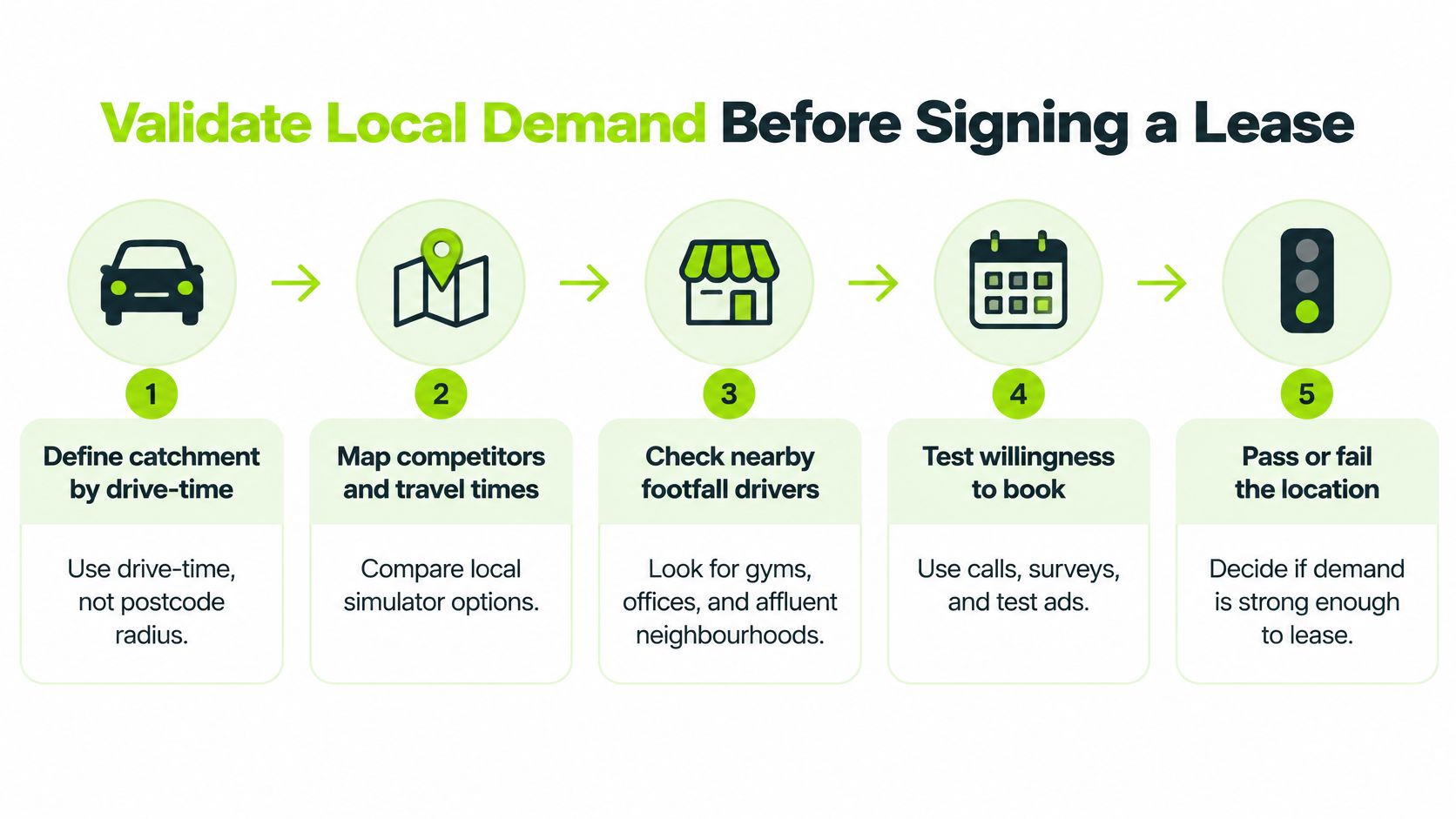
England Golf participation reporting counts 12.6 million adults who played some form of golf in the previous 12 months, including 5.3 million who used off-course formats such as driving ranges, adventure golf, simulators and Topgolf, as reported by England Golf participation coverage. These figures describe participation, not local willingness to pay or commercial simulator revenue. Use them as context, then test the catchment against the following checks.
The five checks
1. Map the catchment by drive-time. Mark 15- and 25-minute journeys, then account for rush-hour delays, parking and access with golf bags. A postcode radius can make a difficult journey look deceptively convenient.
2. Define customer segments. Separate casual players, existing club members, beginners, corporate groups and coached juniors. Estimate each group's likely booking times, session length and reasons to return. “Local golfers” is too broad to support a sales forecast.
3. Test willingness to pay with commitments. Questionnaire answers can show interest, but they do not prove customers will book. Seek deposits, paid trial sessions or founding memberships before treating demand as established. Keep any survey short and focused on past behaviour and likely spend. These survey design tips from Business Loan Warrior can help avoid leading questions.
4. Forecast by daypart. Separate weekday daytime, weekday evenings and weekends. A busy Saturday cannot cover fixed costs if weekday bays sit empty.
5. Calculate break-even bay-hours, then stress-test them. Start with rent, staffing and other fixed costs, then work backwards to the paid bay-hours required to cover them. Test low, base and stronger utilisation cases, and use local booking evidence to justify each one. Do not use a generic revenue benchmark: price, opening hours, VAT treatment and realised occupancy all change the result.
What counts as a pass
A pass means competitor checks reveal a specific gap, such as unavailable coaching slots or limited evening access, and local evidence supports the customer segments and prices in the forecast. Parking and access work for the intended customers. Before signing, seek tangible commitments through a paid trial, deposit or credible waitlist with a clear conversion path.
A fail is a national participation figure standing in for local demand, one average price applied to every time slot, or occupancy borrowed from a busier market. Do not sign a lease until the conservative case shows how the venue can reach break-even.
Choose a Business Model That Sells More Than Bay Hire
Hourly rental is the easy line to model and the weak one to rely on. The majority of simulator users reportedly use the format for swing analysis, lessons, or social play on famous courses rather than a conventional round, while 20% of virtual-golf usage is associated with course play and games, according to BBC Sport's reporting on indoor golf. A plan built only around 60-minute full rounds misses where the visits sit.
The same reporting notes that the first half of 2025 saw more than 5.75 million scores submitted to England's World Handicap System, up 29% year on year, including a 98% increase in April compared with April 2024. Engagement is expanding. That is not the same as demand for a long simulator session or a traditional club membership.
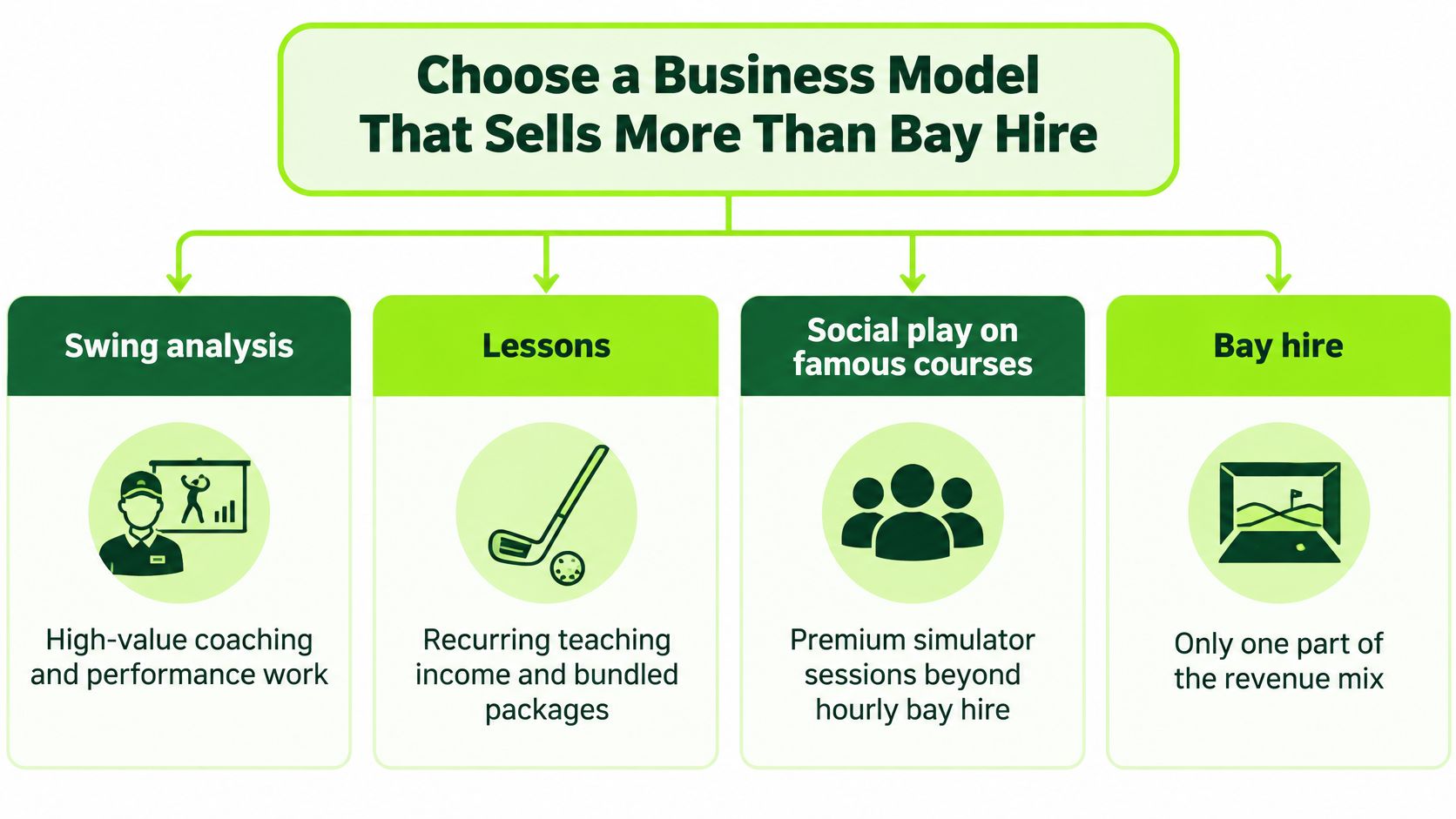
Bay hire against a use-case model
| Bay-hire only | Segmented use cases | |
|---|---|---|
| What you sell | An hour in a bay | A job: diagnosis, a lesson, a social hour, a league night |
| Quiet-hour problem | Discount the rate and hope | Juniors, coaching blocks, corporate mornings |
| Repeat visit | Left to chance | Built into the product |
Model these streams separately, each with its own conversion rate, average spend and repeat-visit assumption.
- Pay-and-play covers casual hours. Price it by daypart, and do not let peak rates leak into empty mornings.
- Coaching bundles and diagnostics sell expertise and a reason to return. They need a named coach and a diary, not a line called "lessons TBD".
- Leagues, juniors and corporate events fill midweek. They need deposits, a minimum headcount and a food offer you can deliver.
- Memberships should be tested against local preference, not copied from another city. Winter value and summer value are different products. How those propositions are built is covered in more depth in guidance on growing indoor golf membership.
The metric that compares unlike visits
Use revenue per occupied bay-hour, not the headline hourly rate. A social visit at a lower bay price plus drinks can beat a quiet-hour booking at a higher rack rate once contribution is counted. Food and beverage belongs in that figure only after you know the gross margin, not as turnover stuck on the end.
If winter memberships only sell because summer golf is miserable, say so in the plan and price the summer offer on its own evidence.
Assess Premises, Equipment and Operating Costs
Rent is typically the largest cost, and business rates move with the property's rateable value and any small-business relief, as set out in guidance on whether simulator businesses are profitable. Neither number should be an average from another town. Get the rateable value for the actual unit, and ask what relief, if any, applies before you model profit.
Utilities become material once several projectors, computers, heating and ventilation systems run long hours. Staffing is the next fixed commitment. The same guidance estimates a full-time employee at roughly £22,000 to £28,000 a year in salary before employer National Insurance and other employment costs. One enthusiastic owner covering every shift is not a staffing plan. It is a temporary workaround that breaks at the first busy weekend.
Costs plans leave off the page
Software subscriptions, calibration, insurance, cleaning, payment fees and repairs sit underneath the glamorous equipment line. Miss them and the contribution margin you calculate later is fiction.
Equipment choice should follow the customer job, not the brochure. Commercial-grade launch monitors, enclosures and impact screens are the baseline if you are selling coaching credibility and repeat social play. A domestic setup in a commercial diary creates downtime, arguments about numbers, and refunds. Capital ranges belong in the forecast section. Here, the decision is specification: accuracy and durability for lessons, game modes and reliability for social groups, and a service plan for both.
Checks before you sign
Work through the unit the way you would compare real estate investment opportunities on any other commercial site. The golf use does not relax the property maths.
- Rateable value and relief. Confirm both in writing. Do not accept the agent's "it'll be fine".
- Permitted use. Entertainment, coaching and alcohol are not the same planning box.
- Power. Several bays plus kitchen equipment can exceed a tired supply.
- Acoustics and ventilation. Under-specifying either one damages dwell time, reviews and the second visit.
- Access and ceiling. If a full swing or a wheelchair bay does not fit, the revenue model does not fit either.
A cheap rent that fails acoustics or power is an expensive rent once you have fitted the bays.
Build Financial Forecasts Around Contribution Margin
Start with capital, then ignore it until the monthly model works. A UK simulator-finance benchmark places a commercial-grade bay, including enclosure, impact screen, projector, launch monitor, turf and computer, at about £45,000, with fit-out commonly adding £5,000 to £20,000 per bay depending on electrical work, acoustics and lighting, as set out by Kandoo's finance guide for golf simulators. Four bays are not four times a consumer simulator. They are four commercial builds plus the room around them.
The calculation, in order
- List monthly fixed costs: rent, rates, insurance, software, salaries, finance and utilities.
- Put a variable cost on each booking: payment fees, balls or mats where relevant, and the food cost if you attach a package.
- Assign a contribution margin to bay hire, coaching, memberships, events and food and beverage. Contribution is price minus the variable cost of that sale, not turnover.
- Divide monthly fixed costs by the weighted contribution per customer. That is the break-even volume. Convert it into occupied bay-hours so the operations team can see the number on a diary, not only on a spreadsheet.
A UK market-entry model in that same finance guide reports that bare bay-hire venues may need roughly 40% to 50% bay utilisation to break even, whereas venues combining memberships, corporate events and food and beverage may reach break-even near 18% utilisation. These are modelled benchmarks, not guaranteed success rates. Test them against your rent and your staffing, not against a national slide.
How revenue mix changes the break-even point
| Venue revenue model | Indicative break-even utilisation | Planning implication |
|---|---|---|
| Bare bay hire | Roughly 40% to 50% | The diary has to be consistently busy before rent is covered |
| Memberships, corporate events and food and beverage | Near 18% in the model | Only if those streams have real margins and real take-up |
The second row is why operators chase a bar and a membership before they have proved either. That is the trap. What a mixed model can earn, and where operators overstate it, is set out in more detail in this look at how much a golf simulator business makes.
Four pitfalls show up in almost every weak forecast. The bar is built before demand for drinks is proved. Daytime underuse is waved away. Memberships are treated as guaranteed recurring revenue. No cash is reserved for projector, screen and launch-monitor maintenance. Hold a maintenance reserve from month one. A dark bay earns nothing and still attracts rent.
Plan Customer Acquisition and Operations Together
The marketing chapter and the operations chapter are the same system. UK simulator pricing is commonly reported at about £20 to £50 per bay per hour, with higher rates possible in London and city centres, according to guidance on starting a simulator business. A four-bay venue open 12 hours a day has 48 available bay-hours. Viability depends on the share that is booked and the average price you realise after off-peak rates, memberships, coaching and events.
Do not multiply a headline rate by 48. Split weekday mornings, weekday evenings, weekends and the seasonal peaks, and write down the booked share you can defend for each.
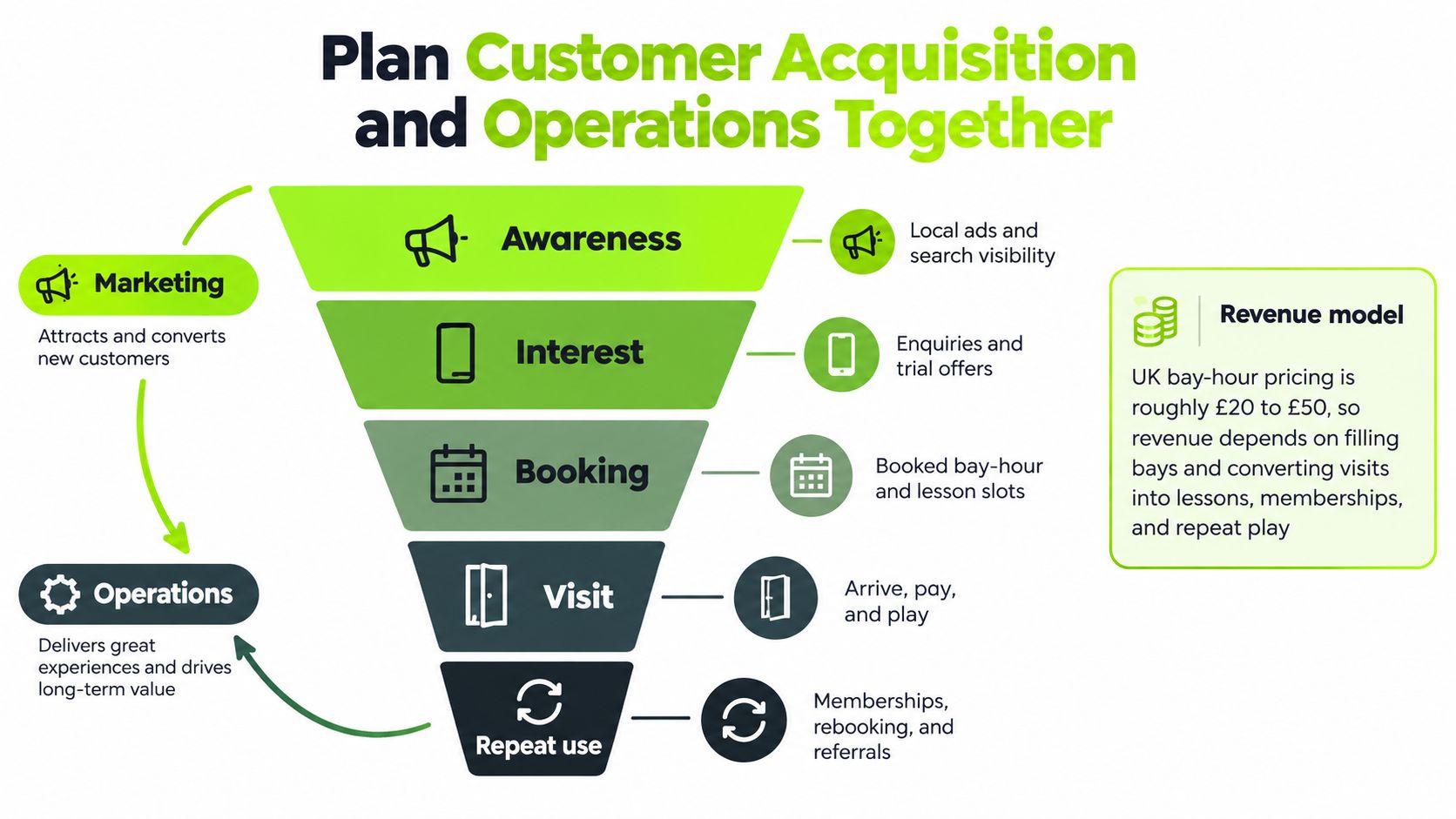
What the plan should specify
Demand without a booking path wastes the advertising. A tidy CRM with no demand does not fill a Tuesday. The constraint differs by site, so name yours.
- Pre-launch list and founding offer. This is the willingness-to-pay evidence from earlier, kept alive until opening week.
- A booking path with a response standard. State who replies, and by when. An unanswered corporate enquiry is lost contribution, not a marketing problem.
- Follow-up that does not rely on memory. First-visit guests who do not rebook inside a set window should hear from you automatically.
- A leagues and events diary aimed at off-peak slots. If the calendar only fills Friday night, it is not doing the job the break-even model needs.
- Two numbers in the CRM. Contribution per occupied bay-hour, and total revenue per visitor. Turnover alone hides a busy room that does not pay the rent.
The commercial sequence is attract, nurture, convert, retain. All four have to be in the plan, with an owner for each. GolfRep works with clubs and indoor facilities on that sequence, tracking from first click to repeat booking, alongside whatever booking and CRM tools the operator already runs. The point is the measurement, not a new logo on the website. Practical next steps for an open venue sit in this guide to growing an indoor golf facility.
Staff the peaks you have forecast. A diary that assumes two coaches and a bar supervisor, with one person on the rota, will miss the contribution margin you just calculated.
Turn the Plan Into a 90-Day Action List
A plan that only works at 60% utilisation is not a plan. It is a wish. Put the work in this order so each assumption collects evidence before you commit capital.
- Map the drive-time and audit competitors. Note prices, technology, coaching and which dayparts are already full.
- Take deposits or founding memberships. Count commitments, not email sign-ups.
- Pick the revenue mix and test it locally. Ask which segments want pay-and-play, a coaching bundle, a league or a membership, and price each one.
- Verify the unit. Rateable value, relief, permitted use, power, acoustics, ventilation and parking, in writing, before signature.
- Build the contribution break-even and stress it at the conservative utilisation cases, with your rent and your salaries, not a borrowed average.
- Stand up booking and CRM before opening day. Response standards, rebooking follow-up, and the two commercial numbers, live from the first week.
Each line in the forecast should point at a piece of evidence: a deposit, a quotation, a rateable-value check, a competitor price, a coach who has agreed days. Optimism is not a source.
If you want the commercial constraint in the plan identified before you commit to the lease, GolfRep can map that constraint across demand, conversion and repeat revenue for clubs and indoor facilities.
GolfRep helps golf clubs and indoor golf facilities build acquisition and revenue systems that hold up under conservative bay utilisation, from first booking through coaching, memberships and repeat visits. If you are writing an indoor golf facility business plan, the useful next step is to see which assumption fails first. Visit GolfRep and map the plan against local demand before you sign.
Ready to tap into our proven growth system?