Golf Simulator Bay Pricing: UK Costs and ROI Guide
A commercial UK simulator bay typically costs roughly £40,000 to £70,000 fully installed, while consumer hire rates run from around £13 to £25 per hour at many regional venues and £50 or more at peak times in major cities.
If those two ranges are the only figures on the proposal, the committee is still guessing. A tidy hardware quote doesn't tell you what the bay must earn each week. Golf simulator bay pricing is a yield decision. Installed cost, the rate you achieve, how full the diary is, and who stands in the bay have to sit on one page before anyone signs a purchase order.
Golf Simulator Bay Pricing as a Commercial Decision
What does a simulator bay have to earn before it stops being a winter talking point and starts paying its way?
That question rarely makes the agenda. A supplier quote lands, one committee member has tried a bay on holiday, and the discussion drifts towards which room it might fit. The installed-cost band and the published UK hire rates set out above are the starting point for the analysis. On their own, they say nothing about what the bay must return.
Purchase price and hourly rate do different jobs, and clubs conflate them constantly. One is capital at risk. The other is yield per sold hour. A cheap launch monitor does not produce a sound rate card. A premium hourly price cannot rescue a room that is not ready to trade.
Four inputs decide whether the bay is a revenue asset or an expensive toy.
- Installed cost. The complete asset, not the brochure package: monitor, enclosure, impact screen, projector or display, hitting mat, flooring and room fit-out.
- Blended realised rate. What the club banks per sold hour after off-peak pricing, member discounts and coaching hours.
- Occupancy. Paid hours measured against the hours you choose to open.
- Booking mix. Members, visitors, lessons, corporate hire and social groups each carry different rates, staffing demands and secondary spend.
Run those four together and the question surfaces. It is never "can we afford a simulator." It is "which combination of rate, occupancy and mix repays the capital inside a timeframe the committee will accept." A bay that looks affordable on a quote can be the most expensive line in the budget. A dear one, properly modelled, can be the cheapest income the club adds.
How Golf Simulator Bay Pricing Works
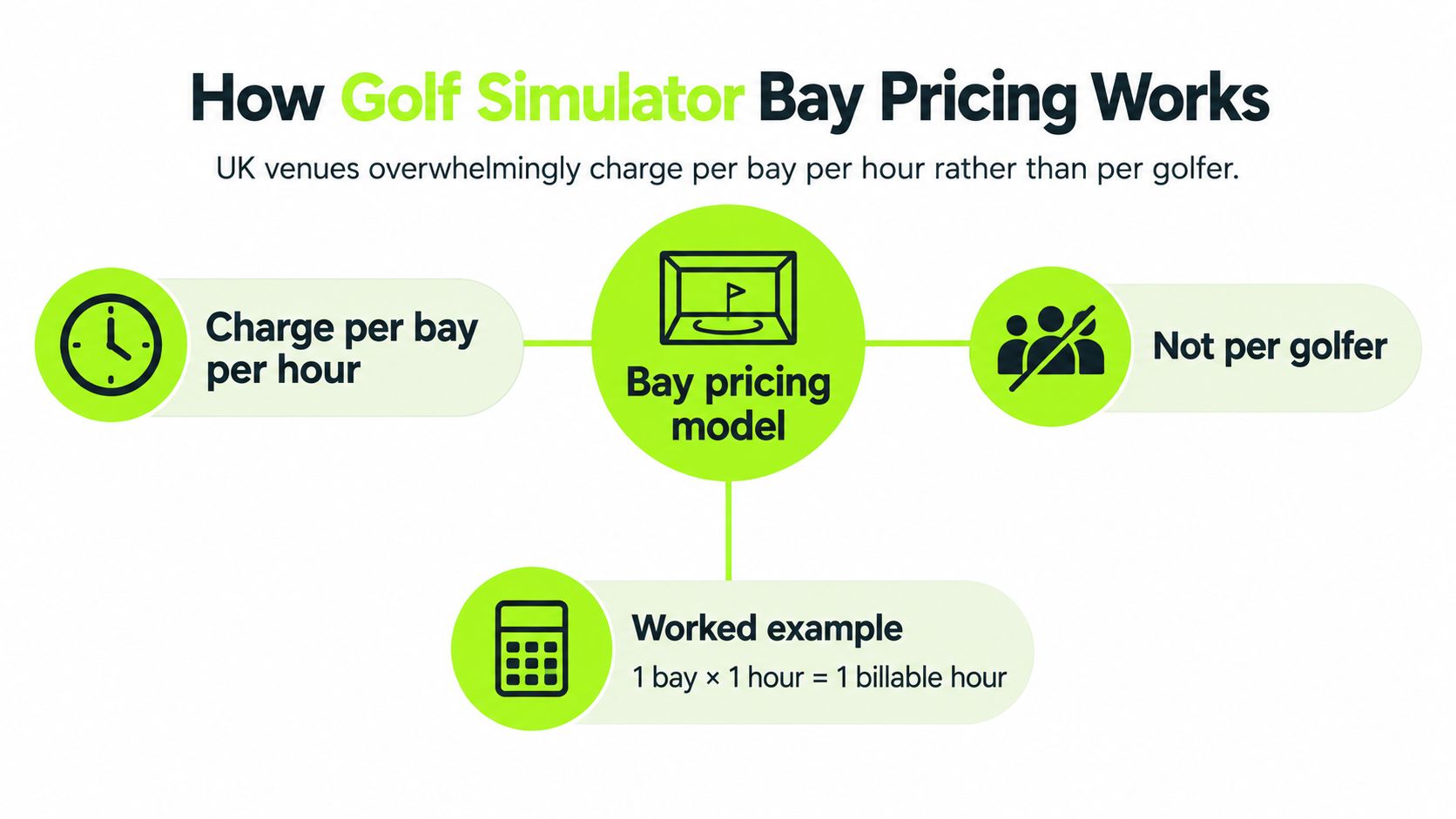
UK venues overwhelmingly charge per bay, per hour, not per golfer. That single mechanic decides whether a simulator helps the club or underprices the room.
The hour is the product
Walk a manager through one booking. At £25 per hour with four players, each golfer pays £6.25. The venue still banks the full £25 for that hour. Evolution Golf Academy, beside Ormonde Fields near Derby, publishes the pattern in full. Off-peak runs from £13 for one player to £17 for two, £21 for three and £25 for four. Peak, covering weekday afternoons and evenings plus weekends, is a flat £25 for up to four. The golfer feels a bargain. The club sells the bay.
Evolution also states that an indoor round takes roughly one hour per player. That is the session-length rule worth writing into the model. One player is often a one-hour booking. Four players who want a proper indoor round will press towards four hours, or they will accept a shorter, social hour. Either way, you are selling time in a room with a player cap, not green fees.
Why the group is the commercial centre
Revenue follows bay occupancy and players per booking. It doesn't follow how many individuals walk through the door. A fixed bay rate makes the four-ball feel inexpensive and keeps the booking rule easy to say at the desk. A per-person charge can lift take from a larger party, and it can also make the group shop elsewhere.
Practical rule: If the website leads with a solo price and most profitable hours are full of four-balls, you are advertising the wrong product.
Two schedules usually sit on the same card. Off-peak often scales with headcount, so a single member practising at lunch doesn't subsidise an empty bay, and a four-ball doesn't get the room for a solo fee. Peak is frequently capped, commonly at four players, at one flat rate. You stop discounting the hours that would have sold anyway.
Operators who set prices that support profitability start from cost and utilisation, then set a price the diary can hold. For a club, the benchmark isn't the number in the hero banner. It's the blended realised rate across every hour you sell.
What a Simulator Bay Costs to Install
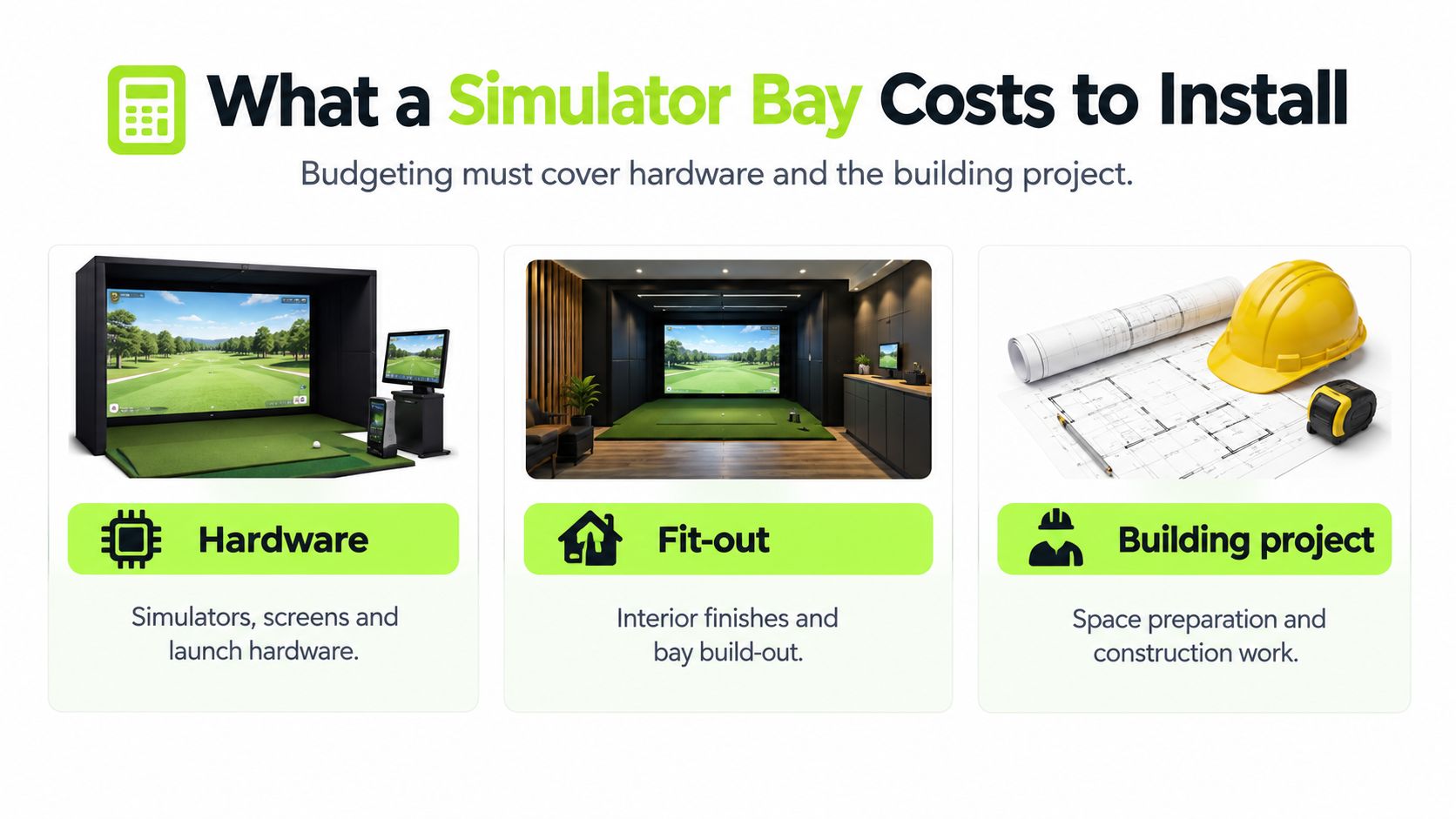
Hire rates are the visible half. Capital is where simulator projects go quiet, because clubs budget for hardware and inherit a building job.
Three tiers, one installed asset
Home and entry-level kits are a different market. A projector-and-enclosure setup lands in the low thousands, and a premium dedicated-room system runs well past that. Neither figure describes a commercial bay that members, visitors and corporate guests will hammer every week.
Within commercial quotes, the spread is wide, and the enclosure fabric isn't the reason. The same published UK installation reviews behind the £40,000 to £70,000 planning range noted earlier put a high-end commercial simulator in the tens of thousands per bay, and a multi-bay venue with full building and hospitality fit-out comfortably into six figures. The driver is the accuracy tier of the launch monitor, plus the building work: electrical upgrades, lighting control, acoustic treatment, ventilation and structural mounting.
Low-cost radar or camera units may give ball speed, launch angle and distance. Ceiling-mounted commercial systems add club and ball tracking, tighter indoor capture and software integration that coaching and club-fitting can sell. Pay for data quality only if a named product uses it. General play doesn't need tour-grade tracking. A teaching bay often does.
How a modest quote becomes a project
Model the bay as a complete installed asset. Software, VAT treatment and a contingency belong in the same sum as the screen. Take a monitor-and-screen package quoted at £15,000 as the example: it becomes a much larger project once the room is fit to trade. I've sat in committees that approved the monitor line and discovered the cable routes, the blackout and the soundproofing after the deposit had gone.
Treat any hardware-only quote as incomplete until a contractor has priced the room.
Cash purchase isn't the only route, and it isn't automatically the cheapest across the life of the asset. Clubs weighing a financed fit-out can compare gym equipment leasing options for how leisure operators separate the kit from the building work and avoid judging a deal on the week-one payment. The same discipline applies here. If the bay is meant to sit alongside a range rather than replace one, weigh it against the digital driving range economics before assuming one indoor product serves every golfer.
Before you compare supplier PDFs, insist on one installed figure that includes:
- The launch monitor and software, at the accuracy tier you will sell.
- Enclosure, screen, projector or display, mat and flooring.
- Room works, including power, light, sound, air and mounting.
- VAT, professional installation and a contingency.
That installed total is the number your payback model divides into.
Typical UK Golf Simulator Bay Hire Rates
Hardware quotes never show what golfers already pay down the road. Your rate card has to live in that market, and the published cards below are the market.
| Venue | Off-Peak or Solo Rate | Peak or Group Rate | Pricing Model |
|---|---|---|---|
| Tehidy Park Golf Club | £15 per hour, one player | £24 per hour, two to four players | Bay rate, scales with group size |
| Evolution Golf Academy, Derby and Nottingham | £13 to £25 per hour by player count | £25 flat, up to four players | Scaled off-peak, flat peak |
| Inner Drive Golf, London | £25 per hour, single player | £40 per hour for two or more | Bay rate, plus a membership |
| World of Golf London | Private-room suite from £30 per hour | Same suite positioning | Premium room, not a standard bay |
| Play In Golf | TrackMan iO £25, 10am to 6pm | £35 from 6pm to 10pm; analytics bay £40 then £50; private studio £65 | Tiered by equipment, privacy and time |
Tehidy Park, linked earlier in this article, is the regional club pattern: a cheap solo hour and a capped group hour that rewards bringing three friends. Evolution's Derby card, already walked through above, runs the same idea with a published off-peak ladder and a flat peak price.
London sells a different product. Inner Drive Golf prices single-player hours from £25 and groups of two or more from £40, alongside a £135 per month membership bundling one off-peak weekday hour, four peak hours and guest access at no extra charge. World of Golf London lists a private-room suite from £30 per hour. Play In Golf prices by hardware tier: a TrackMan iO bay at £25 from 10am to 6pm rising to £35 in the evening, an enhanced analytics bay at £40 then £50, and a premium private studio at £65.
What the cards have in common
No venue in that table charges one price for every hour and every room. The first split is equipment, privacy and coaching suitability. The second is daytime against evening and weekend demand.
A club rate card can cover the same ground with four products:
- General play on a standard bay, off-peak, for members and casual visitors.
- Data-led practice where the tracking is accurate enough that a low-handicap golfer will pay a premium.
- Coaching, sold with the professional rather than as a bare hour.
- Exclusive private use for corporate or social groups buying the room itself.
The premium survives only if occupancy holds. A £65 studio sitting empty on a Tuesday earns less per available hour than a £25 bay that turns all afternoon. Match each tier to a golfer who can feel the difference, then check the booking report a month later and see whether that hour still sells.
Modelling Simulator Bay Revenue and Ongoing Costs
A rate card isn't an annual budget. Occupancy turns it into one, and occupancy is the variable that makes or breaks the case.
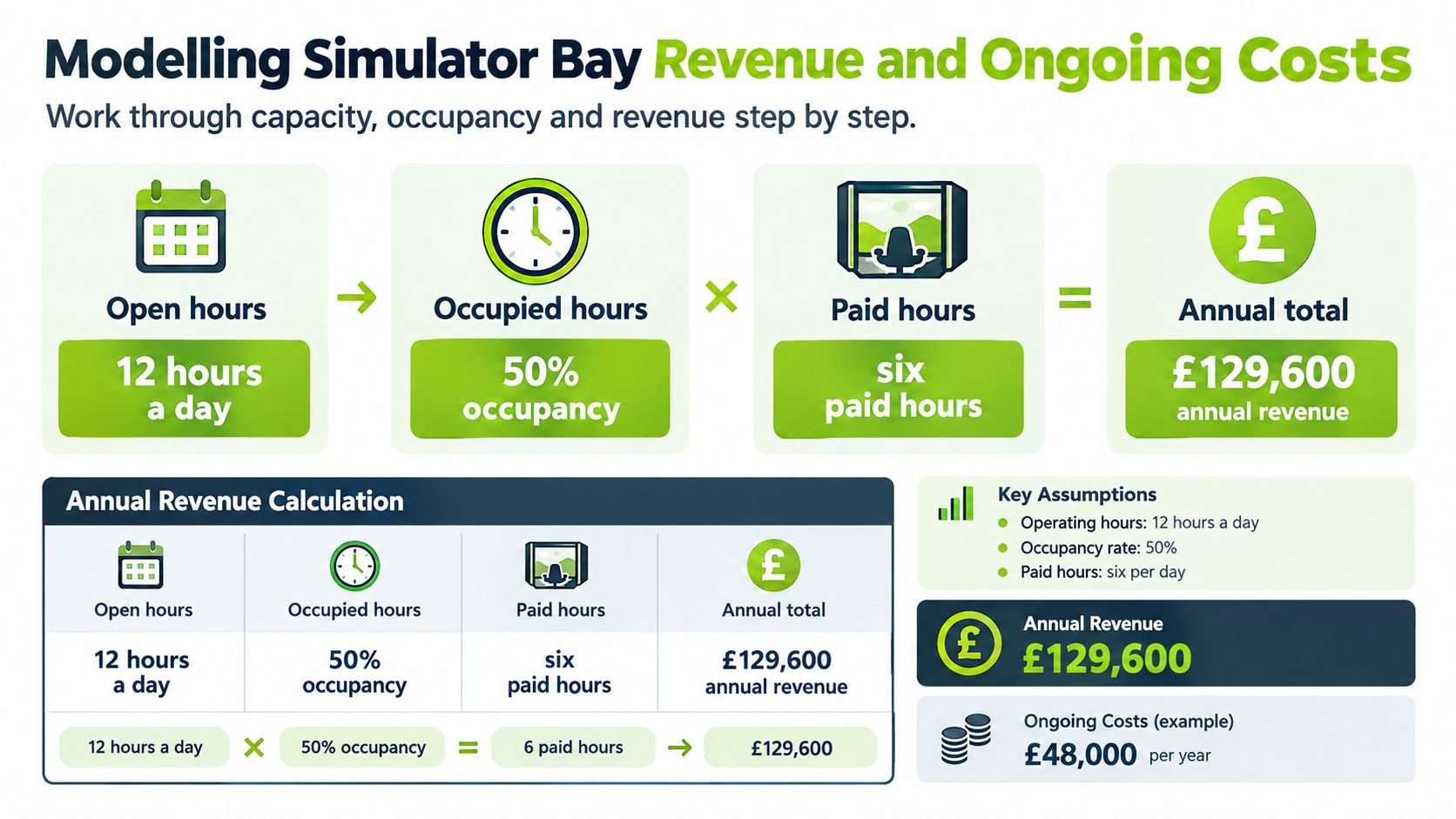
Three occupancy outcomes
Take a bay open 12 hours a day at a £40 headline rate. At 50% occupancy you sell six paid hours. Six hours times £40 times 365 days is about £87,600 of gross bay-hire revenue. The same bay at 25% occupancy is about £43,800. At 75% it is about £131,400. That illustration is set out in UK guidance on starting a commercial simulator business. It is gross revenue, not profit.
Build the three lines before the meeting, not after someone has fallen in love with the top one.
| Occupancy | Paid hours per day | Gross annual bay hire at £40 |
|---|---|---|
| 25% | 3 | About £43,800 |
| 50% | 6 | About £87,600 |
| 75% | 9 | About £131,400 |
What the headline hides
That £40 is a planning rate, not a promise. The same industry note points at lower regional and off-peak trading: £27 per hour per bay in Darlington, £35 per hour at Bunkerbay, and off-peak offers at £25. A blended realised rate, not the Friday-night price, is what you should type into the model.
Then take costs off the gross figure. None of these are optional just because the brochure didn't list them.
- Software licences and any per-course or per-bay subscription.
- Equipment finance, if you didn't pay cash.
- Maintenance and screen replacement. Impact screens are a consumable.
- Staffing for bookings, check-in and supervision.
- Utilities, especially projection, heating and ventilation.
- Marketing, VAT and cancellations.
A committee can sketch this in twenty minutes. Open hours, three occupancy cases, a blended rate below the advertised peak, then a line for each cost above. What remains is the contribution the bay might make to the club. How that contribution sits beside green fees, society income and the bar is the wider question of how golf clubs make money, and the simulator should be judged on the same terms as any other trading space.
Assessing Return on Investment and Booking Mix
Arithmetic gets you to a payback window. Management decides whether the hours inside that window are worth having.
A bay costing £50,000 and generating £50 per booked hour needs 1,000 gross billable hours to recover capital before staffing, software, maintenance and energy. At 20 booked hours a week, that is roughly 50 operating weeks. Comparisons of simulator and launch-monitor providers use that recovery test, and they also note off-peak city benchmarks around £30 to £40 per hour against peak rates of £50 or more. Dynamic pricing, lower on weekday daytimes and higher in the evening or at the weekend, can fill the diary without cutting the membership fee. Coaching and corporate packages are how you get paid for the better tracking data.
Capital recovery before running costs is the first hurdle, not the business case. A bay that "pays back" on paper and consumes the professional's entire Tuesday hasn't paid back.
Booking mix is the variable most proposals skip
The same hour isn't the same revenue. A winter member grinding irons, a visitor paying a visitor rate, a coached lesson, a corporate hire and a social group of non-members ask for different staffing and leave different money behind the bar. Published pricing already shows the spread. Group packages at £20 to £30 per person for six to twelve people sit next to peak individual bookings that reach £78. One estimate values the UK golf-simulator market at USD 214.5 million in 2025, projected to reach USD 436.6 million by 2033, yet that forecast doesn't show which of those customers will reliably fill a private club's bay. Both the prices and the market figures are in the UK golf-simulator market outlook.
Track a short cohort report every month.
- Member versus non-member bookings, so you can see displacement.
- Weekday versus weekend occupancy, by hour.
- Repeat booking rate, not just first visits.
- Lesson attachment, the share of hours sold with a coach.
- Food-and-beverage spend per visit.
- Memberships that started as a simulator booking.
Market growth won't tell you any of that. Source-level reporting will. We recommend clubs judge a source by what came in, what happened next, and whether it produced one booking or ongoing revenue, rather than by a raw enquiry count. AI automations and proper data tracking are what make that capture reliable instead of a spreadsheet someone updates when they remember. The same life-cycle habit facilities managers use when evaluating chiller bids beyond installation costs applies to a bay. Judge the asset on what it costs to run and what mix of customers it keeps, not on the invoice from the fitter.
A cheaper home simulator may well steal some serious practice. Entertainment-led groups can bring people who were never going to join on the strength of the course alone. You only know which is happening if the cohort report exists.
Deciding Whether a Simulator Bay Is Right for Your Club
You can settle the principle in one meeting if the paper answers six questions. If it can't, you aren't ready to sign.
- What installed cost are we committing to, including the room, software, VAT and contingency?
- What blended realised rate is defensible in this catchment, not in a London studio?
- What occupancy by hour do we need before payback is acceptable, and who owns that diary?
- Which segments fill off-peak, and is that a member benefit or a new customer?
- Does the bay complement the course or compete with the range, the professional and the bar?
- Can we see member versus visitor use, and the memberships, lessons and food spend that follow?
The right golf simulator bay pricing decision isn't the cheapest hardware or the highest hourly rate. It's the mix of installed cost, realistic utilisation and booking quality that pays back on your numbers. A bay that only works if every winter evening is full, at a price your members won't pay, is a toy with a business plan attached.
Clubs that want an outside view of the main constraint, whether that is utilisation, conversion or retention, can start with an open strategic conversation. We look at the current setup, the goals and the bottlenecks, and map what a growth system could look like. It isn't a pitch for a simulator, and it isn't a substitute for the checklist above. If you are still weighing a new indoor site rather than a single club bay, the commercial sequence in how to start a golf simulator business is the wider frame.
GolfRep helps golf clubs and indoor facilities improve commercial performance across acquisition, sales process, follow-up, conversion, retention and revenue, including whether a simulator bay is earning its keep. If you want that constraint mapped against your own diary, rate card and membership offer, visit GolfRep and start with a straightforward conversation about the numbers.
Ready to tap into our proven growth system?