Golf Simulator Business Location: How to Choose a Site

You've found a unit with room for simulator bays, the rent looks manageable and there are golf clubs nearby. The agent wants an answer, while your committee or business partner wants to know whether the numbers work. What's harder to establish is who will book when the obvious evening slots aren't available.
At GolfRep, we'd judge a golf simulator business location by its ability to stabilise demand, not by its proximity to golfers alone. The strongest site combines different reasons to visit, fills otherwise weak trading periods and passes a written commercial scorecard before anyone commits to the lease.
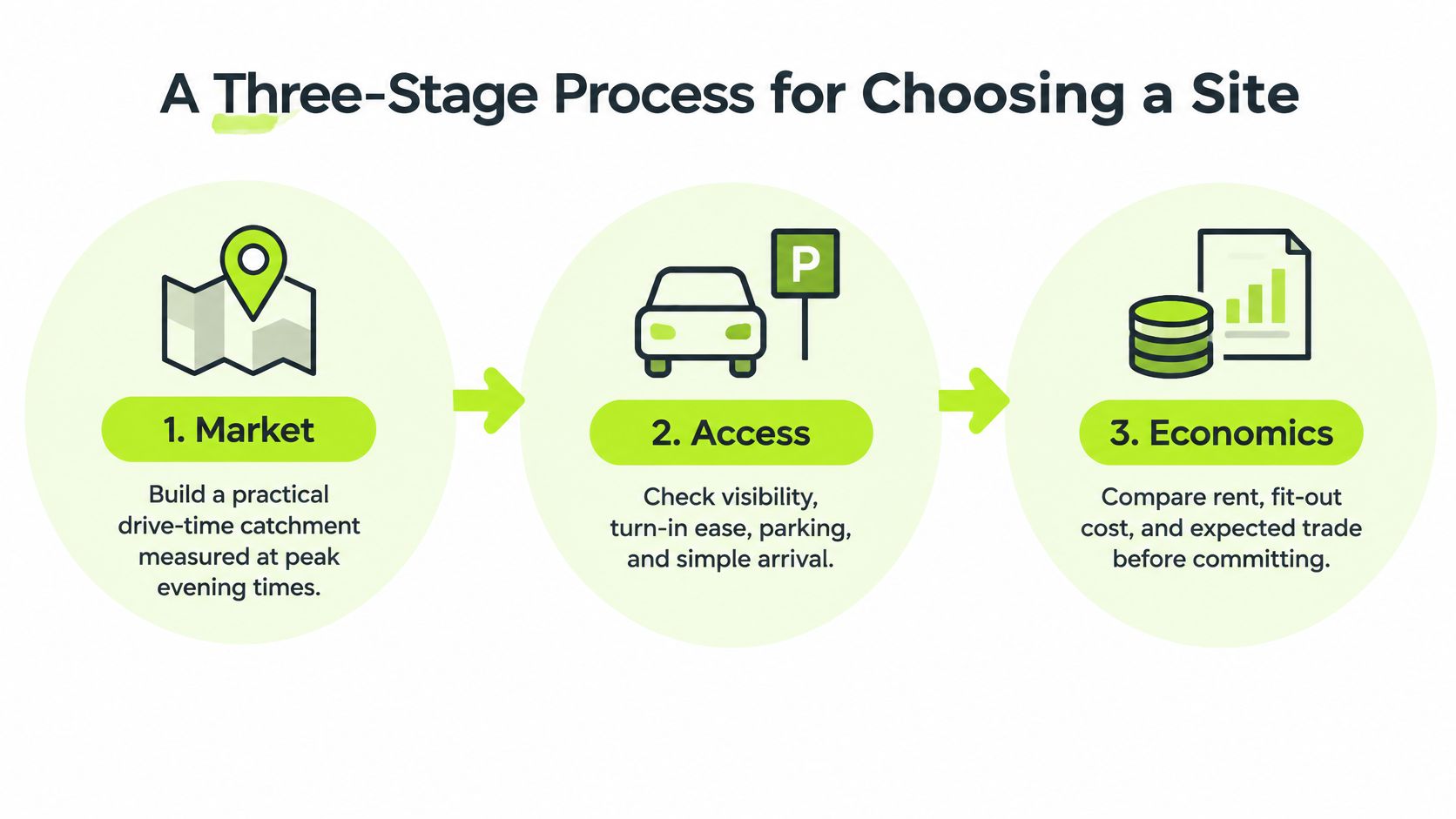
A Three-Stage Process for Choosing a Site
A unit can look suitable on a quiet afternoon and still make a poor venue. Customers might face congested evening journeys, parking restrictions or a competing range offering convenient practice at an established price. A spacious room doesn't resolve those problems.
Use market, access and economics as the initial filters. Within that framework, work through market sizing, competing supply and feasibility, then require a paid demand test before making the final commitment.
Build the evidence before negotiating
Establish the reachable market. Plot a drive-time catchment using Google Maps at the evening times customers would realistically travel. Record households, income indicators, current golfers, lapsed players and independent golfers in a spreadsheet. Don't substitute a neat radius for a realistic journey.
England's market extends beyond membership: the Horsham District Council golf assessment describes approximately 650,000 members across about 1,900 affiliated clubs, alongside roughly 2 million independent players. Counting club members alone therefore misses a relevant audience.
Inspect competing supply. Map ranges, simulator studios and clubs, then record prices, opening hours, coaching provision and bookable availability. Check the booking calendars rather than assuming that a competitor's presence proves either saturation or demand. An established venue with unsold evening capacity requires an explanation before you add more.
Check feasibility and access. Obtain measured drawings, investigate lawful use and request preliminary electrical information before agreeing heads of terms. Visit during intended trading hours. Test the turn-in, parking, public-transport journey and route to the entrance, not just visibility from the road.
Test willingness to pay. Run geographically limited advertising for a clearly described proposed venue. Offer pre-booked trials or founding memberships with transparent opening conditions and refund terms. Measure qualified enquiries, paid bookings and revenue per bay; test repeat bookings through a pop-up or partner venue rather than treating stated enthusiasm as repeat demand.
Site validation stages and pass tests
| Stage | Question to answer | Evidence to gather | Proceed only if |
|---|---|---|---|
| 1. Market | How many golfers and independent players can reach the site? | Drive-time catchment spreadsheet, household income, golfer participation | Catchment supports the bay count at target occupancy |
| 2. Supply | What competing capacity already exists? | Map of ranges, simulators and clubs with price points and hours | Spare evening and weekend capacity is not already sold |
| 3. Feasibility | Can the unit physically and legally host the venue? | Measured drawings, written planning view, electrical review | Layout, planning and landlord approvals are confirmed in writing |
| 4. Demand test | Will people book before the fit-out is paid for? | Pre-sold sessions, radius-limited advertising, cost per qualified enquiry | Booking and repeat rates meet the revenue per bay target |
For supply, treat unsold competitor capacity as a warning, not automatic permission to proceed. You need evidence that your offer serves a different customer, occasion or unmet requirement.
Advance only when every test passes. A failure means revising the proposition or returning to the shortlist, not compensating with a more optimistic forecast.
Sizing Demand From Golfers and Social Players
Counting people isn't the same as forecasting booked hours. England Golf participation reporting cited in GolfRep's franchise-versus-independent guide counted 12.6 million adults playing some form of golf during the previous twelve months, including 5.3 million using off-course formats. Those are participation measures, not evidence of local willingness to pay.
Start with the people who can reach your door during the hours you need to sell. Separate them by their reason for visiting, then assign likely bookings to the calendar.
Model distinct demand pools
| Demand pool | Reason to visit | Time slots to test |
|---|---|---|
| Outdoor golfers | Practice, coaching, course preparation | After work, coaching appointments, poor-weather periods |
| Lapsed golfers | A manageable return without a full round | Introductory sessions and scheduled coaching |
| Independent golfers | Flexible play without club membership | Casual evenings, leagues and weekends |
| Non-golfers | Friends, family occasions and workplace outings | Social evenings, family sessions and private events |
Keep the categories mutually exclusive in your spreadsheet. An independent golfer who also uses a driving range is still the same prospective customer, not separate demand to count twice.
For each pool, estimate reachable households, likely booking frequency and preferred session duration. Then distinguish customers from purchasing units: a social group shares a bay, whereas an individual practice customer may book it alone.
Convert the audience into bay hours
Consider a deliberately hypothetical room with three bays, open twelve hours daily for thirty days. It offers 1,080 bay hours; 300 reachable golfers, each purchasing one hour monthly, would fill approximately 28% of that theoretical capacity.
That isn't a local forecast. It demonstrates why a substantial-looking golfer list can leave considerable capacity unsold. If those customers all want after-work appointments, you'll also have a concentrated booking pattern rather than useful daytime demand.
Non-golfers need their own evidence. UK consumer findings reported by Straits Research indicate that 35% of non-golfers would be more likely to try golf through a simulator, while 55% of UK adults consider simulator golf a good social activity with friends or family, rising to 67% among adults aged 18–34. Test that appetite through paid evening sessions, not a survey asking whether the idea sounds enjoyable.
A full Friday evening doesn't prove that the venue can support its opening hours.
Use separate calendar columns for weekday daytime, weekday evening and weekends. Our guide to identifying market opportunities supports the same discipline: define a reachable customer and a specific buying occasion before forecasting revenue.
Record expected bookings by pool, realistic hours of use and dependence on the largest pool. Treat weekday daytime as unproven until coaches, employers or customers demonstrate a reason to buy it.
Matching Location Type to Your Business Model
Which customers must the venue serve profitably? Answer that before comparing units. A coaching studio needs a different setting from a social venue selling group packages, drinks and private hire.
Don't assume serious golf and entertainment are interchangeable because both use the same simulator. A PGA professional needs suitable teaching conditions; a birthday organiser needs easy arrival, comfortable seating and a session that welcomes beginners.
Location types compared for simulator venues
| Location type | Best for | Main strength | Main risk |
|---|---|---|---|
| Beside a golf club | Lessons, winter practice, member retention | Existing golfers and coaches nearby | Overlap with the club's own practice bays and pricing |
| Town centre or leisure cluster | Social groups, first-time players, evening trade | Strong evening footfall and social spend | Parking limits and higher occupancy costs |
| Retail park or out-of-town unit | Large groups, corporate events, food and beverage | Easy parking and larger floor plates | Weaker evening footfall and limited public transport |
| Hotel or resort | Visitor golf, packages, group stays | Captive guests and food and beverage income | Bookings depend on the hotel's own occupancy |
| Business district unit | Weekday corporate sessions, after-work bookings | Dense office catchment during working hours | Thin weekend trade and quiet evenings |
These are screening characteristics, not guaranteed outcomes. Visit each location when its target customers would arrive and verify the surrounding businesses' actual opening patterns.
Choose complementary trade
For a club-side venue, define what the simulator adds. Winter coaching, junior development and return-to-golf sessions provide clearer purposes than offering existing members another practice option without establishing who pays. Agree how the PGA professional, club and simulator operator divide bookings and income.
A town-centre venue should feel accessible to someone who has never belonged to a club. Check whether customers can combine a session with dinner or drinks without an awkward journey. Strong passing traffic is less useful if groups can't find the entrance or arrive together.
For a retail park, inspect the evening environment after neighbouring shops close. Confirm parking rights and restrictions rather than assuming the car park remains available. A large floor plate loses appeal if the customer journey depends entirely on driving and the proposition depends heavily on alcohol sales.
Hotels and resorts need an operational commitment, not just access to guests. Establish who sells packages, takes reservations and introduces the experience at reception. A business-district unit needs equally clear evidence of bookable employer demand rather than a count of office windows.
Location rule: Choose the setting that can fill your weakest trading period, not the one with the highest raw footfall.
Ownership structure also affects site choice. When comparing a simulator franchise with an independent operation, establish whether required layouts, branding or operating conditions narrow the premises you can use.
The right location type supports the product you intend to sell. Don't take an available unit and then assemble unrelated revenue ideas to justify it.
Premises and Planning Checks Before You Sign
What is the unit's existing lawful use? Resolve that before treating a shop, warehouse or former gym as a viable simulator venue. An agent's description isn't a substitute for the planning history.
For premises in England, Planning Labs' indoor golf planning guide explains that simulator venues normally fall within Use Class E(d), that a Class E(a) shop may move to indoor sport within the same broad class without separate change-of-use permission, and that B2 or B8 premises can require consent. Don't apply that classification automatically elsewhere in the UK; obtain advice under the relevant national planning system.
Planning position by current use of the unit
| Current use | Planning position | Action before signing |
|---|---|---|
| Vacant Class E(a) shop | Move to indoor sport within Class E may not need separate planning permission for the change of use | Get the position confirmed in writing and check licensing for bar activity |
| Class B2 general industrial | Change of use can need planning consent | Obtain a formal planning view and make the lease conditional on it |
| Class B8 storage or distribution | Change of use can need planning consent | Obtain a formal planning view, and check floor loading and vehicle access |
| Existing Class E(d) indoor sport or recreation | Proposed use is usually compatible with the existing lawful use | Confirm opening hours and any conditions attached to the existing consent |
| Unknown or mixed use | Position unclear until the planning history is reviewed | Request the planning history and a written view before any deposit |
Ask the landlord for decision notices, approved plans and conditions. Request a written local planning authority view on your actual operating proposal, including customer numbers, opening hours and any hospitality element.
Permission for indoor sport doesn't settle every ancillary activity. Investigate bar licensing, signage, external cooling equipment, flues, noise and vibration separately. Where hospitality is substantial, JRG Property UK Ltd's advisors for international F&B expansion offer a relevant property-advisory resource for assessing the food-and-beverage component alongside specialist local planning and licensing advice.
Measure the finished operating space
A full-swing simulator commonly needs about three metres of internal clearance, according to GolfRep's simulator business guide. That is a starting point, not confirmation that a particular golfer, launch monitor and enclosure will fit safely.
Measure to the lowest obstruction, including beams, ducts and proposed lighting. Check hitting-zone depth, screen-to-ball distance, side clearance and equipment placement against the selected manufacturer's drawings. Account for both right-handed and left-handed play.
Also test the room while people are waiting, receiving coaching or carrying drinks. Customers shouldn't cross a swing area to reach another bay, and seating must sit outside the striking zone.
Use this sequence before final commitment:
- Obtain measured drawings. Include columns, doors, ceiling obstructions, utilities and drainage, not just the lettable outline.
- Model the operating layout. Draw bays, seating, reception, storage and circulation to scale. Include a safe route from parking to the entrance.
- Commission electrical and fire-safety reviews. Verify supply capacity, equipment loads, emergency arrangements and the implications of the proposed occupancy.
- Assess acoustics and comfort. Where housing is close, commission an acoustic assessment covering impact noise and evening activity. Price ventilation, cooling and noise mitigation before agreeing the fit-out budget.
- Secure written approvals. Have a solicitor make the lease appropriately conditional on planning and landlord consent, including permission for alterations and external equipment.
Check toilets, step-free access and emergency exits against the proposed layout with competent advisers. A nominally accessible entrance doesn't solve an inaccessible customer route inside.
Walk-away test: Reject a layout that only works by compromising swing clearance, circulation or an unresolved consent.
Translate any limits on opening hours, customer numbers or activities into the operating forecast. An attractive headline rent won't rescue a venue that can't trade during its intended selling periods.
Record inadequate clearance, unresolved noise, insufficient power or cooling, inaccessible circulation and premature binding commitments as deal-breakers, not items to sort out after signing.
Costs and Break-Even Occupancy per Bay
Start with the costs the venue carries before anyone books: rent, service charge, business rates, insurance, software, staffing and baseline utilities. Add equipment finance or the cost of purchased simulators, together with maintenance, cleaning and replacement allowances.
Keep cash flow and accounting costs separate. Spreading fit-out expenditure over the lease helps compare sites, but it doesn't remove the need to fund that expenditure before opening.
A hypothetical break-even calculation
The following figures are illustrative assumptions, not market benchmarks:
| Input or calculation | Illustrative value |
|---|---|
| Annual fixed costs across two bays | £90,000 |
| Contribution per booked hour after discounts, card fees and variable costs | £35 |
| Required annual booked hours | £90,000 ÷ £35 = approximately 2,571 |
| Available annual bay hours | Two bays × twelve hours × 360 days = 8,640 |
| Break-even occupancy | Approximately 30% |
Use contribution per booked hour, not the advertised hourly rate. Deduct VAT where applicable and avoid including the same expense in both fixed costs and variable deductions.
Then compare break-even with the hours customers will buy. In this hypothetical model, weekday daytime occupancy of 10% would place greater pressure on evenings and weekends. A theoretical annual average can conceal an unrealistic requirement to sell almost every attractive slot.
For each candidate, record:
- Break-even occupancy: The booked share needed to cover the defined cost base.
- Time-slot occupancy: A forecast split by trading period and season.
- Fit-out payback: Initial investment divided by expected monthly cash contribution after operating costs.
Use our simulator bay pricing guide to assess the rate assumptions behind that contribution. Stress-test a hypothetical 20% fall in bookings, alongside the lease's actual rent-review provisions, without assuming you can raise prices to compensate.
Confirm the Site Before You Sign the Lease
Approve the site only when every mandatory test passes and the conservative cash forecast remains viable. Set that rule before viewing premises. Otherwise, an appealing building can become the favourite before anyone has tested its weaknesses.
Compare shortlisted units using identical assumptions and a written evidence column. A verbal assurance should remain marked unconfirmed until the relevant adviser, landlord or authority supplies an answer.
Use a decision sheet, not an overall impression
| Decision area | Record on the shortlist |
|---|---|
| Commercial demand | Paid test results, likely booking pattern and customer concentration |
| Operating feasibility | Approved layout, permitted activities and achievable trading hours |
| Financial resilience | Conservative cash surplus, fit-out funding and payback |
| Lease exposure | Repair obligations, reviews, break provisions and reinstatement |
| Outstanding conditions | Named owner, required evidence and decision deadline |
Don't let a high total score cancel out a failed mandatory condition. Excellent access cannot compensate for an unsafe layout, and enthusiastic trial customers cannot authorise a prohibited use.
For general transaction preparation, Tandem Space, Inc.’s guide to the office lease process for startups provides useful background on organising a premises search and lease discussions. It isn't simulator-specific or a substitute for a UK commercial property solicitor reviewing your agreement.
Define success beyond opening day
Calculate whether fit-out payback fits comfortably within the secured lease term. Rework the forecast if the final layout loses a bay, permitted hours shorten or landlord conditions increase costs. Those changes alter the investment decision, not merely the opening checklist.
For a golf club, name the simulator's commercial purpose in advance. If it is an introduction channel, track subsequent lessons, outdoor visits and memberships separately from bay revenue, without counting the same income twice. If it is primarily a standalone facility, judge it on sustainable contribution and repeat use.
GolfRep's first call is an open, strategic conversation, not a sales pitch. We review the club's current setup, goals and challenges and map out what a growth system could look like. Score your shortlist this week and progress only the site that clears every mandatory condition.
GolfRep offers a proven growth system for golf businesses, connecting customer acquisition with sales processes, CRM, conversion and retention. If you're evaluating a simulator location, visit GolfRep to book a call and discuss how the proposed venue fits your wider revenue goals and whether we're a good fit.
Ready to tap into our proven growth system?