How to Identify Market Opportunities for Your Golf Club

Most advice on how to identify market opportunities starts in the wrong place. It tells golf clubs to look outward first. Find a new segment. Launch a new package. Run more campaigns.
That sounds sensible, but for many clubs it misses the commercial reality.
A large share of missed growth isn't sitting in some undiscovered niche. It's already in your enquiry inbox, your missed calls, your website forms, and your visitor pipeline. In the UK golf context, many clubs operate below optimal revenue per available tee-time, even as membership enquiries rise. That points to operational and conversion gaps rather than demand gaps, and it means opportunity often comes from better systems, not just broader promotion, as noted by Think Insights on market gap strategy.
The Biggest Opportunity Is Already in Your Pipeline
Clubs often assume the next phase of growth depends on generating more attention. More traffic. More leads. More campaigns.
But if follow-up is slow, if nobody can see every enquiry in one place, and if staff rely on memory or handwritten notes, extra demand doesn't solve the problem. It magnifies it. More leads into a weak process usually means more lost revenue.
The challenge isn't generating enquiries. It's converting them.
That shift matters because it changes how you identify opportunity. Instead of asking only, "Who else can we target?", ask, "Where are we already leaking interest?"
What under-utilisation looks like in practice
At GolfRep, we see the same pattern across private clubs, proprietary clubs, and resort settings. The issue usually isn't that the market has disappeared. It's that the club can't respond consistently enough to turn interest into visits, and visits into members.
Common signs include:
- Missed first responses that sit overnight or through a weekend
- No central record of phone, email, web, and social enquiries
- Inconsistent follow-up depending on who's on duty
- No visibility on whether a prospect booked a tour, visited, or joined
- Marketing judged by volume rather than actual sign-ups
A club can spend heavily trying to "find opportunities" while ignoring the ones already raising their hand.
Why this reframing matters commercially
If your course has available tee-times, unused member capacity, or underfilled categories such as weekday, junior, academy, or corporate, the first market opportunity may be hidden inside existing traffic.
That's why we push clubs to start with pipeline visibility before broadening acquisition. A simple enquiry audit often reveals more commercial potential than another round of generic advertising. If you want to see what that looks like operationally, GolfRep's guide to golf club enquiry tracking gives a useful benchmark for what should be visible.
Define Your Commercial Goals and Target Members
Vague goals create vague analysis. "We want more members" isn't a commercial plan. It's a wish.
Useful opportunity work starts when the club decides what growth should look like in practical terms. That could mean stronger weekday utilisation, better conversion of trial visitors, more resilient membership mix, or more revenue from categories that fit the course and operating model.

Start with commercial intent
Before analysing anything, define the outcome in business terms.
A good goal usually answers four questions:
| Commercial question | What to define |
|---|---|
| What are you growing | Membership count, category mix, off-peak usage, visitor revenue, corporate sales |
| Who is it for | Specific member types rather than "everyone local" |
| What constraint matters | Tee-time pressure, staffing, follow-up capacity, pricing position, clubhouse use |
| How will you recognise success | Enquiries, visits, joins, retention, or spend quality |
Many clubs frequently make this mistake: they choose a campaign before choosing a business objective. Then they end up measuring activity instead of outcomes.
Build simple member profiles that the team can actually use
You don't need an elaborate persona document. You need a clear picture of the people you're trying to attract and the barriers stopping them from joining.
For example:
- The commuting professional may value early morning access, digital convenience, and quick follow-up.
- The family decision-maker may care more about weekend format, flexibility, beginner-friendliness, and whether children feel welcome.
- The lapsed golfer may need reassurance around confidence, commitment, and value rather than a hard sell.
- The corporate buyer often judges speed, clarity, and ease of arranging the first experience.
These aren't abstract marketing labels. They shape offer design, messaging, and operational handling.
Practical rule: If your front-of-house team and your membership contact can't describe the same target member in plain English, the club isn't ready to judge whether an opportunity is real.
Use audience thinking, not just demographics
Age and income help, but they don't tell you enough on their own. Clubs need to understand routines, objections, timing, and channel preference. That's why broader resources on target audience tips for social media can be useful here. The value isn't the social media angle alone. It's the reminder that targeting works best when you understand behaviour, not just postcode data.
A club that defines target members clearly makes better decisions later. It knows which data matters, which enquiries deserve fast escalation, and which offers are worth testing.
Analyse Data to Uncover Hidden Demand
Most clubs sit on more market intelligence than they realise. It's just scattered.
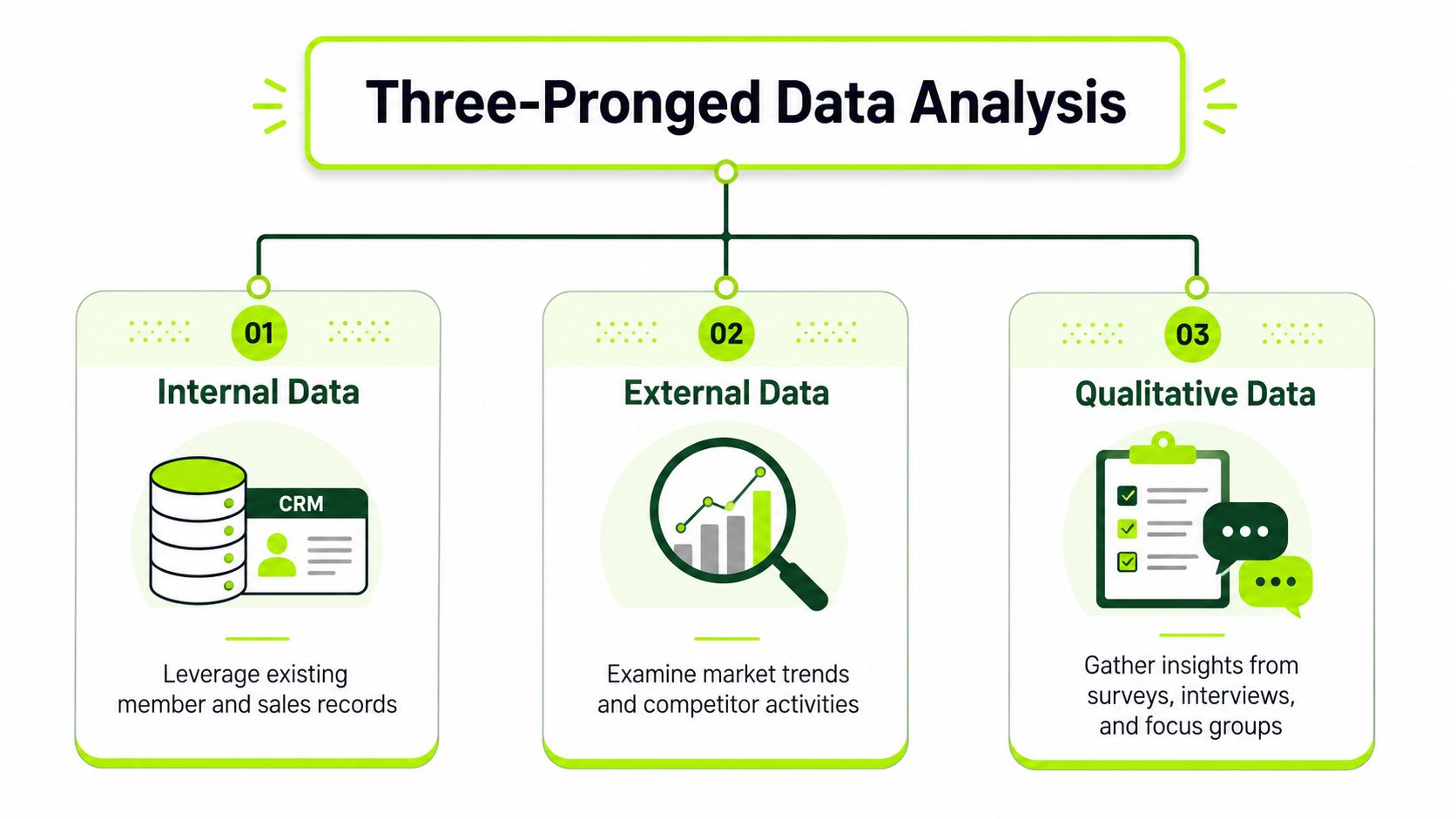
Part of learning how to identify market opportunities is separating signal from noise. In practice, that means pulling insight from three places at once: your own records, your local market, and real-world behaviour.
Start with your internal records
Internal data tells you what the club is already attracting and where conversion breaks down.
Look at:
- Enquiry source so you know whether interest comes from phone, website, email, social, referrals, or walk-ins
- Response pattern so you can see where follow-up slows or stops
- Visit progression so you know how many prospects move from enquiry to show-round or trial round
- Membership type so you can identify which categories convert and which stall
- Churn reasons from resignations, pauses, or informal feedback
This isn't complicated analysis. It's disciplined record keeping. If the club can't trace an enquiry from first contact to outcome, it can't judge whether a segment is weak or whether the process is weak.
For clubs trying to improve that visibility, GolfRep's article on data-driven golf marketing outlines the kind of joined-up tracking that's needed to make decisions with confidence.
Use local market data to calculate the gap
Opportunity stops being guesswork.
In England, only 11% of the 4.4 million adults who play golf belong to a club, according to IUK Business Connect's summary of market opportunity analysis. That same reference shows how clubs can combine golf participation data with Office for National Statistics demographics to estimate their addressable market. It gives a practical example: if males aged 45–64 are 13% of the local adult population, a club can use that as a measurable benchmark against current membership penetration.
That matters because it forces the right question. Not "Do people around here play golf?" but "How much of the relevant local golf population are we converting into members?"
Add digital and behavioural signals
Local demand also leaves clues online.
Search queries, website enquiry patterns, social engagement, and campaign response all show what people are curious about before they ever call. If a club sees repeated interest around flexible golf, beginner pathways, family-friendly activity, or weekday access, that's not proof on its own. But it is a strong clue worth validating.
A simple working model looks like this:
- Internal evidence identifies where current demand converts or fails.
- Local demographic evidence shows who exists in the catchment and where the membership gap is.
- Digital behaviour shows which ideas people are already responding to.
Good opportunity analysis doesn't start with a new product idea. It starts with a mismatch between available demand and current conversion.
Don't ignore qualitative evidence
Numbers tell you where to look. Conversations tell you why things are happening.
Short calls with prospects who didn't join, comments from trial visitors, and reasons given by members who leave often reveal friction points that don't show up in a spreadsheet. Sometimes the issue is price. Often it isn't. It might be uncertainty about commitment, confusion over categories, or a weak first experience.
Clubs that want a broader commercial lens may also find it helpful to review understanding revenue growth analytics. The useful takeaway isn't complexity. It's that revenue growth usually comes from diagnosing the full journey, not isolated campaign metrics.
Validate Opportunities with Low-Cost Tests
An opportunity isn't real because the committee likes the idea. It's real when the market responds.
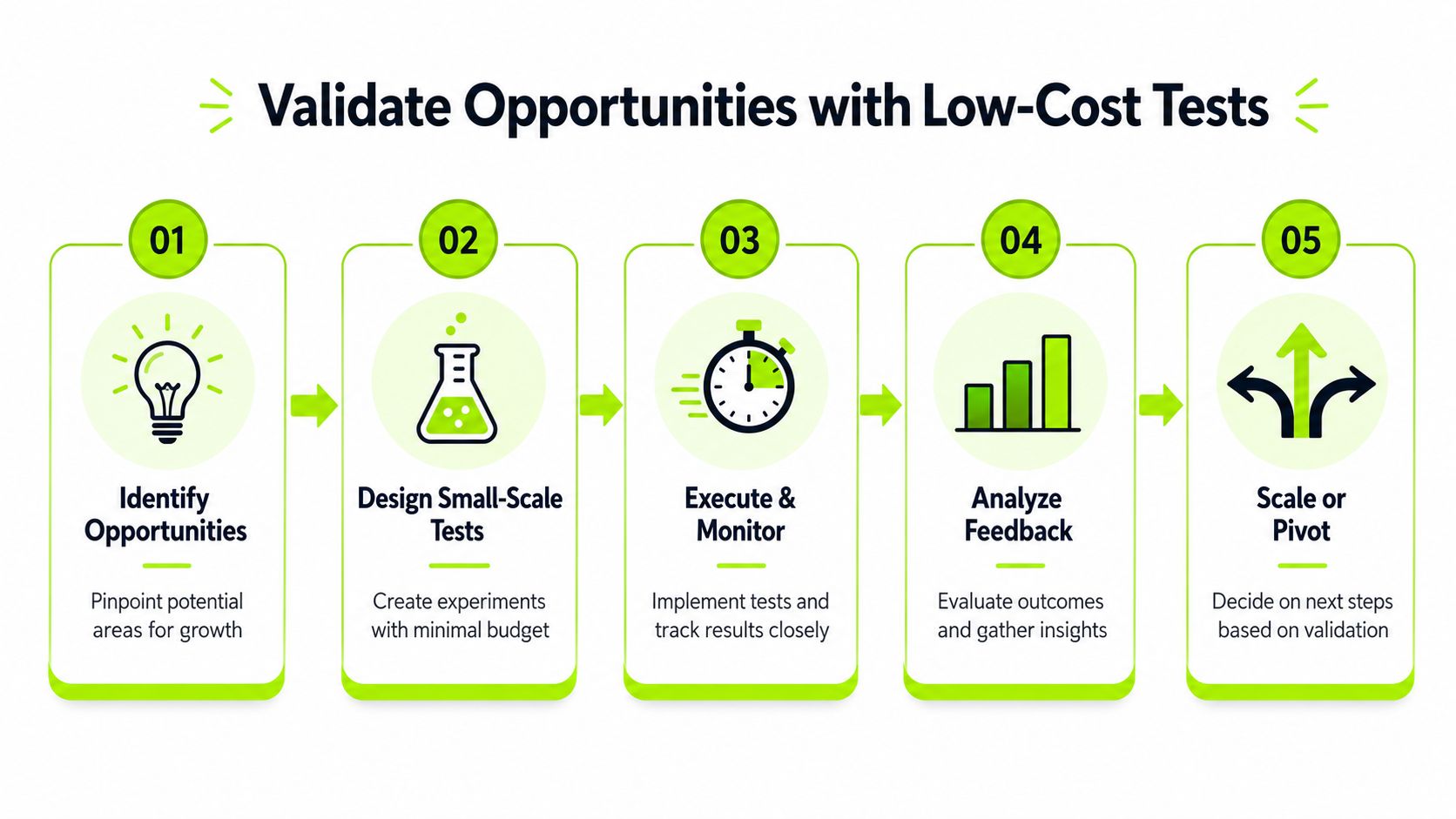
That's why the next step isn't a full launch. It's a controlled test. Most clubs don't need a major rebrand, capital spend, or a complicated membership restructure to validate demand. They need a small experiment with a clear success condition.
Score the options before you test
Not every idea deserves equal attention. A practical way to prioritise is to score each opportunity against two dimensions:
- Market attractiveness, including likely demand, fit with local audience, revenue potential, and ease of explanation
- Internal capability, including staff capacity, response process, tee-time availability, operational readiness, and data visibility
According to Sapioresearch's overview of market opportunity assessment, organisations that score opportunities on criteria such as market size, profitability, and internal capability are 2 to 2.5 times more likely to choose projects that meet return targets. The same source notes that piloting first, such as with a small-scale corporate package launch, can raise the probability of achieving a 1.5 to 2x return on marketing spend by 40 percentage points compared with all-in launches.
That lines up with what works in club growth. The best first tests usually aren't the biggest ideas. They're the cleanest to execute.
What a low-cost validation test looks like
A sensible test has four parts:
| Test element | What good looks like |
|---|---|
| Offer | One clear proposition for one audience |
| Audience | A defined local segment, not broad targeting |
| Pathway | A simple route from interest to booked conversation or visit |
| Tracking | Every enquiry and outcome logged consistently |
Examples might include a weekday pathway for flexible workers, a beginner-friendly family trial format, or a corporate introduction package. The key is to test one variable set at a time.
Keep the experiment small and learn fast
Clubs often ruin useful tests by overbuilding them. They create too many options, too much copy, and too many internal exceptions.
A better approach is:
- Choose one target segment
- Write one offer that solves one clear barrier
- Drive prospects to one response action
- Measure response quality, not just volume
- Refine or stop quickly
If the club wants a practical example of a simple traffic source for testing audience response, running a giveaway on Facebook can be useful when it's tied to proper follow-up rather than treated as a vanity exercise.
A pilot should answer one question clearly: "Would this audience move forward if we handled the opportunity properly?"
What doesn't work
Some clubs still validate opportunities badly. They rely on impressions from one open day, one committee discussion, or one enthusiastic staff member. That creates false positives.
Poor validation usually includes:
- Too many offers at once, which makes results impossible to interpret
- No follow-up discipline, so the club blames demand for a process issue
- No record of objections, which means the next version doesn't improve
- Premature scaling, where a weak pilot becomes an expensive campaign
The point of testing isn't to prove yourself right. It's to make the next commercial decision safer.
Measure Success with Growth-Focused KPIs
A club can generate plenty of activity and still fail to grow. That's why vanity metrics are dangerous.
Website visits, post engagement, and reach can be useful signals. They are not business performance. Membership growth comes from movement through the pipeline, not from attention alone.
The KPIs that actually matter
The right measures are the ones that connect directly to revenue and sign-up quality.
Focus on questions like these:
- How quickly did the club respond to the enquiry
- Did the prospect progress to a call, visit, or trial
- Which source produced serious prospects rather than casual interest
- How many follow-ups happened before the lead went cold or joined
- Which membership category converted best
Many clubs realise they don't have a marketing problem. Instead, they have a measurement problem.
Why tracking changes behaviour
When staff know every enquiry is visible and each stage is tracked, follow-up gets sharper. Delays become obvious. Ownership becomes clearer. Weak points stop hiding behind "we've been busy."
A UK study found that membership businesses using defined conversion tracking across enquiry channels achieved an average 23% higher sign-up rate, and those tracking movement from first contact to site visit and then membership saw a 31% improvement in follow-up quality, according to Discuss.io's write-up on market research tools and opportunity tracking.
That finding matters because it shows where growth often comes from. Not from louder promotion, but from a cleaner path between enquiry and join.
If your club can't see enquiry-to-visit and visit-to-member performance, it can't tell whether demand is weak, the offer is weak, or follow-up is weak.
Avoid the common reporting trap
Committees often ask for headline numbers because they're easy to read. More traffic. More leads. More clicks.
Those figures can hide a failing process. A smaller volume of well-handled enquiries can outperform a much larger top-of-funnel campaign. Clubs that understand this stop chasing noise and start managing conversion quality.
Good reporting should help a manager act. If a metric doesn't influence staffing, follow-up, offer design, or budget allocation, it probably doesn't belong at the centre of your growth review.
Turn Validated Opportunities into Predictable Revenue
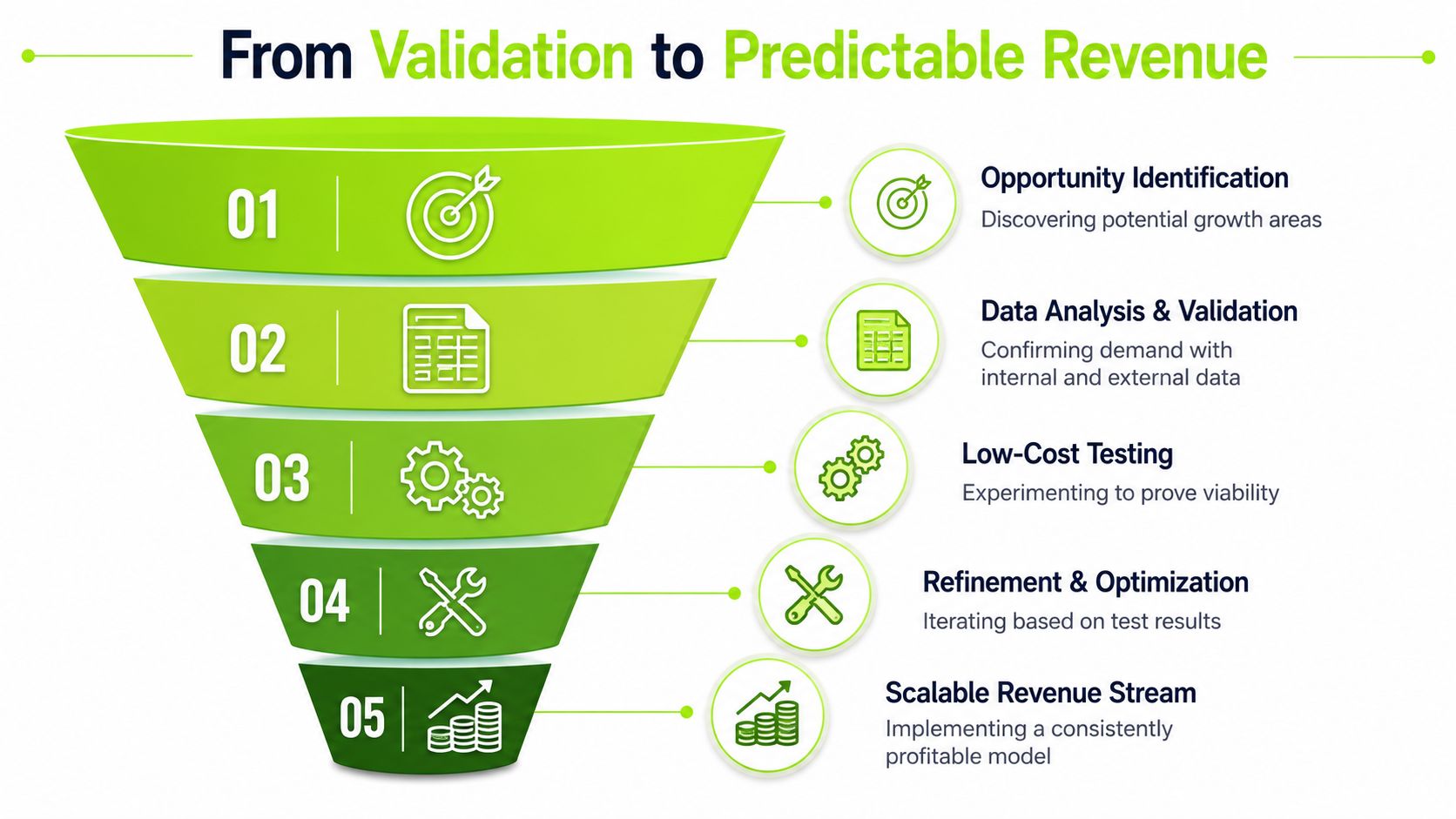
A validated opportunity only becomes commercially useful when the club can repeat the result.
Hence, systemisation matters. Not because systems are fashionable, but because membership growth becomes fragile when it's held together by memory, goodwill, and whoever happens to be on shift that day.
Centralise the pipeline
A club needs one place where all enquiries live. Phone calls, website forms, emails, referrals, and social messages should feed into a central record with clear ownership.
That creates lead visibility. Without it, promising prospects disappear between departments. One person thinks someone else replied. Another assumes the lead wasn't serious. The club loses revenue and blames the market.
Fix response speed first
Response time is one of the most practical levers in the whole growth process. If a prospect enquires and hears nothing for hours or days, interest cools quickly.
Automation helps here, not as a substitute for people, but as a safety net. An immediate acknowledgement, a structured follow-up task, and a clear nurture sequence keep the lead moving while staff handle the personal conversation.
For multi-site leisure operators in the UK, such as golf resorts, moving to a centralised CRM with automated workflows can reduce enquiry drop-off by up to 40% and increase the share of enquiries receiving a response within one hour from 35% to over 85%, according to the SBA guide citing UK hospitality workflow findings.
Those are operational gains. But they become commercial gains when more enquiries turn into booked visits and sign-ups.
Build a repeatable follow-up sequence
The clubs that grow steadily don't rely on a single callback. They use a defined process.
A strong sequence usually includes:
- Immediate acknowledgement so the prospect knows the enquiry was received
- Clear next step such as a call, show-round, trial, or information pack
- Timed reminders so good leads don't get forgotten
- Segment-specific follow-up based on interest, category, and stage
- Outcome logging so the club learns from every contact
At this stage, tools matter because consistency matters. A central CRM with automation, whether built internally or through a specialist partner such as GolfRep, gives clubs a way to combine acquisition with structured nurture rather than treating them as separate jobs.
The real shift in thinking
The common mindset is "get more leads."
The stronger mindset is "build a pipeline that converts interest predictably."
That's a different way to identify market opportunities. It treats opportunity not only as a new audience to chase, but as revenue already within reach if the club can see it, respond to it, and manage it properly.
Clubs that operate this way make better decisions. They test cleaner. They waste less budget. They stop confusing activity with growth. They stop leaving membership revenue trapped in unworked demand.
If your club wants a clearer view of where revenue is being lost between enquiry and membership, GolfRep helps golf clubs build predictable pipelines with lead tracking, CRM-enabled follow-up, and structured conversion systems that turn existing demand into measurable growth.
Ready to tap into our proven growth system?