Golf Club Instagram Marketing: Plan, Convert and Measure

Instagram's UK advertising audience reached 33.4 million people in early 2025, the equivalent of 59.5% of UK adults, according to DataReportal's Digital 2025 United Kingdom report. No golf club can buy that kind of attention through local press or radio, which is why Instagram has become the default channel for so many clubs. The number also flatters. It measures potential advertising reach, not people who can reach your car park this week, and it tells you nothing about whether any of them become members.
That gap is where club accounts succeed or fail. A post can be beautiful, shared widely, and liked by hundreds of people who will never drive through your gate. The same effort, aimed at a defined radius and wired to a booking link, produces a visit you can name, count and follow up.
Golf club Instagram marketing works when every post is one step in a path that ends in a paying member. Plan the mix, convert the interest, measure the result, and the channel stops behaving like a noticeboard and starts behaving like a sales channel.
Why Instagram Earns a Place in a UK Club Plan
Instagram reached 76% of UK online adults in May 2024, up from 73% a year earlier, and reached 81.2% of 18 to 34-year-olds, making it the second most-visited smartphone app for that age group, according to Ofcom's Online Nation 2024 report. Both numbers moved up year on year, which matters more than the headline.
Instagram reach among UK online adults, May 2024 (Ofcom Online Nation 2024)
| Audience | Instagram reach | Relevance to a golf club |
|---|---|---|
| All UK online adults | 76% | Broad awareness across local postcodes |
| Smartphone users aged 18 to 34 | 81.2% | Younger prospects for social golf and flexible memberships |
| Online women | 82% | Family, beginner and social golf audiences |
| Online men | 70% | Traditional golfer audience still reachable |
What the numbers do and don't prove
They prove where the audience sits. They don't prove anyone will join your club. Reach is a distribution fact, not a demand forecast, and a committee that confuses the two will approve a budget it can never justify.
The gender split deserves more attention than it usually gets. Instagram reaches 82% of online women, and a feed built entirely on scratch-golfer imagery writes off a large part of the addressable market for family, beginner and social membership. The male audience is still there at 70%, so this isn't a choice between the two.
Three jobs the channel can do
- Hold and mobilise members. Conditions, competitions, results and clubhouse life keep existing members engaged and give them something worth forwarding to a friend who is thinking about joining.
- Attract local non-members who fit the profile. Targeted posts and paid distribution put the club in front of golfers inside the catchment who already play, but elsewhere.
- Create a reason to act now. An open day place, a trial round, a beginner course starting date or a tour of the clubhouse gives interest somewhere to go.
Two clubs show how different the priorities become. A members' club with a waiting list doesn't need volume; it needs a steady trickle of enquiries from the right postcodes and age bands, because one wrong-fit member on a five-year horizon costs more than a hundred empty impressions. A resort course with weekday gaps has the opposite problem. It needs visitor and society bookings this month, and the content that fills a Tuesday tee sheet looks nothing like the content that fills a membership intake.
Whatever the priority, the plumbing is the same. If the account still runs from a personal login, start with setting up an Instagram business account, because contact buttons, insights and saved replies only exist on a business profile, and the rest of this work depends on them.
Practical rule: pick one of the three jobs for this season and name the single metric that proves it worked. Three priorities and no metric is how a club ends up reporting likes to the committee.
A Weekly Content Mix That Feeds the Pipeline
A weekly mix works when each post has a clear job. Rotate between course conditions, member stories, beginner and social golf, events, membership information, and staff or coaching content. The shares below are a starting framework, not a requirement to publish every idea each week.
Weekly content mix by pillar
| Content pillar | Share of posts | Example post | Pipeline job | Check metric |
|---|---|---|---|---|
| Course and conditions | 20% | Morning light on the ninth with tee times open | Attract local golfers | Visits to the booking page |
| Member stories | 25% | A member describes a first year and a regular fourball | Build trust with prospects | Enquiries that mention a named member |
| Beginner, junior and social golf | 20% | Six-week learn to play sessions | Feed trial and junior sign-ups | Trial booking rate |
| Events and open days | 15% | Open day registration Reel | Fill open day places | Registrations per post |
| Membership and offers | 10% | Joining process explained with one call to action | Turn interest into enquiries | Enquiry form submissions |
| Staff and PGA professionals | 10% | Coaching tip with a lesson booking link | Build relationships with professionals | Lesson bookings from the link |
Course content should help someone decide what to do, not just show a good view. A current phone photo of the ninth, with tee-time availability in the caption, gives a golfer a practical reason to visit the booking page.
Member stories give prospects a human account of club life. A first year in golf, a regular fourball, or a return to the game can answer questions that a membership brochure cannot. Track whether enquiries refer to a named member.
Beginner, junior and social posts work best as a continuing series, so prospective golfers can follow the offer and see what happens next. Give events and open days their own place in the calendar, with a clear date, action and registration measure.

Keep the planner to one page and make it visible to whoever posts. Update it monthly, while keeping the weekly mix consistent enough for the team to use.
Membership and offers make up a smaller share of the mix, so direct selling does not crowd out useful and engaging posts. Staff and PGA professional content can introduce the people behind lessons and club services. Pair a coaching tip with a booking link so interested golfers have a clear next step.
A rhythm a small team can hold
Three feed posts and four to six Stories a week can give a small team a manageable rhythm. Add a Reel for an open day or event when it serves a specific purpose. Include at least one post each week with a single booking or enquiry link. For a repeatable calendar, use these content planning tips from Sup Growth alongside our golf club social media content ideas.
Plan around the season. Spring can carry membership activity, summer can feature visitor golf and societies, and autumn and winter can focus on leagues, coaching and indoor sessions. A calendar helps the team keep posting between events, rather than relying on last-minute updates.
Review the mix each month and check the metric listed for each pillar. That keeps the calendar accountable without changing its structure every time one post performs differently.
Reaching Local Golfers Beyond Your Followers
Every post reaches three groups. Current followers see it if the algorithm favours it. Local non-members see it through shares, hashtags, geotags or paid distribution. Everyone else, including tourists and golfers three hours away, sees it and does nothing that helps you.
The useful market is bigger than most committees assume. England has approximately 4.2 million adult golfers across 2,423 courses, with club membership totalling 730,602 in 2024, according to Hillier Hopkins' 2024/25 golf clubs report. That report also found 59% of members' clubs had more than 600 playing members, up from 56% in 2023, which says two things at once: the demand is real, and your neighbouring clubs are communicating better than they did two years ago.
Three radius rings for golf club Instagram
| Ring | Distance | Offers to promote | Who counts |
|---|---|---|---|
| Core | About 10 miles | Membership, lessons, social and beginner golf | People who can play regularly |
| Extended | Day-trip distance | Visitor green fees, societies and club events | Golfers who will travel for one day |
| Wider | Beyond a day trip | Golf breaks and destination stays only | Tourists and non-bookers, not membership prospects |
Coaching belongs firmly in the core ring. A lesson series is a weekly habit, and nobody drives ninety minutes for a thirty-minute swing fix.

The setup order that keeps targeting honest
- Draw the three rings on a map before you touch the ad account, and agree with the committee which offers belong in each. It's much harder to argue about targeting later.
- Make the free reach local. Geotag every post with the club location, claim the location page, use local hashtags, tag nearby hotels and driving ranges, and ask members to share posts into their own networks.
- Build one paid ad set per ring, split by age band and golf interest, and send each one to a tracked enquiry, trial or open day action so you can compare cost per qualified action across rings.
- Diagnose in the right order. If reach climbs but profile visits and core-ring enquiries don't, change the audience before you change the creative. Beautiful content aimed at the wrong postcodes fails politely and expensively.
Catchment rule: a follower two hours away is awareness, not membership demand. Count them in reach, never in the pipeline.
How to Convert Instagram Interest Into Visits
Interest is cheap and perishable. The mechanics below are the difference between a like and a booked tour, and none of them are technical.
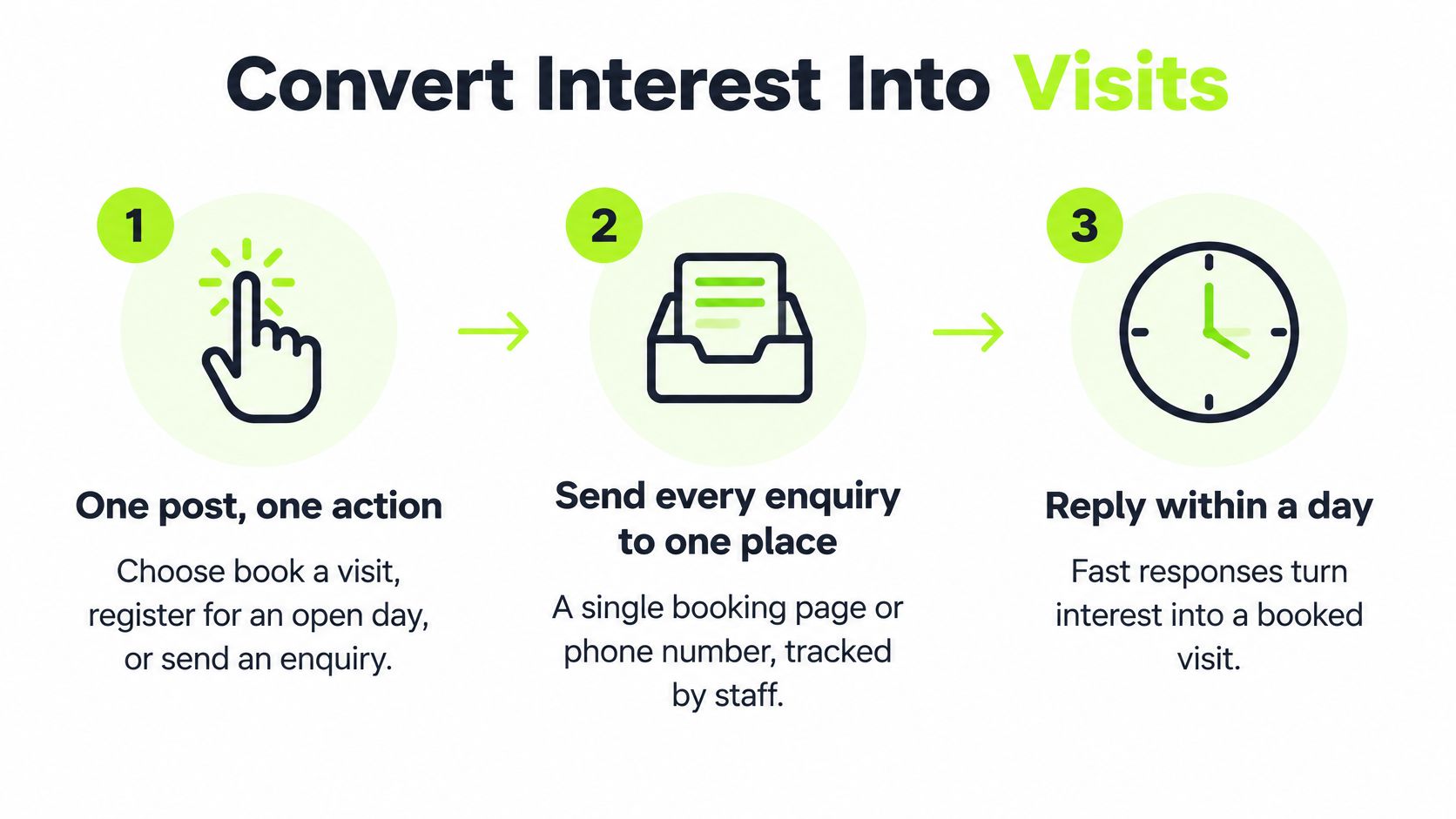
- Give each post one destination. Book a visit, register for an open day, or send an enquiry. Three calls to action on one post makes it impossible to see which one worked, and the report you take to the committee becomes unreadable.
- Send every action to one tracked page. A single landing or booking page per campaign, tagged so the source is recorded the moment the enquiry arrives. Direct messages count as actions too, so the auto-reply needs the same link.
- Auto-reply to direct messages immediately. A saved reply that thanks the sender, sends the booking link and asks for a name and phone number buys you time until a person replies properly.
- Assign the inbox to one named person with a response standard. Same working day is realistic for most clubs. If volunteers or the pro shop also answer messages, brief them on the standard, or the fastest reply in the club becomes the accidental exception.
- Log every enquiry in the CRM with source, stage and next action date. If the next action date is blank, it isn't a lead, it's a message someone read once.
- Invite the enquirer to a visit inside a set window. A trial round, a clubhouse tour or the next open day, booked while the interest is warm, with a reminder 24 hours before.
- Record the outcome, including the reason. Attended, no-show, joined or declined. The reason field is the most valuable data you'll collect all year, because it tells you whether the problem is price, timing, distance or welcome.
- Review weekly and change one thing. Which post produced the most visits, which enquiries have stalled, which stage is leaking. One change at a time is the only way to know what caused the improvement.
The process only works if the first response is fast and the tracking is consistent. A well-crafted post answered three days later is worth less than a plain post answered in an hour, because the person was ready at the moment they typed.
Measuring Instagram Against Membership Revenue
The 2025/26 UK Members' and Proprietary Golf Clubs' Survey reports social media as a successful marketing activity for 49% of members' clubs, according to Hillier Hopkins' 2025/26 survey report. Read that number carefully. Half of members' clubs call it a success, and success in that context is a manager's assessment rather than a count of memberships sold.
To answer a committee properly, build one chain from reach to joined member and report every link in it.
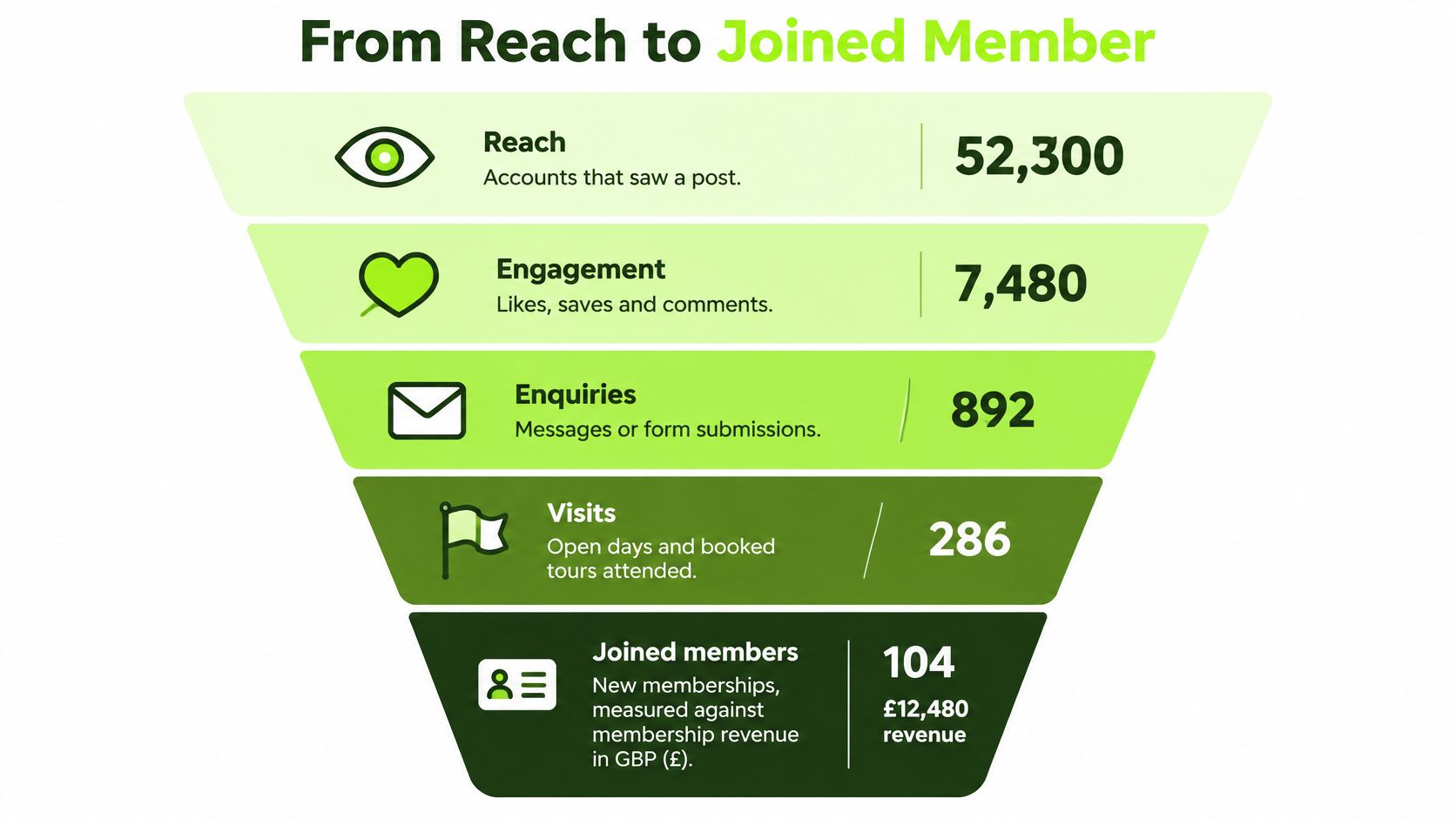
Instagram measures from reach to joined member
| Measure | What it tells you | How to track it | Warning sign |
|---|---|---|---|
| Reach and engagement | Whether content is being seen and liked | Platform insights | High likes with no enquiries |
| Qualified enquiries | Interest from people who fit the membership profile | Tagged form or code per campaign | Enquiries from outside the target radius |
| Booked visit rate | Share of enquiries that book a visit, trial or open day | CRM stage tracking | Enquiries with no next action date |
| Show-up rate | Whether bookings turn into attendance | Booking system and staff log | No-shows after reminders |
| Joining rate | Share of visits that become members | Membership records | Joins delayed for several weeks |
| Cost per joined member | Return on Instagram spend | Ad spend divided by new members from that campaign | Joins already in the pipeline before the campaign |
A worked example, using hypothetical figures
Say a club spends £600 a month on Instagram advertising, and the tracked funnel produces 40 qualified enquiries, 12 booked visits and 4 joins. Cost per joined member is £150. If the average member pays more than that in the first year, the channel is working, and the club can state that in a committee paper without hedging.
Now the honest limits. Some joins arrive weeks after first contact, so a 30-day view will always undercount. Many prospects see several posts before they enquire, so platform attribution will credit the last click and miss the rest. Neither problem is a reason to skip the tracking; both are reasons to report trends across quarters rather than snapshots.
Scale checks help too. Clickthrough Marketing's Q3 2025 UK golf retailers benchmark put the leading UK golf retailer at approximately 183,600 Instagram followers with a reported average engagement of 2,359. Even the biggest account in the sector has an engaged slice in the low thousands, which is why follower counts make poor committee metrics.
Report four lines a month: spend, qualified enquiries, booked visits and joined members, each against the previous month. If you want a simple model for turning those inputs into a return figure, this guide on how to track social impact for small businesses is a reasonable starting point, and our own notes on conversion tracking setup cover the CRM side.
The calculation is only as good as the CRM record. Missing stage data makes cost per join look better than it is, or worse, and either way the committee gets a number nobody should trust.
When someone asks what Instagram brought in this quarter, the answer is already in the four lines.
Working With Creators Within ASA Disclosure Rules
A local golfer offers a course video or a review in exchange for a free round. That arrangement counts as advertising, and it carries rules.
Under the ASA's guidance on recognising ads in social media, content involving a commercial relationship must be treated as advertising when a creator receives payment, free golf, hospitality, products or another incentive, even where the incentive was unsolicited. The same rules cover people with a personal or commercial connection to the club, including employees, owners, directors, family members and friends.
The ASA's guidance on its social media remit applies across feed posts, Stories, Reels and video, because the CAP Code is media-neutral. A casual course walkthrough gets no exemption for being casual.
The disclosure sequence
- Agree the disclosure before the round is played, not after the edit is finished. It's easier to change a caption than to renegotiate with a creator who has already posted.
- Put a clear Ad label at the beginning of the text. A label placed at the end, or buried behind a see more, doesn't count.
- Label the creative itself where only the image or video shows at first, in a size and contrast people can read.
- Check every asset separately. Stories, Reels, reposts and follow-up content each need their own disclosure. A label on last week's post doesn't cover this week's Story.
- Don't rely on tags, codes or the phrase brand ambassador as a substitute for disclosure. They don't do the job on their own.
Keep a one-page approval record for each collaboration: the incentive, the agreed wording, the formats covered, the date and who signed off. It takes four minutes and settles most arguments later.
The commission route is covered by the same principle. The ASA's guidance on brand-owned and paid social media makes clear that a creator earning commission through a personalised tracking link or code is still producing regulated marketing, even with no fixed fee. A club paying per booking for tee times, simulator sessions or lessons should label the content upfront and keep the link for attribution only.
Apply the same process to PGA professionals and members who post on the club's behalf. If you want a wider view of how clubs structure these partnerships, our guide to golf club influencer marketing covers the commercial side.
If you'd hesitate to explain the arrangement to the committee, it needs a label.
Confirm Your First 90-Day Test Before You Scale
Choose one content pillar, one radius, one landing page and one tracked action. Run it for 90 days. That's enough time to gather data and short enough that nobody loses interest.
Record a baseline first: the enquiries, visits and joins from that radius over the previous three months. Without it, every later number is an opinion. Then set the success threshold before you start, in two parts. A cost per joined member the committee has already agreed, and a minimum number of visits per month.
Diary three reviews. At day 30, check that tracking works and the first responses are going out on time. At day 60, look at which content produced visits rather than likes. At day 90, decide. Change only one variable at each review, or you'll never know what moved.
If the threshold is met, scale the winning pillar and radius and leave everything else alone. If it isn't, diagnose before you spend more. Reach problems look like low impressions inside the ring. Enquiry handling problems look like messages with no reply and no next action date. Conversion problems look like visits that arrive, enjoy themselves and never join, and extra budget will make all three worse.
GolfRep builds campaigns around each club's brand, pricing and goals, and recommends using a CRM that shows where each prospect sits, what action is due, and which stage is stalling. That visibility is what turns a 90-day test into a decision rather than a debate.
GolfRep works with UK golf clubs across the whole path from a first Instagram impression to a signed membership: targeted local campaigns, instant qualification of enquiries, and nurture flows that keep warm prospects moving until they book a visit. If you want to know what a realistic cost per joined member looks like in your catchment, and which stage of your own funnel is losing the most prospects, visit GolfRep.
Ready to tap into our proven growth system?