Golf Club Cost Per Lead: How to Calculate It

Seventy-seven per cent of members' clubs and 73% of proprietary clubs reported annual turnover above £1 million, according to the 2024/25 Hillier Hopkins survey of UK golf clubs. Set a £20 enquiry against a revenue base that size and it looks like loose change.
That's exactly where clubs get caught. A golf club cost per lead is a derived number, not a discovered one. It changes with the offer, the answer speed, the joining fee and how long the member stays. A £12 enquiry from a golfer who never books a visit is the most expensive lead a club can buy. A £60 enquiry from a family that joins for six years is the cheapest thing on the spreadsheet.
How to Calculate Cost per Lead for Your Club
Campaign spend divided by enquiries. That's the whole formula, and on its own it tells you almost nothing about whether a campaign worked. A club paying £20 an enquiry that converts one in fifty has bought a very different thing from a club paying £60 that converts one in five.
Three stages sit between a budget line and a new member: the advertising cost to generate an enquiry, the conversion from enquiry to visit or trial, and the conversion from qualified prospect to paid membership. The 2024/25 Hillier Hopkins survey of UK members' and proprietary clubs shows why all three need measuring separately: 40% of members' clubs and 64% of proprietary clubs offered flexible membership packages, so enquiries arrive against different products and price points rather than one joining proposition.
Decide what counts as a lead
Inconsistent counting distorts every figure that follows. Website membership enquiries, phone calls, walk-ins, open-day sign-ups, trial bookings, society enquiries and competition entries are different products with different intent. A club that counts newsletter subscribers as membership leads will report a wonderful cost per lead that means nothing.
- Count only follow-up-worthy enquiries. If nobody on the team would ring the person back as a possible member, it isn't a membership lead.
- Tag the source when the enquiry lands. Untagged enquiries can't be traced to spend, so the campaign that produced them disappears into a blended average.
- Record the visit separately from the enquiry. A booked visit is a different event from a click, and the gap between the two is where most of the money goes.
- Judge payback on subscription revenue first. Leave joining fees out of the first pass so a one-off payment can't make a weak campaign look strong.
Run a campaign through the three stages
The report's own example is the one worth copying. A club spends £1,000 and generates 50 enquiries, a headline cost per lead of £20. If 20% of those become qualified visits, that's 10 prospects and a cost per qualified lead of £100. If 30% of those visits join, the campaign produces three members at roughly £333 each.
| Stage | Example figure | Calculation | Result |
|---|---|---|---|
| Campaign spend | £1,000 | Input | £1,000 |
| Enquiries received | 50 | Spend divided by enquiries | £20 cost per lead |
| Qualified visits (20% of enquiries) | 10 | 50 multiplied by 20% | £100 cost per qualified lead |
| Members joined (30% of visits) | 3 | 10 multiplied by 30% | £333 cost per joined member |
Put those four stages into a spreadsheet with one row per campaign and one column per stage: spend, enquiries, visits, joins, then the cost calculation for each. Nothing more elaborate is required. The sheet earns its keep because it forces the visit count and the join count to sit beside the spend that produced them, which is where most budget arguments get settled.
Check your last campaign this week
Take its spend, divide by the members you can credibly credit to it, and compare the result with first-year subscription revenue. A campaign that cost more than the subscription it produced hasn't paid back yet, whatever the cost per lead column said. Run the same check on your last three campaigns and you'll know whether the constraint sits in the advertising, the first call or the club visit.
What Moves Cost per Lead Up or Down
Two clubs can both report a £20 lead and be in completely different commercial positions. What surrounds the number decides whether it's cheap: the size of the local golfing pool, what's being sold, who's being targeted and how quickly someone answers.

Market size sets the floor
The R&A's 2023 UK Golf Satellite Account puts registered membership at 2.0% of England's population and 3.3% in Scotland, and that gap alone changes how hard a club has to work for the same enquiry volume. A club in a sparse catchment pays more per enquiry because the potential audience is smaller. No amount of creative testing fixes a small pool.
England Golf's 2025 figures reported more than 730,000 club members across 1,735 affiliated English clubs, an average of roughly 421 members per affiliated club. Treat that as a scale reference rather than a target, because location, format and capacity move it a long way in either direction.
The offer changes what an enquiry is worth
A prospect weighing a headline annual subscription needs a different conversation from one weighing an off-peak package, and the qualification bar sits in a different place. Price level does the same work. In a 2022 survey of 82 UK golf clubs, 74% charged membership fees above £1,000 a year, and the average member round rose from £36 in 2021 to £43.50 in 2022. Two clubs can both record a £20 lead while one is chasing a £700 relationship and the other a £2,000 one.
How the fee is explained matters too. In a 2024 Golfshake survey of 3,000 subscribers, 77% of Midlands respondents said their club had explained why the membership fee increased. A prospect who understands the price is a prospect who can be qualified in one call.
Audience, radius, speed and season
- Audience. Junior, family and women's campaigns reach smaller pools than open adult campaigns, which pushes cost per enquiry up. Record the audience on every enquiry.
- Radius. A tight travel filter usually cuts volume and raises the headline cost while lifting the booked-visit rate. Record the postcode against the enquiry so the trade-off is visible.
- Speed. A slow first call raises the effective cost of every lead by wasting the ones already paid for. Record minutes to first contact.
- Competition. Rival clubs bidding on the same local searches raise the price of attention. Record spend by channel so you can see which channel is being bid up.
- Season. Spring and autumn produce cheaper enquiries than December. Record the campaign month rather than just the year.
Improving what arrives is often cheaper than buying more of it, and how to improve lead quality covers the qualification side in more depth. Before changing budgets, compare cost per lead by audience and by package. A blended average hides both the segment that's working and the one absorbing the money.
What Counts as an Acceptable Cost per Lead
No universal benchmark exists, because the acceptable figure is derived from what a member is worth. Any target that arrives from outside the club, whether from an agency deck or a neighbouring manager's anecdote, ignores the subscription, the joining fee and the conversion rate that decide the answer.
- Start with first-year subscription. The 2025/26 Members' and Proprietary Golf Clubs' Survey reports an average annual subscription of £1,760 among members' clubs. Use your own number, but know where you sit against it.
- Add the joining fee you keep. The same survey found joining fees ranging from £140 to £9,300 and averaging £2,350. Count only the part the club retains: a refundable deposit isn't revenue.
- Set an acquisition share. Choose the proportion of first-year revenue you'll spend to win a member. At 20% of £1,760, that's £352 per joined member.
- Convert it into a cost per lead. Multiply the allowance by your enquiry-to-member conversion rate. At 6%, £352 supports about £21 per enquiry. At 4%, the same allowance supports £14.
| First-year subscription | Enquiry-to-member conversion | Acquisition allowance at 20% | Acceptable cost per lead |
|---|---|---|---|
| £800 | 4% | £160 | £6.40 |
| £1,200 | 6% | £240 | £14.40 |
| £1,760 | 6% | £352 | £21.12 |
| £1,760 | 10% | £352 | £35.20 |
| £2,400 | 8% | £480 | £38.40 |
Read that back against the worked campaign. A £20 lead converting at 6% sits just inside a £21 ceiling. The identical campaign converting at 4% is over the line and needs £14 or better to justify the same allowance. Nothing about the advertising changed. Only the conversion did.
The ceiling isn't the cost of the advertising. It's the share of member value you're prepared to spend to win one.
Then run the payback check. £333 per member against £1,760 of annual subscription, or £147 a month, returns the acquisition cost in about 2.3 months before joining fees, bar spend and competition income. That's a comfortable number, and it's the one to put in front of a committee. A member who leaves after four months never repays it, which is why 90-day retention belongs in the same review as the cost figure rather than in a separate conversation about cancellations.
Deciding which enquiries earn that payback is a tracking question, and measuring which enquiries actually convert sets out how to tie spend to the enquiries that turn into members.
When a Higher Cost per Lead Is the Better Buy
Sooner or later a committee asks why the club is paying £60 an enquiry when the club down the road pays £15. The answer starts with where demand is going. England recorded 750,071 club members in 2025, up 2.66% year on year, with junior membership up more than 34% to 61,483, as reported from England Golf's 2025 figures. Scotland reported 220,210 playing members, up 5.4%, with junior boys' membership rising 28.2%.
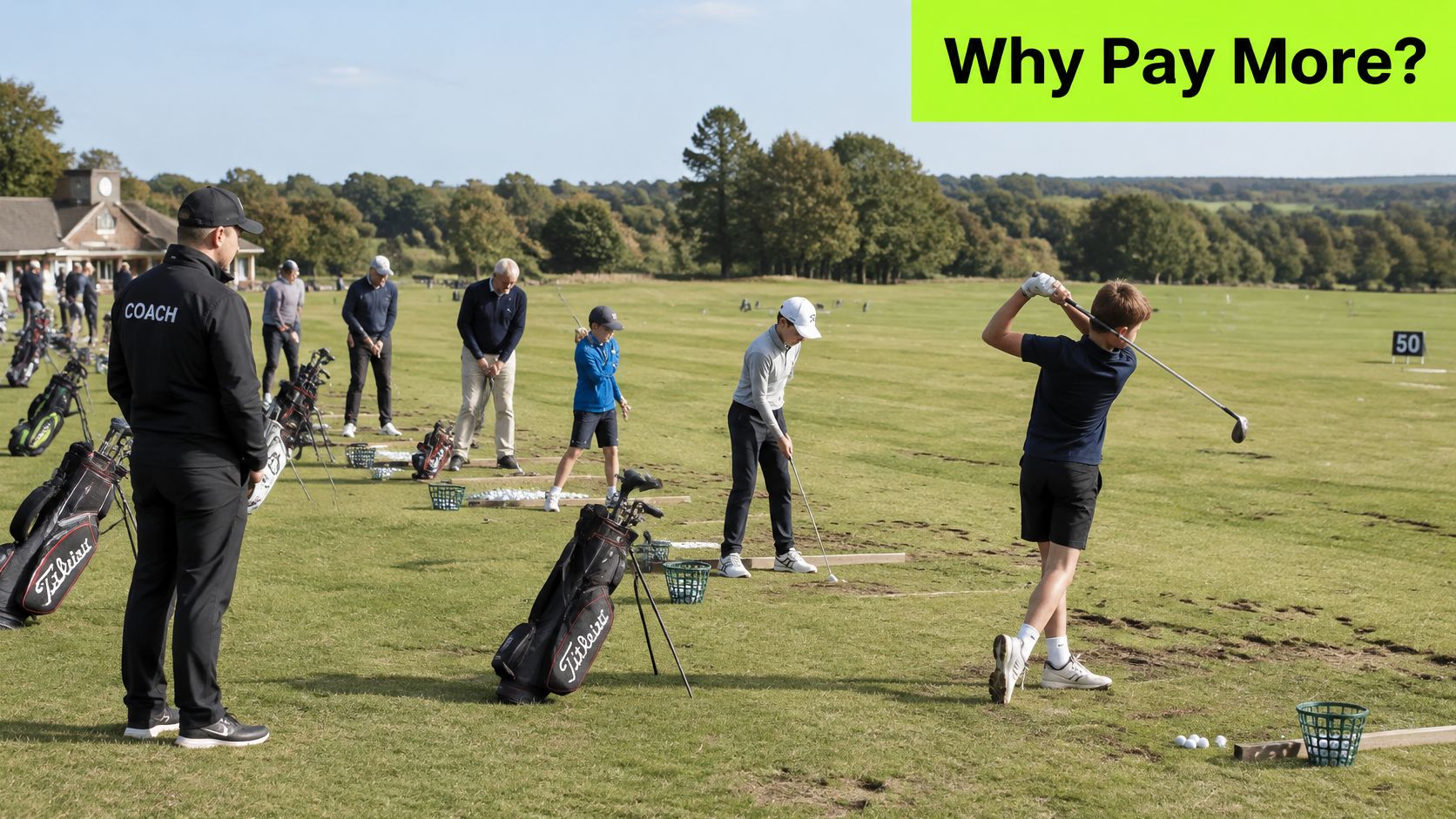
Growth of that shape arrives through parents, families and beginners rather than one-off green-fee hunters, and those audiences need a longer nurture before they join. A cheap enquiry has a predictable failure mode. A trial-round offer fills a form with people who want one round at a discount; they play, they don't join, and the club has paid twice, once for the lead and once for the tee time it discounted.
Price resistance is often assumed rather than tested. In the same 2024 Golfshake membership survey of 3,000 subscribers, 70% of respondents outside the South and Midlands said they were happy with what they paid for membership, against 66% in the South and Midlands. Members who understand the offer tend to accept the price.
Compare audiences on five measures before cutting anything: cost per lead, response speed, booked-visit rate, conversion rate and twelve-month gross margin per member. Then set a separate acceptable cost for each audience, because a junior pathway and an adult full membership don't share one. Response routes differ too. A volunteer-run club that answers enquiries on Tuesday evenings can't run the same funnel as a multi-site group with centralised routing, so a fair cost per lead differs between them.
The test: a higher cost per lead is justified only when the twelve-month margin from the members it produces beats the margin from the cheaper segment after churn.
Reading Cost per Lead Beside Conversion and Revenue
On its own, a cost per lead is half a sentence. It becomes a sentence when three numbers sit beside it: how fast the club replied, how many enquiries reached a real conversation, and how many of those became members. A weakness at any link shows up as a bad lead cost, even when the advertising was fine.

We recommend reviewing those stages one at a time rather than as a single ratio: stage-by-stage conversion, speed to lead, visit-to-join performance, source-level revenue and retention at the 90-day mark. Our pipeline guidance puts a healthy process at 15% to 30% of enquiries converting into memberships. A club converting well below that range has a process problem, whatever its cost per lead looks like on a slide.
Name the constraint, then change one thing
Read the measures together and the constraint usually names itself. A low cost per lead with a weak booked-visit rate points to loose qualification or a slow first call. A high cost per lead with a strong visit-to-join rate isn't a sales problem at all. It's a campaign that needs more volume, and cutting it would be the wrong move.
| Result pattern | Likely constraint | First change to make |
|---|---|---|
| Low cost per lead, low booked-visit rate | Weak qualification or slow first contact | Tighten the offer and contact every enquiry within the hour |
| Low cost per lead, low visit-to-join rate | Poor fit or a weak club visit | Improve the visit itself and the follow-up after it |
| High cost per lead, strong visit-to-join rate | Narrow targeting and low volume | Raise budget on that source before touching the sales process |
| High cost per lead, strong joins, weak 90-day retention | Discount-led or wrong-fit members | Change the offer and review onboarding |
| Rising cost per lead, steady conversion | Audience saturation or tired creative | Refresh creative and widen the radius |
Raw enquiry counts flatter a campaign. Source-level reporting shows what came in, what happened next, and whether that source produced a single booking or ongoing revenue. One row per source, with columns for spend, enquiries, visits, joins and revenue at day 90, settles the argument faster than any dashboard screenshot.
The same discipline shows up outside golf. Customer support KPIs worth tracking separate first-response speed from resolution quality, which is the distinction between speed to lead and visit-to-join rate.
Retention at 90 days belongs in the same table, because a member recruited cheaply who leaves before the first quarter closes reduces the value of the acquisition. The row that looked best at day one can end up the worst. Getting the rows right depends on the tracking underneath, and conversion tracking setup covers how to make each enquiry attributable to the source that produced it. Record which change was made and what the next 90 days produced, so the committee compares like with like.
Practical Levers and the Target to Set Before the Next Campaign
Diagnosis is cheap. Five levers turn it into a plan, each with a measure and a review date so the next conversation is about evidence rather than opinion.

- Target the member profile. Write down the ideal member: home radius, package, family status, playing frequency. Cut any audience producing no booked visits after 60 days, however cheap its enquiries look. Measure qualified leads, review at the next campaign.
- Contact speed. Web enquiries get an answer within one working hour, calls the same day. The measure is the share of enquiries contacted inside the hour, reviewed weekly, because this is the one lever that costs nothing to pull.
- Offer clarity. Campaigns that show the actual course, the package price and what's included produce better-fit enquiries than generic golf imagery. Compare visit-to-join rate by creative, every month.
- Audience spend caps. Give each segment its own budget so a single audience can't absorb the lot, and report cost per joined member per audience monthly. GolfRep uses data-led campaigns built around a club's ideal member profile, which is what makes a per-audience ceiling workable.
- Database reactivation. Lapsed members, former trialists, society organisers and past visitors are the cheapest source a club owns. Work them in sequence and measure joins per 1,000 contacts, quarterly.
Those five levers still need a budget line behind each one, and how to set a golf club marketing budget covers how to split spend across acquisition, reactivation and retention without starving any of them.
Set the ceiling before the brief goes out
Add first-year subscription to any joining fee the club retains, apply the acquisition share you settled on, and you have a target cost per joined member. Convert it into a campaign ceiling using your own enquiry-to-member conversion rate, and write that ceiling into the brief before any spend goes out. Then the campaign is judged against a number agreed in advance.
The 90-day rule: below target with payback inside twelve months, scale the strongest source. Above target, fix conversion before adding budget, starting with speed to lead and booked visits.
Better conversion tracking is usually what lowers the cost per lead fastest, because it shows which enquiries were worth buying in the first place, and Cometly's approach to lowering CPL walks through the tracking side of that work.
Clubs using AI-driven follow-ups see a shorter conversion lag and a higher membership sign-up rate in our own data, and a shorter lag is exactly what brings a £60 enquiry inside the payback window. Our first conversation with a club is an open look at the current set-up, goals and challenges, which is usually enough to see where the constraint sits before any budget moves. Keep the same measures in front of the committee each time. A club that reinvents its reporting every quarter never builds a baseline, and a baseline is what turns a cost per lead from an anecdote into a decision.
GolfRep builds the acquisition and the follow-up side together, so spend, enquiries, visits, joins and 90-day revenue sit on one page and each campaign is judged on the members it produced. If you want your cost per lead tested against your own subscription, joining fee and conversion rate, visit GolfRep and we'll map where the constraint sits in your club before any budget moves.
Ready to tap into our proven growth system?