Boost Golf Member Retention with Enquiry Management

The phone rings. A prospective member wants to know the joining options. Ten minutes later, a website form lands in the inbox. Then someone messages through Facebook asking about a trial round, lessons, and whether there's a route into membership.
On paper, that sounds healthy. Interest is there. The problem is what happens next.
At many clubs, the same pattern repeats. One enquiry gets answered quickly because the office is quiet. Another waits until tomorrow because the secretary is dealing with fixtures. A third gets a polite reply but no follow-up. A fourth visits, likes the course, says they'll think about it, and then disappears because nobody owns the next step. Weeks later, the committee wonders why membership numbers still feel flat.
That's why Golf member retention is often misunderstood. Clubs tend to treat it as a back-end issue. They focus on renewals, social events, and member satisfaction after someone has joined. Those things matter. But a large part of the retention problem starts much earlier, in how enquiries are handled, how prospects are converted, and how new members are integrated into club life.
The Modern Golf Club's Hidden Problem
Most clubs don't have an enquiry problem. They have a process problem.
A manager sees website traffic increasing, more people asking about memberships, and more visiting golfers taking an interest. That creates a false sense of progress. It feels as though growth is happening because interest exists. But interest only matters if the club can respond, track, follow up, and carry that person from first contact into membership.
Where good intent breaks down
A typical club process still looks like this:
- Enquiry lands somewhere random. It might come by email, phone, social media, website form, or direct message.
- One staff member tries to remember it. If they're busy, the follow-up becomes a note on a pad, a flagged email, or a mental reminder.
- Nobody sees the full picture. The manager can't easily tell how many membership enquiries came in, who replied, who booked a visit, or who went cold.
- The prospect feels the inconsistency. Even if staff are polite, the experience feels fragmented.
That's the hidden problem. Clubs often ask, “How do we get more leads?” when the more useful question is, “What happens to the leads we already have?”
Practical rule: If you can't see every live membership enquiry in one place, you don't have a growth system. You have a collection of conversations.
Why this hits retention later
Retention starts before payment.
The first few interactions tell a prospective member what the club will feel like to deal with. If the response is slow, unclear, or dependent on who happens to be in the office that day, the club creates uncertainty before the relationship has even started. That uncertainty carries forward. It affects trust, momentum, and eventually whether that person becomes the kind of settled member who renews year after year.
This is why clubs can be busy and still underperform. Enquiries are arriving. Effort is being made. But without lead visibility, conversion tracking, and a consistent follow-up system, too much value leaks out between interest and integration.
The Real Reason Your Club Is Losing Members
When committees discuss retention, the conversation usually goes straight to course condition, clubhouse atmosphere, competitions, or pricing. Those are real factors. But they're not the whole story.
A retention problem is often an onboarding problem in disguise.
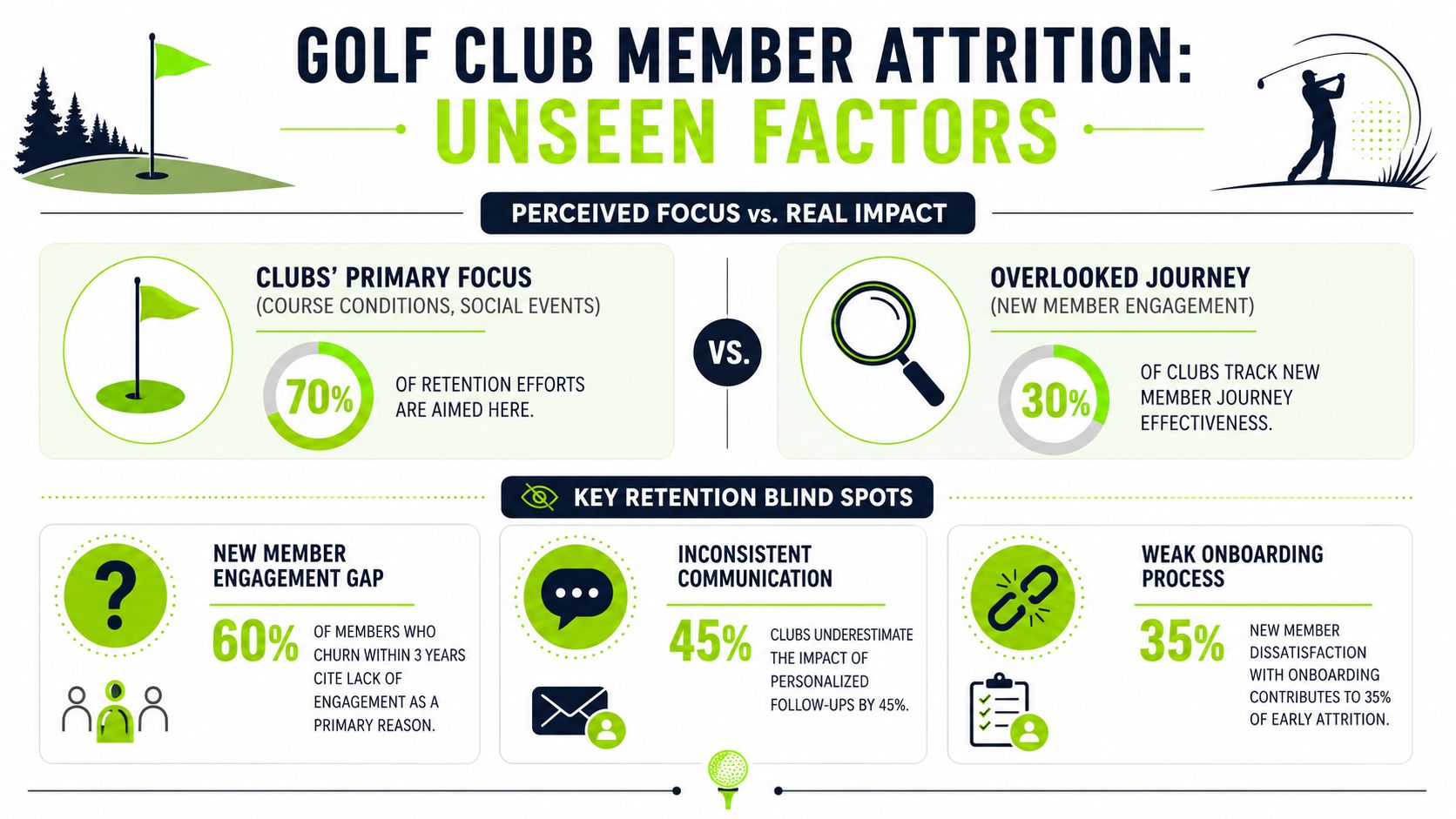
Existing members matter, but so do fragile new ones
Course quality has obvious influence. In a 2024 UK golf club member satisfaction survey by Carr Golf Maintenance, 90% of UK golf club members said year-round course quality will affect their decision to renew, and course conditioning was the leading factor at 55%, ahead of value for money at 39%, tee time availability at 39%, and price at 22%. That tells you standards are high and members notice the basics.
But many clubs take the wrong lesson from that. They hear “retain members by keeping the course good” and stop there.
The bigger operational question is this: what happens to someone after they enquire, visit, join, and spend their first few months trying to find their place in the club?
The leak is often in the first year
That's where a lot of clubs lose people they think they've already won. Studies cited by Club Mark Advisors on membership retention and relations show that up to 25% of new members will leave within the first year if they aren't successfully integrated into the club's lifestyle. That's not a renewal-season issue alone. It's a joining and integration issue.
If a new member joins and gets no real introductions, no structured follow-up, no help finding playing partners, and no clear route into competitions or social touchpoints, they remain peripheral. They may still pay. They may even say they're happy. But they're not embedded.
For clubs trying to improve golf club churn rate, this distinction matters. A member who hasn't integrated isn't really retained yet. They're just on the list.
A signed-up member can still be halfway out the door if nobody helps them become part of the club.
Why clubs misdiagnose it
Most committees review retention after resignations happen. By then, they're looking at outcomes, not causes.
Blind spots tend to be practical:
| Focus area | What clubs often do | What actually helps |
|---|---|---|
| Existing member satisfaction | Invest in course and calendar | Necessary, but incomplete |
| New member experience | Leave it informal | Creates inconsistency |
| Follow-up | Assume staff will remember | Breaks under workload |
| Retention review | Look at renewals only | Misses early warning signs |
That's why Golf member retention needs a wider definition. It isn't just keeping current members happy. It's making sure the people you acquire are properly welcomed, tracked, and absorbed into the life of the club before they drift.
From Enquiry to Engaged Member The Three Year Journey
A membership sale isn't a finish line. It's the start of a longer commitment that has to be managed properly.
Research from England Golf on retention states that converting a new club member into a fully retained member is, on average, a 3-year lifecycle process. That should change how clubs think about acquisition. If long-term retention takes years, then the front end can't be treated as a quick admin exercise.
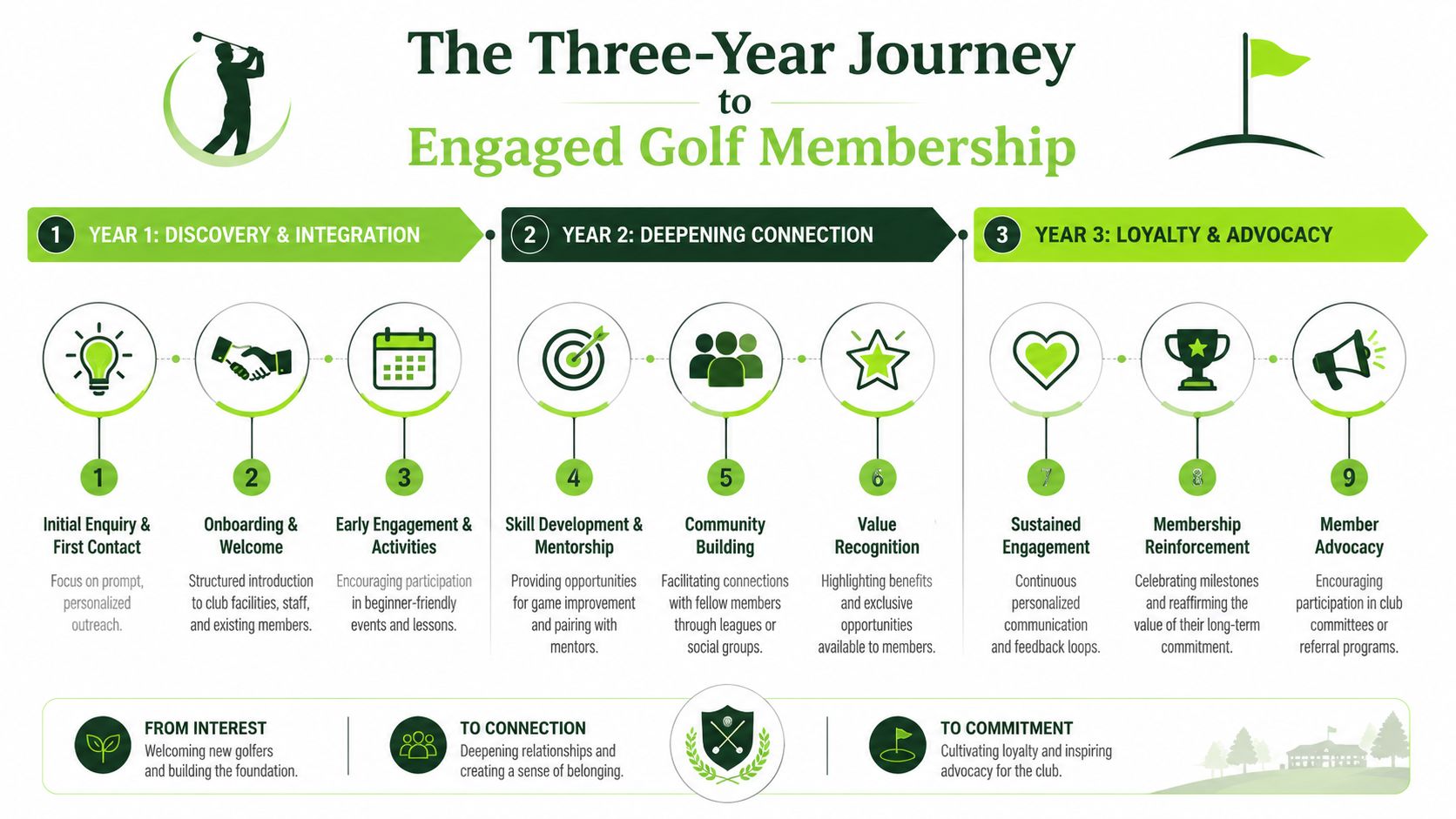
Year one is about momentum
The first stage starts before the person pays anything.
An enquiry comes in. The club replies quickly. A visit is booked. Questions are answered clearly. The prospect meets the right person, sees where they fit, and understands the membership options without confusion. That early handling shapes whether they move forward with confidence or hesitation.
Once they join, the next challenge is simple to describe and hard to execute without systems. The club has to stop the new member from becoming invisible.
A practical first-year approach usually includes:
- Prompt first response so the initial interest doesn't cool off
- Clear next action such as a tour, meeting, lesson, or trial experience
- Structured welcome that introduces the club, not just the payment details
- Early activity prompts so the member uses the club quickly
- Named ownership so one person knows where that member is in the journey
The first 180 days need design
England Golf's retention guidance, as referenced in the same resource, points clubs toward personal communication in the first 180 days, immediate peer introductions, and usage tracking that triggers outreach if engagement drops. That's not over-management. It's recognising that new members often won't build habits by accident.
Some clubs still rely on a welcome email and hope the member “gets involved”. That works for highly confident golfers who already know people. It fails for everyone else.
Working principle: Don't ask new members to build their own pathway into the club. Give them one.
Years two and three are about embedding value
By the second year, the member should no longer feel new, but they still need reinforcement. Clubs deepen connection through consistent contact, suitable playing groups, competitions, coaching, mentoring, or events that match how that member uses the club.
This doesn't have to be expensive. In fact, thoughtful touches often matter more than grand gestures. A well-timed invitation, a personal introduction, or recognition of a membership milestone can do more than generic communication. If you're looking for ideas around meaningful rewards or event recognition, resources on high-impact golf tournament gifts can help clubs think beyond the usual token prizes and create moments that feel considered.
By year three, the goal changes again. You're no longer just preventing dropout. You're reinforcing identity. The member should feel that the club is part of their routine, their social circle, and their calendar.
The journey is long, so the system has to be stable
A three-year lifecycle means clubs can't afford a patchy handoff between marketing, admin, membership, professional staff, and the committee.
If one person handles the initial enquiry well but the onboarding becomes vague, the whole process weakens. If the office does the paperwork but nobody tracks whether the member plays, joins in, or returns after the first few months, the club loses visibility at the exact point where it matters most.
That's why Golf member retention is operational, not just relational. Relationships matter, but they need a system behind them.
Why Manual Follow Up Fails Your Club
Manual follow-up feels personal. In practice, it's usually inconsistent.
A club secretary knows the members, understands the culture, and wants to reply properly. The problem isn't effort. The problem is volume, interruptions, and lack of structure. When enquiries, tours, callback notes, membership forms, and internal questions all sit inside the same working day, follow-up becomes dependent on memory.

Good staff can't fix a weak process
Many clubs frequently get stuck. They think the answer is more discipline, another spreadsheet, or telling the office team to chase harder.
That rarely solves it.
Manual systems break in familiar ways:
- Responses slow down because inboxes get crowded
- Follow-up becomes selective because the most urgent task wins
- Lead ownership gets blurred when several people can access the same enquiry
- Committee visibility disappears because reporting relies on someone compiling notes
- Prospects fall out of view after the first conversation
None of that means the team isn't committed. It means the process isn't built for consistency.
Member expectations don't stop at the course
That matters because service standards are linked. In the same Carr Golf Maintenance survey, 88% of respondents said they have a high expectation for good-to-excellent course conditioning year-round, while 78% said they were satisfied or very satisfied with their club experience. Clubs work hard to maintain standards on the course. But prospects judge standards off the course too.
If the first enquiry is handled poorly, the club creates friction before a member has even reached the first tee.
A slow reply sends a message. So does an unanswered follow-up, a missed callback, or a generic email with a PDF attached and no clear next step. These may look like minor admin slips internally. To the prospect, they signal uncertainty and make the club feel harder to join than it should be.
Why ad hoc follow-up creates false confidence
Manual processes also hide underperformance because they produce activity without clarity.
Someone replied. Someone had a phone call. Someone meant to chase. Someone thinks the prospect “probably joined elsewhere”. That's not a pipeline. It's scattered effort.
A better question for any manager is this: can you tell, today, how many live membership enquiries your club has, what stage each one is at, who owns the next action, and how many have gone untouched for too long?
If the answer is no, that's the operational issue. It's the same reason many clubs start looking for automation support such as golf club automated follow-up. The purpose isn't to remove human contact. It's to protect it by making sure the basics happen every time.
The most expensive missed enquiry is usually the one your club thought somebody else had handled.
What manual work should still do
Manual input still matters in the right places:
| Manual is good for | Manual is bad for |
|---|---|
| Personal phone calls | Remembering every next step |
| Tours and face-to-face visits | Tracking lead stages manually |
| Member introductions | Monitoring every enquiry source |
| Sensitive conversations | Reliance on shared inboxes |
The strongest clubs don't ask staff to do less. They ask staff to do the human work, while systems handle the repetitive and time-sensitive parts.
Building Your Predictable Membership Pipeline
The clubs that improve Golf member retention usually stop treating enquiries, conversion, onboarding, and early engagement as separate tasks. They build one joined-up pipeline.
That pipeline doesn't need to be complicated. It does need to be visible, consistent, and owned.
What a predictable pipeline actually includes
A modern membership pipeline usually has five working parts.
Immediate acknowledgement
When someone enquires, the first job is speed. They shouldn't wonder whether the form submitted correctly or whether anyone saw their message.
That first response doesn't need to be robotic or over-written. It needs to confirm receipt, set expectation, and move the prospect toward a next action. Clubs lose momentum when they answer questions but fail to guide the person forward.
One place to manage every lead
Lead visibility changes everything.
If enquiries from the website, phone, paid campaigns, social channels, and referral routes all end up in different places, nobody sees the complete pipeline. A central CRM solves that. It gives the manager, membership team, or committee a live view of what's in progress.
For clubs comparing lightweight tools before committing to a larger setup, options like Micro CRM software are useful reference points because they show what matters at a practical level: clear lead stages, easy updates, and reliable follow-up prompts.
Structured follow-up instead of hopeful follow-up
Most prospects don't join after one contact. They need reminders, answers, reassurance, and timing that fits their decision process.
That's where clubs benefit from having a defined sequence rather than relying on memory. For example:
- Day one confirms the enquiry and offers a visit or call
- Later follow-up answers common membership questions
- Another touchpoint invites action if the prospect has gone quiet
- A final nudge closes the loop rather than leaving the lead open forever
This doesn't replace personal contact. It supports it.
Tracking behaviour, not just outcomes
The strongest operational shift is moving from outcome tracking to behaviour tracking.
UK club-retention benchmarking cited by Golfmanager through GolfRep's analysis of losing members reports annual retention rates of 92% to 94% where clubs use a data pipeline that tracks retention by cohort and flags declining leading indicators such as rounds played, rather than only looking at renewals. That matters because it turns retention from a post-mortem into an active management process.
In membership growth, the same logic applies before and after joining.
You want to know:
- Which enquiry sources convert best
- Which prospects stall after the first reply
- Which new members haven't engaged early
- Which cohort is dropping in usage
- Which staff follow-up patterns produce movement
Operational insight: If you only review renewals, you're measuring the end of the story. The useful signals appeared much earlier.
Systems let staff be more personal, not less
Some clubs resist CRM and automation because they worry it will make the experience colder. In reality, the opposite is usually true.
When systems handle reminders, stage tracking, and lead visibility, staff get more time for the moments that require judgement. That includes welcome calls, hosted visits, introductions to existing members, and informed conversations with people whose engagement has dipped.
The practical outcome is straightforward:
| Without a pipeline | With a pipeline |
|---|---|
| Enquiries sit in inboxes | Enquiries move through defined stages |
| Staff guess who needs chasing | Tasks are visible and assigned |
| Reporting is manual | Reporting is live |
| Follow-up varies by person | Follow-up is consistent |
| New members can drift unnoticed | Early disengagement becomes visible |
A predictable membership pipeline isn't a marketing extra. It's the operating model that connects acquisition to retention.
The Committee Meeting What This Means for Your Club
If you need to take this into a committee meeting, keep the message simple. The club's retention issue may not be caused only by resignations at renewal. Part of it starts earlier, in how prospects are handled and how new members are integrated.
That changes the discussion from “How do we market harder?” to “How do we stop wasting the interest we already generate?”
The points worth putting on the table
Recent reporting in Golfshake's 2025 UK Golf Club Membership Health coverage found that 77% of golfers plan to renew, 4% do not plan to renew, and 19% remain undecided. That undecided group is where process matters. Clubs rarely move them with vague goodwill alone. They move them with consistent communication, clear value, and active engagement.
For a committee, that creates a practical agenda:
- Review the enquiry path. Where do membership enquiries arrive, who sees them, and how quickly is each one handled?
- Assign ownership. Every live prospect and every new member should have a visible next step.
- Define the first 180 days. Don't leave onboarding to chance or personality.
- Track leading indicators. Watch engagement, usage, and drop-off, not just annual renewals.
- Replace fragmented admin with systems. Clubs need process discipline, not more guesswork.
Questions a committee should ask
A useful committee discussion is usually driven by the right operational questions:
- Can we see the full membership pipeline at any time?
- Do we know how many enquiries are converting to visits and sign-ups?
- What happens in the first months after someone joins?
- Who notices when a new member goes quiet?
- Are we relying on staff memory where a system should exist?
Those questions often reveal the actual issue quickly. The club may not need more awareness. It may need a cleaner process from first contact through to settled membership.
Clubs don't usually lose members in one dramatic moment. They lose them through delayed replies, weak handoffs, and months of low visibility.
If you need internal support to move the conversation forward, it helps to frame this as an operating improvement rather than a marketing expense. A structured case for golf club committee marketing approval often lands better when it's tied to retention, reporting, and member experience rather than promotion alone.
The key point for any manager, secretary, owner, or committee member is this. Golf member retention improves when the club treats acquisition, onboarding, and integration as one connected system. Fix the front end, and the back end gets stronger.
If your club wants a clearer way to handle enquiries, track follow-up, and turn interest into long-term members, GolfRep helps golf clubs build predictable membership pipelines with structured CRM, lead management, and follow-up systems that support real retention.
Ready to tap into our proven growth system?