Golf Club Committee Marketing Approval: A GM's Playbook
You've got a sensible growth idea. The numbers stack up in your head. The team is ready to move. Then the committee agenda lands, your item gets fifteen minutes, and half the room is already worried about cost, member reaction, and whether the club is starting to look “too commercial”.
That's normal in a committee-led club. It's also where good marketing proposals die.
The mistake most GMs make is thinking the job is to prove the campaign is clever. It isn't. The job is to get golf club committee marketing approval by presenting a proposal that feels controlled, governed, and safe to back. Committees don't approve marketing because they suddenly love ads. They approve it when they can see a clear process, clear authority, and clear accountability.
If you're a GM, secretary, or membership lead, stop treating this as a creative pitch. Treat it like a governance exercise attached to a commercial outcome.
The GM's Dilemma and Understanding the Committee Mindset
You're not asking a committee to like marketing. You're asking them to authorise risk.
That changes the conversation immediately. In a private members' club, the committee is usually balancing tradition, finances, member expectations, and board politics at the same time. If your proposal only talks about promotion, social media, or new leads, you'll lose half the room before you finish page two.

Why committees hesitate
Committee caution usually gets dismissed as resistance. That's lazy thinking.
For committee-run clubs in the UK, marketing sign-off should be treated as part of a formal decision chain, not a last-minute operational task. That matters because committee effectiveness depends on factors like composition, board alignment, and communications discipline, which directly affect how members perceive club decisions, as discussed in this committee governance discussion for golf clubs.
In plain English, the committee isn't just judging your idea. They're judging whether approving it makes them look responsible.
Common concerns usually sit under four headings:
- Tradition: Will this feel out of character for the club?
- Cost control: Are we spending money without a proper system behind it?
- Reputation: Could the campaign annoy members or cheapen the club's image?
- Fair governance: Has the right process been followed before this lands in front of us?
If you understand those concerns early, the meeting becomes easier. If you ignore them, you'll hear coded objections like “the timing isn't right” or “we need more detail”.
Practical rule: Committees rarely reject marketing because the idea is too modern. They reject it because the proposal feels under-governed.
Reframe the ask
Don't walk in saying, “We'd like budget for marketing.”
Say, “We're seeking approval for a controlled growth plan with defined reporting, ownership, and review points.”
That sounds different because it is different. The committee needs to hear that this isn't a random spend. It's a structured business case linked to member growth, visitor revenue, reputation, or all three.
A better framing looks like this:
- Commercial need: Membership pipeline is inconsistent, visitor demand is uneven, or enquiries aren't converting well enough.
- Operational issue: The club lacks visibility on leads, response times, follow-up, or campaign performance.
- Governance answer: The proposal includes scope, delegated responsibilities, reporting dates, and approval boundaries.
If you need a broader management perspective on issues like this, GolfRep's writing for golf club managers is worth reading because it focuses on the practical pressures club operators face.
What the committee wants from you
They want confidence that you've done the homework. They want to know who is responsible. They want to know what happens if the plan underperforms. They also want to know this won't create member unrest.
That means your proposal has to respect the club's internal politics without being paralysed by them.
The best GMs don't fight the committee mindset. They work with it. They present marketing as a disciplined process that protects the club while improving commercial performance.
Laying the Groundwork Before the Formal Proposal
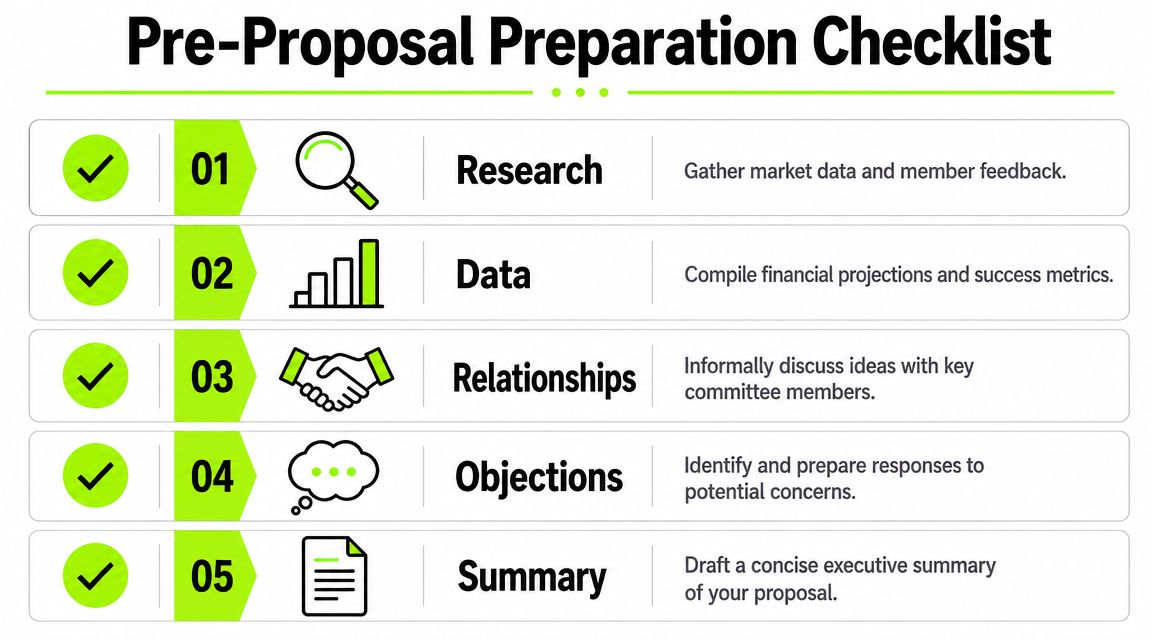
Most approvals are won before the meeting invite goes out.
If your first real conversation about the idea happens in the boardroom, you've left it too late. Committee-led clubs don't run on surprise. They run on pre-alignment.
Do the corridor work first
Before you build the formal pack, speak to the people who will shape the room. Not everyone needs a full briefing, but key voices do.
Ask short, practical questions in one-to-one conversations:
- “What would you need to see to be comfortable with this?”
- “Do you see this as committee authority or board authority?”
- “What concerns do you think members would raise?”
- “Would you prefer a pilot rather than a full rollout?”
You're not lobbying in a clumsy way. You're identifying friction early.
A committee member who raises an objection privately gives you a chance to prepare. The same objection raised publicly, with others watching, can sink the proposal.
Clarify delegated authority before anyone debates the idea
Many clubs waste weeks at this stage.
UK golf club governance guidance often treats marketing as a sub-committee function, but proposals still need formal approval. The bottleneck is usually unclear delegated authority between the committee, the board, and the GM, as outlined in this governance guide for golf clubs.
So ask these questions early:
| Decision point | What you need to confirm |
|---|---|
| Budget approval | Can the committee approve it, or is full board sign-off required? |
| Supplier appointment | Can management appoint the provider once budget is approved? |
| Messaging approval | Does campaign wording need a separate review? |
| Reporting line | Who receives progress updates first, committee or board? |
If you can't answer those points before the meeting, don't present yet.
Find your internal champion
Every committee has one person who understands commercial reality better than the rest. It may be the captain, a finance lead, a younger board member, or someone who has run a business outside golf. Find them.
Your champion doesn't need to sell the whole plan for you. They just need to stop the room drifting into vague hesitation.
A useful internal champion can do three things:
- Back the process when others worry the proposal feels rushed.
- Translate the business case into committee language.
- Support a motion when the room goes quiet and nobody wants to be first.
Approval friction usually isn't about bad ideas. It's about unclear ownership.
If your proposal includes better lead handling, visibility, and follow-up systems, it helps to understand what a club-side process should look like. This overview of a golf club CRM system is useful because it grounds the discussion in operations, not just promotion.
Building Your Bulletproof Proposal and Budget Pack
If your proposal pack starts with “marketing objectives”, you're already on the back foot.
Start with the business problem. In most clubs, the issue isn't a total lack of demand. It's that demand is handled inconsistently. Enquiries come in by email, web form, phone call, and social message. Nobody sees the full picture. Follow-up depends on who's in the office. Good leads go cold.
That's the case you need to make. You are not asking for money to “do some marketing”. You are asking for approval to fix a pipeline problem.
Lead with the leak, not the channel
A strong proposal opens with a blunt diagnosis:
- The club does not have full visibility over membership or visitor enquiries.
- Response handling is inconsistent.
- Conversion can't be improved properly because tracking is weak.
- Committee decisions on future spend will stay difficult if results remain vague.
That immediately moves the debate away from whether Facebook is tasteful or whether a campaign image looks too corporate. It puts the focus where it belongs. Systems, accountability, and revenue discipline.
What the pack should include
Your committee pack doesn't need theatre. It needs structure.
Include these core documents:
| Document | What it should do |
|---|---|
| Problem statement | Show where enquiries are being lost or poorly managed |
| Proposed solution | Explain the system, process, and campaign approach |
| Budget summary | Separate one-time setup from monthly spend |
| KPI sheet | Define how success will be measured |
| Approval request | State exactly what decision the committee is being asked to make |
The most persuasive packs are short. Usually, the executive summary matters more than the deck itself. If you want a good external reference on structure and clarity, these tips for powerful pitch decks are useful because they push you to simplify the argument rather than overdesign it.
Use measurable indicators, not soft language
Committees are far more comfortable approving marketing when they can tie it to visible outputs. That's not just instinct. It's supported by real golf-sector data.
For courses using Digital Marketing Solutions for 90 to 180 days, website sessions rose by 142% and Facebook reach increased by 64.6%, according to Lightspeed's reported performance data. That doesn't guarantee the same result for your club, but it gives a committee a credible reason to view approved marketing as measurable rather than speculative.
That's the language to borrow. Measurable. Reviewable. Visible.
Don't promise magic. Promise reporting.
Build the budget around control
Most clubs make the budget page too vague. Break it down properly. Show what is setup, what is recurring, and what the club gets in return.
Sample Budget and KPI Justification
| Investment Area | One-Time Cost | Monthly Cost | Key Performance Indicator (KPI) | 90-Day Target |
|---|---|---|---|---|
| CRM setup and enquiry workflow | To be confirmed by supplier | To be confirmed by supplier | Lead visibility across all sources | Full enquiry capture and reporting in place |
| Website conversion improvements | To be confirmed by supplier | None or as scoped | Enquiry form completion quality | Cleaner tracking and stronger enquiry intent |
| Paid digital campaigns | None or as scoped | To be confirmed by budget | Website sessions and enquiry volume | Visible traffic growth and enquiry generation |
| Review and local search management | Minimal or as scoped | To be confirmed by resource plan | Review response coverage and local visibility | Faster trust-building improvements |
| Reporting and committee dashboard | To be confirmed by supplier | To be confirmed by supplier | Monthly transparency on activity and outcomes | Agreed reporting cycle live |
Notice what this does. It keeps the committee focused on outputs and governance rather than guessing.
Show the operating model
Your proposal should also answer who does what after approval.
Spell out:
- Who owns campaigns
- Who responds to enquiries
- Who updates the CRM
- Who reports to committee
- Who can approve minor tactical changes without another full vote
That last point matters. If every landing page tweak or budget adjustment needs another committee discussion, the whole thing will stall.
If you want a wider commercial lens on why disciplined tracking matters, this piece on the real ROI of golf club marketing is a useful companion because it pushes the conversation beyond clicks and towards outcomes.
Presenting Your Case with Confidence in the Boardroom
The room doesn't care how hard you worked on the slides.
They care whether the proposal sounds sensible, controlled, and worth backing.
Open like an operator, not a marketer
Your first few sentences matter more than the rest of the deck. Start with the commercial issue in plain English.
Try something along these lines:
The club is getting interest, but we don't have a consistent system for tracking, responding to, and converting enquiries. This proposal is designed to fix that with a controlled process, clear accountability, and regular reporting.
That opening does three useful things. It frames the issue as operational. It makes the proposal sound governed. It avoids jargon.
Don't start with channels. Don't start with brand awareness. Don't start with what the supplier says they can do.
Speak to risk and return together
Committee members will mentally ask “so what?” after every point. Answer it before they need to.
Instead of:
- We want to improve our digital presence.
Say:
- We want better visibility over where enquiries come from so the club can make better decisions on spend and follow-up.
Instead of:
- We're proposing social campaigns.
Say:
- We're proposing a managed acquisition process that brings in enquiries and allows staff to follow up consistently.
This sounds more serious because it is more serious. The proposal isn't about looking busy online. It's about running a proper intake and conversion process.
Keep the room aligned
Presenting well in a committee setting is partly about content and partly about control.
A few practical rules:
- Keep it short: If the pack needs twenty minutes of explanation, it probably isn't sharp enough.
- Bring operational support: If the Head Pro, membership lead, or office team will be involved, align their position in advance.
- State the decision required clearly: Don't make the committee guess whether they're approving budget, process, or principle.
- Ask for approval in words they can adopt: Committees respond better when the resolution is obvious.
A confident presentation feels calm, not flashy. You don't need to “sell” the room. You need to remove enough uncertainty that approving the proposal feels like the responsible option.
Mitigating Perceived Risks and Handling Objections
Every committee objection has a real concern behind it. Treat it seriously and you'll usually get further than if you try to out-argue it.
Objection one: “It costs too much”
This usually means one of two things. Either the committee doesn't trust the process yet, or they can't see how spend will be controlled.
The answer is to phase the decision. Don't force the room into an all-or-nothing commitment if it isn't ready.
A practical response:
- Approve a pilot period
- Limit scope to the highest-priority fixes
- Agree reporting dates in advance
- Put any broader rollout behind review
That turns a big, abstract commitment into a manageable governance decision.
Objection two: “It feels too corporate”
This is common in member-led clubs, especially where committee members worry about tone.
The mistake is to defend marketing in the abstract. Instead, bring the discussion back to club standards. Good marketing doesn't make a club look cheap. Bad marketing does. A disciplined process, careful messaging, and clear sign-off protect the club's image far better than ad hoc promotion ever will.
A club's reputation is shaped as much by inconsistent communication as by poor creative.
Objection three: “What if it doesn't work?”
That's a fair question. Your answer should be simple. We'll know whether it's working because we're agreeing the reporting measures now.
Low-risk actions are particularly helpful. According to Lightspeed's golf marketing guidance, 94% of consumers say a bad review has convinced them to avoid a business. That gives you a practical route into approval. A club can spend weeks arguing over paid campaigns while neglecting faster wins such as review responses and local SEO.
That's often the right starting point in a cautious committee environment.
A sensible low-risk first phase
If approval is hard to secure, propose a first stage focused on trust and visibility rather than broad paid promotion.
For example:
- Review response process: Make sure every review gets a timely, appropriate reply.
- Local SEO basics: Tighten the club's search presence and key listings.
- Enquiry handling workflow: Standardise who responds, how quickly, and what happens next.
- Simple reporting: Show enquiry sources, follow-up status, and outcomes.
That gives the committee evidence without asking them to swallow the entire strategy at once.
Give them the wording
Many committees don't reject proposals because they hate them. They drift because nobody puts a clear motion on the table.
Use wording like this:
That the committee approves a phased marketing and enquiry management initiative, beginning with a defined pilot focused on enquiry handling, review management, and local digital visibility; that the GM is authorised to implement the approved scope within the agreed budget; and that progress is reported back to the committee at the next scheduled review point.
That language makes approval easier because it sounds controlled, limited, and accountable.
Securing Momentum After the Decision
A yes is only useful if something happens next.
Clubs lose momentum after approval all the time. The meeting ends, everyone moves on, and two weeks later nobody is certain what was agreed, who owns the next step, or when results will be reviewed. That's how committee confidence disappears.
If you got the yes
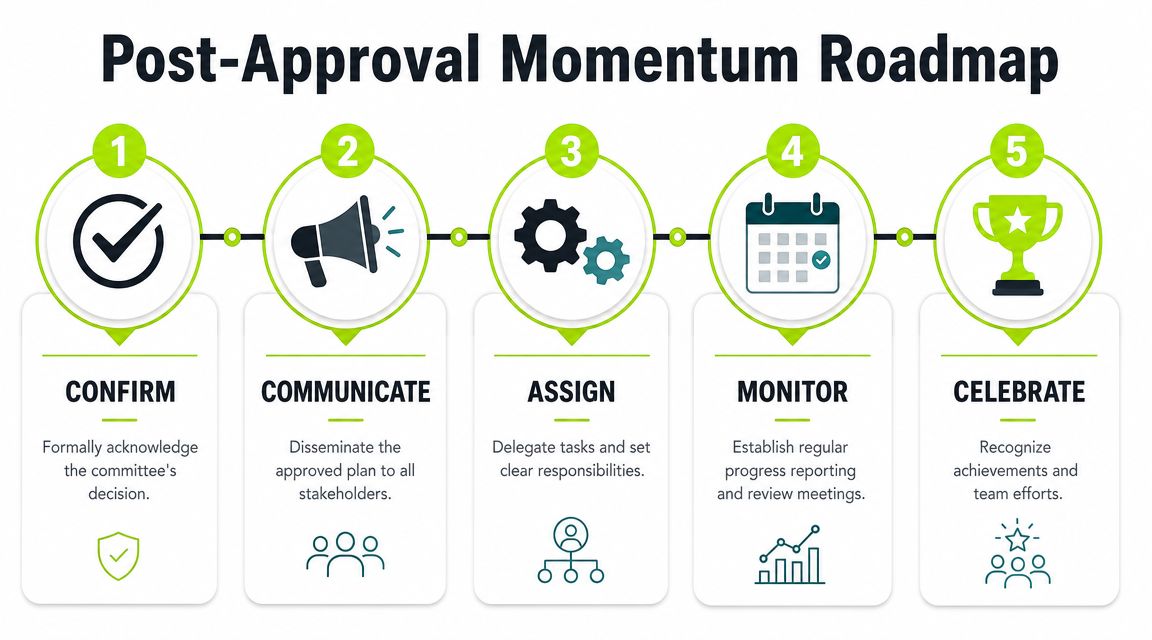
Act quickly. Send a written summary while the decision is still fresh.
Your follow-up should confirm:
- What was approved
- What was not approved
- Who owns implementation
- What the timeline looks like
- When the committee will see the first update
That follow-up note does more than keep things tidy. It protects the decision. If anyone later says, “I thought we were only agreeing principle, not spend,” you've got a clean written record.
Build visible reporting early
Committee confidence rises when reporting is simple and regular.
You do not need a complicated dashboard. You need a reliable one. Show the committee the few things they care about:
| Reporting area | What the committee needs to see |
|---|---|
| Enquiry volume | Are leads coming in consistently? |
| Source visibility | Where are enquiries coming from? |
| Follow-up status | Are staff responding and progressing leads? |
| Conversion progress | Are visits, conversations, or applications moving forward? |
| Issues and actions | What needs fixing before the next report? |
Short reports beat long reports. A committee member should be able to scan the update and understand performance in a couple of minutes.
Boardroom habit: If reporting is unclear, committee support fades faster than campaign performance.
If you got a maybe or a no
Don't sulk. Don't push. Get precise.
Ask three questions:
- Was the issue budget, timing, or process?
- What would need to change for the proposal to be reconsidered?
- Who needs to be involved before it returns to the agenda?
That gives you something useful. A vague rejection is frustrating. A specific objection is workable.
Often the answer is not to rewrite the whole strategy. It's to tighten authority, narrow the first phase, or improve how the proposal addresses member concerns.
Respect legacy while moving forward
This matters more than some managers realise. Many committees are not anti-growth. They are protective of the club's identity. If your implementation ignores that, support weakens fast.
That's why examples from outside pure marketing can help. This piece on Weaving legacy into textiles is useful because it shows how a historic golf institution can modernise presentation without losing its sense of heritage. Clubs need the same balance in their growth decisions.
The real job after approval
Your role isn't just to deliver a campaign. It's to prove that committee-approved growth can be run professionally.
That means:
- communicate early
- assign clear responsibilities
- report accurately
- fix bottlenecks fast
- bring the committee evidence, not excuses
Do that consistently and the next approval gets easier. That's the ultimate win. Not one campaign. A better decision-making culture around growth.
If your club needs a more structured way to win approval, track enquiries, and convert interest into memberships, GolfRep helps UK golf clubs build the systems behind the marketing. That means clearer lead visibility, faster follow-up, and a more predictable pipeline the committee can understand and support.
Ready to tap into our proven growth system?