Golf Club Automated Follow Up
Most advice about golf club growth starts in the wrong place. It tells clubs to generate more leads.
That sounds sensible until you look at how enquiries are handled. A membership prospect fills in a form on Tuesday evening. A society organiser calls during a busy Saturday shift and gets no answer. A visitor asks about flexible options, then hears nothing until someone finds time to reply. The issue isn't always demand. The issue is what happens after interest appears.
Golf club automated follow up fixes the part most clubs still run manually. It turns a patchy process into a visible one. Every enquiry gets a response, every lead has an owner, and every next step is clear.
Why Your Club's Growth Problem Is Follow Up Not Leads
Many clubs assume the answer is more advertising, more social posts, more traffic, more enquiry volume. In practice, the bigger problem is usually a leaky conversion process. Enquiries come in, but they aren't acknowledged quickly, they aren't segmented properly, and they aren't followed through consistently.
That's why lead generation on its own rarely solves the problem. If your current process relies on inbox monitoring, handwritten notes, missed voicemails, and whoever happens to be free that day, adding more enquiries increases the spill.
Manual chasing breaks under normal club conditions
Golf clubs don't operate in tidy sales environments. The person answering the phone might also be dealing with bookings, member queries, and operational issues. The person who should reply to membership leads may only be available at certain times. Committee-led clubs often have even less continuity.
So manual follow up becomes reactive. A good prospect gets an excellent response one day and no response the next.
Practical rule: If a lead has to wait for a staff member to remember the next step, your system is already unreliable.
This is one reason CRM-led automation became more important after GDPR-era consent controls reshaped data collection. The UK Information Commissioner's Office has repeatedly emphasised that organisations need a lawful basis and clear consent or legitimate-interest justification for electronic marketing, which pushed businesses towards cleaner data capture and more structured, auditable follow-up rather than ad hoc chasing, as outlined in this golf CRM and database overview.
Speed matters more than good intentions
Clubs often think they're following up because someone eventually replies. From a prospect's point of view, delayed replies often feel like no reply at all. Interest cools quickly, especially when the person is comparing several clubs.
Missed calls are a major blind spot here. If your club treats unanswered calls as a minor admin issue, you'll lose valuable enquiries without ever seeing them in a report. That's why Rosie's insights on call management are useful reading for club managers who want to understand how call handling affects conversion, not just front-desk workload.
A stronger growth system starts with one question. What happens in the first few minutes after someone raises their hand?
Predictable growth comes from infrastructure
Automated follow up isn't just a marketing add-on. It's operational infrastructure.
A proper system should:
- Acknowledge every enquiry immediately so the prospect knows the club has received it
- Assign ownership internally so no lead sits in limbo
- Trigger the right next step based on the enquiry type
- Track outcomes clearly so managers can see where leads stall
That's also why so much golf marketing underperforms. The campaigns may be fine, but the handling process behind them is weak. We've written before about why most golf club marketing fails, and poor follow up sits near the top of that list.
Defining Your Goals and Lead Segments
Before you automate anything, decide what the system is meant to produce. “More leads” is too vague. “More membership tours booked from membership enquiry forms” is workable. “More off-peak green fee bookings from local visitors” is workable. “More corporate day deposits from business enquiries” is workable.
Those goals shape the follow-up flow, the messages, and the handover points to your team.
Start with outcomes, not software
Clubs often buy a CRM or an automation tool before they've agreed what success looks like. That leads to generic workflows that don't match the actual sales process.
Use a simple hierarchy. Start with the business objective, then define the specific enquiry types that support it.
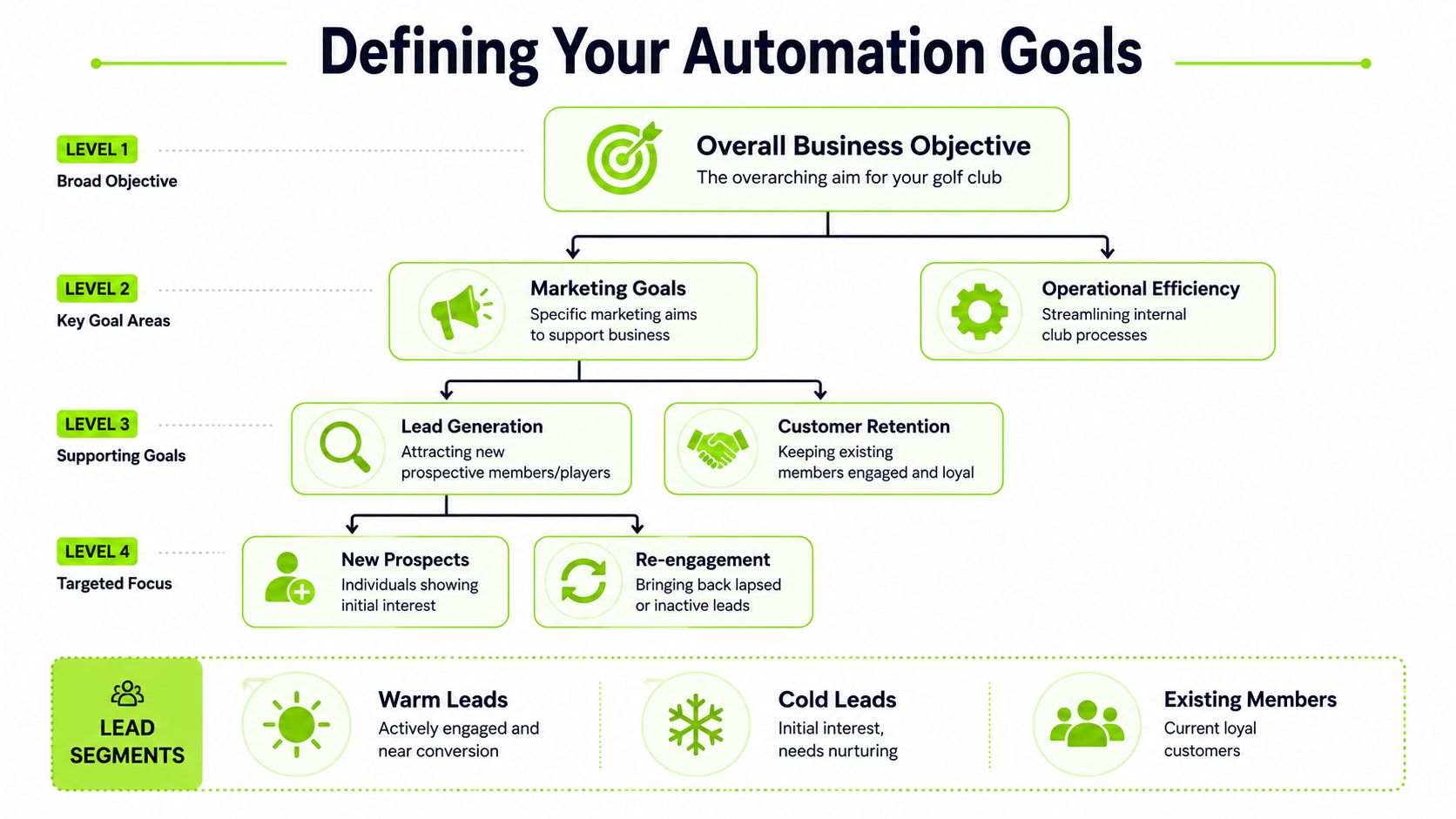
A membership enquiry and a society enquiry shouldn't go into the same bucket. One may need a tour, pricing explanation, and member experience content. The other may need date availability, package options, and a deposit process. If both receive the same sequence, one of them will feel irrelevant from the start.
Segment by intent and by source
A useful segmentation model is usually enough to fit on one page. It doesn't need to be complicated.
Consider separating leads by:
- Intent. Flexible membership, full membership, beginner pathway, visitor booking, society day, corporate event, lessons.
- Source. Website form, paid advertising, social media message, phone call, email, referral, in-club event.
- Sales stage. New enquiry, contacted, tour booked, proposal sent, dormant, converted.
- Consent status. Opted in for marketing, transactional only, consent unclear, opted out.
That last one matters more than most clubs realise.
The real compliance question isn't whether you can automate. It's which touchpoints you can automate, how opt-in should be structured, and how to stay compliant while still responding instantly.
That gap is often overlooked in golf marketing advice. Much of the generic guidance talks about reminders and welcome emails, but not about lawful automation for membership enquiries, event leads, or abandoned forms under UK GDPR and PECR. This research discussion on consent-safe automated follow-up is useful because it frames the issue correctly.
Build your database around future action
Most clubs already have contact data. The problem is that the data isn't structured in a way that supports action. Names sit in spreadsheets, inboxes, booking systems, and notebooks. No single system shows who enquired, what they asked for, whether they were contacted, or what happened next.
That's why database structure matters before message writing. Your fields should help the team act, not just store information. If you're tightening that foundation, this guide to a golf club database is a practical place to start.
A good rule is simple. If a lead lands in the system, your team should be able to answer four questions immediately:
- What does this person want
- Where did they come from
- What are we allowed to send
- What should happen next
Designing Your Multi-Channel Nurture Sequence
An effective golf club automated follow up sequence doesn't feel like a campaign. It feels like a well-run club responding properly.
The structure matters because prospects don't all read email at the same moment, answer calls at the same time, or make a decision after one touchpoint. A single email is easy to miss. A random phone call without context can feel abrupt. A good sequence uses different channels for different jobs.
Give each channel a role
Email is still a core revenue channel, and the UK Data and Marketing Association's 2023 UK Email Benchmarking Report found average open rates across sectors of 32.5% for welcome emails and 29.9% for newsletter emails, which is why timely nurture tends to outperform one-off promotional sends in follow-up workflows, as referenced in this summary of the DMA benchmarks.
That doesn't mean email should do everything.
Use channels with a clear purpose:
- Email for detail. Membership options, next-step guidance, FAQs, club ethos, links to book a visit.
- SMS for urgency and clarity. Simple prompts, confirmations, reminders, and a direct booking nudge.
- Phone tasks for high-intent leads. If someone requests pricing, asks about joining, or opens several messages without booking, your team should get a task to call.
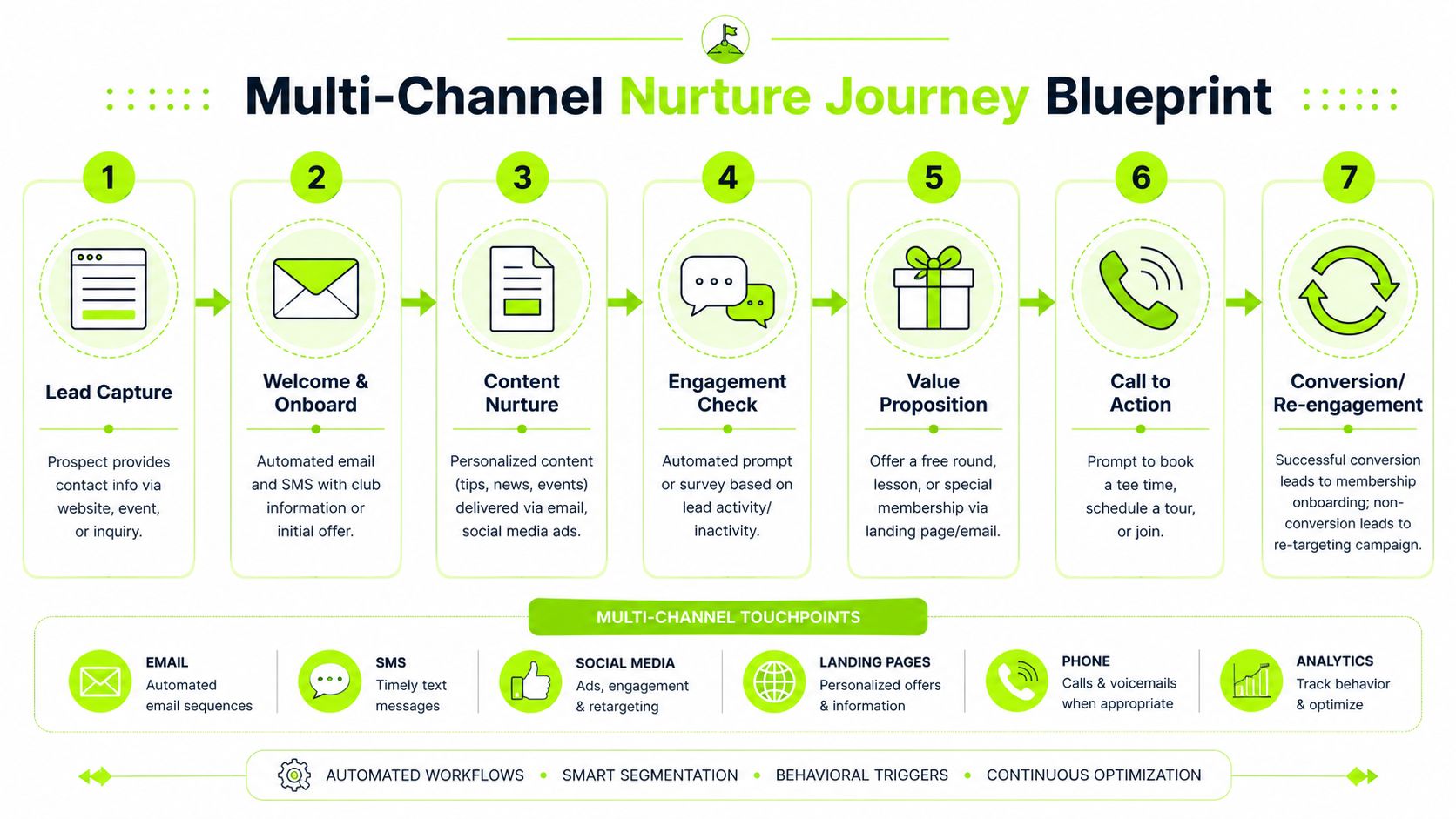
A practical nurture flow for membership enquiries
You don't need a complicated sequence. You need one that matches how golfers decide.
A workable flow often looks like this:
| Timing | Channel | Purpose | Exit trigger |
|---|---|---|---|
| Immediate | Confirm receipt, set expectations, introduce next step | Prospect books a visit or replies | |
| Immediate | Internal task | Alert team to call or review high-intent enquiries | Staff action completed |
| Same day | SMS | Short acknowledgement and simple route to reply | Prospect replies or books |
| Day 1 to 2 | Helpful content on membership types, playing options, what to expect | Prospect moves to active conversation | |
| Day 3 to 5 | Call task or SMS | Prompt a tour, call, or question reply | Tour booked |
| Day 7 onwards | Handle objections, share relevant club information, reinforce next step | Prospect converts or pauses | |
| Final stage | Email or SMS | Re-engage politely, offer easy reply path | Lead marked dormant or reactivated |
The point isn't the exact day count. The point is that each message has a job, and the system stops or changes once the prospect takes a meaningful step.
Avoid the two common mistakes
The first mistake is over-automation. Some clubs load too many messages into the sequence and create noise. If every touchpoint says the same thing, the prospect tunes out.
The second is under-automation. They send a confirmation email and call that “automation”, but there's no reminder, no escalation, no branch for people who engage but don't book.
Strong nurture flows don't chase blindly. They respond to behaviour.
If someone books a tour, stop the prospecting messages. If someone clicks membership pricing twice but doesn't reply, create a call task. If someone ignores everything, slow the cadence and switch to a softer re-engagement message.
That's where the system starts doing real work. If you want to see how this fits into a wider club communication strategy, our guide to golf club email marketing covers the role email should play alongside the rest of the stack.
Crafting Messages That Convert Enquiries into Visits
Automation only works when the messages sound useful, relevant, and human. Most golf clubs don't lose response because the technology failed. They lose it because the follow-up reads like admin.
The best messages reduce uncertainty. They answer the next obvious question and make the next step easy.
What strong follow-up copy actually does
A prospect who has just enquired doesn't usually need a sales pitch. They need reassurance that the club has received the enquiry, clarity on what happens next, and a reason to keep the conversation moving.
That means your messages should do three things well:
- Acknowledge the action. Confirm what they asked for.
- Add context. Give one useful piece of information, not a full brochure.
- Drive one next step. Book a visit, reply with a question, choose a call time.
Write like a club, not a template library
Generic corporate language kills momentum. So do overlong emails full of attached PDFs. Keep the writing plain, specific, and close to the core decision the prospect is trying to make.
If the message could be sent by any club in the country, it won't help your club stand out.
A membership prospect wants to know whether the club fits their playing habits, budget, and lifestyle. A society organiser wants confidence that the day will run smoothly. A beginner may need reassurance far more than pricing detail.
Sample nurture message templates
| Day | Channel | Purpose | Example Subject / SMS Start |
|---|---|---|---|
| Immediate | Confirm enquiry and set expectations | Subject: Thanks for your membership enquiry | |
| Immediate | SMS | Fast acknowledgement | SMS: Thanks for getting in touch with [Club Name] |
| Day 1 | Add value and reduce uncertainty | Subject: A simple guide to choosing the right membership option | |
| Day 3 | Build trust and move toward visit | Subject: Would you like to come and see the club this week? | |
| Day 5 | SMS | Simple prompt to respond | SMS: Just checking you saw our note about visiting the club |
| Day 7 | Re-engage respectfully | Subject: Still considering your options? | |
| Final stage | Close the loop without pressure | Subject: Shall we keep this open for now? |
A few practical templates
Immediate confirmation email
Thanks for getting in touch about membership at [Club Name]. We've received your enquiry and a member of the team will review it shortly. In the meantime, if it helps, you can reply to this email with the type of membership you're considering or any questions you'd like answered before a visit.
Day 1 value email
Choosing the right membership usually comes down to how often you play, when you prefer to play, and whether flexibility matters more than unlimited access. If you'd like, we can point you toward the option that fits best and arrange a time for you to see the course and clubhouse.
SMS prompt
Thanks again for your enquiry. If you'd like to arrange a visit or quick call, just reply here and we'll sort a time.
Notice what these don't do. They don't over-explain. They don't pile in every membership detail. They move the lead to the next step.
Integrating Your Systems for Seamless Automation
Automation falls apart when the systems are disconnected. A website form collects the enquiry, an inbox receives it, a spreadsheet tracks it, and a member of staff tries to remember whether anyone replied. That isn't a system. It's a relay race with dropped batons.
The CRM has to be the central record. Everything else should feed it or respond to it.

What the integrated setup should look like
At minimum, your workflow needs four connected parts:
- Lead capture points such as website forms, phone calls, landing pages, and social enquiries
- A CRM that stores the lead, tags it correctly, and triggers the right workflow
- Communication tools for email, SMS, and staff task creation
- Operational systems such as booking or visit scheduling, so follow-up changes when the prospect takes action
Independent golf-club CRM guidance puts particular value on same-day response to enquiry forms and missed calls, with automated email, SMS, or WhatsApp used immediately after form completion to prevent lead leakage and reduce manual prospect-tracking errors, as described in this CRM guidance for golf membership sales.
Why the CRM must act as the brain
If your booking system knows a prospect has scheduled a visit but your follow-up tool doesn't, the lead keeps receiving the wrong messages. If your call notes sit in a separate spreadsheet, no one can see the full conversation history. If your form entries only land in an inbox, reporting becomes guesswork.
That's why one source of truth matters. The CRM should decide when to start a nurture sequence, when to assign a phone call, when to pause messages, and when to move someone into a different stage.
For clubs using platforms that support broader communication workflows, it's worth understanding how channels like WhatsApp fit into that stack. This guide to WhatsApp automation for GHL is a useful reference if your team is exploring that route. GolfRep also builds this kind of CRM-led follow-up system for golf clubs that need structured lead handling rather than more disconnected tools.
How to Measure and Optimise Your Follow Up System
Once the workflow is live, the next job is simple. Find out where leads are moving, where they're stalling, and where your team needs better visibility.
However, many clubs stop too early. They set up emails and texts, see a few replies, and assume the machine is working. But a follow-up system only becomes reliable when you can measure each stage of the journey.

Track stage metrics, not just top-line enquiries
If you only count total leads, you won't know why conversion is weak. You need stage-level reporting.
Useful measures include:
- Email open rate to see whether subject lines and timing are working
- Click-through rate to see whether the message content creates action
- Reply rate on SMS or email to identify where interest becomes conversation
- Visit or tour booking rate to measure movement from enquiry to real intent
- Lead-to-customer rate to show whether the full process converts
- Time to conversion to understand how long decisions typically take
- Unsubscribe rate to spot poor targeting or message fatigue
A simple dashboard is enough if it gives the manager and committee a truthful picture. You don't need flashy reporting. You need clear answers.
Optimise one point of friction at a time
Don't rewrite everything at once. If opens are low, test subject lines and send timing. If opens are fine but clicks are weak, the message body or call to action probably needs work. If people click but don't book, the landing page or booking step may be the problem.
Good optimisation isolates the blockage before changing the system.
That's also why conversion analytics matter beyond email reports. Clubs need to see the path from first enquiry to final outcome. If you want a practical example of how dashboards surface that journey, Understand your conversion data from FOMOchat is a useful reference point.
Judge the system by efficiency, not activity
More messages sent does not mean better follow up. Better follow up means stronger conversion, cleaner handover to staff, and less lead leakage.
A useful benchmark from UK golf-club CRM operators is the move from manual chasing to segmented, timed nurture flows. They report that tying follow-up into CRM workflows can materially improve paid-media efficiency, citing average outcomes of 2,000% ROAS for membership campaigns and 3,000% ROAS for green-fee campaigns, as noted by The Revenue Club's CRM for golf clubs page.
For most clubs, the biggest win is simpler than that. You finally see which enquiries came in, which were contacted, which booked, and which were lost. That visibility lets you improve the system with intent instead of relying on assumptions.
If your club is generating interest but struggling to handle and convert it consistently, GolfRep helps build the follow-up systems, CRM workflows, and automated nurture processes that turn enquiries into a predictable pipeline.
Ready to tap into our proven growth system?