Golf Marketing That Converts Enquiries Into Members

More enquiries won't automatically produce more members. If your team takes too long to respond, loses track of follow-ups, or can't see which prospects are ready to visit, extra advertising creates more leakage.
That is the uncomfortable truth about golf marketing. Clubs often discuss reach, impressions and campaign volume while the commercial constraint sits elsewhere. A golfer submits a membership form, sends an email or calls the clubhouse, then waits. By the time someone replies, the prospect may have contacted another club, lost interest, or decided that joining will be too difficult.
GolfRep approaches club growth as a conversion and systems problem. Advertising matters, but it must connect to fast response, clear lead visibility, qualification, structured nurture and conversion tracking. The objective isn't a busy inbox. It's a predictable path from local interest to a booked visit, then from a visit to membership and renewal.
Introduction Why Most Golf Clubs Do Not Need More Enquiries
The popular advice is straightforward: increase awareness, run more adverts and generate more leads. That advice is incomplete. A club can increase enquiry volume and still see little movement in membership if nobody owns the next action.
The UK market contains a substantial pool of golfers outside formal club membership. The R&A's 2023 Satellite Account for Golf in the UK recorded 4.3% of adults playing at least once in the previous four weeks and 9.9% playing at least once in the previous year, equivalent to 2.357 million monthly golfers and 5.356 million annual golfers. The figures are set out in The R&A's 2023 UK golf satellite account.
The opportunity is obvious, but so is the bottleneck. England Golf reported 750,071 club members in England in 2025, up from 730,602 in 2024, an increase of 19,469 members, or 2.66% year on year. That was described as the highest level for at least 13 years, according to England Golf membership reporting. Participation is healthy, yet many active golfers still haven't taken the step into club attachment.
Practical rule: Treat every enquiry as a response-time test, not as proof that marketing is working.
A club's first job is to make the prospect feel expected. That means recording every form submission, call and social response in one place, replying quickly, asking sensible qualification questions and giving the golfer a clear next step. Manual spreadsheets and shared inboxes make that difficult because ownership changes, reminders disappear and committees can't see where prospects are being lost.
This guide focuses on the operating system behind effective golf marketing. It covers positioning, audience selection, channel choices, CRM workflows, measurement, pricing and retention. The recommendation is direct: build the conversion process before increasing spend.
How Golf Marketing Works for Membership Led Clubs
Membership-led golf marketing has a wider job than promoting a course. It must help a golfer move through several decisions: whether the club suits them, whether joining is worth the commitment, whether visiting feels comfortable and whether the membership experience will support regular play.
Think of the process as a clubhouse reception desk. Advertising brings people through the door, but the reception team still needs to greet them, understand what they want, direct them to the right person and remember to follow up. A campaign without that reception process may create activity, but it won't create reliable membership growth.
The market supports a segmented approach. One UK golf analysis estimates that 3.883 million adults play at least once a year, including 1.554 million regular golfers who play at least once every four weeks, while 889,000 are club members. Those figures appear in the UK economic impact analysis of golf. The gap represents golfers who may already have interest, ability or spending intent, but who haven't found a suitable membership pathway.
That changes the question clubs should ask. Instead of “How do we reach more golfers?”, ask “Which golfers are closest to joining, and what information will move each group forward?”
The full membership funnel
A practical funnel usually includes:
- Local discovery: A golfer finds the club through search, social media, a recommendation or a local event.
- Initial intent: They check membership details, enquire about a visit, ask about access or compare the club with alternatives.
- Qualification: The club learns about location, playing frequency, experience, preferred membership type and timing.
- Visit and decision: A tour, taster round or conversation turns an abstract offer into a real experience.
- Attachment and renewal: The new member needs a strong first experience, useful communication and a clear reason to continue.
This is why systems beat one-off campaigns. A campaign ends when the advert stops. A properly connected process continues until the enquiry is booked, progressed, won, lost or placed into an appropriate nurture route.
The commercial objective isn't to discount membership to everyone. It is to match the right golfer with the right pathway, then make joining simple enough that genuine intent isn't lost through avoidable administration.
Who You Are Trying to Attract and How to Segment Them
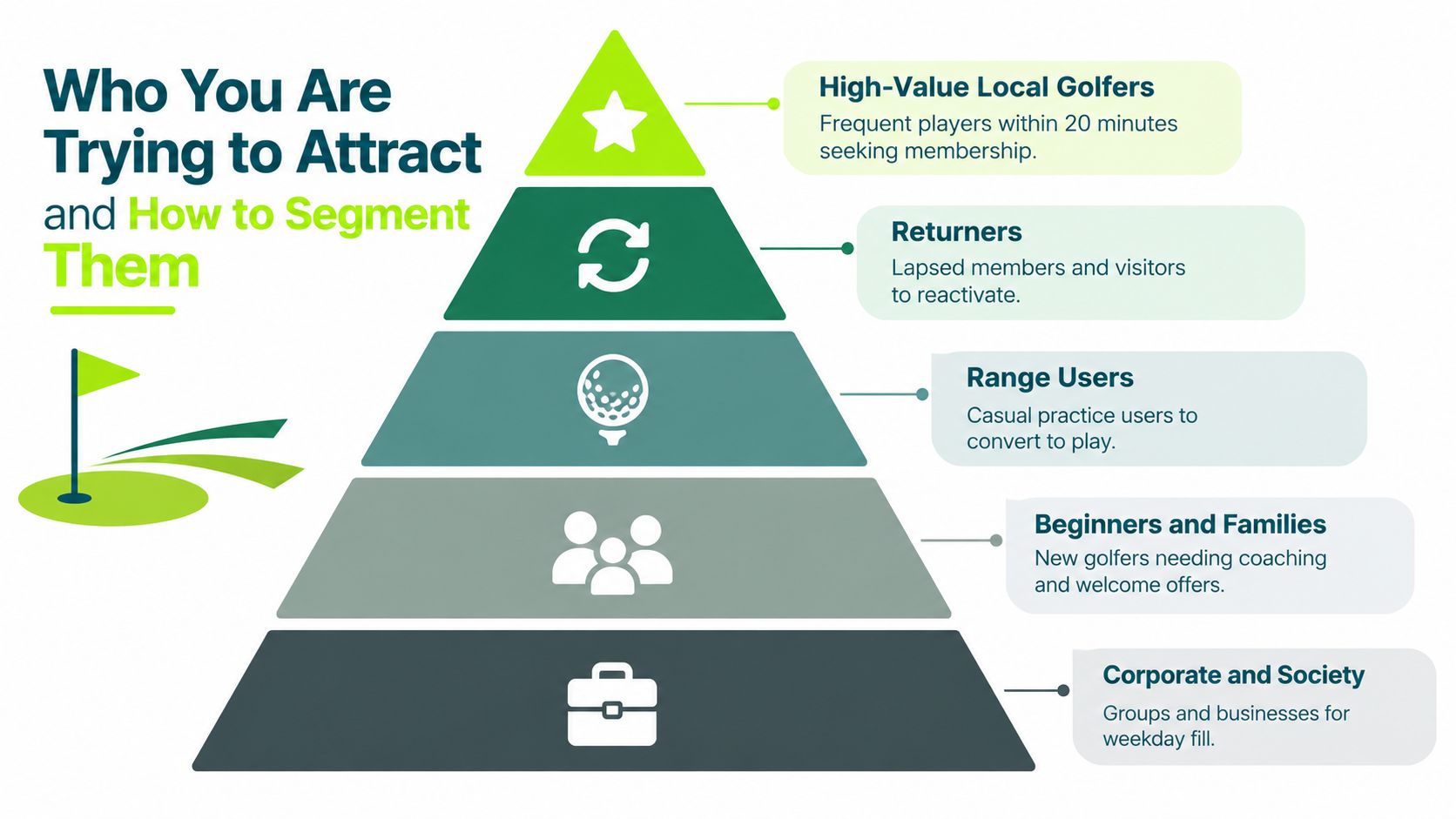
Most clubs can identify their ideal audiences without complicated research. Start with three questions: where does the golfer live, how often do they play and what action are they already considering?
The highest-priority audience is usually the frequent local golfer within a practical travelling distance. This person may already belong elsewhere, play regularly at pay-and-play venues or be searching for a more established home club. Their message should focus on access, atmosphere, standards, playing opportunities and the reasons members stay, not a generic list of facilities.
Returners need a different approach. They may be former members, previous visitors or people who enquired but never booked. Their hesitation could relate to timing, confidence, cost, family commitments or a poor previous experience. A useful message acknowledges the gap and offers a low-friction conversation rather than assuming they need another sales pitch.
Market segmentation for golf clubs is useful when committees need a shared method for defining audiences and tailoring messages.
Match the message to intent
Range users and occasional players often need help understanding how to move from practice or casual play into regular club golf. Beginners and families may respond to coaching, reassurance and a welcoming introduction. Corporate groups and societies have a different commercial role, often helping clubs use weekday capacity and introduce new people to the venue.
Use simple labels in your CRM:
- Frequent local golfer: prioritise a membership conversation and visit.
- Lapsed member or visitor: reactivate with relevant context and a personal follow-up.
- Range or casual player: explain the route from practice to playing membership.
- Beginner or family: lead with welcome, coaching and confidence.
- Corporate or society contact: present group formats, availability and hospitality.
Prioritise before you spend
A club shouldn't give every segment equal budget or sales attention. Rank each audience by commercial value, fit with available capacity and likelihood of taking a next step. Then create a specific landing page or enquiry route for the strongest segments.
The discipline is important because broad messaging produces ambiguous leads. A golfer asking about a society day shouldn't enter the same follow-up journey as someone asking about full membership. The first needs an events response. The second needs qualification, a visit and a membership conversation.
Keep the first version manageable. Agree the segments at committee level, record them consistently and review whether each segment produces visits and members. Segmentation only becomes useful when it changes what your team says and does.
Paid and Organic Channels That Fill Your Pipeline
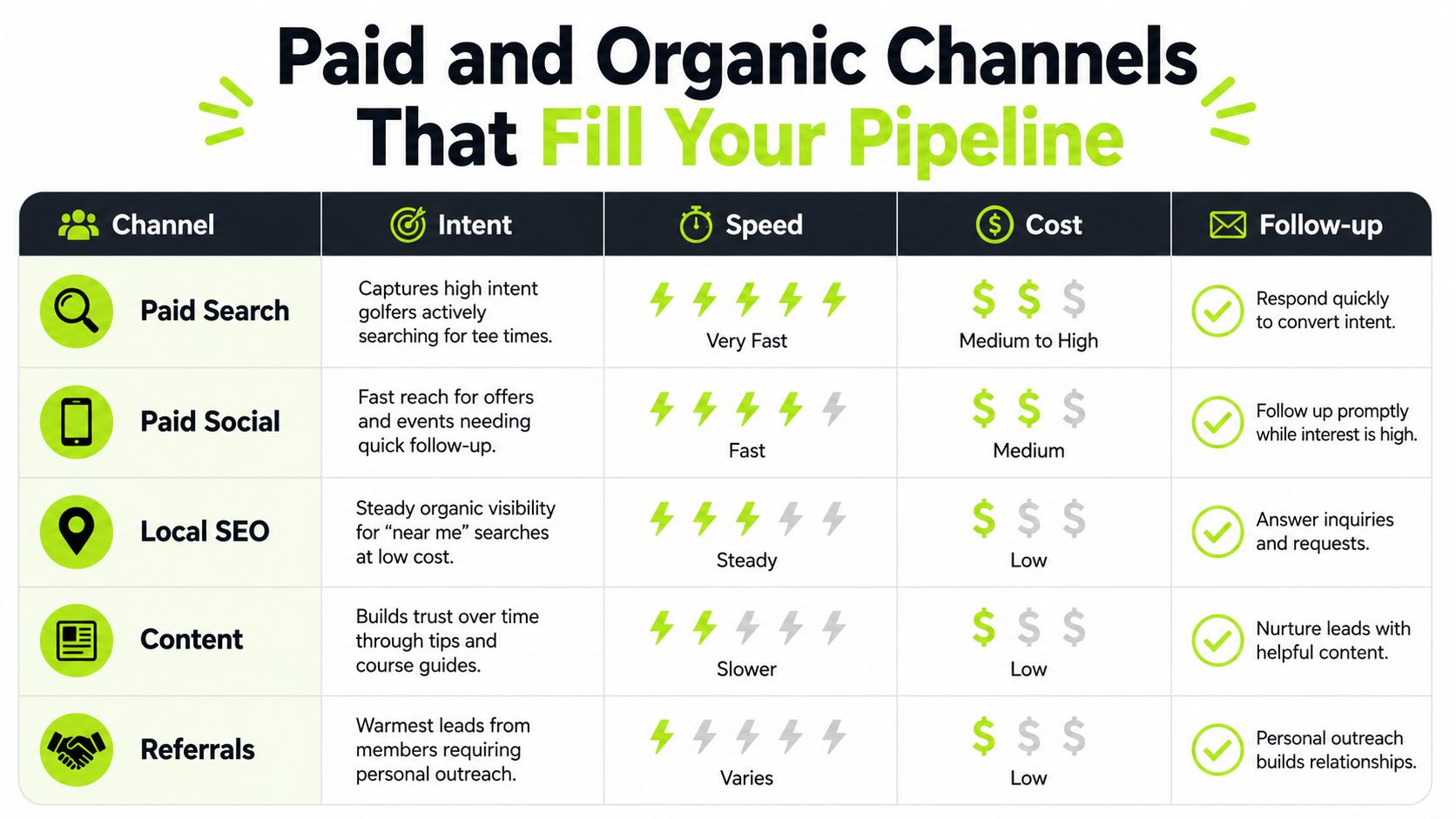
Paid and organic channels don't perform the same job. Paid search captures existing intent, while paid social can introduce an offer or event to people who haven't yet decided to enquire. Local SEO compounds over time, content builds confidence and referrals often arrive with trust already established.
The right mix depends on the club's objective. A membership campaign with an immediate target may need paid search and carefully controlled social activity. A club building long-term local visibility should invest in useful pages, accurate listings and content that answers real golfer questions.
A helpful comparison looks like this:
| Channel | Best For | Follow Up Requirement |
|---|---|---|
| Paid search | Golfers actively searching for membership, courses or local playing options | Immediate response, because intent is already high |
| Paid social | Events, offers, family activity and awareness among defined local audiences | Fast qualification, since interest can be lighter |
| Local SEO | Ongoing visibility for location-based searches | Clear enquiry paths and regular monitoring |
| Content | Answering questions and building confidence before a decision | Nurture links and relevant next steps |
| Referrals | Warm introductions from members, partners and local businesses | Personal outreach from a named club contact |
For clubs developing their local search approach, a practical local SEO playbook for dentists offers transferable ideas around service pages, local intent and content structure. The subject is different, but the underlying discipline is relevant: make it obvious what you offer, where you offer it and what the visitor should do next.
Select channels by operating capacity
Paid search is usually the strongest fit for urgent membership demand because the golfer has already expressed a need. Paid social is useful for reaching families, returners and event audiences, but it requires sharper qualification. Organic channels can reduce dependence on advertising over time, although they still need accurate tracking and clear ownership.
The mistake is judging channels by enquiry count alone. A low-volume source can be valuable if it produces visits and memberships. A high-volume source can be expensive if staff can't respond or if the audience doesn't fit the club.
Every campaign should pass the same test:
- Does the channel reach a defined audience?
- Does the landing page offer one clear next action?
- Is the enquiry logged automatically?
- Does a named person own the follow-up?
- Can the club see the outcome by source?
If the answer to the last three questions is no, adding another channel is premature.
From Enquiry to Booked Visit Lead Qualification and CRM Workflows
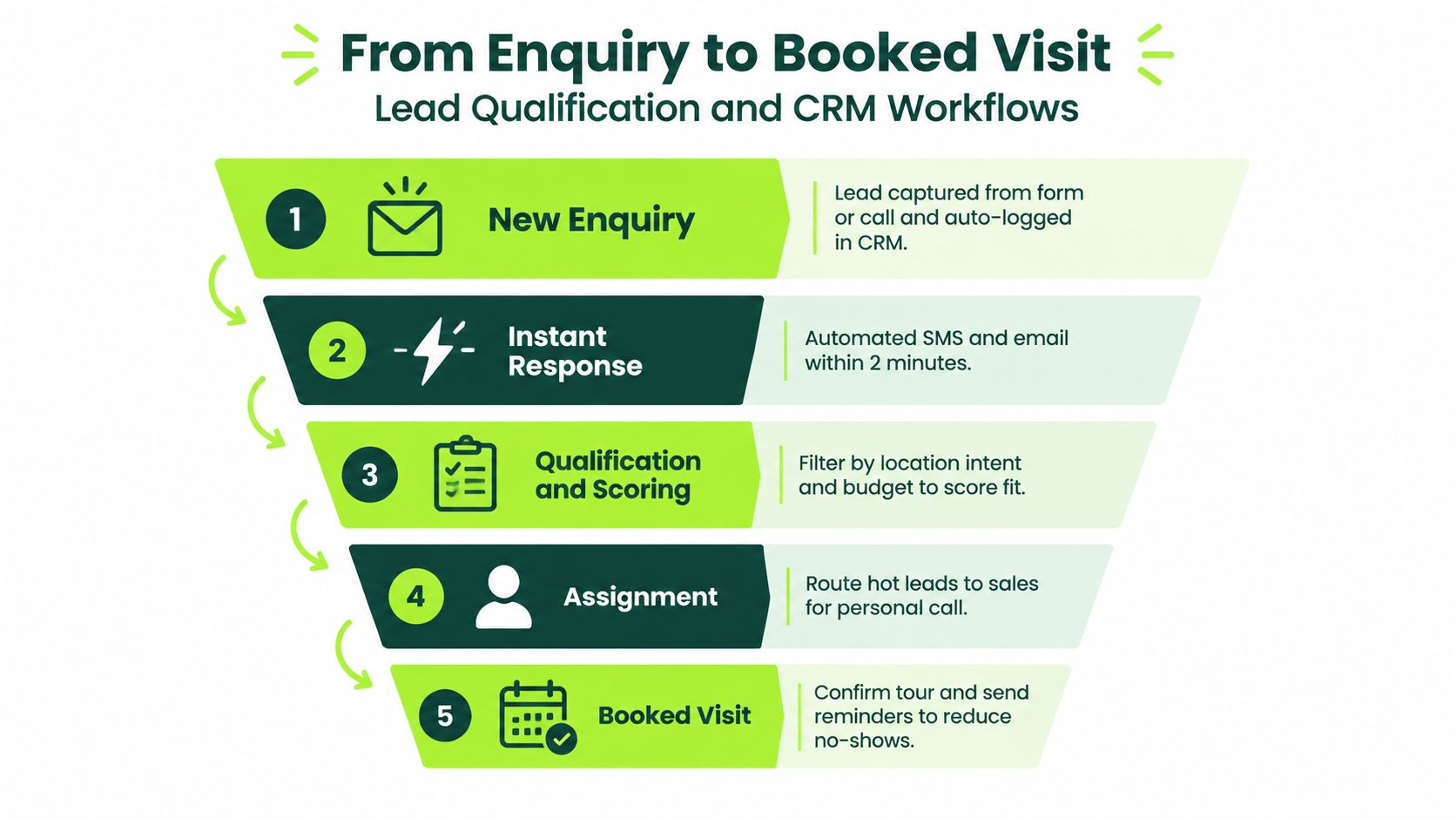
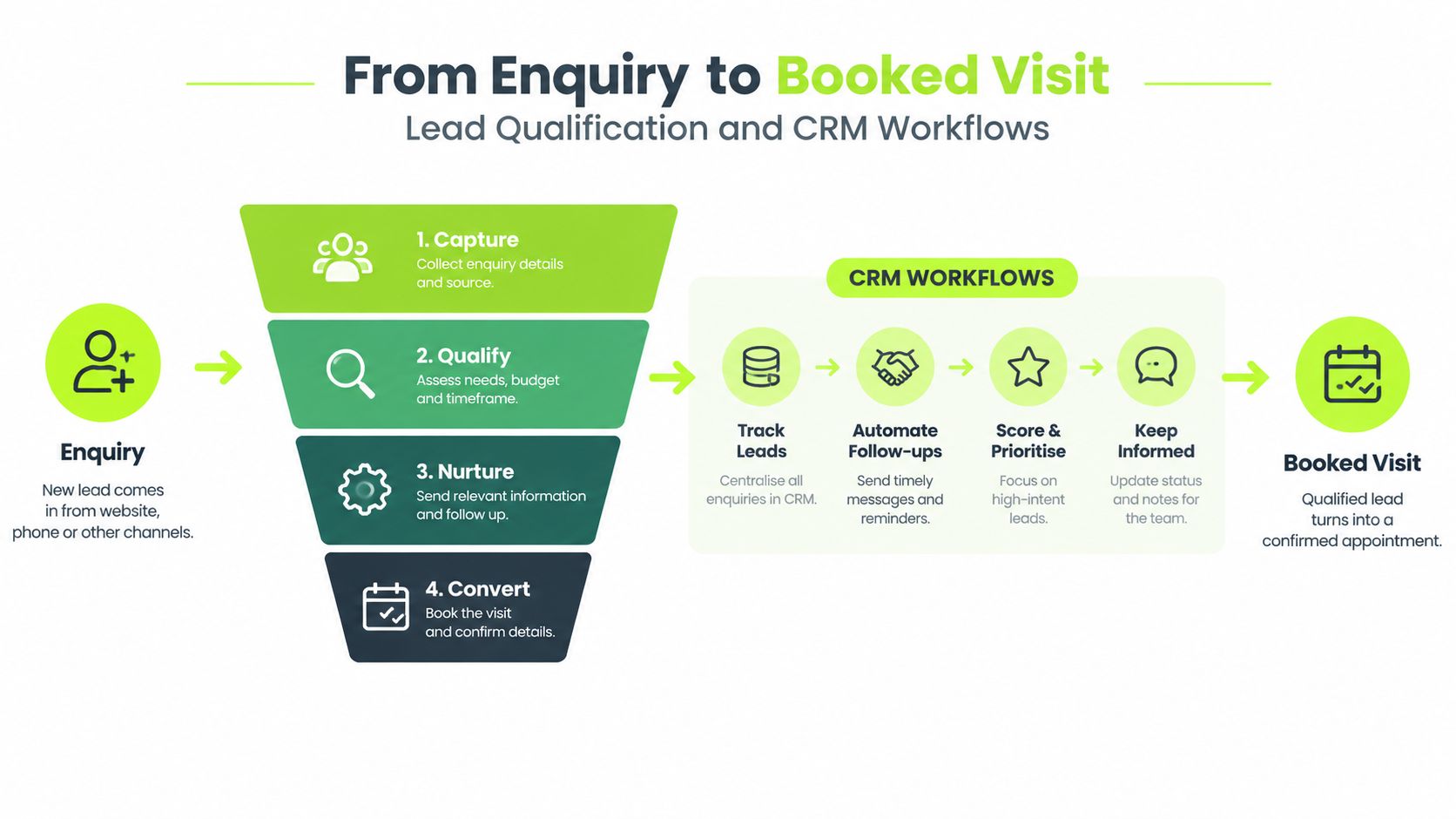
The operational sequence should be simple enough for a busy clubhouse to follow and structured enough for management to measure. A golfer should never have to repeat their story because the first team member failed to record it.
Start by capturing the basics. The CRM should record the person's name, contact details, source, location, enquiry type and preferred next step. A form can gather some of this information, while a phone call should be logged immediately afterwards.
Build five connected actions
First, respond immediately. Send a useful acknowledgement by email or SMS, confirm that the enquiry has been received and explain what happens next. Automation can provide reassurance while a staff member prepares the personal response.
Second, qualify without interrogating. Ask only what helps the club route the lead: where the golfer is based, how often they play, what type of membership interests them and when they would like to visit. The purpose is not to create a complicated score. It's to decide who should respond and what they should say.
Third, score for urgency and fit. A nearby golfer asking to visit soon should be visible as a priority. Someone researching options for later may need useful content and a timed reminder. The scoring rules should reflect the club's capacity, membership structure and commercial priorities.
Fourth, assign ownership. A hot lead should go to a named membership contact, general manager or PGA professional. Shared responsibility often becomes no responsibility. Use CRM task assignment, reminders and escalation when the first action hasn't happened.
Fifth, nurture until there is a decision. If the golfer doesn't book immediately, send relevant follow-up rather than a generic newsletter. A returner might receive a message about rejoining. A beginner may need coaching information. A corporate contact may need a group proposal.
A clear contacts structure helps staff distinguish new leads, active prospects, members and past contacts. The AgentStack help desk contacts overview provides a useful reference for thinking about how contact records and lead stages should be organised.
Response speed is a commercial process, not an administrative detail.
UK golf clubs reportedly take an average of 47 hours and 32 minutes to respond to membership enquiries, and a lead answered within one hour is said to be five times more likely to convert than one left for 24 hours, according to GolfRep's golf club lead management analysis. The same source reports that responding within five minutes can increase conversion rates by 98% compared with slower replies, while a 30-minute wait can reduce conversion odds by up to 100 times versus a five-minute response. These benchmarks should be treated as operating targets, not excuses for making unsupported promises.
Clubs that need a deeper explanation of automated qualification can use lead qualification automation for golf clubs as a practical reference. The central principle remains straightforward: capture every lead, respond quickly, assign a human owner and keep following up until the record has a clear outcome.
Measuring What Matters KPIs Pricing and Offer Strategy
A committee can't manage what it can't see. Reporting should show the movement from source to enquiry, enquiry to visit, visit to membership and membership to renewal. It should also show where prospects stall and how long each stage takes.
Review the pipeline weekly using a small set of measures:
- Enquiry volume by source: reveals which channels create demand.
- Response time: shows whether the club is protecting intent.
- Contact rate: identifies problems with data quality or follow-up.
- Visit booking rate: tests the quality of qualification and the strength of the invitation.
- Visit-to-membership conversion: shows whether the experience and offer fit the audience.
- Open and unresolved leads: exposes leakage that headline enquiry totals hide.
- Renewal risk: highlights members who may need a timely conversation before the renewal window.
The figures need context. A campaign shouldn't be praised for producing leads if the club doesn't know how many became visits. Likewise, a strong visit rate may still conceal weak membership performance if the offer, tour or onboarding experience fails to answer the golfer's concerns.
How to measure marketing effectiveness sets out the broader discipline of connecting activity to commercial outcomes.
Protect value through relevant offers
Discounting is often the quickest response to weak conversion, but it can train prospects to wait for a lower price. Start by finding the actual objection. Is the golfer uncertain about playing opportunities, worried about fitting in, unsure which category applies or unable to commit immediately?
Use structured options instead. A club might offer a guided visit, a clear pathway for beginners, a suitable membership category or a well-explained joining process. The right offer reduces uncertainty without undermining the value of the club.
Retention belongs in the same dashboard. A 2025 UK survey of more than 2,500 golfers found that 77.9% said they would definitely renew their membership in 2026, while 18.3% were undecided. The main reasons for uncertainty included rising costs, tee-time access, not playing year-round, variety and health issues, as reported by National Club Golfer's membership coverage. Renewal forecasting should therefore begin before the invoice or renewal notice. Track engagement, unresolved complaints, usage and stated concerns, then give staff time to intervene.
Common Pitfalls and Short Playbooks You Can Implement Now
The weakest golf marketing programmes usually fail in the handover between interest and action. The advert may be sound, but the enquiry arrives in an inbox nobody checks consistently. A committee may approve a campaign, but no one agrees who owns the follow-up. A club may report lead numbers, but can't explain which source produced members.
Avoid four common mistakes:
- Slow manual follow-up: Replace memory with automatic acknowledgement, assigned tasks and reminders.
- Poor lead visibility: Use one CRM view for new, active, paused, won and lost prospects.
- Generic messaging: Match the next communication to the golfer's segment and stated intent.
- Discount-led growth: Address uncertainty with information, visits and suitable pathways before reducing price.
Hillier Hopkins' 2023/24 UK golf-club survey reported that only 24% of clubs had more leavers than joiners, indicating that many clubs were net-positive but operating within a margin where response, qualification and follow-up still matter. The findings are available in the Hillier Hopkins UK golf-club survey.
A compact implementation plan
For a private members' club: audit every membership contact route, connect forms and calls to a shared CRM, then create a short visit-booking sequence. Review unresolved enquiries in the weekly management meeting.
For a committee-led club: appoint one lead owner, define the response standard and create approved messages for the main audience segments. This removes uncertainty when volunteers change.
For a resort or multi-site operator: standardise the fields and stages across locations while allowing each club to retain its own positioning. Central reporting should show source, response, visit and membership outcomes without forcing every site into identical messaging.
For a club with strong demand but renewal concerns: add a renewal-risk field, record reasons for hesitation and schedule member conversations before the renewal deadline. A waiting list doesn't remove the need for retention planning. The same 2025 survey found that 30% of golfers said their club had a waiting list, up from 27% in 2024, which shows that demand can exist alongside uneven long-term retention.
GolfRep's role is to combine lead generation with structured follow-up, CRM visibility and revenue tracking, rather than operate as a generic advertising agency. The practical test is whether managers can trace a prospect from first enquiry to booked visit, membership and renewal, then make a better decision from the evidence.
GolfRep helps UK golf clubs build predictable membership pipelines through targeted lead generation, rapid follow-up and CRM systems that track each stage from enquiry to booked visit. Visit GolfRep to discuss where your current pipeline is leaking and what a clearer conversion process could look like.
Ready to tap into our proven growth system?