Lead Qualification Automation: A Golf Club Guide

“Get more golf enquiries” is still the default advice given to clubs. It made sense when demand was the main constraint. For many successful UK clubs, it no longer is.
England Golf's affiliated club membership rose to 750,071 in 2025, the highest level in over a decade, while 75% of members' clubs reported growth. That changes the commercial question. Clubs need to know which enquiries fit their membership capacity, pricing, age profile and revenue priorities, then respond in a way that moves the right prospects towards a visit or joining conversation. (The Golf Business)
Lead qualification automation provides that structure. It doesn't replace a membership secretary's judgement or a warm conversation with a prospective member. It makes sure those people spend their time where it can have the greatest effect, instead of working through an unprioritised inbox.
From More Enquiries to Better Conversions
A club can generate strong interest and still lose valuable opportunities. A form submission arrives while the secretary is on the course, an email sits in a shared inbox, or a corporate enquiry gets treated like a standard membership question. By the time somebody replies, the prospect may have spoken to another club.
The first-come-first-served approach looks fair, but it treats every enquiry as equally valuable and equally urgent. A junior golfer asking about coaching, a family looking for flexible access, a golfer ready to join a full membership category and a company enquiring about a golf day all require different responses. Sending the same follow-up to each group creates unnecessary work and weakens the experience.

Practical rule: Speed matters, but speed without relevance simply moves the wrong conversation faster.
Demand must be filtered intelligently
The most useful qualification system captures a small amount of information at the point of enquiry, then applies clear logic. It can identify whether someone is interested in membership, a society day, a wedding venue, junior golf or a resort stay. It can also record the source, the package they viewed and the action they want next.
That makes lead visibility more important than raw lead volume. A manager should be able to see which prospects are new, which have received a response, which have booked a visit and which are waiting for human contact. The club's team shouldn't need to search several inboxes or rely on memory.
Clubs that want a clear explanation of the qualification process can use GolfRep's guide to what lead qualification means. For teams considering external support with first-response and appointment-setting work, a useful resource on the role of a BDR can also clarify where human outreach fits alongside automation.
A stronger pipeline starts with prioritisation
Lead qualification automation should separate three decisions:
- Fit: Does the enquiry match the club's membership categories, location, playing preferences or commercial offer?
- Intent: Has the person requested pricing, a visit, availability or a specific joining route?
- Action: Who should respond, through which channel and with what information?
That is the foundation of a predictable pipeline. GolfRep approaches club growth by combining demand generation with structured follow-up and CRM visibility, rather than treating advertising as the complete solution. The club still owns the relationship. Automation makes the handover organised, timely and easier to manage.
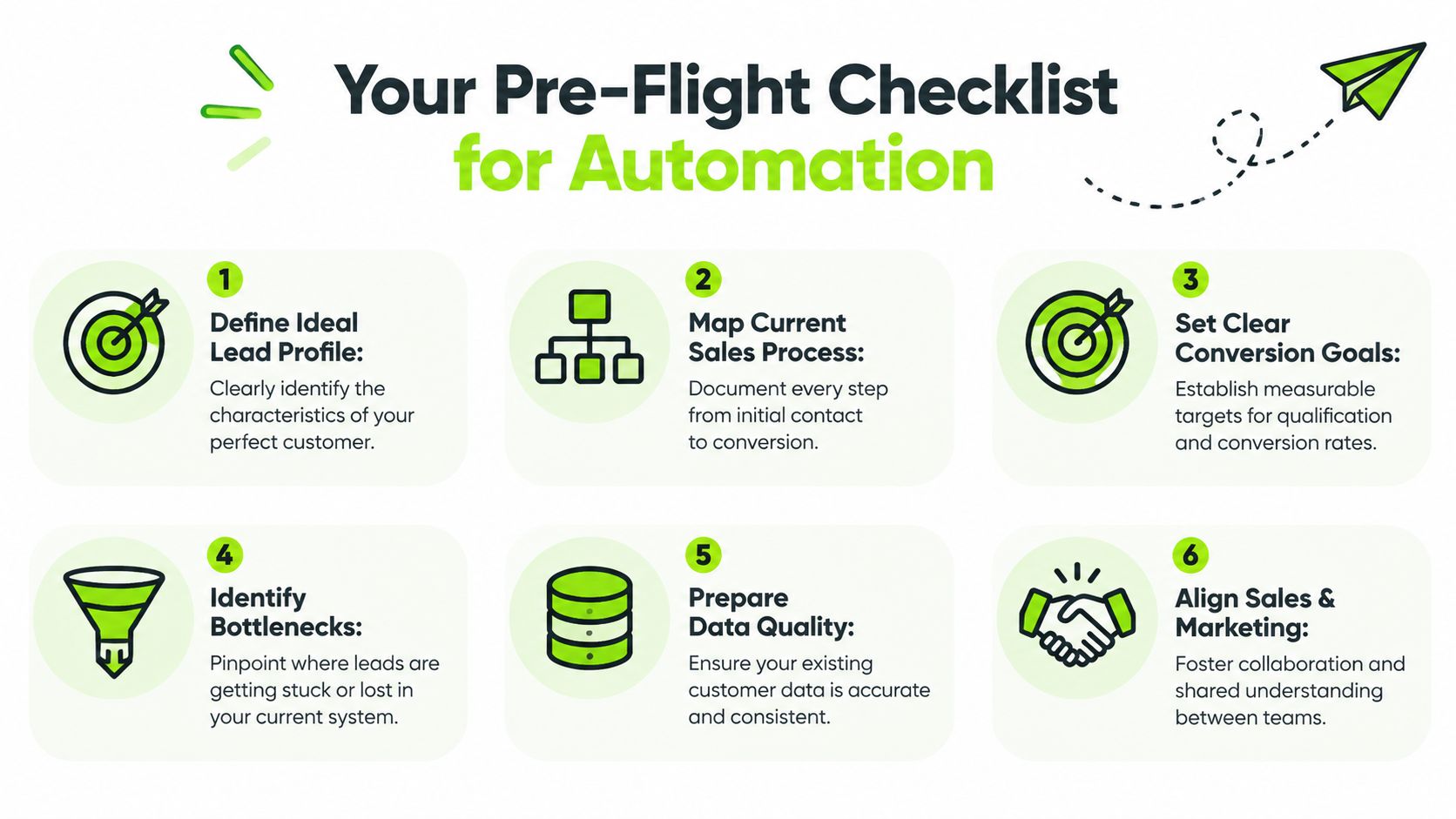
Your Pre-Flight Checklist for Automation
Automation can't rescue an unclear sales process. If the CRM contains duplicate records, membership categories aren't defined or staff disagree about what counts as a good enquiry, an automated workflow will distribute confusion more efficiently.
Before choosing software, prepare the operating rules that the software will follow. This work is less glamorous than selecting an AI feature, but it determines whether the system earns staff trust.
Establish the commercial definitions first
Start by writing down the club's priority enquiry types. These might include:
- Full membership: Prospects seeking the main membership category, with questions about joining fees, subscriptions, access and availability.
- Flexible membership: Golfers who need a different playing pattern or want to understand weekday and restricted options.
- Junior and family golf: Parents, juniors and families who need a more supportive pathway than a standard adult membership sequence.
- Corporate and societies: Enquiries that belong with the events or commercial team, not the membership secretary.
- Visitors and resort guests: Prospects interested in a tee time, stay or experience rather than membership.
The labels must be simple enough for staff to use consistently. If a category doesn't change the next action, it probably doesn't need its own automation route.
Next, describe the ideal member profile for each priority. Consider location, golfer type, likely playing frequency, age profile and the membership package that best fits. Don't use assumptions that the club can't capture or verify. A small number of reliable fields is more useful than a large form that prospects abandon.
Make the CRM trustworthy
The CRM should hold one record for each person, with clear ownership and a visible stage. At minimum, the team needs to know the enquiry source, enquiry type, relevant membership category, last contact, next action and outcome.
Map the current process before automating it. Follow one enquiry from submission through first response, qualification, visit, joining decision and future nurture. Mark every point where information disappears or a person waits for manual intervention.
For broader guidance on preparing an automation process, Mara's actionable advice for early-stage SaaS teams is useful because it keeps the emphasis on process clarity, clean data and manageable workflows rather than unnecessary complexity.
Agree ownership before launch
Every route needs a named owner. Membership enquiries may go to the membership manager, junior questions to the coaching team, and corporate golf to the events manager. A backup owner matters too, particularly for smaller clubs where one person may be away, working remotely or handling an event.
Finally, decide what the system must never do. It shouldn't promise availability without a live check, offer a discount that hasn't been approved or send a family prospect an irrelevant premium membership message. Those guardrails protect the club's brand while allowing staff to benefit from consistent triage.
Building Your Automated Triage Rules
Rules-based triage is the best starting point for most golf clubs. You don't need a complex model to make the first useful decision. You need a clear field, a defined condition and a reliable action.
A practical workflow begins when someone submits a form or enters the CRM. The integration layer checks the enquiry type and relevant fields, applies tags, writes the result back to the record and alerts the right person. The team can then see what happened without opening the original form or forwarding an email.
Rule one, route by enquiry type
Add a required field called Enquiry type. Keep the options clear:
- Membership
- Junior or family golf
- Corporate golf day
- Society or visitor booking
- Resort or accommodation enquiry
If the answer is “Corporate golf day”, tag the record as a commercial event enquiry and notify the events manager. The follow-up should focus on date, group requirements, catering and availability, rather than membership benefits.
If the answer is “Membership”, assign the record to the membership team and start the relevant qualification path. This simple distinction prevents two departments from contacting the same person and makes reporting more meaningful.
Rule two, route by golfer type
A junior or family enquiry should trigger a different response from an adult membership enquiry. The form can ask whether the golfer is enquiring for themselves, a child or a household. The CRM then applies a tag and directs the record to the junior or membership owner.
The message should answer the questions that matter to that group. A parent may want coaching information, supervision, playing opportunities and a clear explanation of how the child can progress. A prospective adult member may care more about access, playing times, social life and the route to a visit.
Rule three, protect high-intent requests
Create a separate route for explicit action requests such as “book a tour”, “speak to someone”, “check membership availability” or “request pricing”. These signals should create an immediate task for the relevant owner and include the person's original message.
UK businesses average 47 hours for lead response, while only 7% achieve a response within five minutes. The same UK lead response study reports that 78% of customers buy from the first company to respond. Those figures make the first routing decision commercially important, especially when a club already has a healthy flow of enquiries.

Keep the first rules transparent
A staff member should be able to read a rule and understand why a record went somewhere. Avoid hiding basic routing inside a black-box system. Start with conditions the team can test, such as enquiry type, golfer type, requested action and selected membership category.
The system should also record exceptions. If a lead is routed incorrectly, the owner needs a way to mark the reason. That feedback becomes the basis for improving the form, field definitions or future scoring model.
Implementing a Simple Lead Scoring System
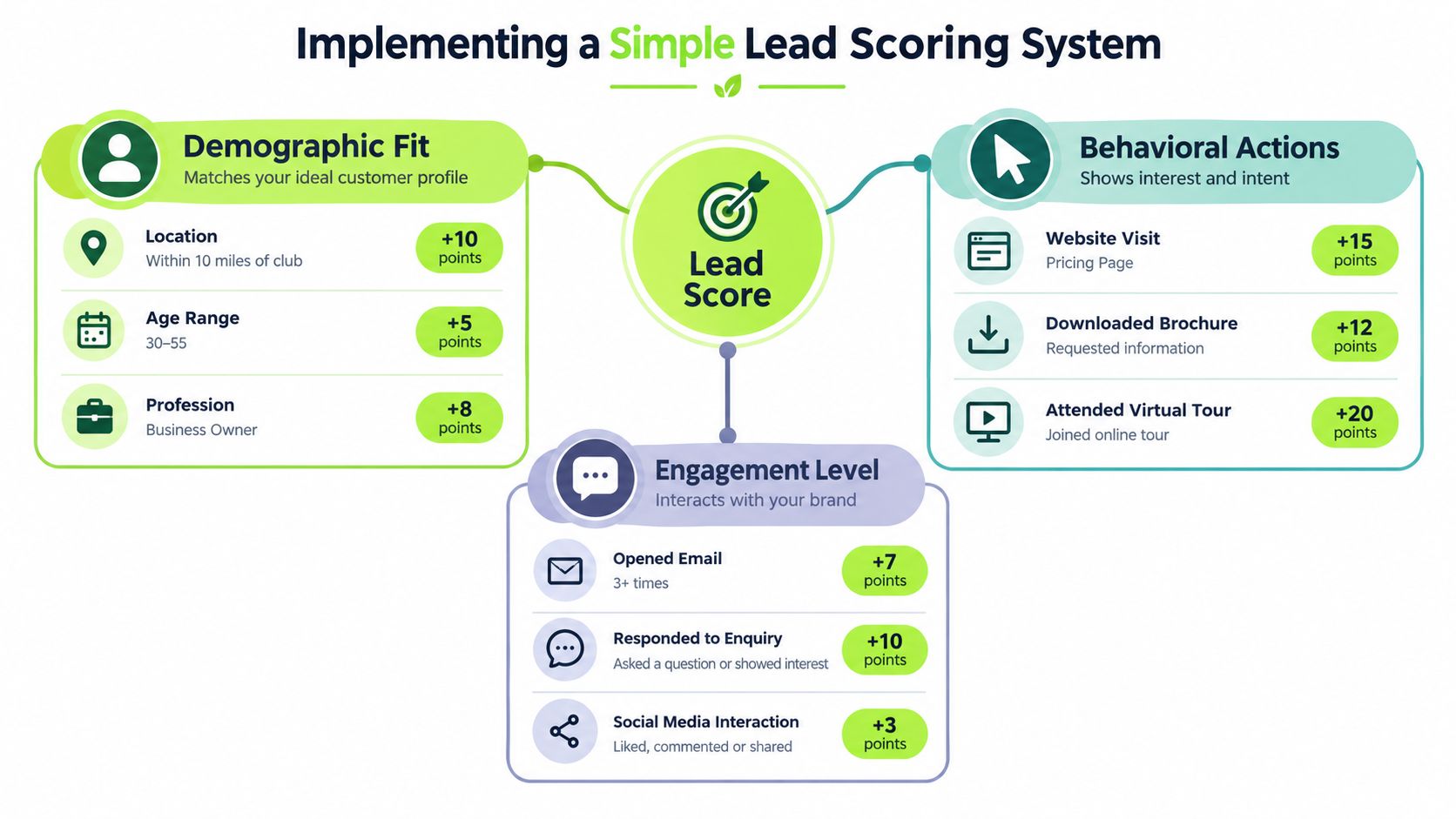
Rules sort enquiries. Lead scoring prioritises them. It helps a club distinguish between a prospect who matches the membership profile and has shown buying intent, and someone who has made a general enquiry without indicating a next step.
A useful score combines two types of information. Fit describes who the person is and whether the club's offer suits them. Behaviour describes what they've done, such as viewing pricing, downloading a brochure or requesting a tour.
Build the model around club decisions
Use a points table that reflects the club's actual priorities. The example below follows the scoring categories supplied for a simple model:
| Signal group | Example signal | Points |
|---|---|---|
| Demographic fit | Within 10 miles of the club | +10 |
| Demographic fit | Age range of 30 to 55 | +5 |
| Demographic fit | Business owner | +8 |
| Behavioural action | Visit to the pricing page | +15 |
| Behavioural action | Brochure download | +12 |
| Behavioural action | Virtual tour attendance | +20 |
| Engagement level | Opened an email three or more times | +7 |
| Engagement level | Responded to an enquiry | +10 |
| Engagement level | Social media interaction | +3 |
These values are examples, not universal truths. A resort may give more weight to booking intent, while a private members' club may prioritise a visit request and membership fit. The important point is that the team can explain the score and change it when outcomes show that the assumptions are wrong.
Combine fit with intent
A local golfer who repeatedly visits the membership pricing page may deserve attention before a distant visitor who opens a general newsletter. A parent who completes a junior enquiry and asks about a trial session should enter a different priority path from someone who only reads a blog post.
Don't score every activity equally. A direct response or booking request usually carries more meaning than a passive interaction. Avoid awarding points for actions that create noise, and consider reducing the influence of older activity so the score reflects current interest.
UK B2B teams using behavioural scoring recorded 39% to 40% MQL-to-SQL conversion, compared with an average of 13%, according to Sera Leads' UK lead generation analysis. The result supports a practical principle for clubs: scoring is valuable when it helps staff identify intent, not when it creates an impressive-looking number.
Make the score visible
A score should never be the only information a staff member sees. Write back the score, the category, the main signals and a short rationale to the CRM. The membership manager should know whether the prospect is prioritised because they requested a tour, viewed pricing or selected a particular package.
That visibility supports a better lead tracking system. It also creates a feedback loop. When staff mark a lead as poor fit, strong fit or wrongly scored, the club can refine the rules rather than accepting the model as permanent.
Triggering Instant Follow-Up from Your CRM
Qualification has no commercial value until it changes what happens next. A score sitting in a CRM doesn't create a visit, and a tag without an owner doesn't create a conversation.
The CRM should turn each meaningful signal into a practical action. That might be a task, an alert, an email sequence, a booking invitation or a pause on communications until a staff member has made contact.
Match the trigger to the next decision
Consider a prospect who submits a membership form, selects a relevant category and asks to visit. The automation should create a task for the membership manager, include the form answers in the record and send the prospect a clear confirmation. The human follow-up then starts with context rather than repeating basic questions.
A different prospect may select a flexible membership option but show limited urgency. That lead can receive information about the package, playing access and the next suitable club event, while the CRM schedules a later review. The system keeps the conversation moving without pretending that every person is ready for a call.
For junior and family enquiries, send the record to the appropriate owner and use language suited to the parent or guardian. For corporate golf, notify the events team and suppress unrelated membership messages. Personalisation should come from the enquiry data, not from elaborate copy that the club can't maintain.
Use thresholds carefully
A threshold should represent a decision the team understands. For example, a club might decide that a high-priority score creates a same-day call task, while a moderate score triggers a nurture sequence and a review if the prospect returns to the pricing page.
Don't set a threshold solely because it produces a convenient number of tasks. The team needs to monitor whether those tasks lead to useful conversations, booked visits and membership outcomes. If staff ignore alerts, the threshold may be too broad, the information may be insufficient or the assigned owner may be wrong.
A workflow built around form submission, AI scoring, CRM write-back and routing can cut front-end triage time for UK SMEs by 30% to 60%, according to Simara's UK SME lead qualification playbook. The operational benefit comes from removing repetitive sorting, not from eliminating human involvement.
Close the loop in the record
Every automated handoff needs an outcome field. Staff should record whether contact was made, whether a visit was booked, whether the prospect attended, whether they joined and why an enquiry was unsuitable.
That information turns follow-up into a managed process. GolfRep's approach to automated follow-up for golf clubs connects qualification signals with CRM actions and nurture, so the club can see more than the original enquiry. It can see how the relationship developed and where prospects stopped progressing.
Common Pitfalls and How to Measure Real Impact
The most common failure is over-engineering. Clubs create too many fields, too many scores and too many message paths before they've agreed which decisions the system needs to make. Staff then stop trusting the CRM because the record is difficult to interpret.
Start with a small number of routes and review them with the people who handle enquiries every day. If a rule can't be explained in plain English, it's probably not ready to automate. If a score doesn't change ownership, urgency or follow-up, it may not deserve a place in the model.
Measure outcomes beyond activity
Response time matters, but it's an operating measure, not the final commercial result. A club should connect qualification data to downstream outcomes such as:
- Booked visits: Which enquiry sources and qualification routes produce visits?
- Show rates: Which segments attend after booking, and which need better reminders?
- Membership conversion: Which routes produce new members rather than conversations alone?
- Member value: Which categories generate recurring membership revenue and sustainable fit?
- Capacity impact: Is automation helping the club manage availability, waiting lists and pricing appropriately?
The UK golf market isn't uniform. Golfshake's 2025 survey found that 30% of golfers said their club had a waiting list, while only 57.4% said membership was growing and 30.63% said under-40s membership was growing. (Golfshake's 2025 membership findings) That makes lead volume a poor standalone measure. A club with a waiting list may need better fit and capacity management, while another club may need stronger conversion among younger golfers and families.
Measure the route from enquiry to revenue, not just the number of alerts your automation creates.
Review false positives and false negatives with the team. A high-scoring lead that never books a visit may reveal weak signals. A low-scoring prospect who joins may show that the model undervalues a particular segment. The system becomes reliable through that disciplined feedback, not through a one-time setup.
GolfRep helps UK golf clubs connect lead generation with qualification, CRM visibility and structured nurture, so managers can see which enquiries become visits, sign-ups and recurring revenue. To discuss a practical system for your club's membership categories and capacity, visit GolfRep and start a conversation about turning existing demand into a more predictable pipeline.
Ready to tap into our proven growth system?