Boost Members with Golf Club Paid Advertising 2026
Most advice on golf club paid advertising starts in the wrong place. It focuses on platforms, creatives, and targeting, as if the main problem is getting more enquiries through the door.
For most clubs, that isn't the primary bottleneck.
The bigger issue is what happens after somebody clicks. If an enquiry lands in a shared inbox, sits unseen for hours, gets forwarded twice, and then receives a vague reply three days later, the ad campaign didn't fail. The process did. Paid advertising only becomes commercially useful when it's tied to a system that captures, tracks, and follows up every lead properly.
The Real Problem with Golf Club Paid Advertising
Many clubs still judge paid advertising by surface signals. They ask whether people clicked, whether the campaign reached enough local golfers, or whether the website got busier. Those questions matter, but they don't answer the one that affects budget decisions. Did the campaign produce members, and can you prove it?
That gap is wider than most clubs realise. A 2025 UK Golf Industry Report noted that only 28% of clubs use advanced analytics for ad attribution, while 62% of general managers report unclear ROI on paid campaigns due to siloed data systems, according to Wilkins Media's coverage of golf course advertising and attribution issues. If you can't connect spend to outcomes, every campaign feels speculative.
Why more leads don't solve a broken process
A club can generate enquiries and still feel like advertising doesn't work. That usually happens for three reasons:
- Leads aren't visible quickly enough. The right person doesn't see the enquiry straight away.
- Follow-up is inconsistent. One prospect gets a call within the hour, another gets an email the next day.
- Conversion data never comes back to marketing. The team knows leads came in, but no one closes the loop on tours booked, proposals sent, or memberships sold.
Practical rule: If your club can't track an enquiry from ad click to membership outcome, you don't yet have a marketing problem. You have an operations problem.
That distinction matters because it changes what you should fix first. Buying traffic before fixing the handoff process often just creates a more expensive version of the same problem.
What paid ads should actually do
Used properly, golf club paid advertising is the front end of a pipeline. Its job is to create qualified demand from the right local audience and send that demand into a structured follow-up system.
That means the ad isn't the product. The system is.
A club that responds quickly, logs every lead, books visits reliably, and tracks sales outcomes will usually outperform a club with nicer creatives and looser processes. The ad gets attention. The CRM and follow-up turn attention into revenue.
Laying the Strategic Foundation Before You Spend
A paid campaign shouldn't begin with "Let's try some ads." It should begin with a business target and a clear decision on what success looks like.
Clubs get into trouble when budget, offer, audience, and internal capacity are all decided on the fly. That usually leads to short test campaigns, vague reporting, and no confidence in the outcome. A better approach is quieter and more disciplined.
Start with one commercial objective
"More enquiries" isn't specific enough. A campaign needs a single commercial job. That could be filling a membership category, generating tour bookings, or creating a pipeline for flexible membership conversations.
The point is focus. If the ad, landing page, and follow-up all point at different outcomes, response quality drops and the team handling leads gets mixed signals.
A useful sense-check before launch:
| Question | Why it matters |
|---|---|
| What are we selling? | Ads perform better when the proposition is clear. |
| Who is it for? | The audience shapes the targeting, messaging, and offer. |
| What happens after an enquiry? | If that answer is vague, fix that before spending. |
Budget for maturity, not a weekend test
Paid campaigns need enough time and consistency to settle. Campaigns live for 90 to 180 days have shown a 142% uplift in website sessions and 4.3% sales growth, with success tied to consistent monthly budgets between £500 and £2,000 and weekly optimisation, according to Lightspeed's digital marketing benchmarks for golf courses.
That matters because many clubs still judge advertising too early. They spend for a few weeks, see mixed quality, then switch it off before the campaign has had time to refine. Search terms need pruning. audiences need adjusting. landing pages need testing. None of that happens if the campaign is treated like a one-off punt.
Clubs that commit to a sensible period of testing usually learn more, spend more efficiently, and make calmer decisions.
Define the club you want to attract
Not every enquiry is equally valuable. A club should know who it's trying to attract before any targeting goes live.
Consider:
- Membership fit. Are you trying to attract full members, lifestyle members, or prospects who need a conversation first?
- Travel reality. Strong intent weakens quickly if the commute is wrong.
- Price positioning. The ad should align with the club's actual market position, not try to appeal to everyone.
Often, clubs overcomplicate things. You don't need a long brand workshop. You need clarity on who is likely to join, why they would choose your club, and what question they need answered before they enquire.
Check internal capacity before launch
A club with no lead ownership should not increase ad volume yet.
Assign who will receive new enquiries, who will make first contact, who books visits, and how outcomes will be logged. Paid advertising is easier to scale when those responsibilities are obvious before the first lead arrives, not after.
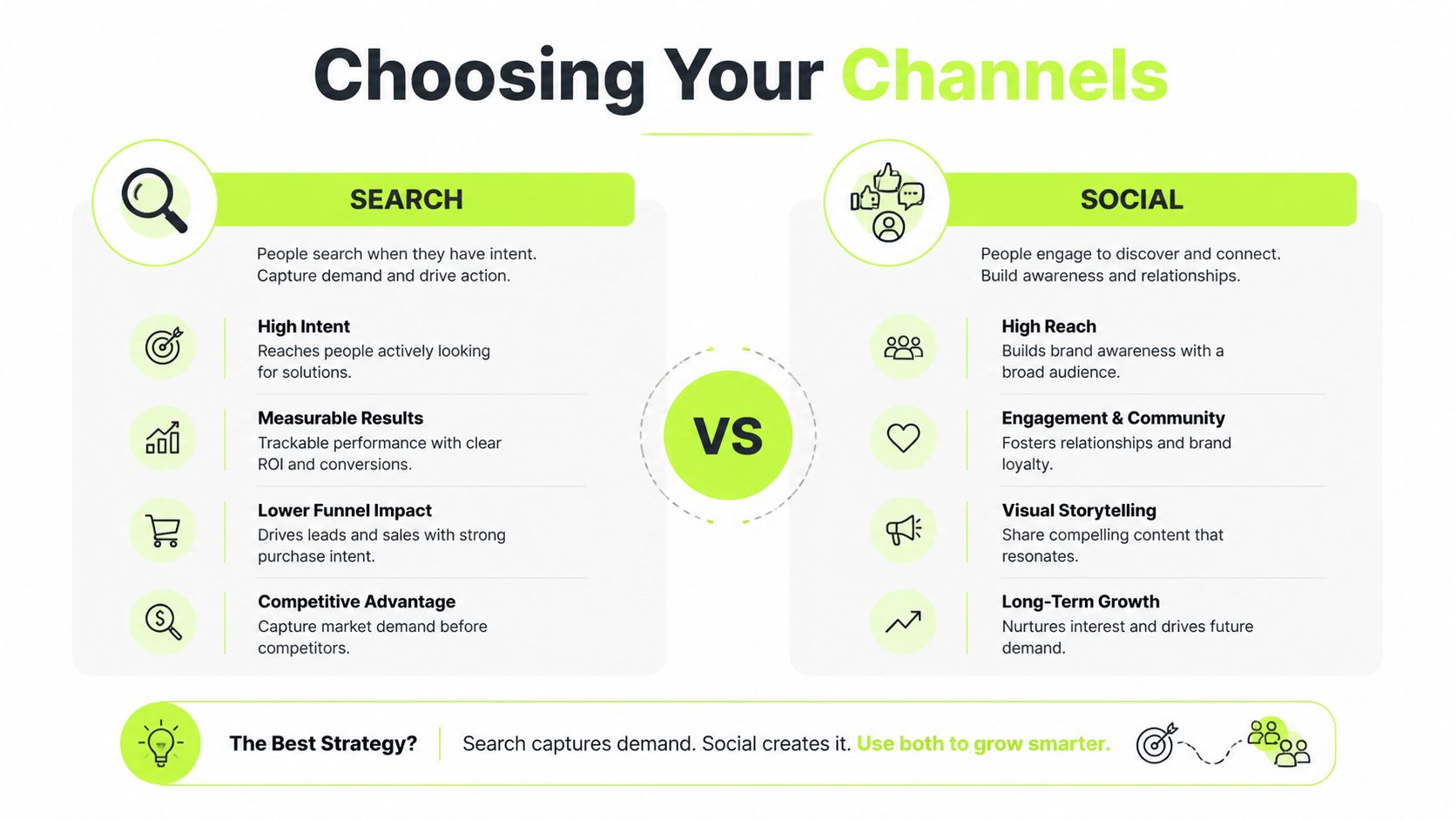
Choosing Your Channels Search vs Social
The debate between Google Ads and Meta usually misses the point. For golf club paid advertising, the question isn't which platform is better in isolation. It's what role each one plays in the buying journey.
What search does well
Search captures demand that already exists. If somebody is actively looking for a local club, comparing options, or searching for terms like golf membership near me, Google is often where that intent shows up first.
That makes search useful for clubs that want enquiries from people already close to a decision. The traffic is usually more direct. The messaging can be more specific. The landing page can answer a practical need rather than trying to create interest from scratch.
Search also forces discipline. It quickly reveals whether your offer matches the language prospects use.
What social does well
Meta works differently. It puts the club in front of a selected local audience before they search. That can be useful for raising awareness, introducing a membership proposition, or staying visible while someone is still in consideration mode.
Social tends to work best when the creative makes the club feel relevant, local, and worth exploring. It can also support retargeting, so people who visited the website but didn't enquire continue seeing the club afterwards.
For a deeper view on that role, GolfRep's write-up on why Meta ads work so well for golf club membership campaigns breaks down the mechanics from a golf-specific angle.
Why the combination often wins
The strongest results usually come from using both channels together, not treating them as competitors. One builds familiarity. The other captures intent when it appears.
A clear example comes from a UK campaign for Get Golfing. The campaign spent £1,275 across integrated Google and Meta ads, generated 644 leads at £1.97 each, and produced £67,840 in new membership revenue, delivering over 21 times return on ad spend, according to The Revenue Club's Get Golfing case study.
That matters because it reflects how people actually decide. Few prospects move in a straight line. They might notice the club on social, visit the site later, search the club name a week after that, and only then enquire. If you only run search, you miss some of the audience-building. If you only run social, you miss some of the demand capture.
Search closes distance to decision. Social creates the familiarity that makes that decision easier.
A simple channel decision guide
| If your club needs | Lean first towards | Reason |
|---|---|---|
| High-intent local enquiries | Google Ads | It captures active search behaviour. |
| Broader local awareness | Meta | It reaches prospects before they search. |
| Better overall efficiency | Both together | Each channel supports a different stage. |
The mistake isn't choosing one channel to start with. The mistake is expecting one channel to do every job.
Crafting Your Offer and High-Conversion Landing Page
Even a well-targeted campaign can underperform if the destination is weak. Many clubs lose momentum at this stage. They pay for attention, then send that attention to a general website page with too many options, too much navigation, and no clear next step.

A landing page should do one job. Turn interest into an enquiry.
Offer clarity matters more than clever wording
Most clubs don't need a dramatic promotion. In many cases, a cleaner offer works better than a bigger offer.
Good examples are usually simple:
- Book a club tour
- Enquire about membership options
- Speak to the membership team
- Request current availability
Those offers reduce friction because they match how people buy. Many prospects are not ready to join on the first click. They are ready to ask a question, see the club, or explore fit. That is enough.
Heavy discounts can create the wrong type of response if the club isn't trying to compete on price. A better route is to make the next step feel easy and worthwhile.
What a landing page needs
A high-conversion landing page doesn't need to be complicated, but it does need focus.
Core components:
- A headline with a clear promise. It should match the ad and confirm the visitor is in the right place.
- A short set of reasons to enquire. Keep this practical. Course, community, flexibility, location, and fit usually matter more than generic lifestyle language.
- A simple form. Ask for what the team will use.
- Trust signals. Testimonials, club imagery, or a short note about who will respond can reduce hesitation.
- One next step. Too many choices dilute response.
The strongest pages remove distractions. Main website navigation often pulls people away before they enquire. That's why a dedicated page usually performs better than sending paid traffic to the homepage.
If the page gives visitors five things to do, many will do none of them.
The page should help the sales process too
Landing pages aren't just for marketing. They should improve lead quality for the team following up.
That means asking for enough context to make the first conversation better. It also means setting expectations clearly. If the visitor knows they'll receive a call, invitation, or follow-up email, the response feels more professional and less abrupt.
GolfRep's article on golf club enquiry conversion covers this from the operational side, which is where most gains are made.
A good ad creates curiosity. A good landing page turns that curiosity into a hand-raiser. Those are different jobs, and both matter.
The Critical Handoff From Ad Click to CRM
This is the part most clubs underestimate. Not because they don't care, but because the failure usually looks small in the moment.
One enquiry lands after hours. Another goes into spam. A third is forwarded to someone who's off that day. None of those issues feels dramatic on its own. Together, they destroy campaign efficiency.
Why inboxes and spreadsheets break down
Shared inboxes work until lead volume rises or staff responsibility becomes unclear. Spreadsheets work until somebody forgets to update one. Then the club loses visibility on who enquired, who replied, what stage each lead is at, and what revenue came from the campaign.
The damage isn't only administrative. Prospects feel it too. Slow replies create doubt. Generic responses make the club feel disorganised. Missed follow-up makes interest fade.
A simple CRM fixes this by creating a single place where every enquiry is logged, assigned, and tracked through the pipeline.
What a proper handoff looks like
At minimum, the process should do four things as soon as a lead arrives:
- Capture the enquiry automatically from the form or ad.
- Acknowledge it immediately so the prospect knows the club has received it.
- Assign ownership internally so one person is responsible for next contact.
- Track the next stage such as called, tour booked, follow-up sent, or won/lost.
That doesn't require complicated software. It requires a reliable process.
A platform such as GolfRep's golf CRM system is one example of how clubs can centralise those stages, automate first responses, and keep lead visibility clear across the team. Other CRM setups can do the same if they're configured properly. The important part isn't the label on the software. It's whether the club can see and act on every lead without relying on memory.
Speed builds trust
The first response is doing more than confirming receipt. It signals competence.
A prospect who enquires about membership wants to know that somebody is paying attention. An immediate acknowledgement followed by a timely, personal next step makes the club feel organised. That creates confidence before any conversation has happened.
A lead should never have to wonder whether their enquiry arrived.
Automation supports staff. It doesn't replace them
Some clubs worry that CRM automation will make communication feel robotic. It doesn't have to. Used properly, automation handles the repetitive parts so the human parts improve.
For example, the system can send the instant acknowledgement, notify the right staff member, and trigger reminders if no one has followed up. That gives the membership or management team more time to have useful conversations instead of chasing admin.
The result is simple. Fewer lost leads. Better response discipline. Clearer accountability.
And that is what protects ad spend.
Measuring What Matters From Clicks to New Members
If you only report on impressions, clicks, and website traffic, you're measuring activity, not commercial performance. Those metrics can help diagnose campaign behaviour, but they don't tell a club whether the spend was justified.
The useful question is narrower. How much did it cost to generate an enquiry, move that enquiry through the pipeline, and convert a new member?
The metrics worth reviewing each month
A practical report should connect marketing numbers to sales outcomes. That usually means tracking:
| Metric | What it tells you |
|---|---|
| Cost per enquiry | How efficiently the campaign creates hand-raisers |
| Lead-to-tour rate | Whether follow-up is turning interest into appointments |
| Tour-to-member rate | Whether the club is converting real sales opportunities |
| Cost per acquisition | What it costs to win a new member |
| Revenue from won deals | Whether the campaign produced bankable value |
Many clubs discover the issue isn't top-of-funnel performance. It's movement through the middle. Plenty of campaigns can generate form fills. Fewer clubs can show how many of those leads were contacted, nurtured, booked in, and closed.
Separate vanity metrics from decision metrics
Impressions and clicks still have a place. They can help spot weak creative, poor targeting, or a mismatch between ad and landing page.
But they shouldn't dominate the review.
A club manager making a budget decision usually needs answers to questions like:
- Which campaign produced actual membership conversations?
- How many enquiries were handled properly?
- Where are leads stalling?
- What revenue can we attribute with confidence?
Those are management questions, not marketing vanity questions. The reporting should reflect that.
The cleanest marketing report is the one a club can discuss in a finance meeting without translating it first.
Build a full-funnel monthly view
A useful monthly review doesn't need to be elaborate. It needs to show movement from first click to final outcome.
One practical structure is:
- Top of funnel. Spend, lead volume, and lead source.
- Middle of funnel. Contacted, responded, booked, attended.
- Bottom of funnel. Proposals, memberships sold, revenue generated.
When that structure is in place, optimisation becomes more intelligent. If cost per enquiry is acceptable but very few leads book visits, the issue is likely in follow-up or qualification. If visits are happening but few convert, the issue may be offer fit, pricing conversation, or on-site sales process.
Without that visibility, clubs tend to make blunt decisions. They pause ads that were working, or keep funding campaigns that only looked good on the surface.
Attribution isn't optional anymore
Earlier, the attribution gap was the warning sign. It then becomes a management priority.
If every enquiry source isn't recorded in the CRM, and every sales outcome isn't fed back into reporting, paid advertising remains hard to trust. Clubs end up relying on anecdotal comments like "we've had a few calls from Facebook" or "people seem to be finding us on Google." That's not enough to plan budget, forecast intake, or improve efficiency.
Good attribution doesn't need to answer every question perfectly. It needs to make budget decisions more grounded than guesswork.
What good looks like in practice
At club level, strong measurement is usually visible in behaviour, not dashboards. The team knows where leads came from. They know which stage each prospect is in. They can see whether the campaign is producing booked visits and new members. And when performance changes, they know where to investigate first.
That closes the loop. The ad creates demand. The landing page captures it. The CRM manages it. The reporting proves what happened.
That's how golf club paid advertising becomes predictable rather than hopeful.
If your club wants a clearer view of how paid advertising, lead handling, and CRM follow-up fit together, GolfRep helps golf clubs build that pipeline around real operational process, not just ad delivery.
Ready to tap into our proven growth system?