Golf Club CRM: The Complete Guide to Membership Growth

Most golf clubs don't need more enquiries. They need to stop losing the ones already arriving.
That sounds counterintuitive when membership numbers are under pressure, but the gap between an enquiry and a joining member is where many clubs struggle. A website form gets completed, a phone call comes in, or someone asks about membership after a visitor round. The information then sits in an inbox, a notebook, a spreadsheet, or someone's memory. By the time a member of staff responds, the prospect may already have spoken to another club.
A golf club CRM fixes that operational gap. It gives the club one visible process for receiving, qualifying, following up, and converting interest. Marketing still matters, but marketing without organised follow-up creates activity rather than dependable membership growth.
Why Most Golf Clubs Are Solving the Wrong Problem
The popular advice is predictable. Run another campaign, increase social media activity, promote an open day, or generate more website leads. Those tactics can help, but they won't solve a club's problem if the existing enquiries aren't handled consistently.
Hillier Hopkins' 2023/24 Members' and Proprietary Golf Clubs Survey found that 24% of member clubs reported more leavers than joiners. The finding highlights a wider operational issue. Clubs need to manage follow-up, re-engagement, renewals, and churn, not just attract more people to an enquiry form. The practical implications for golf club marketing become much clearer when the full member journey is visible.
A club can have a healthy stream of interest and still produce disappointing membership results. Staff may answer some enquiries quickly and overlook others. One prospect might receive a helpful call, while another receives a generic email several days later. A third may attend a trial round and then hear nothing because nobody owns the next action.
The bottleneck sits after the first contact
Response time matters because membership decisions are often made while interest is active. A UK lead-response study found that nearly 10% of firms replied within 5 minutes, while over 46% replied within an hour. The study recommends responding within the first hour, ideally within the first 5 minutes, because speed affects conversion outcomes. SurveyBooker's UK lead-response study provides useful context for clubs reviewing their own process.
Golf-specific analysis is even more direct. It reports an average response time of 47 hours and 32 minutes for UK golf-club membership enquiries, and says a lead answered within one hour is five times more likely to convert than one left for 24 hours. GolfRep's analysis of golf club membership response times shows why a fast, structured process is more valuable than another disconnected campaign.
Practical rule: If the club can't show who owns every open enquiry and what happens next, it doesn't have a lead-generation problem. It has a pipeline-control problem.
Manual processes fail because they depend on individual memory and availability. A CRM creates accountability, records communication history, and keeps follow-up moving when the original staff member is busy or absent. That's the difference between collecting enquiries and operating a conversion system.
What a Golf Club CRM Actually Does
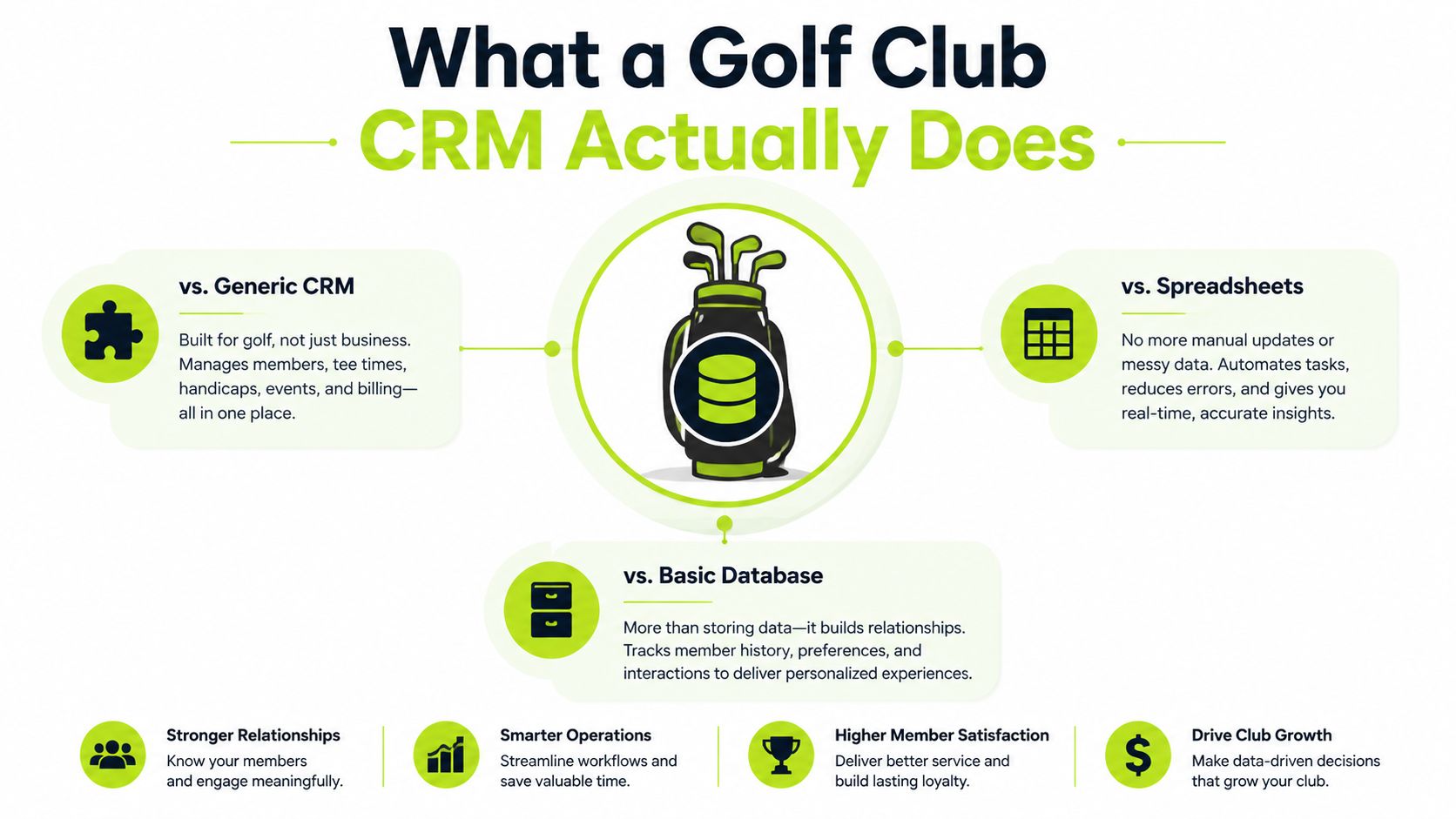
A golf club CRM is a system that manages relationships with prospects, visitors, members, societies, and other commercial contacts across their lifecycle. It isn't just a contact list. The useful distinction is whether the system tells staff what happened, what stage the contact is in, and what action is due next.
A basic database can store a name and email address. A spreadsheet can add notes and colours. A generic CRM can record sales activity. A golf-specific CRM connects those records to club processes such as membership enquiries, visitor rounds, open days, waiting lists, renewals, upgrades, and reactivation.
From contact record to active pipeline
A practical pipeline might contain stages such as:
- New enquiry: The contact has arrived through a form, phone call, social media message, email, or referral.
- Qualified: Staff understand the prospect's preferred membership, playing needs, timescale, and relevant eligibility.
- Visit or trial booked: The prospect has a scheduled opportunity to experience the club.
- Follow-up due: The next call, message, tour, or membership information has a defined owner and date.
- Joined, paused, or lost: The outcome is recorded so the club can learn from the source and process.
The system should capture leads from the channels the club uses, rather than forcing staff to re-key every contact. It should also trigger a prompt or message when an enquiry is received, while preserving the opportunity for a personal conversation.
That makes CRM the operational backbone between marketing and membership administration. Advertising might create attention, but the CRM shows whether the attention became a conversation, a visit, and eventually a joining decision.
Why a generic contact list isn't enough
A golf club needs context. A visitor interested in flexible midweek play should not receive the same communication as a family considering junior and full membership. A corporate organiser needs a different path from someone asking about a waiting list. A lapsed member needs recognition of their previous relationship with the club.
Clubs looking beyond golf can also learn from adjacent hospitality operations, particularly the way systems connect table management and guest recognition to a more complete customer record. The principles discussed in this resource on table management and guest recognition are relevant because they reinforce a simple point: staff serve people better when useful history is available at the moment of interaction.
A spreadsheet records information. A CRM organises decisions, timing, ownership, and follow-up around that information.
Core Features That Drive Membership and Revenue Growth
A CRM should earn its place by improving the work that leads to membership and revenue. The features below matter because they remove specific points of failure, not because they sound advanced.
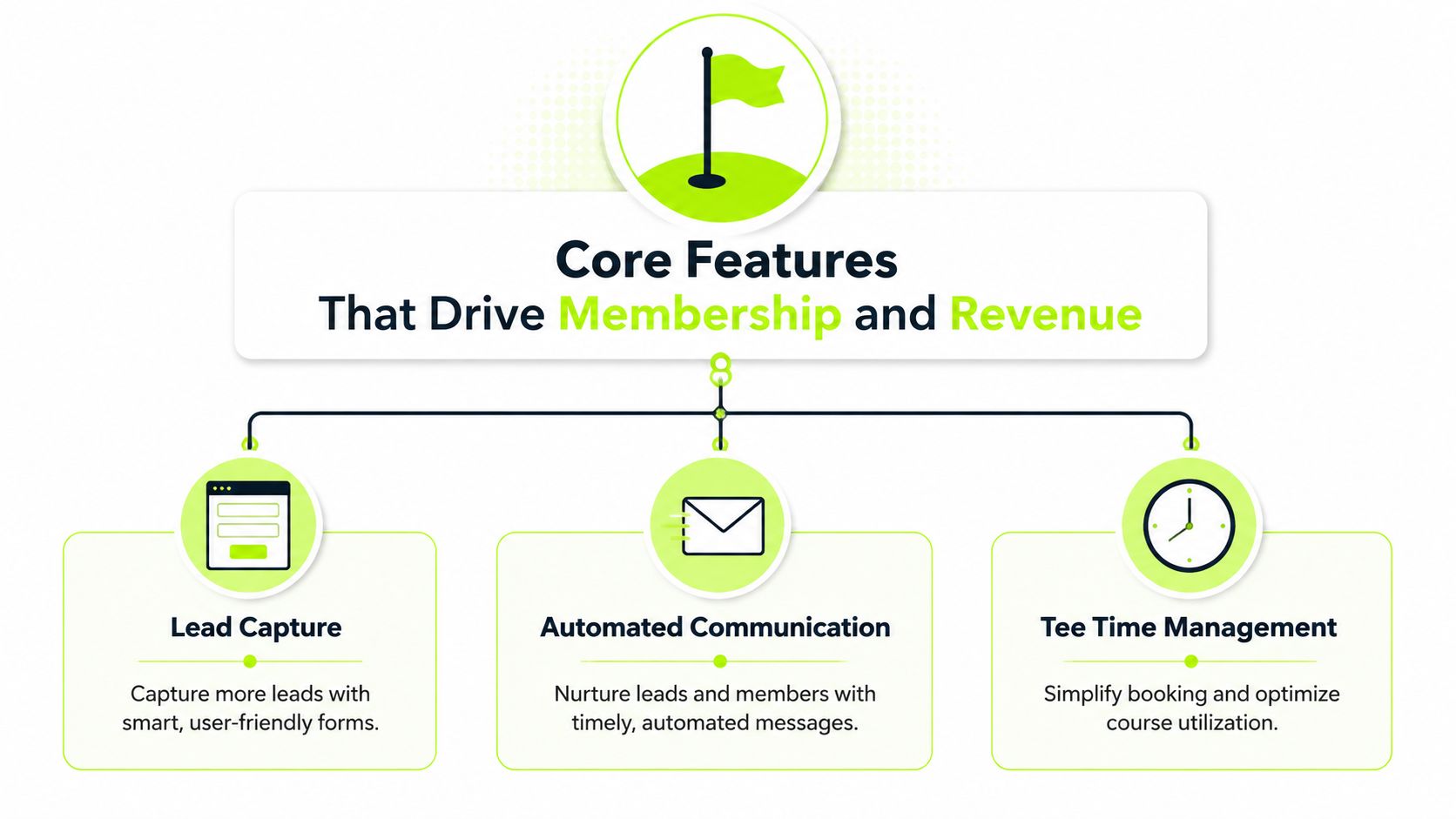
Lead capture is the starting point. Website forms, telephone enquiries, social messages, open-day registrations, visitor bookings, and referrals should feed into a shared record. The form should collect enough information to guide a conversation, such as preferred playing pattern and membership interest, without becoming an obstacle.
The features worth prioritising
- Immediate acknowledgement: A prospect should receive a useful confirmation while the enquiry is fresh. The message can set expectations, answer a common question, and tell the prospect when a team member will respond.
- Pipeline visibility: Managers need to see new, active, stalled, booked, and closed opportunities without asking several staff members for updates.
- Automated nurture: Not every prospect is ready to join after the first conversation. A planned sequence can provide membership information, explain the next step, invite a visit, and prompt staff to make a personal follow-up call.
- Booking integration: When a prospect books a trial round, tour, or open-day visit, that event should appear against the contact record. Staff can then follow up based on what happened rather than sending a generic message.
- Lifecycle management: The same system should support renewal reminders, upgrades, lapsed-member reactivation, and new-member onboarding. Acquisition is only one part of the relationship.
- Waiting-list control: A waiting list should be searchable, segmented, and actively nurtured. Prospects shouldn't disappear into a passive file because a place isn't available today.
The UK club market makes segmentation particularly important. Hillier Hopkins' 2023/24 survey found that 64% of members were aged 51 or over, with female membership at 18% and junior membership at 9%. The earlier Hillier Hopkins report supports the practical case for different journeys by age band, membership type, and engagement stage.
Revenue opportunities beyond full membership
A useful CRM can also manage society enquiries, corporate golf days, visitor conversion, lesson-related opportunities, and hospitality contacts. The pipeline stages differ, but the discipline is the same. Capture the contact, assign responsibility, record the next action, and measure the outcome.
Clubs comparing software and process design may find the broader discussion of CRM and lead strategy useful, particularly around the relationship between lead capture, qualification, and follow-up. For golf clubs, the system must then be adapted to the realities of tee sheets, membership categories, club committees, and seasonal demand.
Automation should support staff, not replace judgement. A timed message can remind someone about a visit, but a membership manager still needs to answer questions about culture, playing rights, competitions, fees, and whether the club suits the prospect.
For a practical example of how nurture fits into daily operations, see GolfRep's guide to automated follow-up for golf clubs.
How to Evaluate and Choose the Right CRM System
The right CRM is the one staff will use every day. A powerful platform that requires constant administration usually performs worse than a focused system that makes the next action obvious.
Start with the club's current workflow. Map how an enquiry arrives, who sees it, who responds, where notes are stored, how visits are booked, and how the outcome is reported. Ask vendors to demonstrate that exact process using a realistic membership enquiry, not a polished generic sales example.
Compare the important criteria
| Criteria | Why It Matters | Red Flags |
|---|---|---|
| Ease of use | Staff need to update records during busy operational periods | Long forms, confusing menus, or heavy reliance on one administrator |
| Lead capture | Enquiries should arrive in one visible queue | Manual copying from inboxes, social channels, or spreadsheets |
| Automation | Follow-up should continue when staff are occupied | Only basic broadcast email, with no action-based triggers |
| Booking integration | Visits and trial rounds need to connect to the prospect record | Separate systems with no shared status or history |
| Reporting | Managers need to identify bottlenecks and sources | Attractive dashboards with no clear conversion definitions |
| Membership lifecycle | The system should support renewals and reactivation | A sales-only pipeline that ends when someone joins |
| Support | Clubs need help with setup, permissions, and process design | Self-service documentation with no accountable contact |
A generic CRM can work when the club has internal technical capacity and a willingness to configure every golf-specific workflow. A basic member database may be sufficient for administration, but it often lacks enquiry ownership and nurture. A purpose-built golf platform can reduce configuration work, although clubs should still test its flexibility before committing.
Questions to ask before signing
Ask how the system handles duplicate contacts, consent, data migration, staff permissions, missed tasks, and reporting by enquiry source. Ask whether the vendor can connect to the club's existing booking, payment, website, and membership platforms. Ask to see the process for changing a membership category or handling a prospect who joins after a trial visit.
Budget should include implementation, data cleaning, staff training, integrations, and ongoing support. The cheapest licence can become expensive if staff continue using side spreadsheets because the system doesn't match their work.
A CRM decision is a process decision. Choose the platform that makes the right behaviour easier, not the one with the longest feature list.
Give staff a voice in the evaluation, especially the people who answer the phone, manage tours, and update member records. Their objections usually expose practical weaknesses long before a committee sees them in a report.
Implementation Steps and Integration Scenarios
Implementation works best when the club starts with one clearly defined pipeline rather than trying to automate every activity at once. Membership enquiries are usually the right first use case because the stages are understandable and the commercial outcome is clear.
Build the foundation first
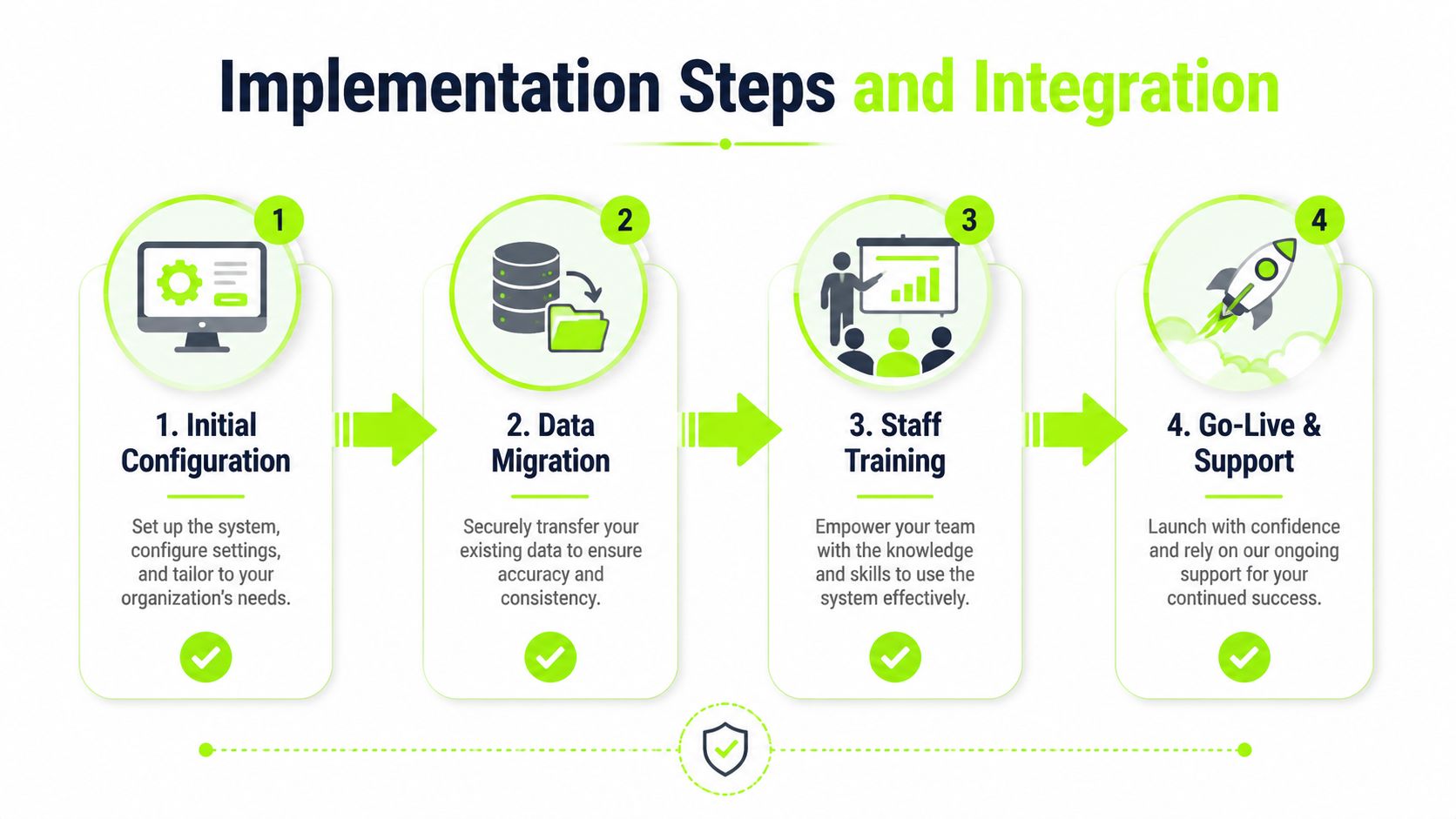
- Initial configuration: Define the stages, owners, enquiry sources, membership categories, and required fields. Keep the pipeline readable. If staff can't understand a stage, reporting will become unreliable.
- Data migration: Clean existing spreadsheets and databases before importing them. Remove duplicates, identify outdated records, record consent appropriately, and separate current members from prospects and lapsed contacts.
- Staff training: Train around daily tasks rather than technical features. Staff should know how to create a contact, record a call, move a prospect forward, schedule the next action, and close an outcome.
- Go-live and support: Launch with a small set of automations, review the first records, and correct problems quickly. A system becomes trusted when staff see that it reflects reality.
Connect the systems staff already use
A website enquiry form should create a record, identify the source, assign an owner, and trigger an acknowledgement. The staff member should then see the next action without searching through several inboxes.
A booking integration can connect a trial round or club tour to the enquiry. After the visit, the CRM should prompt a personal follow-up and record whether the prospect is considering membership, needs more information, or has decided not to proceed.
Membership-system integration supports the other side of the lifecycle. When someone joins, the club can start an onboarding journey. When renewal approaches, the system can identify members who need attention. When a member lapses, staff can segment the contact for appropriate re-engagement rather than treating them as a cold lead.
The same architecture can support society and corporate enquiries, although those pipelines need different questions, timeframes, and commercial outcomes. Staff should avoid forcing every opportunity into a membership template.
Clubs reviewing integration design can use these actionable integration strategies as a useful reference point. The key test is practical: does the connection reduce duplicate entry and make the next human action clearer?
Adoption is the real implementation test
The most common failure isn't a technical error. It's a return to old habits. A manager keeps a private spreadsheet, a receptionist records calls on paper, and the CRM becomes incomplete. Set one agreed source of truth, review pipeline hygiene in regular meetings, and make ownership visible.
Automation also needs governance. Check message timing, consent, tone, and escalation rules. A prospect should never receive an irrelevant promotion because a staff member failed to update a stage.
Measuring Success with KPIs and Reporting
A CRM dashboard should help a manager decide what to do next. It shouldn't become a collection of attractive charts that nobody uses.
Begin with response time. Track when an enquiry arrived, when the first meaningful response was made, and whether the response came from automation, staff, or both. A UK-focused analysis reported that 78% of customers buy from the first company to respond, while UK businesses averaged 47-hour response times and only 7% achieved replies within 5 minutes. The report also states that responding within 5 minutes makes firms 100 times more likely to connect than waiting 30 minutes. The UK lead-response analysis gives clubs a strong reason to make speed visible.
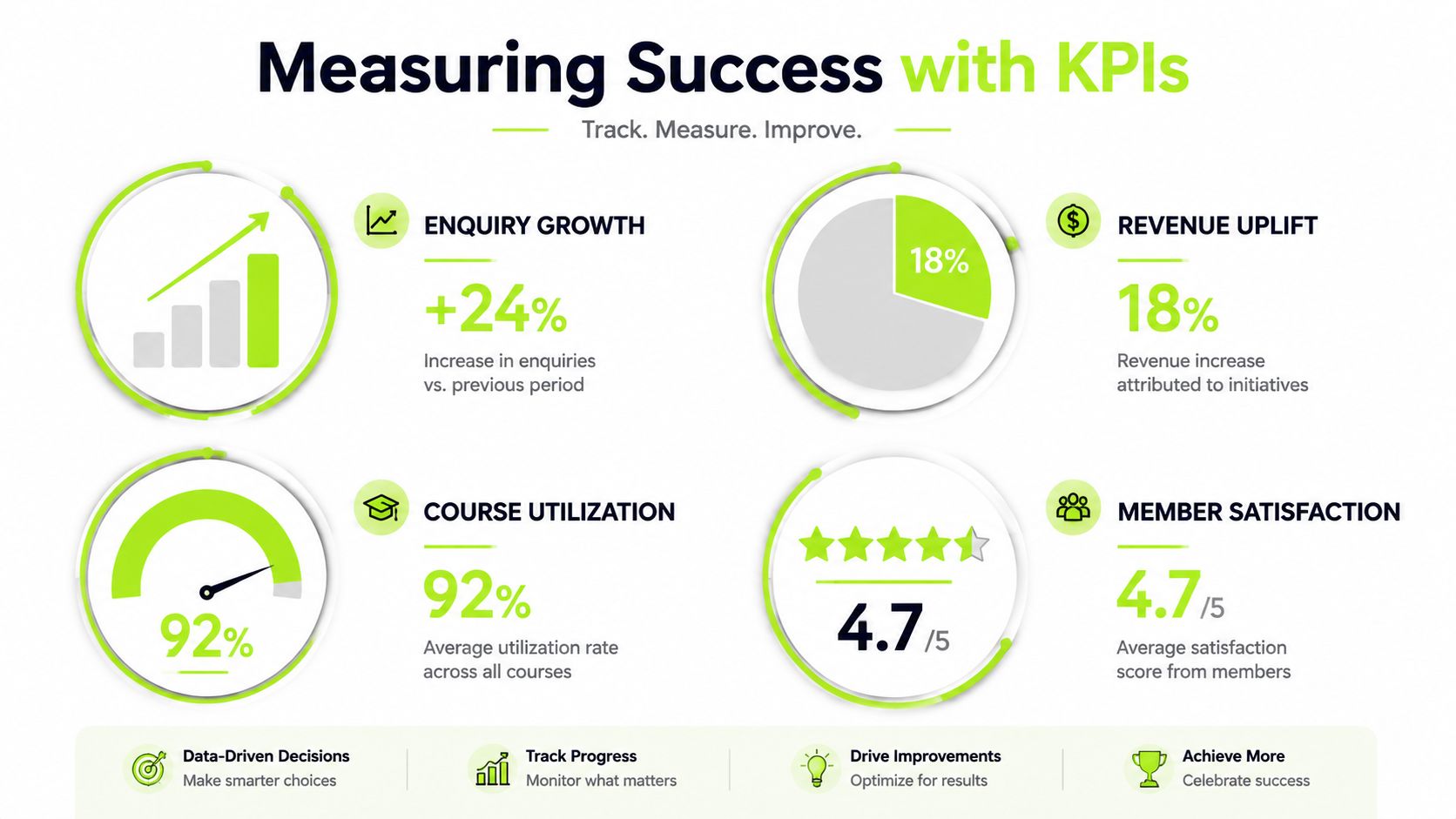
Track the whole journey
Useful measures include:
- Enquiry response time: Review the median and the slowest responses, not only the average.
- Enquiry-to-visit conversion: Identify whether prospects are booking a tour, trial round, or open-day place.
- Visit-to-membership conversion: Separate interest from actual joining behaviour.
- Time to conversion: Find out whether prospects stall at qualification, booking, or decision stage.
- Renewal and reactivation: Monitor member continuity and the outcomes of lapsed-member campaigns.
- Revenue by source: Compare referrals, social media, paid campaigns, website traffic, and partner activity based on completed outcomes.
The 2024/25 UK survey reported that 71% of members' clubs used member referrals, 60% used social media, but only 14% used email campaigns and 12% used direct mailings. It also reported that 75% of members' clubs experienced growth, with growth averaging 8% and ranging from 2% to 18%. The survey analysis on golf club digital marketing suggests that many clubs still rely more heavily on acquisition channels than on structured nurture.
Report by source and stage. If social media generates many enquiries but few visits, the issue may be qualification or follow-up. If visits are strong but joining decisions stall, the club may need clearer membership explanations, better hosting, or a more deliberate post-visit conversation.
For a broader commercial view, GolfRep's explanation of the real ROI of golf club marketing is useful because it focuses attention on outcomes rather than surface-level activity.
Real Club Results and ROI Guidance
A credible CRM case study should show the process and the outcome, not just a headline claim. GolfRep has worked with clubs and golf groups on systems that combine lead generation, immediate qualification, structured nurture, booked visits, and outcome tracking. The relevant lesson isn't that every club will produce the same result. It's that predictable growth comes from connecting each stage.
Bidston Golf Club is one example cited by GolfRep, where the club was revived from near-closure with more than double membership and six-figure recurring revenue. Addington Palace provides an example of steady pipeline development, while Downes Crediton shows how a rapid, profitable membership campaign can be built around a clear commercial process. Macdonald Hotels & Resorts demonstrates the additional coordination required when a multi-site operator needs centralised CRM and automated follow-up across locations.
Those examples should be treated as specific outcomes, not universal benchmarks. A club's results depend on its offer, reputation, capacity, pricing, local market, sales discipline, data quality, and ability to provide a good member experience after joining.
Calculate the return properly
A sensible ROI model includes:
- membership income generated from CRM-managed opportunities;
- visitor, society, corporate, or hospitality revenue influenced by the pipeline;
- the value of renewals and reactivated members;
- reduced waste from campaigns that produce enquiries but no follow-up;
- staff time saved by removing duplicate data entry and manual reminders.
Use a defined period and compare the cost of the system, implementation, training, and ongoing management with the revenue and retention outcomes it influences. Don't claim the CRM caused every joining decision. Instead, record the stages it supported and use attribution carefully.
The first operational improvement may be visibility rather than immediate revenue. Managers can see unanswered enquiries, stalled visits, and weak sources. Once those problems are corrected, the club has a stronger foundation for campaigns and budget decisions.
A golf club CRM isn't a substitute for a compelling product or a welcoming club. It ensures the club responds properly when potential members show interest, gives staff a shared process, and turns follow-up from an optional task into normal operating discipline.
GolfRep helps UK golf clubs combine lead generation with structured follow-up, CRM-enabled nurture, and pipeline reporting from first enquiry to booked visit and membership outcome. Visit GolfRep to discuss how a practical CRM growth system could fit your club's existing operations and membership goals.
Ready to tap into our proven growth system?