Golf Club Visitor Revenue: A System for Predictable Growth

Most golf clubs are chasing the wrong problem. They keep asking for more enquiries, more traffic, more exposure, then wonder why visitor income still feels unpredictable. The blunt truth is that golf club visitor revenue usually stalls because clubs fail to handle the interest they already have, not because they lack demand.
That matters because the opportunity is real. In Britain and Ireland, golf clubs serving visitors reported a 19% rise in casual visitor revenue in 2025, and one quarter saw visitor revenue jump 32% versus the same period in 2024, worth around £17,000 per club on average according to the sector source cited in the brief. That's not a niche win. It's a sign that visitor income is still one of the clearest growth levers available to UK clubs when enquiry handling, tee-time fill, and repeat-play conversion are taken seriously. Visitor revenue growth in Britain and Ireland
The clubs that win here don't rely on luck or a busier marketing calendar. They build a system that makes every enquiry visible, every response accountable, and every booking trackable. That's the difference between a club that grows visitor income by accident and one that makes it predictable.
Why Your Visitor Revenue Is Stalling
The usual diagnosis is wrong. Clubs assume they need more enquiries, more ads, or a better-looking website. The bigger leak sits after the enquiry lands.
Interest is not the problem
Visitor demand already exists in the market. A UK golf-industry report cited by National Club Golfer says one club generated £163,952 in visitor green fee sales, while the GCMA says 95% to 98% of club cash comes from member subscriptions and visitor green fees. Visitor income is not a side project, it is one of the two cash pillars that keeps a club moving. Visitor green fee scale at club level and GCMA on club cash flow concentration
That should change how committees think. If visitor revenue sits inside the main cash engine, then weak enquiry handling is not a minor admin issue. It is a direct revenue problem.
The leak is operational
Most clubs do not lose prospects because the golfer never asked. They lose them because nobody owns the enquiry, nobody replies quickly enough, or nobody follows up in a structured way. Shared inboxes and manual chasing create gaps, and gaps create dead leads.
Practical rule: if a lead can sit untouched, it will sit untouched.
The fix starts with discipline, not creativity. Assign ownership, measure response time, and make the pipeline visible. Without that, a club can celebrate enquiry volume while revenue leaks away.
Revenue grows when the system improves
Clubs that measure visitor performance properly make better decisions about pricing, tee-time use, and conversion. Revenue management only works when the club treats each enquiry as a tracked commercial opportunity, not as a casual message that someone will get to later. You also need a clear way to determine social proof's ROI if you are spending time and money trying to influence visitor demand.
If your current approach depends on memory, goodwill, or whoever happens to be in the office, you do not have a revenue strategy. You have a hope strategy.
First Principles Defining and Measuring Success

Visitor income looks simple on paper. You sell a round, collect the money, and move on. In practice, that view misses the operational choices that determine profit, especially tee-sheet usage, rate integrity, and the quality of each conversion.
Track the right measures
Start with Occupancy Percentage, or OCC%. It shows how much of your available tee-sheet capacity is being used. If the tee sheet is half empty, better messaging will not fix the day.
Next is Revenue Per Available Round, or RevPAR. This ties income to availability, so you can judge whether full tees are producing enough value. It is the cleaner measure because it forces you to assess fill and yield together, instead of flattering one while ignoring the other.
The third measure is Average Rate Per Round, or ARPR. That is the average income you receive for each visitor round sold. It matters because a busy diary with weak pricing can look healthy while still leaving money on the table.
Use the metrics together
A club that watches only total revenue makes poor decisions. It may celebrate a strong month even if that result came from heavy discounting or packing low-value tee times into the diary. OCC%, RevPAR, and ARPR give you the context that total income cannot.
Use one monthly review, not a pile of reports. Booking pace, day-of-week performance, seasonality, and local events all need to sit in the same conversation.
That is how clubs see whether growth is coming from rate, from utilisation, or from both. The difference matters because one route is sustainable and the other gives away value.
Keep the benchmark practical
Use the revenue outcome, not gut feel, to judge pricing and tee-sheet decisions. Clubs that apply dynamic pricing and data-led reporting around RevPAR improve visitor green-fee revenue because they stop guessing about what each tee time is worth. Read more in Golf course revenue management and RevPAR.
If you are spending time and money on reviews, testimonials, or other trust signals, you also need to determine social proof's ROI. If you cannot see what content changes behaviour, you are still guessing.
The same standard applies to enquiry tracking. A simple system should show where leads come from, who owns them, and whether follow-up is happening on time. Clubs that want that discipline in one place should use golf club enquiry tracking instead of relying on inbox memory and informal chasing.
Fixing the Leaks in Your Enquiry Handling Process
The biggest conversion problem in golf clubs is usually not the source of the enquiry. It's the handoff after the enquiry arrives. That's where clubs lose pace, lose ownership, and lose the chance to book the visit.
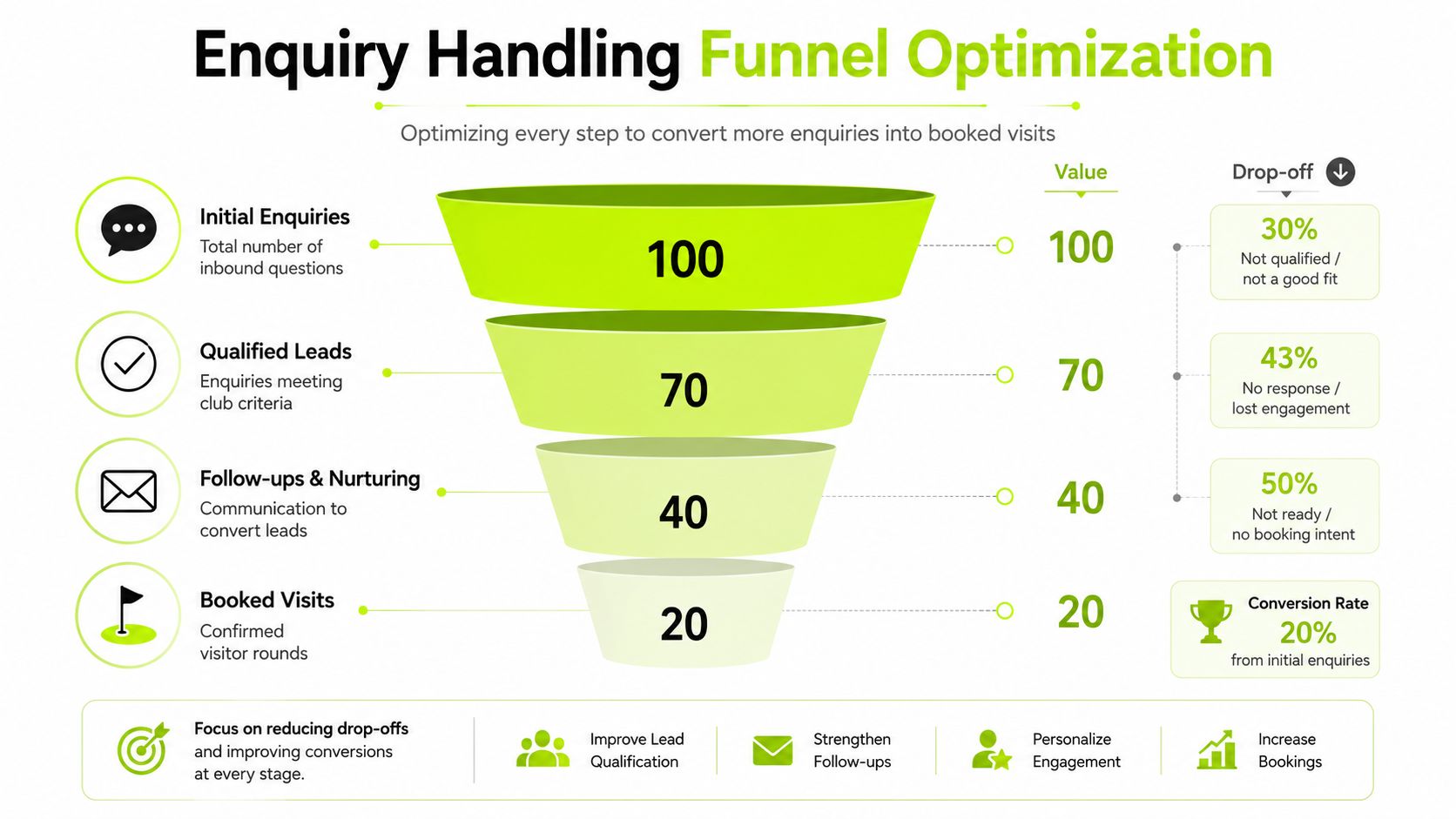
Across 50+ UK clubs, the average response time to an enquiry was 30 hours, despite hundreds of membership, society, and event enquiries each year, and faster responses were consistently linked to higher conversion rates according to The Revenue Club. That's too slow for a visitor market where prospects often contact more than one venue and book the one that feels easiest to deal with. Average enquiry response time at UK clubs
Where the leak happens
Manual handling creates three weak points. First, enquiries sit in a shared inbox with no owner. Second, the reply depends on who notices it. Third, follow-up happens only if someone remembers to chase it.
That's how good enquiries go cold. Not because the golfer vanished, but because the club failed to run a process.
A better model is simple. Every enquiry gets a named owner immediately, the owner responds quickly, and the enquiry moves through a visible sequence until the outcome is recorded. GolfRep's enquiry tracking guidance also points clubs to monitor source, response, status, and contact history, because revenue leakage usually shows up at handoff points. Golf club enquiry tracking
Stop relying on memory
The wrong fix is adding more tasks to the team's day. The right fix is removing dependence on memory. Centralise the lead sources, standardise the follow-up, and make the next action visible.
If the team can't see who owns the lead and what happens next, the lead isn't really being managed.
That's why structured follow-up beats improvisation. It also makes coaching possible, because you can see where enquiries stall instead of guessing why bookings are weak.
Use fewer tools, not more
One of the common mistakes is piling on extra initiatives before the basics work. Start with enquiry capture, response speed, and booking visibility. Only then worry about nurture flows or clever segmentation. GolfRep's revenue generation guidance makes the same point, a centralised CRM reduces manual chasing and makes visitor revenue more predictable across sites. Golf club revenue generation
For clubs trying to cut wasted admin and remove manual handoffs, it's also sensible to reduce operational costs while the process is being cleaned up. Inefficiency in follow-up is not just a sales issue, it's a cost issue too.
Building Your Predictable Revenue Engine
A club does not need a complicated stack to turn enquiries into bookings. It needs a workflow that handles the basics the same way every time, without depending on one person's memory or inbox habits. That is the difference between sporadic visitor rounds and a repeatable pipeline.
Start with capture and ownership
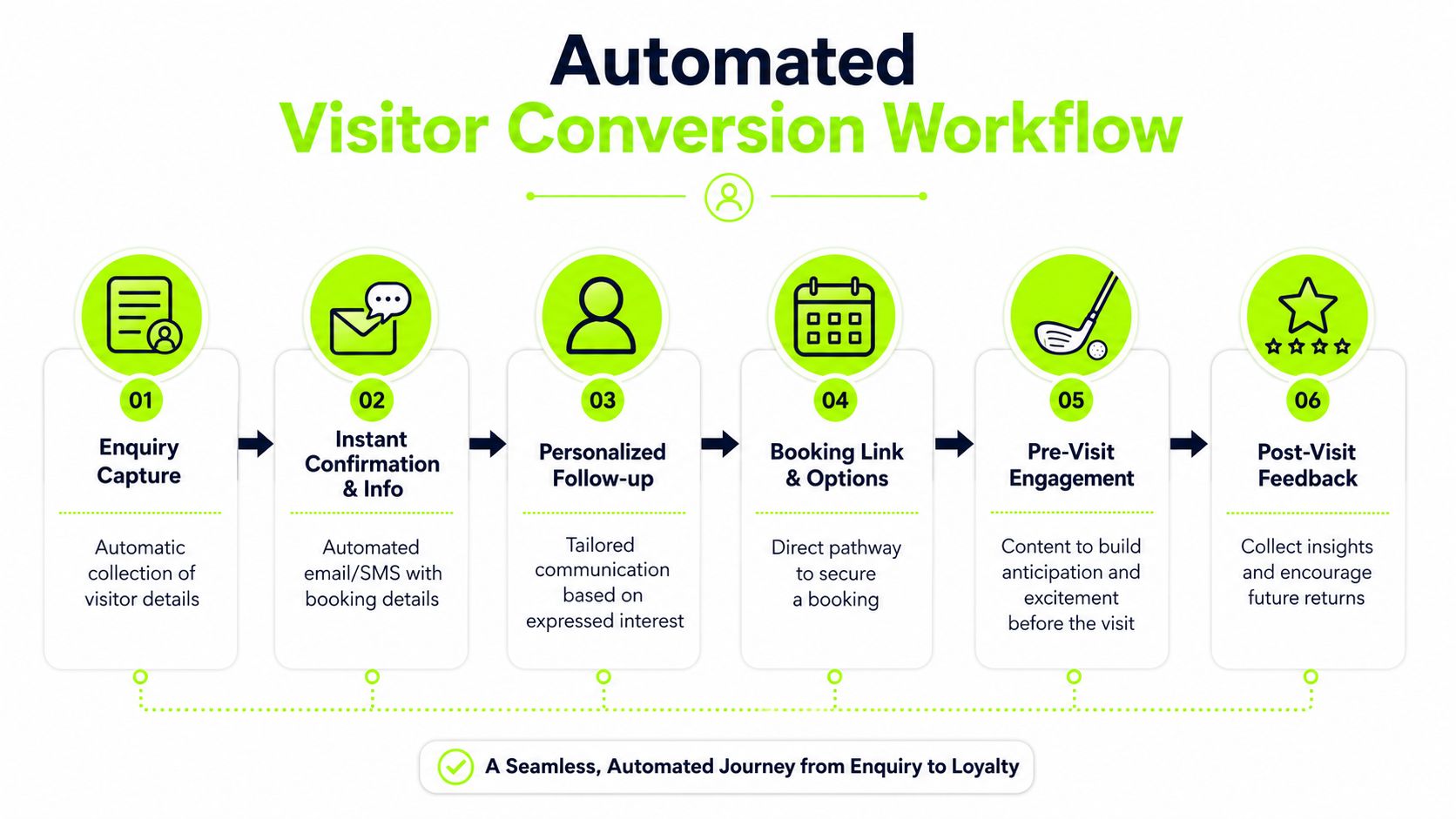
Every lead source should feed into one place. Website forms, phone enquiries, social messages, and email replies all need to land in the same CRM or tracked inbox. Once the enquiry appears, assign a named owner straight away.
That owner is responsible for the next action, not just the first reply. If responsibility is vague, the lead drifts and the booking disappears into admin.
Automate the early response
The first message should be instant and useful. It should confirm receipt, give the key booking details, and tell the prospect what happens next. That reply does not need to be flashy. It needs to stop the enquiry from going cold.
After that, use a short follow-up sequence. First reply, second contact, visit invitation, reminder, and outcome logging. Keep it structured. A club with a tidy workflow knows which leads were contacted, which were booked, which attended, and which disappeared.
Make visibility a priority
A visible pipeline is a key asset. It tells managers where demand enters, where it stalls, and which channels are producing actual bookings. Without that, clubs cannot tell whether they have a sales problem, a pricing problem, or a follow-up problem.
GolfRep's predictable revenue for golf clubs approach is built around this exact principle, centralise the enquiry, automate the first touch, and track the path to visit. If you want the longer version of that operating model, read it.
Use the system to support the team
A platform such as GolfRep earns its keep, not as a generic marketing agency, but as a way to connect enquiry generation with CRM-led follow-up and conversion tracking. The point is not more activity. The point is a pipeline that can be managed.
Rule of thumb: if the team cannot see the lead, they cannot convert it reliably.
When the system is built properly, staff spend less time chasing scraps and more time handling real opportunities. That is also where reduce operational costs becomes a practical result of better process, not a separate project. Predictable revenue comes from control, clear ownership, and consistent follow-through.
Optimising Yield with Pricing and On-Site Experience
Once enquiry handling is under control, the club can make each visitor worth more. Clubs that try to raise yield before they fix conversion are wasting time. A leaky funnel weakens every pricing decision because the club is still losing bookings before price even has a chance to do its job.

Price the round to demand, not habit
Dynamic pricing works only when it follows real booking behaviour. Set rates around booking pace, time of day, and the amount of tee sheet left to sell. That keeps the course working harder and stops the club from discounting out of habit.
For clubs that want a practical view of how this sits inside a wider revenue model, read golf club green fee revenue. The point is simple. Price should support yield, not just fill gaps.
Treat the visit as part of the sale
Visitor income does not stop at the tee. The on-site experience shapes whether a guest returns, recommends the club, or books a society day later. The round is only one part of the transaction.
The operational details matter most. Fast check-in. A clear welcome. Simple food options. Timed prompts from the pro shop. A clean handover to the bar or catering team. None of that is flashy, but each part helps turn a one-off round into repeat play. Clubs that ignore this leave money on the table even when the tee sheet looks busy.
Protect the brand while you raise value
Raising price does not mean weakening the product. It means charging properly where demand supports it and using quieter slots with intent. If the club does this badly, visitors learn to wait for bargains. If it does it properly, the club protects its premium feel and improves utilisation at the same time.
A good benchmark is to plan your Algarve golf outing and look at how packaged golf experiences are presented. The lesson is not to copy a resort. It is to see how clarity, convenience, and presentation affect booking behaviour.
Clubs that get this right treat pricing, service, and repeat play as one system. They also keep the commercial side tight, with pricing decisions tied to the same discipline that drives visitor conversion and follow-up.
Sustaining Growth Through Reporting and Optimisation
Visitor revenue should be managed like a system, not a campaign. If a club only looks at results when the season feels busy, it will miss the gaps that subtly suppress income. The better habit is disciplined reporting and small, regular adjustments.
Review the same few numbers every month
Keep the focus on the measures that matter, OCC%, RevPAR, ARPR, booking pace, response time, and conversion by lead source. That gives you enough information to see whether the system is healthy without drowning the team in noise.
The goal is simple. Spot what's working, remove what isn't, and tighten the handoff between enquiry and booking. When the club sees those patterns consistently, decisions get better fast.
Fix the next constraint, not everything at once
One month the issue may be slow response. Another month it may be pricing discipline. Another month it may be weak follow-up after the first reply. Don't scatter attention across a dozen projects. Fix the biggest leak first, then move to the next one.
That's how sustainable visitor growth happens. Not through one big marketing push, but through a repeatable process that keeps improving.
Build a habit of evidence
Clubs that do this well don't argue from opinion. They look at the pipeline, check the booking pace, and adjust. That is the core discipline behind predictable golf club visitor revenue. It's boring, but it works.
If your club wants visitor income to become more reliable, stop asking for more leads and start tightening the system around the ones you already get. A cleaner pipeline, faster response, and better reporting will do more for revenue than another round of broad promotion.
A CTA for GolfRep.
Ready to tap into our proven growth system?