Golf Course Revenue Management: A UK Club’s Guide for 2026

Most advice on golf course revenue management starts with price. Raise peak rates, discount shoulder times, watch the weather, track the tee sheet. That matters, but it's incomplete.
A club can sharpen pricing and still lose revenue every day if enquiries sit in inboxes, visitor leads go untracked, and membership follow-up depends on whoever happens to be free in the office. In practice, the bigger issue usually isn't demand creation. It's demand conversion.
That matters because the sector is large enough for small operational gains to have real consequences. The UK's 2,510 golf courses are projected to generate £2.8 billion in revenue in 2026, with the average club turning over £1.1 million a year, and 68% of green fee income already coming through online revenue sources according to IBISWorld's UK golf courses industry outlook. If a club improves how it captures and converts the demand it already generates, the financial effect can be meaningful without changing the course, the clubhouse, or the market.
Beyond Pricing The Real Challenge in Golf Revenue
Plenty of clubs treat revenue management as a pricing exercise. They review the Saturday morning green fee, discuss twilight rates, and maybe test a few changes in summer. Then they wonder why revenue still feels unpredictable.
The answer is usually sitting between marketing and operations.
Pricing doesn't fix a leaky pipeline
If a visitor clicks through, looks at availability, starts an enquiry, and never hears back, the problem isn't price. If a prospective member requests details and waits days for a reply, lowering or raising annual dues won't rescue that lead. A club can generate interest and still fail commercially because its process breaks after the enquiry arrives.
That's why golf course revenue management has to include three linked parts:
- Demand generation: getting the right golfers to notice the club
- Demand handling: capturing every enquiry in a visible system
- Demand conversion: following up quickly enough to turn intent into revenue
Most clubs talk at length about the first part and far less about the second and third.
Practical rule: If your team can't see every enquiry, assign ownership, and track the outcome, you don't have a revenue system. You have activity.
Revenue sits across the whole club
A golf club doesn't sell one thing. It sells tee times, membership, society days, bar and restaurant spend, retail, lessons, buggy hire, and events. Revenue management only works when those streams are looked at together rather than in isolation.
That changes decision-making quickly. A cheap visitor round that fills a dead slot may be sensible if it also drives food and beverage spend. A premium tee time may be worth protecting if it limits congestion and preserves member satisfaction. A membership campaign may look healthy on paper but still underperform if no one follows up properly.
A simple way to think about it is this:
| Area | Weak approach | Strong approach |
|---|---|---|
| Pricing | Fixed seasonal rate card | Rates adjusted to real demand |
| Enquiries | Shared inbox and memory | Central tracking and ownership |
| Membership sales | Reactive callbacks | Structured follow-up process |
| Reporting | Monthly totals only | Lead-to-revenue visibility |
The clubs that improve fastest connect operations to conversion
The clubs that outperform don't just tweak prices. They build a pipeline that links website traffic, enquiries, follow-up, bookings, and renewals. They know where a lead came from, who spoke to them, whether they visited, and what happened next.
That's the main challenge in golf revenue. Price matters, but price only works when the club has the systems to catch the demand it creates.
Auditing Performance and Segmenting Your Audience
Before changing rates or launching new campaigns, a club needs a clean view of current performance. Most revenue problems become easier to solve once you can separate assumption from pattern.
Start with a practical audit
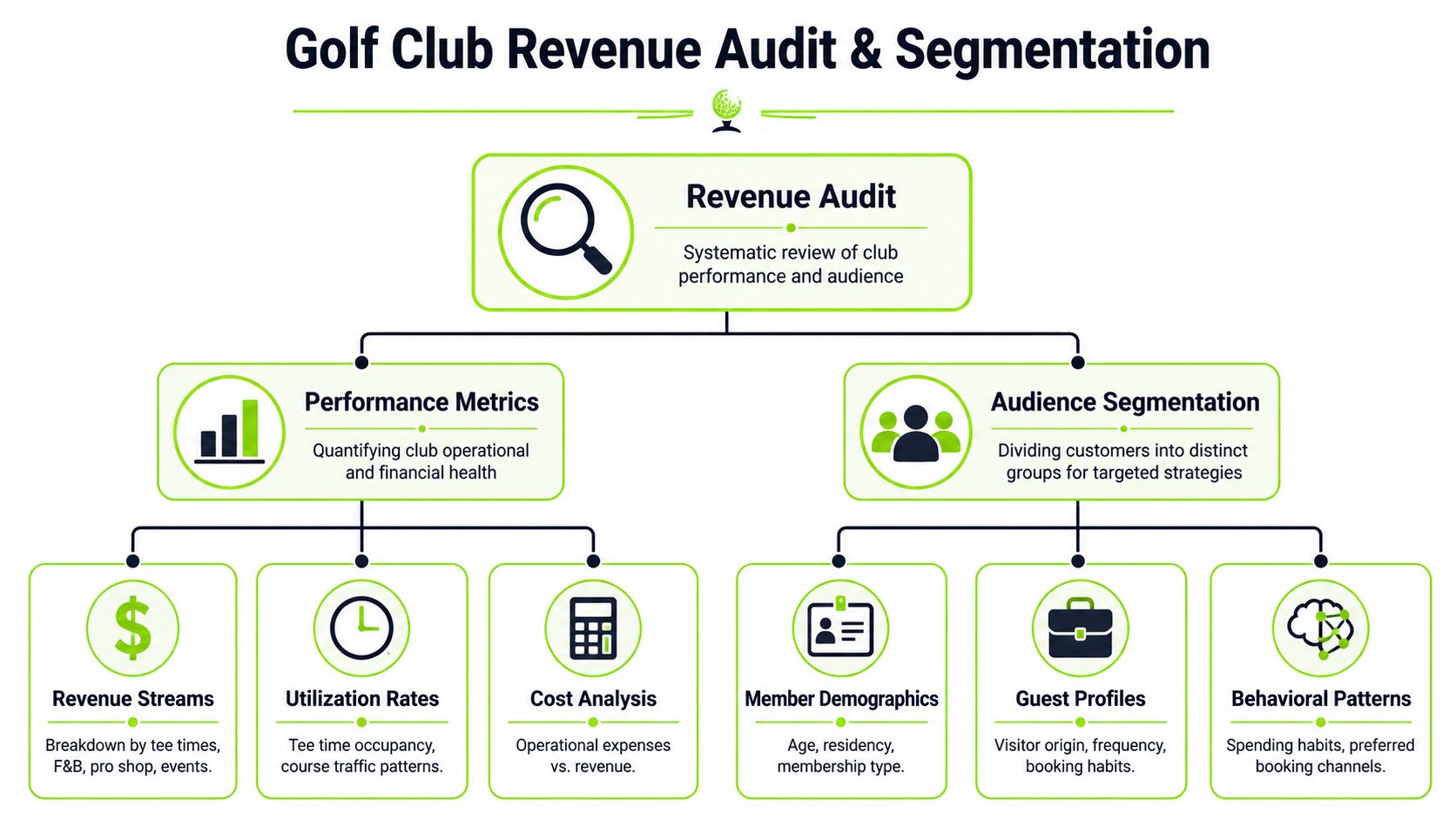
A useful audit isn't complicated. It asks where revenue comes from, when demand peaks, where space goes unused, and which golfer groups behave differently. You don't need a huge data team. You need clean categories and discipline.
Review these areas first:
- Revenue streams: tee times, membership, food and beverage, pro shop, events, lessons, buggy hire
- Tee sheet usage: which dayparts sell naturally, which require help, and where gaps create dead inventory
- Booking behaviour: how far in advance different customers book and which channels they prefer
- Enquiry handling: where leads arrive, who responds, and whether outcomes are recorded
Clubs often discover that they have more demand data than they thought, but it's trapped in different systems or spread across email, phone notes, and spreadsheets.
A proper segmentation exercise helps close that gap. If you need a useful primer, GolfRep's article on market segmentation for golf clubs is a good reference point for structuring audiences in a way the team can use.
Segment by behaviour, not just category
Many clubs split golfers into members and visitors, then stop there. That's too broad to support strong pricing or follow-up.
A more useful model might include:
- Core members: regular users with high loyalty and strong secondary spend
- Peak-time visitors: golfers willing to pay for preferred slots
- Value-led off-peak players: more flexible on timing, more price sensitive
- Societies and corporate groups: higher planning needs, broader spend potential
- Lapsed prospects: people who enquired before but never joined
- Younger membership prospects: often interested, but put off by rigid fee structures
These groups don't need the same message, the same product, or the same timing.
Clubs make better decisions when they stop asking, “What should our price be?” and start asking, “Which customer are we trying to serve in this slot?”
Membership structure deserves the same scrutiny as green fees
One of the more overlooked issues in UK club revenue management is how membership is packaged. A significant barrier for Millennial and Gen Z golfers in the UK is large, upfront annual membership fees, and shifting to subscription-style models similar to Netflix or a gym is described as a largely untapped option for more stable recurring revenue in Golfmanager's 2026 revenue guidance.
That doesn't mean every club should abandon annual billing. It does mean committees should stop treating membership as a fixed product that can't be redesigned. Monthly access, flexible categories, and staged pathways into full membership can reduce friction without cheapening the club.
For many clubs, the best next step is to gather direct member and prospect feedback before changing the offer. A structured survey process helps reveal what people value, what they find confusing, and what puts them off. AgentStack's guide to CX surveys is useful here because it shows how to ask better questions instead of collecting vague comments that no one can act on.
Implementing Dynamic Pricing and Yield Tactics
Dynamic pricing gets talked about as though it's a switch. Turn it on, and revenue improves. In reality, it works when the club understands why demand changes and adjusts inventory deliberately.

The four levers that actually matter
Effective revenue management balances demand forecasting, pricing, tee sheet optimisation, and distribution, and common mistakes include static pricing and failing to tighten tee intervals in peak periods, as outlined in Sagacity Golf's guide to golf course revenue management.
Those four levers work together:
Demand forecasting
Look at booking pace, day of week, season, local events, and recurring patterns. Forecasting doesn't need to be perfect. It needs to be better than guessing.Pricing strategy
Different time slots have different value. The mistake isn't charging more at peak. The mistake is pretending every slot deserves the same rate.Tee sheet optimisation
Inventory design matters. If intervals are too loose at high demand times, the club limits revenue before pricing even comes into play.Distribution
Where the booking happens affects margin, data ownership, and future repeat business.
Where clubs usually go wrong
The biggest pricing errors are rarely dramatic. They're small habits repeated for too long.
Common examples include:
- Leaving prices static for convenience: the market shifts but the rate card doesn't
- Using broad seasonal thinking only: Tuesday afternoon in April isn't the same as Saturday morning in June
- Protecting old pricing logic: “We've always charged that” is not a strategy
- Ignoring booking windows: golfers booking far in advance and golfers booking late don't behave the same way
A strong pricing model gives the team room to test. It doesn't lock them into a rigid annual decision that everyone is afraid to revisit.
If you're working through green fee strategy in more detail, GolfRep's piece on boosting golf club green fee revenue is a helpful companion to the operational side of pricing.
Small adjustments often beat big announcements
Many committees hesitate because they assume dynamic pricing means constant volatility or customer confusion. Done badly, it can. Done properly, it looks like structured yield management.
That usually means:
- clear differences between premium and lower-demand slots
- regular review of occupancy and booking pace
- tighter control of inventory in periods that already sell well
- measured changes rather than erratic swings
Operational note: The easiest revenue to lose is the value hidden in already popular tee times. Clubs often chase more demand before they fix underpriced demand.
Dynamic pricing is only one part of golf course revenue management, but it is the part that exposes whether a club is willing to treat tee times as perishable inventory rather than fixed-price tradition.
Optimising Inventory and Channel Management
A tee sheet is inventory with an expiry date. If a slot goes unsold, it disappears. That makes inventory control just as important as the price attached to it.
Many clubs focus on filling the sheet. Better operators focus on filling the right parts of the sheet, through the right channels, at the right margin.
Treat the tee sheet like a managed asset
Inventory decisions shape both revenue and experience. If visitor access crowds key member times, dissatisfaction grows. If protected member space sits unused while visitor demand is turned away, revenue is lost. If societies are accepted into awkward positions, the rest of the day suffers.
A stronger approach looks at the tee sheet in blocks rather than isolated bookings:
| Inventory decision | Risk if unmanaged | Better approach |
|---|---|---|
| Member allocation | Empty protected slots | Release rules based on booking pace |
| Visitor windows | Peak times sold too cheaply | Reserve premium periods for stronger value |
| Group bookings | Disrupts wider flow | Place groups where pace and spend align |
| Twilight inventory | Heavy discounting by habit | Price to actual demand and utilisation |
Channel choice affects long-term value
Third-party aggregators can help a club reach golfers it wouldn't otherwise reach. That's useful. The problem starts when the club becomes dependent on channels that own the customer relationship.
A direct booking isn't just a cheaper transaction. It gives the club first-party data, future marketing permission where appropriate, and a clearer path to repeat play, society bookings, coaching, and membership nurture.
That changes the economics. A third-party booking may fill a gap today. A direct booking can become a known golfer in the club's own system.
Push direct without shutting off reach
This isn't an argument to abandon all external channels. It's an argument to use them deliberately.
Practical ways to strengthen direct bookings include:
- Make the website journey simple: availability, pricing, and booking paths should be obvious
- Use external platforms selectively: let them support reach, not replace your own booking engine
- Capture data at every step: names, preferences, visit history, and follow-up permissions matter
- Give direct bookers a better experience: easier amendments, clearer communication, and relevant post-visit contact all help
The real value of a direct booking isn't the first round. It's what the club can do with that relationship afterwards.
Here, golf course revenue management moves beyond yield. The club isn't just selling a slot. It's deciding whether to own the customer or rent access to them through someone else.
Building Your Revenue Engine with CRM and Automation
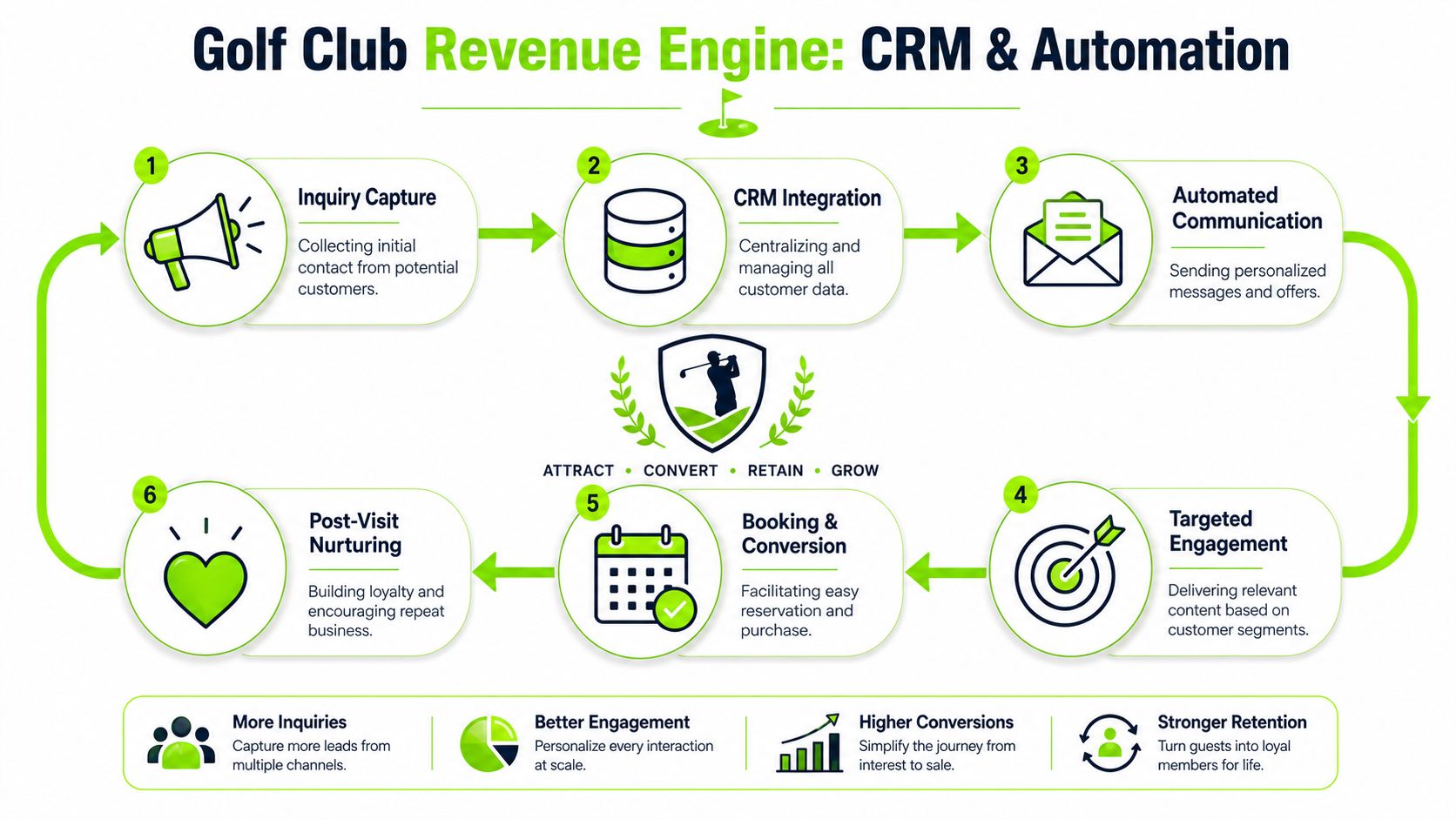
The pricing model can be sound. The website can be strong. The ad campaign can generate serious interest. None of that matters much if the club handles enquiries slowly and inconsistently.
That's the gap many clubs underestimate.
Speed changes conversion
GolfRep's data shows the average response time to UK golf club membership enquiries is 47 hours and 32 minutes, and a lead that receives a response within one hour is five times more likely to convert than one that waits 24 hours, according to GolfRep's analysis of marketing analytics for golf clubs.
That single operational issue explains why so many clubs feel they need more leads when what they really need is better lead handling.
If a prospect asks about membership on Monday and hears back on Wednesday, the opportunity has already cooled. The club may still log the enquiry as demand, but commercially it behaved like a loss.
CRM creates visibility that clubs usually lack
A proper CRM isn't there to make the team feel more technical. It's there so no lead disappears.
The system should answer basic questions immediately:
- Who enquired?
- What were they interested in?
- When did they enquire?
- Has anyone responded?
- What happened next?
- Are they still active, lost, booked, or undecided?
Without that visibility, clubs rely on memory and goodwill. That works until staff get busy, people go on leave, or follow-up becomes nobody's defined job.
A golf-specific setup also allows the club to segment and nurture leads based on real behaviour. Someone asking about a trial round should not receive the same sequence as a society organiser or a lapsed member.
GolfRep's article on golf club CRM software covers the practical side of what that infrastructure should include.
Automation improves consistency, not just speed
Some clubs still resist automation because they think it removes the personal touch. In practice, the opposite is often true. Automation handles the repetitive first layer so staff can spend more time on valuable human conversations.
Useful automations include:
- Instant acknowledgement: confirms the enquiry was received
- Lead routing: sends the enquiry to the right person or team
- Task creation: ensures follow-up has an owner and a deadline
- Nurture sequences: keeps warm prospects engaged until they're ready
- Reactivation flows: brings old enquiries back into view
That doesn't replace a club manager, secretary, or membership lead. It prevents simple admin delays from killing demand.
For clubs thinking more broadly about conversion operations, the logic is similar to the wider SME world. A useful external perspective is DigiVisi's piece on hiring a CRO consultant for UK SMEs, which explains why structured conversion systems often outperform ad hoc sales efforts.
A club doesn't need robotic communication. It needs a process that guarantees nobody waits in silence.
Measuring Success with KPIs and Continuous Refinement
Revenue management fails when reporting stops at total sales. A club can take more money in one month and still underperform if pricing, occupancy, or conversion quality worsens underneath the surface.
The answer is to track a short list of operational KPIs consistently and use them to refine decisions.
Track the metrics that change behaviour
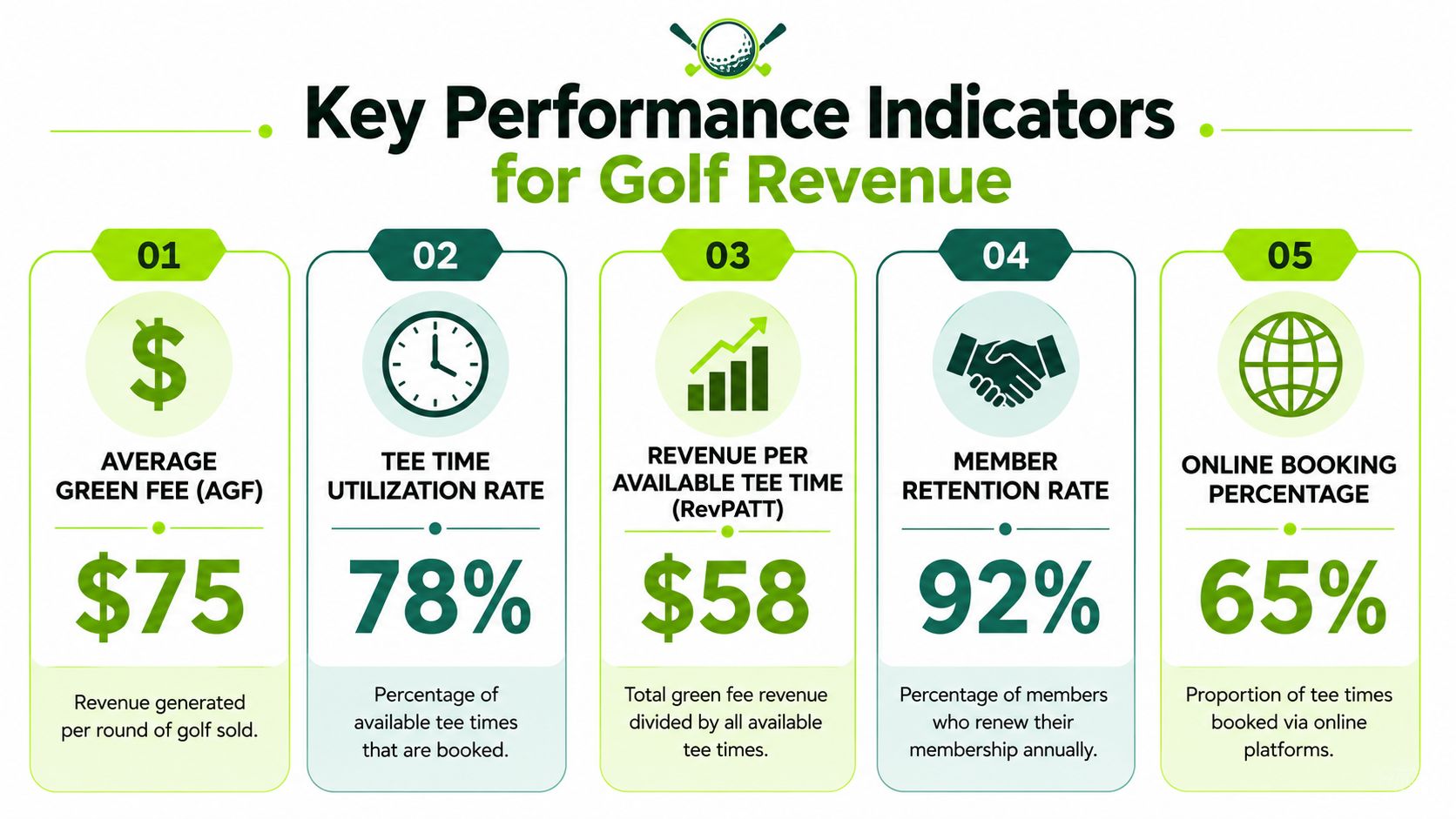
Clubs adopting dynamic pricing and data-led reporting have seen visitor green fee revenue increase by 32% within six months, and key metrics to watch include RevPAR and ARPR, according to The Revenue Club's golf revenue management case study.
The most useful measures are:
OCC %
Occupancy Percentage. Rounds played divided by available inventory. This shows how much of the tee sheet the club is using.RevPAR
Revenue Per Available Round. Total green fee revenue divided by capacity. This tells you how effectively the full inventory is being monetised.ARPR
Average Rate Per Round. Total green fee revenue divided by rounds played. This shows pricing strength on the rounds you sold.
Together, they stop the team from looking at volume or price in isolation.
Use a simple review rhythm
A monthly review is usually enough for most clubs if the data is clean. The discussion should stay practical.
Ask:
- Which dayparts improved or weakened?
- Did pricing changes lift RevPAR or just reduce occupancy?
- Which channels produced the best quality bookings?
- Where did follow-up or conversion break down?
- Which test should run next month?
That creates a cycle of refinement rather than committee debate based on instinct.
Borrow discipline from outside golf
Golf clubs don't need to copy online retail, but they can learn from how digital businesses monitor commercial performance. A helpful comparison point is Oviond's overview of key e-commerce performance indicators, especially the principle that each metric should inform an action rather than sit in a report no one uses.
Working principle: If a KPI doesn't help the club decide what to change next, it's probably not a useful KPI.
The clubs that improve steadily don't chase novelty. They review, adjust, test, and repeat. That is what turns golf course revenue management from a pricing project into an operating discipline.
GolfRep helps UK golf clubs build predictable pipelines by connecting demand generation, CRM visibility, and structured follow-up into one revenue system. If your club is generating interest but not converting enough of it, GolfRep is worth a closer look.
Ready to tap into our proven growth system?