Golf Club Revenue Generation: A Predictable Playbook 2026

Most advice on golf club revenue generation starts in the wrong place. It tells clubs to run more campaigns, buy more ads, post more on social media, and chase more leads.
That sounds productive. It often isn't.
For most clubs, the biggest revenue problem is simpler and more frustrating. Enquiries come in, but nobody owns them properly. A membership prospect fills in a form and waits. A visitor checks tee times but drops out before booking. An events lead asks about room hire and gets a reply days later, or gets no useful follow-up at all. The demand was there. The process failed.
That's why clubs can feel busy and still leave money on the table. If you only focus on generating attention, you build a bigger funnel into the same weak conversion process. Better golf club revenue generation comes from turning existing interest into booked rounds, clubhouse spend, visits, and long-term members.
The Real Revenue Problem at Your Golf Club
A lot of clubs assume they have a marketing problem when they really have a conversion problem.
The UK market already gives clubs a strong commercial base. The sport supports more than 1,800 golf facilities across the country, and the England Golf ecosystem alone reports over 750,000 affiliated members, which is why revenue growth is driven less by creating demand from scratch and more by converting existing golfers into higher-value, longer-term customers, as noted in this overview of revenue generation in the golf industry.

The leaky bucket problem
Most clubs don't have an empty pipeline. They have a leaky one.
Interest exists across memberships, visitor golf, society days, functions, coaching, and food and beverage. But if the club can't respond quickly, track conversations, and move prospects to the next step, that interest leaks away. The result is familiar. Staff think lead volume is weak, while the underlying issue is that lead handling is inconsistent.
A simple example shows the pattern. A prospective member asks for pricing and playing rights. One staff member replies with a PDF. Another promises a callback. A third assumes the prospect will get back in touch when ready. No visit is booked. No follow-up is scheduled. No one can see what happened next.
Practical rule: If your club can't say exactly where an enquiry sits today, you don't have a pipeline. You have inboxes.
That's why “more leads” often makes things worse. It adds pressure to a process that already lacks ownership.
What actually changes revenue
Revenue improves when clubs tighten the middle of the journey. That means enquiry capture, response, qualification, follow-up, visit booking, and conversion tracking.
In practice, that means clubs need to know:
- Who enquired: Not just a name in an email inbox, but the actual prospect, source, interest, and status.
- What they wanted: Membership, a green fee, a function, a lesson, or something else.
- What happened next: Reply sent, call made, visit booked, quote issued, follow-up pending.
- Who owns the next action: One named person, not a vague team responsibility.
If this sounds obvious, that's because it is. The problem is that many clubs still run revenue generation manually, across spreadsheets, inboxes, memory, and paper notes.
A sharper explanation of this issue sits in GolfRep's article on how most golf clubs lose 30% of enquiries without realising. The important point is not the headline. It's the pattern. Clubs usually don't lose revenue because nobody was interested. They lose it because nobody ran a proper follow-up system.
Diagnosing Your Revenue Gaps and Opportunities
Before changing pricing, promotions, or channels, audit what happens after someone shows intent. That's where most revenue gaps become visible.
Start with the handoff points
Revenue leaks usually happen where responsibility gets fuzzy. Website to office. Office to membership team. Visitor booking to clubhouse. Event enquiry to function manager.
Ask these questions first:
- Membership enquiries: How quickly does someone get a useful reply, not just an acknowledgement?
- Visitor bookings: Where do golfers abandon the process, and can anyone see that?
- Events and functions: Do you collect full contact details, event type, likely date, and budget context?
- Food and beverage opportunities: When someone books golf, do you present a relevant dining or clubhouse option?
- Coaching and academy leads: Are these treated as one-off enquiries or as a route into wider club spend?
A useful audit doesn't stop at “do we advertise enough?” It asks whether the club can track intent across each income stream.
Audit the customer journey, not just the channel
Many clubs review their website, social media, and signage, but skip the more commercial question. What happens after somebody takes the first step?
Use a short working table with your team.
| Revenue stream | Key question | Common gap |
|---|---|---|
| Memberships | Do we move every enquiry towards a visit or conversation? | Information sent, but no next step booked |
| Green fees | Can a visitor book easily on mobile and direct? | High friction, too many clicks, weak follow-up |
| Events | Do we follow up non-bookers with a clear offer? | Enquiry answered once, then forgotten |
| Food and beverage | Do golf customers see relevant hospitality offers? | Separate teams, no joined-up selling |
This isn't only about software. It's also about clarity. If nobody can describe the process in plain English, the process probably doesn't work.
Clubs that improve revenue usually don't begin with a new campaign. They begin by mapping what happens between first enquiry and money in the bank.
Check whether your offer is clear enough to convert
Some clubs respond quickly and still struggle because the offer itself is muddled. The prospect can't tell why this club is worth joining, why the function room suits their event, or why the visitor experience is worth the rate.
That's partly a sales issue and partly a positioning issue. If your club presents itself in a generic way, it becomes harder to justify price and easier for prospects to delay. Good operators sharpen the value proposition before they spend more on traffic. There's a useful outside example in BPE Digital's guide to crafting brand identities, because clubs also need a consistent message that staff can repeat confidently across website, phone, email, and in-person conversations.
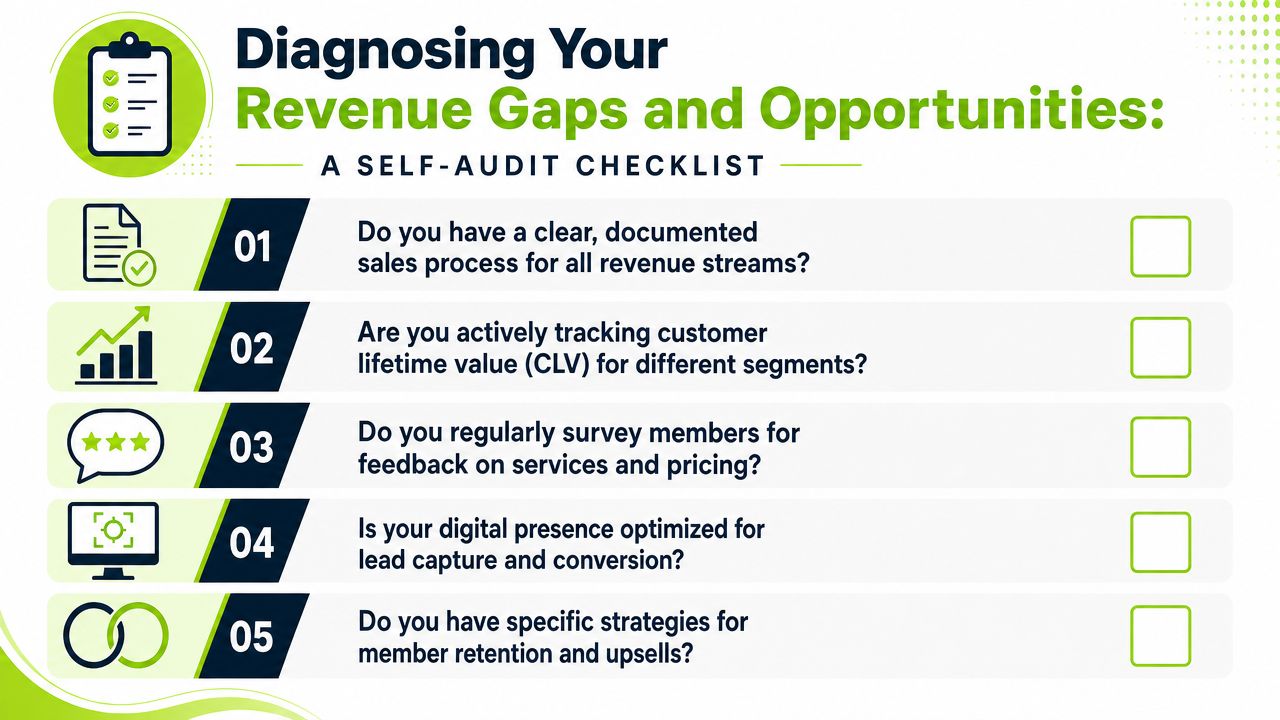
A practical self-audit should cover these five areas:
- Lead visibility: Can you see every live enquiry in one place?
- Response quality: Does the first reply answer the core question and invite a next step?
- Follow-up discipline: Is there a planned sequence, or does it depend on memory?
- Offer clarity: Can prospects understand the value quickly?
- Conversion tracking: Can you tell which enquiries turned into revenue?
If you can't answer those cleanly, that's where your next revenue gain sits.
Optimising Your Core Revenue Engines
The clubs that grow revenue consistently do not treat memberships and green fees as separate admin tasks. They manage both as conversion systems with pricing discipline, clear offers, and staff actions that happen the same way every time.
That matters because demand already exists. The leak is usually in how the club handles it.
Membership growth without cheapening the offer
A membership enquiry is not a lead-generation win. It is a sales opportunity that can still be lost through vague messaging, slow follow-up, or an unstructured visit.
Many clubs default to tactical discounts because they feel easier than fixing the process. That choice creates a bigger problem. Prospects learn to wait, current members question value, and the club ends up filling gaps at a weaker average yield. A better approach is to improve conversion at full price for people who are already a good fit.
In practice, that means tightening four parts of the journey:
- Targeted positioning: State clearly who the membership suits, what kind of playing access they get, and what makes the club worth joining beyond the course itself.
- Hosted visits: Replace casual “drop in and have a look” responses with booked tours, trial rounds, or meetings that are owned by a named staff member.
- Planned follow-up: Send a useful reply, answer objections, and schedule the next contact instead of hoping the prospect comes back.
- Consistent value framing: Present golf, competitions, practice access, social use, coaching, and food and beverage benefits as one coherent offer.
Committee-led clubs often worry that this feels too sales-driven. It is organised buying support. If nobody guides the prospect, the decision gets delayed, and delayed decisions rarely become paid memberships.
One common pattern is easy to spot. A prospect asks about joining, receives a price list, visits once on a Saturday when the office is stretched, then hears nothing for ten days. The club records that as low demand. It is poor conversion.
There is a wider commercial case for managing each income stream with intent in GolfRep's guide to golf club revenue structure.
Green fee revenue should be managed, not guessed
Green fee revenue often suffers from the opposite mistake. The club has demand, but pricing and booking control are too blunt to capture it properly.
A static rate card is simple to administer. It is also one of the fastest ways to undercharge strong tee times and leave quieter periods unsupported. Analysts at Sagacity Golf, in their guidance on golf course revenue management, recommend tracking direct rounds booked divided by all rounds played and all green-fee revenue divided by rounds played. They also note that static pricing leaves peak demand underpriced and weaker periods underfilled.
The commercial goal is yield, not just occupancy.
| Approach | What it looks like | Likely outcome |
|---|---|---|
| Static pricing | Same logic all week, broad seasonal rates | Peak times sell too cheaply, quiet periods stay thin |
| Data-led pricing | Rates reviewed against demand, booking pace, and time-of-day patterns | Better average rate and stronger use of quieter windows |
| Direct booking focus | Club steers demand to its own channels | Better margin, better customer data, better remarketing options |
The same thinking already exists in hospitality. Operators use revenue management to boost restaurant profits by matching price, timing, and capacity more carefully. Golf clubs should apply the same discipline to the tee sheet.
Here is the practical trade-off. If a Saturday morning always fills two weeks out, the price is probably too low. If Tuesday afternoons stay empty and the only answer is “that's just how it is,” the club is probably not packaging, pricing, or promoting those times well enough.
Operator note: A full tee sheet at the wrong average rate is not strong performance. It is busy work that leaves money behind.
The clubs that improve core revenue engines do two things at once. They protect price integrity and build a repeatable process for turning real interest into paid bookings, paid rounds, and paid memberships.
Expanding Revenue Beyond the Fairway
A lot of clubs talk about diversifying revenue, but they still run the clubhouse, events diary, and golf operation as separate islands. That's why revenue beyond the fairway often stays patchy.
The better model is integration. A golfer shouldn't feel like they've used one business for a round and a completely different business for food, social events, or room hire. The club should present one joined-up experience with multiple ways to spend.
Turn quiet space into saleable inventory
UK golf clubs can increase revenue by treating the clubhouse as a year-round asset. That includes weekday and off-peak function hire, plus bundled offers such as 9 & Dine that lift utilisation across golf, food and beverage, and events, as outlined in UK POS guidance on improving golf club revenue. One of the biggest mistakes is under-communicating the value proposition.
That under-communication shows up everywhere. A club has a good function room but hardly mentions it on the website. Visitors finish a round, but nobody presents a post-golf dining offer clearly. Society organisers enquire about golf only and never hear about food packages, bar tabs, or presentation options.
A practical club scenario looks like this:
- A midweek tee sheet has spare capacity.
- The clubhouse is quiet outside lunch.
- The events space sits unused for long stretches.
- The team treats these as separate issues.
They aren't separate. They're one yield problem.
Build cross-sell into the customer journey
Consider a visiting fourball booking online. If the journey ends at “tee time confirmed”, the club has only sold one product. If the booking journey adds a relevant dining package, a drinks option, or a prompt to ask about future society and event use, average spend can rise without changing the volume of golfers.
The same logic works the other way round. Someone enquires about a birthday, wake, business breakfast, or Christmas function. That lead should sit in the same commercial view as golf enquiries, because they may also become golf customers, corporate day organisers, or future members.
A few high-value moves usually work better than lots of disconnected ideas:
- Bundle naturally: Offer golf and food combinations people already understand.
- Use booking data: If visitors return often, present society, lesson, or membership options at the right time.
- Promote off-peak space: Sell weekday room hire and quieter shoulder periods with a clear use case.
- Link teams together: The golf office, bar, and events team need one customer view.
A club trying to improve this side of the business should also tighten how it runs food and beverage management, because hospitality margin often depends less on footfall alone and more on how offers, staffing, and sales prompts are coordinated.
The clubs that monetise the clubhouse best don't treat hospitality as an add-on. They treat it as part of the member and visitor journey.
Building Your Predictable Revenue System
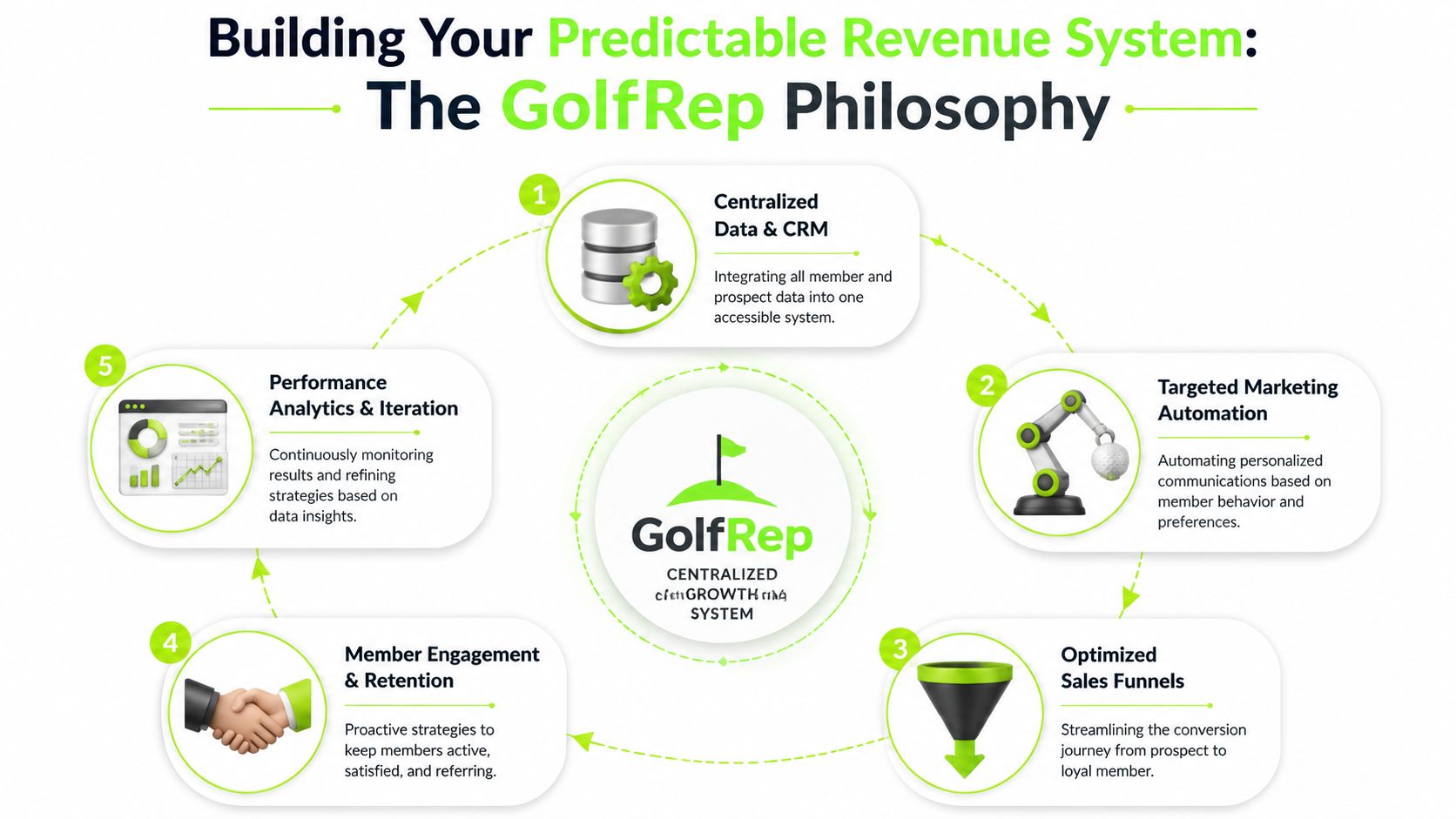
Once a club sees where enquiries leak, the next step isn't buying random tech. It's building one system that catches demand, routes it properly, and keeps follow-up moving.
That system usually rests on two foundations. A central CRM and simple automation.
What the system needs to do
A predictable revenue system should do four things well.
Capture every enquiry
Website forms, phone callbacks, event enquiries, visitor requests, membership interest, and referrals should land in one place.Assign ownership fast
Every lead needs a named next action. Not a general inbox. Not “someone will reply”.Trigger useful follow-up
A membership prospect should get a different sequence from an events lead or a lapsed visitor. Relevance matters.Show the pipeline clearly
Managers should be able to see open enquiries, stalled leads, booked visits, live opportunities, and conversion outcomes without chasing staff for updates.
For clubs with limited staff, the most sensible place to automate first is where the revenue lift is clearest. That usually means enquiry handling, visit booking, and new member nurture flows, rather than a long list of unprioritised ideas, as reflected in this sector view of golf club automation priorities.
What this looks like in day-to-day club operations
A good system doesn't have to feel complex.
A membership prospect fills in a form on Sunday evening. They receive an immediate acknowledgement with relevant next steps. The right team member sees the enquiry on Monday with full context. If no visit is booked, the system prompts follow-up. If the prospect goes quiet, the nurture sequence continues with useful information rather than a dead stop.
An events lead asks about a Friday function. The system captures the event type, date window, and contact details. If the room is unsuitable for that date, the lead isn't lost. The club can still offer an alternative date, a different package, or future follow-up.
Most clubs don't need more admin; they need less reliance on memory.
Systems beat heroic effort
Some clubs still depend on one excellent staff member who “knows everyone” and remembers to chase things. That works until they're off, overloaded, or leave.
A system is safer than heroic effort because it creates consistency.
| Manual approach | System approach |
|---|---|
| Enquiries sit in inboxes | Enquiries enter one visible pipeline |
| Follow-up depends on memory | Follow-up is scheduled and tracked |
| Reporting is hard | Managers can review pipeline status quickly |
| Revenue leaks are hidden | Bottlenecks become visible |
Best test: If your membership secretary vanished for two weeks, would your pipeline keep moving?
If the answer is no, your revenue process is still person-dependent rather than system-led.
Your Implementation Roadmap and Key Metrics
More marketing will not fix a club that handles enquiries slowly, inconsistently, or not at all. The fastest revenue win is usually better conversion of demand you already have.
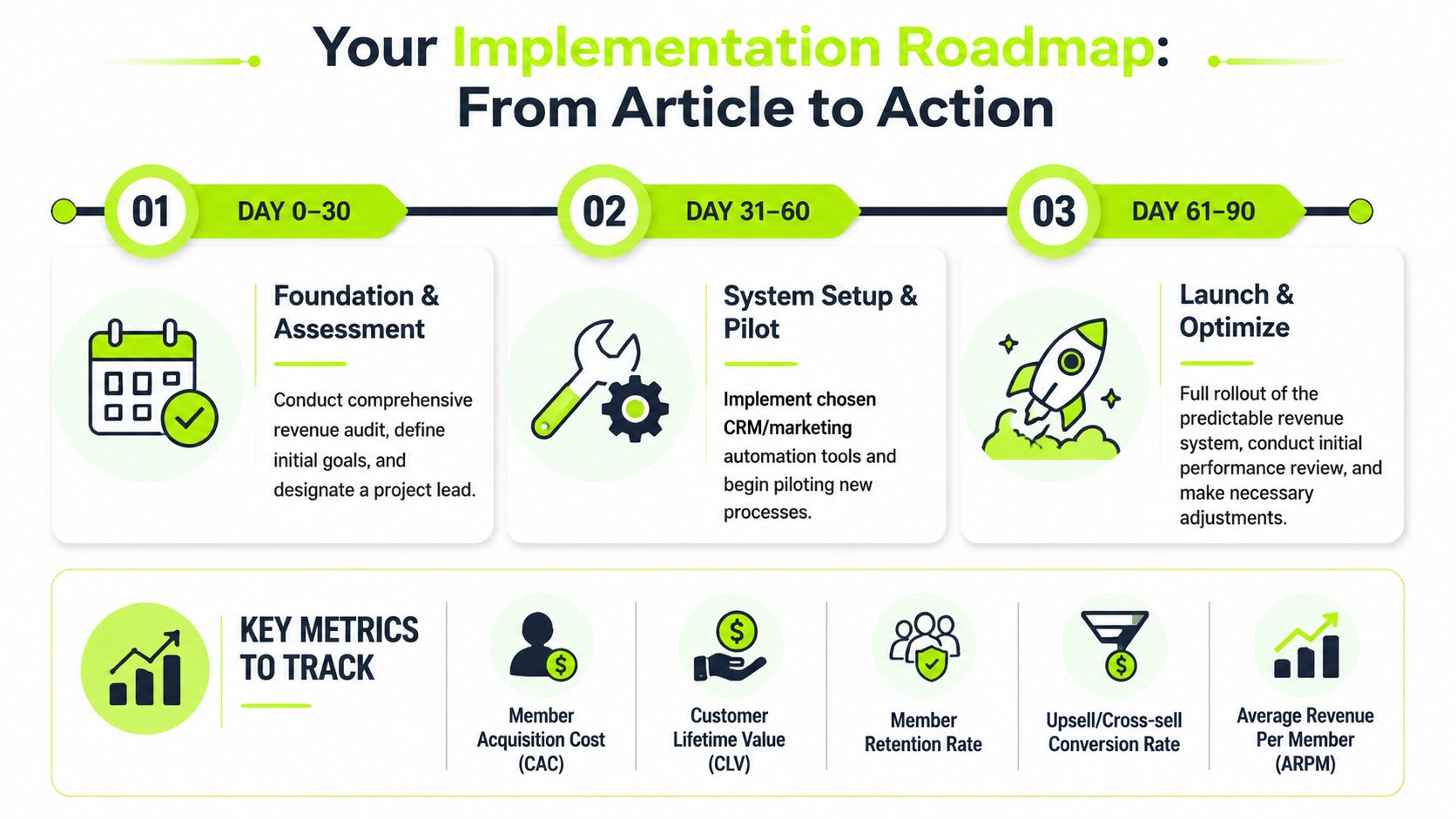
First 30 days
Start with visibility and ownership.
A new club client often tells me they have a lead problem. After a week of reviewing forms, inboxes, phone logs, and visitor requests, the pattern is usually different. Enquiries are arriving. The club just cannot see them in one place, measure what happens next, or spot where they stall.
Map every enquiry source. Website forms, phone calls, email inboxes, social messages, visitor bookings, event requests, and membership referrals all count. Then assign each source to one logging point and one accountable owner.
The first questions are practical:
- Where do enquiries arrive today
- Who replies first
- How is follow-up recorded
- What gets dropped when the office is under pressure
Set a short list of commercial metrics from day one. Keep it tight. Track enquiry volume by type, response time, booked visits or show-rounds, and final outcomes. That is enough to expose whether the issue is weak demand or weak conversion.
Days 31 to 60
Build one repeatable sales process before you spread effort across the whole club.
For many clubs, the right starting point is membership enquiries. For others, it is society days or private events because the deal value is higher and the buying window is shorter. Choose the journey where better follow-up will produce a visible commercial result quickly.
Write the process in plain English. First reply. Second contact. Invitation to visit or speak. Reminder. Outcome logging. Escalation if there is no response. This should be clear enough that a new staff member can follow it without guessing.
Pricing discipline matters here. Clubs that rush into discounting usually create a different problem. They fill a gap for a month, then train prospects to wait for an offer and make full-fee conversion harder. A better approach is to improve response quality, speed, and the visit experience first, then review whether the offer itself needs adjusting.
By the end of this phase, management should be able to answer two questions without chasing staff for updates. Which enquiries are still active, and what is the next action on each one?
Days 61 to 90
Extend the process to the next revenue stream only after the first one is working reliably.
That could mean visitor follow-up, event nurture, academy enquiries, or cross-sell prompts between golf and hospitality. Add one process at a time. Review where handoffs fail, where response times slip, and where prospects disappear without a recorded reason. That is how clubs build a system that survives busy weeks, holidays, and staff changes.
Use a scorecard a committee can read in two minutes.
| Metric | Why it matters |
|---|---|
| Enquiry response time | Shows how quickly the club reacts while interest is still high |
| Enquiry-to-visit rate | Shows whether initial interest turns into a meaningful next step |
| Visit-to-sale rate | Shows sales performance, not just lead volume |
| Direct booking share | Shows how much control the club has over its booking mix |
| Revenue per round | Shows whether tee sheet usage is producing enough value |
The infographic above includes broader measures such as customer lifetime value, retention, upsell rate, and average revenue per member. Those matter. They matter more after the basics are under control. If a club still has patchy follow-up and unclear pipeline ownership, advanced reporting will not solve the commercial problem.
Committees usually back investment faster when they can see process failure turned into measurable improvement.
Golf club revenue generation becomes more reliable when clubs treat enquiry handling as an operating discipline rather than a series of campaigns. Better response times lead to more visits. More visits create more sales opportunities. That is how existing demand turns into predictable revenue.
If your club wants help building that kind of system, GolfRep works as a specialist growth partner for golf clubs, combining lead generation with structured follow-up, CRM visibility, and automation so more enquiries turn into booked visits, members, and recurring revenue.
Ready to tap into our proven growth system?