GolfRepOS Our Operating System for Modern Golf Clubs

Most golf club marketing advice starts in the wrong place. It tells clubs to buy more adverts, publish more content and generate more enquiries. But an enquiry only has value when someone responds quickly, understands the golfer's intent, follows up consistently and records the outcome.
That distinction matters in a market with a substantial membership base. England had 1,735 affiliated golf clubs and more than 730,000 club members in 2025, while the average county contained about 21,408 golfers, according to figures reported from England Golf in industry coverage. Clubs don't usually need a theoretical argument for demand. They need a reliable way to turn interest into visits, applications, renewals and long-term membership.
GolfRepOS, our operating system for modern golf clubs, is built around that practical problem. It connects lead generation, CRM records, automated follow-up, pipeline management and reporting, so a club can see what happens from the first click to the membership outcome.
The Real Bottleneck for Golf Clubs Is Not Enquiries
The popular assumption is simple: more enquiries create more members. That only works when the club can handle every enquiry properly.
In practice, prospective members often arrive through several channels. One person fills in a website form, another sends a message on WhatsApp, another leaves a voicemail, and someone else replies to an advert after office hours. Those conversations may sit in different places, with no shared record of who has responded, what the golfer wants or what should happen next.
Marketing spend can therefore increase activity without improving the result. An extra 100 enquiries a month produces only eight additional members at an 8% conversion rate. If the club's post-enquiry handling improves conversion to 20%, the same volume produces 20 members, without requiring another advertising campaign. Those figures are an illustrative operating example, not a reported industry benchmark, but they show why response and follow-up deserve as much attention as acquisition.
The gap appears after the form is completed
A general manager can often see how many enquiries arrived. The harder questions are usually less visible:
- Response time: How long did each golfer wait for a meaningful reply?
- Lead visibility: Which prospects are active, dormant, qualified or lost?
- Conversion tracking: Which source produced the booked visit and eventual member?
- Follow-up ownership: Who is responsible for the next action?
- Member journey: What happens after a trial round or initial conversation?
Manual processes fail because they depend on memory. A busy membership secretary may intend to call back, but a competition, staff absence or reception rush can push the task down the list. By the time someone returns the call, the golfer may have chosen another club.
Practical rule: If a club can't show the next action for every live enquiry, it doesn't yet have a dependable membership pipeline.
What an operating system means in plain English
An operating system for a golf club is the connected layer that captures, qualifies, routes and measures enquiries. It combines a CRM, automation workflows, data-led advertising and reporting, rather than leaving each function in a separate tool.
That system doesn't replace a welcoming clubhouse or a knowledgeable membership team. It makes their work more consistent. The club still needs people to host visits, answer detailed questions, build trust and deliver the experience promised in the advert.
The important change is that staff no longer have to reconstruct the golfer's history from an inbox, spreadsheet and memory. The system preserves context, prompts the next step and gives the general manager a clearer view of where growth is being won or lost.
What GolfRepOS Actually Is and What It Is Not
A modern club may already use several useful tools. The problem is that useful tools don't automatically form a useful system.
A typical arrangement might include an email platform for newsletters, a booking widget for visits, a spreadsheet for prospects, an advertising account managed elsewhere and a separate report assembled for the committee. Each tool may work as designed, but the club still has to move information between them.
GolfRepOS brings the operating layer together. It isn't a website, a CRM licence or an advertising account. It gives marketing, sales follow-up and revenue reporting a shared data layer, so a prospect's source, conversation, booking activity and membership status can be understood in one connected view. Clubs assessing why disconnected systems create friction may find Cloudvara's integration guide useful because it explains the underlying principle of connecting systems rather than making staff repeat data entry.
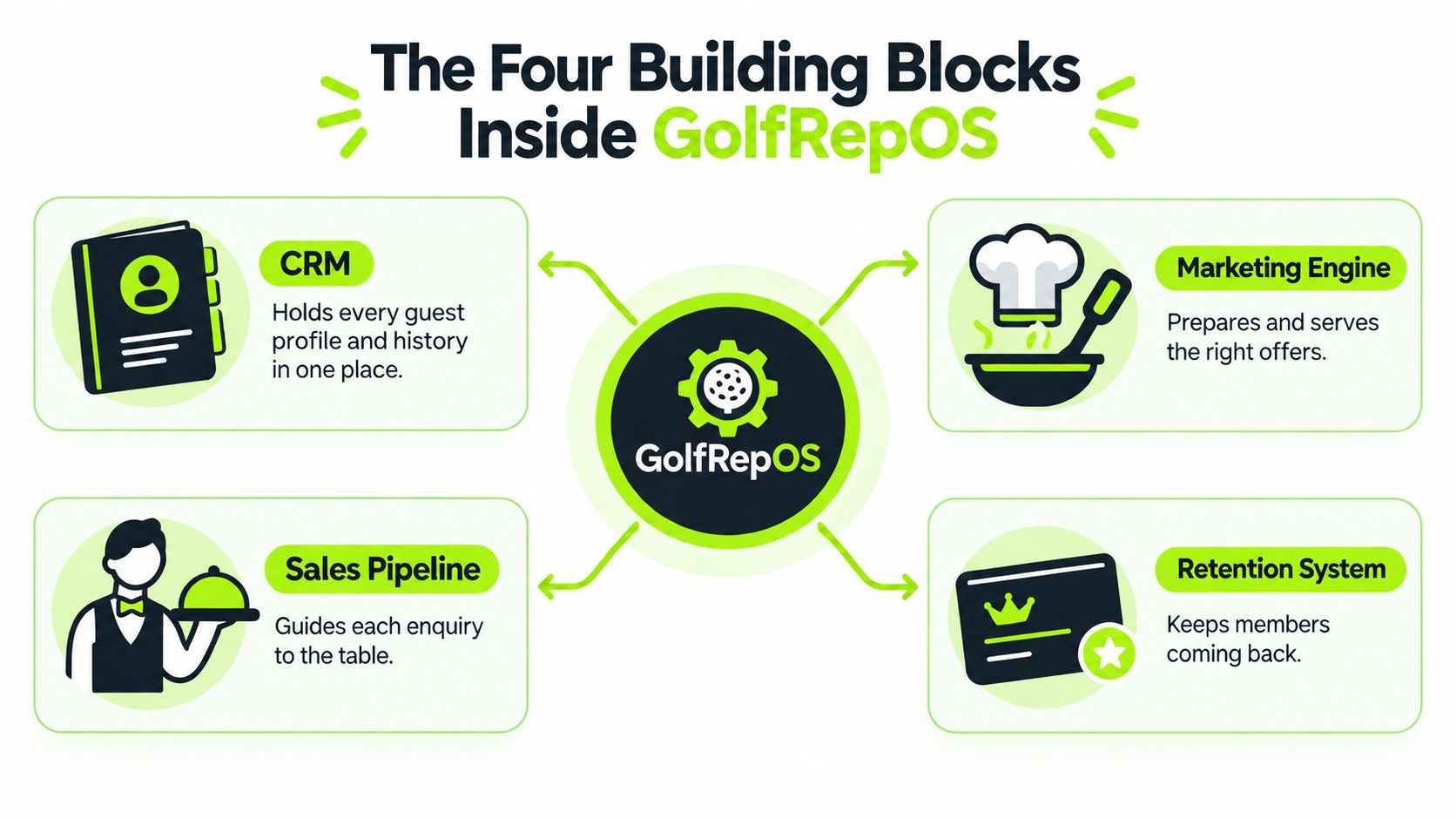
Think of the club as a restaurant
A restaurant doesn't manage reservations, kitchen preparation, table service and payments as unrelated activities. Each stage depends on the same guest information.
The reservation book is the CRM. It holds the golfer's profile, enquiry source, conversation history and current status. The equivalent for a club is a structured record that doesn't disappear when the original email is archived.
The kitchen workflow is automation. It prepares confirmations, reminders and follow-up messages at the right time. Staff still provide hospitality, but they don't have to remember every routine communication.
The waiter guiding the guest to the table is the sales pipeline. It shows whether an enquiry needs qualification, a call, a trial round, an application or a decision.
The till and end-of-service report are reporting. They connect activity and spend to booked visits, membership outcomes and the commercial picture a committee needs to review.
GolfRepOS isn't a magic lead generator. It won't make an unsuitable offer attractive, replace the club's hospitality or run effectively without agreed processes and human ownership. Its role is to provide the connective tissue between those activities.
Clubs that want to understand the CRM element in more detail can review the golf club CRM guide. The central principle is straightforward: the system should make the right action obvious to the right person, while preserving enough context to make every conversation feel personal.
The Four Building Blocks Inside the System
A golfer's journey looks simple from the outside. They see an offer, submit an enquiry, speak to the club, visit the course and decide whether to join. Internally, each handoff creates a risk of delay or lost information.
GolfRepOS addresses the journey through four connected components, using the restaurant analogy as a practical way to understand the machinery.
The CRM is the reservation book
The CRM records who the golfer is, where the enquiry came from, what they asked for and what has already happened. A Saturday golfer looking for a trial round shouldn't receive the same response as a lapsed member asking about rejoining or a family looking for flexible access.
The record can hold the relevant source and conversation history, allowing staff to continue the discussion without asking the golfer to repeat themselves. It also gives managers visibility over unassigned or stalled opportunities.
Automation is the kitchen workflow
Automation handles repeatable communication. It can acknowledge an enquiry, provide the next useful detail, remind a prospect about an appointment and prompt a staff member when a personal intervention is needed.
That doesn't mean sending the same message to everyone. A well-built journey uses the information captured in the CRM to vary the timing and content. A golfer interested in weekend access may need different information from someone comparing weekday categories.
Clubs exploring this operational layer can use the golf club automation resource to understand how scheduled workflows reduce reliance on memory.
Data-led advertising tastes the menu
Advertising should be judged by the quality of bookings and membership outcomes, not by clicks alone. The data-led advertising component helps the club identify which messages, locations and audience profiles are producing genuine interest, then informs where budget should be concentrated.
It also closes the loop. When the club records what happened after an enquiry, future campaigns can be assessed against meaningful outcomes rather than surface-level activity.
Reporting reconciles the till
Reporting gives the general manager a practical answer to questions that otherwise become subjective. Which enquiries became visits? Which visits became members? Which sources deserve continued investment? Where are prospects slowing down?
The value comes from the shared member record. CRM activity informs automation, automation creates engagement signals, advertising uses outcome data, and reporting brings the result back to the decision-makers. The system becomes more useful because each stage adds context to the next.
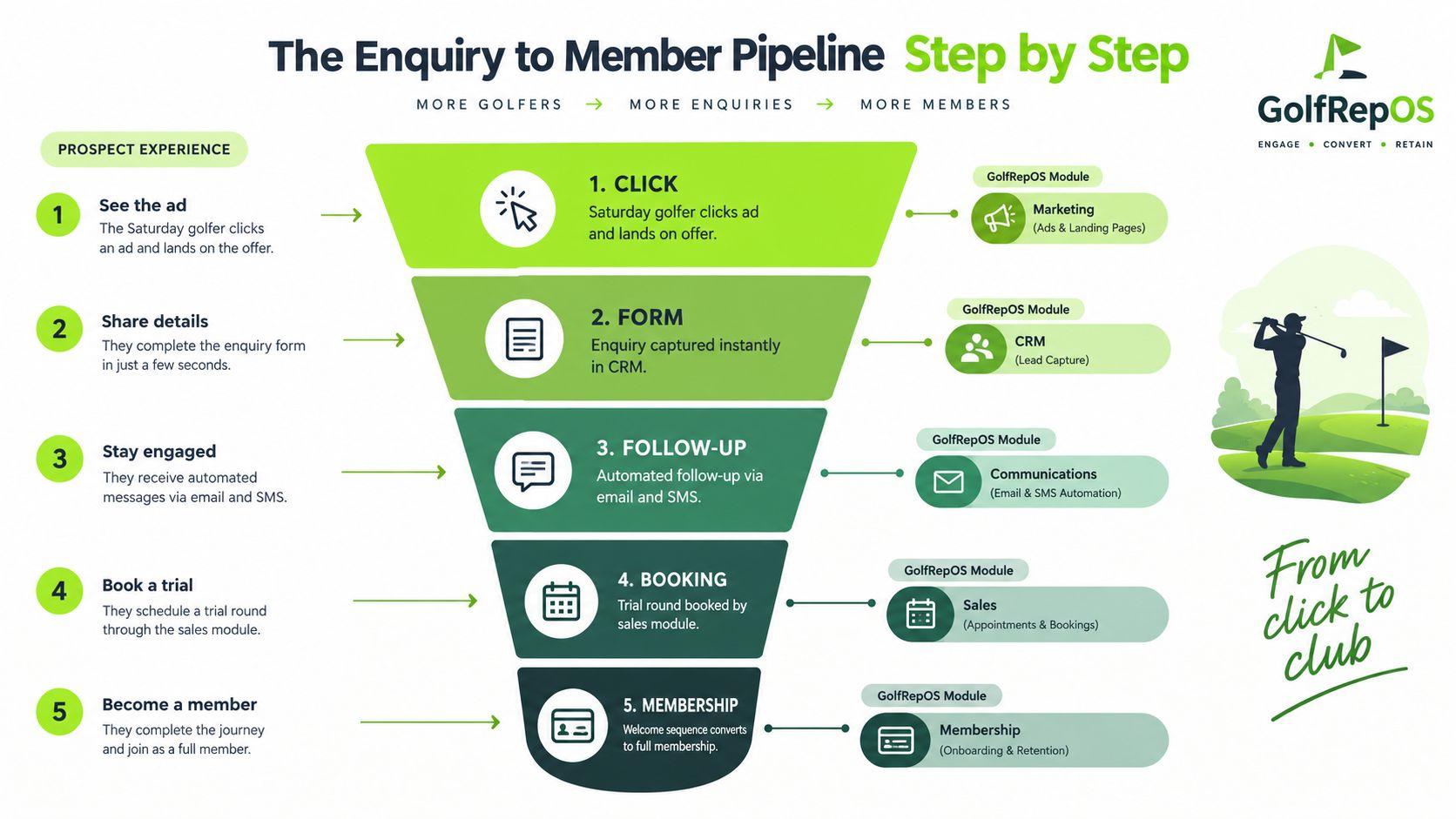
The Enquiry to Member Pipeline Step by Step
Consider a golfer searching on a Saturday morning for a trial tee time. The important question isn't only whether they saw the club's advert. It's whether the club can respond while the golfer is still actively comparing options.
First contact creates the record
The golfer clicks an advert and completes a form. The data-led advertising engine records the campaign context, while the CRM captures the enquiry with its source, device and stated intent. Staff don't need to copy those details from one system to another.
The first message should confirm receipt and make the next step clear. It might explain how trial visits work, offer a suitable booking route or ask a simple qualifying question about playing frequency and preferred times.
Qualification determines the next action
The CRM assigns the enquiry to a stage based on the information available. A golfer ready to book should move differently from someone gathering general information. A prospect interested in weekend access may need a membership-category explanation, while a golfer with limited availability may need an off-peak conversation.
The point isn't to reduce people to a score. It is to help staff prioritise personal attention and avoid treating every enquiry as an identical task.
Follow-up continues when the club is busy
Automation sends the agreed sequence after the initial response. A reminder can answer a common question, another message can explain the experience of a visit, and a staff prompt can appear when the prospect has engaged but hasn't booked.
That matters during busy periods. The duty manager may be dealing with arrivals, the professional may be coaching and the secretary may be handling committee work. The system keeps the journey moving without pretending that automation can replace human judgement.

A visit turns interest into evidence
The booking confirmation should connect to the relevant availability and preserve the appointment against the prospect's record. After the visit, the system can capture attendance, engagement and the next conversation.
The membership offer then responds to behaviour rather than a generic calendar date. Someone who attended a trial round and asked about joining should receive a clear next step. Someone who didn't attend may need a rescheduling message rather than a membership application.
This structure helps clubs convert a busy participation market into more durable relationships. England Golf reported 750,071 club members in 2025, up 2.66% year on year, and more than 24,000 iGolf subscribers had moved into club membership, including 9,600 in 2025 alone, according to reported England Golf membership figures. The opportunity is substantial, but newer entrants still need a thoughtful welcome and follow-up path after the first conversion.
The same logic applies to retention. A system can remind staff about unresolved questions, identify members who have stopped engaging and support communication suited to different playing patterns. It gives the club a repeatable process instead of relying on an enthusiastic individual to remember every relationship.
Real Club Outcomes From Putting the System to Work
The useful lesson from club growth work isn't that one campaign produces a dramatic result. It is that a specific system behaviour moves a specific operational measure.
GolfRep's published case studies include Bidston Golf Club, Addington Palace, Downes Crediton and Macdonald Hotels & Resorts. The relevant pattern is the connection between infrastructure and outcome, not a promise that every club will reproduce the same result.
| Club | Outcome | Module Responsible |
|---|---|---|
| Bidston Golf Club | Enquiry-to-member performance improved as consistent follow-up replaced sporadic calls | CRM, lead scoring and automated journeys |
| Addington Palace | Membership waiting-list growth followed advertising signals surfaced through the pipeline | Data-led advertising and CRM visibility |
| Downes Crediton | Administrative workload reduced when reporting replaced spreadsheet reconciliation | Reporting and shared records |
| Macdonald Hotels & Resorts | Conversion improved when offers responded to behaviour rather than calendar dates | Behavioural triggers and automated nurture |
What the sequence looks like for a club
A practical onboarding process starts with discovery, not an immediate campaign launch. GolfRep first needs to understand the club's membership categories, current enquiry sources, booking process, brand standards and commercial priorities.
The next stage maps the journeys. That includes the first response, qualification questions, visit booking, post-visit follow-up, application process and welcome communications. The club's team should challenge any step that doesn't reflect how members make decisions.
Data and tracking then connect the journey to reporting. Historical enquiry data is useful where it exists, but a club doesn't need a perfect archive to begin. The immediate requirement is a clear structure for recording new enquiries and their outcomes consistently.
A committee should expect the system to improve visibility before it improves every result. Managers can see where prospects are waiting, staff can act on named tasks, and the board can discuss pipeline quality with more confidence. Over time, that disciplined record gives advertising and follow-up decisions a stronger foundation.
Implementation Timeline and What Your Club Will Need
Implementation works best when the club treats it as an operational project rather than another advertising task. The system has to reflect the club's categories, capacity, tone and approval process.
A practical five-week rollout
Week one, discovery and data audit: GolfRep reviews the current enquiry journey, existing tools, membership categories, booking process and historical data where available. The club should nominate one point of contact and provide access to relevant records.
Week two, CRM build and journey mapping: The team structures pipeline stages and maps key journeys from enquiry to visit, application and welcome. The club supplies its membership rules, preferred language and internal ownership for each stage.
Week three, advertising and source tracking: Tracking is installed across the relevant campaigns and forms. The club provides brand assets, approved offers, geographic priorities and the practical limits on available tee times or visits.
Week four, reporting and training: Dashboards are configured around the measures the committee needs to review. Staff learn how to manage records, complete handoffs and interpret pipeline status.
Week five, go-live and optimisation: The system launches, with a 30-day optimisation window for reviewing response quality, routing, messages and reporting.
The club's internal time commitment is typically a few hours per week during implementation. That is manageable for most committees when scheduled around board cycles, but it shouldn't be left to an undefined volunteer role.

The club isn't starting again each month
Once live, the system should retain the journeys, records, source tracking and reporting structure. The club still needs to review performance and approve changes, but it shouldn't rebuild its process from scratch every month.
Security, privacy and cost deserve early discussion. The club needs clear data ownership, sensible access permissions and a transparent explanation of fixed platform costs alongside variable advertising spend. A responsible implementation also explains how consent is captured, how staff access is controlled and how records can be exported if the relationship ends.
The Risk-Free Guarantee should be read as a defined commercial safeguard, not a substitute for shared responsibilities. The club must provide timely access, accurate membership information and an agreed process for handling enquiries. GolfRep must define the agreed uplift, review evidence and the remedy if the agreed outcome isn't delivered.
Security, Privacy, Pricing and the Risk-Free Guarantee
Committee members usually ask four direct questions: Where does the data live? Who can access it? What will the club pay? What happens if the expected result doesn't arrive?
How is member and enquiry data handled?
A sound process should be GDPR-aligned. Forms, advertising journeys and email communications need appropriate consent capture, and the club should understand what information is collected and why.
GolfRepOS is designed around controlled access, encryption in transit and at rest, role-based permissions and audit logs that record who accessed or changed a record. The club should still confirm its own legal, retention and data-processing requirements before implementation.
Can the committee forecast the cost?
Pricing is structured as a monthly platform fee alongside performance-linked advertising spend. That separation helps a committee distinguish the cost of the operating layer from the variable budget used to generate demand.
The right commercial conversation includes the agreed objectives, the expected responsibilities on both sides and the reporting used to review progress. A low headline fee isn't useful if the club can't see what it includes or how additional spend is approved.
What does the Risk-Free Guarantee protect?
If GolfRepOS doesn't deliver the agreed enquiry or membership uplift within the first six months, the platform fee is refunded and the club keeps the assets built during onboarding. The agreement should define the target, the measurement method, the review window and the evidence required.
Underperformance needs to be assessed against the agreed baseline and the conditions the club committed to meet. That includes access, response ownership, offer availability and accurate outcome reporting. The guarantee protects the club from paying the platform fee when the agreed result isn't delivered, while still requiring an honest joint review.
| Area | What GolfRepOS Provides | Club Protection |
|---|---|---|
| Data handling | Consent-aware capture, controlled records and documented access | Clear ownership and appropriate governance |
| Security | Encryption, role-based permissions and audit visibility | Reduced risk of uncontrolled staff access |
| Pricing | Monthly platform fee separated from advertising spend | More predictable committee budgeting |
| Performance | Agreed outcome, tracking and review process | Platform fee refund if the agreed uplift isn't delivered within the first six months |
| Exit and portability | Defined access to the assets created during onboarding | The club keeps those assets and can clarify data export and exit terms |
What happens if the club leaves?
A sensible contract explains length, notice, exit terms and data portability before work begins. The club should know which records, creative assets, workflows and reporting outputs it can retain, and in what format.
GolfRep's role is to help a club build a predictable pipeline, not to create dependence on opaque processes. The relationship should be judged through visible enquiry handling, conversion tracking, member experience and agreed commercial outcomes.
GolfRep helps UK golf clubs connect data-led advertising with structured follow-up, CRM visibility and measurable membership journeys. Visit GolfRep to discuss where enquiries are currently being lost and what a practical operating system could look like for your club.
Ready to tap into our proven growth system?