A Guide to Golf Club Enquiry Tracking for Predictable Growth

For most UK golf clubs, the conversation often starts with a desire for more leads. But what we have seen time and time again is that the real issue is not a lack of interest; it is the way current enquiries are being handled. Effective golf club enquiry tracking is not about finding more people. It is about capturing the incredible value that is already knocking on your door but slipping away through slow responses and manual disorganisation.
The True Cost of Unmanaged Enquiries
"We just need more leads." It's a phrase we hear constantly from club managers and committees. While a strong lead generation campaign has its place, the bigger, more immediate win for most clubs is fixing how they manage the interest they already have. The hidden cost of fumbling enquiries is staggering, quietly undermining your club's ability to grow predictably.
Let's be clear: this is not a marketing failure. It is a systems failure. When a potential new member or a society organiser has to wait 48 hours for someone to get back to them, their initial excitement dies. In that window, you can be sure they have contacted two or three other local clubs, and the first one to give a prompt, professional response is the one that secures their business.
Where Good Enquiries Go to Die
A disorganised process creates multiple black holes where revenue simply vanishes. These are not isolated mistakes; they are recurring problems caused by relying on outdated, manual methods.
- Lost Membership Revenue: An email from a prospective 7-day member lands in a crowded general inbox. It gets read, but nobody takes ownership, and it is never followed up. Just like that, thousands of pounds in annual subscription fees are gone.
- Missed Visitor Income: A voicemail comes in from a corporate client wanting to book a 20-person golf day. The message is scribbled down incorrectly or completely forgotten during a hectic afternoon. That lucrative booking, worth a significant amount in green fees and food and beverage, ends up at a competitor.
- A Damaged Reputation: A golfer who feels ignored is not likely to reach out a second time. Worse, they might share their poor experience with friends and other local golfers, painting a picture of a club that is unprofessional and does not value their interest.
The core challenge for most clubs is not generating interest. It is having the right structure in place to handle, respond to, and convert that interest into actual business. A single lost lead is a symptom of a much larger systemic issue.
From Chaos to Clarity
Relying on cluttered inboxes, sticky notes, or complicated spreadsheets is a recipe for disaster. One person sees an enquiry and assumes someone else will deal with it. Without a central system, there is no visibility, no accountability, and no way to see where a potential customer is in their journey.
The answer is to build a proper pipeline. As a growth partner for golf clubs across the UK, this is exactly what we help implement. A structured system ensures every single enquiry, whether it comes from your website, a phone call, or a social media message, is captured, assigned, and tracked through to a conclusion. This is how you turn enquiry management from a constant headache into your most predictable driver of growth.
Before you even think about spreadsheets or CRMs, your tracking system has to start with a solid foundation. You need a clear, deliberate plan for defining and capturing every single enquiry that comes your way. Without it, you are just collecting a jumble of names and numbers with no context, making any attempt at follow-up inefficient and inconsistent.
Let's be honest, not all enquiries are created equal. A visitor asking about a twilight green fee has a completely different motivation and value than a corporate event manager looking to book a golf day for 50 people. Lumping them together is one of the most common mistakes we see, and it kills your ability to prioritise effectively.
The real work begins by mapping out every single type of enquiry your club receives. This exercise forces you to think about all your income streams and helps you build distinct pathways for each one.
Getting a Grip on Your Enquiry Types
Most clubs find their enquiries fall into a few core categories. Organising them from the outset is the first step toward building a predictable sales pipeline. It helps your team instantly understand who they are talking to and what is at stake.
Here's a breakdown of the most common enquiry types we see and the best ways to capture them:
Key Enquiry Types and Their Primary Tracking Methods
| Enquiry Type | Primary Capture Method | Key Information to Collect | Initial Tagging Example |
|---|---|---|---|
| Membership | Dedicated website form, specific email address | Desired membership type, current handicap, previous club | source:website intent:membership-7day |
| Society/Corporate Golf | Specific enquiry form, trackable phone number | Company name, number of players, preferred dates, budget | source:facebook-ad intent:society-booking |
| Visitor/Green Fee | Online booking engine, general phone line | Number of players, desired tee time, date | source:tee-sheet intent:visitor-booking |
| Functions & Events | "Weddings" or "Events" page form, dedicated email | Event type (wedding, party), expected guests, preferred date | source:google intent:function-wedding |
| Pro Shop/Lessons | Direct email to Pro, walk-in | Lesson type (individual, group), specific product query | source:direct-email intent:lesson-enquiry |
By thinking through each category, you can start building a system that is tailored to the prospect's needs and the real value they represent to your club.
The goal is simple: build a system where every incoming lead is automatically tagged by its source (where it came from) and its intent (what it is for). This simple act provides immediate clarity and lays the groundwork for a powerful follow-up process.
Creating Specific Channels to Capture Leads
Once you have defined your enquiry types, the next practical step is to create dedicated channels to capture them. This is how you stop everything from piling into one chaotic inbox that someone has to sort through manually. It ensures information is organised from the very first touchpoint.
Think about implementing these specific methods:
Smart Website Forms: Ditch the single "Contact Us" form. Instead, create separate forms for different needs. Your "Membership Enquiry" form should ask about handicap and playing history, while a "Society Booking" form needs to ask for the number of players and preferred dates.
Dedicated Email Addresses: This is an easy win. Set up unique, clearly labelled email addresses that forward to your main system, like
membership@yourgolfclub.co.ukandevents@yourgolfclub.co.uk. You immediately know the lead's intent without even opening the email.Trackable Phone Numbers: Running a Facebook ad campaign for a new flexible membership? Use a unique phone number from a service like CallRail that routes to your main line. Now you know for certain that every call to that number came directly from that specific ad.
This approach stops data capture from being a passive chore and makes it an active part of your sales process. When a new enquiry lands, you already know who they are, what they want, and how they found you.
Our detailed guide on golf club lead management digs even deeper into structuring these initial touchpoints. Getting this first stage right is the most critical part of building a reliable tracking system and ensuring no potential revenue slips through the cracks.
Building Your Central Enquiry Hub with a CRM
So, you have got your enquiry channels mapped out. What now? All the best tracking in the world will not help if leads are just piling up in different inboxes or getting lost in a spreadsheet. It is time to bring everything together.
This is where a good Customer Relationship Management (CRM) system comes in. Forget the corporate jargon; a CRM is simply a central hub for every interaction with a potential new member or event organiser. It is the modern replacement for overflowing inboxes, forgotten voicemails, and messy Excel files, turning a random collection of contacts into a clear, manageable pipeline.
Essentially, it creates a structured path for every enquiry, making sure nothing slips through the cracks.
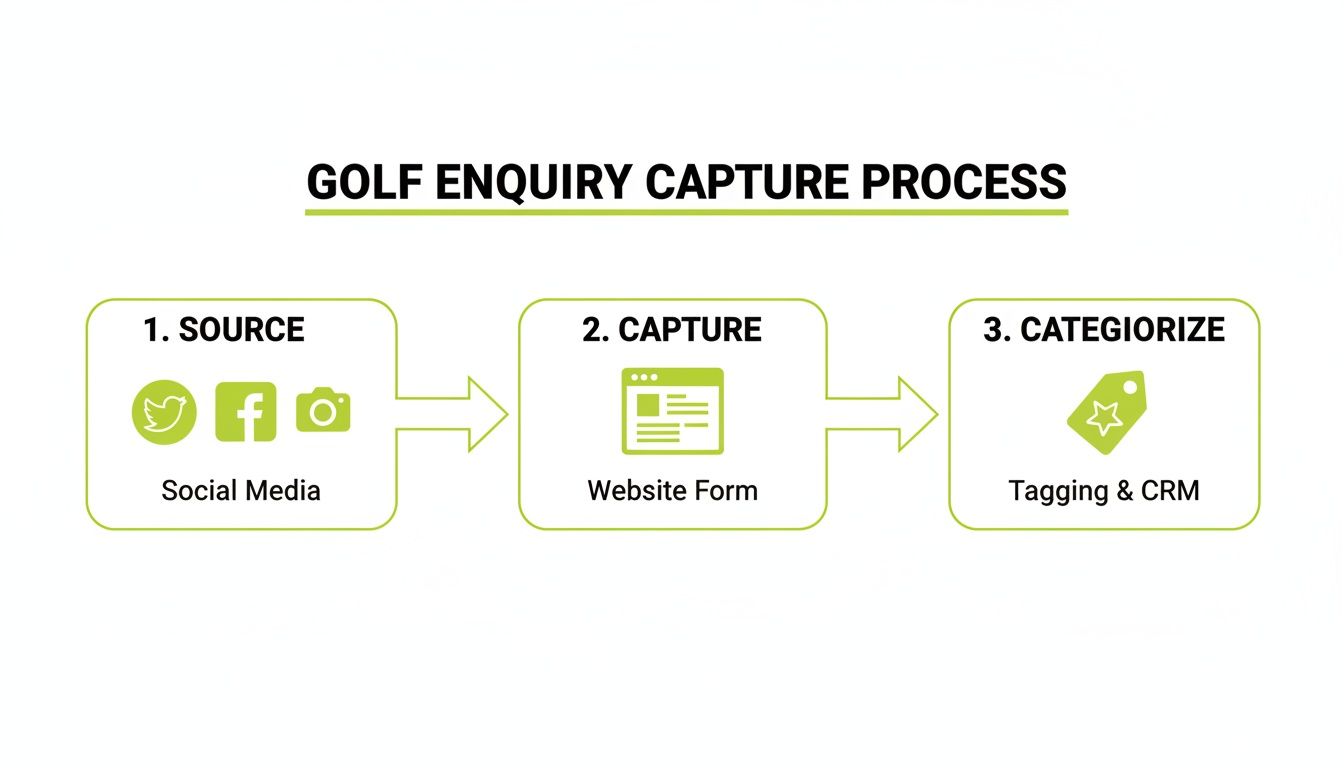
This process, moving from initial interest to organised data, is exactly what a CRM is built to manage.
Creating Your Single Source of Truth
The real power of a CRM in golf club enquiry tracking is that it creates a single source of truth. When it is set up properly, you and your team get a complete, real-time view of every single prospect. You can see who is responsible for which lead, check the last conversation, and know exactly what needs to happen next.
This simple change eliminates the guesswork. It stops two staff members from accidentally chasing the same person or worse, nobody contacting them at all. Suddenly, you have clear ownership and accountability for every lead that comes into your club.
A well-configured CRM is not just another piece of software; it is an operational tool for efficiency. It gives managers a complete overview of the sales pipeline, from the first click to the final handshake, ensuring no opportunity is ever missed.
Configuring a Pipeline That Matches Your Process
A generic CRM setup is useless. The trick is to mould it to your club's actual sales process. You need to build a pipeline that mirrors the real-world journey a prospect takes.
For most clubs, a typical membership pipeline might include stages like these:
- New Enquiry: The starting point. A lead lands here automatically from your website form, dedicated email, or even a manual entry from a phone call.
- Contact Made: A team member has reached out with that first crucial phone call or email.
- Tour Booked: The prospect is committed and has a date in the diary to visit the club.
- Proposal Sent: Following a great tour, the formal membership offer or society quote is in their hands.
- Converted/Member: Success! They have signed on the dotted line and paid their fees.
- Lost/On Hold: They have either chosen another club or decided to delay their decision.
With a structure like this, you get an instant snapshot of your entire pipeline. A manager can see at a glance that you have 15 new enquiries to action, 8 tours booked for the week, and 4 proposals awaiting a decision. This is how you shift from putting out fires to proactively forecasting your revenue.
Customising Fields for Deeper Insight
Beyond just pipeline stages, a CRM lets you capture specific details that are uniquely valuable to a golf club. These are called custom fields, and they are what turn a basic contact list into a powerful sales tool. Instead of just a name and email, you can gather the intelligence needed for a truly personal conversation.
Think about adding custom fields for:
- Current Handicap: Tells you their playing ability right away.
- Previous Member Status: Did they use to be a member? This is vital context.
- Membership Interest: Are they after a 7-day, 5-day, or more flexible package?
- Enquiry Source: Shows exactly which marketing channel delivered the lead (e.g., Google Search, Facebook Ad, Member Referral).
This kind of detail means that when you pick up the phone, you are not starting from scratch. You already have context about their golfing life, which allows for a much warmer and more effective conversation.
To really dig into this, you can check out our comprehensive guide on implementing a golf CRM system. Taking the time to build this central hub is the single most important step you can take towards predictable revenue and sustainable growth for your club.
Automating Follow-Up to Maximise Conversions

With your CRM now pulling all your enquiries into one place, you can start building a system that works for you around the clock. When it comes to turning an enquiry into revenue, nothing is more important than speed and consistency. This is not about replacing your team with robots; it is about ensuring that first contact is instant and every follow-up happens right on schedule.
Your staff cannot be on call 24/7, but your systems can. Think about the prospect who fills out a membership form at 10 pm on a Tuesday. They should not have to wait until your team is back in the office the next morning. An automated system can engage them immediately, capitalising on that initial wave of interest.
The Power of the Instant Response
That golden window, the first few minutes after someone gets in touch, is your biggest opportunity. It is your chance to make a fantastic first impression and stand out from other clubs that might take a day or two to reply manually.
A 24/7 automated response is a game-changer. I am not talking about a generic "Thanks, we'll be in touch" email. A truly effective instant reply should:
- Confirm Immediately: Let them know their message is safe and sound with your team.
- Set Expectations: Be clear about what happens next. For example, "Our Membership Manager, Sarah, will personally be in touch within 24 hours."
- Offer Instant Value: Give them something to look at right now. This could be a link to a slick digital brochure, a virtual tour of the course, or a page with member testimonials.
This simple automation guarantees that every single prospect feels acknowledged from the get-go. It is a foundational piece of any modern golf club enquiry tracking strategy.
Building Simple Nurture Sequences
Beyond that first email, you can build out simple but powerful nurture sequences. Think of these as a series of pre-planned, timed emails and text messages designed to keep your club at the front of a prospect's mind. They guide someone from casual interest towards taking that next step, like booking a tour.
A great nurture sequence works quietly in the background, making sure every lead is followed up with systematically. This frees up your staff to stop chasing cold leads and focus their energy on having brilliant conversations with genuinely engaged prospects.
These sequences do not have to be complex to work wonders. A solid starting point for a membership enquiry might unfold like this:
- Instantly: The confirmation email, complete with the club brochure.
- Day 2: A personal-feeling email from the Club Manager or Head Professional, sharing what makes your club truly special.
- Day 4: A quick SMS to see if they have any questions, including a direct number for a chat.
- Day 7: An email highlighting a specific benefit, like the vibrant social calendar or competitive events, with a clear call-to-action to book a visit.
Each message is carefully crafted to answer questions they might have and overcome any hesitation, gently nudging them along. For a deeper look at how to structure these communications, check out our guide on lead nurturing best practices.
The results of this approach are clear. The Hillier Hopkins Golf Clubs Survey for 2024/25 revealed that the proportion of members' clubs with over 600 members has now hit 59%. This growth reflects how CRM-powered nurture systems are turning clicks into tours and tours into members. You can explore more data in the full Hillier Hopkins survey. It confirms what we see every day: the clubs that thrive are the ones that systematise their follow-up.
Measuring What Matters for Reporting and Optimisation
Putting a tracking system in place is a fantastic start. But if all you are doing is capturing enquiries and sending automated replies, you are only halfway there. The real power comes from digging into the data to make smarter, more confident decisions. This is the turning point where your club stops just reacting to the phone ringing and starts proactively building a predictable pipeline for growth.
Frankly, a good golf club enquiry tracking system is not about creating more reports to file away. It is about focusing on a handful of key numbers that give you a crystal-clear, at-a-glance view of your sales health. These are the metrics that show you what is working, what is a waste of money, and where the biggest opportunities are hiding.
Identifying Your Core KPIs
You do not need a spreadsheet with dozens of columns. From our experience working with clubs, a few carefully selected Key Performance Indicators (KPIs) will tell you almost everything you need to know. These are the numbers that should be front and centre on your dashboard, simple enough for any manager or committee member to understand instantly.
For a snapshot of your commercial health, we always recommend starting with these:
- Lead Response Time: How long does it actually take for someone on your team to contact a new enquiry? A fast response time is a huge sign of a professional, organised operation that prospective members will notice.
- Enquiry-to-Visit Rate: Of all the people who fill out a form or call, what percentage actually book and turn up for a tour? This metric is a direct reflection of how compelling your initial follow-up is.
- Conversion Rate by Source: This is where it gets really interesting. Which marketing channels are actually making you money? Are the leads from your Facebook ads turning into members at a higher rate than those from a Google search?
The goal is not to create complex reports. It is to build a simple dashboard that gives you immediate, actionable insights. Think of these KPIs as the vital signs of your membership and visitor revenue streams.
To get started, here is a breakdown of the essential metrics you should be monitoring and why they are so critical for understanding your pipeline.
Essential KPIs for Golf Club Enquiry Tracking
| KPI (Key Performance Indicator) | What It Measures | Why It's Important for Your Club |
|---|---|---|
| Total Enquiries | The total number of new leads generated across all channels (web, phone, walk-in) in a given period. | This is your top-of-funnel health check. Is your marketing generating enough initial interest to hit your targets? |
| Lead Response Time | The average time taken from when an enquiry is received to when the first contact is made by your team. | Speed is everything. A fast response dramatically increases the likelihood of conversion and shows you take new business seriously. |
| Enquiry-to-Visit Rate (%) | The percentage of new enquiries that result in a booked and completed club tour or visit. | This shows how effective your initial communication is at turning a casual enquiry into a genuinely interested prospect. |
| Visit-to-Member Conversion Rate (%) | The percentage of prospects who attend a tour and subsequently join the club. | A low rate here might point to issues with the on-site experience, the tour itself, or how you present your membership offer. |
| Cost Per Acquisition (CPA) | The total marketing spend for a channel divided by the number of new members acquired from that channel. | This metric moves beyond gut feeling. It tells you exactly how much it costs to 'buy' a new member from each marketing activity. |
| Conversion Rate by Source (%) | The percentage of enquiries from a specific channel (e.g., Google, Facebook, Referral) that convert into members. | This reveals your most profitable channels, allowing you to double down on what works and cut what does not. |
These KPIs give you the vocabulary to discuss performance objectively and make decisions based on solid evidence, not just intuition.
Using Data to Make Informed Decisions
Once you can see these KPIs on a live dashboard in your CRM, the guesswork disappears. You can start having conversations based on hard facts and build a strategy that you know will work.
This data-driven approach lets you answer crucial business questions with total confidence:
- Where should we spend our marketing budget? If you see that your member referral programme has a 50% conversion rate but a local magazine ad only has a 2% rate, you know precisely where to allocate your funds next year.
- Why are we losing potential members? A high enquiry-to-visit rate but a low visit-to-conversion rate tells you the problem is not getting people interested; it is something happening during the tour or in the final sales pitch.
- How can we improve our follow-up? By looking at which automated emails get the most opens or which SMS messages prompt a call back, you can constantly refine your nurture sequences to be more effective.
This is not just theory; the numbers back it up. A 2025 report from The Revenue Club highlighted that UK clubs using these exact systems saw visitor rounds increase by 13% on average, with visitor income jumping from £274k to £315k. That growth is a direct result of using data to attract enquiries and a system to convert them. You can explore the details of this record-breaking performance for yourself.
For a club manager, it all adds up to a shift from reactive management to predictable, data-led growth. It is about building a robust system that not only captures every opportunity but also gets smarter over time, securing a healthy future for your club.
Turning Tracking into Your Unfair Advantage
If there is one big takeaway from this guide, it is this: the idea that simply getting more leads will solve your club's growth problems is a myth. The clubs that are pulling ahead are not just the ones with immaculate courses; they are the ones powered by great systems.
Making the leap from chaotic inboxes and messy spreadsheets to a clean, visible pipeline is the most powerful change you can make. It is the difference between reacting to forgotten voicemails and proactively guiding every single enquiry with care. When you have proper golf club enquiry tracking in place, every potential member or society booking gets the immediate, professional attention it deserves. That is how you maximise your chances of turning interest into revenue.
The True Measure of Success
Building a predictable stream of income is not about chasing an endless supply of new enquiries. It is about getting the absolute most from every person who has already raised their hand and shown an interest in your club. Each logged call, every automated follow-up, and all the tracked interactions work together to create a smooth journey for the prospect and a clear, manageable process for your team.
Your real advantage comes from knowing your numbers inside and out. When you can pinpoint your best lead sources, see your actual conversion rates, and understand how long it takes to close a deal, you stop guessing and start making strategic decisions. That clarity is the foundation of long-term, sustainable growth.
Putting a structured enquiry system in place is not just another admin task to tick off. It is the engine that will drive a predictable and healthy future for your club, making sure no opportunity ever slips through the cracks again.
Common Questions on Golf Enquiry Tracking
When we talk with club managers about setting up a proper system for tracking enquiries, the same few questions always come up. Let's tackle them head-on, because the answers often surprise people.
What’s the Difference Between a CRM and My Booking Software?
This is a great question, and the distinction is crucial. Think of it this way: your booking software is for transactions. It is brilliant at managing tee times and payments for people who are already customers or visitors.
A CRM (Customer Relationship Management) system, on the other hand, is for building relationships. It manages the entire journey of a potential member, from the moment they first show interest to the day they sign up. It is designed to track conversations, automate follow-ups, and give you a clear, visual map of your sales pipeline. Your tee sheet software just was not built for that.
How Much Time Does It Really Take to Set This Up?
Another common worry is the time commitment. The good news is you can have a functional, effective system running in a matter of days, not weeks or months. The trick is to start simple.
Do not try to boil the ocean. Begin by defining your main enquiry types (like 'Membership' and 'Society Day'), setting up a basic pipeline in your CRM, and automating that first crucial response. You can add more sophisticated sequences later. The time you will save on chasing people and piecing together information means you will see a return on that initial effort almost immediately.
Will This Just Create More Work for My Staff?
Absolutely not. In fact, it does the exact opposite. A well-configured tracking system is designed to slash the administrative burden on your team by automating all those repetitive tasks: sending out brochures, chasing up with follow-up emails, and sending reminders.
A good system provides clarity, not more complexity. It frees your team from digging through crowded inboxes and messy spreadsheets, so they can focus on what they do best: giving personal club tours and talking to genuinely interested prospects.
This focus is more critical now than ever. The data shows a huge opportunity for clubs that are organised enough to seize it. Golfshake’s 2025 survey revealed that 57.4% of golfers confirmed membership growth at their clubs. On top of that, England Golf’s iGolf service saw 9,600 users convert to full club membership. This highlights a clear digital path from casual interest to a committed member, a journey that is only manageable if you have a system in place to nurture these leads. You can discover the full insights into golf club membership trends and see for yourself why this is so important.
Ready to stop losing leads and start building a predictable revenue pipeline for your club? As a strategic growth partner for golf clubs, GolfRep implements the systems that turn interest into members. Let's have a conversation about your growth goals.
Ready to tap into our proven growth system?