Boost Golf Club Green Fee Revenue: 2026 Playbook

Most advice on golf club green fee revenue still starts in the wrong place. It tells clubs to push harder on advertising, chase more website traffic, or drop rates to fill the tee sheet. That can create activity, but activity isn't the same as revenue quality.
A fuller tee sheet doesn't automatically mean a healthier visitor business. If the club responds slowly, prices too broadly, treats every enquiry the same, and tracks only rounds played, it can work harder while earning less than it should.
The more useful question is simpler. How much visitor demand already exists inside your current enquiry flow, and how much of it leaks out through weak handling, poor visibility, and manual follow-up? In our experience, that's where a large share of the missed value sits.
The Hidden Drain on Your Green Fee Revenue
Many clubs do not have a lead generation problem. They have a revenue handling problem.
Interest is already there. It comes through online booking journeys, society enquiry forms, email, phone calls, member referrals, and third-party partners. The loss happens in the gap between enquiry and conversion, where slow replies, weak tracking, and inconsistent follow-up reduce both booking volume and booking value.
I see this pattern repeatedly. A club invests in ads, gets more traffic, and assumes demand is the constraint. Then an uncompleted booking goes uncalled, a society organiser waits 24 hours for a quote, or a weekday four-ball enquiry sits in a shared inbox until the player books elsewhere. The tee sheet looks like a marketing issue from a distance. Up close, it is an operating issue.
Where clubs lose money
The drain usually comes from a few predictable weaknesses:
- Slow response times: Visitor intent drops quickly when replies depend on who is free in the shop.
- No lead visibility: Management cannot see how many enquiries arrived, which channel produced them, or who followed them up.
- Manual follow-up: Second and third contact attempts rely on memory rather than a defined process.
- One-size-fits-all pricing: High-demand tee times and low-demand inventory are sold with the same logic.
- No value path: The booking is treated as a single round instead of a chance to add buggies, food and beverage, retail spend, repeat visits, and future membership interest.
Practical rule: If an enquiry can arrive without being tracked, it can be lost without anyone noticing.
That point matters because adding more demand into a weak system rarely improves results. It usually creates more missed callbacks, more discounting, and more pressure on front-of-house staff.
Digital demand has made this easier to fix, but only for clubs prepared to run visitor sales with structure. Online bookings and digital enquiries leave signals behind. Clubs can track source, response time, conversion rate, average party value, and rebooking behaviour if the right systems are in place. Without a proper CRM, automation, and clear ownership, those signals go unused.
That is where a lot of green fee revenue leaks out. Not at the top of the funnel, but in the conversion layer after interest is shown.
A lot of that missed value sits in plain sight, as outlined in these hidden revenue opportunities many golf clubs miss. Clubs that improve green fee revenue consistently are usually the ones with tighter enquiry handling, better follow-up discipline, and clearer pricing control.
This is also why better reporting matters. Even simple demand pattern analysis can show where enquiries stall, which days underperform, and which channels produce higher-value bookings. Tools used for forecasting and trend analysis, including PlotStudio AI for time series, can support that thinking, but the first step is operational discipline. Capture every enquiry. Route it properly. Follow it up on time. Price it based on demand and value, not habit.
Establishing Your Revenue Baseline
If you measure visitor performance only by total green fee income, you'll miss the decisions that improve it. Revenue totals tell you what happened. They don't tell you why it happened, whether it was high quality, or whether you had to sacrifice margin to get there.
A useful baseline starts with a different mindset. Stop asking only, “What should we charge for a round?” Start asking, “What does each available tee time produce?”

Move from fee per round to yield per tee time
That shift sounds minor, but it changes pricing, packaging, and staffing decisions. Industry analysis from the National Golf Foundation shows the average 18-hole public facility generates roughly 45% more revenue per occupied tee time than playing fees alone, which highlights how much ancillary spend can alter the value of a round for the operator, as noted in the NGF analysis of course economics.
If your team looks only at the green fee line, you can make poor decisions very quickly. A lower-priced booking that reliably brings food and beverage spend, buggy hire, and retail may outperform a higher-priced booking that produces nothing else. Equally, a busy tee sheet full of low-yield rounds can create the illusion of success while underperforming financially.
The baseline metrics that matter
Most clubs need a short operating view, not a bloated reporting pack. Start with a handful of measures that force clearer decisions.
| Metric | What it tells you | Why it matters |
|---|---|---|
| Revenue per available tee time | The earning power of your inventory | Shows whether pricing and occupancy are working together |
| Average yield per booking | The total value attached to a reservation | Exposes whether packages and add-ons are being sold |
| Ancillary spend per visitor | Non-green-fee value from a round | Helps operations and hospitality work toward the same outcome |
| Booking source by value | Which channels deliver better bookings | Prevents overvaluing low-quality volume |
| Lead-to-booking conversion | How effectively enquiries become paid rounds | Links marketing effort to operational execution |
You don't need perfect data on day one. You need consistent definitions. If one team records a buggy as visitor revenue and another leaves it in a separate system, your reporting will stay muddy and your pricing decisions will stay reactive.
Build a practical review rhythm
Weekly review beats occasional deep analysis. Look for patterns in booking pace, cancellation behaviour, weekday fill, and average spend by visitor type. Segment by useful categories such as direct web bookings, email enquiries, societies, hotel guests, and member guest introductions.
For clubs trying to spot seasonality or booking trends more clearly, a visual guide like PlotStudio AI for time series can help managers think in terms of patterns over time rather than isolated monthly snapshots.
The baseline is not a finance exercise. It's an operating tool. If your team can't use it to change pricing, follow-up, or packaging this week, it's too abstract.
Once the baseline is in place, golf club green fee revenue becomes far easier to manage. You can see where premium demand is underpriced, where weekday inventory lacks a proper offer, and where apparent “good volume” is weak yield.
Implementing Dynamic Pricing and Yield Management
Static pricing protects admin simplicity, not margin. If a club charges one broad visitor rate across large parts of the week, it usually underprices the slots golfers would have paid more for and wastes weak inventory by reacting too late.

Start with demand patterns, then set rules
Dynamic pricing works best when it reflects how golfers book. Saturday mornings, bank holiday weekends, society-friendly mid-mornings, and late Sunday gaps do not carry the same demand, booking window, or add-on potential. Pricing them as if they do is a choice to leave revenue on the sheet.
The common objection is brand risk. Committees worry that variable pricing will make the club look cheap or inconsistent. That only happens when pricing changes are arbitrary, poorly explained, or used as a substitute for proper sales control. Well-run yield management does the opposite. It protects premium times and gives weaker periods a clear commercial plan.
Online booking growth has made this easier to manage, as noted earlier. More visitor demand now arrives through channels that show booking pace, lead time, abandonment, and conversion patterns. That matters because clubs no longer have to guess where demand is strong. They can see it in the enquiry flow and act before staff start making one-off pricing calls at the desk.
What good pricing logic looks like
A workable model usually responds to a small set of variables:
- Day and time sensitivity: Saturday at 9:30am should be priced and protected differently from Tuesday at 2:40pm.
- Booking window: Early bookers often behave differently from short-notice buyers.
- Remaining inventory: A nearly full premium period needs rate protection, not panic selling.
- Visitor type: Direct web visitors, societies, hotel guests, and member-introduced guests often produce different total spend.
- Add-on behaviour: Some bookings are worth more because they regularly include buggies, breakfast, or bar spend.
Golf clubs can borrow useful discipline from other inventory-led sectors. A practical explanation of revenue management for STR managers is helpful because it shows how operators set rules around demand, timing, and stock instead of relying on gut feel.
Protect premium inventory. Shape weaker demand.
The mistake I see most often is treating every empty tee time as a pricing problem. It usually is not. Some empty slots need a better package, some need earlier follow-up on enquiries, and some should stay expensive because discounting them damages stronger future demand.
Use pricing in layers.
| Inventory type | Better approach | What to avoid |
|---|---|---|
| High-demand peak times | Hold premium rates and restrict unnecessary offers | Blanket promotions that teach visitors to wait for deals |
| Shoulder periods | Apply modest tactical changes and test value-led bundles | Large price cuts that weaken perceived quality |
| Quiet weekday slots | Add targeted value such as a buggy, food credit, or flexible format | Dropping the green fee with no plan to increase total spend |
| Late-release inventory | Use pre-set rules close to the play date | Ad hoc staff discounting that changes by who answers the phone |
That last point matters more than many clubs admit. If the pro shop, the office, and the website all behave differently, the market notices. So does your margin.
A better question is not whether the tee time sold. The question is whether the club sold the right slot, at the right rate, to the right type of visitor.
For a practical example of how clubs can defend high-value demand instead of over-discounting it, see how golf clubs can maximise peak season revenue.
Systems decide whether pricing holds up in the real world
Dynamic pricing breaks down when the systems behind it are weak. If the booking engine cannot segment demand clearly, if staff cannot see booking patterns quickly, or if online and offline availability drift out of sync, the pricing model will collapse into exceptions and guesswork.
That is why this is not only a pricing discussion. It is an operating model. Clubs sitting on plenty of visitor interest often fail to convert it well because the follow-up, booking path, and rate rules are disconnected. One enquiry gets a fast reply and a strong offer. Another sits in an inbox until the golfer books elsewhere. One caller is quoted full rate. Another gets an untracked discount. Revenue leaks out through inconsistency long before a marketing problem appears.
The strongest setups usually include:
- Clear pricing rules: Staff know what can change, when it can change, and who approves exceptions.
- Connected booking paths: Website, booking engine, CRM, and back-office processes match.
- Visible demand signals: Teams can spot unusual pace, soft periods, and high-value opportunities early.
- Structured post-booking prompts: Add-ons are offered during booking and in follow-up messages, not left to chance.
Clubs do not need constant price changes. They need a pricing system that matches demand, protects premium inventory, and works with the enquiry flow they already have. That is how yield management improves green fee revenue without training the market to buy only on discount.
Creating Irresistible Packages and Promotions
A visitor rarely values only the round. They value the day. Clubs that understand that build offers around the full experience, not just the tee time.
The mistake is assuming a package means a discount. It doesn't have to. In fact, the strongest packages usually increase perceived value without weakening your core rate.
Packages that solve a real buying decision
A golfer booking for a quiet Wednesday afternoon may want convenience. A local business arranging hospitality may want certainty and a format that feels easy to approve. A beginner group may want less intimidation and more structure. The package should answer the buyer's actual concern.
That leads to stronger offers than generic “specials”.
For example:
- Twilight and a pint: Best for late-day inventory where pace of play is lower and the bar can benefit from post-round trade.
- Four-ball with breakfast rolls and coffee: Useful for morning visitor groups who want a simple, well-organised arrival.
- Corporate golf morning: Tee times, light breakfast, reserved dining space, and optional meeting room use for local businesses.
- Learn and play sessions: A beginner package with tuition, club hire, a short-format playing experience, and a relaxed drink afterwards.
- Winter warmer rounds: Not a cheap green fee, but a seasonal offer with soup, hot drink, or buggy inclusion depending on conditions.
Each of those packages changes the commercial conversation. You're no longer arguing over the base green fee. You're selling ease, experience, and added spend.
Match the package to the inventory
The best promotions are built around a slot the club wants to improve. If weekday late mornings are soft, don't push a vague offer across the whole week. Create one package for that specific window and make the booking path reflect it.
A simple planning grid helps.
| Inventory challenge | Better package angle | Operational note |
|---|---|---|
| Quiet weekday afternoons | Casual social golf with food or drinks | Make service timing easy for the clubhouse team |
| Underused corporate demand | Hosted four-ball with breakfast or lunch | Give the organiser one clear point of contact |
| Beginner-friendly periods | Coaching-led entry package | Avoid placing novices into the busiest member times |
| Weather-sensitive shoulder months | Comfort-focused seasonal bundle | Frame it as experience value, not desperation pricing |
A package should make the buyer's decision easier and the club's economics better. If it does only one of those, rewrite it.
Promotions that damage value
Some promotions look busy on paper and weak in practice. Common examples include broad percentage-off offers, rates with too many conditions, and campaigns that create internal confusion because nobody knows what can be sold, to whom, and when.
What tends not to work:
- Unclear offer language: Visitors don't understand what's included.
- Too many options: Staff can't explain them consistently.
- No follow-up process: Interest arrives, then sits.
- No commercial purpose: The package isn't tied to a specific gap in inventory or a target segment.
Good packaging also creates future value. A well-run visitor package can introduce the club to local golfers who later return, bring friends, book societies, or ask about membership. That's why promotion design should sit close to follow-up and CRM, not in isolation.
Building a System for Predictable Visitor Conversion
Most clubs either protect revenue or lose it. Not in the advert. Not in the creative. In the handling.
Visitor conversion becomes inconsistent when the club relies on heroic effort from busy staff. One person is excellent on email. Another is great on the phone but forgets to follow up. Someone else handles society enquiries well, but only when they're in. None of that scales, and none of it is predictable.
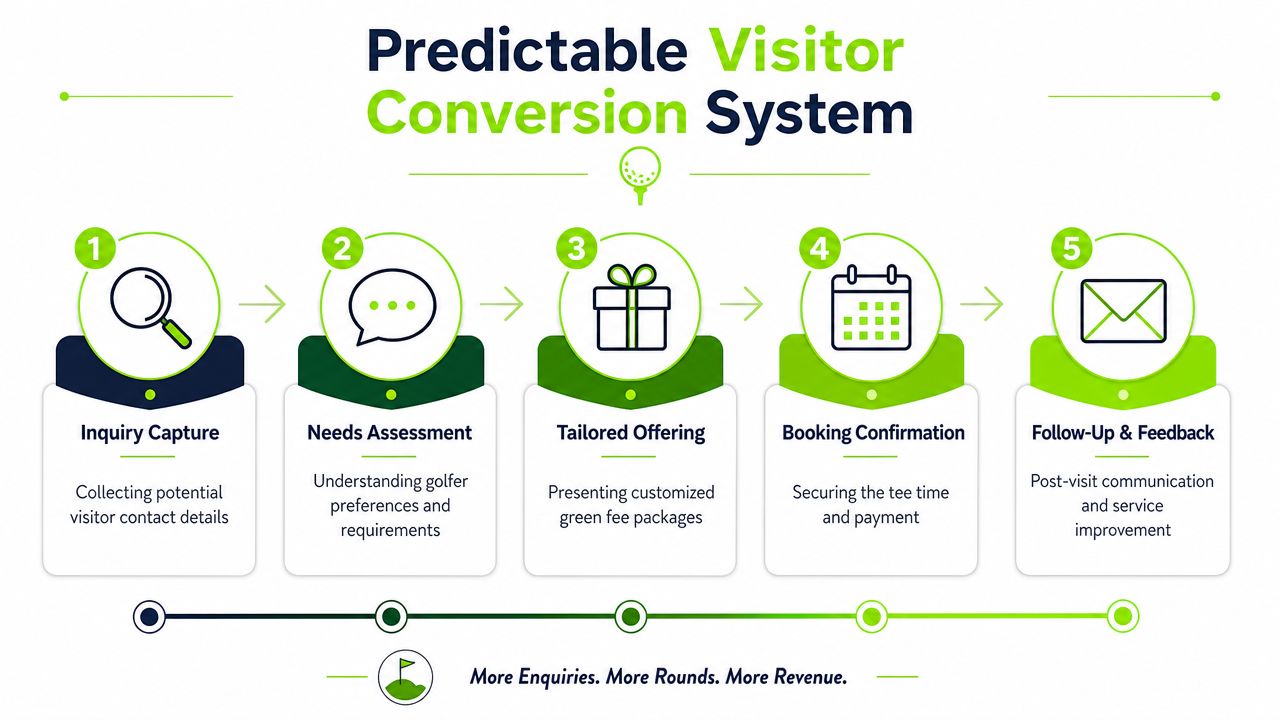
Manual handling costs more than clubs think
A casual visitor enquiry often looks small, so it gets treated casually. But repeated across a season, those missed responses and half-completed follow-ups add up to a significant drag on golf club green fee revenue.
The problem usually isn't staff intent. It's the absence of a system that does four jobs well:
- Captures every enquiry
- Routes it to the right person fast
- Triggers timely follow-up
- Shows management what happened
Without those four pieces, clubs run on fragments. A booking engine holds one set of data. The pro shop has another. Email inboxes contain the rest. Nobody gets a full pipeline view.
What a workable conversion system looks like
A practical setup doesn't need to be complicated. It does need to be disciplined.
Capture everything in one place
Every meaningful visitor action should create a visible record. That includes website forms, email enquiries, phone callbacks requested online, group booking requests, society interest, and package-specific enquiries.
The core principle is simple. If a lead exists, it belongs in a CRM or central lead log with an owner and a next action.
Respond immediately, then follow properly
Most clubs underestimate how much reassurance matters in the first response. Visitors don't just want an answer. They want proof that the club is organised and easy to deal with.
Use an automated acknowledgement where appropriate, but don't stop there. The first human follow-up should be useful. It should confirm availability or next steps, answer likely questions, and make booking friction low.
Fast acknowledgement prevents silence. Proper follow-up creates confidence.
Build sequences, not one-off messages
A single reply isn't a process. It is one touchpoint. Strong conversion systems use structured sequences depending on the type of enquiry.
A direct visitor who looked at weekday golf may need:
- a prompt first reply,
- a reminder if no booking follows,
- a customized package suggestion,
- and a post-visit message that encourages repeat play.
A corporate organiser needs a different cadence. So does a society lead. So does a beginner enquiry.
Automation helps without replacing staff judgement. The repetitive parts should be systemised. The nuanced parts should stay human.
Give management real visibility
Most clubs can tell you roughly how many rounds were played last month. Far fewer can tell you how many green fee or group enquiries were received, how quickly they were answered, how many are still open, and which source produced the highest-value bookings.
That lack of visibility creates bad management habits. Teams discuss outcomes after the fact instead of improving conversion while demand is still live.
A manager should be able to open one dashboard and see:
- New enquiries by source
- Open leads awaiting response
- Average response speed
- Lead-to-booking status
- Value by package or visitor type
- Rebook and repeat-play signals
Standardise ownership
Clubs often lose leads in shared responsibility. One person thought another had replied. Another assumed the booking engine had handled it. Nobody owned the next step.
Assign clear ownership rules:
- direct visitor enquiries go to one function,
- group and society leads go to another,
- and every unbooked lead has a next review date.
That sounds basic, because it is. But basic systems outperform clever improvisation every time.
For clubs refining this side of operations, automated follow-up for golf clubs is one of the clearest ways to remove delay, reduce missed opportunities, and make the pipeline visible.
The real benefit isn't just more bookings
A better conversion system does more than lift booking confidence. It changes the way the club operates. Staff stop searching inboxes. Managers stop guessing. Promotions become easier to test because the response path is cleaner. Pricing changes become easier to assess because lead handling is no longer chaotic.
When clubs say they want more visitor revenue, what they often need is more control over how visitor demand is captured, worked, and converted.
From Data to Decisions Your Growth Dashboard
A dashboard should help a manager act, not admire reports. If it only tells you last month's revenue total, it's too late to be useful. The better view combines lagging indicators with leading indicators so you can spot issues before they hit the month-end figure.
That means blending financial outcomes with operational signals from the enquiry and booking process.

What to put on the dashboard
Keep it tight. A practical dashboard for golf club green fee revenue should include measures from four areas.
Commercial outcomes
Track the revenue result, but view it in context:
- Total visitor revenue
- Revenue per available tee time
- Average booking value
- Ancillary revenue attached to visitor play
These tell you whether the club is selling time well, not just selling time.
Demand and booking pace
This layer shows what is forming in the pipeline:
- Future tee-sheet occupancy by daypart
- Booking pace for key periods
- Package uptake by slot or segment
- Channel mix for direct bookings
If weekday afternoons are drifting soft, you want to see that early enough to act.
Conversion performance
Many clubs lack visibility into:
- Enquiries received
- Response speed
- Open leads with no next action
- Lead-to-booking conversion by source
- No-booking reasons where available
If your dashboard can't show where an enquiry stalled, it can't help you improve conversion.
Retention and repeat value
Visitor revenue isn't just first-booking revenue:
- Repeat visitor bookings
- Reactivation of lapsed visitors
- Post-visit feedback themes
- Visitor journeys that later lead to wider club interest
This stage sees the club starting to connect visitor play with longer-term commercial value.
How often to use it
Not every metric needs daily attention. The dashboard works best when different roles use it differently. The operations team may watch live demand and open leads. Senior management may review weekly patterns and pricing performance. Committees usually need a simpler monthly summary with commentary and decisions attached.
The key is that every number should point to an action. Hold rate. Add value. Trigger follow-up. Tighten response standards. Adjust inventory rules. Drop a weak package. Expand a strong one.
GolfRep helps golf clubs turn scattered enquiries into a predictable revenue pipeline with CRM, automation, structured follow-up, and clear reporting. If your club wants better control over visitor demand, stronger conversion, and a more systemised approach to growth, explore how GolfRep works.
Ready to tap into our proven growth system?