Mastering Golf Club Pipeline Management for Growth

Most advice about golf club growth starts in the wrong place. It starts with lead generation, more campaigns, more adverts, more website traffic. For many UK clubs, that isn't the actual problem.
The main problem is what happens after someone enquires.
A prospect fills in a form, calls the office, replies to an email, or asks about membership after a visitor round. Then the process breaks. The enquiry sits in a shared inbox. A note gets left on a desk. A follow-up depends on one busy member of staff remembering to act. By the time anyone responds properly, the prospect has gone cold or joined elsewhere.
That is why golf club pipeline management matters. It isn't sales jargon. It's operational control. If a club can't see where enquiries come from, who owns the next action, which prospects are qualified, and where deals stall, it doesn't have a pipeline. It has a pile of names.
Why Your Membership Problem Is Conversion Not Enquiries
The assumption that clubs need more enquiries is popular because it feels simple. Spend more on marketing, get more leads, solve the problem. In practice, many clubs already have enough interest to grow. They just don't have a reliable system for handling that interest.
Industry benchmarking from GGA Partners shows that membership conversion rate from enquiries typically averages between 8% and 12% of qualified enquiries, while natural attrition from existing membership is usually 5% to 8% annually according to GGA Partners' golf benchmarking standards. That should sharpen the conversation inside any committee room. If members leave every year and your club converts only a share of qualified interest, waste inside the enquiry process becomes expensive very quickly.
Where clubs usually lose the sale
The failure points are usually mundane:
- No single owner: an enquiry arrives, but nobody is clearly responsible for the next step
- Slow response: a prospect waits too long for a useful reply
- No qualification: staff don't know whether the person is ready to visit, comparing clubs, or asking casually
- No visibility: management can't see which leads are live, stalled, or lost
- No follow-up rhythm: the club responds once, then goes quiet
Most membership problems don't begin with weak demand. They begin with weak follow-up.
This is why clubs often feel busier without becoming more effective. Staff are answering emails, taking calls, and booking viewings, but there's no controlled process behind it.
Marketing without process creates more admin
More enquiries can make things worse if the handling process is loose. A club with spreadsheets, inbox folders, and handwritten notes doesn't need more volume first. It needs structure. Otherwise each campaign creates more leakage.
That's the shift we push clubs to make. Stop thinking only about promotion and start thinking about conversion operations. If that sounds familiar, our view on why golf club leads don't convert goes deeper into the gap between enquiry and member.
Designing Your Membership Sales Funnel
A membership funnel should be boring in the best possible way. Clear stages. Clear ownership. Clear rules for movement. If a club can't define what stage a prospect is in, it can't forecast sensibly and it can't improve conversion.
Sagacity's guidance is useful here. A robust stage model should include lead source, enquiry timestamp, contactability, qualification score, visit booked, visit attended, proposal or membership offer, and closed-won or closed-lost status, and it warns that stale opportunities with no next step or outdated close dates quickly inflate the pipeline according to Sagacity Golf's revenue management guidance.
The stages that actually work
Below is a simple structure that works well for private clubs, member clubs, and resorts selling membership.
| Stage | Description | Key Action |
|---|---|---|
| Enquiry received | A new prospect has made contact by form, call, email, referral, or event | Log the enquiry with source and timestamp |
| Contact made | The club has made real contact, not just sent an automated acknowledgement | Confirm interest and establish the next conversation |
| Qualified | The club knows the prospect's likely fit, timescale, and membership interest | Record qualification notes and readiness |
| Visit booked | A specific visit date and time is in the diary | Send confirmation and pre-visit details |
| Visit attended | The prospect has experienced the club in person | Capture feedback and identify objections |
| Proposal sent | Membership options or application details have been presented | Set a follow-up date |
| Closed won or closed lost | The outcome is confirmed | Record reason and final status |
Entry and exit criteria matter
Most clubs make the same funnel mistake. They use stage names without stage rules.
A lead should not move to Visit booked because someone said they were interested in coming down. It moves when there is a date and time in the calendar. A lead should not sit in Qualified for weeks without a scheduled next action. A lead should not remain “live” if nobody has spoken to them and no close date makes sense.
Practical rule: every pipeline stage needs an entry condition, an exit condition, and a named owner.
That level of discipline feels rigid at first, but it removes ambiguity. Committee members stop arguing over impressions and start looking at facts. Staff stop carrying the process in their heads.
Keep the funnel simple enough to manage
Some clubs overcomplicate this and create too many stages. Others reduce everything to “lead”, “hot”, and “joined”, which tells you very little. The right middle ground is a funnel detailed enough to show movement but simple enough to audit every week.
For a useful outside comparison of how funnel thinking changes by buying journey, this overview of DialNexa Labs funnel strategies is worth reading. The principles are broader than golf, but the lesson applies well to membership sales: the funnel should reflect the actual decision process, not a generic sales template.
If your current process is still informal, a defined club-specific sequence like the one outlined in our guide to the golf club sales process is usually the fastest place to tighten control.
Building Your CRM and Lead Capture Foundation
If enquiries live in different places, your pipeline isn't under control.
That sounds obvious, but many clubs still run membership sales across a website inbox, a spreadsheet on one person's laptop, scraps of paper at reception, and a handful of conversations in staff members' heads. The result is predictable. Leads go missing. Follow-up varies by who is on shift. Managers get updates based on memory instead of records.
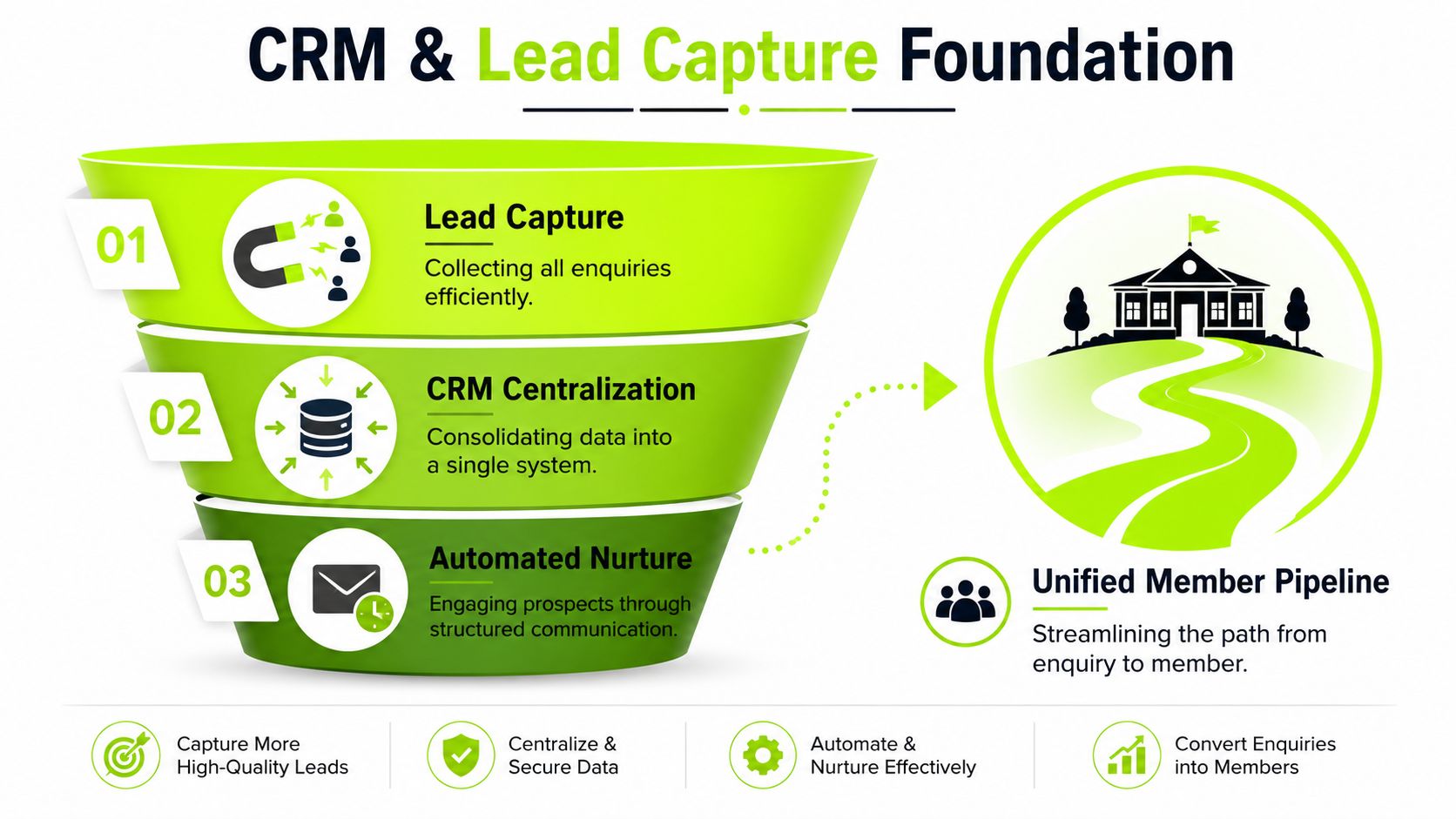
Codex Golf's KPI guidance makes the direction clear. Clubs should define clear objectives and move from Excel to CRM systems and management dashboards to visualise results in real time, while keeping the KPI set manageable at around 8 to 10 measures according to Codex Golf's KPI guidance for golf club management.
What a CRM changes in day-to-day operations
A proper CRM does three jobs at once.
First, it creates a single source of truth. Every enquiry enters one system, whether it came from a website form, a social campaign, an email, a phone call, or an open day list.
Second, it creates accountability. The system shows who owns the lead, when it came in, what happened next, and whether the next task is overdue.
Third, it creates history. Anyone picking up the conversation can see the last contact, the prospect's interests, and what has already been promised.
That matters more than most clubs realise. Prospects notice quickly when they have to repeat themselves or when the club responds as if nobody has spoken to them before.
What to capture from the first touch
At minimum, every new membership enquiry should be logged with:
- Lead source: website, referral, social, open day, phone, visitor round, or another defined channel
- Timestamp: when the enquiry arrived
- Contact details: the practical basics needed to respond properly
- Interest notes: category, timescale, and any clear motivation
- Owner: the person responsible for the next action
- Next step: a dated task, not a vague intention
Without that, reporting becomes guesswork and automation becomes risky.
Don't buy software just to recreate your spreadsheet
Some clubs do move into software, but they still use it like a digital filing cabinet. That misses the point. A CRM should route leads, assign tasks, trigger nurture, and show pipeline health. It should make dropped follow-up harder, not just give the club a prettier place to lose information.
If you're reviewing tools, it helps to understand the wider category of club membership software, especially where membership administration and sales workflow overlap. For clubs focused specifically on enquiry handling and visibility, our overview of a golf club CRM system covers the practical requirements in more detail.
A CRM isn't there to store names. It's there to make sure the next action happens.
Automating Qualification and Nurture Sequences
A prospect enquires on Tuesday at 9:12 pm. They're looking at joining before the main season picks up. They want to know what category fits, whether the club has an active competition calendar, and whether they can bring family into the experience.
If that enquiry waits until Thursday because the office was busy, the club has already made life harder than it needed to be.
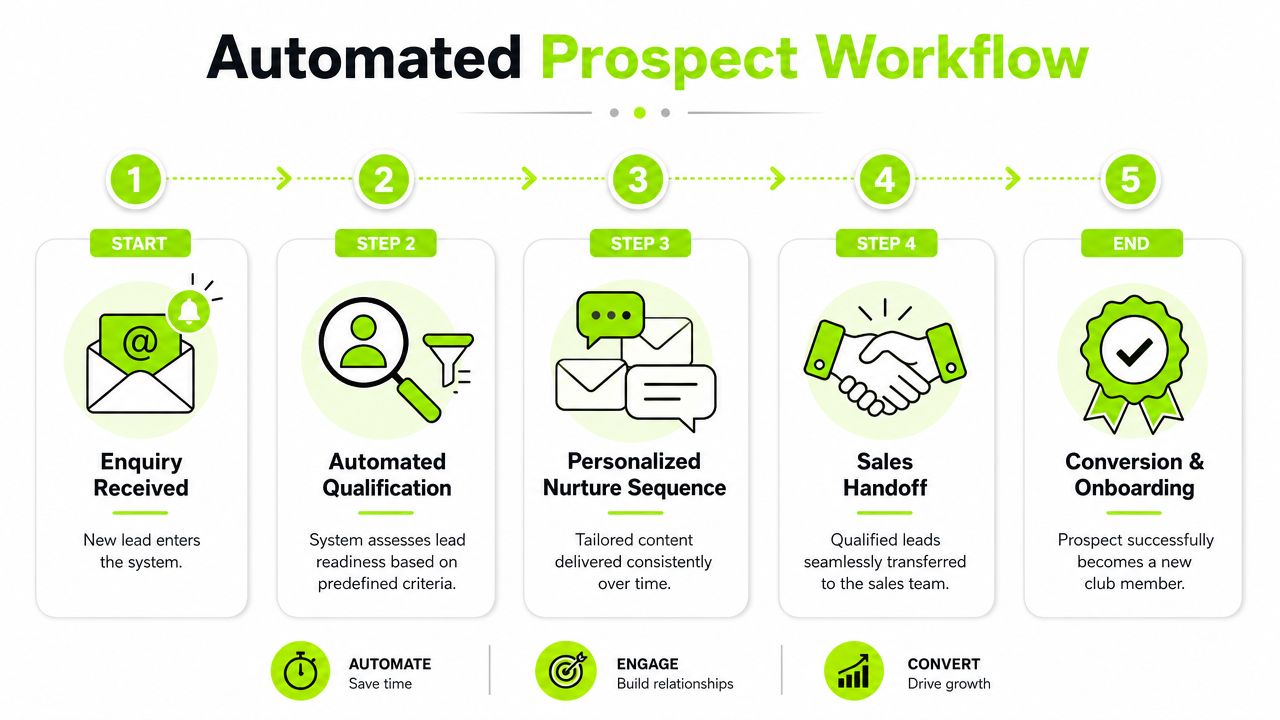
Automation becomes useful, not because it replaces people, but because it handles the repeatable parts instantly and consistently. The strongest recent guidance in this area points to a system built around CRM centralisation and automated nurture, rather than reactive manual follow-up, as noted in GolfRep's guidance on golf course management systems.
What should happen immediately after an enquiry
A practical automated sequence usually starts with three actions.
Acknowledge the enquiry straight away
The prospect should know their message has been received. That reply should feel clear and useful, not like a generic autoresponder from another industry.Ask simple qualification questions
Not a long interrogation. Just enough to understand category interest, likely timing, and whether the prospect is ready for a visit.Offer a direct route to the next step
If someone is ready to visit, don't make them wait through a long email exchange. Give them a clear path to book or request times.
A well-built system can do all of that before a staff member starts work the next morning.
What good automation sounds like
Poor automation feels robotic. Good automation feels organised.
For example, an initial message might confirm receipt, explain what happens next, and offer a short set of questions. If the prospect signals high intent, the system can notify the membership lead and prioritise a personal call. If the prospect is interested but not ready, they move into a nurture path instead of disappearing.
That nurture path should be practical and club-specific:
- Member experience stories: short examples that show what club life is like
- Course and facility updates: useful for prospects comparing overall value, not just price
- Event highlights: signals culture and activity level
- Membership guidance: helps the prospect understand options and fit
- Visit prompts: light reminders to move from interest to action
The handoff is where many clubs still fail
Automation doesn't fix a weak handoff. It only exposes it faster.
If the system qualifies a prospect and alerts the team, someone still has to take ownership. That means a named person, a target response habit, and a clear record of what happened next. The prospect shouldn't have to restart the conversation because the automation did its job and the team didn't.
Fast acknowledgement without a real follow-up is just a polite delay.
For clubs trying to combine paid acquisition, CRM workflows, and structured nurture in one setup, GolfRep is one option used in the sector for building a managed enquiry-to-membership process. The important point is less about brand and more about architecture. The club needs one joined-up system that captures, qualifies, routes, and nurtures leads without relying on memory.
Automation should support judgement, not replace it
Some prospects need speed. Others need reassurance. Others need time.
That is why the best sequences don't force everyone down the same path. They branch by readiness. A referral from an existing member may need a different flow from a cold website enquiry. A family prospect may care about different details from a weekday golfer focused on availability and competitions.
When clubs get this right, automation doesn't make the process colder. It makes it more responsive, more consistent, and far easier to manage.
Measuring What Matters a Pipeline KPI Dashboard
Clubs do not need another reporting pack. They need a scoreboard the membership team can use on a Tuesday morning to decide who to call, which stages are slipping, and where enquiries are getting stuck.
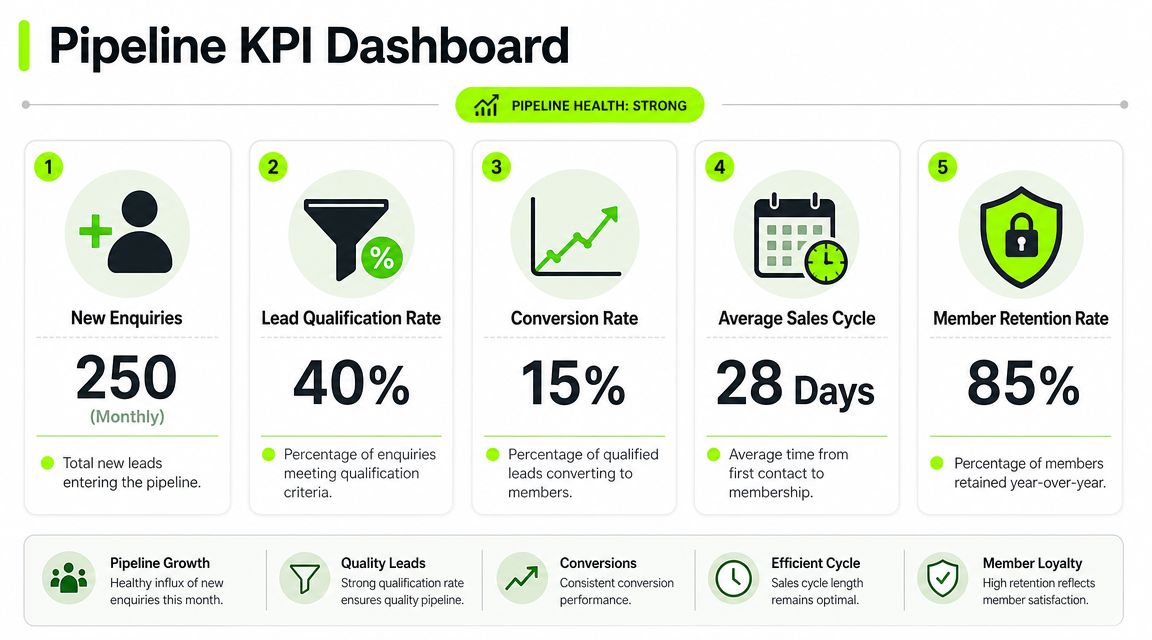
A useful pipeline dashboard is operational first and presentational second. If it only reports joins and resignations at month-end, it arrives too late. If it tracks twenty figures and no one owns them, staff stop looking. The clubs that improve conversion usually monitor a short set of numbers that point to action.
The numbers that actually help a club convert
For most UK clubs, six measures are enough:
- Enquiries by source: which channels produce people who are worth speaking to
- Speed to first proper contact: whether fresh enquiries are handled while interest is still high
- Contact rate: how many enquiries become a two-way conversation
- Visit or trial booking rate: whether interest turns into a meaningful next step
- Stage-to-stage conversion: where prospects stall between enquiry, visit, proposal, and decision
- Closed-lost reasons: the recurring causes behind missed joins
These measures help managers fix this week's problems. A weak contact rate may point to poor data capture. A healthy visit rate with weak post-visit conversion often points to pricing friction, a vague joining process, or inconsistent follow-up from the team.
One warning. Do not let staff hide behind averages. A club can report an acceptable monthly conversion rate and still have a broken middle stage where too many qualified prospects sit untouched for ten days.
Use benchmarks carefully
As mentioned earlier, GGA Partners' benchmarks frame the challenge. Many clubs convert only a modest share of enquiries, while normal member attrition keeps creating backfill pressure. That context matters because pipeline reporting should answer a hard question. Is the club generating enough qualified opportunities, and is it converting enough of the ones it already has?
That is why leading indicators matter more than end-of-month totals. If visits booked are falling, or if too many prospects are sitting at proposal stage without a next action, management can intervene before the joins number drops.
Key takeaway: Track the steps that lead to membership, not just the membership number itself.
Tie pipeline reporting to commercial reality
Membership sales should sit alongside capacity and revenue discussions, not in a separate box. A five-day category may be selling well but creating pressure on busy tee sheets. A flexible category may convert easily but produce weaker annual value. A family package may take longer to close but deliver better retention and stronger food, beverage, and coaching spend once those members settle in.
That trade-off needs to be visible in reporting. Otherwise, teams chase the easiest join rather than the right join.
Email performance belongs in that conversation too. If follow-up messages are landing in spam or being throttled by poor domain setup, the club may blame staff for weak nurture when the problem is deliverability. This guide to email sending best practices is a useful reference for clubs cleaning up sender setup and trying to make sure prospects receive what the CRM is sending.
Review rhythm turns reports into management
The dashboard only works if someone uses it regularly.
Weekly pipeline reviews should be short and specific. Which new enquiries have not had a real conversation? Which visits happened without a recorded next step? Which opportunities are sitting in the same stage with no owner and no date attached? Monthly reviews can then look for patterns by source, membership type, and closed-lost reason.
At one Surrey club, we found the issue was not lead volume. Enquiries were coming in consistently. The drop happened after the visit because no one had a standard post-visit sequence, and promising prospects were left to “have a think” without a clear follow-up date. A simple dashboard made that visible within weeks.
That is the point of pipeline KPIs. They give the club a repeatable way to manage conversion as an operating system, not a guessing exercise.
Advanced Pipeline Strategy Managing a Waitlist
A waitlist can hide bad pipeline management.
Clubs often assume that once demand is strong, the work is done. It isn't. A waitlist that sits untouched becomes old quickly. People's circumstances change. Their urgency changes. Their loyalty to your club is often weaker than the club assumes.
Guidance for private clubs points to a more useful approach. When prospects may wait 6 to 18 months, clubs should keep them warm by segmenting them, sending quarterly updates, and inviting selected individuals to curated experiences, as outlined in Club Marketing's guidance on building a prospective member pipeline with a waitlist.
A waitlist is a future-member pipeline
The clubs that handle this well don't treat the list as static inventory. They treat it as a relationship programme.
That means segmenting by likely joining horizon, family profile, and the parts of club life that matter most to each prospect. A family looking for a full club experience should not receive the same communication as a golfer mainly interested in competitions and course access.
What keeps a waitlist warm without overdoing it
A good waitlist strategy is measured, not noisy.
- Quarterly updates: enough to stay visible without becoming background noise
- Member stories and event highlights: give prospects a feel for the culture they're waiting to join
- Curated invitations: selective access can build connection without diluting exclusivity
- Clear status handling: the club should know who remains interested, who has gone quiet, and who is likely to convert when space opens
This is still pipeline management. The timescale is just longer.
A well-run waitlist also protects standards. It gives the club time to learn more about fit, maintain quality of intake, and shape a more predictable joining flow instead of reacting to sudden spaces with hurried decisions.
A full club still needs a pipeline. It just needs one built for future demand rather than immediate sale.
If your club has enough interest but not enough control, GolfRep helps build the operational side of growth: enquiry capture, CRM structure, automated follow-up, and clear pipeline visibility so managers can turn warm interest into a repeatable membership process.
Ready to tap into our proven growth system?