Golf Club CRM System: Unlock Predictable Revenue
Most advice about a golf club CRM system starts in the wrong place. It starts with marketing. More campaigns, more traffic, more enquiries.
For most UK clubs, that isn't the actual constraint.
The bigger issue is what happens after interest appears. A prospect fills in a form. A visitor asks about membership. Someone books, plays, spends in the bar, then disappears from view because their data sits in separate systems. Staff mean well, but follow-up depends on inboxes, spreadsheets, memory, and whoever happens to be on shift.
That's why we treat CRM differently at GolfRep. A golf club CRM system isn't just a database for contacts. It's the operating layer that helps clubs respond properly, track every enquiry, connect booking and payment behaviour, and turn existing interest into more predictable revenue.
Why Your Club's Growth Problem Isn't What You Think
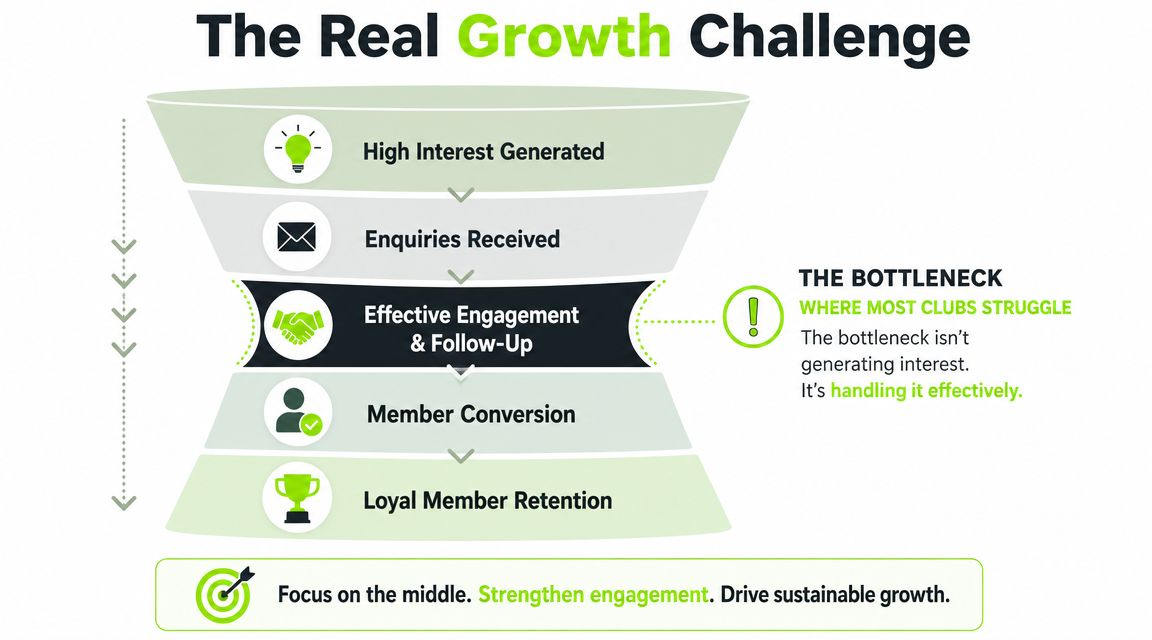
Many clubs say they need more leads. In practice, many need fewer leaks.
The pattern is familiar. Enquiries arrive from the website, social channels, referrals, or event pages. Someone logs some of them. Others stay in an inbox. Follow-up happens when time allows. If a prospect doesn't reply first time, the trail often goes cold.
That creates a false diagnosis. The committee sees patchy conversion and concludes demand is weak. Often, demand isn't the issue. Handling, visibility, and consistency are.
The pressure on clubs has changed. Golfer expectations now reflect wider consumer behaviour. The ONS reported that 97% of UK adults were recent internet users in 2024, and UK Finance said 84% of all UK retail payments were contactless in 2024, which points to a market that expects fast digital response, easy booking, and smooth payment journeys, as noted in this UK golf software discussion. Many clubs, though, still run on lean staffing and legacy admin processes.
Signs your club has an enquiry handling problem
You don't need a technical audit to spot this. The symptoms are operational:
- Enquiries live in too many places. Website forms, inboxes, phone notes, WhatsApp messages, and paper call-backs never form one usable pipeline.
- Response depends on staff availability. If one person is off, delayed, or busy with members at the desk, prospects wait.
- No one can see the full journey. Management knows how many enquiries arrived, but not which ones were contacted, chased, visited, quoted, or lost.
- Follow-up lacks structure. Staff send one reply, then rely on memory to send the next.
Clubs rarely lose opportunities because nobody cared. They lose them because the process relied on people remembering what to do next.
This isn't unique to golf. Other venue-led sectors see the same issue when interest is high but sales handling is loose. That's one reason resources like Bare Digital for wedding venue visibility are useful to read. The lesson isn't about weddings. It's about what happens when venues focus on visibility without building a proper conversion process behind it.
Why more marketing can make the problem worse
If your club already responds slowly, tracks enquiries inconsistently, or can't see where leads stall, buying more traffic can amplify the waste.
More leads into a weak process usually means:
| Issue | What happens in the club |
|---|---|
| Slower handling | Staff face a larger backlog |
| Lower visibility | More prospects go untracked |
| Patchy follow-up | Hot enquiries cool off before anyone speaks to them properly |
| Poor decision-making | Marketing gets blamed when operations caused the loss |
A club with a sound CRM process can spend on growth with confidence. A club without one often pays to create more admin.
What a Golf Club CRM System Really Is
A golf club CRM system is often described as software for managing contacts. That definition is too narrow to be useful.
The better way to think about it is as air traffic control for enquiries, members, and visitors. Air traffic control doesn't just hold a list of planes. It monitors movement, coordinates actions, flags risk, and helps each journey reach the right destination without chaos. A golf club CRM should do the same for commercial activity.
It's not a digital address book
A simple database stores names, email addresses, and perhaps a few notes. That's useful, but it won't fix operational bottlenecks.
A real CRM should answer practical questions such as:
- Where did this enquiry come from
- Who has responded
- What stage is the prospect in
- What should happen next
- Has this person booked, visited, purchased, or gone quiet
- Which leads are being neglected
If the system can't do that, it isn't helping the club run a reliable pipeline.
Working rule: if staff still need separate spreadsheets to know who to call, your CRM isn't functioning as the core system.
Generic software versus golf-specific use
In this scenario, clubs often make poor buying decisions. They choose a generic CRM because it looks flexible, then discover it doesn't fit golf operations without heavy manual work.
Golf clubs don't just manage sales conversations. They manage membership journeys, tee time behaviour, visitor activity, event registrations, spending patterns, renewals, and booking rules. A golf club CRM system has to sit alongside those realities.
That's why clubs should evaluate CRM vendors with process fit in mind, not just feature lists. A platform can look impressive in a demo and still fail if it doesn't support the day-to-day rhythm of a club.
The system should connect marketing and operations
The most useful CRM doesn't stop at capturing enquiries. It links the first click or form submission to the rest of the journey.
That means marketing activity, website forms, staff follow-up, and later customer actions should all contribute to one visible record. If someone first asked about membership, then booked a round, then visited the bar, then opened a renewal email months later, that history should make sense in one place.
That's the difference between “we have software” and “we have a system”.
For clubs thinking about pipeline structure before platform choice, our guide to golf club lead management is a useful starting point because the process needs to be clear before automation is added on top.
The Measurable Benefits of a System-Driven Approach
When clubs move from manual handling to a system-led process, the benefits show up in three areas that matter commercially. Acquisition, retention, and workload.
The strongest use case isn't mass emailing. It's behaviour-triggered workflow automation. Modern golf CRM setups can segment players using rounds booked, profile data, sales activity, or loyalty information, then send targeted follow-up such as a post-round thank-you or renewal reminder using the tee sheet as the trigger source, as described in Lightspeed's golf CRM overview.
Better acquisition because fewer enquiries disappear
Manual processes make clubs reactive. A form arrives. Someone sees it later. A reply goes out. No one knows whether a second message was sent. The sales path is inconsistent from one prospect to the next.
A CRM-driven process changes that.
- Every enquiry enters one pipeline. Staff don't need to search across inboxes or remember where someone first got in touch.
- Tasks are assigned clearly. A membership enquiry can trigger the next action instead of waiting for someone to notice it.
- Lead status becomes visible. Prospects aren't just “in the inbox”. They're new, contacted, qualified, booked for a visit, or stalled.
That creates something most clubs lack. Predictability.
Better retention because communication matches behaviour
Retention often gets treated as a once-a-year renewal admin job. That's too late.
A member who has gone quiet, reduced play, or stopped spending in other areas of the club is signalling something long before renewal comes due. If the CRM can recognise that behaviour and trigger the right communication, staff can act earlier.
Here's where the difference becomes practical:
| Behaviour | Useful CRM response |
|---|---|
| A player completes a round | Send a post-round thank-you and relevant next-step message |
| A member approaches renewal | Trigger reminders and internal follow-up tasks |
| A visitor shows repeat usage | Route them into a visitor-to-member conversion flow |
A renewal campaign works better when it starts with behaviour, not when it starts with panic.
Lower admin load because repetition is automated
The biggest win for lean teams often isn't marketing output. It's operational relief.
A well-configured CRM takes repetitive jobs off staff desks:
- Acknowledgement emails no longer need to be written from scratch each time.
- Reminder messages can be scheduled based on actual activity.
- Segment lists don't need to be rebuilt manually every week.
- Basic follow-up tasks can be prompted automatically.
Club staff already juggle member service, tee sheet issues, visitor questions, finance admin, and on-site operations. If the system removes avoidable manual work, staff can spend more time on the conversations that need a human touch.
One platform option in this area is GolfRep, which centralises lead and member data, tracks prospect progress, and supports structured follow-up workflows for golf clubs. The value isn't in the label. It's in whether the club can see every lead, act on time, and measure what happened next.
Essential Features for Predictable Growth
Not every CRM sold to golf clubs deserves the name. Some are little more than contact lists with email tools attached.
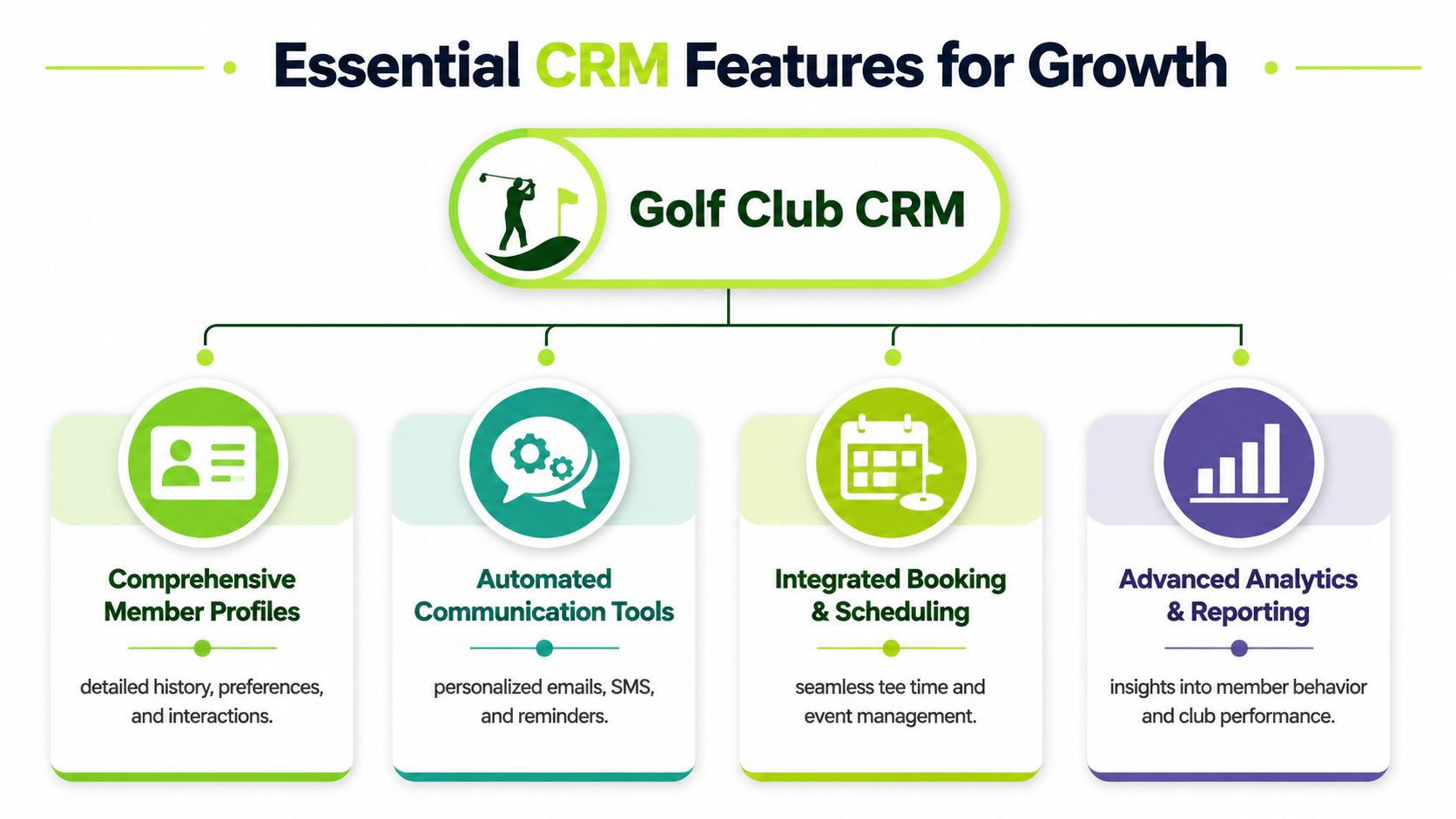
If the goal is predictable revenue and cleaner operations, a golf club CRM system needs a shortlist of essential capabilities. Anything less pushes work back onto staff.
A single record that combines booking and spend data
This is the foundation.
A golf club CRM's value is strongest when it integrates directly with the tee sheet and POS stack, because that turns fragmented touchpoints into a single customer record. Booking behaviour, spend in the pro shop or clubhouse, and playing preferences can then sync automatically instead of being re-entered manually. UK golf software reporting also highlights Accounts & Reports, Membership, and Competitions & HCPs as the most valued operational features, which shows that clubs get the most from CRM when it supports financial reporting and member lifecycle management rather than sitting alone as a contact database, according to Golf Business Monitor's review of the UK and Ireland software landscape.
Without that integration, clubs end up with split identities. One person on the tee sheet, another in EPOS, another on an email list. Staff can't make good decisions if the records don't line up.
Automated communication that follows real activity
The next requirement is workflow automation that reflects how clubs operate in practice.
The system should support:
- Instant acknowledgement when an enquiry arrives
- Timed follow-up after no reply
- Renewal sequences linked to member status
- Segment-based campaigns for visitors, trial prospects, active members, and lapsed contacts
This isn't about flooding inboxes. It's about removing avoidable gaps.
Reporting that management can actually use
A dashboard full of charts doesn't help if no one can answer simple commercial questions.
A usable CRM should show:
| Reporting need | Why it matters |
|---|---|
| Enquiry source visibility | So the club knows what is generating real opportunities |
| Pipeline stage tracking | So staff can see where prospects stall |
| Conversion tracking | So management can judge process quality, not just lead volume |
| Renewal and re-engagement activity | So member retention is managed proactively |
Clubs benefit from broader thinking around account management as well. Even outside golf, frameworks like OneNine on account management are helpful because they reinforce a key operational truth. Growth doesn't come only from acquiring contacts. It comes from managing relationships properly after first contact.
Practical segmentation, not vanity fields
A lot of CRM setups fail because they collect too much irrelevant data and too little useful data.
Clubs don't need dozens of custom fields nobody updates. They need enough structure to act intelligently. For example:
- Frequent bookers with low ancillary spend
- High-spend occasional visitors
- Members nearing renewal
- Lapsed members with previous activity
- Prospects who enquired but never booked a visit
That's the kind of segmentation that drives better follow-up. It also supports cleaner databases over time, which is why clubs reviewing their setup should pay attention to how they manage and structure records in the first place. Our guide on the golf club database covers that side of the process in more depth.
Comparing Manual Processes to a CRM System
The easiest way to understand CRM value is to compare it with what many clubs still rely on now. Shared inboxes, spreadsheets, diary reminders, and staff memory.
Those tools aren't useless. They're just fragile. They work until volume rises, staff change, or follow-up requires coordination across departments.
Operational comparison
| Metric | Manual Process (Spreadsheets & Email) | CRM-Driven Process |
|---|---|---|
| Enquiry response handling | Depends on who sees the message and when | Routed into a defined workflow with assigned action |
| Lead visibility | Scattered across inboxes, notes, and separate files | Centralised in one pipeline |
| Follow-up consistency | Ad hoc and memory-led | Structured and repeatable |
| Data accuracy | Vulnerable to duplicate records and outdated notes | More reliable when synced with connected systems |
| Team handover | Difficult when staff are away or leave | Easier because activity history is logged |
| Conversion tracking | Based on rough estimates and end-of-month review | Visible by stage and source |
| Member insight | Split between booking, payment, and communication systems | Joined-up view when integrations are in place |
What this means day to day
The commercial difference shows up in ordinary moments.
A visitor asks about membership after playing twice. In a manual process, that enquiry may sit in an inbox until someone has time to answer. In a CRM-driven process, the club can see prior activity, assign the next step, and follow a defined sequence.
A member approaches renewal after reduced usage. In a manual process, that risk often becomes visible too late. In a system-led process, the warning signs are easier to spot and act on.
Manual systems rely on good intentions. CRM systems rely on process.
That's why committees sometimes underestimate the issue. The club feels busy, staff are working hard, and enquiries are coming in. Yet revenue still feels inconsistent because there's no dependable operational path from interest to conversion.
A Practical Roadmap for CRM Implementation
CRM projects fail when clubs try to do everything at once. They also fail when software is installed before the process is agreed.
A cleaner approach is to implement in stages. Keep it practical. Build around existing workflows, then improve them.
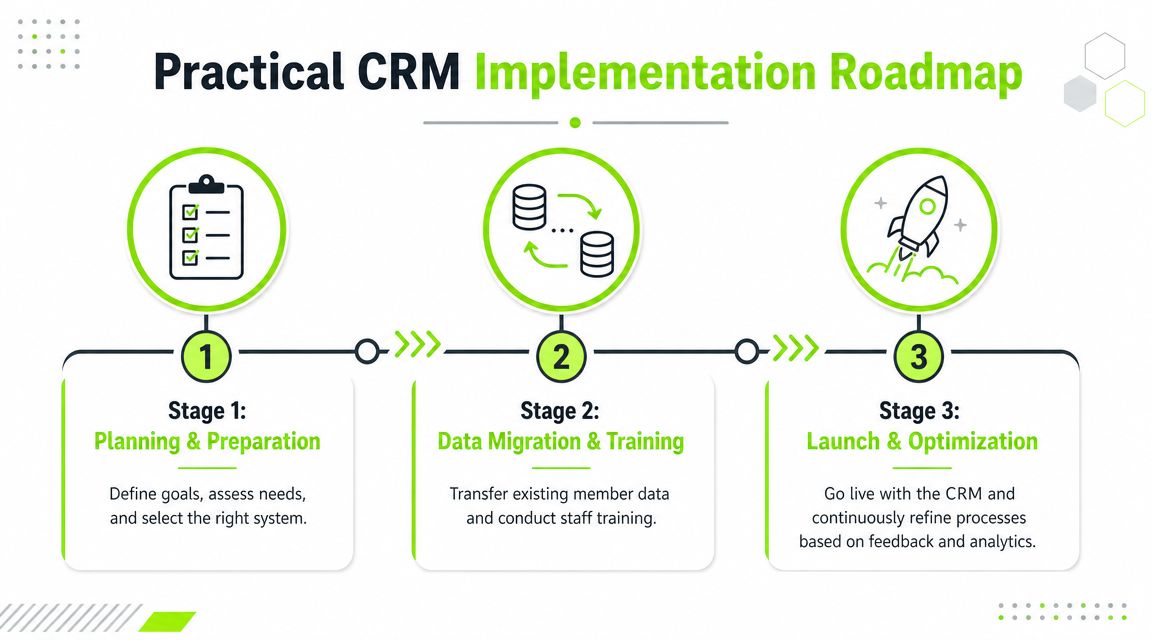
Stage one planning and preparation
Start with the commercial journey, not the software menu.
List the contact points that already exist. Website forms, phone calls, membership emails, visitor bookings, event enquiries, and walk-ins. Then decide which journeys matter first. Most clubs should prioritise membership enquiries, visitor follow-up, and renewals before anything more advanced.
A short planning checklist helps:
- Map your current process. Note where enquiries arrive, who responds, and where leads currently get lost.
- Gather existing data sources. Export contacts from spreadsheets, inboxes, website forms, EPOS lists, and booking systems.
- Decide what success looks like. Better visibility, faster follow-up, cleaner reporting, and less manual chasing are sensible starting points.
Stage two data migration and training
Many clubs create future problems by importing messy data without review.
Clean the records before migration. Remove duplicates, standardise obvious naming issues, and decide which fields genuinely matter. If the system starts with poor data discipline, staff lose trust in it quickly.
Training should be role-based. The membership manager doesn't need the same view as the professional shop team or a general manager. Keep the focus on everyday use:
| Role | What they need to do |
|---|---|
| Front-of-house staff | Log enquiries and check contact history |
| Membership or sales staff | Manage pipeline stages and follow-up tasks |
| Managers | Review reporting, response handling, and conversion performance |
For clubs thinking about workflow design before launch, our article on golf club automation gives a useful framework for deciding what should be automated and what should stay human-led.
Stage three launch and optimisation
Go live with the smallest useful version, not the most complex version.
That usually means one enquiry pipeline, a handful of templates, basic reporting, and clear ownership of follow-up. Once staff use it consistently, the club can add more segmentation, smarter automations, and deeper integrations.
Start with one pipeline you'll actually use. A simple live system beats an elaborate setup nobody trusts.
The clubs that get value from CRM aren't always the most technical. They're the ones that commit to process, keep the setup relevant, and review performance regularly instead of treating the platform like a one-off IT job.
Conclusion: Building Your Club's Growth Engine
A golf club CRM system shouldn't be viewed as software that sits on the side of the business. It should sit near the centre of it.
If your club is serious about predictable growth, the priority isn't just to generate more interest. It's to make sure existing interest is captured, visible, followed up properly, and connected to the rest of club operations. That's what turns marketing from hopeful activity into something commercially dependable.
The clubs that struggle most with growth often aren't invisible. They're inconsistent. Enquiries come in, but the response process varies. Staff work hard, but there's no shared pipeline. Visitor behaviour exists in one system, spending in another, and communication history somewhere else again.
A proper CRM changes that by creating structure.
It helps clubs replace guesswork with visibility, delayed replies with planned follow-up, and fragmented records with one clearer view of the customer. That matters for membership sales, visitor conversion, renewals, and day-to-day admin efficiency.
There's also a mindset shift involved. CRM isn't there to add complexity. Used properly, it reduces it. It gives lean teams a way to respond faster, manage more consistently, and stop relying on memory as a business system.
For committee-led clubs, that often means fewer blind spots. For owner-led and resort operations, it means more control over pipeline quality across teams and sites. For managers, it means knowing what is happening instead of chasing updates from multiple people and platforms.
The practical question isn't whether your club needs a CRM in theory. It's whether your current process can reliably convert the interest you already generate.
If the answer is no, the growth issue isn't at the top of the funnel. It's in the operational system underneath it.
If you want help building a practical CRM-led pipeline for your club, GolfRep works with golf venues to improve lead handling, automate follow-up, and create clearer visibility from first enquiry through to membership conversion.
Ready to tap into our proven growth system?