A Modern Guide to Golf Course Management
Effective golf course management is about much more than keeping the greens in pristine condition and the tee times running smoothly. It is a complex balancing act, blending day-to-day operational excellence with a sharp focus on strategic business growth. The real magic happens when every part of the club, from the greenkeepers and clubhouse staff to the membership and events teams, works in perfect harmony.
Redefining Modern Golf Course Management
For years, the formula for running a golf club was straightforward. A great course and a welcoming clubhouse were usually enough to keep the membership roster full. That world has changed. Today, a successful club must operate like any other high-performance business, with every department pulling in the same direction to boost revenue and deliver an unforgettable member experience.
The main challenge facing most UK clubs is not a lack of interest in the game. In fact, many are fielding a healthy number of enquiries for memberships, society days, and private events. The real problem, the bottleneck, is in how they handle that interest. Without a solid process in place, too many valuable leads slip through the cracks due to slow enquiry response times, patchy follow-ups, and no clear lead visibility.
Shifting from Manual Tasks to System-Driven Growth
Look under the bonnet at many clubs, and you will find a tangle of spreadsheets and disconnected software trying to manage everything. This manual approach is not just inefficient; it makes it nearly impossible to get a true picture of the club's performance. It is time for a fundamental shift in thinking.
This guide is all about moving away from that constant, reactive fire-fighting and towards a more structured, system-driven way of working. This new model focuses on three core areas:
- Operational Excellence: Building efficient, repeatable processes for everything from course maintenance and clubhouse management to staffing.
- Predictable Pipelines: Creating a reliable system to generate, nurture, and convert new membership and event enquiries.
- Data-Informed Decisions: Using the right metrics to track conversion rates, understand member behaviour, and make smarter strategic choices.
The goal is to build a club that runs like a well-oiled machine. One where growth is not left to chance but is the direct, predictable result of well-designed systems. This creates financial stability and, just as importantly, frees you up to focus on the long-term vision instead of getting bogged down in daily admin.
Ultimately, what modern golf course management comes down to is control and predictability. When you integrate your daily operations with a powerful growth engine, you are not just setting your club up to survive; you are positioning it to thrive in a competitive market. It is about making sure every potential member gets a prompt, professional welcome and is guided seamlessly from their first enquiry to becoming a loyal, long-term part of your community.
Mastering the Four Pillars of Club Operations
A successful golf club does not just happen. It is built on a foundation of operational excellence, and that means getting four key areas right. Think of these as the four legs of a table; if one is wobbly, the whole thing is unstable.
Effective golf course management is about mastering these four core pillars. It is about creating smooth, repeatable workflows that work in harmony, pulling the club away from constant fire-fighting and towards a more strategic, long-term vision.
Agronomy and Course Maintenance
Let's be honest, the golf course is the heart of the club. It is your main asset and the primary reason members join. Modern agronomy is a precise science, a delicate balance between creating immaculate playing surfaces and ensuring the long-term health of the turf. The goal is not just a great course for the club championship; it is delivering consistent, high-quality conditions that members can rely on week in, week out.
This goes far beyond just mowing fairways and rolling greens. A proper strategic maintenance plan includes:
- Aeration and Topdressing: Yes, it can cause a bit of short-term disruption, but it is absolutely essential for relieving soil compaction and promoting deep, healthy root growth.
- Targeted Nutrition: This is all about using data to feed the turf what it needs, when it needs it. It builds resilience without wasting money on unnecessary fertilisers.
- Water Management: Smart irrigation is key. The aim is to conserve every drop of water possible while keeping the course in prime condition, especially with costs and regulations on the rise.
If you skimp on a proactive agronomy programme, you are just storing up bigger, more expensive problems for later, from disease outbreaks to chronic drainage issues.
Clubhouse and Food and Beverage Operations
Your clubhouse should be more than just a place for a post-round pint. It is the club's social centre and a huge, often untapped, source of revenue. Too many clubs treat their food and beverage (F&B) operation as a simple amenity, but that mindset leaves a lot of money on the table.
The secret is to see the clubhouse as a profit centre in its own right. This starts with understanding what your members actually want and then building an offering that brings them through the doors for reasons other than golf. Think society days, corporate events, weddings, and local community gatherings. A well-run F&B operation does not just boost the bottom line; it deepens member engagement and makes the club a real destination.
A well-managed clubhouse becomes the hub of the community, creating loyalty and revenue streams that are independent of the weather or the golf season. It diversifies your income and strengthens your financial stability.
Staffing and Team Development
At the end of the day, it is your people who deliver the member experience. Every single interaction, from the greenkeepers on the course to the team in the pro shop, shapes a member's perception of the club. That is why recruiting, training, and retaining great people is not just an HR task; it is fundamental to successful golf course management.
In today's competitive labour market, you simply have to invest in your team. That means offering fair wages, providing good training, and building a positive culture where people feel valued. A happy, motivated team provides better service, and that translates directly into higher member satisfaction and retention. You can learn more about how a structured approach improves all areas of your club, including the team that powers it, by exploring our comprehensive golf marketing services.
The UK golf sector is a major industry, with forecasts suggesting it will generate £2.8 billion in revenue by 2025. But this growth brings challenges, especially around staffing. To keep experienced greenkeepers and other key staff, clubs have to address wage pressures and really focus on becoming an employer of choice. You can dig deeper into these industry trends and financial insights from IBISWorld.
Financial Oversight and Management
The final pillar holding everything together is sharp financial management. This means getting on top of your budgeting, creating accurate forecasts, and having a crystal-clear understanding of all your revenue streams, from membership dues and green fees to F&B and event income.
Good financial oversight is what allows you to make smart, informed decisions. It shows you where to invest for the best return, how to get a grip on rising operational costs, and how to set prices that truly reflect the value you are providing. Without a solid handle on the numbers, you are flying blind. By connecting your financial data with your operational performance, you get a complete picture of the club's health, allowing you to plan for the future with real confidence.
Building Your Predictable Membership Pipeline
If you are relying on the old 'wait-and-see' approach to membership sales, you are falling behind. Sustainable growth in today's competitive market is not about simply opening the doors and hoping for the best. It is about building a proactive, predictable system to attract, engage, and convert new members.
Think of it as a modern growth engine. Getting an enquiry is just the first step. Where most clubs stumble is not a lack of interest; it is the slow, inconsistent response that follows. The real advantage comes from having a solid process that handles every single lead with speed and professionalism.
The Critical Importance of Enquiry Response Time
When a potential member gets in touch, a stopwatch starts. A slow reply does not just annoy them; it silently tells them they are not a priority. In a world of instant communication, people expect quick answers. A delay of just a few hours could mean they have already moved on to a competitor.
This is exactly where manual processes fail. Trusting one person to monitor an inbox, find the right information, and type out a perfect reply is a recipe for missed opportunities. People get busy, emails are overlooked, and potential members slip through the cracks. It is time to stop patching a leaky bucket and build a systematic, automated approach instead.
A fast response time is the single most effective way to boost your conversion rates. An automated system ensures every lead gets an immediate, professional acknowledgement right when their interest is highest, setting your club miles apart from the competition.
Achieving Complete Lead Visibility
Let me ask you a question: how many membership enquiries did your club get last month? How many booked a tour, and how many actually signed up? If the honest answer is a rough guess based on gut feel, you are not alone, but it is impossible to manage performance or make smart decisions that way.
Effective golf course management demands complete lead visibility. This means having a central hub, usually a Customer Relationship Management (CRM) platform, where every interaction with a prospect is logged.
- Source Tracking: Know precisely where leads are coming from, whether it is your website, a social media ad, or a word-of-mouth referral.
- Status Updates: See at a glance where everyone is in the pipeline, from initial enquiry to a scheduled tour or a signed contract.
- Communication History: Keep a full record of every email, phone call, and note. This makes every follow-up seamless and personal.
Without this clarity, you are flying blind. A structured system lights up the entire sales process, showing you what is working and where the bottlenecks are.
A strong membership pipeline is the engine that powers the entire club. This diagram shows how the core operational pillars are all interconnected.
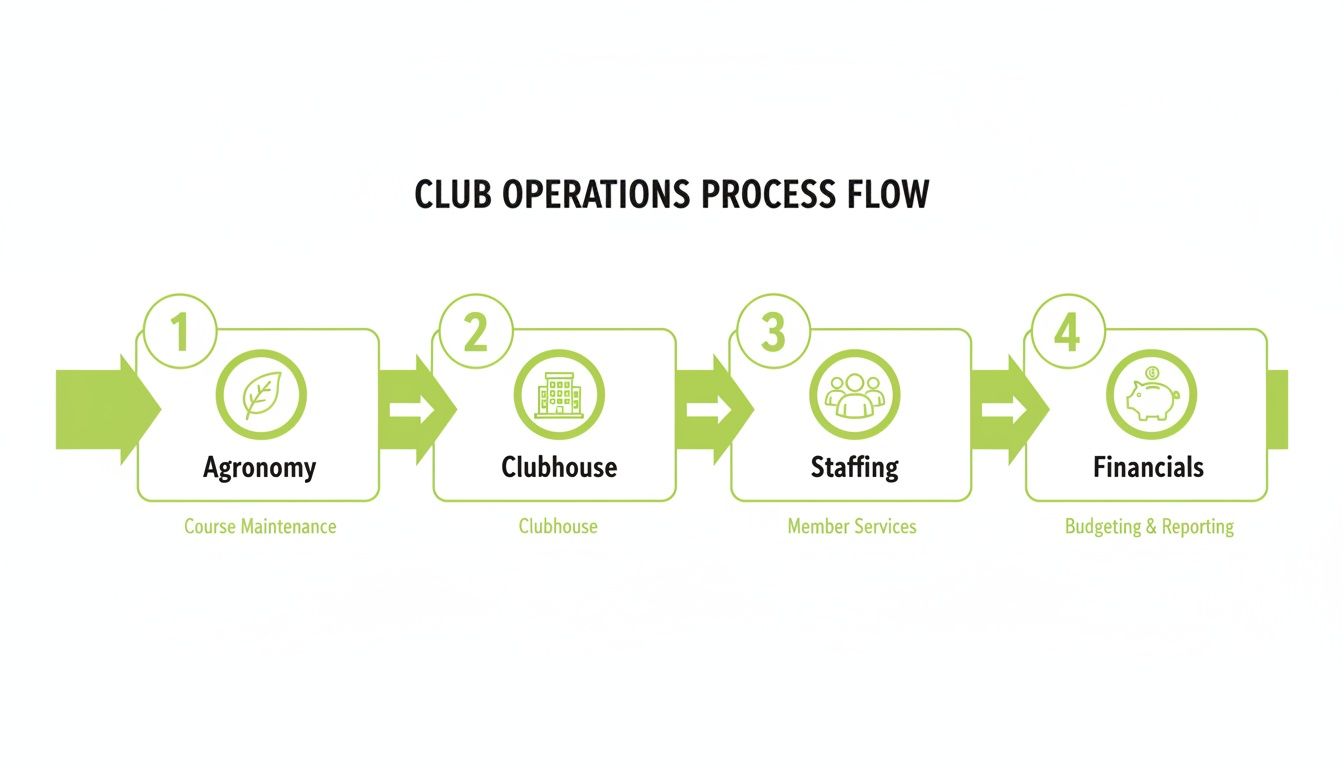
As you can see, a predictable flow of new members directly supports everything from agronomy and clubhouse services to staffing and the club's financial health.
Using Nurture Sequences to Guide Prospects
Let's be realistic: not everyone who enquires is ready to sign up on the spot. Many are just starting their research and need more information before they commit. This is where automated nurture sequences become your best friend. They are a pre-planned series of communications, usually emails or texts, designed to build trust and gently guide a prospect towards the next step.
A simple yet effective nurture sequence might look like this:
- An immediate welcome email that delivers your digital brochure.
- A follow-up email a few days later showcasing a few glowing member testimonials or a unique feature of your club.
- An invitation to book a call or a club tour to experience the facilities for themselves.
This kind of automated follow-up ensures no lead ever goes cold. It keeps your club front and centre in their minds and provides genuine value without draining your team's time. To dive deeper into these strategies, you can learn more about getting your golf course online. This systematic approach turns a cold enquiry into a warm, engaged prospect who is far more likely to become your next member.
How to Grow Revenue Beyond Membership Fees
While a healthy membership roster is the financial backbone of any club, relying solely on subscriptions is a risky game. True financial stability is built on diversifying your revenue streams and making the most of every commercial opportunity that comes your way. This means looking beyond the familiar faces of your members to strategically welcome visitors, societies, and corporate clients.
With operational costs on the rise, a data-led approach to pricing and packaging these non-member activities is not just a good idea; it is a necessity. The goal is to maximise profitability without alienating your core membership base, transforming your club into a multifaceted business that thrives all year round.
Optimising Visitor Green Fees
Visitor green fees are a direct line to extra income, yet so many clubs stick to a simple, static pricing model. A far more effective strategy is dynamic pricing, where tee time costs fluctuate based on demand, the time of day, and the season. This model is standard practice in the travel and hospitality sectors for a reason: it ensures you are not leaving money on the table during your busiest periods.
This approach is crucial in the current market. In the UK, the average green fee at a Top 100 course is projected to hit £237 in 2025, a massive 10.7% increase from the previous year. This surge in visitor pricing is easily outpacing rises in membership fees, highlighting the pressure on clubs to balance costs with revenue. You can dig into the numbers behind these escalating visitor fees in UK Golf Guy's detailed analysis.
A well-structured system allows you to implement this effectively, automatically adjusting prices to get the most from available slots without you having to constantly micro-manage it.
Creating Compelling Society Packages
Golf societies are a brilliant and reliable source of revenue. They often book in large groups and are happy to spend on food and drink. Winning their business, however, takes more than just offering a discounted round. The key is to create compelling, tiered packages that cater to different needs and budgets.
Think about offering structured packages like these:
- The Bronze Package: Coffee, bacon rolls, and 18 holes.
- The Silver Package: Adds a one-course lunch and a small prize pack.
- The Gold Package: A premium offering with a two-course dinner, a dedicated event coordinator, and branded merchandise.
This tiered approach makes the decision simple for society organisers and creates clear upsell opportunities for you. The real challenge is managing the bookings and enquiries efficiently. A messy system of emails and spreadsheets often leads to slow responses and, ultimately, lost business.
By systematising your society packages and how you handle enquiries, you create a repeatable and profitable sales process. This guarantees every group gets a professional and timely response, dramatically increasing your chances of securing the booking.
Becoming a Premier Events Venue
Your clubhouse and grounds are valuable assets that can be marketed for a huge range of private and corporate functions. From weddings and anniversary parties to business meetings and team-building days, these events can generate serious income, especially during off-peak golfing hours.
Success here depends on treating it as a distinct part of your business. That means actively marketing your facilities as a premier venue, not just an add-on to a golf club. It needs a dedicated process for fielding event enquiries, managing bookings, and coordinating with suppliers.
A central Customer Relationship Management (CRM) system is vital for this. It lets you manage these diverse customer segments, from individual golfers to large corporate clients, all in one place. This ensures a consistent, high-quality experience across the board, which is the foundation for building repeat business and earning the kind of powerful word-of-mouth referrals that fuel long-term growth.
Choosing the Right Technology for Your Golf Club

Let's be honest, trying to grow a modern golf club on a foundation of disconnected spreadsheets and manual to-do lists just does not work. It is the enemy of growth. To build a reliable membership pipeline and run a smooth operation, you need a solid technology foundation. This is not about being flashy; it is about choosing a few smart tools that fix your biggest headaches.
Think of your technology as the club's central nervous system. It should connect every department: marketing, operations, F&B, finance, and give you a single, accurate view of your club's health. The right systems get rid of the guesswork, take repetitive tasks off your team's plate, and give you the hard data needed to make smart decisions.
For most clubs, this foundation rests on three core pillars that need to work together.
The Central Hub: A Customer Relationship Management (CRM) System
If you make one technology investment, make it a CRM. This is the single most important tool for any club serious about growth. It becomes your central database for every single interaction with members, prospects, society organisers, and event clients. No more scattered notes in a drawer or confusing spreadsheets; a CRM creates one source of truth.
It is built to give you complete lead visibility. You can track a prospect from the moment they first click on your website all the way through to signing their membership agreement. This system is the engine that drives effective golf course management, making sure no enquiry ever gets lost or forgotten in a busy inbox.
With a properly set-up CRM, your team can:
- Automatically log every email, phone call, and visit.
- See precisely where every prospect is in your sales pipeline.
- Group your audience for targeted, relevant communications.
The Engine: Marketing and Sales Automation
The bottleneck for most clubs is not a lack of enquiries; it is having the time and people to follow up with them quickly and consistently. This is where automation makes a world of difference. An automation platform plugs into your CRM to handle enquiry responses and nurturing campaigns without you lifting a finger.
Imagine a potential new member fills out a form on your website. An automation platform can instantly send them a personalised acknowledgement email along with your digital brochure. From there, it can follow up with a planned series of helpful emails, keeping your club at the front of their mind. All of this happens without taking up any of your team's valuable time.
This systematic approach to follow-up is a game-changer. It ensures every single lead receives a prompt, professional experience, which dramatically increases the chances of conversion and frees up your staff to focus on building real relationships with the hottest prospects.
The Compass: Data Analytics and Reporting
You cannot improve what you do not measure. The final piece of the puzzle is a strong analytics tool that helps you track your key performance indicators (KPIs) and understand what is actually driving results.
Your CRM holds all the raw data, but an analytics tool is what turns that data into something you can actually use. It presents information in clear, visual dashboards that answer your most important questions: Which marketing channels are bringing in the best leads? What is our average membership conversion rate? How long does it take for a new enquiry to become a full member?
This data-first approach takes the emotion and guesswork out of your strategy. It gives you the clarity to double down on what is working, fix what is not, and spend your budget with confidence.
Having the right tools is fundamental. Below is a simple breakdown of the essential technology stack that modern clubs are using to drive predictable growth.
Essential Technology for Golf Club Growth
These three components, working in sync, create a powerful system that not only makes daily operations easier but also lays the groundwork for sustainable, long-term success.
Your Action Plan for Better Club Management
Knowing what to do is one thing; actually doing it is what separates the clubs that thrive from those that just get by. The final, and most important, step is to turn all this insight into action. You need a clear framework to take a hard look at how you operate now and build a more predictable system for growth. This is not about tearing everything down overnight. It is about making smart, incremental changes that build towards a much stronger future.
The timing could not be better. Golf is booming in Great Britain. Data from Sporting Insights shows that rounds played are up 15% year-to-date in 2025, hitting the highest five-year average on record. While that is fantastic news, this surge puts immense pressure on club facilities and staff. It also makes it crystal clear why having optimised systems is no longer a 'nice-to-have'. You can read the full research about golf's record-breaking year to understand just how significant this trend is.
Start with an Honest Operational Audit
First things first: you need a brutally honest assessment of where your club stands today. The audit should follow the entire journey of a potential member, from the very first time they hear about you to the moment they sign on the dotted line. It is all about spotting the friction points and missed opportunities that are quietly costing you money.
Here is a simple, four-step framework to get you started:
- Measure Your Enquiry Handling: Send a test enquiry to your own club. Seriously. Time exactly how long it takes to get a response. Is it minutes, hours, or even days? This one, simple test often reveals the single biggest weakness in a club’s sales process.
- Map the Prospect's Journey: Get a whiteboard and document every single touchpoint a potential member has with your club. Think about your website, social media, phone calls, and the on-site visit. Where are the gaps? Where does the experience feel disjointed?
- Assess Your Technology Stack: Are you trying to manage leads with a messy spreadsheet and a cluttered email inbox? Or do you have a central system, like a CRM, that gives you a clear picture? Be honest about the tech gaps that are stopping you from seeing the full story on every lead.
- Define Your Real KPIs: It is time to move past vanity metrics. The numbers that truly matter for growth are things like your lead-to-visit rate, your visit-to-membership conversion rate, and how much it actually costs you to acquire a new member.
Once you complete this audit, you are no longer guessing. You are replacing assumptions with solid data, and that is the only foundation for making strategic decisions that lead to real, sustainable growth.
This structured approach gives you a system to capitalise on the current high demand for golf, making sure your club is in the best possible position to succeed.
If you are looking for a bit of inspiration on how other clubs have put these principles into practice, you might find our golf club growth case studies helpful. This is your plan to take control, build a predictable pipeline of new members, and secure your club’s financial future.
Got Questions About Modernising Your Club? We've Got Answers
Stepping into a more organised, system-driven way of managing a golf club always brings up a few questions. It is completely natural. Here, we tackle some of the most common queries we hear from club managers, secretaries, and committees across the UK.
We have kept the answers straightforward and practical, no jargon, just what you need to know to grow your club sustainably.
How Quickly Should We Really Respond to a Membership Enquiry?
The golden window? Five minutes. Seriously. While that might sound incredibly fast, responding within five minutes is the single biggest lever you can pull to boost conversion rates. Think about it: a potential member is at their peak interest the very moment they hit 'send' on your enquiry form.
A swift, professional reply immediately puts your club leagues ahead of others who might take a day or two to get back. This is where a good automated system is worth its weight in gold. It can send an instant acknowledgement with your brochure and ping the right person on your team, making sure that initial spark of interest never fizzles out.
If We Can Only Afford One Piece of Tech, What Should It Be?
Hands down, a Customer Relationship Management (CRM) system. It is the most important investment you can make for growth. A CRM becomes the single source of truth for all your member and prospect information, finally letting you ditch those clunky, disconnected spreadsheets.
A CRM gives you a bird's-eye view of your entire sales pipeline. You can see every touchpoint, from the first time someone visits your website to the day they sign on the dotted line. No more leads falling through the cracks, just personalised, timely follow-ups.
Why Are We Talking About Systems Instead of Just Pumping More Money into Marketing?
This is a big one. Many clubs think their problem is a lack of enquiries. But time and again, we see that the real issue is not at the top of the funnel; it is the bottleneck in handling the interest they already have. Spending more on advertising before you have the right systems in place is like trying to fill a leaky bucket.
Adopting a systems-first mindset means you get the most out of every single pound you invest. It builds a reliable, predictable pipeline because you know every lead is being nurtured properly. By simply fixing your follow-up process, you will convert more of the enquiries you are already getting. That is a far smarter and more cost-effective approach than just buying more ads.
At GolfRep, we live and breathe this stuff. We specialise in helping UK clubs build the predictable growth systems they need to thrive. We blend smart lead generation with the CRM and automation frameworks required to turn curiosity into long-term commitment, setting your club up for lasting success.
Ready to tap into our proven growth system?