Attract New Golf Club Members: Your 2026 Playbook
Most advice on how to attract new golf club members starts in the wrong place. It tells clubs to post more on social media, run more ads, or offer another joining incentive.
That misses the operational problem.
There is no shortage of golfers in the market. Sport England's Active Lives data and England Golf's participation reporting have shown that golf participation recovered strongly after the pandemic, with hundreds of thousands of adults playing each month, creating a real opportunity for clubs that can convert pay-and-play, social, and driving-range golfers into members, as noted in this membership growth summary. The issue is that many clubs still handle enquiries with manual admin, delayed replies, and inconsistent follow-up.
A club can spend money generating interest and still fail to grow if nobody sees every lead, responds quickly, and guides that prospect towards a visit. Predictable membership growth comes from systems. Better lead visibility, faster response times, structured nurture, and clear next steps.
The Real Reason Your Club Is Struggling for Members
Clubs often assume demand is the problem. In practice, conversion is usually the bigger weakness.
A prospect fills in a form on a Sunday evening. The email lands in a general inbox. Nobody calls until Tuesday. By then, the prospect has already visited another club, booked a trial elsewhere, or gone cold. The enquiry was real. The system failed.
That is why more lead generation alone rarely fixes a membership gap. If the club's process is slow, manual, or unclear, more traffic just creates more leakage. Clubs don't need a busier inbox. They need a reliable way to turn interest into booked visits and joined members.
Where the leakage usually happens
Most clubs lose momentum in familiar places:
- Enquiries sit unseen because they arrive through scattered channels such as web forms, email, phone calls, or social messages.
- Replies are generic and read like admin acknowledgements rather than a membership conversation.
- No one qualifies intent so serious prospects and casual information seekers get treated exactly the same.
- There is no follow-up rhythm once the first reply is sent.
Practical rule: If your membership process depends on one person remembering to chase every lead manually, it isn't a process. It's a risk.
A lot of committee-led clubs recognise this only when numbers start sliding. The first fix usually isn't a bigger ad budget. It's better handling. If that sounds familiar, this breakdown on what to fix first when golf club membership is declining is a useful place to pressure-test your current setup.
Systems create confidence
When a club knows every enquiry is captured, acknowledged, assigned, and followed up, marketing becomes far less speculative. You stop wondering whether advertising works and start seeing which sources produce visits, conversations, and sign-ups.
That shift matters because membership growth is rarely one big campaign win. It's a chain of smaller operational wins, repeated consistently.
Rethinking Your Target Audience Beyond the Usual Suspects
The phrase "new members" is too broad to be useful. If you want to attract new golf club members efficiently, you need to know which local groups are most likely to join, and why.
England Golf reported that affiliated membership passed 700,000 golfers in 2023, showing the market is not full and that clubs can still convert a large base of active golfers if they offer the right entry points, pricing, and onboarding journey, according to this UK membership analysis.

Stop targeting "golfers" as one audience
A club manager will often say, "We want more members within a reasonable drive of the club." That's true but not specific enough to build ads, landing pages, or follow-up messages around.
Start with segments you already recognise operationally:
- Frequent pay-and-play visitors who already know the course and need a clearer route into membership.
- Lapsed members who may not need persuading on the club itself, only on whether rejoining fits their life now.
- Driving-range and academy users who are engaged with golf but haven't yet seen club membership as the next step.
- Existing members' families and friends who trust the environment before they ever enquire.
- Corporate and society players who value convenience, hosting, and structured access more than tradition alone.
Match the message to the motive
Each audience joins for different reasons. That sounds obvious, but clubs still run one generic message for everyone.
A flexible-working professional may care about easy booking, practice access, and whether membership feels simple to start. A returning older golfer may care more about community, routine, and finding playing partners. A family might look at coaching, atmosphere, and whether the club feels welcoming rather than formal.
A useful starting point is to review a few customer profiling examples from Baslon Digital, then adapt that thinking to your local golfer base. You don't need a complex persona document. You need practical insight your team can use in ads and follow-up calls.
The most expensive audience is the one you target too broadly. You pay for attention from people who were never likely to join.
Use simple club data before spending more
You probably already have enough information to build a sharper picture:
| Audience | What to check | What it often reveals |
|---|---|---|
| Pay-and-play regulars | Booking frequency and timing | Whether convenience or value is the trigger |
| Lapsed members | Reason for leaving | Whether flexibility or pricing structure needs reframing |
| Academy users | Lesson attendance and progression | Whether they need a guided path into club life |
| Referrals | Who introduces them | Which current members influence decisions |
Clubs don't need more guesswork here. They need a short list of audiences, a reason each group would join, and a distinct next step for each.
Executing a Local Paid Media Campaign That Delivers
Clubs rarely have an awareness problem. They have a campaign control problem.
I see the same pattern repeatedly. A club runs ads, gets clicks, picks up a handful of form fills, then concludes paid media is expensive or inconsistent. The actual failure usually happens earlier in the setup. The audience is too loose, the message is too generic, or the campaign sends traffic into a dead end that staff cannot convert.
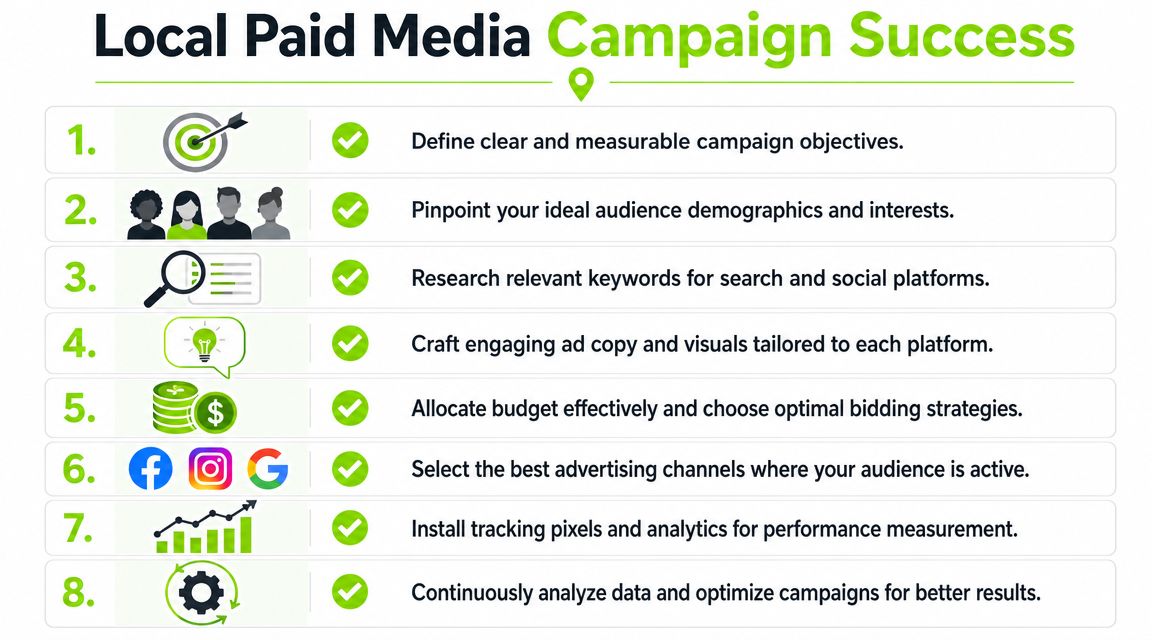
Paid media works at club level when it is built for operational follow-up, not just reach. That means tight geography, clear intent, and one defined next action.
Build around realistic travel behaviour
A golfer may like your course and still never join if the drive is inconvenient on a weekday morning or after work. Start with member and visitor data, then map a catchment your team can defend commercially. For some clubs, that is a tight radius around commuter towns. For others, it includes a wider area because the course, practice offer, or membership structure justifies the trip.
Google's guidance on location targeting for ads is useful here because it forces a practical question. Which postcodes produce people who can and will visit?
Set campaigns up with that in mind:
- Group postcodes by travel reality, not by county or broad region.
- Split nearby and outer catchments so your message matches the likely commitment.
- Exclude weak areas if they generate leads that never answer, never visit, or always price-shop.
- Run ads when the club can respond because a lead left untouched for half a day is already colder than commonly realised.
Match the ad to a specific membership conversation
A paid campaign should not ask one advert to do every job. A flexible membership route, a beginner pathway, and a full seven-day proposition attract different buyers and different objections.
Use creative that reflects the actual experience of joining your club:
- Real club imagery that shows the course, practice areas, clubhouse, and member environment.
- Short video that gives a prospect a feel for the place, not just a flyover of holes.
- Copy tied to one action such as booking a visit, requesting membership options, or speaking to the team.
- Benefits that change a decision like easier access to tee times, coaching support, or a sociable route into club life.
Stock images and vague prestige language usually get attention from the wrong people. Local recognisability gets better enquiries.
Stop paying for curiosity clicks
The fastest way to waste budget is to treat paid media as a visibility exercise. Club managers should judge campaigns by qualified enquiries, booked visits, and eventual joins. Click-through rate matters, but only if it leads to a sales process your team can control.
The common mistakes are predictable:
- Boosting posts instead of building proper campaigns. Visibility rises, intent does not.
- Sending traffic to the homepage. Prospects get distracted, confused, or lost.
- Using one message for every audience. New golfers and lapsed members do not respond to the same promise.
- Ignoring what happens after the click. Good ads cannot rescue a weak form, slow response time, or poor follow-up.
That last point matters most. Paid media is only the front end of the conversion engine. If you want examples of campaign structure, audience setup, and offer positioning, GolfRep's guide to golf club paid advertising explains the mechanics well. The same principle applies after the click. Landing pages need a clear next step and enough intent filtering to help staff follow up properly. For a useful review of strategies to transform visitors into customers, study how page structure, form design, and conversion friction affect lead quality.
A local paid campaign delivers when every step is connected. The ad gets the right person to act. The page captures enough detail to qualify intent. The club responds fast enough to turn interest into a visit. Systems make the spend predictable.
Crafting the No-Discount Offer and Landing Page
Discount-led acquisition often creates the wrong conversation. It trains prospects to compare price before they understand value, and it can weaken the club's position before the relationship has even started.
A better approach is to make the next step easy, useful, and specific.
The strongest recent evidence for club growth points to frictionless digital journeys and personalisation, with the more valuable question being how to use a smooth digital experience to turn anonymous traffic into a scheduled visit, as discussed in this article on private club website copy and conversion.
Build one page for one decision
A membership landing page shouldn't behave like the rest of the website. It has one job. Help the right prospect take the next step.
That usually means including:
- A clear headline that speaks to the type of golfer you want to attract.
- A short explanation of membership pathways so visitors don't need to hunt for basic information.
- Visible reassurance such as testimonials, member feedback, or signs of a welcoming culture.
- A simple form that asks for enough information to follow up well, without creating unnecessary friction.
- A strong call to action built around a visit, conversation, or personalized recommendation.
A landing page should answer the prospect's first practical question: "What happens if I enquire?"
Offers that protect your brand
The best no-discount offers create commitment without cheapening the proposition. They give a serious prospect a reason to raise a hand and give your team a better starting point for the conversation.
Examples that work well for clubs include:
- Club experience day for prospects who want to feel the atmosphere before discussing membership options.
- Personalised tour and membership consultation for golfers comparing routes, playing patterns, and usage.
- Beginner or returner pathway review for people who aren't sure where they fit.
- Hosted practice and facilities introduction for players using ranges or coaching but not yet integrated into club life.
If you're reviewing your page structure, Receiver's advice on strategies to transform visitors into customers is a useful external reference because it focuses on the mechanics of reducing friction rather than on design trends.
What not to do
Don't send paid traffic to a general membership page with multiple menus, outdated PDFs, and no obvious action.
Don't bury pricing context completely either. You don't need to publish every scenario if your club doesn't want to, but prospects do need enough clarity to decide whether a conversation is worthwhile.
Don't treat the form submission as the finish line. It's the handover point into your conversion system.
Building Your Automated Enquiry Conversion System
Clubs rarely have an enquiry problem first. They have a handoff problem.
A prospect fills in a form, asks about membership, then waits. The message sits in a shared inbox. A team member plans to call after lunch. Nobody logs the conversation properly. Two days later, the prospect has already visited another club. That is how membership revenue leaks out of the middle of the process.
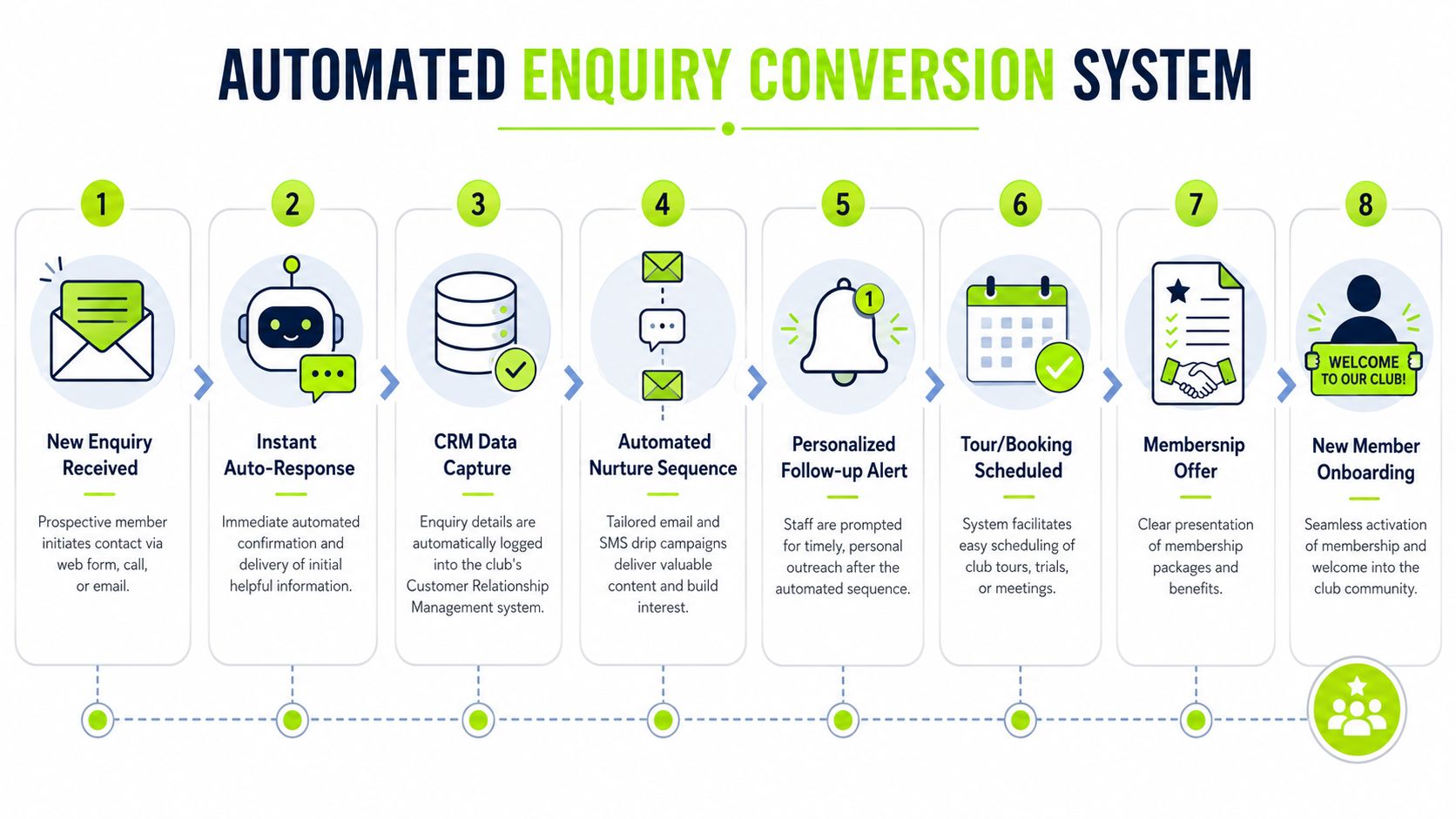
Predictable growth comes from a system that captures every enquiry, responds immediately, assigns ownership, and keeps follow-up moving without relying on memory or goodwill. If that system is weak, buying more leads only increases waste.
What the system needs to do
At minimum, your enquiry process should handle five jobs every time:
Capture the lead centrally
Every web form, email, call note, and social enquiry should land in one record, not across inboxes and notebooks.Acknowledge instantly
The prospect should get an immediate confirmation that tells them the enquiry was received and what happens next.Assign the next action
Someone specific needs to own the lead, with a clear task and response window.Track the stage
New enquiry, contacted, visit booked, attended, follow-up sent, joined. If staff cannot see the stage, management cannot spot drift or fix bottlenecks.Continue follow-up automatically
Prospects often need more than one touch. The system should trigger reminders and follow-up messages without waiting for staff to remember.
A practical workflow
Clubs do not need complicated software. They need a process the team will use on a busy Wednesday morning and a wet Saturday afternoon.
A workable setup looks like this:
| Stage | System action | Staff action |
|---|---|---|
| Enquiry received | CRM creates record | Team reviews source and details |
| Immediate response | Automated email or SMS sent | None needed at this moment |
| High-intent alert | Notification triggered | Staff call promptly |
| Not ready yet | Nurture sequence starts | Follow-up task scheduled |
| Visit booked | Calendar entry logged | Prepare personalised tour |
| Post-visit | Follow-up reminders triggered | Membership conversation continues |
The trade-off is simple. A lightweight system used consistently beats a more advanced setup that nobody updates. I have seen clubs spend money on ads, forms, and CRM licenses, then still lose enquiries because staff skip stages or log notes late. Keep the workflow simple enough that compliance is realistic.
Why automation matters in a club setting
Automation protects the human part of the sales process.
It stops good enquiries getting buried on busy days. It keeps standards consistent when reception, membership, and management all touch the same lead. It gives committee-run clubs continuity when responsibility shifts between volunteers and staff. It also gives management a proper view of response times, booked visits, drop-off points, and source quality.
Fast follow-up is basic service. A prospect has asked to hear from your club. Delayed response signals disorganisation before they have even visited.
For clubs reviewing systems, the core requirements are straightforward. You need lead stages, instant confirmations, task reminders, and reporting that shows where enquiries stall. Some clubs build that with general CRM tools. Others prefer software designed for the sector. GolfRep's marketing automation approach for golf clubs is one example of a setup built around lead capture, instant response, nurture flows, and conversion tracking in one process.
The nurture sequence clubs often miss
A prospect who does not answer the first call is still active in many cases. They may be at work, comparing clubs, checking costs with a partner, or waiting for a better time to visit.
That is why follow-up needs structure.
A simple nurture sequence should include:
- A prompt follow-up message confirming the best next step.
- A short email answering common questions about the visit or membership route.
- A reminder tied to convenience such as available viewing times.
- A final check-in that leaves the door open without sounding needy.
The common failure is not poor persuasion. It is inconsistency. One missed call and one generic email is not a conversion process. It is an admin action.
The clubs that convert well treat enquiry handling like an operating system. Every lead is logged. Every lead gets a response. Every lead has a next action. That is what turns interest into booked visits instead of missed opportunities.
From Club Visit to Confirmed Member
Once the visit is booked, the process becomes personal.
The strongest club tours don't feel like scripted sales presentations. They feel informed, relevant, and well-paced. The person leading the visit knows why the prospect enquired, what type of golf they play, and what they seem to care about most.
Before the prospect arrives
Review the enquiry record first. If the prospect came through a flexible-membership page, don't open with the competition schedule. If they mentioned family use, show the parts of the club that support that decision. A good tour feels customized because it is.
Then make the route practical. Show the arrival experience, clubhouse, changing areas, practice facilities, and the part of the course or playing culture most likely to matter to that individual.
"People rarely join because the brochure was complete. They join because the visit helped them see themselves belonging there."
During the visit
Clubs often talk too much.
A prospect doesn't need a history lecture unless they ask for one. They need context, clarity, and evidence that the club suits the way they want to play. Ask questions, listen carefully, and adjust. If they are comparing options, acknowledge that openly and help them understand fit rather than pushing for an immediate yes.
Useful questions include:
- How often do you play at the moment
- What are you looking for that you're not getting now
- Would you mainly play socially, competitively, or a mix
- What would make joining feel straightforward
After the visit
Never end a tour with "Let us know if you have any questions."
End with a next step. That may be a follow-up call, a membership recommendation, or a direct invitation to complete the application. Then log the outcome properly and follow through when you said you would. Clubs that convert well after visits are usually not more persuasive. They are more organised.
Key Metrics and Budgeting for Predictable Growth
If you can't see the pipeline, you can't manage it. That is why clubs need a small set of operational metrics tied to actual stages, not vanity reporting.
Start with the measures that reflect movement through the funnel:
- Lead volume tells you how many enquiries are entering the system.
- Lead source shows where those enquiries came from.
- Response status shows whether anyone handled them.
- Booked visits tell you whether interest is progressing.
- Visit attendance shows whether the booking process is producing real appointments.
- New members joined is the final result.
Track the full path, not one isolated number
Many clubs focus on cost per lead because it feels tidy. On its own, it can be misleading.
A cheaper lead source is not better if nobody books a visit from it. A more expensive source may still be worthwhile if it produces serious prospects who join cleanly. That is why budgeting should be tied to stages, team capacity, and conversion bottlenecks.
For clubs wanting to sharpen the reporting side, some of the marketing analytics insights from HireMediaBuyers.com are useful because they push attention back towards measurement discipline rather than platform noise.
Sample 3-Month Membership Campaign Budget and Timeline
| Phase | Month 1 | Month 2 | Month 3 | Key Activities |
|---|---|---|---|---|
| Setup | Audit current funnel | Refine targeting and tracking | Review system performance | CRM setup, lead source mapping, landing page preparation |
| Campaign launch | Start local campaigns | Optimise creatives and audiences | Scale strongest segments | Paid media management, postcode targeting, lead quality review |
| Enquiry handling | Implement instant responses | Monitor response consistency | Tighten follow-up gaps | Staff alerts, automated confirmations, nurture workflows |
| Sales process | Standardise club visits | Review visit outcomes | Improve post-visit follow-up | Tour structure, objection handling, membership pathway discussions |
| Reporting | Baseline metrics | Compare source quality | Forecast next quarter | Lead tracking, visit tracking, joined member reporting |
What a manager should ask each month
Use a short review rhythm:
- Which sources are producing booked visits
- How quickly are enquiries being contacted
- Where are prospects stalling
- Does staff capacity match lead volume
- Which membership pathway is converting best qualitatively
That is what turns marketing from guesswork into a managed growth system.
If your club wants a clearer way to attract new golf club members without relying on patchy admin or one-off campaigns, GolfRep helps clubs build the full pipeline: local lead generation, CRM capture, automated follow-up, and visibility from first enquiry to signed member.
Ready to tap into our proven growth system?