Attract New Golf Club Members: A UK Guide
Most advice on how to attract new golf club members starts in the same place. Run more ads, post more on social media, ask members for referrals, create an offer, wait for the leads to come in.
That advice is incomplete.
The clubs that struggle with growth usually don't have a pure visibility problem. They have a conversion process problem. Enquiries come in through the website, a Facebook form, an email inbox, a phone call, or a conversation in the pro shop. Then they sit. Nobody logs them properly. Nobody follows up in a consistent way. Interest fades before a visit is booked.
That matters because there is genuine demand in the market. England Golf's data shows adult golf club memberships in England rose from 732,000 in 2022 to 750,000 in 2023, a 2.5% uplift, which shows the market can grow when clubs convert interest into membership more effectively, as noted in this England Golf participation summary.
Clubs don't need more random activity. They need a system.
Why Generating Enquiries Is Not Your Biggest Problem
A club manager's week is fragmented. Membership enquiries compete with diary pressure, competitions, staffing issues, member complaints, weather disruption, visitor bookings, and committee requests. In that environment, even good clubs let warm prospects drift.
That's why the common advice to generate more enquiries misses the core issue. If the club can't see every lead, respond quickly, and follow up without gaps, more enquiries often just create more waste.
The hidden leak is after the enquiry
Many clubs still handle prospect interest with a mix of inbox folders, handwritten notes, spreadsheet tabs, and memory. That's manageable when enquiries are low. It breaks down as soon as volume increases or when more than one person touches the process.
A prospect might fill in a form on Sunday evening, get no reply until Tuesday afternoon, and by then they've already booked another visit elsewhere. Another might ask about joining, receive a brochure, and then hear nothing again.
Practical rule: If a club can't answer “how many membership enquiries are currently active and what happens next for each one?”, it doesn't have a lead generation problem. It has a pipeline management problem.
The same pattern shows up repeatedly. Clubs believe they need more top-of-funnel traffic when the actual bottleneck is the handover between interest and action.
For a useful parallel on why systems matter more than isolated tactics, the broader lesson in these foundational golf principles applies neatly to club growth too. Solid fundamentals beat occasional flashes of effort.
Growth comes from process, not hope
The clubs that consistently attract new golf club members don't rely on chance. They build a repeatable route from enquiry to visit, and from visit to membership decision.
That starts with visibility. Every enquiry should enter one place. Every lead should have an owner. Every stage should be visible. Every follow-up should be scheduled, not left to memory.
A lot of the industry's poor results come from treating marketing and sales as separate jobs. They are not separate in a golf club context. The advert, landing page, call, visit, trial round, membership conversation, and onboarding all sit in one journey.
If you want a deeper look at why clubs often waste good demand, this breakdown on why most golf club marketing fails gets to the core issue.
The shift in thinking is simple. Stop asking only, “How do we get more enquiries?” Start asking, “What happens to every enquiry within the first hour, first day, and first week?”
Targeting High-Value Members with Precision
The first mistake clubs make in acquisition is trying to speak to everyone. The second is assuming that more reach means better reach.
Neither is true.
If you want to attract new golf club members profitably, you need to define the kind of member you want more of. That means looking at lifestyle fit, playing intent, travel convenience, and buying readiness, not just broad age bands.
Start with the member profile, not the advert
A private member club shouldn't market the same way to a regular pay-and-play golfer, a returning former member, a beginner looking for lessons, and a golfer who already plays elsewhere but wants a better club environment.
Those are different audiences. They respond to different messages.
A practical starting point is to segment prospects into groups such as:
- Committed local golfers who already play regularly and are comparing clubs
- Lapsed members who need a reason to reconsider club life
- Newer golfers who need reassurance, not pressure
- Socially motivated prospects who care as much about community as the course
- Flexible-commitment buyers who want clarity on pathways into membership
This matters even more because traditional channels aren't as dependable as many clubs assume. A 2024 club growth trends report noted that member referrals fell by 50% versus 2021, while the average sales cycle lengthened to 14.7 days. That doesn't mean referrals no longer matter. It means they can't carry the full load.
Use local paid media properly
Facebook, Instagram, and Google are useful because they let clubs control geography and intent. The mistake is using them with generic creative and broad targeting.
A better approach is to set a sensible local catchment and write to the prospect's actual decision criteria.
Consider the difference:
| Weak approach | Strong approach |
|---|---|
| “Join our golf club today” | “Considering membership closer to home? Book a club tour and see how the week actually works here.” |
| Generic course photo | Real imagery of clubhouse, members, coaching, and playing environment |
| Focus on price first | Focus on fit, access, experience, and route to joining |
| Send traffic to homepage | Send traffic to a dedicated membership page |
Most clubs already know who tends to join. They often live within practical driving distance, care about ease of access, and want confidence that the club atmosphere suits them. Your targeting and copy should reflect that.
Clubs don't need more impressions from people who will never visit. They need qualified local attention from golfers who can realistically picture themselves at the club.
Don't let discounts do all the work
Discount-led campaigns can fill a spreadsheet with weak enquiries. They often attract people shopping on price rather than commitment.
That doesn't mean offers are wrong. It means the offer should reduce uncertainty, not reduce value.
Good examples include:
- A guided club visit with someone who can answer membership questions clearly.
- A member-for-a-day experience that shows the atmosphere, not just the course.
- A coaching-led introduction for newer golfers who feel intimidated by traditional joining routes.
The point is precision. Better targeting brings in prospects who are more likely to visit. Better messaging brings in prospects who already understand why the club might fit them.
Building Your Automated Enquiry Conversion Machine
Most membership campaigns fail at the click.
Not because the advert was terrible, but because the next step was weak. The prospect clicks, lands on a busy homepage, scrolls through mixed messages, and leaves. Or they submit a form and hear nothing useful afterwards.
A proper conversion machine has three parts. Landing page, offer, and automation.
The landing page must do one job
Your main website has to serve many audiences. Visitors, societies, weddings, coaching, corporate golf, dining, and members all need information. That makes it a poor destination for paid membership traffic.
A dedicated landing page works better because it removes distraction and gives the prospect one clear action.
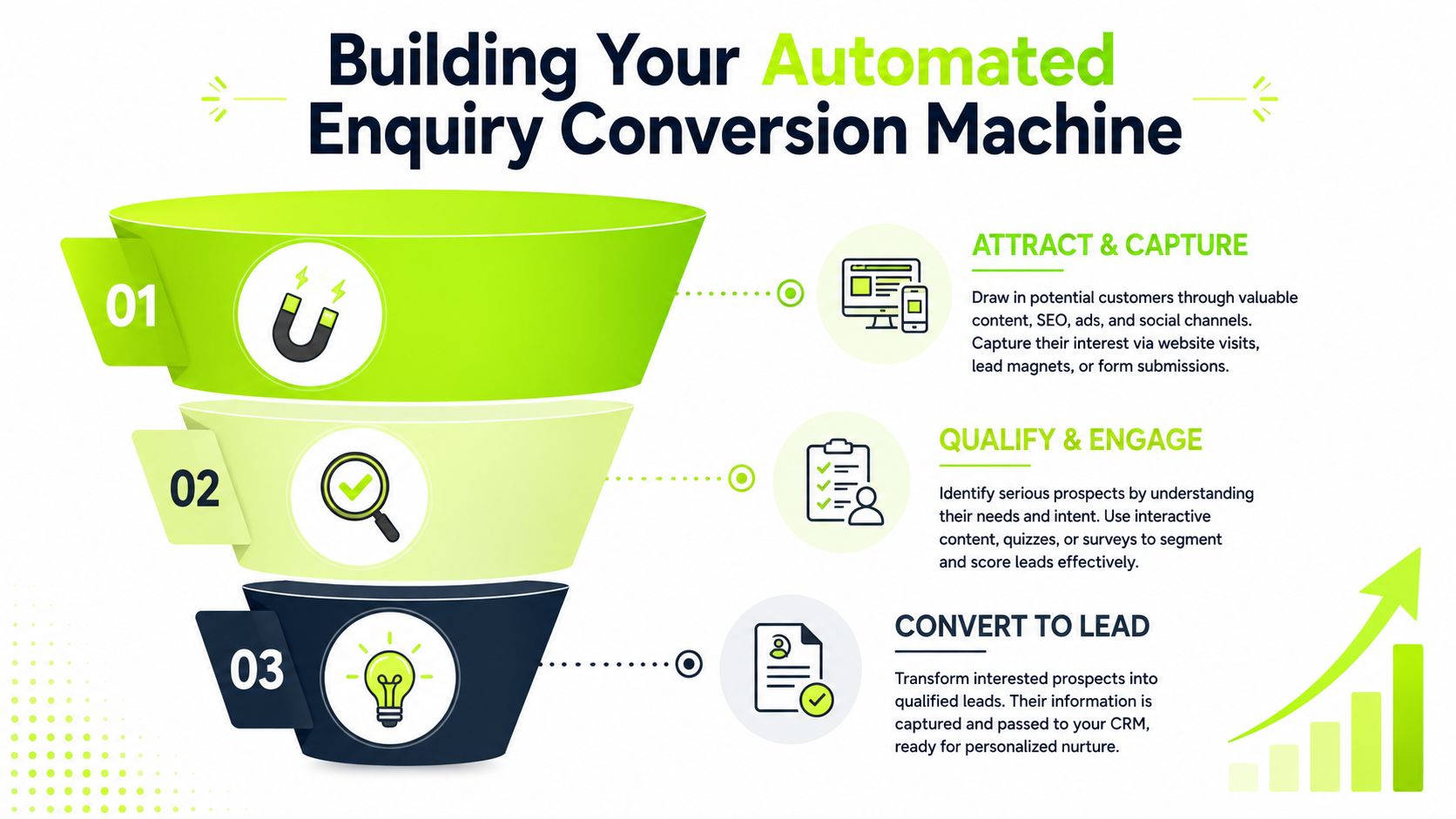
That page should answer simple questions fast:
- Who is this for
- Why consider this club
- What happens next
- How do I book a visit or request information
A strong landing page doesn't try to say everything. It helps the right person take the next step.
The offer should reduce hesitation
Clubs often ask whether they need to discount. Usually, they don't. In a market where adult male golf membership in England reached its highest recorded level at 675,000 in 2023, clubs are competing for a limited local audience, and small improvements in lead handling matter more than broad discounting.
That changes how the offer should work.
Instead of “join now and save”, think in terms of lower-friction next steps:
- Book a tour and coffee
- Play with a member host
- Meet the PGA professional for a short assessment
- Attend a new member welcome evening
These offers don't cheapen membership. They make it easier for a prospect to move from curiosity to conversation.
Automation should start immediately
Most clubs still underperform. A lead fills in a form and then waits for someone to notice.
A better system replies instantly with confirmation, next steps, and a simple route to booking. That can include email, SMS, and calendar booking. It can also include basic qualification questions so the club understands intent before the first conversation.
For clubs exploring conversational tools, this guide on how to generate leads with AI agents is useful background for thinking about automated first-touch engagement without losing control of the club experience.
A practical automated flow often looks like this:
- Immediate confirmation that the enquiry has been received.
- Short follow-up message asking what type of membership interest they have.
- Invitation to book a tour, visit, or trial experience.
- Reminder if no action is taken within the next few days.
- Hand-off to a staff member when the prospect reaches a clear intent stage.
If you're still relying on manual inbox checks, the operational gains from golf club automation are significant.
The first response should happen while the prospect still remembers why they enquired.
Nurturing Qualified Leads into Paying Members
A qualified lead is not a future member yet. It's someone who has shown enough interest to deserve organised follow-up.
That middle stage decides whether the club wins or loses.
Plenty of clubs respond once, send a brochure, then assume the prospect will come back when ready. Most won't. People compare options, get busy, forget details, and delay decisions. If the club disappears during that window, the lead goes cold without ever saying no.
Put every lead inside one visible system
The foundation is a CRM, even if the club starts with a simple setup. Every enquiry should sit in one place with status, notes, source, next action, and ownership.
The wider principle is straightforward. Industry guidance on private club membership points to a clear system: capture all enquiries in a CRM, respond immediately, and use automated nurture flows. Failure at that stage is a primary reason clubs lose prospects before they ever visit.
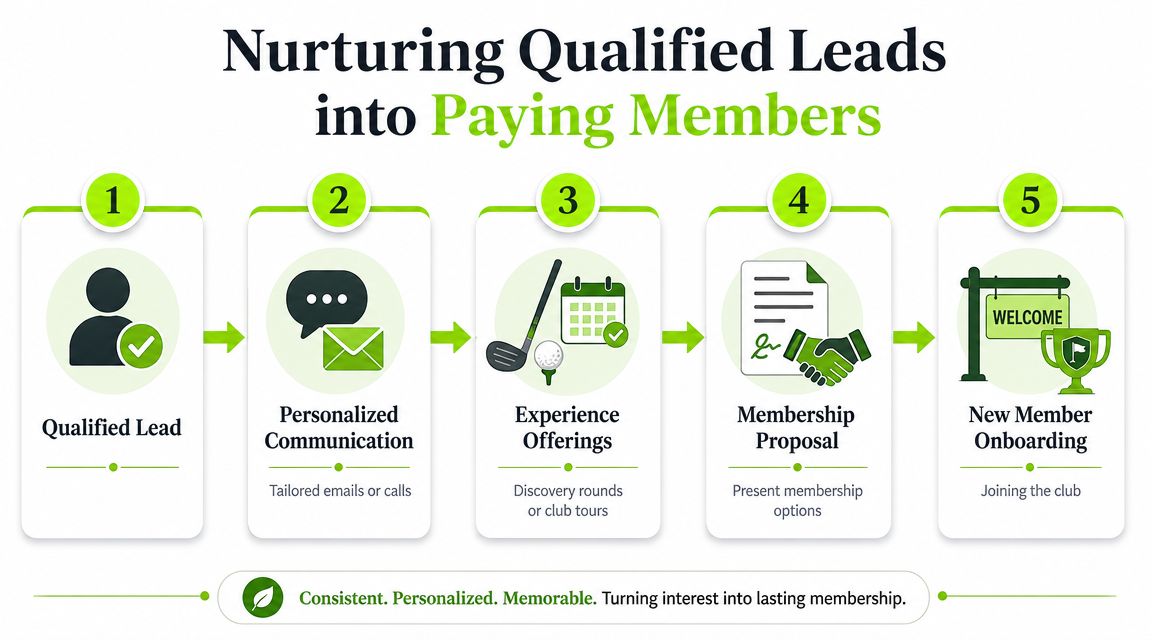
Without that visibility, follow-up becomes patchy. With it, the club can see who needs a message, who has booked, who has gone quiet, and who is ready for a proper membership conversation.
Build a nurture flow that answers real doubts
Most prospects don't need more slogans. They need reassurance.
A good nurture sequence uses a mix of email and text messages over time. Not spam. Not pressure. Useful prompts that answer the questions people are asking themselves.
For example:
- Email one might welcome the lead, confirm next steps, and explain the joining journey clearly.
- Text message follow-up might invite them to pick a convenient time for a visit.
- Email two could show the club experience, including member events, playing opportunities, and what different types of members tend to enjoy.
- Email three might handle practical objections such as time commitment, playing access, beginner confidence, or how introductions are handled.
- Personal outreach should come in when interest strengthens, especially after opens, clicks, replies, or a visit booking.
Good nurture doesn't chase people. It reduces uncertainty until a decision feels easier.
One of the simplest improvements clubs can make is to stop sending generic brochures as the main follow-up asset. A brochure is static. A nurture sequence can adapt to behaviour.
Use behaviour, not guesswork
When a prospect clicks the visit-booking link, replies to a text, or opens the membership guide repeatedly, that's a signal. Staff should see it and respond accordingly.
Many clubs benefit from a documented process, not just goodwill. If the club wants a useful operational benchmark, these lead nurturing best practices align closely with what works in membership sales too.
The key is consistency. Every qualified lead should receive the same standard of follow-up, whether the enquiry came in during a quiet Tuesday morning or after a busy weekend competition.
Measuring What Matters for Predictable Growth
Most clubs track activity that feels reassuring but says very little. Website visits. Social likes. Email opens in isolation. General “interest”.
Those numbers don't tell you whether the membership pipeline is working.
To attract new golf club members consistently, the club needs a small set of operational metrics that expose where prospects move forward and where they stall.
Focus on movement through the pipeline
These are the numbers that matter most:
| Metric | What it tells you | Basic formula |
|---|---|---|
| Cost per enquiry | How efficiently campaigns create initial interest | ad spend divided by number of enquiries |
| Cost per qualified lead | How much it costs to produce prospects worth following up | ad spend divided by number of qualified leads |
| Enquiry-to-visit rate | Whether follow-up is strong enough to turn interest into action | visits booked divided by enquiries |
| Visit-to-member rate | Whether the club experience and sales conversation are doing their job | memberships sold divided by visits |
| Overall acquisition cost | What it really costs to add a member | total sales and marketing cost divided by memberships sold |
These figures don't need to be complicated. They do need to be visible.

If enquiry volume is high but visit bookings are weak, the problem is usually response speed, follow-up quality, or offer clarity. If visits happen but memberships don't, the issue is probably fit, presentation, onboarding, or pricing communication.
Ignore vanity metrics
A campaign can have impressive reach and still produce poor business outcomes. That's why managers need to ask tougher questions than “How many people saw it?”
Ask instead:
- Which lead sources produce booked visits
- Which campaign messages attract serious prospects
- Which staff handovers create delays
- Where do leads drop out most often
- Which membership pathways convert best after a visit
That level of tracking changes decision-making. It stops the club from overvaluing channels that create noise but not members.
If a club can't trace a new member back to the enquiry source, response path, visit, and close process, it can't improve the system with confidence.
Use data to coach the process
Measurement isn't only for budget decisions. It also improves staff behaviour.
When the team can see how many enquiries were contacted, how many booked a visit, and how many are still waiting for a next action, accountability improves naturally. The sales process becomes visible rather than anecdotal.
For clubs that want a broader view of communication workflow, these B2B lead nurturing best practices are useful because the underlying principle is the same. Consistent, relevant contact beats one-off outreach every time.
Predictable growth doesn't come from perfect forecasting. It comes from knowing which stage needs attention this week and fixing it before the leak gets larger.
Your 90-Day Plan to a Predictable Pipeline
Most clubs don't need a total overhaul on day one. They need an organised first quarter with clear decisions, simple tools, and disciplined follow-through.
The objective across ninety days is to replace ad hoc membership handling with a working pipeline.
Month one builds the foundation
Start by cleaning up the basics.
- Define your target member groups based on who the club wants more of, not who happens to enquire.
- Audit every enquiry route including website forms, social forms, email inboxes, phone calls, and front-desk conversations.
- Choose one CRM and make it the single place where leads are recorded and managed.
- Map the stages from new enquiry to joined member so everyone uses the same language.
This month is also where clubs should decide what the primary conversion offer is. Tour, trial experience, assessment, or hosted visit. Keep it simple and clear.
Month two activates the system
Once the foundation exists, launch carefully rather than trying to do everything at once.
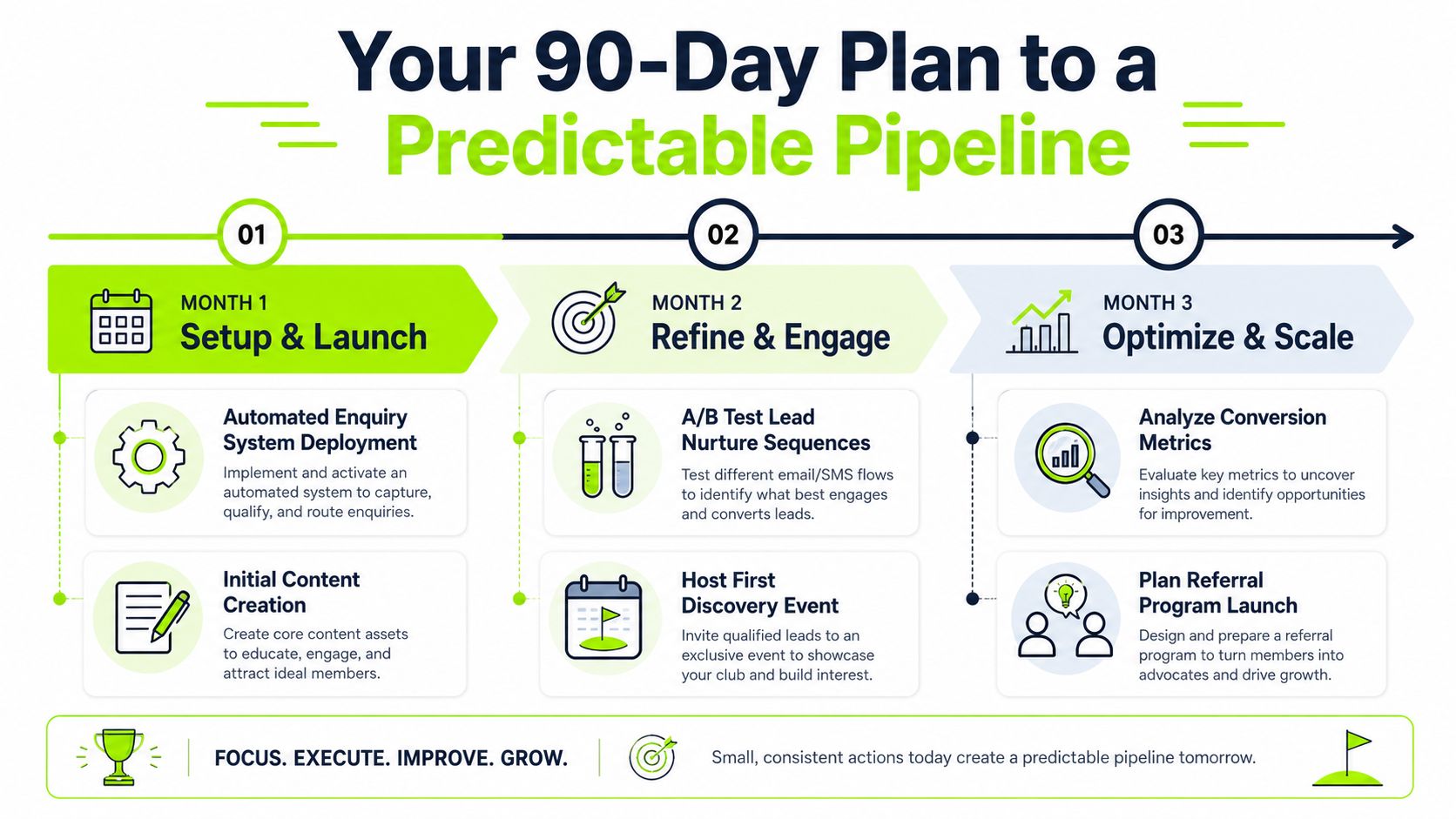
A practical activation month includes:
- Launch one targeted paid campaign focused on a defined local audience.
- Send traffic to a dedicated landing page rather than a general website section.
- Turn on immediate response automation for every enquiry.
- Create a short nurture sequence that supports booking a visit.
- Assign ownership so no lead sits without a next action.
At this point, don't judge success by volume alone. Judge it by whether the system is functioning cleanly.
Month three optimises what's already working
By now, patterns will start to show. Some messages will attract better-fit prospects. Some offers will generate stronger visit intent. Some leads will stall at obvious points.
That's where improvement begins.
Use month three to review:
- Which source creates the best enquiries
- Which follow-up messages prompt replies
- How many leads book visits
- Where staff response slows down
- What prospects ask most often before joining
The strongest clubs don't treat member growth as a campaign. They treat it as an operating system. That's the difference between occasional spikes and a predictable pipeline.
If your current approach to attract new golf club members still depends on manual follow-up, memory, and hope, the next ninety days should focus less on doing more and more on building better.
GolfRep helps UK golf clubs build predictable membership pipelines with targeted lead generation, CRM visibility, and structured follow-up systems that turn enquiries into visits and visits into members. If you want a clearer, more reliable way to grow without leaning on discounts or patchy manual processes, explore GolfRep.
Ready to tap into our proven growth system?