Why Golf Club Leads Don't Convert and How to Fix It

It’s a frustratingly common story in the golf world: the enquiries are coming in, but the membership numbers just aren't budging. The simple reason for this often has very little to do with your marketing or even the quality of the lead itself.
Instead, the problem usually starts the moment after someone expresses interest. We’re talking about slow response times, patchy communication, and a complete lack of tracking that allows genuinely interested people to go cold.
Your 'Leaky Bucket' Is Costing You Members
For many club managers, the default solution is always "we need more leads". The logic seems simple enough: more enquiries should mean more members. But this mindset often papers over a much more significant crack in the foundation.
The real challenge for most clubs isn't generating interest; it’s what you do with that interest once you have it.
Think of your membership pipeline as a bucket. All your marketing efforts are the tap, steadily pouring water (new enquiries) into it. But if that bucket is full of holes, it doesn’t matter how much water you pour in. You’re going to keep losing it. That’s the 'leaky bucket' problem in a nutshell, and it’s costing clubs a fortune in lost revenue.
Where Enquiries Go Cold
These leaks aren't usually catastrophic, one-off failures. They’re small, seemingly minor process gaps that add up. A website form that sits in an inbox for 24 hours. A promised follow-up call that never gets made. Different team members giving out conflicting information.
Each one of these little missteps is another hole in your bucket. Today's prospective member expects a prompt, professional, and organised response. Anything less, and they’re already looking at your competitor down the road.
The core issue is rarely a lack of leads. The true bottleneck in membership growth is almost always a manual, disjointed process that fails to guide a prospect from initial curiosity to a signed-up member. Fixing the follow-up is the first, and most critical, step.
We're about to diagnose exactly where and why these leaks happen. Forget generic marketing theory; this is a practical look at the specific weak points in your club’s conversion process. Once you understand these common pitfalls, you can start building the systems needed for predictable growth. To go deeper, you can also explore our detailed guide on effective golf club growth strategies and see how a systematic approach changes everything.
To give you a clearer picture, let's break down the most common places where that valuable 'water' escapes from your bucket.
The Four Most Common Conversion Leaks in Golf Clubs
Here’s a summary of the critical points where golf clubs lose potential members after the initial enquiry is made. These are the holes you need to plug first.
Recognising these symptoms is the first step. The goal here is to shift your focus from just getting more leads to getting more from the leads you already have.
When you start plugging the holes in your bucket, you turn your marketing spend from an unpredictable cost into a reliable engine for new memberships.
How to Diagnose Your Membership Pipeline Leaks
Trying to figure out why your membership enquiries aren't converting can feel like searching for a leak in an old pipe. The issue is rarely one big, obvious burst; more often, it's a series of small, hidden cracks that, together, drain away your club's potential. Before you can patch anything up, you have to find out exactly where you're losing pressure.
This isn't about getting lost in complex analytics or marketing buzzwords. It’s about taking an honest look at your process from the perspective of a potential member. Think of it as a simple self-audit, designed to uncover the gaps between someone showing interest and them signing on the dotted line.
Start with Response Speed
The first and most crucial place to look is your response time. In a world where we expect instant answers, every minute you delay chips away at your chances. A slow reply doesn't just annoy a prospect; it sends a clear message that your club might not be as organised or attentive as they’d hoped.
To see where you stand, you need to measure it. Get your team to run a quick, revealing test:
- Submit a test enquiry through your website’s contact form.
- Start a timer and see precisely how long it takes to get a personal response back (an auto-reply doesn't count).
- Run this test a few times, especially during evenings and weekends when many people are making enquiries.
If your response time is measured in hours, or worse, days, you’ve just found your first major leak. A prospect’s interest is never higher than in the moment they reach out. Give them too much time, and that initial excitement fades, or worse, they get a call back from your competitor down the road.
Assess Lead Visibility and Tracking
The next common leak happens behind the scenes in how your team manages enquiries. When a new lead comes in, what’s the very next step? If the answer involves a shared spreadsheet, a forwarded email chain, or a notebook behind the desk, you have a visibility problem. These manual methods are where promising leads go to die.
This map breaks down the three most common failure points that cause interested prospects to go cold.
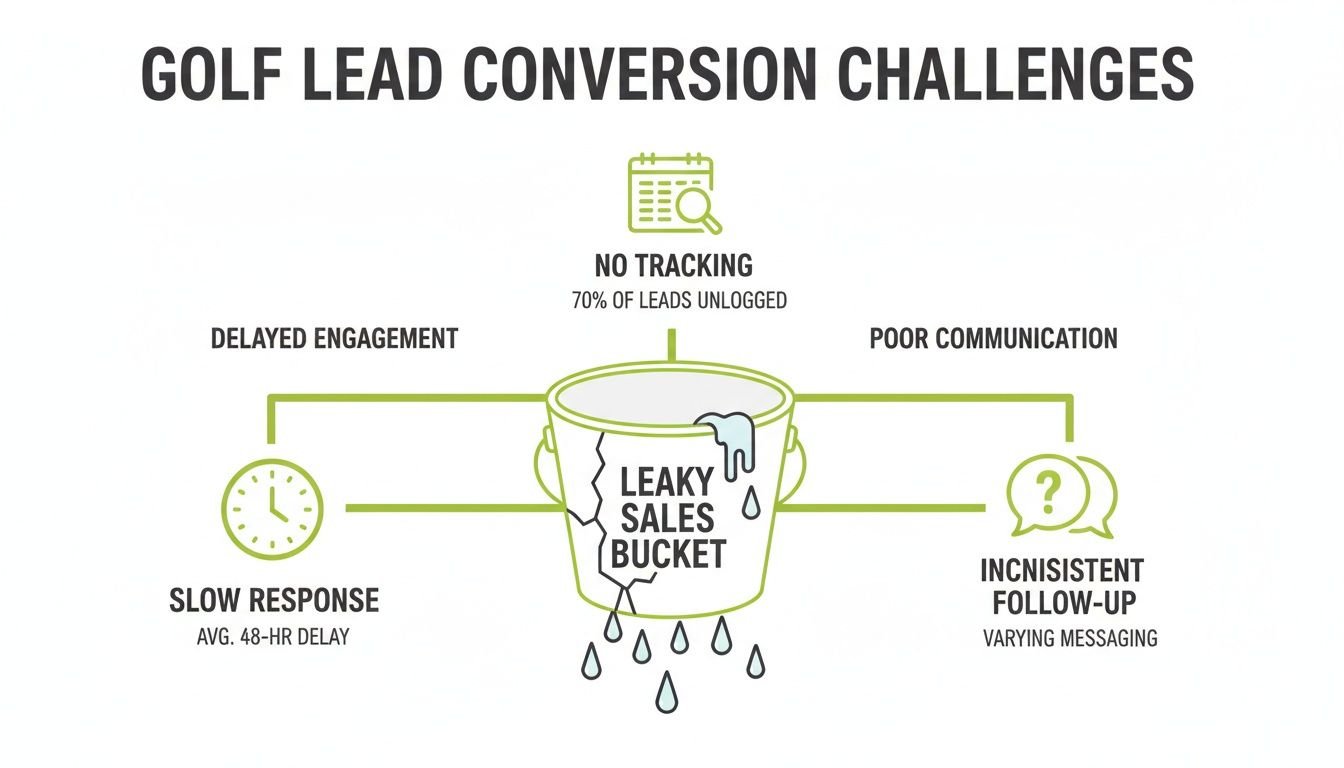
As you can see, slow responses, inconsistent communication, and a lack of proper tracking all feed into this 'leaky bucket' effect, stopping potential members from ever making it through your pipeline.
To test your own system, ask yourself these questions:
- Who owns the lead? Is one person clearly responsible for following up, or is it a free-for-all where everyone thinks someone else is handling it?
- Can anyone see the history? If that prospect calls back a week later, can any staff member instantly see their original enquiry and every conversation since?
- Is follow-up scheduled? Is there a reliable process for making those crucial second, third, and fourth contact attempts?
If you can't give a confident 'yes' to all three, it’s almost certain that good leads are slipping through the cracks. Inconsistent follow-up is a massive reason why golf club leads don't convert.
Without a central system, every conversation starts from zero. A prospect is forced to repeat themselves, different staff members offer conflicting information, and the entire experience feels disjointed and unprofessional. This isn't a staff problem; it's a systems problem.
A disorganised process not only creates a terrible experience for the potential member but also makes it impossible for you to see what’s actually working. You can't improve what you don't track. For a deeper look at how to centralise this data, our guide on implementing a golf CRM system offers a clear framework for clubs of any size.
By taking the time to diagnose these leaks, you shift your focus from just getting more enquiries to actually converting the ones you already have.
The Hidden Costs of Slow Follow-Up and Poor Tracking
Those pipeline leaks we just diagnosed aren't just minor admin headaches. They’re a constant, silent drain on your club’s finances, quietly holding back your growth. A delayed response or a messy follow-up doesn't just annoy a potential member; it actively damages your reputation and sends them straight into the arms of your competition. Every hour that ticks by between an enquiry and a proper response has a real, measurable cost.
This isn’t about being polite; it’s about meeting modern expectations. Today’s consumer, whether buying a car or a golf membership, expects a prompt and professional reply. A slow response signals that your club might be inefficient or disorganised, creating a poor first impression that’s incredibly hard to undo. That initial buzz a prospect feels when they hit 'submit' on your enquiry form quickly fades to apathy, and then to frustration.
The Problem with “Lead Decay”
This rapid drop-off in interest even has a name: lead decay. It’s a simple but brutal concept: the longer you wait to respond, the less likely you are to ever convert that enquiry. The data from other industries is stark, showing that the odds of even making contact with a new lead drop by over 10 times in the first hour. Wait a full day, and that promising enquiry has gone completely cold.
Think about it. That enquiry that landed in your inbox on Friday evening? It's practically worthless by Monday morning. While your team was off for the weekend, that same person has probably already spoken to two other clubs with systems in place to respond instantly.
This is one of the biggest reasons why so many golf club leads go nowhere. Clubs that still rely on someone manually checking an admin inbox are starting every race several laps behind. The prospect has already moved on, had their questions answered, and booked a tour somewhere else, all before you’ve even had the chance to say hello. It has nothing to do with your course or your facilities; it’s purely down to a process that can't keep up.
The Internal Chaos of Poor Visibility
The damage isn't just external. When there’s no central system for tracking enquiries, the internal chaos is something prospects can actually feel. If you’re managing leads through forwarded emails or a shared spreadsheet, you are asking for trouble. A potential member calls back to ask a question, gets a different person on the phone, and has to explain who they are and what they want all over again.
It’s a deeply unprofessional experience. It causes confusion and makes the club look like a mess. We see these all-too-common scenarios play out time and time again:
- Duplicate Contact: Two different staff members call the same prospect on the same day, completely unaware of what the other is doing.
- Contradictory Information: One person quotes the standard joining fee, while another mentions a special offer the first person knew nothing about.
- Lost History: A prospect refers to a conversation they had last week, but the staff member they're talking to now has no record of it and no idea what they're talking about.
Every one of these moments chips away at a prospect's confidence. They start to feel like just another number. These are symptoms of a broken system, not a bad team. Good intentions and hard work can’t make up for the shortfalls of a manual process. Without a proper structure, your team is flying blind, and the prospect’s journey is left entirely to chance. For clubs ready to fix this, the first step is understanding what a solid golf club sales process actually looks like.
Ultimately, the hidden costs are huge. You’re not just losing the lifetime value of a potential member; you're also wasting staff time and marketing budget on enquiries that were doomed from the start because of how they were handled. This is why our entire philosophy at GolfRep is built on a simple truth: robust systems are the only way to turn your marketing spend into predictable, sustainable growth.
Building a System to Convert More Enquiries Into Members
Pinpointing the leaks in your membership pipeline is a great start, but it's only half the battle. Knowing where the problems are is one thing; fixing them for good is another. The real solution is to build a structured, reliable system that ensures every single enquiry is handled with speed, professionalism, and consistency. This is how you move away from guesswork and start building a predictable pipeline of new members.
A truly effective system doesn't need to be complicated. In our experience, it rests on three core pillars that work in harmony to guide someone from a flicker of interest to becoming a fully-fledged member. Get these right, and the common reasons why golf club leads don't convert simply start to melt away.

Pillar 1: Instant Automated Acknowledgements
That very first interaction sets the tone for everything. When someone takes the time to fill out a form on your website, their interest is at its absolute peak. Making them wait hours, or worse, a full day, for a response is a surefire way to lose them to a competitor down the road.
This is where automation becomes your secret weapon. A simple, automated email or SMS message, sent the moment an enquiry lands, achieves two crucial things:
- It meets modern expectations: The prospect gets immediate confirmation that you've received their message. It makes them feel heard and valued right from the off.
- It buys your team time: It takes the pressure off your staff to drop everything and reply instantly. This gives them the breathing room to follow up with a thoughtful, personal message when they're ready.
This first touchpoint isn't about the hard sell. It's about starting a professional conversation and reassuring the prospect they made the right choice in contacting your club.
Pillar 2: A Central CRM for Seamless Lead Tracking
The second pillar brings order to the chaos. Scattered spreadsheets, overflowing inboxes, and scribbled notes are where good leads go to die. A central Customer Relationship Management (CRM) system acts as the single source of truth for every interaction you have with a potential member.
Instead of your team wondering who spoke to whom and when, everyone gets complete visibility. A good CRM, designed for the unique needs of a golf club, lets you:
- Track every lead: See exactly where an enquiry came from, whether it was a website form, a social media campaign, or a phone call.
- View full communication history: Any team member can instantly see all previous emails, calls, and notes for any prospect.
- Schedule follow-ups: Set automated reminders so that crucial follow-up call is never forgotten.
A central CRM transforms your follow-up process from a game of chance into a structured, measurable system. It ensures that no matter who a prospect speaks to, the conversation is always informed, personal, and professional.
This is precisely the kind of system we've built with our partners, including multi-site operators like Macdonald Hotels & Resorts. For a group their size, having a centralised view of enquiries across all venues isn't just a nice-to-have; it's essential for managing their pipeline at scale and delivering a consistent brand experience.
Pillar 3: Structured Communication Sequences
The final pillar is all about nurturing interest over the long haul. Very few people decide to join a golf club after one email. It’s a considered purchase, often taking weeks or even months. A structured communication sequence ensures your club stays top-of-mind throughout that entire decision-making process.
This involves a pre-planned series of automated and manual touchpoints designed to build a relationship and provide value. This isn't about spamming people with sales pitches. It’s about sharing genuinely useful information that helps them make an informed decision.
A typical sequence might look something like this:
- Instant Acknowledgement: An immediate automated email thanking them for their enquiry.
- Personal Follow-Up: A call from a team member within the first hour to answer any initial questions.
- Informative Email: A message sent two days later with details about club life or upcoming social events.
- Tour Invitation: A follow-up a week later inviting them for a personal tour of the facilities.
This systematic approach frees up your team to focus their time on what they do best: having meaningful conversations with engaged prospects. The system handles the repetitive, admin-heavy tasks, bringing predictability and control to your process and ensuring every single lead is given the best possible chance to become a long-term, loyal member.
Attracting the Right People in the First Place
You can have the most finely tuned follow-up process in the world, but it won't matter if you're constantly feeding it the wrong kind of enquiries. We’ve talked about slow responses and poor tracking, but there’s another, quieter reason why good leads go cold: a mismatch between the people your marketing attracts and the reality of your club’s culture.
It's a subtle but powerful disconnect that can silently sabotage your growth.
Think about it. If your marketing paints a picture of a vibrant, modern club, but a prospect arrives for a tour and finds an atmosphere that feels exclusive to a much older generation, that initial spark of excitement dies instantly. The problem isn’t the person who enquired; it’s the chasm between the expectation you created and the experience you delivered.

The Generational Culture Gap
This isn’t just a theory; it's a real, documented challenge across the UK golf industry. Many clubs are working hard to bring in younger members, but they often find that their existing membership can be an unintentional deterrent. This isn't about pointing fingers at long-standing members, but about being honest about social dynamics.
A younger prospect wants to see people like them. They're looking for a community they can genuinely connect with, not one where they’ll feel like an outsider. If they don't see that on their first visit, the enquiry fizzles out, no matter how much they love the course.
The data backs this up. The stubbornly high average age of members is a key barrier for younger people. A recent in-depth survey of 82 UK clubs found that 64% of members are over 50, with men making up 76% of the total. What’s more, this demographic skew has actually increased over the last decade, highlighting a growing challenge for clubs trying to attract new blood. You can find more details on golf club demographics and membership trends in this report.
Aligning Your Marketing with Your Reality
So, what's the answer? It’s not about pretending your club is something it isn't. Authenticity is everything. If your club has a more traditional, mature membership, your marketing needs to reflect that. The messaging, the imagery, and the platforms you use should all be geared towards attracting people who will feel right at home in that environment.
On the other hand, if your goal is to genuinely attract a younger crowd, you have to be ready to build a culture that truly welcomes them. This goes beyond a new coat of paint and might involve:
- More flexible competitions: Moving away from rigid weekend-only formats to suit modern work lives.
- Modern social events: Thinking beyond the traditional club dinner to include more casual, family-friendly get-togethers.
- Updated facilities: Making sure the clubhouse, changing rooms, and practice areas feel fresh and inviting.
Trying to attract a new generation without making real cultural shifts is a surefire way to waste your marketing budget on a pipeline full of people who will never feel like they belong.
The most effective marketing doesn't just get you enquiries; it gets you the right enquiries. It attracts people who are a natural fit for your club's unique character, creating a pipeline of high-value prospects who are far more likely to join and, just as importantly, stay for the long haul.
At GolfRep, our data-led approach starts by getting to the heart of your club's true identity. We don’t use a cookie-cutter strategy. Instead, we build campaigns that speak directly to your ideal member profile, whether that's a seasoned golfer looking for a traditional community or a young professional after a modern, flexible club. This alignment is the bedrock of a predictable, sustainable growth pipeline. It ensures that when someone comes for a tour, the experience they find is exactly the one they were promised.
Your First Steps to a Predictable Membership Pipeline
We’ve talked through the common reasons why good golf club leads fall through the cracks, from sluggish follow-up to a jarring disconnect between your marketing and the actual club experience. Theory is great, but turning those ideas into action is where you'll see real growth. It's time to get practical and start building a more reliable membership pipeline.
The aim here isn't a complete, overnight overhaul. That’s a recipe for chaos. Instead, this is about taking small, deliberate steps to figure out what’s working and, more importantly, what isn’t. Real, lasting change is built on solid foundations, not quick fixes.
This is where the real work starts. To help you get going, we have put together a practical checklist. Think of it as your first diagnostic, a way to get an honest, data-driven picture of where your club stands today.
Your Immediate Action Checklist
Spend some time this week working through these steps to gather some baseline data. This isn’t about pointing fingers; it's about getting the clarity you need to make smart decisions moving forward.
Time Your Response Speed
Get a true measure of your speed. Submit three separate test enquiries through your website at different times, for example, one mid-morning, one in the evening, and one on a Saturday. Meticulously track how long it takes to get a personal response for each one. This gives you a real-world average, not just what you think it is.Map the Prospect Journey
Grab a whiteboard or a big sheet of paper and physically map out every single touchpoint a potential member has with your club. Start from the moment they hit your website and follow their path through every email, phone call, and tour, right up to their final decision. Make a note of every person and department they interact with along the way.Review Your Last Ten Enquiries
Dig into the files for the last ten membership enquiries that went cold. For each one, ask your team: do we know exactly why they didn't join? Was a follow-up call ever made after their tour? The answers, or the lack of them, will shine a spotlight on the gaps in your process.
These first steps give you the clarity to stop guessing and start building. You can't fix a leak you can't see. This audit is your way of finding exactly where the holes are in your pipeline so you can finally start plugging them.
Your Questions Answered
We’ve worked with hundreds of clubs, and over the years, a few common questions always come up when we start talking about lead conversion. Here are some of the most frequent ones, along with some straight-talking answers.
We’re a small club with limited staff. Is a CRM system really necessary?
This is a concern we hear all the time, but it’s often a misconception. A modern CRM isn’t about adding another job to your list; it’s about taking work off your plate. Think of it as an extra team member who never sleeps.
A good system automates all the repetitive, time-consuming tasks like sending that initial "Thanks for your enquiry" email or nudging a prospect who hasn't replied. This frees up your team from being chained to spreadsheets, so they can focus their time on what really matters: having quality conversations with the people most likely to join. The goal is efficiency, not complexity.
We get plenty of enquiries. Why not just focus on getting more leads?
This is the "leaky bucket" problem. This thinking is a trap that many clubs fall into. Pouring more leads into a broken follow-up process is an expensive way to stand still. You end up spending a fortune on marketing just to see most of that interest evaporate.
It’s far better to fix the leaks first. By tightening up your follow-up and tracking, you squeeze the maximum value from every single enquiry you’re already getting. It’s much more profitable to convert 20% of 100 leads than it is to convert 5% of 400 leads. A solid conversion process turns your marketing spend into predictable revenue and creates a proper foundation for growth.
How can we track conversions if people visit the club and sign up in person?
This is exactly why a simple, central system is so crucial. A good CRM will follow a potential member from their very first click on a Facebook ad or website form, right through to their first day at the club.
When a prospect books a tour, that’s logged in their profile. When they come in and sign the paperwork, your staff just needs to make one final click to update their status from 'Lead' to ‘Member’. This simple action is incredibly powerful. It closes the loop, connecting that final, in-person sale all the way back to the marketing campaign that brought them in, giving you a crystal-clear picture of what’s actually working.
At GolfRep, we build the systems that turn enquiries into members. We combine lead generation with the automated follow-up and CRM structures needed to create a predictable growth pipeline for your club. Discover how our Growth System can work for you.
Ready to tap into our proven growth system?