Golf Club Meta Ads That Convert: A Complete Guide 2026

Most advice about golf club Meta ads starts in the wrong place. It starts with audience size, ad formats, and lead volume.
That misses the commercial reality inside most clubs.
A club can generate enquiries and still fail to grow membership if nobody responds quickly, nobody tracks what happened next, and nobody can tell the committee which campaign produced actual members rather than a list of names. Good advertising matters. But for UK clubs, the bigger issue is usually what happens after the form is filled in.
That's why golf club Meta ads should be treated as one part of a wider acquisition system. The ad gets attention. The tracking proves what's working. The follow-up converts interest into booked visits and, ultimately, recurring revenue. Without that, you're not building pipeline. You're collecting admin.
Why Your Golf Club Has a Conversion Problem Not a Lead Problem
The common assumption is simple. If membership is soft, the club needs more leads.
In practice, many clubs already receive enough interest to grow. What they lack is a reliable way to handle that interest before it cools. For UK golf clubs, the average response time to membership enquiries is 47 hours and 32 minutes, and that delay can produce a 0% conversion rate across entire pipelines because the prospect has already joined another club (GolfRep research on golf club response times).
That number should change how you look at golf club Meta ads. If your process takes nearly two days to reply, buying more traffic won't solve the underlying problem. It will just expose it.
Manual follow-up breaks under pressure
Most clubs don't ignore enquiries on purpose. The breakdown usually comes from ordinary operational pressure.
- The office gets busy: Staff are dealing with visitors, member calls, functions, and daily administration.
- The enquiry lands at the wrong time: A form arrives on Friday evening and sits untouched until Monday.
- No one owns the pipeline: Marketing generates the lead, but nobody has a defined process for the next step.
When that happens, the prospect doesn't wait. They enquire elsewhere, book a visit elsewhere, and join elsewhere.
Practical rule: If a club can't see how quickly each enquiry was answered, it can't see where membership revenue is being lost.
Ads only work when the system behind them works
A serious Meta campaign needs more than creative and budget. It needs visibility from click to sale. That's where proper measurement matters, especially if you want committee confidence rather than another argument about whether “Facebook works”.
A useful technical reference for this is GA4 and Meta CAPI implementation, which explains how tracking can connect ad activity with what occurs on your website and inside your lead flow.
This lesson is straightforward. Your club probably doesn't have a pure lead problem. It has a speed, process, and visibility problem. Solve those first, and Meta ads stop being a gamble. They become a dependable source of qualified membership demand.
Establishing Your Campaign Strategy Before You Spend a Penny
Clubs often rush into ads because a committee meeting ends with the same instruction: “Let's put some money behind Facebook and see what happens.”
That approach creates activity, not strategy. If you want golf club Meta ads to produce predictable results, you need one commercial objective, one clear audience, and one measurable route from enquiry to member.
The opportunity is there. The UK golf club market grew from USD 123.79 million in 2018 to USD 149.01 million in 2024 and is projected to reach USD 196.93 million by 2032, with a CAGR of 3.55% according to Credence Research on the UK golf club market. Clubs that invest with discipline are operating in a growing market. Clubs that boost posts without a plan are just spending into it.
A fuller explanation of why this channel works for membership acquisition sits in this related guide on why Meta ads work so well for golf club membership campaigns.
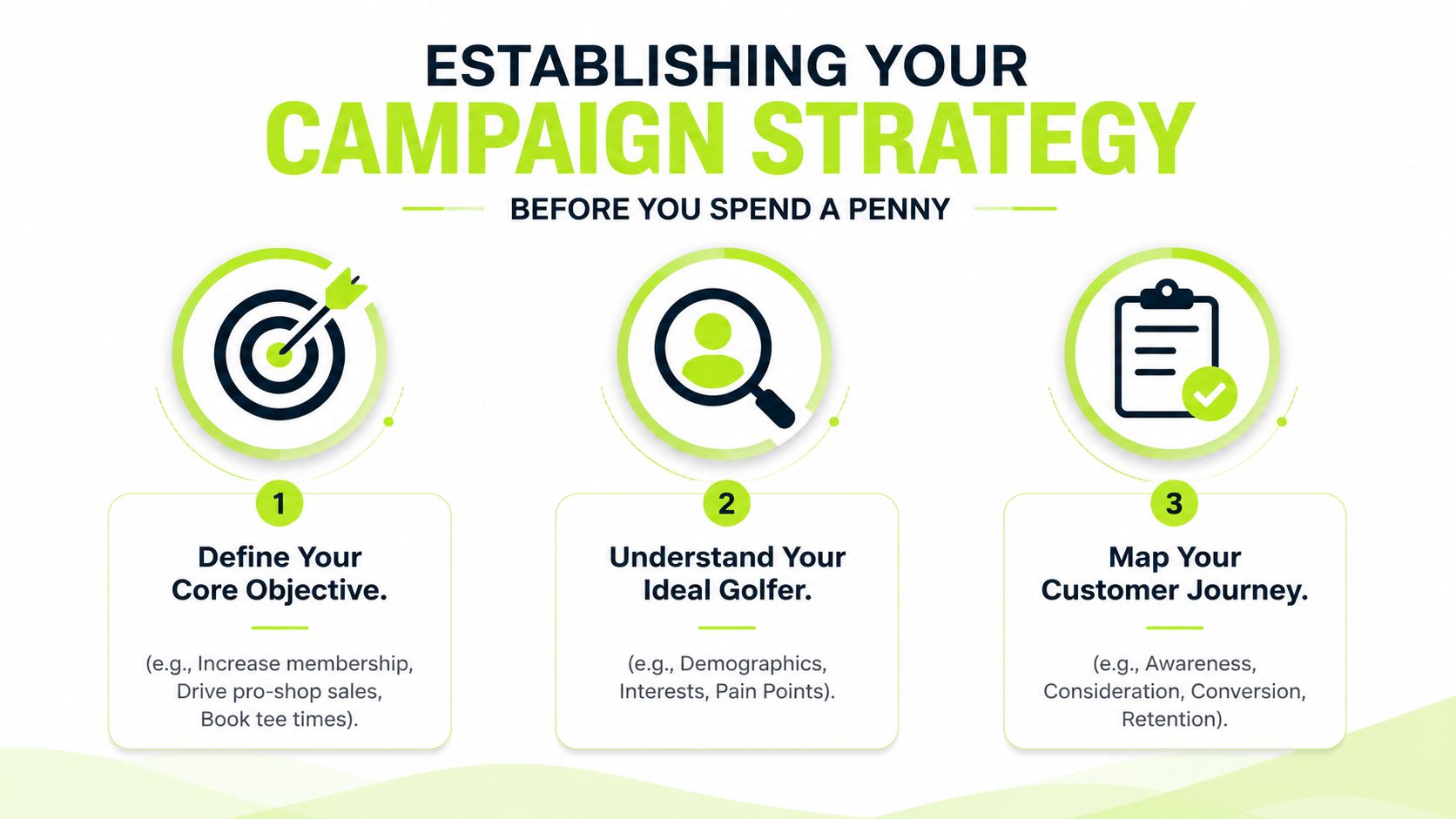
Start with the business outcome
The first question isn't “how many clicks can we get?” It's “what kind of member are we trying to acquire?”
A club looking to fill a limited number of premium membership places should run a very different campaign from a club focused on rebuilding volume. The message, offer structure, landing page, and follow-up all change once that commercial aim is fixed.
Use this simple filter before any ads go live:
| Decision area | What to define |
|---|---|
| Primary objective | Membership enquiries that fit your club's ideal profile |
| Commercial measure | Cost per member acquired, not cost per click |
| Sales milestone | Enquiry, booked visit, application, join |
If the club can't agree those basics internally, the campaign isn't ready.
Build around one journey, not five
A common mistake is asking one campaign to do too much. Clubs try to promote membership, societies, green fees, events, and the pro shop in the same burst of spend.
That confuses the audience and muddies the reporting. A membership campaign should send people into a dedicated path built for membership enquiries and follow-up. Keep the journey clean.
The strongest campaigns usually feel narrow. One audience. One offer. One next step.
Plan for committee reality
In many clubs, the ad account isn't the bottleneck. Approval is.
Creative gets delayed. Budget gets trimmed. Landing pages get debated line by line. That's normal in committee-led environments, so the strategy has to be simple enough to survive that process. The more complicated the campaign, the slower the launch and the weaker the execution.
A practical planning checklist looks like this:
Decide the membership category first
If you're promoting a specific intake, say so clearly.Agree the enquiry route
Choose one form, one page, and one internal owner.Set the reporting standard
Review booked visits and members gained, not just leads generated.
Clubs that do this before launch usually make better decisions later. They can see what they're buying, why they're buying it, and whether it's turning into revenue.
Targeting High-Value Golfers in Your Local Area
One of the fastest ways to waste money on golf club Meta ads is to target “people interested in golf” and leave it there.
That audience is usually too broad to be commercially useful. It includes casual followers, holiday golfers, equipment browsers, and people well outside realistic travelling distance. A private member club doesn't need more vague awareness. It needs local, high-intent attention from golfers who could join.
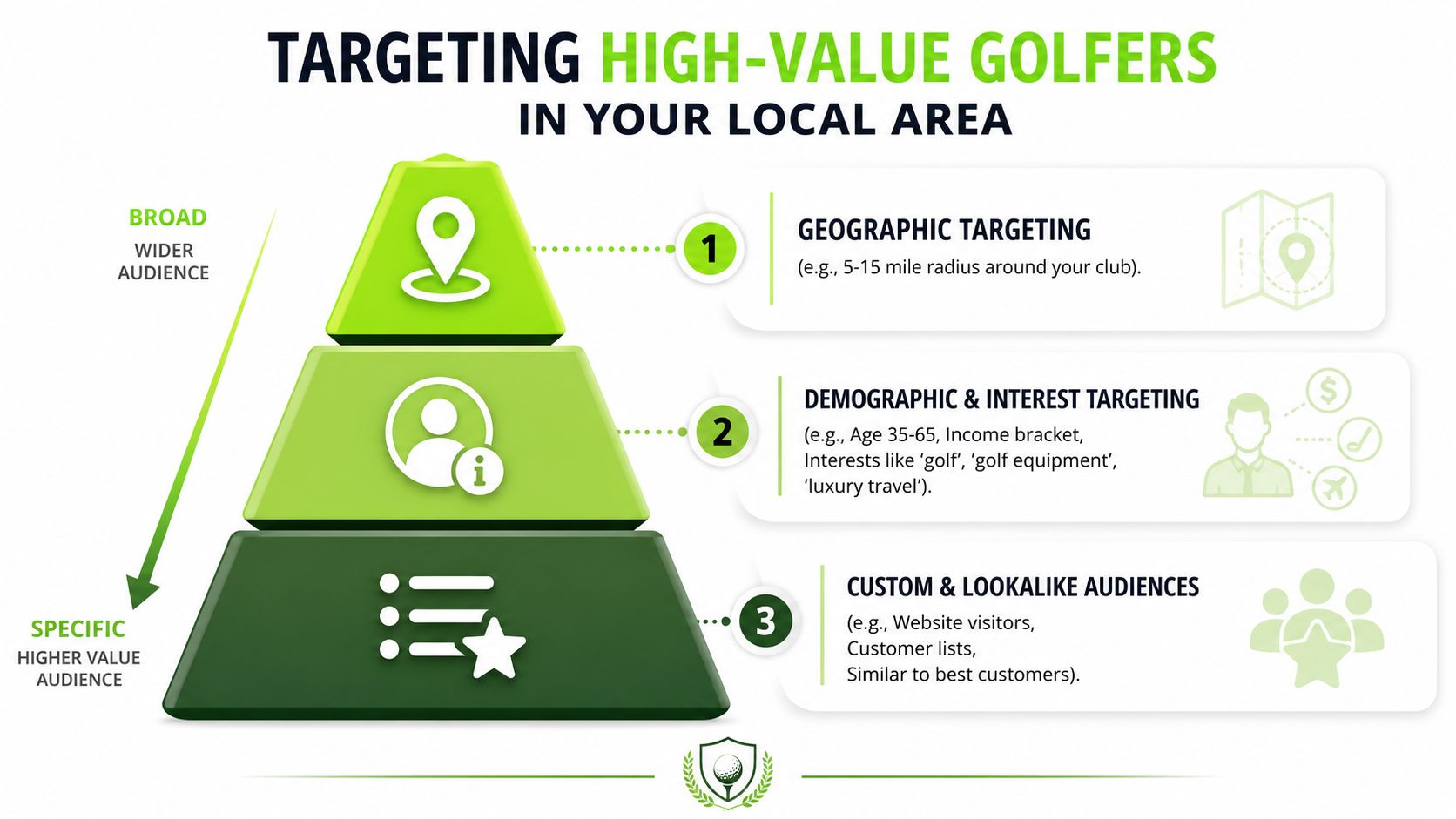
The mechanics are straightforward. ProfileTree's guidance on digital marketing strategies for UK golf clubs highlights three essentials for strong Meta performance in this space: Look-alike Audiences built from existing member profiles, interest targeting around equipment brands and competitor clubs, and a geographic radius based on practical travel distance. The same source notes that over 60% of golf-related searches in the UK occur on phones, which means targeting and landing page experience must both be built with mobile use in mind.
Start with travel reality
The first layer is geography. Not broad county targeting. Not “let's cover the whole region.” Practical travel distance.
A golfer might admire your course from afar and still never become a member because the drive doesn't work for weekday play, winter golf, or family routine. Clubs should target the catchment they can realistically serve.
Ask a blunt question: would this person drive to the club on a Wednesday afternoon in poor weather, not just on a sunny open day? If the answer is no, they shouldn't sit in the core audience.
Refine with signals of quality and intent
Once geography is right, interest targeting helps sharpen the audience. It is here that many clubs either overcomplicate things or stay too generic.
Useful signals include:
- Equipment and brand affinity: Golfers engaging with recognised equipment brands often show more active involvement in the game.
- Competitor club interest: People following nearby clubs may already be comparing options.
- Lifestyle fit: Premium clubs should speak to golfers who value experience, convenience, and standards, not only price.
This doesn't mean building dozens of tiny audiences on day one. It means starting with a sensible structure that reflects how real golfers choose clubs.
Use your member data properly
The strongest targeting tool is often the data you already hold. A member email list can help Meta build a Lookalike Audience that resembles your existing base. For a club manager, the plain-English version is simple: you give Meta a seed audience of current members, and the platform looks for similar people.
Don't ask Meta to find “golfers”. Ask it to find more people who resemble your best members.
That's a major difference.
Design for the phone first
Because so much golf-related browsing happens on mobile, the ad and the destination need to work on a small screen. If the form is clumsy, the page is slow, or the button sits halfway down a dense block of text, good targeting won't save the campaign.
A practical mobile checklist:
| Element | What good looks like |
|---|---|
| Headline | Clear in one glance |
| Image or video | Recognisable club identity, not generic stock |
| Landing page | Fast, simple, and easy to complete on mobile |
| Form | Short enough to finish without friction |
Targeting should make the campaign smaller, not bigger. That's usually how membership campaigns improve.
Designing Ad Creative and Copy That Sells Memberships Not Discounts
Many golf club ads fail before the audience has even considered the offer. The problem isn't always the targeting. It's the message.
A typical weak ad shows a stock-style image of a golfer, adds a vague line about joining now, and then leans on a discount to create urgency. That might generate curiosity, but it rarely attracts the kind of member a club aims to attract. Discount-led creative often pulls the conversation towards price when the club should be selling quality, fit, and experience.
That matters even more in the current market. In 2025, the average green fee at a Top 100 course in the UK reached £237, up 10.7% from the previous year, according to UK Golf Guy's review of 2025 summer green fees. Serious golfers are showing they'll pay for quality. Your ad should reflect that.
For clubs wanting ideas on platform-specific setup and campaign structure, this overview of golf club Facebook ads is a useful companion.
Show the club, not a fantasy version of golf
The best-performing membership creative usually feels local and recognisable. Real fairways. Real clubhouse spaces. Real practice areas. Real members, with permission, if the imagery fits the brand.
That does two things. First, it helps the right prospect picture themselves at your club. Second, it filters out people who were never a fit in the first place.
A premium course should look premium. A welcoming community club should feel warm and approachable. The creative has to match the membership experience people will meet when they visit.
Write copy that sells the outcome
Membership copy works better when it speaks to what the golfer gets, not just what the club has.
Compare these two approaches.
| Weak angle | Stronger angle |
|---|---|
| Join now for a special offer | Explore membership at a club built for regular play and long-term value |
| Great course, great clubhouse | Book a visit and see whether the course, facilities, and membership culture fit the way you play |
| Limited spaces available | Applications now open for golfers looking for a better home club |
The second column doesn't rely on cheap urgency. It speaks to standards, suitability, and commitment.
A strong membership ad should make the right golfer feel invited and the wrong golfer feel neutral.
Video can help if it stays authentic
Short video often outperforms static imagery when it captures movement and atmosphere properly. A calm walk up the opening hole, a glimpse of the practice ground, a member competition day, or a simple talking-head invitation from the club manager can all work.
If a club needs to produce variations quickly, tools for fast AI video ad generation can help turn existing assets into usable campaign creative without organising a full production shoot. The key is restraint. The output still needs to feel like your club, not like a generic template.
A practical ad formula is simple:
- Lead with place: show the course or clubhouse clearly
- State the membership opportunity: not a vague awareness line
- Offer one next step: enquire, book a visit, or request details
Creative that protects the club's positioning usually attracts better conversations later. That's the point.
The Technical Backbone for Tracking Real ROI
A lot of clubs run Meta ads with one serious handicap. They can't tell which enquiries became booked visits, and they definitely can't show which campaign produced paying members.
That makes every review meeting harder than it needs to be. One person points to leads. Another points to spend. Somebody asks whether any of it worked. Without tracking, nobody has a clean answer.
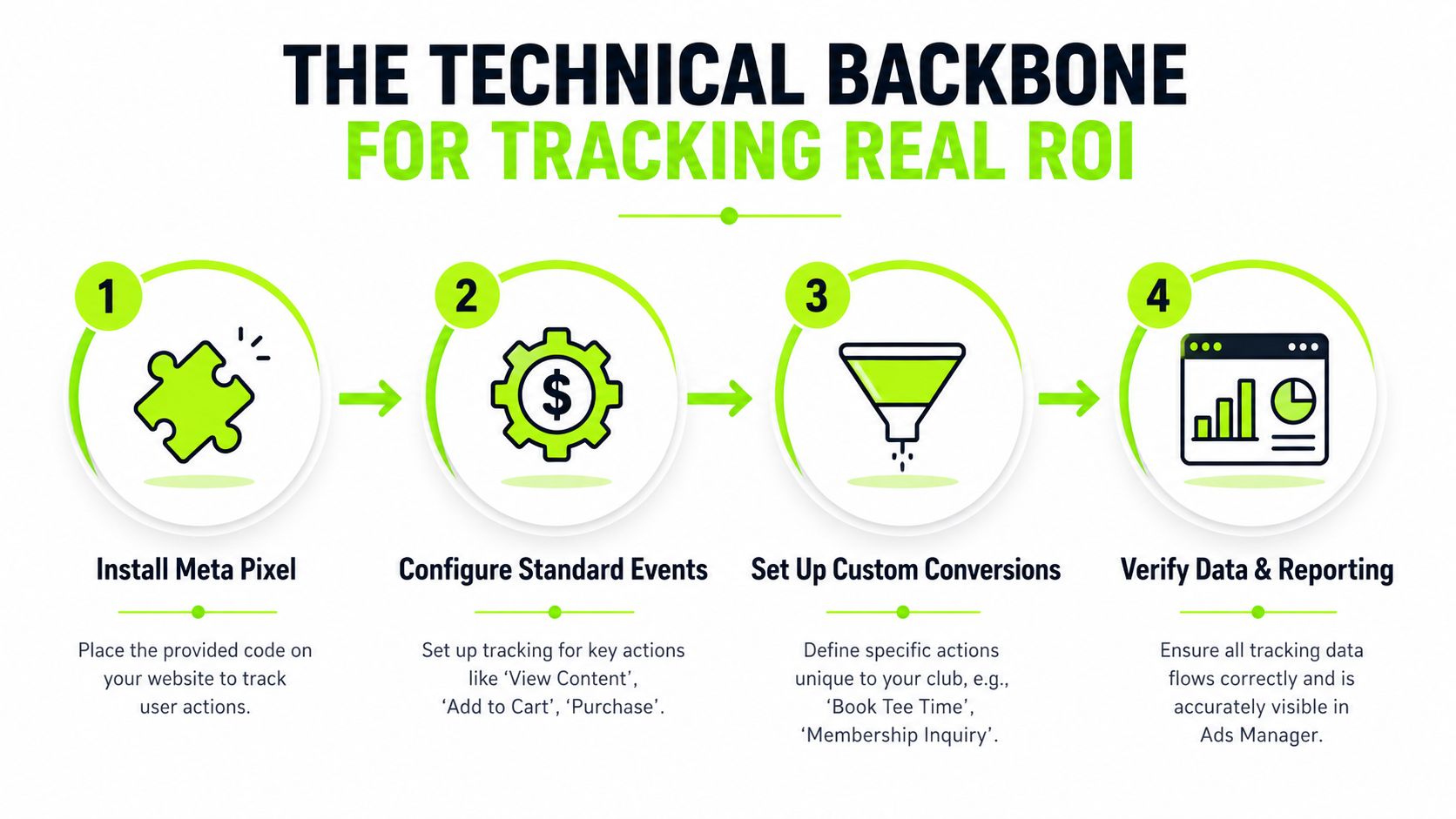
The technical baseline is not optional. GolfRep's guide to golf club marketing ROI is clear on this point: the right methodology requires installing the Facebook Pixel and using unique tracking URLs for campaign-level attribution so the club can isolate source-to-sale conversion rate and measure cost per member acquired, not just cost per enquiry.
If you want a clearer view of how enquiry visibility fits into this process, this article on golf club enquiry tracking adds useful context.
What the setup needs to do
In plain English, your tracking setup should answer four questions:
- Which ad produced the enquiry
- Whether that enquiry booked a visit
- Whether the visit turned into membership
- What it cost to acquire that member
If your reporting stops at “we got leads”, you're still too close to the top of the funnel.
Keep the attribution clean
Clarity is often lost by many clubs. They run multiple ads, send traffic to the same page, and collect enquiries through forms that don't distinguish one campaign from another.
A better setup uses:
- The Meta Pixel: to record activity on the website
- Unique tracking URLs: to separate campaigns properly
- Defined conversion points: such as membership enquiry and booked visit
- Consistent naming: so reports stay readable for staff and committee members
Tracking should reduce arguments, not create more of them.
For clubs using lead forms or external form tools, this guide on how to send conversions to Facebook Meta is a helpful reference for understanding how conversion data can be passed back into Meta more reliably.
Report commercial movement, not platform noise
The biggest technical mistake isn't usually a broken pixel. It's weak reporting discipline.
A club can have the tracking installed and still focus on the wrong numbers. Impressions, clicks, and form fills have their place, but they don't prove return on investment. Booked visits, applications, and members do.
A simple reporting view should separate metrics like this:
| Category | Useful for | Not enough on its own |
|---|---|---|
| Reach and clicks | Diagnosing ad delivery | Proving commercial success |
| Enquiries | Measuring response volume | Measuring revenue |
| Booked visits and joins | Assessing pipeline quality | None. This is the real test |
Good tracking turns Meta from a channel you hope is working into a channel you can defend with evidence.
Building a System That Converts Leads While You Sleep
The hidden failure point in golf club Meta ads is rarely the ad itself. It's the gap between the enquiry arriving and the club responding with enough speed and structure to move that person forward.
That gap is where revenue leaks out.
Much of the existing advice on this topic still treats the journey as if the job is done once the form is submitted. It isn't. GolfRep's analysis of golf club Meta ads identifies the underlying problem: clubs often generate leads and then lose 50%+ of those enquiries due to slow response times, which creates a hidden revenue leak that better ad copy alone won't fix.
The problem with manual follow-up
Manual follow-up sounds sensible until real life gets involved.
A membership enquiry comes in at lunch. The secretary is tied up. The general manager means to ring later. A committee member wants to approve the wording of the reply. The prospect receives a delayed email with a PDF attached and no clear invitation to visit.
Nothing in that sequence is unusual. That's why it happens so often.
The challenge isn't staff effort. It's that human follow-up is inconsistent by nature when the process depends on memory, spare time, and inbox discipline.
What a working post-enquiry system looks like
A proper system does the early work immediately.
When someone enquires, the club should be able to:
- Acknowledge the enquiry straight away
- Deliver relevant information without delay
- Ask qualifying questions where appropriate
- Offer a clear route to book a visit or call
- Log every action inside a CRM
That doesn't replace your team. It protects their time.
Instead of chasing every cold lead manually, staff can focus on warm conversations with people who have engaged, replied, or booked. That's a very different workload from downloading a form submission and hoping someone remembers to call.
The best automation doesn't feel robotic. It feels organised.
Why speed matters operationally
Speed isn't just a sales idea. It's a service signal.
A golfer who enquires about membership is already assessing the club. A slow, vague, or inconsistent response tells them something about how the place is run. A fast, structured response gives confidence before they've even set foot on site.
That's especially important for clubs trying to justify premium pricing or attract members from nearby competitors. The follow-up process becomes part of the product.
Connect Meta, CRM, and nurture into one flow
Here, clubs usually see the biggest shift in performance. Not from changing one headline, but from connecting the pieces.
A healthy acquisition flow looks like this:
| Stage | What should happen |
|---|---|
| Ad click | Prospect sees a relevant membership message |
| Enquiry | Details are captured cleanly |
| Immediate response | Automated acknowledgement and next-step prompt |
| Nurture | Timely messages keep the prospect engaged |
| Booked visit | Staff step in for high-value conversation |
| Outcome tracking | CRM records whether the lead joined |
Once that system is in place, golf club Meta ads stop acting like isolated campaigns. They become the front end of a repeatable membership pipeline.
Automation fixes the handoff
The clubs that handle leads best don't necessarily have more staff. They usually have better handoffs.
The ad hands the lead to the form. The form hands the lead to automation. Automation hands the warmed prospect to staff. The CRM records every stage so nobody is guessing.
That's the missing link in most conversations about golf club Meta ads. You don't need more names in a spreadsheet. You need a system that responds, qualifies, nurtures, and shows the club what happened next.
Measuring for Members and Optimising for Growth
A club manager shouldn't need to be a media buyer to judge campaign performance properly. But they do need to look at the report through a commercial lens.
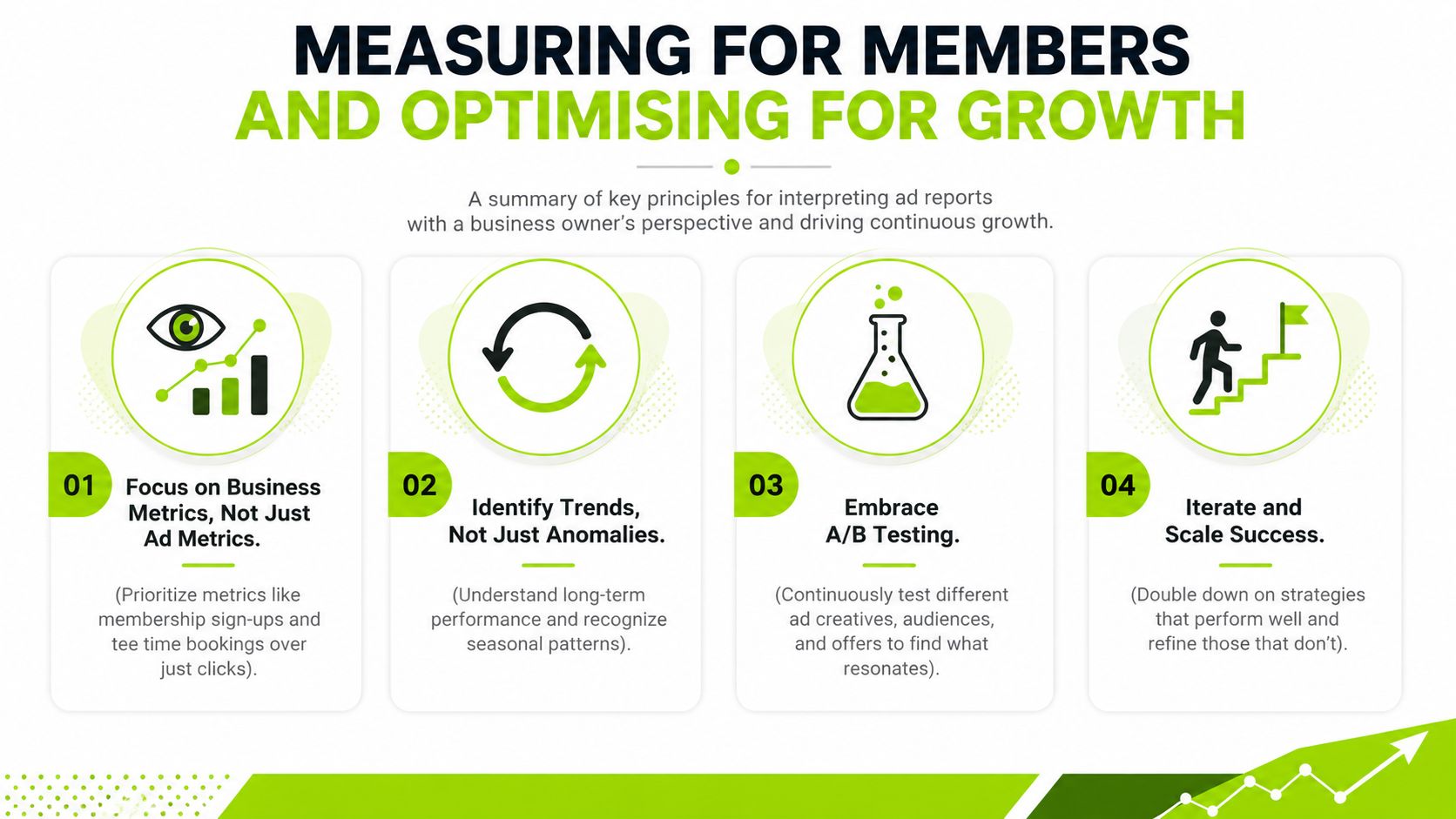
That means moving past vanity metrics. Reach can look impressive. Clicks can look busy. Lead volume can create optimism. None of those tells you whether the campaign produced members at an acceptable acquisition cost.
Many golf club Meta ads drift off course. As noted in Kingfisher Ads' discussion of Meta ad strategies, much of the advice in the market still leans on broad “golf lovers” targeting and weak measurement. That leaves clubs blind to the key number that matters, which is true cost per member rather than cost per enquiry. The more useful approach is often hyper-local, trigger-based targeting measured correctly.
Read the report in the right order
When reviewing campaign performance, use a bottom-up lens rather than a top-down one.
Start with the question that matters most. Did members join? Then work backwards.
A sensible review order looks like this:
- Members acquired
- Booked visits
- Qualified enquiries
- Ad spend and source
- Creative and audience performance
That sequence keeps the discussion anchored to business results. It also helps stop meetings being hijacked by surface-level platform numbers.
Separate signal from noise
Not every campaign needs endless complexity. But every campaign does need clarity on which metrics are diagnostic and which are decisive.
| Metric type | Role in decision-making |
|---|---|
| Impressions and click-throughs | Useful for spotting weak ads or audience mismatch |
| Enquiry volume | Useful for checking lead flow |
| Booked visits | Strong signal of lead quality and follow-up effectiveness |
| Cost per member acquired | Core measure of commercial success |
If your reporting never gets below the enquiry line, the club still doesn't know enough.
Broad targeting often flatters early metrics and weakens final conversion. Local intent usually tells the truth faster.
Optimise methodically
Too many clubs make reactive changes. One quiet week and they rewrite the whole campaign. One busy spell and they assume everything is solved.
A better approach is controlled testing. Change one variable at a time and keep the rest stable long enough to learn.
Good tests usually involve:
- Creative angle: premium course quality versus community and belonging
- Audience structure: member lookalikes versus competitor-interest segments
- Timing: active membership windows versus always-on general promotion
- Call to action: enquire for details versus book a visit
The point of testing isn't to create constant churn. It's to identify what repeatedly leads to booked visits and membership decisions.
Use performance to guide budget
Once a club knows which audience, message, and timing combination produces actual members, budget decisions become easier. Spend can move towards what works rather than being spread evenly to satisfy internal preference.
That matters in clubs where every marketing decision needs justification. Data-led optimisation gives management and committees a shared reference point. It moves the discussion away from opinion and towards visible pipeline performance.
Golf club Meta ads are worth doing when they're measured like a growth channel, not a noticeboard. If you optimise for members, the platform becomes far more useful. If you optimise for attention alone, it stays noisy.
If your club wants a clearer view of what's working from first click through to booked visit and membership revenue, GolfRep helps UK golf clubs build that full system. The focus isn't just on generating enquiries. It's on tracking them, responding properly, and turning them into a predictable pipeline.
Ready to tap into our proven growth system?