Unlock Golf Club Marketing ROI in 2026

Most advice about golf club marketing ROI starts in the wrong place. It assumes the club needs more enquiries.
Often, it doesn't.
Many clubs already generate enough interest to grow. The problem often resides between the first enquiry and the final membership decision. Leads arrive through a form, a Facebook ad, a call, or a website visit, then disappear into an inbox, a spreadsheet, or a staff handover that nobody owns properly. That isn't a marketing issue alone. It's an operational issue that directly shapes revenue.
Beyond Enquiries The Real Meaning of Golf Club Marketing ROI
Golf club marketing ROI isn't just a report on ad spend. It's a measure of how efficiently a club turns demand into recurring membership revenue.
That sounds obvious, but in practice many clubs still judge marketing by surface signals. They look at clicks, likes, website traffic, and general awareness. Those things can be useful indicators, but they don't answer the only question that matters. Did the club gain the right members at a profitable cost, and did the process work reliably enough to repeat?

The clearest way to think about this is the leaky bucket. If your club pours more budget into lead generation while response handling stays inconsistent, you're not fixing growth. You're paying to lose opportunities faster.
Why small conversion gains matter
The UK golf club market includes about 1,875 clubs and around 1.17 million affiliated golfers, and female affiliated golfers reached 19.6% in 2024, up from 16.4% in 2017, which means the audience is changing and clubs can't rely on one traditional member profile any longer, as outlined in this analysis of ROI in golf marketing for UK clubs.
In a finite local catchment, even a modest improvement in enquiry handling can change outcomes materially. Not because marketing suddenly became magical, but because fewer interested people fall through the cracks.
Practical rule: If a club can't see where enquiries came from, who followed them up, and what happened next, it can't calculate ROI with confidence.
What ROI looks like in the real world
A useful definition is simple. Return on investment equals the value of members gained and retained, compared with the cost required to acquire them.
That means proper ROI sits across the full pipeline:
- Enquiry capture: Did the campaign attract the right people?
- Lead visibility: Did staff see every enquiry in one place?
- Follow-up discipline: Did someone respond quickly and consistently?
- Sales conversion: Did the lead book a visit, trial, or conversation?
- Member quality: Did the club attract people likely to stay, spend, and fit the club?
When clubs focus only on the top of funnel, they confuse activity with performance. Predictable growth doesn't come from creative campaigns alone. It comes from systems that connect marketing, sales process, and member onboarding without gaps.
How to Connect Marketing Spend to Membership Revenue
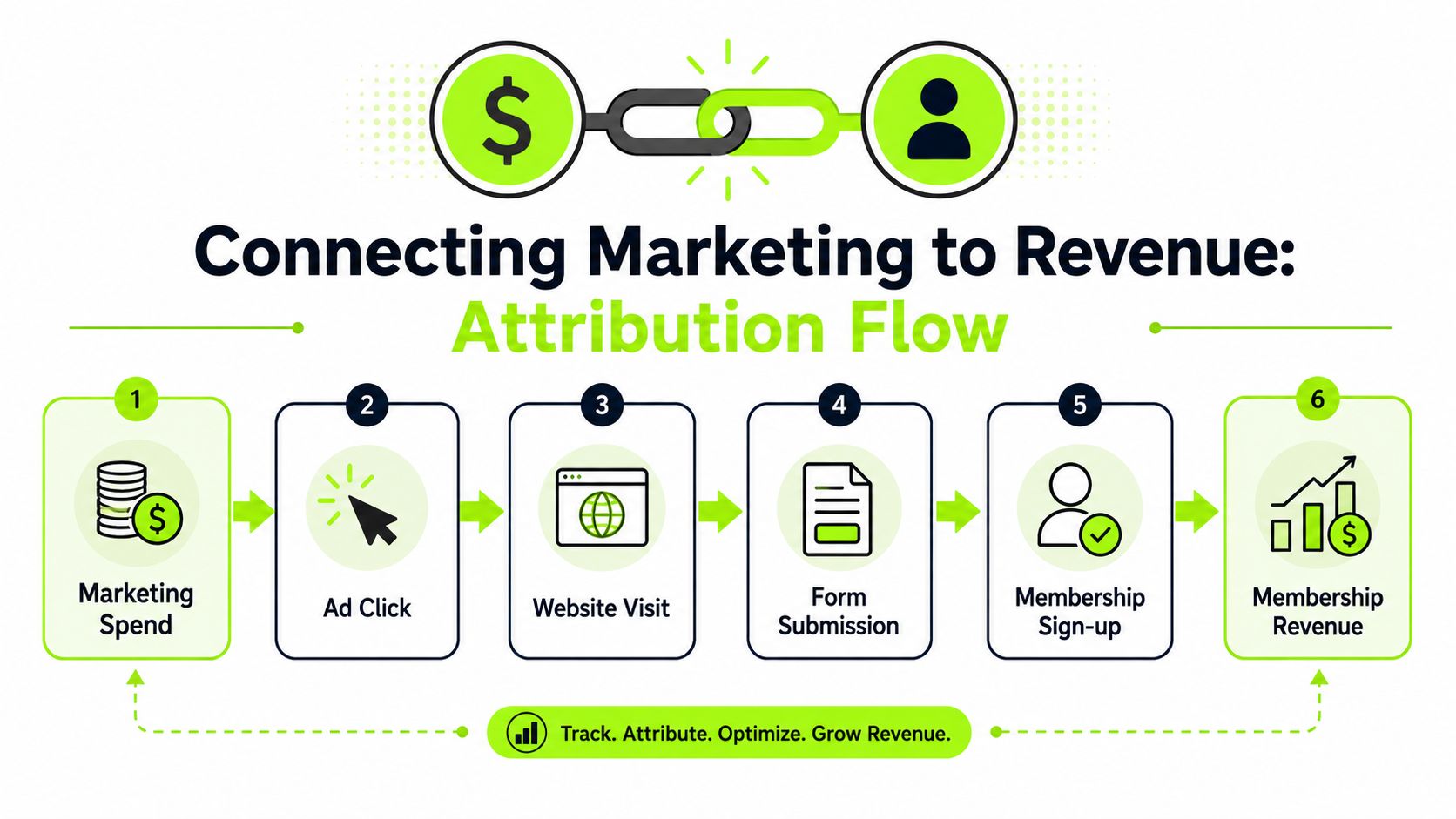
A club should be able to answer a basic question without guesswork. Which campaign produced which memberships?
If that answer relies on memory, email searches, or someone saying "I think they came from Facebook", the data isn't strong enough to judge spend. Proper attribution gives each campaign its own trail and follows that trail all the way to revenue.
What attribution actually means
Attribution isn't technical jargon for analysts. It's just a method for connecting a marketing action to a real outcome.
For golf clubs, true ROI measurement requires campaign-level attribution, using unique tracking URLs, ad-specific promo codes in the booking engine, and call-tracking numbers so the club can isolate which channel generated a booked tee time or membership enquiry, as explained in this guide to measuring golf marketing ROI.
A simple example helps. If you run one paid search campaign for membership, one paid social campaign for visitor golf, and one print advert for society bookings, each should have its own tracking path. Otherwise all three channels blur together and the club starts giving credit to the wrong activity.
Vanity metrics versus revenue metrics
Website visits matter less than what happens after the visit.
A post that gets attention but produces poor-fit leads can look successful while delivering weak commercial results. A quieter campaign can outperform it if the follow-up is tighter and the lead quality is better.
Clubs usually need to shift reporting away from broad engagement and towards commercial movement:
- Cost per enquiry: What did it cost to generate initial interest?
- Cost per booked visit or tour: Did the enquiry progress?
- Cost per member acquired: What did the club pay for a signed member?
- Time to follow-up: How long did the lead wait?
- Source-to-sale conversion: Which channel produces members, not just leads?
The moment a lead enters the club's system, marketing and operations become the same conversation.
Why a central system matters
Spreadsheets can log names. They don't manage a pipeline well.
A CRM gives the club one place to store source data, call notes, booked tours, follow-up stages, and outcomes. That visibility makes ROI measurable because each lead has a history rather than a scattered trail across inboxes and staff memory.
For clubs trying to organise that front-end process better, this guide for building a social media system is a useful companion read because it shows how channels should feed a structured lead journey rather than produce disconnected activity. Clubs also benefit from a more disciplined reporting setup like the one discussed in GolfRep's piece on data-driven golf marketing.
Essential KPIs Your Golf Club Should Be Tracking
Most clubs track enquiries. Fewer track the steps that decide whether those enquiries become members.
That's why KPI selection matters. If you only measure volume, you won't see where the pipeline breaks. Good golf club marketing ROI depends on a small set of numbers that describe speed, progression, conversion, and value.
The KPI table most clubs actually need
| KPI | What It Measures | Example Target |
|---|---|---|
| Enquiry Response Time | How quickly the club replies after a lead comes in | As fast as possible, with a same-day standard |
| Lead-to-Conversation Rate | How many enquiries turn into a real two-way exchange | Consistent upward trend month to month |
| Tour or Visit Booking Rate | How many leads commit to visiting the club | Stronger than last period and improving by source |
| Tour-to-Member Conversion Rate | How effectively visits convert into memberships | Stable and improving with better follow-up |
| Cost Per Member Acquired | Total marketing and sales cost divided by new members won | Low enough to protect margin |
| Member Lifetime Value | The longer-term revenue value of a member relationship | Higher than acquisition cost by a healthy margin |
| Lead Source Conversion Rate | Which channel produces the best members | Clear ranking by source and segment |
| Follow-up Completion Rate | Whether staff actually complete the intended nurture steps | Near-complete execution across all live leads |
| Lost Lead Reason | Why prospects didn't progress | Categorised consistently and reviewed regularly |
What each KPI reveals
Enquiry response time tells you whether the club treats leads as live opportunities or admin tasks. A delayed reply often has less to do with staff effort and more to do with poor ownership, no automation, or no system for alerts.
Lead-to-conversation rate shows whether your messaging and first response create momentum. If leads arrive but don't engage further, the issue may be relevance, timing, or a weak initial contact process.
Tour or visit booking rate is where many clubs discover the gap between interest and intent. This KPI reflects the quality of your call handling, email follow-up, and clarity of next steps.
Useful test: If a manager can't see booked visits and pending follow-ups in one view, the club isn't managing a pipeline. It's reacting to messages.
Tour-to-member conversion rate gives a clearer signal than raw enquiry volume. It shows whether the club experience, membership proposition, and sales conversations are doing their job.
Cost per member acquired forces discipline. It stops the club from celebrating campaigns that feel busy but don't produce profitable outcomes.
Member lifetime value protects against short-term thinking. A lead source that produces fewer but better members can be far more valuable than a source generating high volumes of low-commitment interest.
How to use KPIs without overcomplicating them
The point isn't to build a giant dashboard. The point is to identify where momentum stalls.
A committee-led club doesn't need dozens of metrics. It needs a reporting rhythm that answers a few operational questions every week:
- Where did leads come from
- Who has been contacted
- Who is booked to visit
- Who is still active
- Why deals were won or lost
If you're refining that reporting discipline, this article on how to identify critical business metrics is a sensible reference because it helps separate meaningful KPIs from noise. For clubs specifically looking at lead handling and visibility, GolfRep's article on golf club enquiry tracking covers the practical side of making those numbers usable.
Calculating Your Marketing ROI in Practice
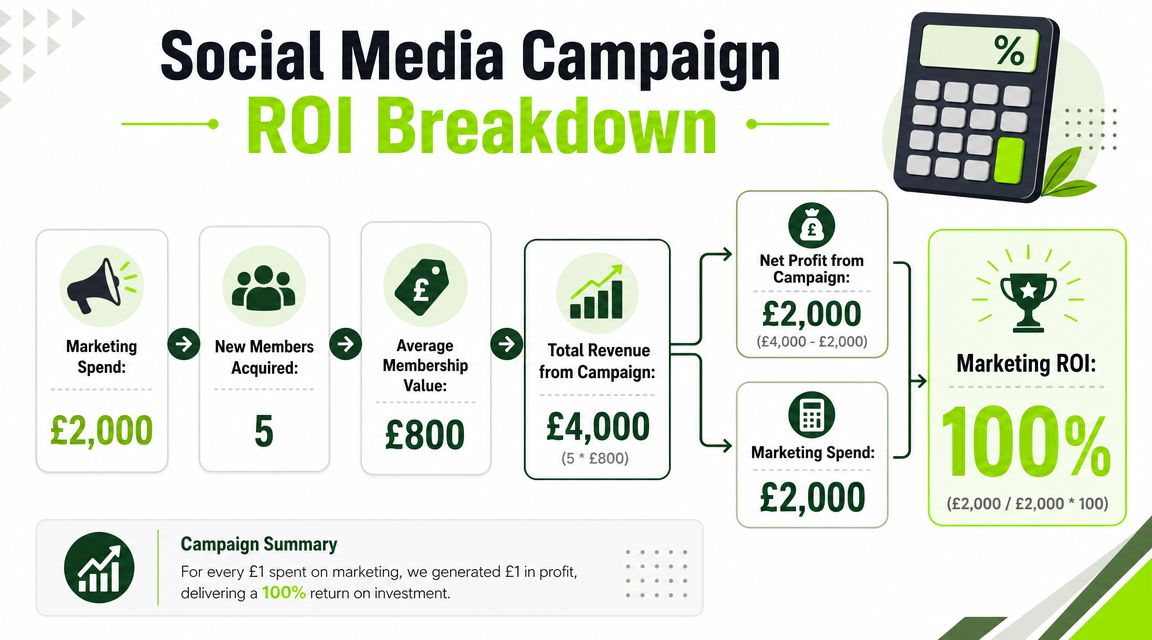
A clean ROI calculation starts with revenue you can reasonably connect to a campaign, then compares that revenue with the cost required to generate and convert it.
The formula itself is simple enough. The hard part is deciding what to count and what to exclude. That's why clubs should avoid made-up assumptions and only use data they can track through the pipeline.
A practical way to calculate it
Start with a single campaign. For example, a paid social campaign promoting membership open days.
The club should gather:
- Campaign spend
- Number of enquiries from that campaign
- How many enquiries became booked visits
- How many visits became members
- The membership revenue tied to those new joins
Then calculate:
- Campaign revenue minus campaign cost
- Divide that figure by campaign cost
- Express the result as a percentage if you want a standard ROI view
If the club can't connect revenue directly to the campaign, don't force the calculation. Use a provisional view and mark it clearly as incomplete.
What to include and what not to include
Include direct marketing costs and any clearly linked sales handling costs if you want a fuller picture.
Be careful with attribution when multiple touchpoints are involved. A prospect may click an ad, read emails, call the office, visit the club, then join later. That doesn't make ROI impossible, but it does mean clubs need a consistent attribution rule before reporting outcomes.
A practical reporting sheet usually includes:
- Campaign name and date range
- Source tracking method
- Enquiries created
- Visits booked
- Members won
- Revenue recognised
- Cost per stage
- Final ROI assessment
A rough but honest ROI figure is more useful than a precise-looking report built on guesswork.
Where clubs usually go wrong
The biggest mistake is counting interest as income.
An enquiry has potential value. A booked visit has stronger intent. A signed member has revenue. Those stages shouldn't be blended together in one optimistic number.
The second mistake is ignoring delayed conversion. Membership decisions often take time, especially in private clubs. A campaign may look weak after one week and strong after proper follow-up. That's why clubs should review ROI over a suitable window and keep the pipeline open long enough to see the full result.
Why Most Golf Club Marketing Fails to Deliver ROI
Poor golf club marketing ROI usually isn't caused by weak ad creative. It's caused by operational leakage after the lead arrives.
A club can run sensible campaigns, target the right postcode, write a strong offer, and still get poor returns if nobody owns the next step. That is where most underperformance lives. Not in visibility, but in conversion discipline.
The common failure points
The first problem is slow response. An enquiry comes in after hours, sits in a shared inbox, and gets answered when someone remembers. By then, the prospect may have moved on, cooled off, or contacted another club.
The second is no structured follow-up. Staff reply once, then wait. But many membership decisions need several touches. A reminder, a call, an invitation to visit, a well-timed email, a nudge after the tour. Without that structure, opportunities don't get developed.
The third is poor lead visibility. If the club can't see who enquired, who responded, and which stage each lead has reached, management can't spot bottlenecks. Problems stay anecdotal instead of becoming fixable.
Discount-led marketing creates another problem
Clubs also weaken ROI when they rely too heavily on price-led campaigns.
Research on golfer motivations points to a broader opportunity. England had 10.1 million golfing adults in 2024 and 3.2 million new adult golfers, while younger cohorts such as Gen Z are often more motivated by coaching, community, and social connection than price alone, which supports measuring lifetime value and conversion quality rather than only short-term lead cost, as discussed in this review of golf participation and ROI strategy.
That matters because discount-led campaigns can fill the top of funnel with the wrong type of prospect. Interest increases, but retention quality may not.
The cheapest lead often becomes the most expensive member to acquire if the club has to keep re-selling value after the first conversation.
Broken systems create predictable outcomes
This isn't about blaming membership staff or managers. Most clubs operate with busy teams, multiple responsibilities, and fragmented tools.
If there is no automatic acknowledgement, no pipeline view, no lead owner, and no follow-up schedule, poor ROI is the expected outcome. The club hasn't built a process that supports conversion. It has hoped good intentions would cover the gap.
Systems for Improving Your Golf Club's Marketing ROI
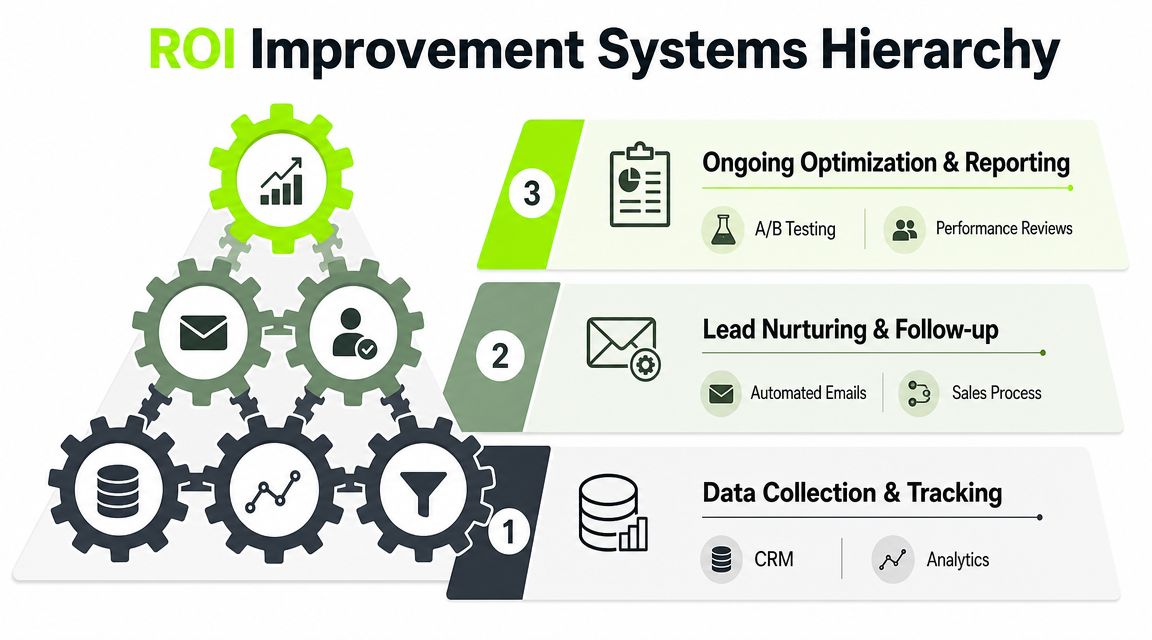
Improving ROI starts when the club treats growth as a managed pipeline rather than a series of campaigns.
The strongest setups usually combine tracking, follow-up, and conversion design. Each part supports the others. If one is missing, performance becomes harder to measure and harder to improve.
Start with lead visibility
A club needs a central record for every enquiry. That means source, date, segment, contact history, outcome, and next action all live in one place.
A CRM transitions from optional admin software to a revenue control tool. Without it, staff work from scattered notes and managers can't see where deals stall.
Some clubs use general-purpose CRM platforms. Others use a golf-specific setup or a managed system. GolfRep is one option that combines lead generation, structured follow-up, and CRM visibility for golf clubs, but the principle matters more than the platform name. The club needs one pipeline, one view, and clear ownership.
Build follow-up into the process
Fast acknowledgement should happen automatically. Personal follow-up should happen deliberately.
That usually means:
- Instant confirmation: The lead gets an immediate response confirming receipt and setting expectation.
- Assigned ownership: One person is responsible for the next action.
- Sequenced nurture: Email, call, and reminder steps are scheduled instead of improvised.
- Status tracking: Open, contacted, booked, toured, joined, lost.
Consequently, many clubs see the biggest practical lift because consistency replaces memory.
For a wider operational view, this article on how to build a revenue-aligned marketing engine is helpful because it frames marketing as a business system rather than a content exercise.
Improve conversion at the point of action
The booking and enquiry journey must be easy to complete, especially on mobile.
Over 70% of modern golf bookings happen on smartphones, and conversion drops if the booking process takes more than three clicks, which is why clubs benefit from mobile-first design and CRM segmentation such as separating lapsed leads from weekday-only players, as outlined in this guide to analysing golf marketing data.
That has direct operational value. A visitor golfer shouldn't receive the same message as a lapsed membership lead. A weekday retiree and a younger prospect looking for coaching and social connection shouldn't be pushed through the same journey.
Clubs that want to strengthen this part of the pipeline can also review GolfRep's practical guidance on golf club marketing automation, especially where response speed and follow-up consistency are limiting conversion.
Better ROI often comes from removing friction, not increasing budget.
From Guesswork to Growth Taking Control of Your Pipeline
Golf club marketing ROI becomes much easier to improve once the club stops treating it as a marketing-only score.
It is really a pipeline management issue. Spend creates opportunity. Systems determine whether that opportunity becomes revenue. When a club can see every lead, respond quickly, follow up properly, and measure conversion by source, ROI stops being vague. It becomes operationally controllable.
That shift changes decision-making.
Instead of asking whether marketing is "working", clubs can ask sharper questions. Which channels produce the right members. Which segments convert well. Where leads stall. Which staff process needs support. Whether the booking journey creates friction. Those are useful management questions because they lead to action.
The clubs that grow steadily usually don't rely on one clever campaign or one seasonal promotion. They build a repeatable process for capturing demand, handling enquiries, and converting interest into committed membership. That process is measurable, trainable, and improvable.
For managers, owners, and committees, that's the main opportunity. You don't need more noise in the market. You need control over what happens after interest appears.
When that happens, golf club marketing ROI stops being guesswork and starts becoming a reliable part of club growth.
If your club wants a clearer view of where enquiries are being won, lost, or left untouched, GolfRep helps golf clubs build structured pipelines that connect lead generation, follow-up, and CRM visibility so marketing spend can be judged against actual membership outcomes.
Ready to tap into our proven growth system?