Golf Club Marketing Strategy for Predictable Growth 2026

Most golf club marketing advice starts in the wrong place. It tells clubs to buy more traffic, post more on social media, run another open day, or increase ad spend. That sounds sensible until you look at what usually happens after an enquiry lands.
The issue usually isn't demand. It's what the club does next.
A strong golf club marketing strategy doesn't begin with more promotion. It begins with making sure every enquiry is seen, answered, tracked, and moved towards a visit. If that system is weak, more leads only create a bigger leak. If that system is organised, even modest enquiry volume can produce steady membership growth.
That matters because the wider market is no longer behaving like an industry in retreat. The Hillier & Hopkins Golf Clubs Survey highlights changing fortunes for clubs over the last 20 years found that more than 70% of UK clubs reported membership growth in each year from 2021 to 2023, and almost three-quarters, around 74%, reported growth in 2023. For club managers, that changes the conversation. Growth is no longer a lucky exception. It can be built when the commercial process is handled properly.
Why Your Marketing Problem Is Not What You Think
Most clubs that say, "We need more enquiries," need a better process for handling the enquiries they already get.
The clearest sign is response time. GolfRep's analysis of golf course advertising performance found that the average time to respond to a membership enquiry in the UK golf sector is 47 hours and 32 minutes. That's not a marketing failure. It's a sales handling failure.
A prospective member doesn't stop researching after contacting your club. They keep going. They enquire elsewhere, compare replies, and judge responsiveness as part of the experience. If your first reply arrives two days later, the prospect may already have booked a visit somewhere else or mentally ruled your club out.
Slow follow-up doesn't just reduce efficiency. It changes who joins, because the most motivated prospects tend to choose the club that answers first.
Many committees and management teams often get stuck. They review ad performance, discuss reach, and question creative, when the underlying issue sits inside the admin process. A Facebook campaign or Google campaign can generate interest, but neither can rescue a club that leaves prospects sitting in a shared inbox.
Manual handling creates predictable problems:
- Enquiries go unseen when they land outside office hours or during busy operational periods.
- Ownership stays unclear when no one is responsible for the next action.
- Follow-up becomes inconsistent because one member of staff phones, another sends an email, and neither updates a central record.
- Decision-making gets distorted because the club thinks the campaign failed when the process failed.
A practical explanation of why most golf club marketing fails starts with this exact point. Clubs often have enough interest to grow, but they don't have enough structure to convert that interest reliably.
The change in mindset is simple. Stop treating marketing as lead generation in isolation. Treat it as a pipeline. Traffic matters. Enquiries matter. But response speed, lead visibility, and booked visits matter more because that's where revenue is won or lost.
Laying the Foundations Before You Spend a Penny
Before running ads, fix the digital front door.
Too many clubs pay to drive traffic into a weak website, an incomplete Google listing, or a contact process that creates friction. That's backwards. If the basics are loose, more traffic only means more wasted opportunities.
UKPOS research on golf course marketing and promotions points to a problem many clubs still underestimate. 42% of UK clubs still do not offer online booking, and 31% have unclaimed Google Business Profiles. Fixing these foundational gaps can increase enquiry volume by 35% before a single pound is spent on ads.
Your website has one job
A club website doesn't need to win design awards. It needs to help a prospective member move from curiosity to action.
That means a visitor should quickly understand:
- What type of club this is. Private members' club, resort, flexible, premium, family-oriented, competitive, beginner-friendly.
- Who membership is for. Not everyone. The right people.
- What the next step is. Enquire, book a tour, request a call, attend a trial experience.
- How to act on mobile. Many prospects will browse on their phone, often between tasks, with little patience.
If the membership page is vague, hidden, or overloaded with committee language, people leave. If the contact form goes nowhere obvious, people leave. If the site looks neglected, people question the standards of the club itself.
Fix the friction points first
Before spending on Google Ads or Meta, run a blunt internal audit.
- Check your Google Business Profile. Claim it, complete it, and make sure the club's details are accurate.
- Review mobile usability. Test the site on a phone as if you were a prospect, not a staff member who already knows where everything is.
- Add a clear conversion path. Membership pages should lead to one obvious action, not five equal options.
- Enable online booking where relevant. If you offer club visits, taster rounds, or tour appointments, make the booking step easy.
- Tighten enquiry forms. Ask only for the information needed to start a useful conversation.
Practical rule: if a local golfer can find your club but can't take the next step quickly, the marketing system is incomplete.
A proper strategic marketing plan for a golf club starts here, not with channel selection. Foundation work is less exciting than paid campaigns, but it has far more impact on efficiency.
What clubs often get wrong
The common mistake is assuming digital infrastructure can be fixed later. It usually can't. Once campaigns are live, teams get pulled into reacting to incoming leads, discussing spend, and managing expectations. The weak points stay weak.
A better sequence is:
- Make the club easy to find.
- Make the club easy to understand.
- Make the club easy to contact.
- Make every contact traceable.
Only then does paid promotion have something solid to amplify.
Defining Your Ideal Member and Membership Offer
A generic membership message attracts generic enquiries. That's expensive, time-consuming, and often a poor fit for the club.
When clubs say they want "more members", they usually mean something more specific. They may want committed golfers who play regularly. They may want younger professionals who use the club socially as well as competitively. They may want weekday members who fill quieter inventory without putting pressure on peak times. Those are different commercial goals, so they need different messaging.
Stop advertising one membership to everyone
One of the biggest weaknesses in golf club marketing strategy is lazy positioning. The club presents a single membership proposition and expects it to appeal equally to every local golfer. It won't.
A better approach is to separate likely member types by intent and fit. For example:
| Member type | What they usually care about | What your message should emphasise |
|---|---|---|
| Flexible weekday player | Availability, value, ease of access | Quiet tee sheet periods, practical flexibility, straightforward joining process |
| Weekend committed golfer | Competition, course quality, club standard | Playing experience, member culture, fixture strength |
| Family-oriented prospect | Lifestyle, welcoming atmosphere, usable facilities | Social environment, family friendliness, time well spent |
| Premium all-access member | Status, service, convenience | Quality, consistency, exclusivity, smooth experience |
This isn't about inventing endless membership categories. It's about clarity. If the club knows who it most wants to attract, the marketing becomes sharper and the sales conversations become easier.
Match the offer to the member, not the committee
Clubs often describe membership the way internal stakeholders discuss it. Price bands, constitutional language, voting rights, categories, and historical package names. Prospects don't think like that.
They think in practical terms:
- Will I fit in here?
- Can I play when I want?
- Is it worth the money?
- How easy is it to get started?
- What happens if I enquire?
That's why the strongest membership offer is usually framed around experience and fit, not just entitlement. "Join our club" is weak. "Book a visit and see whether our weekday membership suits your playing routine" is much stronger because it feels relevant and low-friction.
The best membership messaging doesn't try to appeal to everyone. It makes the right prospect feel understood.
What good segmentation changes downstream
Segmentation isn't just an ad targeting exercise. It affects the whole pipeline.
When the ideal member is clearly defined:
- Ad platforms can target more intelligently
- Landing pages can speak in plain language to a specific audience
- Staff can tailor follow-up conversations
- The club can present the right membership route earlier
- Poor-fit enquiries become easier to identify
As enquiry quality is not random, clubs shape it through the way they present themselves.
A weekend golfer looking for busy competition golf should not receive the same message as a lapsed player exploring a flexible return to the game. Both might join, but not through the same argument. A club that recognises that difference will waste less time, qualify leads faster, and create a smoother experience from first click to first visit.
Building Your Channel Mix for Predictable Enquiries
Once the foundations are sound and the audience is defined, channel choice becomes a planning exercise rather than guesswork. The aim isn't to be active everywhere. It's to build a dependable flow of relevant enquiries from the right local golfers.
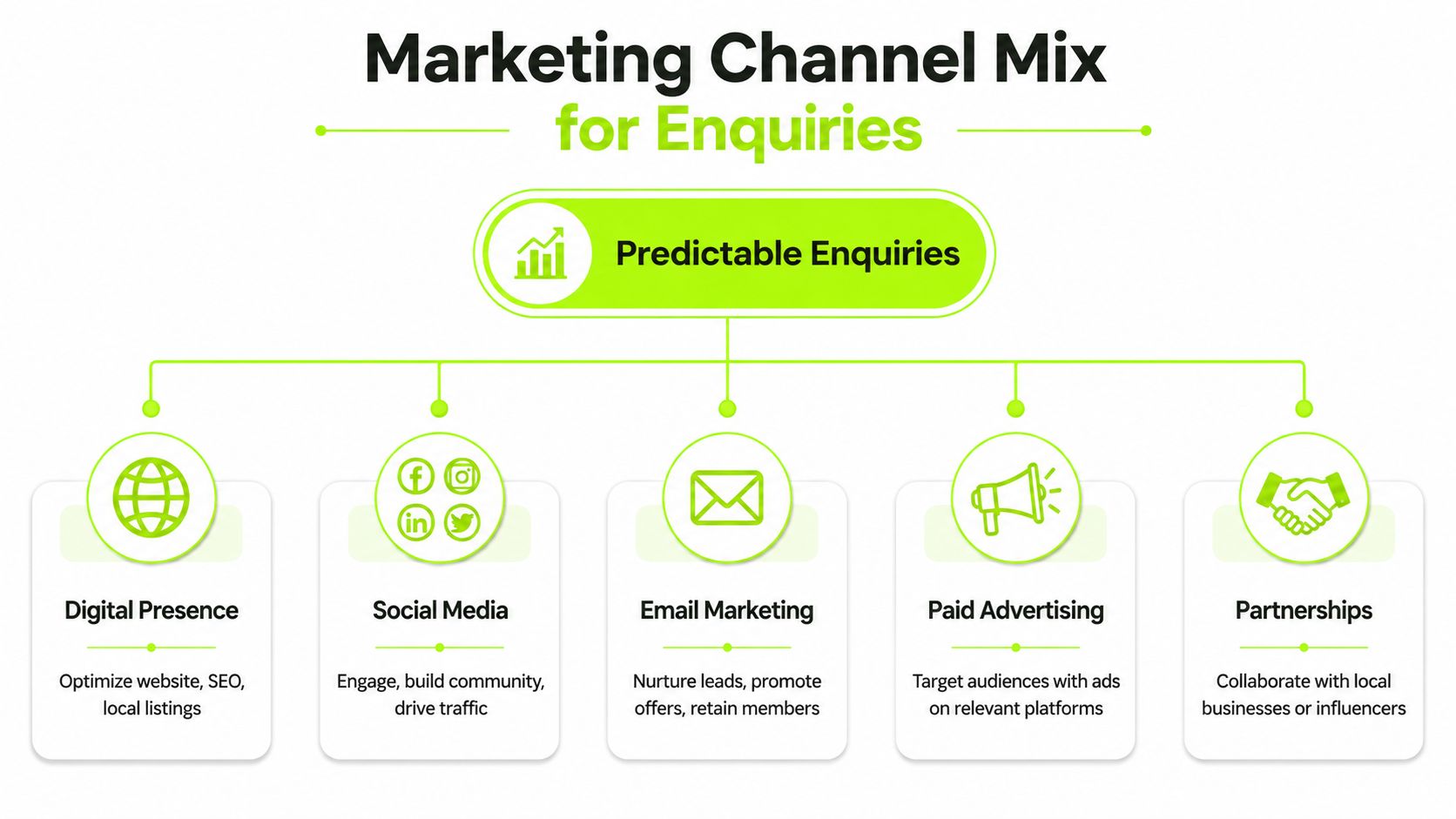
The strongest results usually come from combining demand capture with demand creation. Search does one job. Social does another. Email and follow-up do another again. Problems start when clubs expect a single channel to carry the whole system.
What each channel is really for
Google Search is where active intent shows up. These are the golfers already looking for a club, exploring membership options, or comparing local choices. Search campaigns are useful because they catch demand that already exists.
Meta platforms are different. They help clubs appear in front of local golfers who may not be actively searching today but match the right demographic or behavioural profile. That makes social useful for awareness, consideration, and re-engagement.
Email sits in the middle of the journey. It rarely creates cold demand on its own, but it's excellent for nurturing an existing enquiry, prompting a visit, or keeping a prospect warm while they compare options.
Local partnerships can also play a role. Hotels, driving ranges, golf retailers, and local employers can support awareness if the club has a clear route for turning interest into trackable enquiries.
Why segmentation lowers waste
The best-performing campaigns aren't broad. They're filtered.
GolfRep's guide to proven strategies for golf club membership growth notes that UK advertising campaigns that segment local golf prospects by playing frequency and automate nurture sequences see an 18–22% reduction in cost-per-acquisition and a 28% higher lead qualification rate compared to generic campaigns.
That makes sense in practice. A golfer looking for a seven-day playing option won't respond to the same message as someone exploring a more flexible category. When targeting, creative, and landing pages all reflect that distinction, the campaign attracts more suitable enquiries and wastes less budget on curiosity clicks.
A simple channel model that works
For most clubs, a practical mix looks like this:
- Search for high intent. Capture local golfers already looking.
- Paid social for audience building. Reach nearby prospects who fit the club profile.
- Email and automation for follow-up. Keep momentum after the first enquiry.
- Local visibility work. Support trust through strong listings, reviews, and referral touchpoints.
The key is sequencing. Search without follow-up wastes intent. Social without clear positioning creates weak enquiries. Email without CRM visibility turns into guesswork.
Good channels don't fix a broken process. They feed a working one.
What doesn't work reliably
A lot of clubs still lean heavily on open days as the main acquisition tactic. Open days can help, but only when they connect to a defined next step. If everyone attends, enjoys the course, and then leaves without a booked follow-up, interest dissipates quickly.
The same applies to "boosting posts", sporadic seasonal promotions, or handing digital activity to whoever has spare time in the office. None of that is a system. It produces bursts of activity, not predictable enquiries.
A channel mix only becomes dependable when each part has a clear role and every lead enters the same follow-up process. That's when marketing stops feeling random and starts behaving like an organised commercial function.
The System That Turns Enquiries Into Members
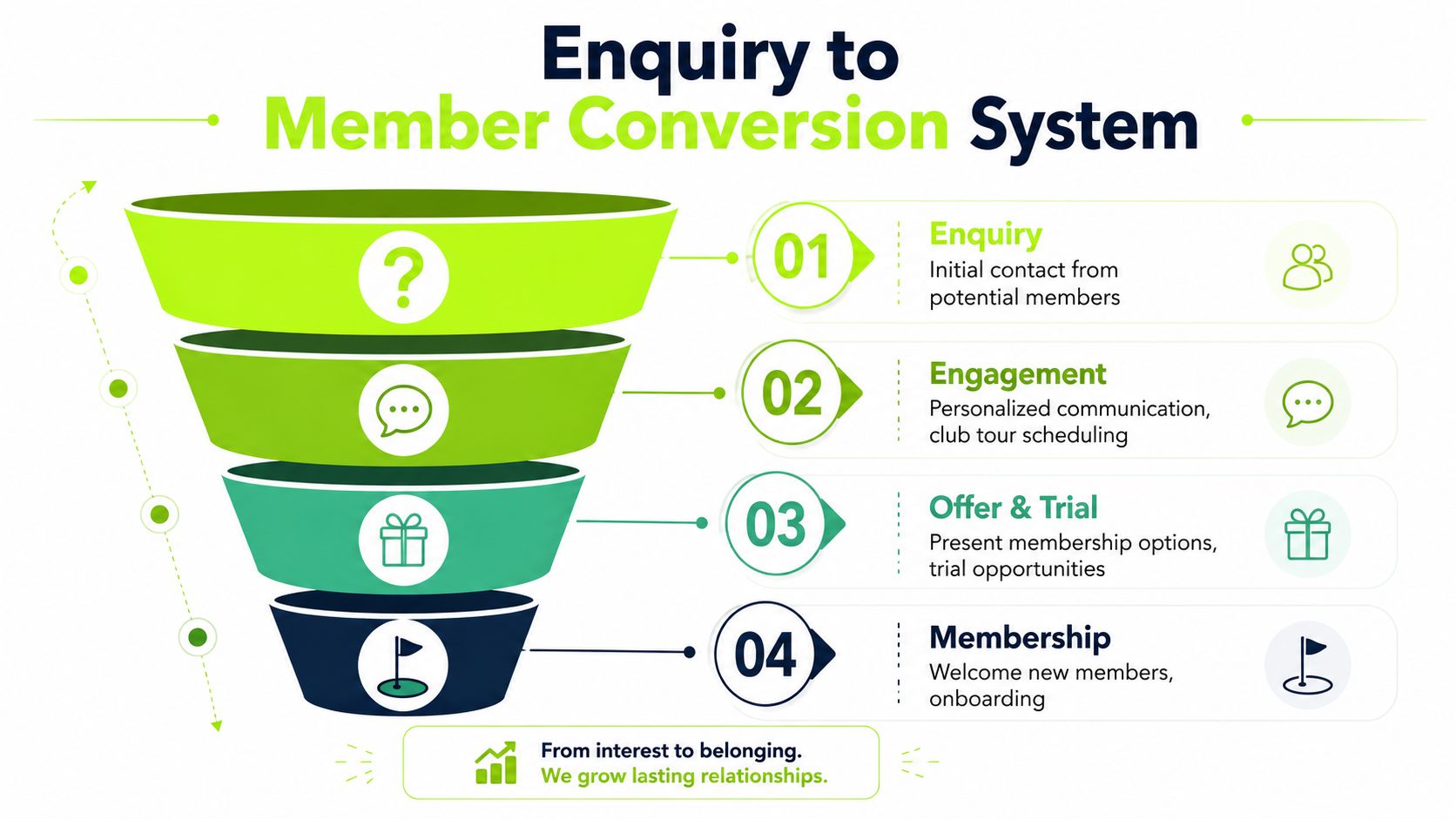
Most golf clubs win or lose not in the advert, not in the click, and not in the form fill, but in the minutes and hours after the enquiry arrives.
A club can have a strong brand, a good course, and a healthy marketing budget, but if follow-up is slow or inconsistent, conversion stalls. That's why the most important part of any golf club marketing strategy is the post-enquiry system.
Speed changes outcomes
Response time isn't a soft best practice. It has a direct effect on conversion.
GolfRep's analysis of golf club sales process performance shows that a membership lead that receives a response within one hour is five times more likely to convert than one that waits 24 hours. That's the commercial argument for speed in one line.
The operational implication is obvious. If your club relies on somebody checking emails between meetings, after the morning shop rush, or in the evening, you're leaving conversion to chance.
The process clubs should standardise
The Golf Club Managers' Association has also highlighted the value of structured response handling. In GCMA guidance on strengthening membership strategy, clubs using a standardised multi-channel enquiry response protocol, with first contact within 15 minutes and follow-up within 24 hours, achieve a 35–40% higher visit-to-join conversion rate than clubs using ad-hoc follow-up. The same guidance notes a 62% drop in prospect engagement after the first 45 minutes when the first human touch is delayed.
That points to a simple operating model:
Capture every lead into one CRM
Don't leave enquiries split across email inboxes, paper notes, website forms, and social messages. One central record gives the team visibility.Acknowledge instantly
An automated email or SMS confirms receipt and reassures the prospect that the enquiry hasn't vanished.Assign clear ownership
One staff member should own the next action. Shared responsibility usually becomes no responsibility.Make the human call quickly
Speed matters because prospects are comparing clubs in real time.Move towards a booked visit
The conversation should aim for a concrete next step, not a vague promise to stay in touch.
Automation is not impersonality
Some clubs worry that automation feels cold. In practice, bad manual handling feels colder.
An automated acknowledgement is not there to replace a person. It's there to bridge the gap until a person responds. It gives the prospect confidence that the club is organised. Then the human follow-up can do the relational work properly.
A useful golf club automation system should make three things easier:
- Lead visibility so no enquiry disappears
- Task creation so staff know who does what next
- Nurture consistency so prospects receive timely prompts without relying on memory
If a club cannot say exactly where each membership enquiry sits today, it doesn't have a pipeline. It has a pile of messages.
What the nurture flow should do
Not every prospect is ready to join immediately. Some need a call. Some need a visit. Some need reassurance about membership fit, pricing, or playing access. That's where nurture matters.
A good nurture flow doesn't bombard people. It guides them. It should:
- Prompt participation with a simple next step
- Check engagement based on whether the prospect clicked, replied, or booked
- Ask for feedback if they haven't moved forward
The objective is not endless communication. It's momentum.
The real trade-off
Clubs often think the trade-off is between investing in ads or investing in systems. It isn't. The trade-off is between spending money to create leads and spending money wisely enough to convert them.
If the club already generates interest but handles it manually, the fastest gain usually comes from system design, not another campaign. That is less glamorous than fresh creative or a bigger budget, but it's usually the decision that turns sporadic enquiries into a repeatable membership pipeline.
Measuring What Matters and Optimising for Growth
A golf club can't improve what it doesn't track. Yet many clubs still judge marketing by loose signals such as whether the phone felt busier, whether a post got attention, or whether an event seemed well attended.
Those indicators can be useful, but they don't tell management whether the system is producing members efficiently.
Track the pipeline, not just the campaign
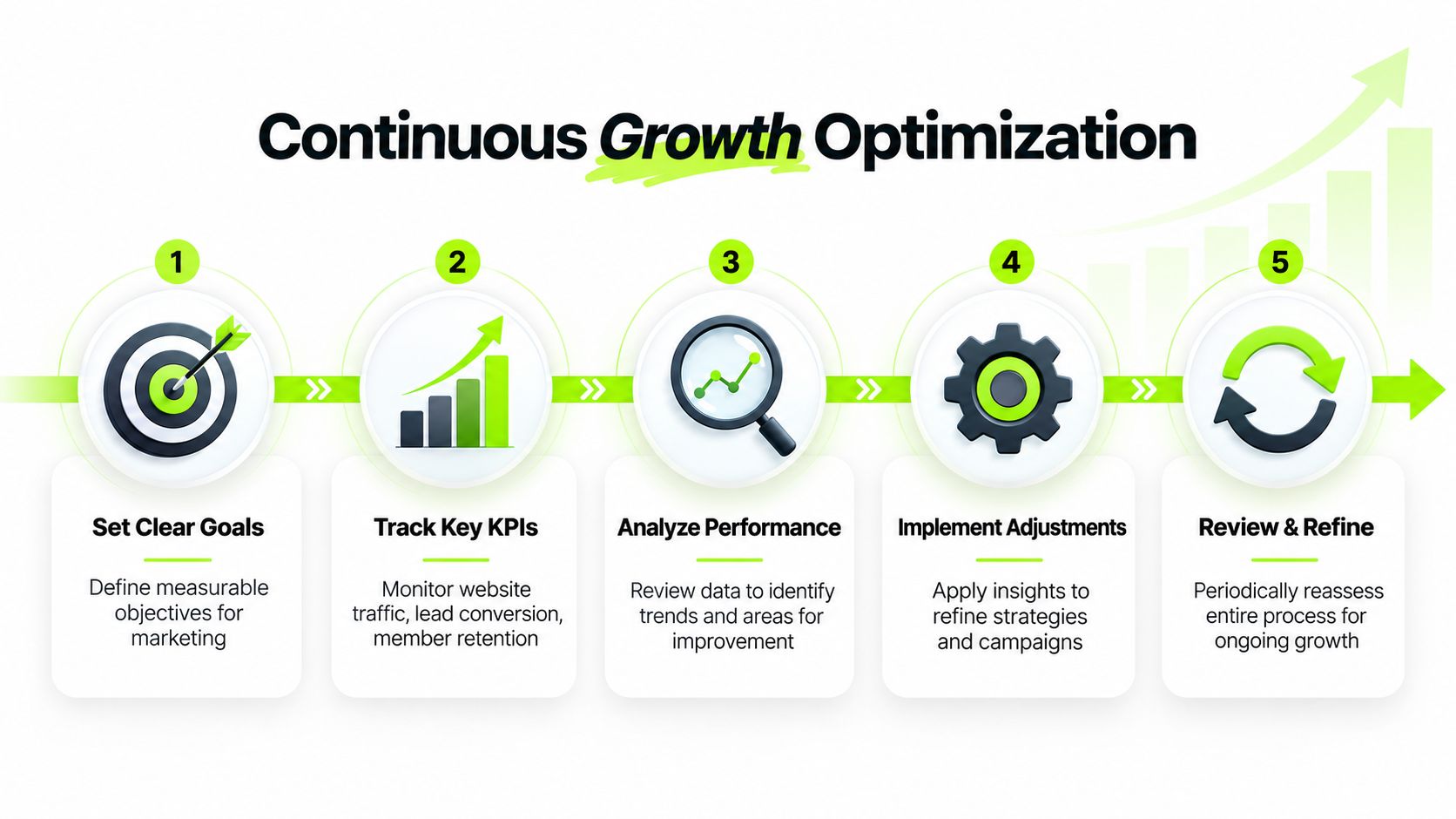
The most useful reporting view is simple. Start with the first enquiry and follow it through to outcome.
At minimum, clubs should be able to see:
- How many enquiries arrived
- Where they came from
- How quickly the club responded
- How many were booked for a visit
- How many joined
- Where leads stalled or were lost
This shifts the discussion from "Did the advert work?" to "Where is the process breaking?" That's a much more useful management conversation.
The metrics that deserve attention
Clicks, impressions, and reach have their place, but they are not the commercial scoreboard. A practical reporting stack focuses on business outcomes.
| Measure | Why it matters | What it tells you |
|---|---|---|
| Cost per enquiry | Shows acquisition efficiency | Whether channel spend is producing interest at a sensible level |
| Response time | Shows operational discipline | Whether the club is protecting conversion opportunity |
| Cost per booked visit | Connects marketing to sales progress | Whether enquiries are turning into real conversations |
| Visit-to-member conversion | Shows sales quality | Whether the club presents and follows up effectively |
| Cost per new member | Ties everything together | Whether the whole system is commercially viable |
A committee doesn't need a complicated dashboard. It needs visibility into these few points, reviewed consistently.
Manager's view: if reporting stops at lead volume, the club is measuring activity, not performance.
An example 90-day implementation timeline
A workable rollout doesn't need to be overwhelming. Most clubs can phase it.
| Phase | Timeline | Key Actions |
|---|---|---|
| Foundation audit | Days 1 to 30 | Review website, forms, mobile journey, Google Business Profile, and current enquiry handling |
| CRM and process setup | Days 31 to 60 | Centralise leads, define ownership, create response templates, and build follow-up tasks |
| Campaign launch and refinement | Days 61 to 90 | Launch targeted campaigns, monitor lead quality, review response speed, and improve weak points |
This approach keeps the order sensible. Foundation first. Process next. Promotion after that.
Optimisation should be routine
Most growth gains don't come from dramatic reinvention. They come from regular adjustment.
That means asking practical questions:
- Which enquiry sources produce booked visits, not just form fills?
- Which membership messages attract the best-fit prospects?
- Where are staff response times slipping?
- Which follow-up steps produce replies and bookings?
Clubs that review these questions regularly tend to make calmer, better decisions. They don't panic when one campaign has a quiet week, and they don't overreact to vanity metrics.
The point of measurement isn't to create more admin. It's to give management confidence. When the pipeline is visible, decisions become easier. Budgeting becomes easier. Accountability becomes easier. That is what turns marketing from a recurring debate into an organised growth function.
GolfRep helps UK golf clubs build that kind of predictable pipeline. Not by acting like a generic agency, but by combining lead generation, CRM structure, automation, and disciplined follow-up so clubs can see what happens from first enquiry to signed member. If you want a clearer view of where your current process is leaking, explore GolfRep.
Ready to tap into our proven growth system?