Golf Club Membership Retention: A Practical Blueprint
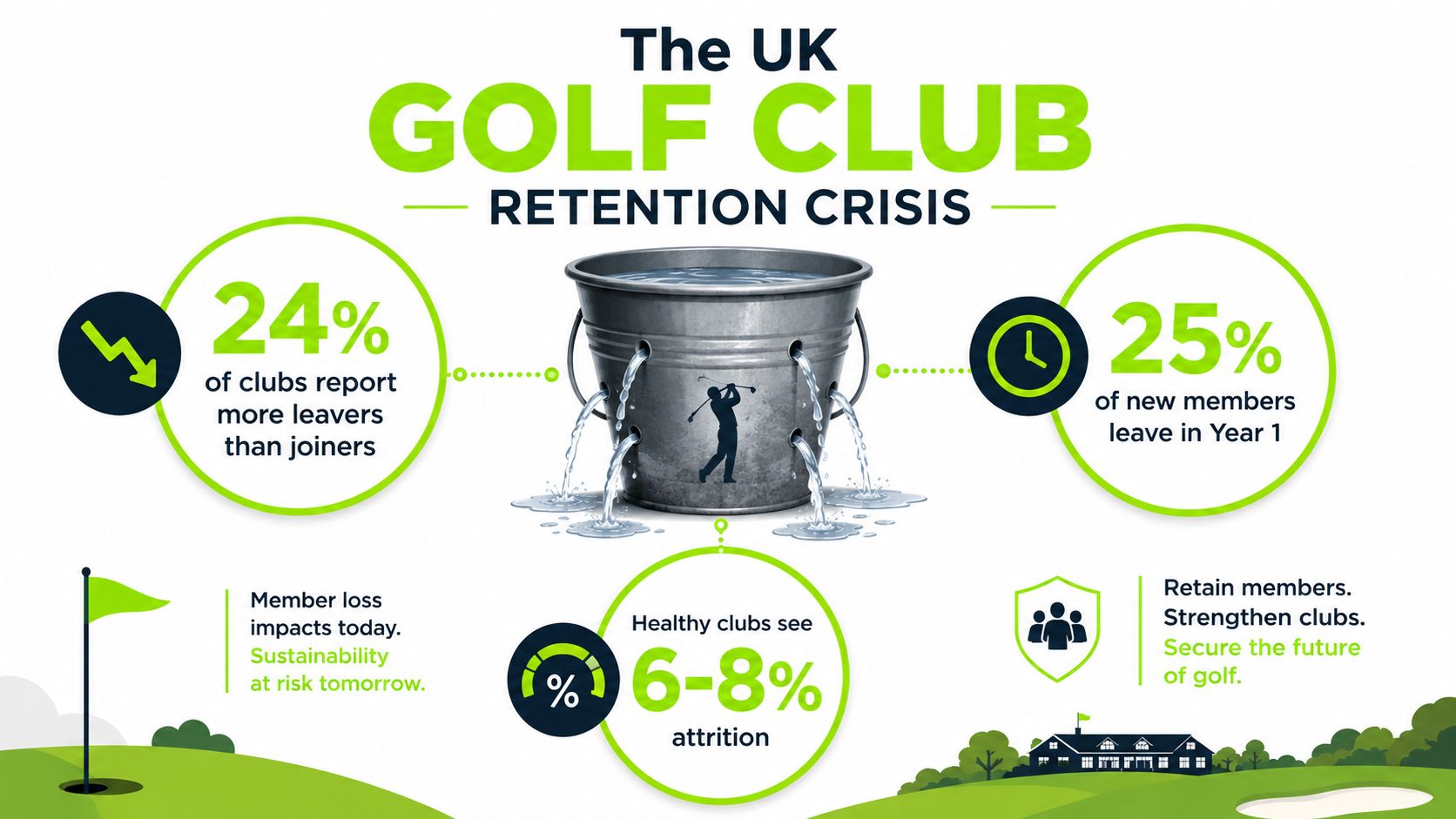
24% of UK members' golf clubs reported more leavers than joiners in a 2023/24 survey, which means nearly one club in four was shrinking rather than growing, even before renewal season had fully played out Golf Rep. That is the core retention problem. It's not a polite conversation at year-end, it's a breakdown in the first months after joining, when England Golf guidance says a new member is still being converted over a 3-year process and up to 25% of new members can leave in their first year if they aren't properly integrated into club life Golf Rep.
Healthy clubs usually sit around 6% to 8% annual attrition, which is a very different operating rhythm from the clubs seeing far higher losses ClubMark. Smaller clubs can feel that pressure most sharply, because the 2014 Golf Participation Report linked clubs with fewer than 250 members to 20.5% attrition, while clubs with more than 1,000 members were down at 6.5% attrition ClubMark. The lesson is blunt. Retention is won or lost early, and committee-led venues feel every mistake faster because there's less slack in the system.
Practical rule: if a member is quiet in the first 180 days, treat that as a retention signal, not a personality quirk.
Why Most UK Clubs Leak Members in the First 180 Days
The mistake in golf club membership retention is treating the renewal notice as the main event. By then, the member has often already stopped booking, drifted away from the social side of the club, and checked out mentally long before any formal resignation arrives.
The UK figures show the scale of that early drift. 24% of clubs reported more leavers than joiners in the survey cited above, while average joiners moved from 70 in 2022 to 73 in 2023 and average leavers increased from 48 to 56 Golf Rep. This is an onboarding problem, a usage problem, and a visibility problem.
The first season matters more than the renewal letter
England Golf's guidance says turning a new member into a retained member takes 3 years, and warns that up to 25% leave in their first year if they aren't integrated into club life Golf Rep. That puts the work in the opening months, not at the point of renewal. The club has to make people feel known, used, and noticed before a spreadsheet starts flagging expiry dates.
The early signal is usually quietness. If a member does not play, does not book, and does not show up socially in the first months, the resignation later is only the last visible step. Low activity in the first 30, 90 and 180 days is the warning pattern to watch Golf Rep. Manual “keep an eye on them” management breaks down because busy clubs lose sight of the silent members first.
A resignation is the end point. The leak starts earlier.
Why smaller clubs feel the leak more sharply
The older UK-linked benchmarks still matter because they show how quickly weak onboarding hits smaller venues. Clubs with fewer than 250 members faced 20.5% attrition, while clubs with more than 1,000 members were at 6.5% ClubMark. Larger clubs can absorb missed touchpoints. Smaller clubs feel every one of them, so a few poor first impressions turn into visible churn fast.
That is why the club diary matters. A welcome pack alone does not retain anyone. A structured first 180 days gives the secretary, the PGA professional, and the membership team clear checkpoints, and it gives the club a way to spot early disengagement before it turns into a resignation.
Designing the First 180 Days Around a Real Risk Window
Make ownership explicit
Ownership comes first. Someone has to be accountable for each stage of the journey, because if everyone owns it, nobody does. In practice, the secretary can own the record and escalation, the PGA professional can own playing and confidence-building touchpoints, and the club's hospitality or reception team can own visible welcome and recognition.
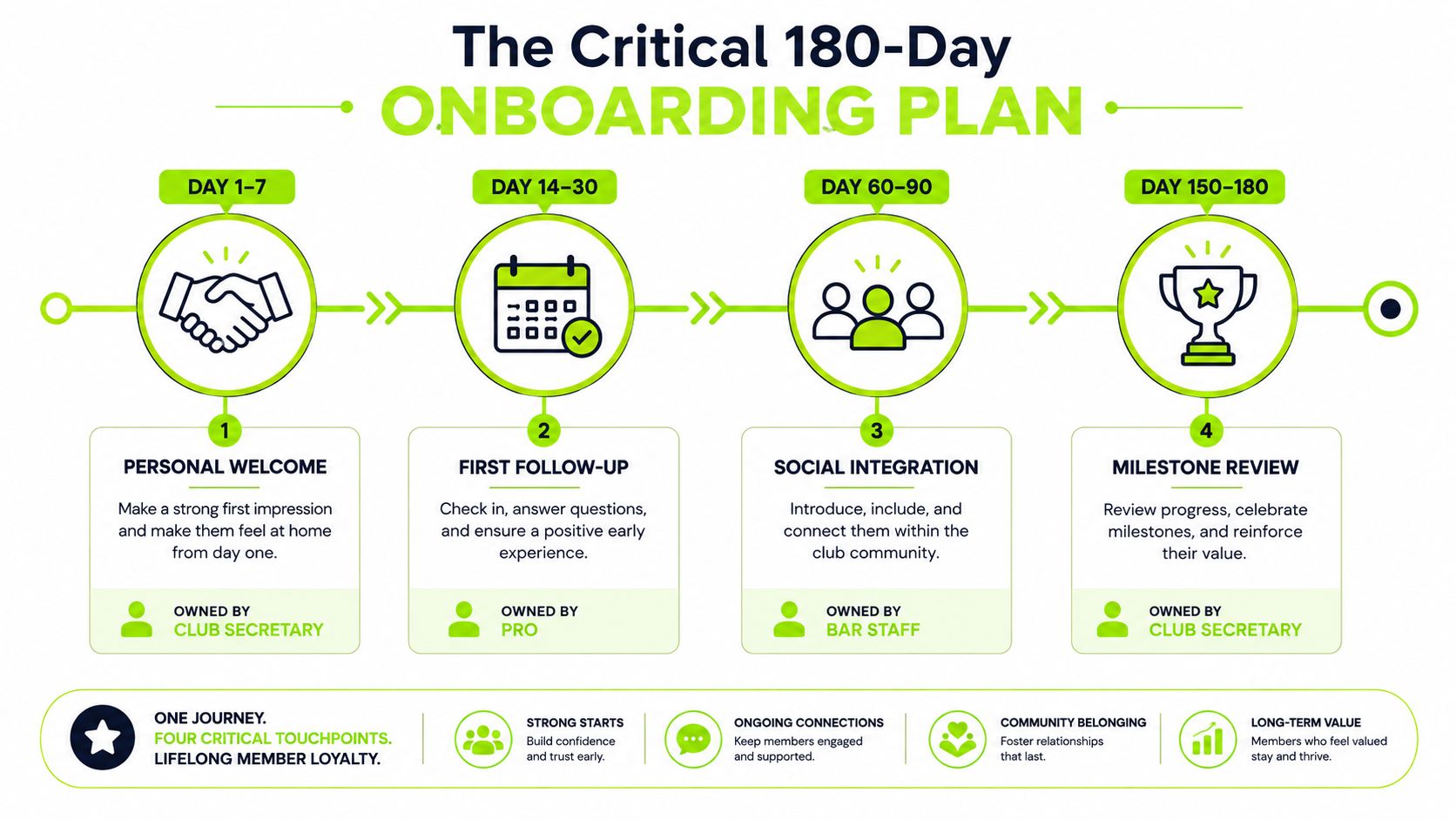
A club does not need a complex programme to start. It needs a consistent sequence with named owners. Day 1 to 7 should include a personal welcome call, a club orientation, and a clear point of contact. Day 14 to 30 should check whether the member has booked, played, or attended anything. Day 60 to 90 should look at whether they've made a social connection. Day 150 to 180 should start a renewal preparation conversation, especially if activity has been light.
Build the sequence into the CRM
A CRM should hold the sequence, not a memory bank. The member record needs the join date, membership category, source, last visit, rounds played, and cohort, then it needs tasks that fire automatically when dates arrive or behaviours change. That way the club secretary is not chasing from a notebook, and the PGA pro is not relying on someone else to remember a follow-up. It also gives the club a clean route into database marketing for member retention, where timing and trigger points matter more than broad broadcast messages.
A practical onboarding sequence usually looks like this:
- Day 1 to 7, Personal Welcome: short call, clubhouse introduction, and a named contact.
- Day 14 to 30, First Usage Check: confirm the member has booked, played, or been introduced to another member.
- Day 60 to 90, Social Integration: invite to a competition, roll-up, or social event.
- Day 150 to 180, Milestone Review: review activity, confidence, and renewal readiness.
Club reality: if the first contact is delayed, the member starts forming opinions without you in the room.
What the welcome sequence should actually contain
A good welcome is specific. It confirms where to park, who to speak to, how to book, what to expect in competitions, and how the member will be introduced into club life. It also gives a simple next step, such as a first round with the pro or a committee member who knows the social side of the club.
The point is to remove friction quickly enough that the member gets to their first positive experience before hesitation sets in. Clubs that do this well tend to look organised from the outside and calm on the inside, because the process is doing the remembering for them. The ComBase guide to member retention makes the same case for structured touchpoints, and that principle applies just as strongly in the first months as it does at renewal.
Building a Member Journey That Surfaces Quiet Drop-Offs
A club diary only helps retention if it gives members repeated reasons to appear, not just a reason to renew. Competitions, mixed friendlies, inter-club matches, coaching clinics, and social evenings all have a place, but they need to sit inside a member journey rather than arrive as isolated notices. Members should keep seeing evidence that the club has something for their level of play, their pace, and their social preference.
The useful approach is to map the year around participation points that are easy to recognise in the CRM and easy to compare with actual behaviour. An annual calendar can include welcome events for newer members, competitive dates for regular players, social sessions for less frequent visitors, and learning routes for people who want more confidence before they enter competition. That gives the membership team a clean benchmark against booking data, because low usage stands out against a planned programme instead of disappearing into it.
The same structure also gives committee-run clubs a clearer way to spot quiet drop-offs before they become resignations. If a member has stopped booking into the events that suit their category, the issue is visible in the calendar pattern, not buried in a renewal conversation months later. A practical database marketing approach for golf clubs helps here because it ties the diary to member records, usage history, and follow-up tasks without relying on memory.
A sample 12-month engagement pattern
A workable calendar does not need to be clever. It needs to be predictable.
- Spring: welcome pairs, mixed opening events, and first-competition introductions.
- Summer: regular comps, captains' days, and guest invites.
- Autumn: social golf, coaching refreshers, and format changes to keep interest alive.
- Winter: shorter events, indoor practice sessions, simulator access, and lighter social activity.
The point is consistency. If a member does not see a reason to book for several weeks, they drift into the background, which is where clubs lose the thread. Tracking members who have not played in 30, 60 or 90 days gives the club a sensible trigger for outreach, rather than waiting for a complaint or a resignation notice.
The low-usage call should sound human
A low-usage call is not a sales script. It is a service check. The question is not “why haven't you been in?” It is “what would make it easier to use the club more often?”
A simple version can sound like this, “Hi [Name], we have noticed you have not been out much recently. Everything all right with booking or finding a game? If it helps, I can point you towards the next suitable event or introduce you to a few members.”
That line works because it is specific, light, and useful. It gives the member a way back in without asking them to defend their absence. Clubs that want a cleaner retention process usually pair that sort of check-in with the structured touchpoints described in the ComBase guide to member retention, then track who responds, who books, and who still stays quiet after the first prompt.
CRM Automations and Personalised Communications That Trigger on Behaviour
A monthly newsletter does not retain members on its own. Behaviour-triggered communication does more useful work because it responds to what the member has done, or has not done. The same principle that applies to enquiry response time applies here too. If someone's interest or usage changes, the club should see it quickly and act while the context is still fresh.
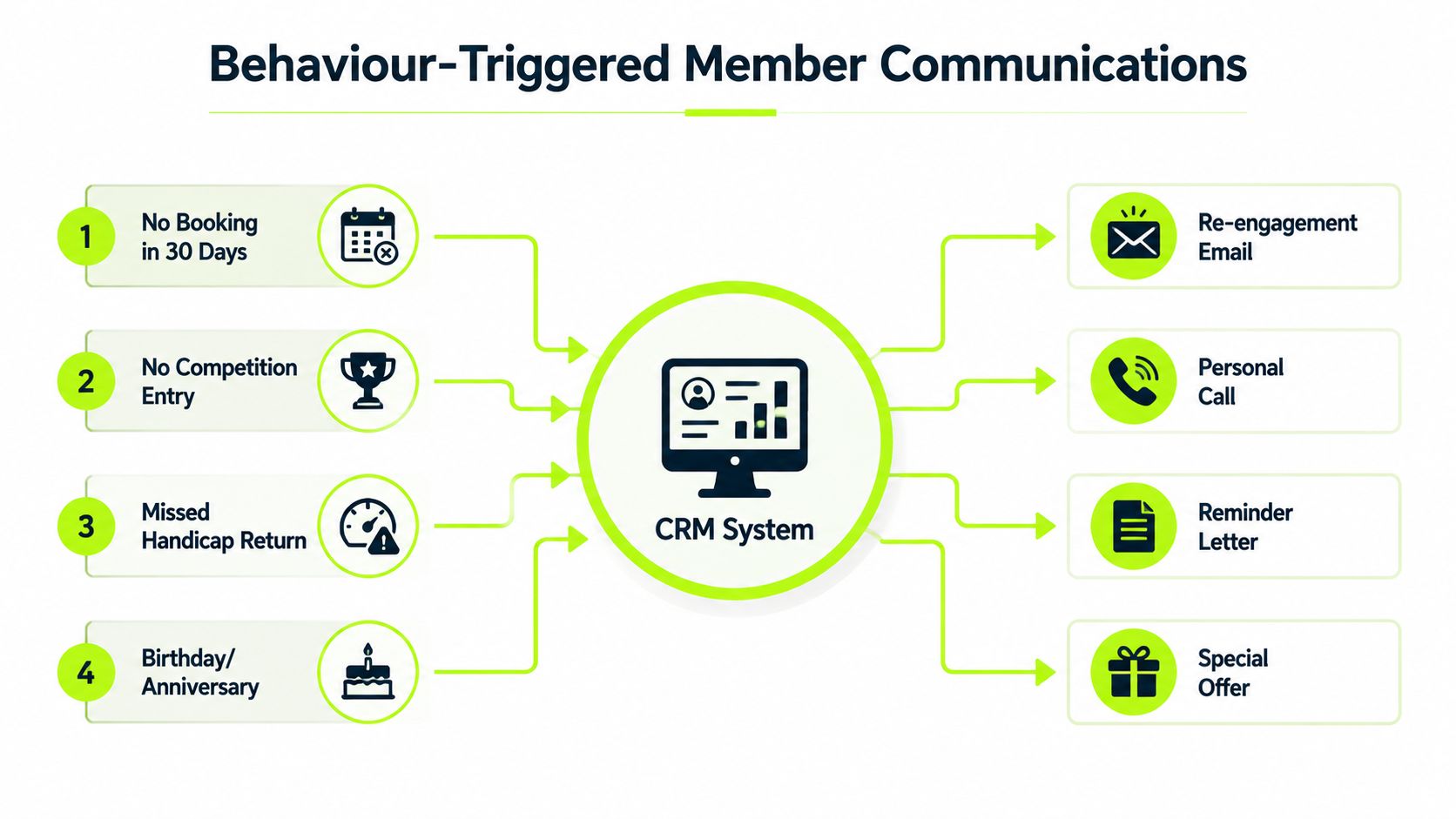
That means the CRM needs the right fields. At minimum, it should capture rounds played, last visit, category, source, and joiner cohort. Once those fields are in place, the club can build simple logic around them. No booking in 30 days should trigger a re-engagement note. No competition entry all season should flag a personal call. A missed handicap return should create a reminder task. Birthday month and anniversary of joining can be used for light-touch recognition.
GolfRep's own CRM-led work sits in this world, because the same system that tracks enquiries can also track member behaviour and follow-up tasks. The point is not software for its own sake, it is visibility and a cleaner route from signal to action.
For clubs comparing systems and processes, the internal note on GolfRep's database marketing approach shows why member records need to support follow-up rather than just storage. The same logic also sits behind a guide to golf club automation, where the sequence matters more than the software label.
Three messages that are worth automating
The best automations are short and practical. They should match a real behaviour and offer a clear next step.
No booking in 30 days.
“Hi [Name], we have not seen a booking from you recently. If you would like a hand finding the right tee time, event, or playing group, reply here and we will help.”No competition entry.
“Hi [Name], we have a few upcoming events that suit different handicaps and formats. If you would like a recommendation, we can point you towards the right one.”Birthday or anniversary.
“Happy [birthday/joining anniversary], [Name]. Thanks for being part of the club. We hope you enjoy the season ahead.”
What not to automate
Avoid generic newsletters dressed up as retention. Avoid messages that read like admin reminders unless there is a real action needed. Avoid sending the same message to everyone, because members who play weekly do not need the same nudge as members who only appear at social events.
The club that does this well spots behaviour early and responds calmly. Manual chasing burns time. Systems save it.
Pricing and Benefits Without Defaulting to Discounts
Pricing decisions often get discussed as if they're only about the fee number. They're not. They're about whether the membership ladder matches how different people use the club. A fair fee can still lose people if the category doesn't fit, the benefits feel thin, or the club makes no effort to show value during quieter periods.
The better question is whether the club has enough category variety to keep people in play. Mid-week options, lifestyle categories, younger adult tiers, and introductory offers can all reduce friction, but only if they're built to reflect real usage patterns rather than to chase a short-term uptake spike. If the club trains members to wait for a deal, it creates its own pricing problem later.
For clubs reviewing category structure, the pricing plans resource is useful as a practical comparison point for how value is packaged, but the club still has to decide what suits its own course, demand, and committee appetite.
| Category | Typical member | Usage pattern | Retention risk | Support needed |
|---|---|---|---|---|
| Full membership | Regular player | Frequent rounds and competitions | Lower if value is clear | Strong diary, recognition, competition access |
| Mid-week membership | Flexible player | Mainly off-peak use | Medium if tee access is poor | Clear booking guidance, social invites |
| Lifestyle membership | Less frequent user | Occasional golf, more social use | Higher if benefits aren't visible | Events, guest access, light-touch contact |
| Introductory offer | New joiner | Trial period or first-season use | Higher if onboarding is weak | Structured 180-day sequence, early follow-up |
Test value before you test price
Usage data tells you whether people are using the category they bought. Exit interviews tell you whether the category fitted them. If those two things keep pointing in the same direction, the issue is probably not price alone. It may be category design, booking friction, or unclear benefit communication.
If the committee only talks about discounting, the club usually hasn't measured value well enough.
The cleanest defence of a fee increase is evidence that the club is delivering a clearer experience, not just a busier spreadsheet. If members are getting real access, proper communication, and visible service, the conversation becomes one of fairness rather than concession.
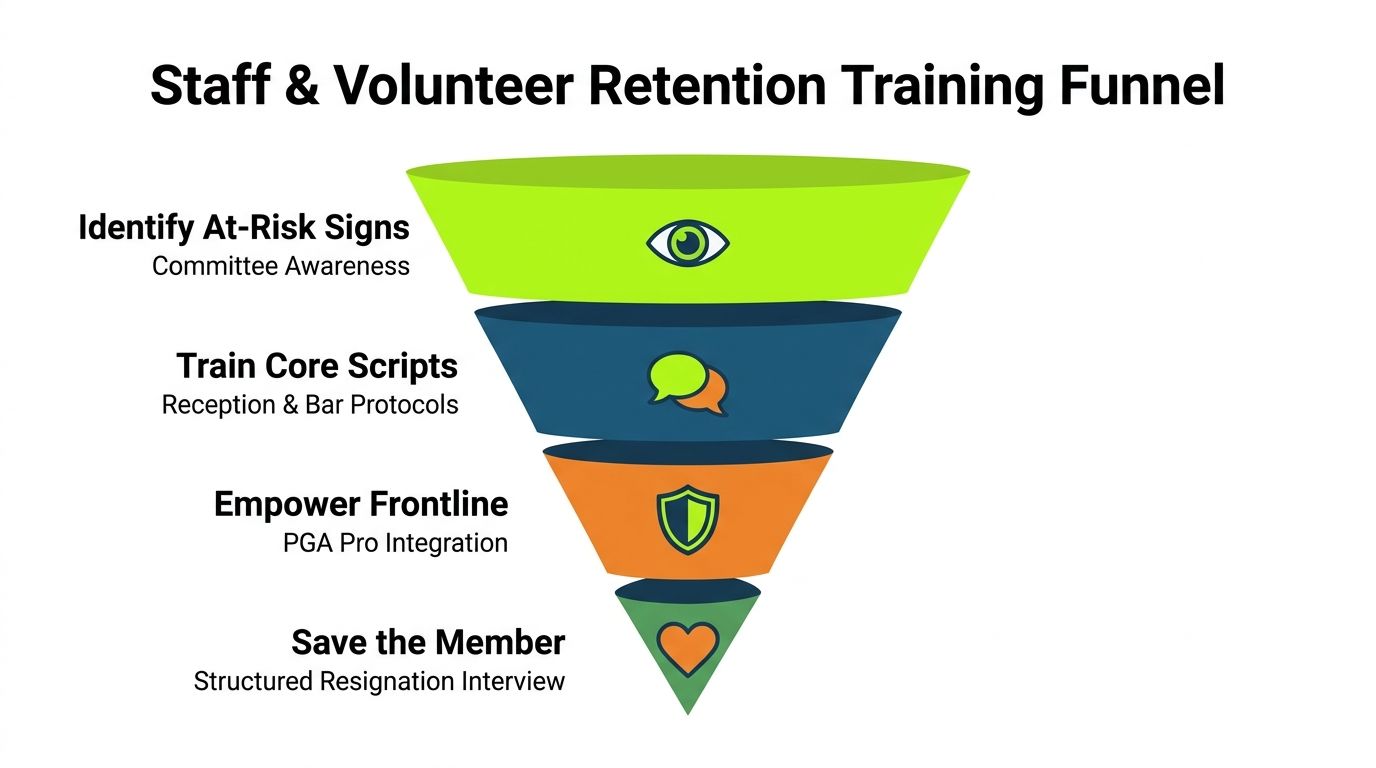
Training Volunteers, Staff and PGA Pros to Spot and Save At-Risk Members
Many clubs rely on instinct rather than a documented process for spotting at-risk members. A receptionist, bar team member, PGA pro, or committee volunteer may care about the club and still miss the warning signs, because caring and knowing what to do are different things. Retention becomes dependable only when the club writes down the behaviour it wants to track, trains the response, and gives one person ownership of the save process.
A monthly membership huddle helps more than many clubs realise. Keep it short, use real names, and review quiet members, new joiners, no-shows, resignation hints, and recent praise. The point is not to create a tribunal. It is to make the club notice patterns before they turn into losses.
What frontline staff need to recognise
The most useful signals are usually ordinary. A member stops booking, stops chatting at the bar, avoids competitions, or becomes less responsive to general notices. Frontline staff often see that first, which is why reception scripts and bar-side awareness matter. A simple “Have you enjoyed the course recently?” or “Would you like me to point you towards the next members' event?” can reopen a conversation that would otherwise never happen.
The PGA pro also has a role here. A member who is disengaging may not need a sales pitch. They may need a playing recommendation, a lesson offer, or an easier route back into the social side of the club. That is a retention task, not just a coaching one.
A clean resignation conversation
When a member says they are thinking of leaving, the response should be calm and structured.
- Acknowledge first: “Thanks for telling us, and I'm sorry to hear that.”
- Ask one useful question: “What's the main reason you're considering it?”
- Listen without pushing: do not argue, justify, or jump to discounting.
- Record the reason in the CRM: moved, financial, played less, life change, dissatisfaction.
- Escalate to the named owner: the person responsible for the save process.
What not to offer straight away is a blanket discount. That trains the whole club to wait for one. A better response might be a frozen category, a simpler membership type, a pause option, or a specific support offer such as a lesson or an introduction to a regular playing group.
How to run winback properly
Lapsed members are usually warm contacts because they already know the course, the people, and the environment. That makes them a better re-acquisition source than a cold prospect, provided the club handles them with structure. The sequence should start with a personal call, then move to email, then a targeted landing page or contact form if needed.
Segment the reason before you send anything. Someone who moved away needs a different path from someone who played less or became unhappy. Timing matters too, with checks at 30, 90 and 180 days after leaving so the club does not lose the thread. A practical comparison of exit signals and recovery points is laid out in this guide to golf club churn rate. A re-join incentive can work in some cases, but it should not become the default answer to every exit.
A practical re-joining conversation sounds like this, “We have noted your circumstances changed. If the club is ever the right fit again, we can talk through the options that suit how you would use it.” That leaves the door open without sounding needy.
The mistake many clubs make here is trying to rescue everyone with the same offer. The right process is narrower, calmer, and easier to repeat. It also gives the committee better evidence about which reasons for leaving are controllable and which ones are not. For a fuller explanation of how exits, cohorts, and recovery windows fit together, the cohort retention glossary is a useful reference point.
Measuring Retention With Cohort Analysis and Leading Indicators
Retention meetings go better when the club looks at cohorts rather than just totals. Total membership can hide a weak intake year, while cohort analysis shows whether this year's joiners are behaving differently from last year's. That matters because you need to know whether a change in onboarding, communications, or category design is working for the people who arrived under it.
A practical dashboard for a secretary or general manager should track retention by joiner cohort, acquisition channel, membership category, average rounds played among retained members, resignation reason trend, time to second round, and a simple CRM engagement score. For a clear explanation of the language behind that kind of reporting, the cohort retention glossary is a useful reference point.
Read the numbers in the right order
Start with who stayed, then ask why. If a cohort is weaker than expected, don't jump straight to price. Check whether the joiners were contacted quickly, whether they got to a first round, whether they appeared in events, and whether their last visit dates have drifted.
That matters because resignations are a lagging indicator. By the time they show up, the leading indicators have already moved. Quiet booking patterns, low event attendance, and delayed second rounds tend to tell you more than the resignation email itself.
A sensible rollout for a small club team
A realistic implementation plan fits around a busy season and a small staff group.
- Days 1 to 30: audit resignations, agree the dashboard, and set up the CRM fields.
- Days 31 to 60: launch the 180-day onboarding sequence, train staff and the PGA pro, and schedule the first membership huddle.
- Days 61 to 90: roll out the engagement calendar, start the winback campaign, and report the first cohort numbers.
That sequence keeps change manageable. It also avoids the common mistake of launching five new initiatives at once and then wondering which one broke.
Common mistakes clubs keep repeating
- Too many messages, not enough ownership.
- Discounting before diagnosis.
- Measuring renewals only, not activity.
- Leaving frontline staff out of the retention process.
- Treating lapsed members as an afterthought instead of a pipeline.
For clubs that want a practical view of churn mechanics, the internal guide on golf club churn rate ties the same principles back to measurable loss patterns. The committee doesn't need more noise. It needs a cleaner picture of where members slip away and which intervention kept them.
If your club wants help turning enquiry handling, onboarding, and member follow-up into a system rather than a set of good intentions, GolfRep builds the CRM, automation, and follow-up structure around it. We work with clubs that need clearer lead visibility, better conversion tracking, and a retention process staff can run during a busy season.
Ready to tap into our proven growth system?