Boost Golf Club Member Retention: 2026 Guide to Loyalty

Most advice on golf club member retention starts in the wrong place.
It tells clubs to generate more enquiries, run another joining campaign, or sharpen the offer at renewal time. That sounds sensible until you look at what happens inside many clubs. Enquiries sit in inboxes. Follow-up depends on one busy staff member. New members receive a welcome pack, then silence. By the time a resignation lands, nobody can clearly see the warning signs that were there months earlier.
At GolfRep, we see the same pattern repeatedly across the UK market. The issue usually isn't demand alone. It's the lack of an operational system that handles enquiries properly, moves prospects into membership smoothly, and then keeps members engaged through structured follow-up. Clubs don't just need more leads. They need visibility, response discipline, onboarding, and retention processes that don't rely on memory and goodwill.
Why Your Club's Real Problem Is Not New Enquiries
Many committees still treat membership growth as an acquisition problem. If numbers are flat, the answer must be more advertising, more open days, more trial offers, or more social media. That thinking is expensive because it ignores the leak in the bucket.
A club can generate steady interest and still go backwards if members leave through the side door. According to a 2023/24 survey of UK members' golf clubs by Hillier Hopkins, 24% of clubs reported more leavers than joiners, which means nearly one in four clubs saw net membership decline despite a rising average of new joiners. That's the clearest sign possible that acquisition alone isn't enough.
Enquiries are only useful if your club can convert and keep people
Most clubs don't have a lead problem in the way they think they do. They have a handling problem.
An enquiry comes in through the website. Someone intends to call back later. The prospect goes cold. Or they visit, join, and then spend the first few months trying to work out where they fit. Nobody notices they've stopped booking tee times. Nobody checks whether they've entered a competition, attended an event, or met anyone beyond the person who processed their payment.
That isn't a marketing issue. It's an operational one.
Practical rule: If your club can't see where enquiries stall, where new members disengage, and which members are drifting, more lead generation simply feeds a broken process.
What stagnation usually looks like in real life
At club level, the symptoms are familiar:
- The office is reactive: Staff answer what's urgent today, not what matters for long-term retention.
- Follow-up is inconsistent: Some prospects get called quickly, others wait too long.
- Onboarding is administrative: New members receive forms and information, but not integration.
- Warning signs stay invisible: Reduced play, lower event attendance, or silence at renewal time aren't tracked in one place.
The result is predictable. Clubs spend time and money attracting prospects, then rely on manual habits to convert them and retain them.
Growth needs a system, not a burst of activity
The clubs that create predictable membership don't separate acquisition from retention. They connect them. They track the enquiry, record the visit, manage the joining process, and then continue communication after the sale. They understand that golf club member retention starts before the invoice is paid, because expectations are shaped from the first response.
If a club manager wants steadier numbers, the first question isn't “How do we get more enquiries?” It's “What happens to every enquiry and every new member once they enter the club's pipeline?”
That's where the main gains sit.
Diagnosing Your Retention Leaks with Data
Retention problems rarely appear without warning. Clubs usually have the clues already. They're just scattered across tee booking software, membership records, event lists, bar spend reports, email inboxes, and a few conversations nobody logged.
The fix starts with visibility.
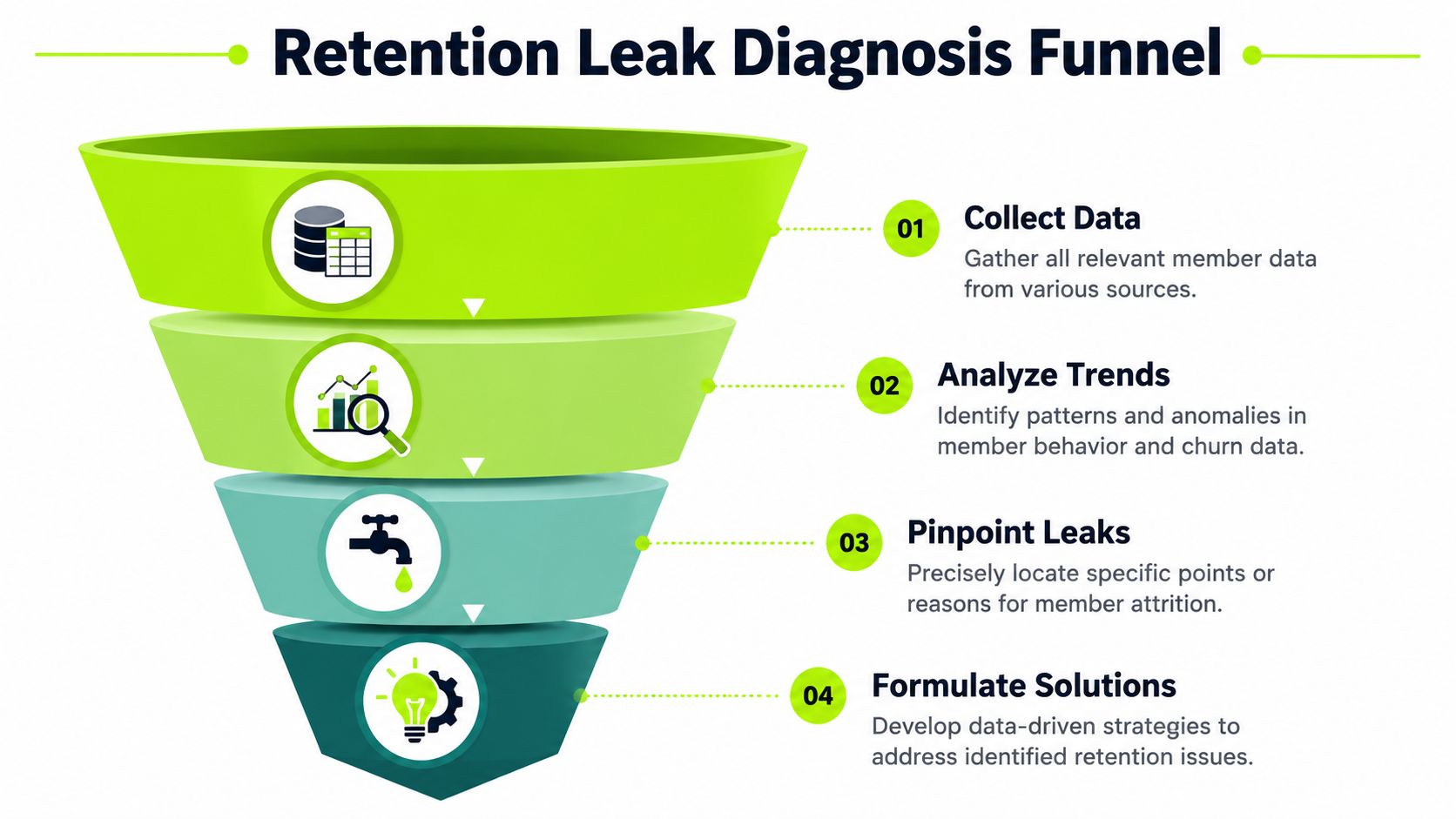
Start with one member view
If your club manager, membership secretary, and professional shop team all hold different bits of the story, you can't diagnose churn properly. Build a single working view of each member using simple fields your club can maintain consistently.
Track details such as:
| Member signal | Why it matters |
|---|---|
| Joining date | Helps identify first-year risk and renewal timing |
| Membership category | Shows whether certain products struggle to retain |
| Playing frequency | Spots members whose routines are weakening |
| Competition entry | Signals social connection and club involvement |
| Event attendance | Reveals who is engaging beyond the course |
| Household or family status | Helps shape relevant communication and programming |
| Notes from staff contact | Adds context no booking report can show |
This isn't about turning your club into a data lab. It's about making sure someone can answer a simple question quickly: who is drifting, and why?
Look for drop-off points, not just resignations
Most clubs only analyse retention when a member leaves. That's too late. The better approach is to inspect the member journey for moments where engagement weakens.
Useful questions include:
- Are new members booking regularly after joining, or dropping away early?
- Do some categories engage with golf but ignore social events, or vice versa?
- Are under-45s and families finding relevant ways to use the club?
- Do members go quiet before renewal, or much earlier?
A churn figure on its own won't tell you much. Behaviour patterns will.
For clubs that want a quick way to frame the maths, a simple tool for retention analysis can help you sense-check retention rate calculations before you build a fuller internal dashboard.
Create an at-risk list your team can actually use
Many clubs overcomplicate things. You don't need advanced modelling. You need a practical list.
A member who used to play often, attended occasionally, and then stops appearing in the booking sheet shouldn't be treated as a future resignation. They should be treated as an active follow-up task.
Build a weekly review around members who show some combination of these signals:
- Reduced tee bookings: Their usual pattern has changed noticeably.
- No recent event participation: They're no longer turning up beyond casual play.
- Little or no staff interaction: Nobody has spoken to them in a meaningful way.
- Approaching renewal with low recent usage: Value may now feel unclear to them.
If you want a useful primer on how clubs think about attrition in practical terms, GolfRep's guide to golf club churn rate is a good operational reference point.
Turn diagnosis into action
Data only matters when it triggers behaviour. Assign someone to review the at-risk list weekly. Decide what happens next. That might be a phone call, an invitation to a suitable event, a check-in from the professional, or a conversation about a membership category that suits current playing habits better.
Clubs lose members when information exists but nobody owns it. Diagnosis needs to lead straight to intervention.
The Critical 180-Day Member Onboarding System
A welcome email isn't onboarding. A bag tag isn't onboarding. A handbook full of rules certainly isn't onboarding.
For golf club member retention, the first six months matter far more than most clubs realise. England Golf notes in its retention guidance that converting a new club member is a 3-year process, and that up to 25% of new members leave in their first year if they are not properly integrated into the club's lifestyle. It also highlights the importance of a structured process in the first 180 days.
That should change how every club handles a new joiner.
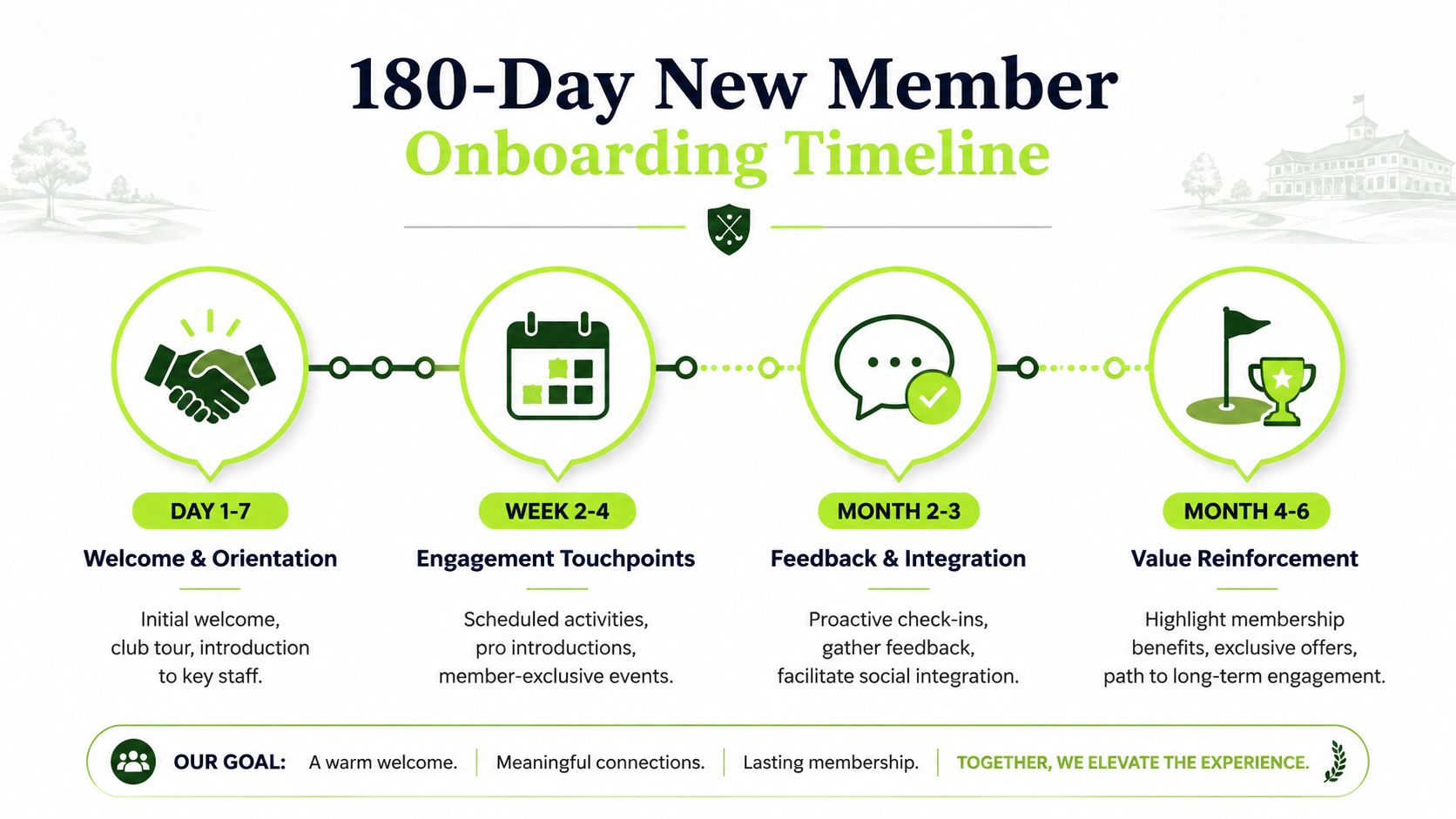
What a proper onboarding system looks like
The strongest onboarding systems combine CRM triggers, staff accountability, and personal contact. Not one or the other. Both.
A new member joins. Their interests are recorded properly. They're tagged by category, age band, playing preference, and whether they joined as an individual, couple, or family. The system then prompts the right next steps automatically, so nothing depends on someone remembering to follow up next Thursday.
A workable sequence often includes:
- Early welcome contact: A personal message from the club manager or membership lead, not just an automated receipt.
- Relevant introductions: Pair the member with a captain, organiser, or existing member who suits their profile.
- Event invitations that fit: Midweek roll-ups, women's golf, junior pathways, family socials, beginner-friendly competitions, or non-golf gatherings.
- Usage checks: If they haven't booked, played, or attended, the system flags it for outreach.
Make the journey feel personal without making it manual
Automation gets misunderstood in golf clubs. People assume it means robotic communication. Used properly, it does the opposite. It protects the personal moments because the routine tasks are handled consistently.
Here's a typical example.
A new member joins after visiting the club on a Saturday. In the CRM, they're marked as a weekend golfer who wants competitions but is also new to the area. That should trigger a personalized follow-up path. They receive a welcome message, an invitation to a suitable upcoming event, a note introducing the competition organiser, and a reminder to book a short check-in with the professional or membership lead.
If there's no activity after that, the system should alert a human to step in.
That's why a dedicated golf CRM system matters. It doesn't replace relationships. It gives your staff the structure to build them at the right moment.
Operational insight: The biggest onboarding failure isn't poor intent. It's relying on busy people to remember every touchpoint for every new member.
The first 180 days need planned milestones
The safest way to manage this period is to define clear stages:
| Timeframe | What the club should do |
|---|---|
| First week | Welcome, orientation, key contacts, explain how to get started |
| First month | Introduce events, golfing groups, and relevant social routes |
| Following months | Check participation, ask for feedback, remove friction |
| By six months | Reinforce value, confirm integration, intervene if usage is low |
The key difference is this. Traditional onboarding gives information. Effective onboarding creates belonging.
And belonging doesn't happen because the club hopes it will. It happens because someone designed the process and made sure the system supports it.
Driving Engagement with Strategic Programming and Benefits
A busy diary doesn't automatically create retention. Many clubs prove that every year. They run the same dinners, the same formats, the same member notices, and then wonder why parts of the membership barely engage.
Retention improves when programming reflects how different members use the club.

Flexible membership is now part of the retention conversation
The traditional model still works for some golfers, but it doesn't fit everyone. According to the Hillier Hopkins 2024/25 golf clubs survey, 40% of members' clubs and 64% of proprietary clubs offer flexible membership options. That growth reflects a clear shift in how clubs are adapting to member needs.
The lesson isn't that every club should dilute its core membership. It's that rigid structures lose people whose time, family schedule, work pattern, or playing habit no longer matches a single all-in package.
More events isn't the answer. Better-matched events are
Clubs often say, “We already run plenty.” That may be true. The question is whether the right members want what's on the calendar.
A practical way to review programming is to compare three things:
| Segment | Common mistake | Better retention move |
|---|---|---|
| Younger working members | Midweek-heavy diary and formal formats | Time-friendly formats and lower-friction entry points |
| Families | Golf-only messaging | Family-friendly social use and shared club experiences |
| Infrequent golfers | Full-commitment expectation | Flexible use models linked to actual habits |
You don't need to become all things to all people. You do need to stop assuming one member journey suits everyone.
Build benefits around behaviour, not tradition
Some members want competition and routine. Others want social belonging, occasional play, and easier access to the club around work and family life. If your benefits are framed only around tee access, handicap, and fixture lists, you'll miss part of the value modern members seek.
That's where clubs can learn from broader membership thinking. Good digital communities work hard on belonging, habit, and relevance, not just access. The same principle appears in this guide on retaining members in online communities, and the lesson translates well to golf clubs: people stay where participation feels natural and recognised.
A useful internal exercise is to audit your calendar and member communications against real segments:
- Established competitive golfers: Are they still getting strong core golf value?
- Newer social members: Do they have low-pressure ways to take part?
- Couples and families: Is there anything designed with them in mind?
- Time-poor members: Do they have a route that feels realistic rather than second-class?
For clubs reviewing event planning and usage of the clubhouse, this article on clubhouse event marketing strategy offers a useful lens on how to make programming more intentional.
Clubs retain members when they make the club easier to belong to, not when they simply add more dates to the diary.
How to Position Value and End the Discounting Cycle
Discounting feels like action. That's why clubs keep reaching for it.
A renewal incentive, an initiation fee reduction, a limited-time joining offer, a cheap trial. Each one promises a quick fix. The problem is that price-led growth usually creates price-led loyalty, and that's weak loyalty.
The better position is often the harder one to hold. Explain value clearly. Protect the core product. Give people membership routes that match behaviour rather than slashing headline price.
According to Play More Golf's guidance on enhancing member retention at your golf club, discounting erodes perceived value and attracts members who are less likely to be retained long-term, while a value-led approach built around flexible, behaviour-linked models supports stronger retention.
Why discounts usually create the wrong expectation
Once a club trains the market to wait for offers, two things happen.
First, existing members start to question what full price really means. Second, prospects begin comparing your club on discount mechanics rather than fit, culture, course quality, convenience, and experience. That weakens your position before the relationship has even started.
A club that relies on discounts also tends to attract people making a short-term purchase decision. They may join because the entry price fell. They won't necessarily stay when the standard fee returns and they still haven't built a habit or social connection.
What to say instead of cutting price
Staff need stronger language around value. Not vague statements. Specific reasons your club is worth joining and worth staying in.
Use value points such as:
- Belonging: Who will this member meet? How quickly can they become part of club life?
- Ease of use: How easy is it to book, play, attend, and understand what's available?
- Fit: Which membership path aligns with their actual playing pattern?
- Experience: What makes the club feel organised, welcoming, and worth returning to?
Manager's test: If a prospect asks, “Why should I pay this here?”, your team should be able to answer without mentioning a discount.
Flexible isn't the same as cheap
Some clubs often get stuck. They assume the only alternative to discounting is rigid pricing. It isn't.
A flexible, behaviour-linked model can preserve value because it aligns cost with usage while keeping the premium full membership intact. That gives members an option when life changes, without telling the market your core product is overpriced.
Examples of stronger positioning include:
| Weak approach | Stronger approach |
|---|---|
| Joining fee waived this month | Clear explanation of what membership unlocks and who it suits |
| Short-term low-price offer | Structured pathway into the club with planned follow-up |
| Generic “best value” claim | Specific benefits matched to different member profiles |
| One-size-fits-all package | Different routes based on playing habits and availability |
The club's job isn't to be the cheapest local option. It's to make the value obvious, credible, and consistent from first enquiry through renewal.
Assigning Roles and Measuring What Matters for Retention
Retention systems fail when everybody cares about retention but nobody owns the work.
That's common in golf clubs. The committee assumes the office is handling it. The office assumes the professional team will flag issues. The professional team assumes the member will speak up if something is wrong. In practice, the warning signs drift past unnoticed.
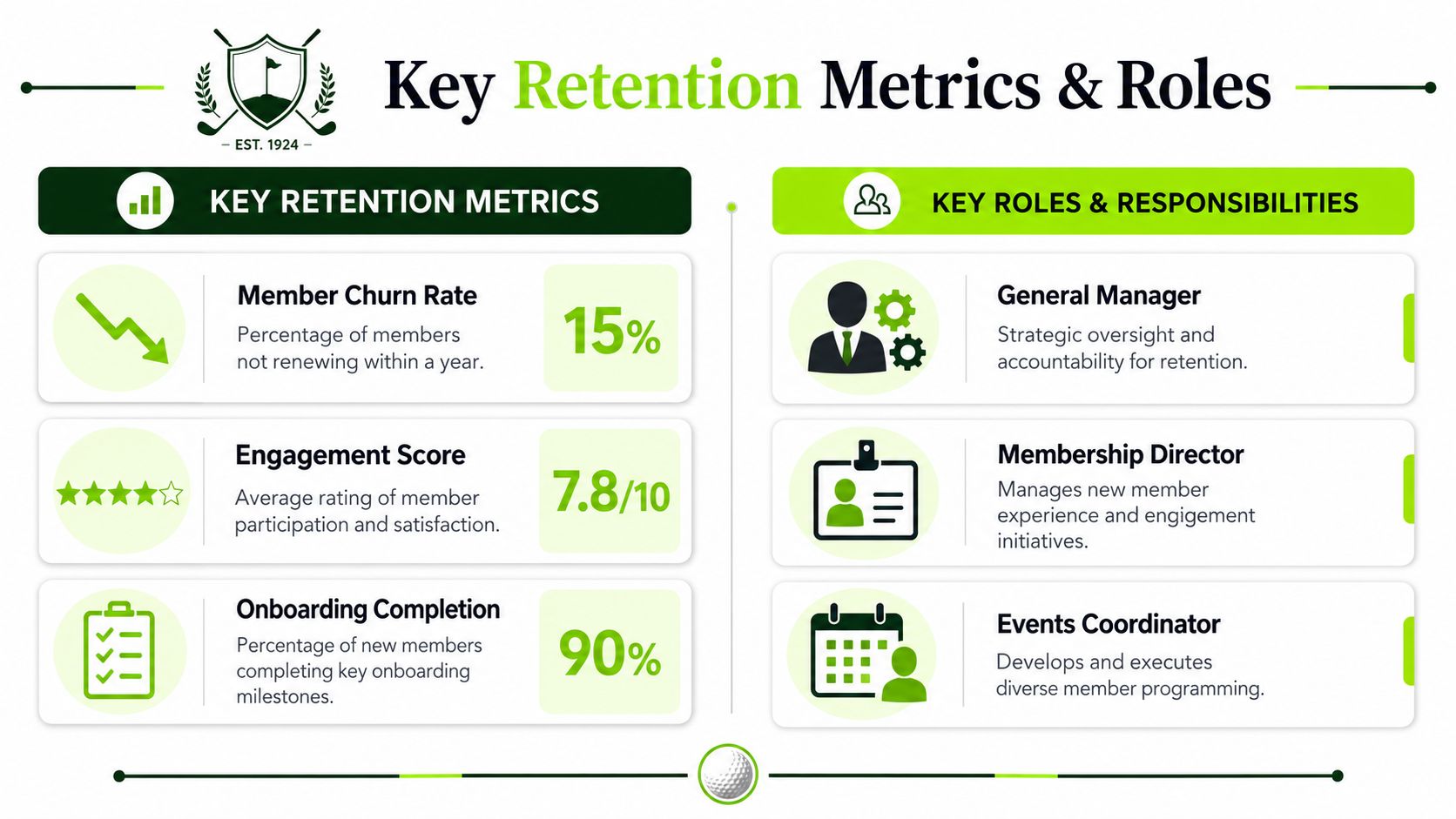
Give retention clear ownership
A practical setup usually looks like this:
- General Manager: Owns the retention plan, reporting, and standards across departments.
- Membership Secretary or manager: Tracks onboarding progress, member communications, and renewal risk.
- Professional team: Flags behaviour changes, low engagement, and opportunities for reactivation.
- Events or clubhouse lead: Monitors participation and whether programming matches member segments.
- Committee or board: Reviews retention health at decision level instead of discussing only top-line membership count.
The point isn't to create bureaucracy. It's to stop key actions falling into the gap between roles.
Measure behaviours, not just headcount
Most clubs look at one number too late. Total members. By itself, that number hides the story.
Track indicators that show whether your system is working:
| What to measure | Why it matters |
|---|---|
| Enquiry response time | Slow replies damage conversion before membership even starts |
| Visit-to-join conversion | Shows whether follow-up is effective after initial interest |
| Onboarding completion | Confirms new members are actually moving through the first key steps |
| Playing and event participation | Reveals who is integrating and who is fading out |
| Renewal risk list | Forces action before resignation arrives |
A monthly review should lead to decisions, not just observations. Which members need contact? Which categories are under-engaged? Which events aren't pulling the right people? Which staff tasks are slipping because the process is too manual?
Retention improves when clubs treat it like an operating system, not a seasonal conversation.
The clubs that hold members well usually do ordinary things with unusual consistency. They respond quickly, record information properly, follow a clear onboarding path, and act when behaviour changes. That's less glamorous than a new campaign, but it's far more dependable.
GolfRep helps golf clubs build that kind of dependable system. If your club wants a clearer view of enquiries, better follow-up, structured onboarding, and a more predictable membership pipeline, you can explore how GolfRep approaches retention and growth without relying on discounts.
Ready to tap into our proven growth system?