Golf Club Membership Drive: A Practical Playbook for 2026
Most golf club membership drives underperform for a boring reason. The advertising gets the attention, but the follow-up system cannot turn that attention into booked visits, conversations, and signed memberships.
I see the same failure pattern across clubs. An enquiry lands in a shared inbox. Staff reply between other jobs. A phone lead is written on a pad, then missed. A prospect asks about joining, but no one owns the next step or checks whether a tour was arranged. The committee reviews the campaign and asks for more marketing spend, even though the critical inefficiency sits after the enquiry arrives.
GolfRep has covered this problem in detail in its analysis of why most golf club marketing fails. The short version is simple. Membership growth becomes predictable when the club runs lead handling like a sales process, with speed, tracking, and clear accountability.
Clubs are rarely short of interest alone. They are short of a reliable system for converting interest into revenue.
That is why a strong membership drive starts well before the first advert goes live. The offer matters. The targeting matters. But the clubs that grow consistently are usually the ones that respond quickly, follow up in a structured way, and move prospects from enquiry to visit without friction. Without that discipline, extra enquiries just create a bigger pile of missed chances.
Why Your Last Membership Drive Probably Disappointed You
If your last golf club membership drive disappointed you, it probably wasn't because too few people saw the offer.
The more common failure is operational. Clubs generate interest, then handle that interest with manual processes that were never designed for speed, consistency, or accountability. An enquiry lands by email. A member of staff replies when they can. Another prospect phones when the office is covering visitors. Someone fills in a form, but no one knows whether they were contacted, invited for a tour, or lost.
GolfRep's view is simple. A membership drive succeeds when the club treats enquiries like a pipeline, not a pile.
The key problem has already been laid out clearly in GolfRep's own analysis of why most golf club marketing fails. The bottleneck isn't usually lead generation. It's what happens after the lead arrives.
The wrong diagnosis
Many committees still ask one question after a weak campaign. How do we get more enquiries?
That question can be expensive, because it assumes the top of the funnel is broken. In reality, the club may already have enough interest to hit its target if it can respond quickly, track each lead properly, and move prospects towards a visit.
Most drives don't collapse because the message was unseen. They collapse because the prospect felt unseen.
What poor handling looks like in practice
A failed drive often includes a mix of familiar issues:
- Slow first replies: prospects wait too long for confirmation that anyone has received their enquiry.
- No lead ownership: staff assume someone else has followed up.
- Weak visibility: managers can't see where each prospect sits in the process.
- No tour discipline: visits happen ad hoc rather than through a booked pathway.
- No reporting: clubs know how many enquiries came in, but not how many became members.
The result is predictable. Marketing feels inconsistent, conversion feels mysterious, and decision-makers keep changing the promotion instead of fixing the system.
What to do instead
Start with a more useful question. If every current enquiry were handled properly, how many members would we win?
That reframes the job. Instead of chasing volume for its own sake, you build a process that protects every lead. Once that process is in place, advertising becomes more valuable because the club can absorb and convert demand instead of leaking it.
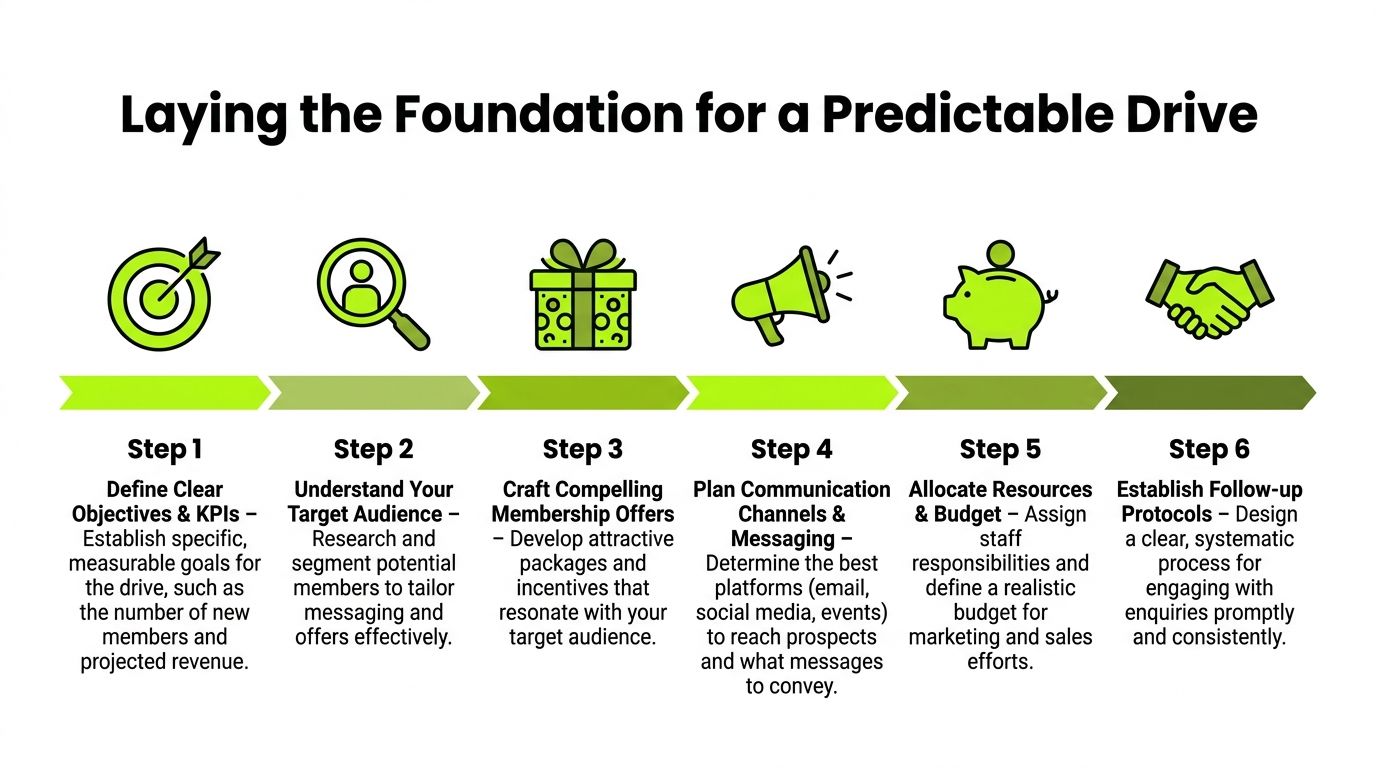
Laying the Foundation for a Predictable Drive
A predictable drive starts before the first advert goes live. Clubs that rush to creative, spend, or discounting usually end up with a campaign that looks active but feels vague.
The planning stage should answer three things. Who are you trying to attract. What offer makes sense for that audience. How will the club handle every enquiry from first click to first visit.
Start with member profiles, not broad categories
"New members" isn't a useful audience. It hides too many different buying behaviours.
Most clubs still aim their drive at the traditional full-time member, but the market has widened. The fastest-growing conversion pipeline is the nomadic iGolf segment, with 29,000 iGolfers joining clubs since 2021, including 9,000 brand-new members who previously had no club affiliation, as noted by the GCMA on the iGolf boom.
That has practical consequences. A golfer moving from iGolf into club membership doesn't think like a long-standing member switching clubs. They often want flexibility, clear booking access, simple handicap visibility, and a low-friction route into belonging.
Define a small number of target profiles such as:
- The returning member: somebody who left club golf years ago and now wants structure again.
- The flexible local golfer: somebody who plays often enough to justify value, but resists rigid commitment.
- The iGolfer ready to settle: somebody already engaged with the game but not yet attached to one venue.
Build the offer around buying reality
Many clubs create offers around what feels tidy internally rather than what a prospect can understand quickly.
That shows up in overcomplicated categories, unclear joining terms, and pricing pages that need explanation. Simplicity converts better. A prospect should be able to grasp the route in, what they get, and what happens next without emailing for basic clarification.
A few planning rules help:
- Remove ambiguity: make the entry point obvious.
- Protect margin: don't rely on blanket discounting to make the campaign work.
- Match the product to the segment: flexible golfers need a different pathway from traditional seven-day joiners.
There is still a major gap in practical guidance around credit-based or highly flexible membership models in the UK market, even though industry commentary points to growing demand for flexibility and notes affordability pressure among golfers in the Lightspeed review of golf course membership ideas. That means clubs need to test offers carefully rather than copy another venue's price list without context.
Practical rule: An attractive offer is one the prospect understands quickly and the club can fulfil profitably.
Map the campaign before launch
A drive becomes predictable when responsibilities are assigned in advance. That includes marketing, response handling, tour scheduling, and reporting.
A simple planning sequence works well:
| Stage | What the club needs to decide |
|---|---|
| Pre-launch | Audience, offer, landing page, enquiry flow |
| Launch | Messaging, creative, phone and email coverage |
| Active campaign | Response standards, tour booking process, lead review |
| Post-campaign | Conversion review, objections logged, next-cycle changes |
Clubs also benefit from stronger creative planning. Short-form video often helps explain atmosphere, course quality, and membership value more clearly than static graphics. For teams thinking about message delivery rather than just design, these video marketing insights for creators are useful because they focus on how content earns attention and prompts action.
Attracting the Right Enquiries Not Just More of Them
A golf club membership drive shouldn't try to collect the largest possible list of names. It should attract prospects who are likely to join if the club handles them well.
That's a different standard, and it changes how you judge marketing. High enquiry volume can look impressive in a committee report, but weak-fit leads consume staff time, clog inboxes, and distort conversion data. Focused campaigns often look smaller at the top and stronger at the bottom.
Why broad targeting wastes budget
Generic messaging tends to produce generic responses. "Join now", "memberships available", and "limited spaces" can generate clicks, but they often fail to pre-qualify interest.
A better campaign filters as it attracts. It speaks to a defined golfer, addresses a specific reason to consider membership, and makes the next step feel relevant. The ad should do some of the qualification before the form is ever completed.
That is where many clubs need more discipline around audience selection and screening. If your team wants a straightforward reference point on the questions that help separate curiosity from buying intent, this guide on how to qualify leads effectively is a useful prompt.
What a targeted campaign can do
A good example came from a UK-based campaign using precision-targeted Meta ads. It achieved an approximately 30% conversion rate from enquiry to 7-day member by offering a limited-time £500 joining fee, generated 71 highly qualified leads at £3.20 per lead, and produced £25,000 in new membership revenue within two months, according to this Meta ads case study for golf clubs.
The lesson isn't that every club should copy that exact offer. The lesson is that precision beats volume when the audience, message, and follow-up pathway line up.
How to tighten lead quality
A stronger acquisition campaign usually includes three ingredients:
- Specific audience choices: local golfers, lapsed members, flexible players, or iGolf-type prospects each need different messaging.
- Clear offer framing: the prospect should know whether this is a joining route, a trial pathway, or a flexible step into full membership.
- Intent-based next steps: don't ask for more detail than needed, but do ask enough to spot genuine interest.
Managers who want to improve this part of the pipeline should also review GolfRep's guidance on improving lead quality for golf clubs.
Better marketing doesn't just create demand. It filters for the kind of golfer your club can actually convert and retain.
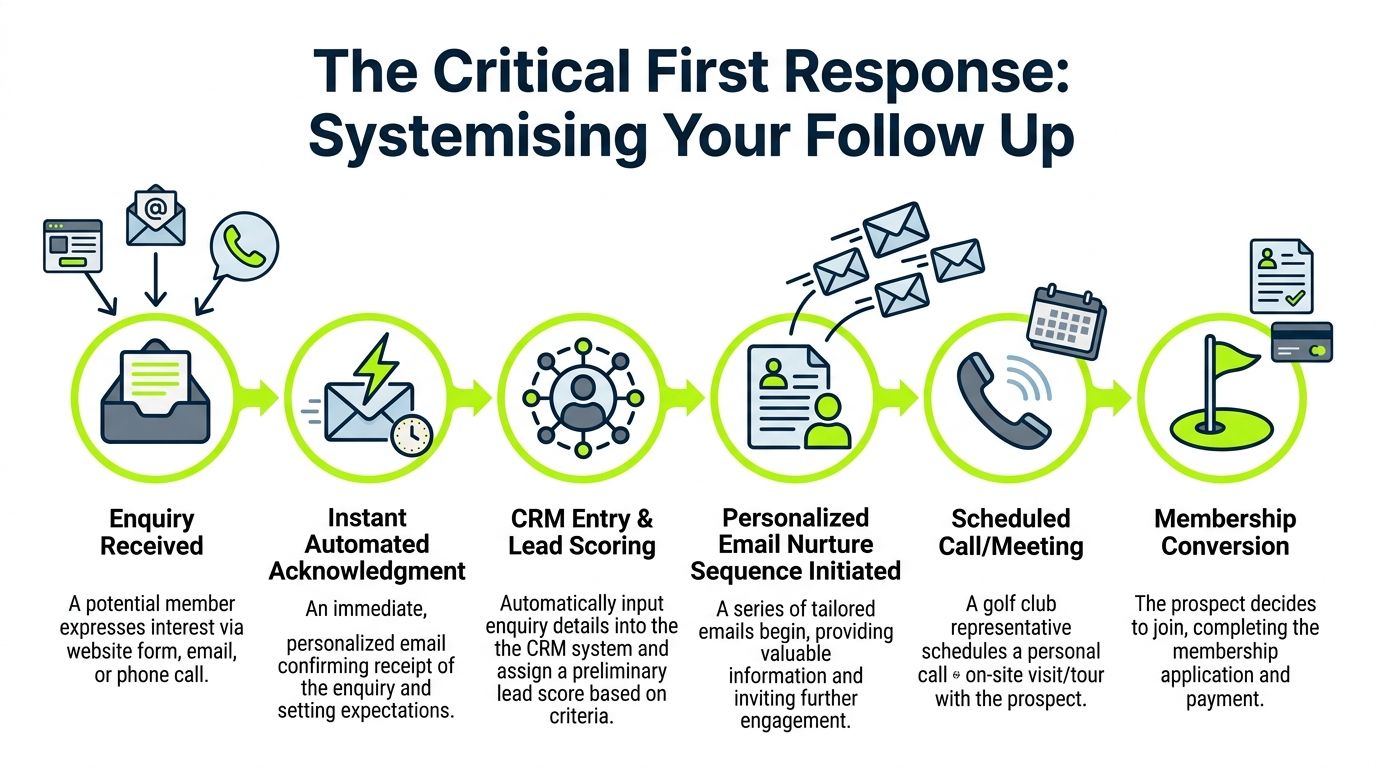
The Critical First Response Systemising Your Follow Up
The first response shapes the entire sales process. It tells the prospect whether the club is organised, attentive, and easy to deal with.
Most clubs still handle follow-up through a mixture of inbox monitoring, memory, and good intentions. That works until the office gets busy. Then response times drift, details get missed, and no one can see where the prospect stands.
The core issue is already clear. The GolfRep review of golf club membership enquiries found that the primary operational failure is not low enquiry volume, but slow response times and poor conversion tracking, with the most important metrics being average response time, lead contact rate, and tour booking rate.
What the first response must do
A useful first response doesn't try to close the sale. It does four smaller jobs well.
- Confirm receipt immediately: the prospect should know their enquiry has arrived.
- Set expectations: tell them what happens next and when.
- Create confidence: use a professional tone, clear language, and a named contact.
- Move them forward: offer a simple next action such as a call or club visit.
An instant acknowledgement matters because it protects intent. A golfer who enquires is interested now, not at some undefined point later. If the first reply is delayed, the club invites comparison shopping and gives the prospect time to cool off.
Why manual follow-up keeps failing
Manual follow-up isn't bad because staff don't care. It fails because it depends on memory and availability.
One team member responds quickly. Another is on annual leave. A phone lead is written on paper and never entered anywhere. A website form goes to a generic inbox. A promising enquiry gets one polite reply but no second touch when the prospect doesn't answer immediately.
That isn't a marketing issue. It's a system issue.
The clubs that convert consistently don't rely on heroic admin. They build a process that works on ordinary days, busy days, and staff absence days.
A simple response framework
A reliable setup usually looks like this:
Instant acknowledgement
Trigger an automatic email the moment the form is submitted. Keep it short. Thank the prospect, confirm receipt, and explain the next step.CRM capture
Every enquiry should enter one visible system. Not a spreadsheet one week and an inbox search the next. The club needs one record showing source, interest, contact attempts, and outcome.Assigned ownership
Someone must own the next action. Shared responsibility often means no responsibility.Timed follow-up sequence
If the prospect doesn't respond to the first manual contact, there should already be a planned second and third touch.Tour booking discipline
The purpose of follow-up is not endless email exchange. It's to move suitable prospects to a visit, call, or meeting.
A club can build this internally with the CRM it already uses, provided the workflow is clear. Some clubs use specialist support to combine lead generation, automated acknowledgements, nurture flows, and reporting in one managed system. GolfRep is one example of a UK golf-specific option built around that model.
Example of a first acknowledgement
Below is the kind of message that works because it's prompt and straightforward:
Thanks for your enquiry about membership at [Club Name]. We've received your details and a member of the team will be in touch shortly. If you'd prefer to visit the club sooner, you can reply to this email and we'll arrange a suitable time to show you around.
Then the club follows with a more personal message once someone has reviewed the lead.
For a fuller breakdown of how to structure that workflow, GolfRep's guide to a golf club follow-up system is a useful operational reference.
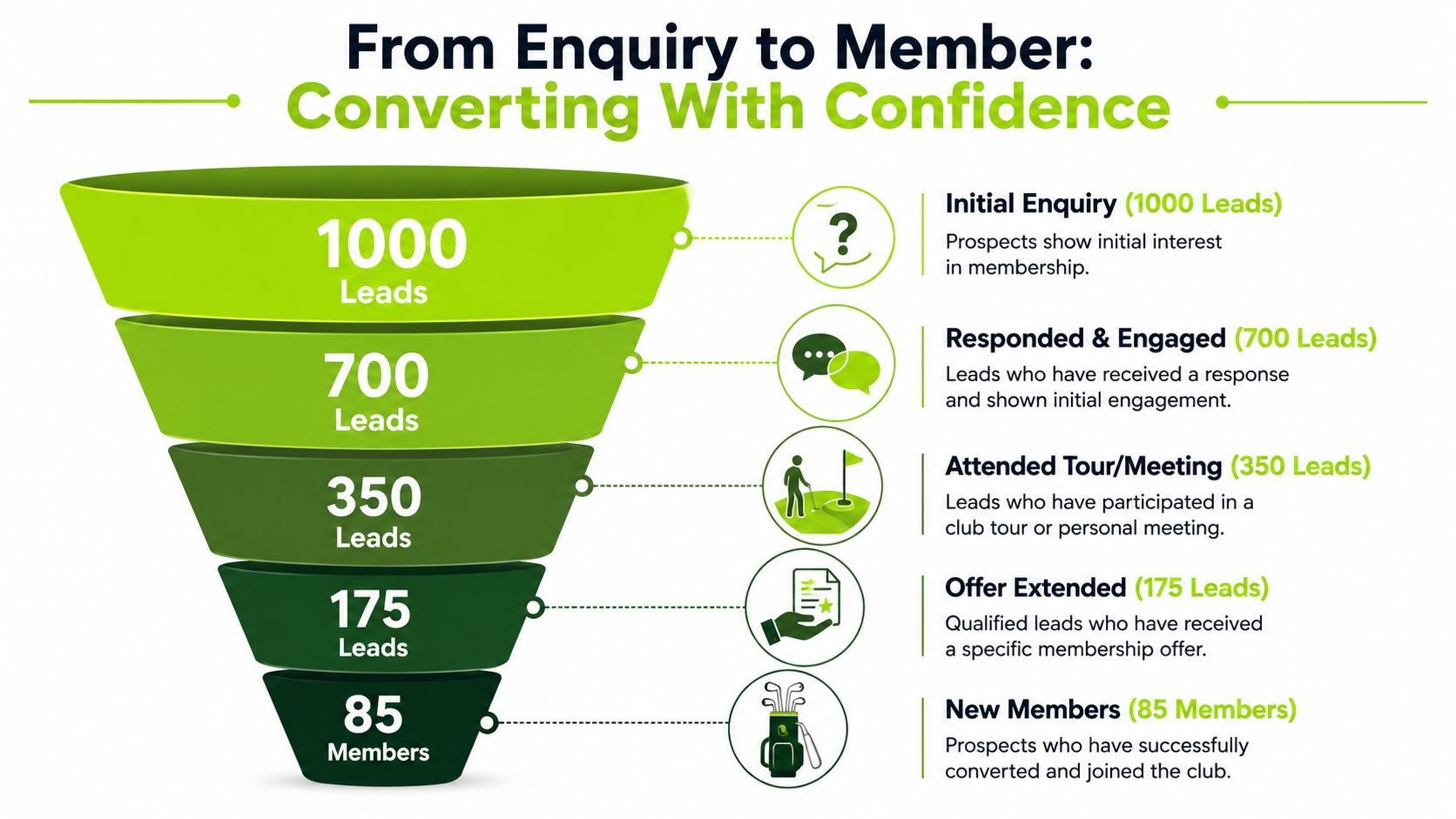
From Enquiry to Member Converting With Confidence
Once a prospect has enquired and received a strong first response, the job changes. The club now needs to reduce uncertainty.
Most golfers don't join because they were chased hardest. They join because the club made the decision easy. That usually happens through a sequence of useful contact points that answer practical questions before hesitation turns into silence.
A strong nurture journey feels helpful
A prospect's early questions are predictable. Can I play when I want. How busy is the course. What's included. How straightforward is the joining process. Will I fit in here.
A good nurture flow answers those questions across several touches rather than dumping everything into one long email. It might include a welcome message, a short note about membership categories, an invitation to tour the club, and a follow-up focused on daily experience such as tee availability, competitions, practice access, or community.
Why tours still matter
The tour is often the moment the prospect stops comparing and starts deciding. That's because membership is not just a price decision. It's a confidence decision.
The club visit should feel structured. Not a rushed walk to the first tee between tasks. Assign a host, prepare a short route, and make sure the prospect hears the details that matter to their likely membership type.
A few things make tours convert better:
- Context before the visit: send a confirmation with who they'll meet and what they'll see.
- Relevance during the visit: tailor the conversation to the prospect's playing habits and concerns.
- Follow-up after the visit: summarise what was discussed and make the joining step simple.
A tour should answer, "Can I see myself here?" If it only lists facilities, it has missed the point.
Match conversion to local affordability
One reason nurture needs to be adjusted is that affordability isn't uniform. The GolfSupport affordability league table for golf club membership shows a sharp regional spread, with residents in Newcastle Upon Tyne needing 41 hours of work to afford membership, compared with 79 hours in Southampton.
That doesn't mean one area is easy and another is impossible. It means your conversion messaging should reflect local economic reality. In one market, certainty and convenience may be enough. In another, prospects may need clearer explanation of value, payment structure, or the practical difference between visitor spend and membership commitment.
Convert without sounding desperate
Clubs often weaken conversion at the final step by becoming too passive or too pushy.
The passive version says, "Let us know if you have any questions." The pushy version jumps straight to discounting. Neither is ideal.
A better close is calm and specific. Confirm the category discussed, explain the joining process, set out any relevant timing, and invite a clear next action. Confidence converts better than pressure.
Measuring What Matters Revenue and Retention
A membership drive is not finished when the adverts stop. It is finished when you know what revenue came in, what it cost to acquire, and how many of those joiners still look healthy 6 to 12 months later.
Too many clubs review a drive like a marketing exercise. They count enquiries, compare the total with last year, and call it a result or a disappointment. That misses the essential point. Membership growth becomes predictable when the club measures the full commercial chain, from first response to signed direct debit to early retention.
As noted earlier, industry reporting shows that clubs are still bringing in meaningful numbers of new members. The gap is not whether demand exists. The gap is whether your club can convert that demand consistently, then keep the members it worked to win.
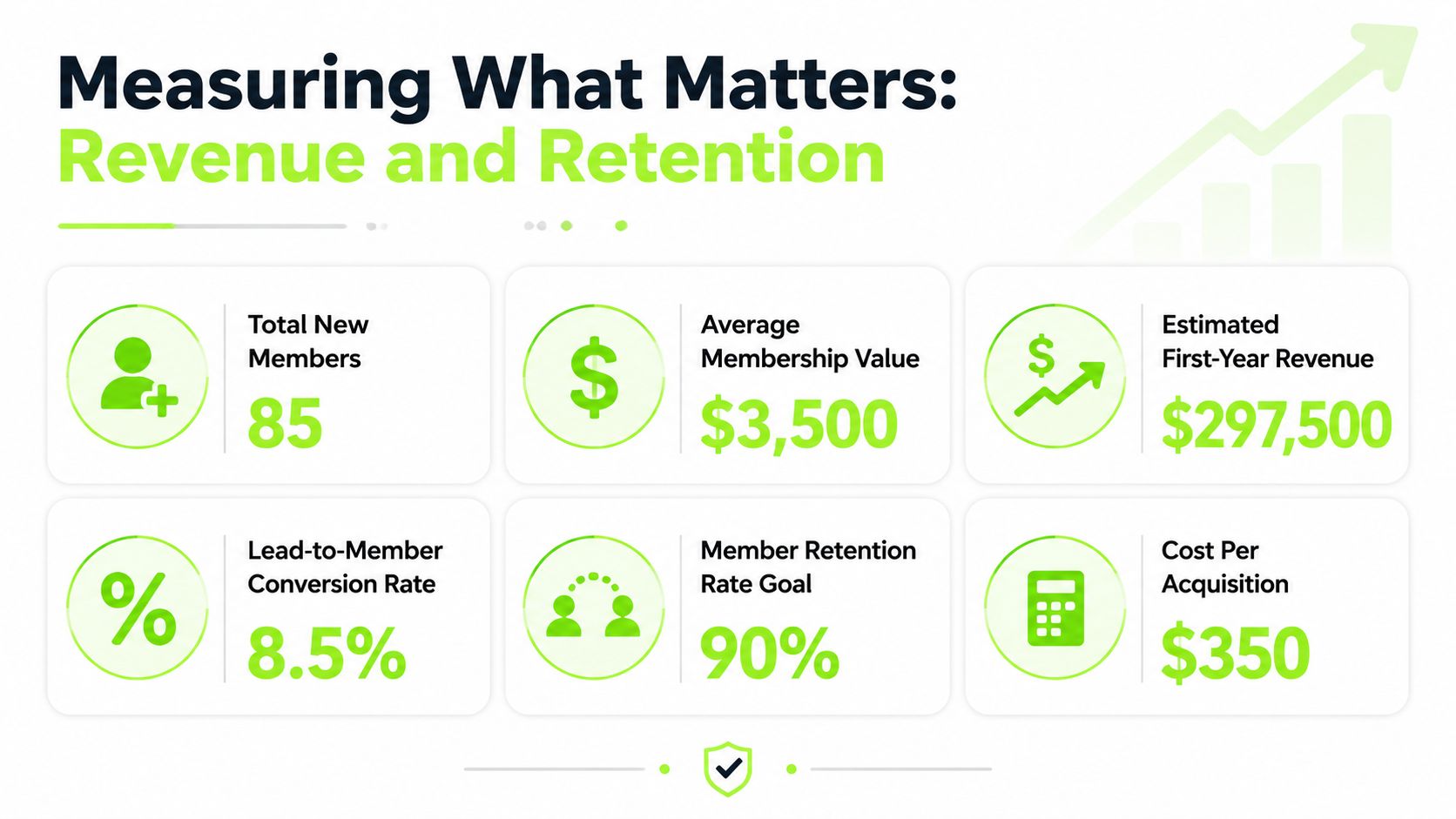
The KPIs worth watching
The best KPIs tie activity to money and member quality. Vanity metrics do not help a manager make better decisions.
| KPI | Why it matters |
|---|---|
| Cost per enquiry | Shows what it takes to generate initial interest |
| Cost per acquisition | Shows what it takes to win an actual member |
| Lead contact rate | Shows whether your staff and process are actually reaching prospects |
| Tour booking rate | Shows whether follow-up is creating real sales conversations |
| Lead-to-member conversion | Shows whether the full system works, not just the advertising |
| Retention after joining | Protects long-term member value, not just first-year cash |
One warning here. A cheap enquiry is often an expensive member if the lead never answers, never visits, or joins on the wrong category and leaves quickly. I would rather see a club paying more for well-matched enquiries that convert cleanly than celebrating low lead costs from weak traffic.
What managers should review after every drive
A useful review is short, specific, and tied to decisions. Pull the numbers while they are still fresh, then ask:
- Which source produced the best-fit enquiries
- How fast did the club respond on average
- How many leads received a personal follow-up, not just an automated reply
- How many prospects progressed to a tour or trial step
- Where did leads stall or disappear
- Which objections came up repeatedly
- Which membership category held up best after joining
That final point matters more than many clubs admit. A drive can look strong at month one and weak by month six if new members joined under pressure, joined on the wrong package, or arrived with expectations the club did not set properly. Revenue quality matters as much as revenue volume.
Good post-campaign analysis gives you a working system. It shows whether the problem sat in targeting, response speed, visit handling, closing, or onboarding. That is how a club stops blaming the advert for losses that were really caused by follow-up gaps.
If your club wants a clearer membership pipeline, GolfRep helps UK golf clubs build structured enquiry handling, follow-up systems, and conversion tracking so membership growth isn't left to chance.
Ready to tap into our proven growth system?