How to Improve Lead Quality: Golf Club Guide 2026

Most advice on how to improve lead quality starts in the wrong place. It tells clubs to buy more traffic, run more campaigns, and widen the top of the funnel.
That sounds sensible until you look at what happens inside most clubs.
Enquiries arrive. Nobody knows which source produced them. A staff member replies when they get a chance. Some prospects get a call, others get an email, and others disappear into a spreadsheet that never gets updated. The problem isn't demand. The problem is handling.
For golf clubs, lead quality is usually a systems issue, not a marketing issue. A poor process makes good enquiries look weak. A structured process makes the right enquiries easier to spot, faster to contact, and more likely to convert into visits, conversations, and memberships.
Why More Enquiries Are Not the Answer
The most common mistake in club marketing is treating volume as progress.
If a club says it needs better leads, the default response is often to generate more of them. More Meta ads. More Google Ads. More website forms. More budget. But adding more enquiries into a weak follow-up process doesn't improve lead quality. It just creates more missed calls, more delayed responses, and more uncertainty about what is and isn't working.
Industry guidance in the UK golf sector points to the same sequence problem. Clubs improve lead quality when they track post-enquiry conversion, prioritise speed-to-lead, maintain follow-up consistency, and qualify leads before trying to scale traffic, while many clubs start too late in the chain by focusing on traffic volume first according to this GolfRep industry post.
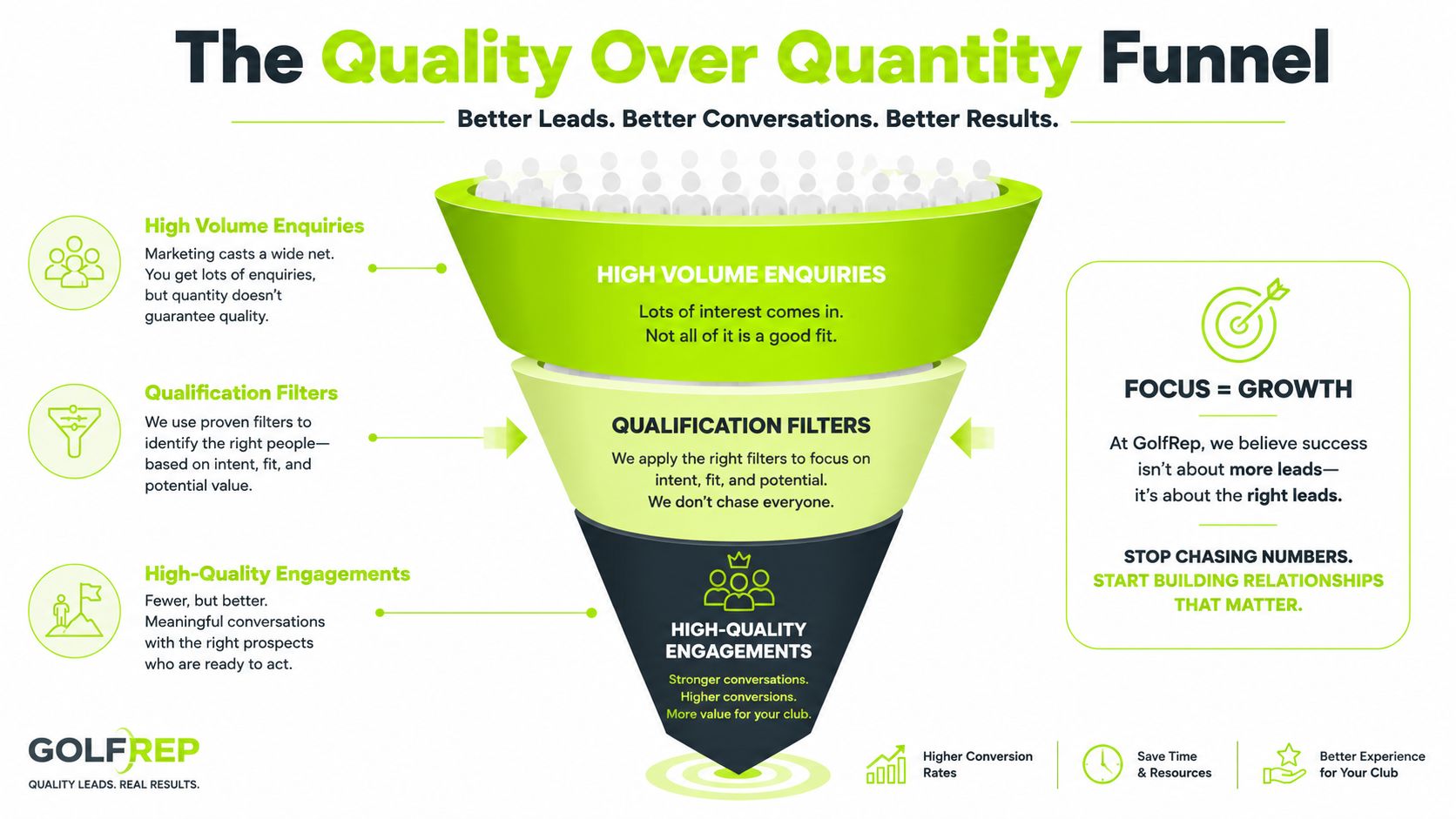
What a broken system looks like
A club with a broken lead system usually has a few clear symptoms:
- Slow responses: enquiries sit unread until somebody finishes another task.
- No ownership: nobody knows who should call, email, or log the next action.
- Patchy visibility: managers can see lead counts, but not lead-to-visit or lead-to-member outcomes.
- Manual chasing: staff rely on memory instead of a CRM, so follow-up becomes inconsistent.
- Premature scaling: spend increases before the club has fixed the basics.
None of that is a traffic problem.
It's an operations problem wearing a marketing disguise.
Practical rule: If your club can't tell you how many enquiries became visits, and how many visits became members, you don't have a lead generation problem yet. You have a lead management problem.
Why clubs misread low quality leads
Many clubs call a lead "poor quality" when the issue is that the club didn't respond properly.
A prospect who enquired on a busy Tuesday afternoon might have been perfectly viable. But if they waited too long for a reply, received a generic email, or never got a structured follow-up sequence, the opportunity was lost before anyone had a fair chance to assess it.
That is why the first move isn't usually more promotion. It's fixing the chain between form fill and membership conversation.
A club that wants predictable growth needs a pipeline, not a pile of enquiries. That means process discipline. It means response standards. It means clear qualification criteria. And it means replacing ad hoc admin with repeatable systems.
If your club has been chasing more leads without tightening the way it handles them, this is usually where the waste begins. A useful companion read is this breakdown of why most golf club marketing fails, because the failure point is often after the click, not before it.
Diagnose Your Current Lead Sources and Quality
Before changing campaigns, diagnose what your club already has.
Most clubs have more lead sources than they think. Website forms, Facebook lead forms, email enquiries, phone calls, open day registrations, referral introductions, visiting golfer enquiries, and walk-ins all create demand. The issue is that they often sit in separate places with no common tracking.
If you want to understand how to improve lead quality, start by building lead visibility. That means knowing where each enquiry came from, what happened next, and whether that source produces real membership conversations or just noise.
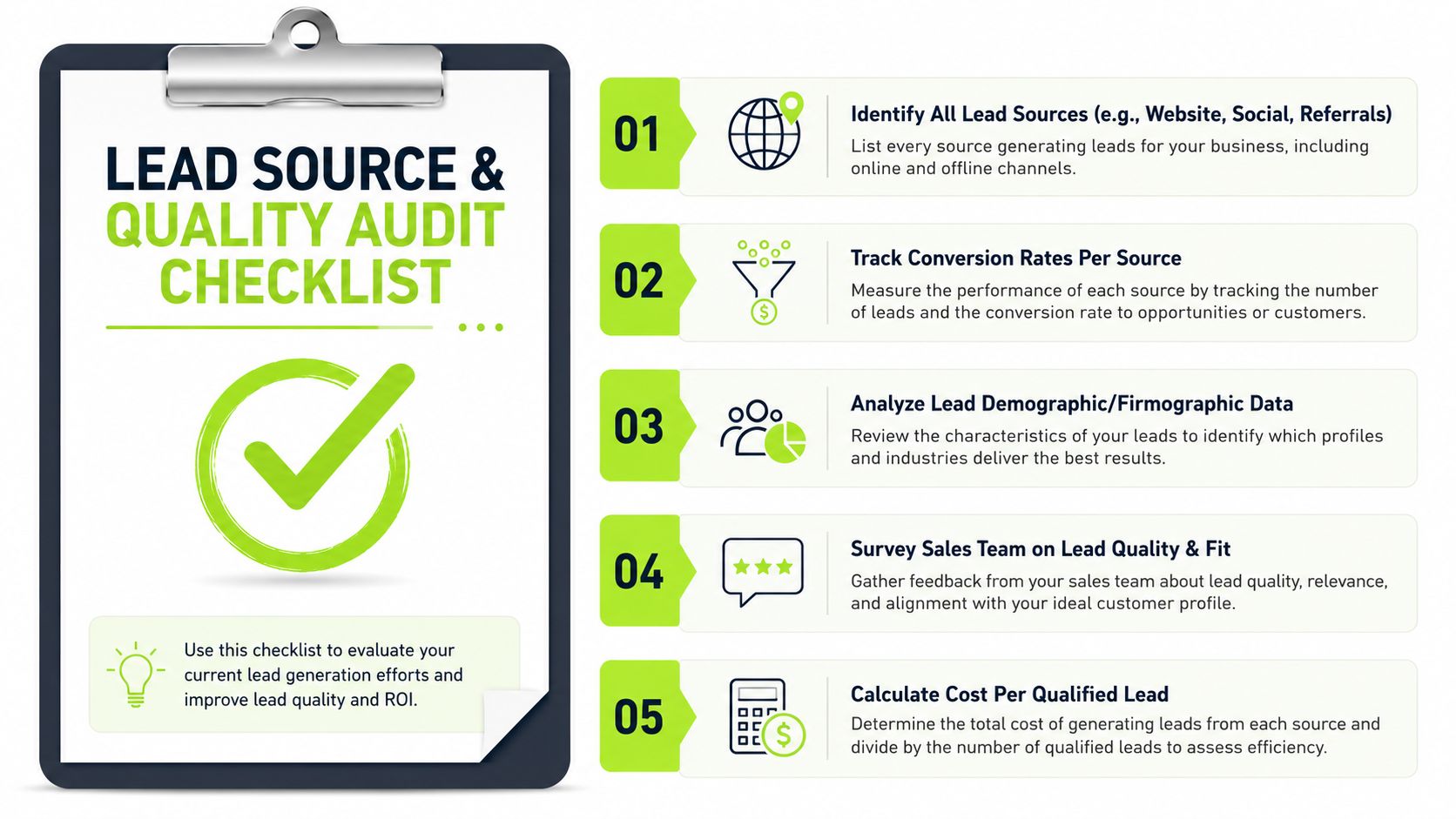
Map every source before you judge performance
The first mistake is judging a channel by volume alone. A source that produces fewer enquiries may still be stronger if those enquiries book visits, ask better questions, and match the club's membership profile.
Start with a simple source map.
| Lead source | Where it appears | Who handles it | Where outcome is recorded |
|---|---|---|---|
| Website enquiry form | Club website | Office or membership team | CRM or inbox |
| Paid social lead form | Meta or Instagram | Office or outsourced partner | CRM, spreadsheet, or ad platform |
| Phone enquiry | Reception or office | Whoever answers | Often not recorded properly |
| Referral | Existing members or local contacts | Secretary or manager | Usually informal |
| Open day registration | Event tool or form | Events or membership team | Mixed |
This table doesn't need to be complicated. It needs to be accurate.
Once you've listed sources, check whether each one can be followed from first contact to outcome. If the answer is no, the club has a visibility problem before it has a lead quality problem.
Review quality through outcomes, not impressions
A practical audit looks at the source and then asks a short set of operational questions:
- Did the club respond quickly enough?
- Was the lead qualified in the first contact?
- Did the prospect book a visit, call, or trial experience?
- Did the lead progress to a real membership discussion?
- Did the club log the reason when the lead went cold?
Clubs often think a channel is underperforming when the real issue is that nobody can see what happened after the enquiry landed.
Many committees frequently find themselves stuck. They see ad spend, clicks, and form fills, but they don't see whether those leads fit the club or whether the club followed up properly.
For a broader paid media perspective, this guide on enhancing Google Ads leads is useful because it reinforces a principle that applies well beyond Google Ads. Better input targeting matters, but quality still has to be assessed through downstream conversion, not surface-level campaign activity.
Run a practical quality audit
Use a short internal review with the team that handles enquiries.
- Check source clarity: can staff identify where each lead came from without guessing?
- Review handoff quality: does the enquiry move straight into one system, or does it bounce between inboxes and spreadsheets?
- Look at fit signals: what questions tend to come from stronger prospects, and which sources produce them?
- Ask the front line: which enquiries usually turn into visits, and which ones rarely progress?
- Log failure reasons: no response, late response, poor fit, pricing objection, no follow-up, or unclear next step.
That last point matters. If every lost lead is recorded as "not interested", the club learns nothing.
A proper audit gives managers something they can act on. It shows which channels deserve more attention, which messages are attracting the wrong people, and where the process itself is lowering apparent lead quality.
Refine Your Targeting to Attract Better Prospects
Once the audit is done, the next job is to stop attracting people who were never likely to become members in the first place.
Better lead quality starts with sharper targeting. Not broader targeting. Not louder offers. Sharper targeting means the club knows who it wants, what those prospects value, and what message will bring them into a serious conversation.
The UK golf market is already giving clubs a clear signal. The average age of golf club members has declined from 56.18 to 54.99, junior participation has risen by 10.5 percentage points, and clubs are facing a 90,000-person rise in potential members since 2023, which points to a younger inflow that needs targeted nurture rather than generic promotion as outlined by GCMA using England Golf data.
Stop writing ads for everyone
That demographic shift changes how clubs should think about targeting.
A younger prospect isn't automatically a discount-driven prospect. In many cases, they are evaluating flexibility, lifestyle fit, ease of joining, and whether the club feels relevant to their stage of life. If the ad copy only talks about tradition, or only pushes a temporary price offer, the club may pull in low-intent enquiries while missing people who would fit and stay.
At the same time, pricing matters as a qualification signal. In the UK golf sector, 74% of golf club membership fees now exceed £1,000 annually, with the wider UK Golf Courses industry projected at £2.8 billion in 2026, a 2.2% CAGR from 2020–2025, and 2,510 businesses in the sector, which reinforces that many clubs are selling a premium membership proposition rather than a bargain product according to this UK golf industry summary.
That means your targeting should filter for willingness to invest, not just interest in golf.
Build an ideal member profile that reflects real buying behaviour
A useful profile goes beyond age and postcode. It should include signals such as:
- Membership intent: are they asking about joining categories, waiting lists, or club visits?
- Playing pattern: weekday flexibility, weekend usage, family involvement, or junior participation.
- Value expectations: course quality, community, competitions, coaching, hospitality, and service.
- Financial fit: not whether they want "cheap golf", but whether they are comfortable with the club's positioning.
Here is the trade-off many clubs avoid. If your messaging leans too heavily on green fee discounts or short-term price hooks, you'll generate attention from people shopping on price. Some will convert, but many won't fit the club's long-term membership model.
If your messaging reflects the actual membership experience, you tend to attract fewer but stronger prospects.
The best campaigns don't try to persuade everyone to join. They help the right people recognise themselves in the offer.
This is also why channel strategy and message strategy can't be separated. If you're running paid social, your creative has to match the profile you're trying to attract. A useful reference point is this look at golf club Meta ads, which shows why campaign success depends on who the message is built for, not just who sees it.
For a non-golf example of how audience definition shapes lead quality, Zenfox.ai's SaaS lead guide is worth reading. The category is different, but the principle is the same. Better leads come from tighter audience alignment, clearer qualification intent, and messaging that repels the wrong fit as much as it attracts the right one.
Implement Instant Qualification and Lead Scoring
A good enquiry can go cold faster than most clubs realise.
Across UK golf clubs, 60 per cent of potential members who make an initial enquiry to a private club will not proceed if they receive no response within 24 hours, which makes response time a conversion mechanism, not an admin task as referenced in this GolfRep article on market segmentation.
That single fact changes how lead handling should be built.
Manual follow-up is where quality drops
When a club relies on inbox monitoring and memory, three things usually happen.
First, response time varies wildly depending on the day. Second, staff ask different questions, so qualification is inconsistent. Third, nobody can prioritise properly because every enquiry looks the same until someone reads it.
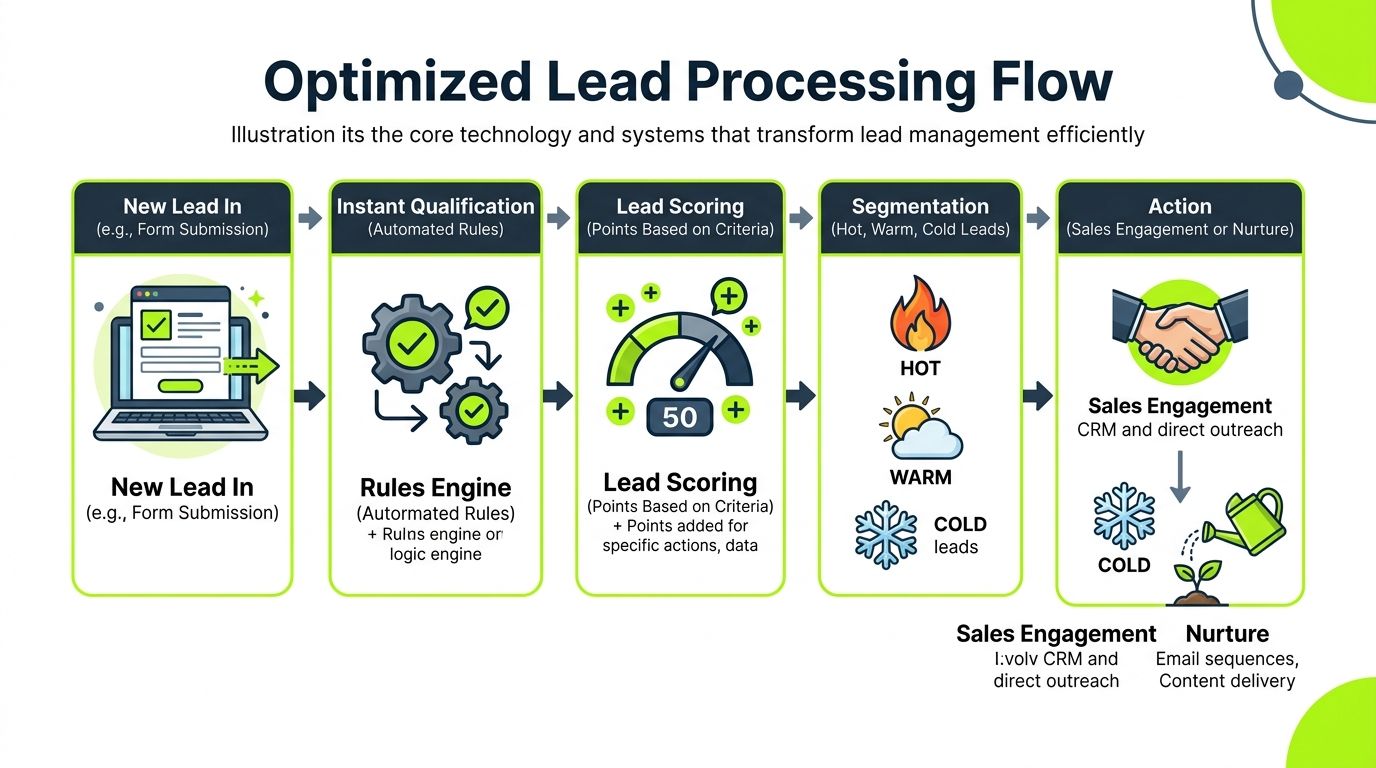
That's why instant qualification matters. It doesn't mean replacing human conversation. It means using forms, CRM rules, and automated workflows to identify likely fit at the point of enquiry.
What instant qualification looks like in practice
A simple membership enquiry form can do more work than most clubs ask it to do.
Instead of just collecting name, email, and phone number, it can also ask the questions that shape lead quality:
- Membership interest: full, flexible, family, junior, corporate, or unsure.
- Timeframe: ready to visit, comparing clubs, or planning later in the year.
- Playing background: existing member elsewhere, returning to golf, beginner, or junior parent.
- Primary interest: course access, competitions, community, coaching, or business use.
Once that information enters a CRM, the club can score and route the enquiry automatically.
| Signal | Example interpretation | Next action |
|---|---|---|
| High intent | Wants a visit soon and asks about joining | Immediate staff call and visit booking |
| Warm interest | Comparing options and wants more detail | Short email sequence and follow-up call |
| Early stage | Curious but not ready | Nurture sequence with relevant club content |
This isn't complicated technology. It's disciplined use of basic systems.
Use automation to protect the first response
UK golf commentary also points to common club failings around data analytics, personalisation technology, and process consistency, while describing AI-driven automation and CRM-enabled nurture systems as tools that support 24/7 lead qualification, reduce lead decay, and improve booked visit conversion compared with manual handling in this Entegraps article.
The practical takeaway is straightforward. The first response should happen automatically, even when the club team is busy.
That can include:
- An instant confirmation email that acknowledges the enquiry and sets expectations.
- Automatic lead assignment so one person owns the next action.
- Scoring rules that flag urgent, high-intent prospects.
- Task creation inside the CRM so nobody relies on memory.
If you want a broader framework for how teams streamline lead qualification, that resource is useful because it strips the process back to the essentials. Capture the right information early, apply consistent rules, and route people according to intent.
A club doesn't need more admin around leads. It needs fewer manual decisions and better automated ones.
Build Nurture Sequences That Convert Members
Most prospects don't join on the first touch.
They enquire, compare, get busy, forget to reply, revisit the website, speak to a partner, or wait until their schedule makes sense. If the club has no structured follow-up after the first contact, many of those prospects disappear from view.
A good nurture sequence solves that. It keeps the club present without chasing blindly. It also means staff don't have to reinvent the process for every enquiry.
What a strong nurture sequence actually does
The word "nurture" gets overused, so it's worth being plain about it.
A nurture sequence is a series of relevant follow-ups triggered by the prospect's enquiry, intent, and behaviour. It should move them toward the next sensible step, not bombard them with generic sales emails.
A high-intent lead might get:
- An immediate acknowledgement
- A prompt invitation to book a visit or call
- A reminder if they don't choose a time
- A follow-up with membership detail and a named contact
A lower-intent lead might get a different path:
- A note introducing the club and what membership includes
- Content that shows the course, community, and playing environment
- Information on joining routes and common questions
- A later check-in when timing may be better
The key difference is relevance. Stronger leads get direct next steps. Earlier-stage leads get context and trust.
A real example of lower volume and better handling
A documented UK golf club implementation using HubSpot achieved a 17% conversion rate from 53 leads into 9 new members, alongside 1,065% ROAS, equal to £10.65 for every £1 spent, with automated email sequences and sales KPI tracking helping improve response times and reduce manual effort in this Revenue Club case study.
That matters because it demonstrates something clubs often resist. You don't need a huge number of leads if the club handles the right leads well.
The better lesson from that case isn't the platform name. It's the structure behind it:
- Leads entered one system, not several disconnected places.
- Automated emails carried the conversation forward when staff weren't immediately available.
- Sales activity was tracked, so the club could see which enquiries were won, lost, or left untouched.
- Lost enquiries were reviewed, which gave the team a way to improve rather than repeat guesswork.
A nurture flow should answer the prospect's next question before they need to ask it.
What clubs get wrong after the first response
The most common failure isn't poor copy. It's silence.
A club sends one reply, the prospect doesn't answer immediately, and the conversation ends. That isn't a considered sales process. It's a missed opportunity dressed up as politeness.
A proper sequence should be timed, purposeful, and easy to maintain. It should also be visible inside the CRM, so staff can see what the lead has received before making contact. If your club wants a practical benchmark for that process, these lead nurturing best practices are a useful reference because they focus on sequencing and clarity, not generic marketing theory.
The clubs that convert consistently don't rely on one well-timed email from a busy manager. They build follow-up that works even on the days when nobody has spare time.
Track the Right KPIs to Continuously Improve
If a club measures the wrong things, it will optimise the wrong behaviour.
Many lead quality discussions often falter. Managers look at clicks, form fills, website traffic, or campaign reach and assume those numbers describe pipeline health. They don't. Those numbers only describe activity.
The useful KPIs are the ones that show whether enquiries move through a controlled system and become real membership outcomes.
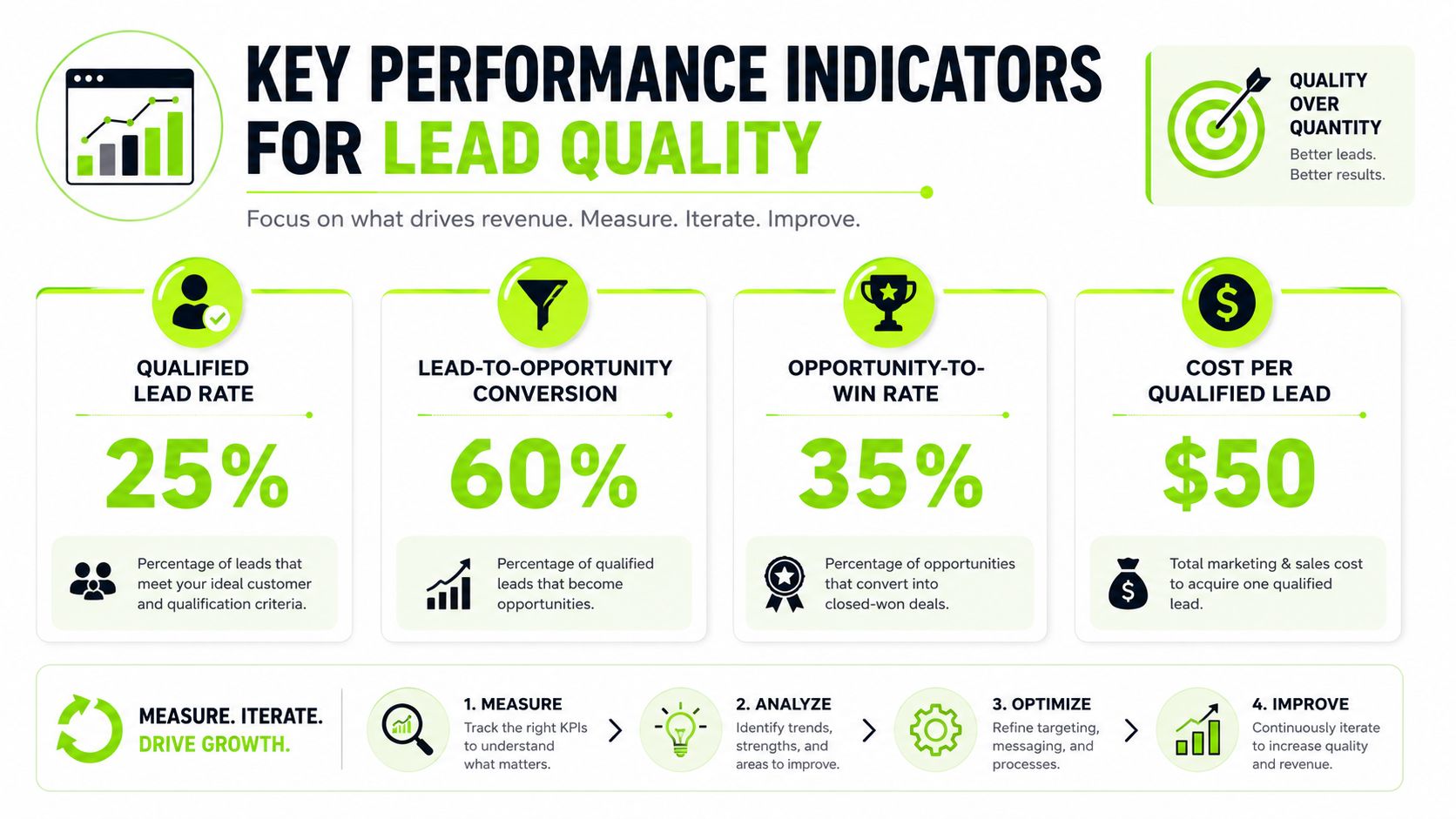
The numbers that actually matter
A club should have a small reporting set that any manager or committee member can understand.
- Qualified lead rate: of all enquiries received, how many match the club's criteria for a serious prospect?
- Lead-to-visit rate: how many enquiries progress to a tour, trial, meeting, or meaningful sales conversation?
- Visit-to-member rate: once a prospect reaches that stage, how often does the club convert?
- Cost per qualified lead: what does the club spend to generate someone worth following up properly?
Those metrics create accountability across the whole system. Marketing has to attract the right traffic. Operations has to respond quickly. Sales follow-up has to move people forward.
Use KPIs to diagnose weak links
When one number drops, the club can ask better questions.
If enquiry volume is healthy but qualified lead rate is weak, the targeting or message is off. If qualified lead rate is good but lead-to-visit rate is poor, response handling or follow-up is usually the issue. If visits happen but memberships don't, the problem may sit with pricing communication, experience quality, or sales conversations.
England Golf's 2022 Sustainability Plan also notes that clubs prioritising local employment and community integration see 30% higher member retention, which shows that long-term pipeline quality isn't just about acquisition mechanics. Trust, relevance, and local credibility matter after the lead becomes a member too in the England Golf Sustainability Plan.
That is the bigger point. Lead quality doesn't end when someone fills in a form. It carries through the whole membership journey.
Keep reporting simple enough to use
A complicated dashboard no one trusts is worse than a simple weekly report people read.
Track the handful of KPIs that connect spend, response, progression, and membership outcome. Review them regularly. Use them to spot bottlenecks early. Then adjust one part of the system at a time so the club learns what changed and why.
When clubs do that consistently, "how to improve lead quality" stops being a vague marketing question. It becomes a practical management discipline.
If your club wants a more predictable membership pipeline, GolfRep helps golf clubs combine lead generation with structured follow-up, CRM visibility, and automated nurture systems so enquiries don't get wasted after they arrive.
Ready to tap into our proven growth system?