How to Attract Younger Golf Club Members: 2026 Guide

A lot of UK clubs are having the same conversation right now. The committee wants younger members. The website gets some traffic, social posts go out, a few enquiries come in, and then momentum disappears somewhere between inbox, reception, and follow-up.
That's usually where the underlying problem lies.
If you want to understand how to attract younger golf club members, start by dropping the assumption that the answer is more marketing. Most clubs don't have a lead problem first. They have a conversion system problem. They rely on manual replies, patchy handovers, inconsistent tours, and vague next steps. Younger golfers notice that friction immediately.
At GolfRep, we see the same pattern across the UK. Clubs ask how to generate more enquiries, but the bigger growth opportunity is nearly always inside the existing process. If a club can't respond quickly, track interest properly, and move prospects into a clear membership pathway, a larger ad budget just creates a larger leak.
The Modern Challenge Beyond Just Attracting Enquiries
The most common mistake is treating membership growth like a top-of-funnel problem. A club sees a quiet month, assumes demand is weak, and starts looking for a new campaign. Meanwhile, enquiries from the last few months are sitting in email chains, on handwritten notes, or with a staff member who meant to call back but got pulled into operations.
That's not a marketing issue. It's an operating model issue.
Younger golfers behave differently from long-established private club members. They compare options quickly, expect a clean digital experience, and want simple next steps. If your club makes it hard to enquire, hard to understand the offer, or hard to book a visit, they won't wait for the committee meeting next Thursday.
Why more enquiries won't fix a weak process
A club can double its ad activity and still feel no meaningful improvement if the handling process stays the same. More leads only help when the club can see them, respond to them, and move them through a consistent journey.
In practice, that means:
- Visible lead capture: Every enquiry should land in one place, not across inboxes, forms, and scraps of paper.
- Fast response: Prospects should hear back while interest is still high.
- Tracked progression: Management should know who enquired, who booked a visit, who went quiet, and why.
- Clear ownership: One person or system must drive the next action every time.
Practical rule: If your club can't answer “How many membership enquiries are currently active, and what happens next for each one?”, you don't yet have a pipeline. You have a pile of interest.
The committee frustration is usually predictable
Most clubs don't lack effort. They lack structure. Staff are busy, volunteers are stretched, and membership recruitment gets squeezed between tee sheets, events, bar issues, and day-to-day member needs.
That's why the clubs that grow consistently build systems rather than relying on memory. They stop asking only, “How do we get more leads?” and start asking better questions:
| Question clubs often ask | Better question |
|---|---|
| How do we get more enquiries? | How do we stop losing the enquiries we already get? |
| Should we run more ads? | Do we have a process that can convert demand reliably? |
| Are our prices the problem? | Are our offer, follow-up, and booking journey creating friction? |
The clubs that attract younger members best usually aren't doing one flashy thing. They've built a predictable route from first click to first visit, and from first visit to signed membership.
Redefining the Golf Club Product for Younger Generations
Before you promote membership harder, make sure the offer fits the people you want to attract. Many clubs still market a traditional seven-day proposition to golfers whose schedules, habits, and expectations look very different.
That mismatch matters.
UK clubs that are successfully attracting younger members aged up to 40 are doing two things in particular. They offer flexible membership packages that suit occasional players, and they relax rules on jeans, trainers, and mobile phones to create a more welcoming and less formal environment, as reported by Golf Business News on successful golf club strategies.
Build around actual playing habits
A younger golfer often isn't rejecting golf club membership outright. They're rejecting a format that assumes they can play the same way as a retired or long-established member.
That's why clubs should review the product through three filters:
- Time flexibility: Can someone play without committing to the same routine every week?
- Entry flexibility: Is there a lower-friction route into membership than full traditional access?
- Cultural fit: Does the club feel welcoming, or does it feel like a test?
Membership Model Comparison
| Feature | Traditional Model (Problem) | Flexible Model (Solution) |
|---|---|---|
| Access | Full commitment expected from day one | Tiered access based on playing frequency |
| Usage pattern | Built for frequent, fixed-time players | Built for occasional and irregular play |
| Trialability | Enquire, visit, then commit | Trial packages and lighter entry points |
| Tone | Formal expectations dominate | Clear standards, but more relaxed atmosphere |
| Communication | Membership sold as status | Membership sold as convenience and fit |
A practical product review often leads to options like points-led access, short-term trial memberships, off-peak categories, or transitional packages for golfers who aren't ready for a full commitment. The point isn't to slash prices. The point is to match the offer to modern use.
Protect tradition by being selective, not rigid
Some committees worry that any move toward flexibility will weaken the club's identity. Usually the opposite happens when changes are handled properly. Clubs can preserve standards while removing rules that create unnecessary distance.
A smarter approach is to separate standards that support the club experience from rules that signal old habits. Pace of play, course care, respect for staff, and member conduct still matter. But inflexible formality around dress or phone use often creates avoidable friction for younger prospects.
Clubs don't need to become something else. They need to remove barriers that stop the right people from seeing themselves there.
The best product changes are usually narrow, deliberate, and operationally clear. One membership pathway for occasional players. One clearer dress code. One easier route to try the club before committing. That's often enough to change the quality of conversations dramatically.
Creating a Digital Shopfront That Actually Converts
Most clubs think of their website as a brochure. Younger prospects treat it like a reception desk. If the site is unclear, slow, or awkward on mobile, they won't push through to enquire.
Your digital shopfront should answer three questions quickly: what's available, who it suits, and what to do next.

Make the next step obvious
Many clubs lose prospects because the membership page asks people to “get in touch” without defining what happens next. That's vague, and vague pages don't convert well.
Instead, give prospects a clear path such as:
- Book a club visit
- Request membership options
- Ask about flexible membership
- Speak to the membership team
This principle applies offline too. UK clubs improve conversion when they use clear instructional prompts such as “Ask at reception to find out more” or “Pick up a leaflet today”, and when they place leaflet dispensers in visible areas like reception and locker rooms, according to UK POS guidance for attracting more golf club members.
Remove avoidable friction from the enquiry form
If your form asks for too much too early, people abandon it. Keep initial forms simple. Name, email, phone, and area of interest is usually enough to start the conversation.
Then connect that form to a proper system, not a general inbox.
For clubs reviewing this part of the journey, this guide on improving website conversion for golf clubs is worth reading because it focuses on practical changes rather than generic design advice.
Treat mobile like the default
A younger golfer will often first see your club on a phone. They may come from Instagram, a WhatsApp share, a Google search, or a local recommendation. If they land on a desktop-style page with tiny text, buried contact details, and a long PDF, they won't keep digging.
Check the basics:
- Fast-loading pages: Membership information should open quickly.
- Short sections: Don't make people scroll through committee history before pricing structure.
- Tap-friendly buttons: Calls to action should be easy to hit on mobile.
- Plain English: Replace club jargon with direct language.
A strong digital shopfront doesn't need to be flashy. It needs to reduce uncertainty and make the next action feel easy.
Using Modern Channels to Build Your Membership Pipeline
Clubs often hear the advice to “use social media” and stop there. That's too broad to be useful. Modern channels only work when they're tied to a specific audience and a clear next step.
For many UK clubs, the most overlooked audience is the casual local golfer who already plays but hasn't committed anywhere. That matters because the most underserved opportunity is converting iGolfers aged 30 to 50 into full members through structured pathways rather than just discounts. England Golf data points to a “gradual shift towards younger membership profiles” in the 30 to 50 group, but clubs still struggle because they lack “play-and-pay models” and “casual tee-time availability” that fit working lives, as discussed by the GCMA in its look at the average golfer in England.
Target the golfer, not the platform
The right starting point isn't Facebook, Instagram, or email. It's the segment.
A useful younger-member audience often looks like this:
- Local regular players: They already play paid golf but don't belong anywhere.
- Lapsed members: They liked club golf before, but life and schedule changed.
- Social golfers with intent: They play with friends, follow golf online, and want better access without heavy formality.
Once you know the segment, channel choice gets easier. Paid social can work well when the messaging is specific. Local search is useful when someone is actively comparing clubs. Community partnerships can be effective when your club has a clear entry point to promote.
Build campaigns around fit, not price
Most clubs default to “join now” messaging too early. That's rarely the best opening for younger golfers. Better messages speak to convenience, flexibility, atmosphere, and ease of joining.
Examples include:
- Flexible golf for busy local players
- Membership options for occasional golfers
- A more relaxed club experience with simple ways to get started
- Play more often without the full traditional commitment
Creative matters too. Show the environment, not just the course. Include terrace, practice ground, clubhouse energy, casual events, and normal members in real settings. Younger prospects want to know whether they'll feel comfortable there.
If your team is exploring content formats that support this, Keyvello's 2026 guide for lead generation gives useful ideas for using video to create stronger initial interest.
Use channels that feed a pipeline
A campaign only becomes valuable when the lead enters a trackable system. That's why acquisition should be designed backwards from the follow-up process.
A practical channel mix often includes:
| Channel | Best use | Common mistake |
|---|---|---|
| Paid social | Reach local golfers by interest and lifestyle | Sending traffic to a generic homepage |
| Instagram content | Build familiarity and reduce perceived formality | Posting course photos with no next step |
| Search traffic | Capture existing local demand | Failing to match landing pages to intent |
| Partnerships | Reach golfers through nearby businesses or communities | No system for handling referred enquiries |
For clubs using Meta, this guide to golf club Instagram ads is a useful starting point because it focuses on audience, offer, and conversion path together.
The goal isn't broad awareness for its own sake. It's a visible membership pipeline built around golfers who are already close to a decision.
The Critical System for Converting Enquiries into Members
At this juncture, clubs either grow predictably or stay stuck.
Many committees still believe conversion depends mainly on who answers the phone well or who happens to be on reception that week. In reality, consistent recruitment comes from a repeatable process. The clubs doing this well don't leave follow-up to chance.
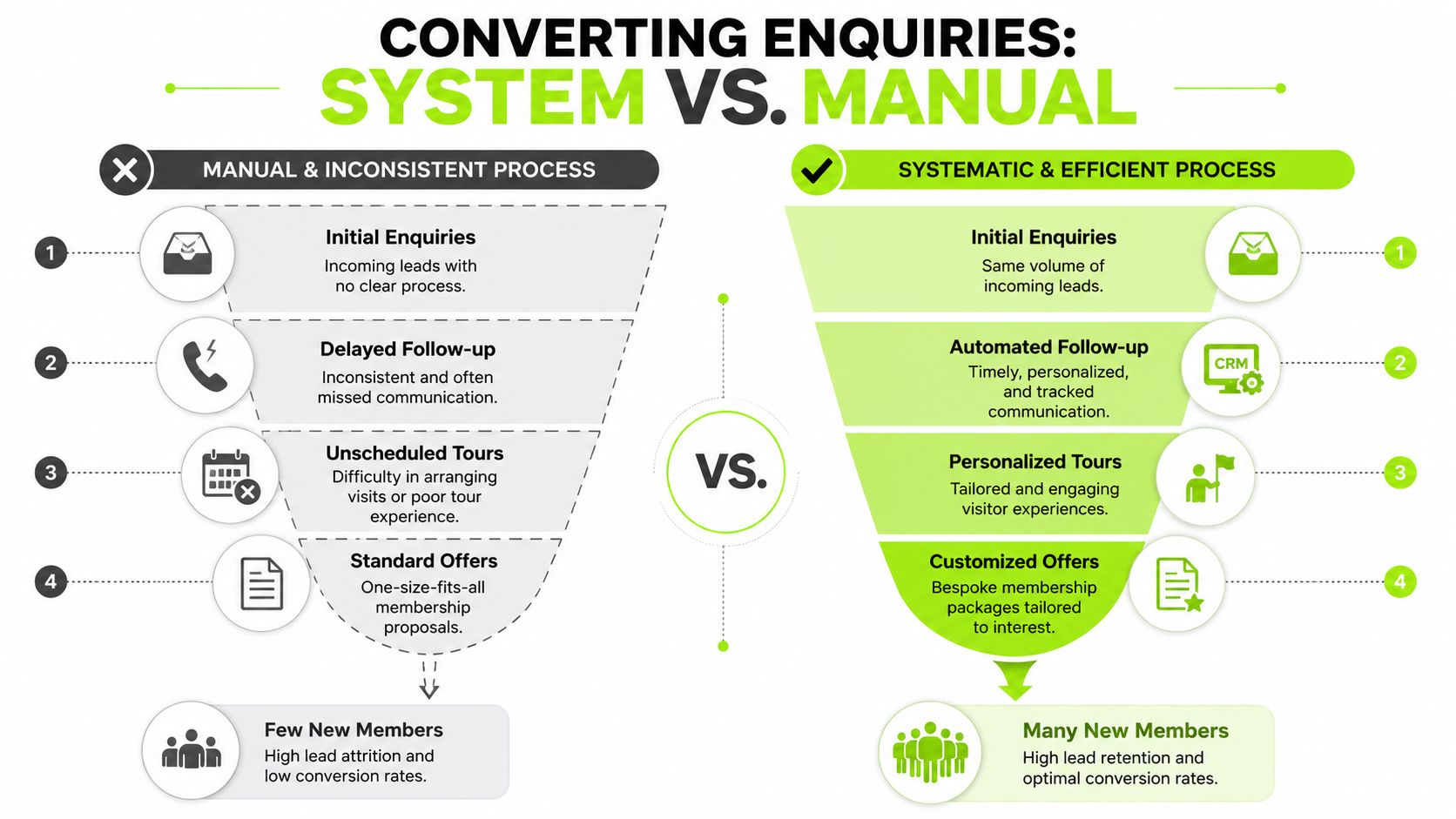
Top-performing UK clubs follow up on membership enquiries 100% of the time, while average clubs manage follow-up at around 20% of the time, according to the GCMA's membership strategy guidance. That gap should change how clubs think about growth.
What a manual process actually looks like
In many clubs, the journey looks roughly like this. A prospect submits a form. The email lands in a shared inbox. Someone intends to reply. A few days pass. A message goes out. No one tracks whether the prospect replied, visited, or went cold.
That's not a pipeline. It's a series of good intentions.
The practical problems are familiar:
- Lead visibility is poor: Management can't see every active opportunity.
- Response time varies: Some prospects get a same-day reply, others wait.
- Follow-up stops early: If the first call isn't answered, the lead often dies.
- No stage tracking exists: Nobody knows the enquiry-to-visit rate or where drop-off happens.
What a proper CRM process changes
A usable CRM doesn't need to be complicated. It needs to make the next action obvious and visible.
A solid enquiry workflow usually includes:
- Instant capture into one system from forms, ads, and manual enquiries.
- Immediate acknowledgement so the prospect knows the enquiry was received.
- Assigned follow-up task to a named staff member.
- Structured nurture sequence if the person isn't ready to talk immediately.
- Stage tracking from enquiry to visit to proposal to join.
Key point: Younger prospects rarely disappear because golf wasn't interesting. They disappear because the club created silence, delay, or uncertainty.
The system should support people, not replace them
Some managers hear “automation” and imagine robotic communication. Good systems don't replace human contact. They protect it.
A short automated acknowledgement, a reminder to call, a visit-booking prompt, and a follow-up email after a tour all help staff stay consistent. The conversation can still be warm, personal, and customized. The difference is that it happens every time.
A club should be able to open one dashboard and answer basic questions:
| Pipeline question | What the system should show |
|---|---|
| Who enquired this week? | All new leads in one place |
| Who needs a reply today? | Outstanding tasks and overdue follow-up |
| Who booked a visit? | Scheduled appointments by stage |
| Where are leads dropping out? | Stage-by-stage visibility across the pipeline |
That level of visibility changes the quality of committee decisions. Instead of guessing whether demand is weak, the club can see whether the issue is offer, speed, tours, or follow-up discipline.
Onboarding and Retaining Your New Younger Members
Signing a new younger member isn't the finish line. It's the point where expectations become real.
Clubs often lose momentum at this stage. The sales conversation feels personal and responsive, but the first few weeks of membership feel vague. No clear welcome. No warm introduction. No obvious playing route. The member joined, but still feels like a visitor.
Reduce friction immediately
Younger golfers often care less about the cheapest route in and more about whether the club fits into real life. For golfers under 30, the bigger issue is often time efficiency rather than green fee cost, and attracting them means reducing the total journey from home to return to “less than 4 hours”, as highlighted in Golfshake's discussion on moving golf clubs into the 21st century.
That insight should shape onboarding.
A new member's first experience should make playing feel easy, not administratively heavy. Show them how to book quickly, when quieter windows are available, how shorter formats work if relevant, and who to contact if they need help.
Build a structured first-month experience
A practical onboarding sequence can be simple but deliberate:
- Welcome pack: Include booking guidance, club contacts, and a plain-English explanation of how to get the most from the club.
- Personal introduction: Connect the member to a staff contact, membership host, or suitable playing group.
- Early invitations: Don't wait for them to figure out the social side alone.
- Check-in message: Ask how the first visits have gone and whether anything is unclear.
A younger member who understands how to use the club in week one is far more likely to feel they made the right decision.
Retention starts on day one
Retention work isn't a later-stage exercise. It starts the moment someone pays.
That means tracking early behaviour, noticing non-usage, and giving people reasons to return before doubt sets in. Clubs should pay attention to the first booking, first event, first guest round, and first meaningful connection with other members.
For clubs tightening this part of the member journey, this guide on golf club member retention is useful because it focuses on practical systems rather than vague loyalty advice.
A younger member doesn't need constant hand-holding. They do need a club that feels organised, responsive, and easy to belong to.
A 90-Day Roadmap to Attract Younger Golfers
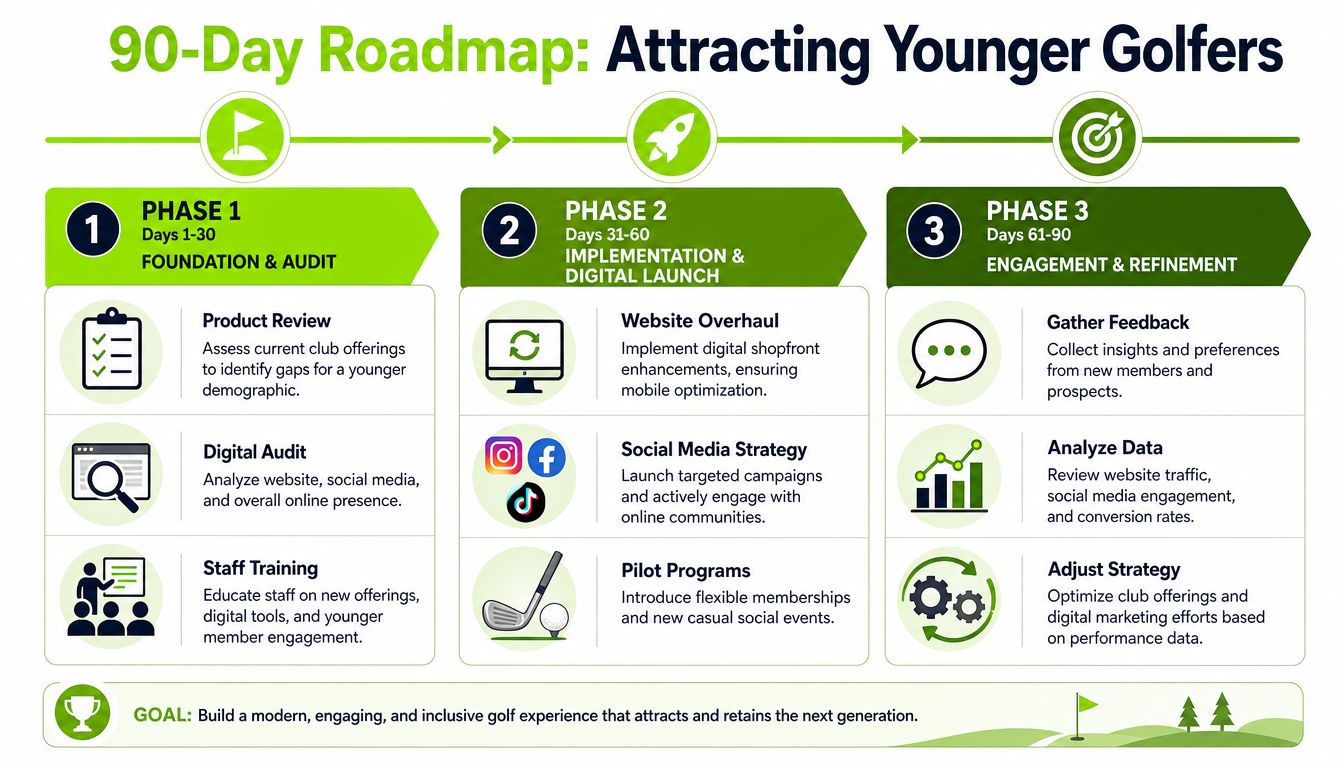
Most committees don't need another list of ideas. They need a sequence they can act on. The fastest way to lose momentum is to debate product, website, ads, and follow-up all at once without assigning ownership.
A useful plan for how to attract younger golf club members should start with foundations, then move into acquisition, then tighten conversion and retention.
Days 1 to 30 foundation and audit
Start by reviewing what the club is selling and how enquiries are currently handled. Don't begin with ad creative.
Audit these areas first:
- Membership offer: Is there a credible entry route for occasional or younger players?
- Website journey: Can someone understand the offer and enquire quickly on mobile?
- Lead handling: Where do enquiries go, who responds, and how is follow-up tracked?
- Internal ownership: Which staff member or team owns recruitment activity day to day?
This stage should also include staff alignment. Reception, the manager, membership lead, and anyone giving tours should know the current offer, common objections, and expected next steps.
Suggested KPIs for this phase:
| KPI | What to check |
|---|---|
| Enquiry response time | How quickly first contact happens |
| Lead visibility | Whether all enquiries sit in one system |
| Form completion quality | Whether forms capture usable intent |
Days 31 to 60 implementation and launch
Once the product and process are clearer, improve the digital journey and activate targeted lead sources. This is the point to launch campaigns, not before.
Priority actions:
- Update membership pages with clearer options and stronger calls to action.
- Simplify enquiry forms and route submissions into a central CRM.
- Launch targeted campaigns aimed at local younger golfers and non-member regular players.
- Create a follow-up sequence for every new enquiry.
- Standardise the club visit experience.
At this point, management should stop relying on anecdotal feedback like “we've had a few calls” and start reviewing actual pipeline stages.
Useful KPIs now include:
- Enquiry-to-visit rate
- Visit-to-proposal rate
- Number of active leads by stage
- No-response follow-up completion
Days 61 to 90 optimisation and onboarding
By the third month, the focus shifts from setup to refinement. At this stage, many clubs either become consistent or drift back into old habits.
Review the whole journey:
- Which audiences are producing the best-fit enquiries?
- Which membership option is getting the strongest response?
- Are visits converting, or is the issue now inside the in-person experience?
- Are new younger members getting active quickly after joining?
This phase should also tighten onboarding. Every new member should receive the same high-quality start, with a named contact, a clear route into play, and a short early check-in.
Operational habit: Review pipeline performance weekly, not just at committee meetings. Slow feedback creates slow growth.
Keep the roadmap simple enough to run
Clubs don't need a huge stack of software or a marketing department to make this work. They need a clear offer, one visible pipeline, disciplined follow-up, and a membership journey that reflects how younger golfers live.
If the club can achieve that, marketing starts to work harder because the back end can finally support the front end.
If your club wants a more predictable way to attract and convert younger members, GolfRep helps UK golf clubs build the full system behind membership growth. That includes lead generation, CRM setup, structured follow-up, and pipeline visibility, so enquiries don't disappear between departments and good prospects don't go cold.
Ready to tap into our proven growth system?