Golf Club Membership Ideas: Boost Growth in 2026

Most advice on golf club membership ideas starts in the same place. Run more ads, post more on social media, hold more open days, push harder for enquiries. That sounds sensible, but it misses where many clubs lose growth.
From GolfRep's perspective, the primary bottleneck usually isn't demand. It's what happens after someone gets in touch. Enquiries sit in inboxes. Calls aren't returned promptly. No one knows who owns the lead. Prospects ask for prices, then hear nothing for days. Committee-led clubs often assume the issue is top-of-funnel volume when the bigger problem is inconsistent follow-up.
That matters even more in a market where there is clear room to grow. England Golf data cited by The Golf Magazine states there are 1,735 golf clubs in England and more than 730,000 registered members, while about 2.6 million people in the UK play golf without belonging to a club. The same source says only about 22% of the UK's 3.9 million golfers are club members, leaving around 78% as non-members, which is a large addressable audience for clubs that make joining easier and more relevant (England Golf membership data via The Golf Magazine).
The clubs that grow predictably tend to do something less glamorous. They build systems. They know where enquiries come from, how quickly staff respond, which prospects book visits, and which new members stay engaged after joining.
These nine ideas are built around that reality. They're not just promotional tactics. They're practical operating choices that help clubs turn interest into long-term membership.
1. Implement a Structured Enquiry Response System
The fastest way to waste a good enquiry is to treat it casually.
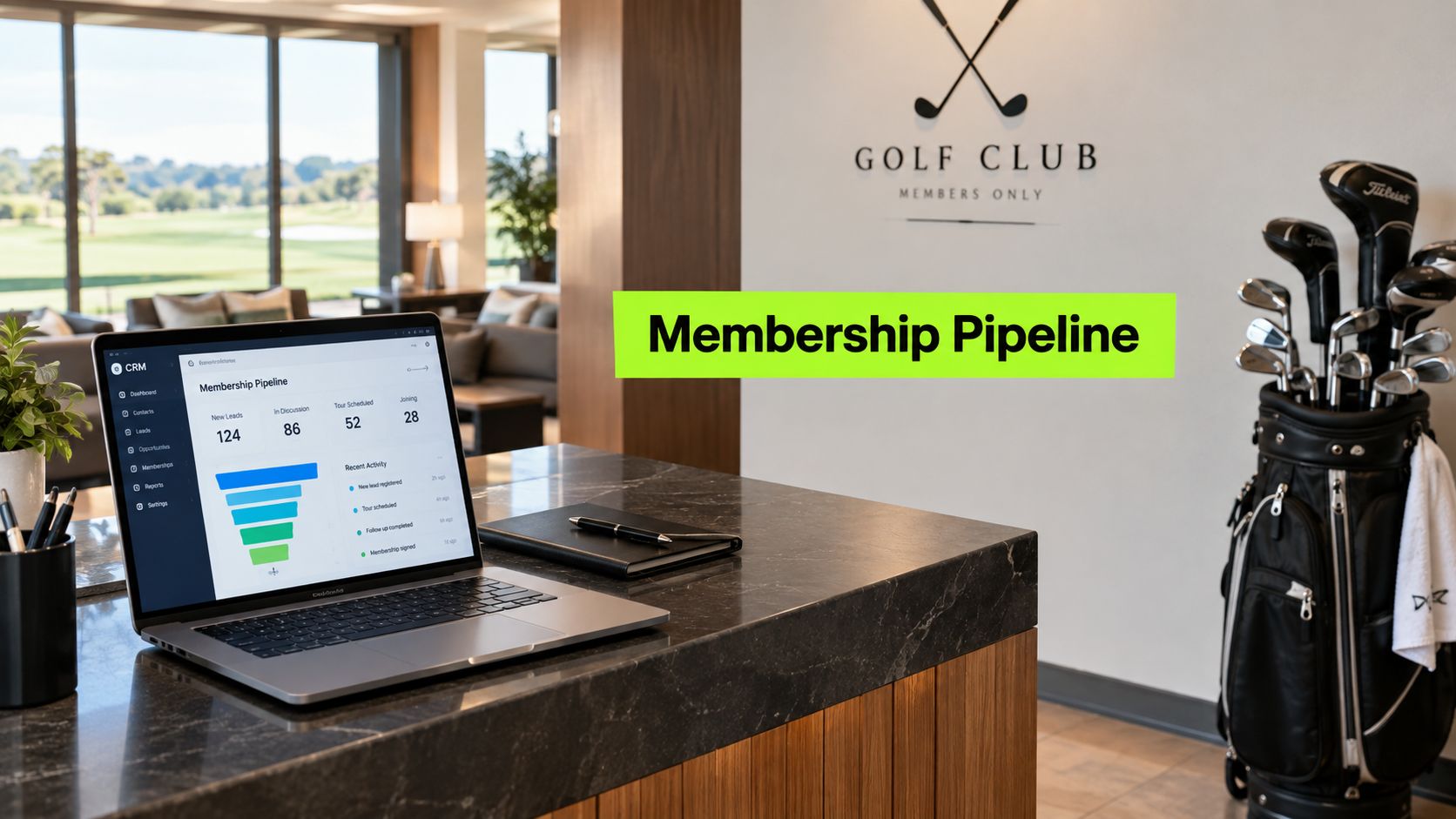
At many clubs, membership leads arrive through a website form, a Facebook message, a phone call to the office, or a conversation in the pro shop. Then they disappear into separate inboxes and notebooks. No one can see the full pipeline, and no one can say with confidence whether the club has a lead problem or a handling problem.
Put one person in charge of first response for every incoming membership enquiry. If that person is away, name a backup. Then set a fixed rule for how the club replies, what gets sent, and how the next step is booked.
A simple visual can help teams picture the issue in operational terms, not marketing theory.

What a reliable first response looks like
The first message shouldn't try to do everything. It should confirm the enquiry, answer the immediate question, and move the prospect towards a visit, call, or trial.
Use a short protocol such as:
- Assign ownership immediately: One named staff member handles the lead until it is either booked, closed, or handed over properly.
- Reply with context: Reference the person's message, preferred membership type, or playing background so the response feels human.
- Offer one clear next step: Invite them to a call, club tour, taster event, or hosted round rather than sending a vague brochure and hoping for the best.
- Log the interaction: Record enquiry source, response time, staff owner, and current status in one place.
Practical rule: If your team can't see who owns each membership enquiry today, you don't have a marketing problem first. You have a process problem.
At GolfRep, we often see clubs improve by making lead ownership visible and consistent. The same principle shows up in other industries too. When back-office handling is slower than front-end activity, opportunities leak out of the system. That pattern is clear well beyond golf, as shown in this piece on addressing YouTube automation bottlenecks.
2. Build a Lead Qualification and Nurture Workflow
Not every enquiry deserves the same follow-up.
Some people want to join this month. Some are comparing three clubs. Some are returning to golf after years away. Some only want a handicap and occasional play. If you send all of them the same email sequence and leave it there, your follow-up becomes bland and your staff spend time in the wrong places.
Ask better questions early
Qualification doesn't need to feel like an interrogation. It should help your team understand fit, intent, and timing.
Good opening questions usually cover:
- Current playing status: Are they a club member elsewhere, an iGolf player, or completely new to club golf?
- Playing habits: Do they want weekend competition golf, casual weekday golf, or practice and social use?
- Joining timeframe: Are they looking now, later this season, or just researching?
- Membership preference: Full, flexible, intermediate, social, corporate, or uncertain.
- Practical constraints: Budget sensitivity, distance from club, and preferred tee times.
Once you have those answers, segment the lead. A lapsed golfer needs different follow-up from a beginner, and both need different follow-up from a golfer ready to visit next week.
Nurture without becoming forgettable
Most clubs either overdo nurture with generic newsletters or underdo it with a single reply and silence. The middle ground works better. Short, relevant follow-up over a few touchpoints keeps the conversation moving without exhausting the prospect.
GolfRep's view is simple. Automation should support staff, not replace them. An automatic acknowledgement can go out instantly. After that, human follow-up should reflect the lead's answers and intent. Clubs that want to tighten this process can start with these lead nurturing best practices for golf clubs.
A useful outside example comes from video-led lead capture. If your club uses video in ads or landing pages, the asset only works if the follow-up is aligned with the viewer's intent. This guide on lead generation videos is a good reminder that creative and nurture need to work together.
3. Create a Membership Trial or Taster Day Programme
More enquiries will not fix a weak club visit. If the first real experience feels unplanned, prospects stall, compare alternatives, and disappear.
A trial or taster day works because it answers the questions that brochures and price sheets cannot. Prospects judge the pace of play, the welcome at reception, the standard of the practice areas, and whether they can see themselves belonging at the club. That is why this sits inside a growth system, not a promotions list.

Make the trial structured, not casual
Casual invitations create admin noise and weak follow-up. A scheduled programme gives staff a repeatable process and gives prospects a clear next step.
Set up the trial with a defined format. Fixed dates help. So does a consistent host. The prospect should know exactly what is included, how long it lasts, who they will meet, and what happens afterwards.
A practical structure looks like this:
- Run on a reliable schedule: Monthly or fortnightly usually works better than ad hoc invitations.
- Define the experience: Nine holes, range access, clubhouse tour, coffee with a staff host, or a beginner taster with coaching.
- Assign ownership: One named person should manage confirmations, attendance, and post-visit follow-up.
- Brief the team: Reception, pro shop, and membership staff should know who is arriving and why.
- Capture feedback on the day: Ask what felt right, what raised concerns, and which membership route they are considering.
The trade-off is operational. Trials use tee time inventory, staff hours, and planning discipline. Poorly targeted trials can also fill with curious visitors who never intended to join. That is why these events work best after basic qualification, not as an open invitation to everyone who clicks an ad.
Value comes from what the club learns. Patterns appear quickly. One group cares about flexibility. Another wants a family-friendly environment. Some need a shorter path into membership, such as a points model, off-peak category, or social-to-golf progression. Use those signals to refine packaging and follow-up.
Social proof helps here too, but collect it properly. A short post-visit testimonial from attendees can strengthen future trial promotion and help the club understand what resonated. Use FormBackend to manage testimonials if you want a simple way to capture that feedback without adding more admin.
One point matters more than the event itself. A taster day is only useful if the next step is scheduled before the prospect leaves. Book the call. Set the follow-up visit. Send the personalized membership option while the experience is still fresh. That is how a trial becomes part of a predictable conversion system instead of a pleasant day that goes nowhere.
4. Develop a Referral and Ambassador Programme
Existing members can bring in the right prospects faster than most paid campaigns. But only if the club makes referral easy, visible, and worth doing.
The mistake many clubs make is launching a referral offer that sounds nice on paper but creates work for the member. If someone has to print a form, explain the scheme, and chase the office for credit, the programme fizzles out.
Keep the mechanism simple
Referral systems work when a member can make an introduction in seconds. That might be a direct email introduction, a simple form linked from the member portal, or a named contact in the office who takes ownership of referred prospects.
The reward matters, but clarity matters more. Members should know exactly what happens when they refer someone, how the club tracks it, and when the reward is applied.
Useful structure includes:
- One easy referral route: No multiple forms or vague instructions.
- Fast acknowledgement: Thank both the member and the prospect promptly.
- Priority handling: Referred leads should not sit in the same queue as cold enquiries.
- Visible recognition: Tell the referring member when the person has joined.
Choose ambassadors carefully
Not every member wants to actively refer, and that's fine. A small number of well-connected members often drive disproportionate value. Captains, committee members, active competition players, women's section leaders, and sociable newer members can all be strong ambassadors if they believe in the club and trust the process.
In practice, clubs get better results when ambassador activity is tracked inside the same lead system as every other enquiry source. That gives you proper lead visibility instead of relying on memory.
If you collect member stories to support referrals, use a clean system rather than gathering them ad hoc. A straightforward tool for managing testimonials can help organise that process without creating extra admin.
5. Use Data-Led Targeting and Build Conversion Tracking
You don't need more reports. You need a cleaner view of what's happening from first click to signed member.
Many clubs underperform concerning their lead analysis. They know roughly how many enquiries came in, but they can't say which postcode areas produce the best members, which channels produce time-wasters, or where leads stall.
Start with local reality, not broad golf interest
The best targeting often begins with your current member base. Look at where members live, how far they travel, which age groups are growing, and which membership categories retain well. Then compare that with the type of golfer the club says it wants.
A useful fact for club strategy is that the majority of member clubs in the UK saw membership increase in 2023 to 2024, and only 24% of clubs reported more leavers than joiners, meaning 76% attracted more new members than they lost according to the Hillier Hopkins Members' and Proprietary Golf Clubs' Survey 2023/24 (Hillier Hopkins golf clubs report 2023 to 2024). Growth is happening. Clubs need to know exactly where their own process is helping or hurting that outcome.
Track the stages that actually matter
A simple spreadsheet is better than an elaborate system nobody updates. At minimum, record:
- Enquiry source: Website, Meta ad, Google search, referral, phone, walk-in.
- Lead owner: Who is responsible today.
- Response handling: When the lead came in and when the first reply went out.
- Pipeline status: New, contacted, qualified, booked visit, trial attended, joined, lost.
- Loss reason: Price, timing, unsuitable package, no response, chose another club.
The point isn't admin for its own sake. It's to make lead visibility operational. When a club reviews stuck leads weekly, poor follow-up stops hiding in the background.
6. Establish Clear Membership Pricing and Packaging Strategy
Clubs often make pricing harder than it needs to be.
Some hide prices entirely. Some publish partial information that creates more questions than answers. Some present old-fashioned categories that only make sense to insiders. Prospects then hesitate because they can't tell what's right for them, what they'll pay, or whether they're even the kind of golfer the club wants.
Clarity converts better than secrecy
If someone has to email the club just to understand the difference between categories, the packaging is doing too much work. Good pricing structure reduces confusion and makes the first conversation easier.
That doesn't mean every club should compete on low price. It means each package should have a clear buyer and a clear explanation.
Strong packaging usually includes:
- A defined audience: Beginner, frequent player, intermediate age band, lifestyle player, social user, or corporate account.
- A clear access model: Full access, limited tee windows, weekday only, points-based, or social plus golf.
- A clear payment route: Annual and staged payment options where appropriate.
- A simple comparison: Enough information for a prospect to narrow the field before speaking to staff.
Match packages to modern buying behaviour
Affordability is a real issue in many locations. Golf Support found that in half of the 18 towns and cities surveyed, local residents would need to work full-time for 60 hours or more to afford full golf club membership, with Southampton at 79 hours and 42 minutes and Leicester at 79 hours and 24 minutes (Golf Support membership affordability league table).
That's one reason flexible, age-tiered, and lower-friction entry points matter. If your current categories only make sense to traditional full members, you're leaving capable prospects out of the picture. Clubs reviewing their commercial structure can use these golf club package deal ideas to build packages that are easier to explain and easier to sell.
7. Implement a Member Onboarding and Retention System
Membership growth becomes unpredictable when clubs treat the sale as the finish line. The direct debit starts a different job. It shifts from persuasion to habit-building.
Clubs usually lose new members in ordinary ways. Nobody explains how tee booking works. Nobody introduces them to people they are likely to play with. Nobody notices that they visited once, felt awkward, and never settled in.
Build the first ninety days deliberately
As noted earlier, member expectations are shifting. New joiners often want clearer guidance, faster access to play, and less guesswork around club norms. If the early experience feels confusing or overly formal, usage drops before loyalty has had any chance to form.
That is why the first ninety days need a defined process, not a welcome pack and good intentions. Assign ownership to one named staff member. Set contact points in advance. Decide what a new member should do in week one, month one, and month three.
A good onboarding system gives people early wins. The member books a tee time without help. Plays with someone they know. Understands competitions, handicap steps, and practical rules. Feels confident arriving at the club.
Retention starts with usage and connection
Retention problems usually show up long before renewal. A new member who has not booked, played, attended, or replied to outreach is already at risk.
Clubs that manage this well track simple signals. Has the member played in the first two weeks? Have they used the practice area? Have they attended a new member event or met a club contact? If not, staff follow up while there is still time to fix the issue.
A practical onboarding flow might include:
- Immediate welcome: A personal call or email from a named contact within the first few days.
- First-visit guidance: Clear instructions on arrival, tee booking, dress expectations, competition access, and handicap setup.
- Introductions: A buddy, staff host, or arranged game with compatible members.
- Early milestone prompts: A reason to return quickly, such as a hosted roll-up, beginner competition, or clinic.
- Thirty-day review: A short check-in to ask what has been easy, what has been unclear, and what would help them use the club more.
This takes coordination. It also prevents expensive waste. If your team spends time and money generating enquiries, then leaves new members to work things out alone, the conversion system is incomplete.
The clubs that retain well do not rely on members to ask for help. They notice low engagement early and intervene before a quiet dropout becomes a non-renewal.
8. Create Targeted Content Marketing to Address Member Concerns
Most membership content is written as if the prospect already wants to join.
That's backwards. Prospects usually have unresolved concerns. They're wondering whether the club is too formal, too competitive, too expensive, too difficult for beginners, too far away, or not for people like them.
Answer the real questions your staff hear
Useful content starts with sales conversations, not a blank content calendar. Ask reception, the office, the pro shop, and current members what questions come up most often. Then create content that removes those objections.
Good examples include a beginner-focused membership page, a short clubhouse and course tour video, a “what to expect on your first visit” article, and clear FAQ content around guests, handicaps, payment options, and dress code.
The trade-off is consistency. Content only helps conversion if staff use it in follow-up. A strong FAQ page that never gets sent to prospects won't change much.
Show culture, not just course condition
Aerial shots and sunny fairways are useful, but they don't answer the social question. Prospects want to know whether they'll fit.
That's especially important as younger participation grows. Golfshake reports that in 2025 overall golf club membership growth rose by nearly 10 percentage points year-on-year, with 86% of respondents identifying as current club members compared with 84% in 2024, and junior participation posting the largest gain at +10.5 percentage points. The same report says the UK golf courses industry comprises 2,510 businesses and is projected to reach a market size of £2.8 billion in 2026, after growing at a CAGR of 2.2% between 2020 and 2025, while total club members declined by 150,000 over the past decade (Golfshake on the health of golf club membership in 2025).
Those numbers point to a mixed picture. There is momentum, but clubs still need to explain value clearly and appeal to newer, younger, and less traditional audiences.
If your content only shows the course, you're marketing scenery. If it shows access, atmosphere, and fit, you're helping someone decide.
9. Develop a Corporate and Group Membership Programme
Corporate membership is often treated as an add-on. It should be treated as a structured growth channel.
For the right club, local businesses can provide reliable revenue, multiple introductions, and repeat usage that supports food and beverage, events, and guest play. But the offer has to be built properly. A vague “contact us for corporate options” page won't do much.
Package the offer for buyers, not golfers
A business owner or office manager isn't buying golfing tradition. They're buying client entertainment, staff benefit, networking access, or a flexible hospitality asset.
That means your proposal should be commercial and straightforward. Show what the company gets, how the seats work, who can use them, what hosting options exist, and how billing is handled.
A practical corporate structure might include:
- Small company package: Limited named users with guest benefits.
- Mid-size package: More seats plus event or meeting access.
- Premium package: Higher access, hosted golf days, and broader hospitality use.
- Clear admin process: Named account manager, invoicing terms, and renewal notice.
Don't force younger professionals into old models
This also connects to individual membership strategy. The GCMA has noted a gap in how clubs convert younger professionals, with traditional 5- and 7-day memberships no longer well aligned to younger demographics. The same source highlights a 12% decline in under-35 memberships in 2023 to 2024 and says 68% of young golfers cited high upfront equity costs as their main deterrent, while pointing to the need for age-tiered, equity-free models (GCMA membership strategy guidance).
That's relevant because many corporate prospects eventually become individual members. If the step from company-linked access to personal membership is financially jarring, conversion drops. Clubs can strengthen that pathway by designing better offers and clearer follow-up, especially when using a dedicated framework for golf club corporate membership marketing.
9-Point Golf Club Membership Ideas Comparison
| Initiative | Implementation complexity | Resource requirements | Expected outcomes | Ideal use cases | Key advantages |
|---|---|---|---|---|---|
| Implement a Structured Enquiry Response System | Low–Medium: process definition and basic automation | Staff ownership, CRM/automation, templates, tracking | Faster replies; often 30–50% conversion improvement | Clubs receiving enquiries but lacking consistent follow-up | Rapid lead conversion, accountability, consistent prospect experience |
| Build a Lead Qualification and Nurture Workflow | Medium: forms, scoring and segmented automations | CRM/automation, qualification forms, tailored content | Higher-quality leads, predictable conversion rates, staff efficiency | High enquiry volumes with mixed intent | Prioritises hot leads; personalised automated engagement |
| Create a Membership Trial or Taster Day Programme | Medium: event logistics and scheduling | Staff/volunteers, reserved tee times, hospitality, follow-up tools | High trial-to-member conversion (≈60–70%), strong social proof | Prospects unsure about club fit; experiential selling | Experience-driven conversion; generates testimonials and word‑of‑mouth |
| Develop a Referral and Ambassador Programme | Low: define incentives and simple tracking | Incentive budget, tracking mechanism (CRM/link), promotion materials | High conversion rates (≈70–80%), lower acquisition cost | Clubs with engaged existing members | Cost-effective acquisition; leverages trusted member advocacy |
| Use Data-Led Targeting and Build Conversion Tracking | High: cross-channel tracking and analytics setup | Analytics/CRM, ad budget, targeting expertise | Predictable CAC, clear ROI, pipeline visibility and forecasting | Clubs investing in digital marketing and optimisation | Optimises ad spend; surfaces best channels and bottlenecks |
| Establish Clear Membership Pricing and Packaging Strategy | Low–Medium: research and decision alignment | Market research, pricing decisions, website/material updates | Faster decisions, fewer stalled negotiations, self-selection by budget | Clubs with pricing ambiguity or frequent haggling | Transparency reduces friction; enables segmentation and upsell |
| Implement a Member Onboarding and Retention System | Medium: multi-touch 90‑day programme and follow-ups | Staff/volunteer time, welcome packs, scheduling/calendar tools | Higher first‑year retention (often 80%+), stronger engagement | Clubs with new-member churn or retention goals | Improves lifetime value; builds advocates and reduces early churn |
| Create Targeted Content Marketing to Address Member Concerns | Medium: content planning and production cadence | Content creators, video/photo assets, website and social channels | Fewer objections, improved organic traffic, support for sales | Clubs needing to pre-answer FAQs and build credibility | Educates prospects, builds trust, and supports conversion journeys |
| Develop a Corporate and Group Membership Programme | Medium–High: B2B packaging and relationship management | Business development staff, invoicing, event capacity, onboarding | Bulk, predictable revenue; lower per-person acquisition cost | Clubs near businesses or targeting corporate client entertainment | Scales revenue quickly; secures stable high-value accounts |
From Ideas to a Predictable Growth System
Each of these golf club membership ideas can help on its own. A better referral programme can create warm introductions. A clearer pricing page can reduce friction. A taster day can move a hesitant prospect closer to joining. But clubs usually see the biggest shift when these ideas stop operating as isolated tactics and start working as one joined-up system.
That system begins with visibility. You need to know where enquiries come from, who owns them, how quickly they were handled, what the prospect wanted, and what happened next. Without that, clubs tend to fall back on instinct. More ads get approved because it feels productive, while poor response handling remains hidden.
Then comes structure. A prospect should move through a clear path. Enquiry, response, qualification, visit or trial, follow-up, package discussion, join, onboarding, retention. That doesn't need to feel robotic. It should feel organised. The prospect gets timely communication. Staff know what happens next. Committee members can see whether growth problems sit in lead volume, conversion, or retention.
Many clubs often get stuck. They assume membership growth is mostly a promotion problem, when it's often an operations problem with a marketing symptom. If the club replies inconsistently, hides pricing, fails to nurture warm leads, and leaves new members to fend for themselves, more leads won't solve much. They'll just expose the weakness faster.
At GolfRep, that's why we focus so heavily on systems over one-off campaigns. Lead generation matters, but it only has commercial value when the club can capture, qualify, convert, and retain the people showing interest. The clubs that create predictable growth don't rely on memory, goodwill, or a heroic staff member holding everything together manually. They use clear processes, CRM visibility, and consistent follow-up.
That approach also protects the club commercially. It becomes easier to forecast intake, spot bottlenecks, judge which packages convert best, and identify where prospects are falling out. It also makes member experience more consistent, because the same discipline used in lead handling carries through into onboarding and renewal.
If your club is reviewing its membership strategy for the coming season, start with the handover points. How quickly do you respond? Who owns each lead? What happens after a trial? What do new members experience in their first few weeks? Those questions usually reveal more growth opportunity than another ad campaign.
The clubs that win aren't always the clubs with the biggest audience. They're often the clubs with the clearest system.
GolfRep helps golf clubs build predictable membership growth by combining lead generation with structured follow-up, CRM visibility, and practical conversion systems. If your club is generating interest but not turning enough of it into long-term members, explore how GolfRep approaches pipeline growth for clubs that want more than another marketing campaign.
Ready to tap into our proven growth system?