Master Golf Club Membership Conversion in 2026

Most advice about golf club membership conversion starts in the wrong place. It tells clubs to run more ads, post more often, hold another open day, or increase website traffic.
That sounds sensible, but it misses the actual operational problem. Most clubs don't lose membership revenue because nobody enquired. They lose it because interested golfers weren't handled properly once they did.
At GolfRep, we see the same pattern repeatedly. A prospect fills in a form, sends an email, or asks about membership after a round. Then the enquiry lands in a shared inbox, sits there while the office is busy, gets answered inconsistently, or receives a polite but passive reply that asks the golfer to take the next step themselves. The issue isn't effort. It's that the process relies on memory, availability, and manual follow-up.
Golf club membership conversion improves when clubs treat enquiries as a tracked pipeline rather than admin. The clubs that convert reliably don't just create interest. They respond fast, route leads into a visible system, book visits quickly, and follow up with discipline.
The Real Conversion Bottleneck Most Clubs Overlook
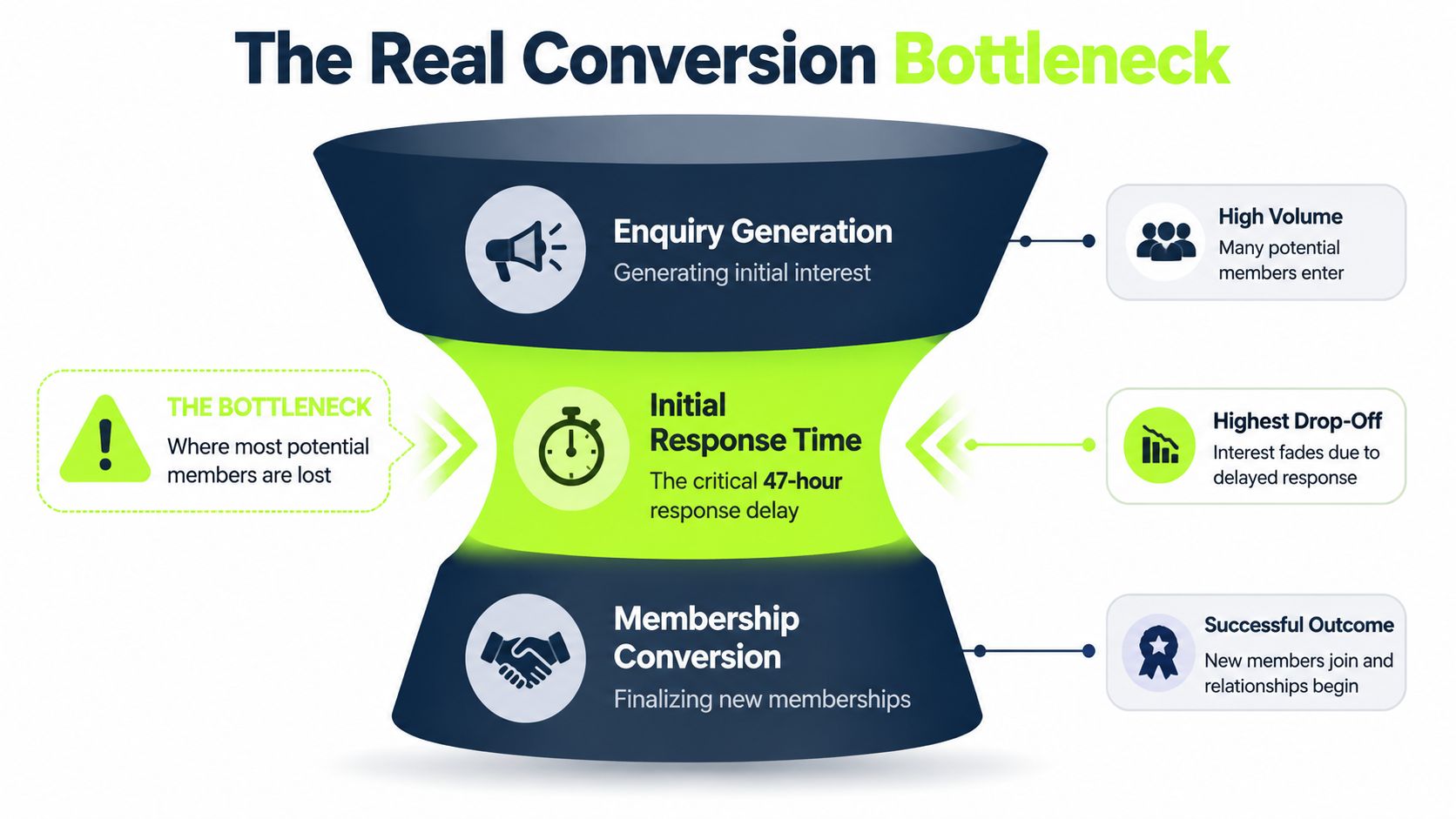
The common belief is that clubs need more enquiries. In practice, many already have enough interest to grow. The bigger failure sits immediately after the enquiry arrives.
In the UK golf sector, the average time to respond to a membership enquiry is 47 hours and 32 minutes, and leads that receive a response within one hour are five times more likely to convert into members according to GolfRep's membership sales analysis. That gap tells you where the leak is. Not at awareness. At response handling.
What enquiry leakage looks like in a club
Enquiry leakage rarely looks dramatic. It looks ordinary.
A prospect submits a membership form on Saturday afternoon. Nobody sees it until Monday. The secretary replies on Tuesday. The golfer has already visited another club, forgotten why they were interested, or lost momentum.
Another prospect calls during a busy period, gets told someone will ring back, and never hears anything useful beyond a general brochure email. A third comes through Facebook, but the message stays inside one staff member's account instead of entering a central system.
Practical rule: If an enquiry can sit in one person's inbox, notebook, or memory, it can be lost.
Most clubs don't have a lead generation problem as much as an enquiry management problem. Staff are stretched. Office hours are limited. Committee-led decision making slows changes. The membership process often depends on who happened to be on duty when the lead arrived.
Why manual follow-up keeps breaking
Manual follow-up fails because membership enquiries don't arrive in a tidy sequence during office hours. They come in evenings, weekends, after competitions, after visitor rounds, and during moments when interest is highest.
A manual process also creates inconsistent quality. One prospect receives a strong reply with a tour invitation. Another gets a short message saying "let us know if you'd like more details". Those are not equivalent sales experiences.
The trade-off is simple:
| Approach | What happens in practice |
|---|---|
| Manual inbox handling | Slow replies, unclear ownership, patchy follow-up |
| Spreadsheet tracking | Some visibility, but weak accountability and no automatic action |
| CRM with automation | Instant acknowledgement, task ownership, booking prompts, full tracking |
Clubs often assume the answer is more staff effort. Usually it isn't. The answer is a system that removes delay, standardises the first response, and makes every lead visible from first contact to decision.
Slow response doesn't just reduce conversion. It changes how the prospect judges the club's professionalism.
That matters because the first reply is not admin. It's part of the sale.
Defining Your Ideal Member and Success Metrics
Before fixing conversion, decide who you're trying to convert. "More members" isn't a useful operating target. Clubs grow faster when they define the member type that fits their pricing, capacity, tee sheet, and culture.
The UK member profile is shifting. The average UK golf club member age has declined to 54.99, with iGolfers and younger golfers aged 30 to 50 needing flexible offers to convert, according to the GCMA summary of England Golf data. That doesn't mean every club should chase the same audience. It means clubs should stop assuming the traditional full member profile is the only viable target.
Build two or three usable member personas
A persona should influence how you present membership, not just how you describe a demographic.
For most clubs, the practical starting point is a small set of segments such as:
- The time-poor iGolfer: Plays regularly, values convenience, dislikes rigid structures, responds to flexible access and simple joining paths.
- The younger professional: Wants to know when they can play, how easy it is to integrate socially, and whether the club feels current rather than formal.
- The family or lifestyle-led prospect: Cares about inclusion, events, and whether membership will be used beyond medal play.
A useful framework is to segment by behaviour, barriers, and likely trigger to join. If your team needs a simple refresher on that thinking, this guide to market segmentation for golf clubs is a practical starting point.
For clubs that haven't formalised their planning process, even a general resource like this practical marketing plan for startups is useful because it forces clear decisions about audience, offer, channel, and measurement. The principle carries over well to membership growth.
Track pipeline metrics, not just joiners
Many clubs only look at one number: new members signed. That tells you the outcome, not the problem.
A better conversion view is:
Lead response time
How quickly did the club acknowledge and engage the enquiry?Visit booking rate
Of all membership enquiries, how many became a booked tour, call, or trial step?Visit attendance
How many booked prospects showed up?Visit-to-join ratio
Which tours produced real applications?Time to decision
How long does each member type typically take to join?
Match metrics to member type
Different personas move differently through the pipeline. A younger golfer may respond well to speed, flexible messaging, and evening tour slots. A family-led prospect may need more reassurance about the broader club environment.
Clubs often make one generic membership offer and then wonder why response quality is mixed. The offer isn't wrong. It's just too broad.
If you define the target member clearly, your enquiry process becomes sharper. You ask better questions, offer the right next step, and judge performance against the right conversion behaviour rather than a vague sense that "enquiries feel quiet".
Attracting and Capturing Qualified Enquiries
A lot of clubs attract attention but capture it badly. That's why marketing can appear expensive even when demand exists. The issue isn't only reach. It's whether the right local golfer sees a relevant offer and can respond through a process that doesn't create friction.
In the UK, approximately 78% of golfers are not club members, representing a market of over 3 million people, and GolfRep's membership ideas analysis makes the point clearly that a systematic conversion process can turn a small fraction of that audience into meaningful recurring revenue. That should change how clubs think about top-of-funnel activity. You don't need every golfer. You need the right non-member to enter a controlled follow-up system.
The offer determines the quality of the enquiry
A generic "Membership Enquiry" button usually produces mixed intent. Some prospects are curious. Some are price shopping. Some only want a brochure.
More effective capture starts with an offer that matches the segment:
- For iGolfers: trial access, flexible membership conversation, or a hosted club experience.
- For younger professionals: a guided visit around work hours, social golf introduction, or a clear route into club life.
- For frequent visitors: a membership cost comparison during a booking or post-round follow-up.
The point isn't clever wording. It's alignment. When the offer reflects the prospect's actual barrier, the enquiry arrives better qualified.
Why shared inbox forms underperform
A standard contact form sent to an office email is one of the weakest tools in the process. It doesn't qualify the lead, doesn't route it properly, and doesn't trigger immediate action.
A stronger capture setup does three things at once:
| Capture element | Why it matters |
|---|---|
| Clear call to action | Tells the golfer exactly what happens next |
| Useful form fields | Captures membership interest and context without creating friction |
| Workflow trigger | Sends the enquiry into a system, not just an inbox |
That last point matters most. If the form doesn't trigger an automated response, internal alert, and CRM record, you're still relying on manual recovery.
Better channels still fail without better capture
Clubs can use paid social effectively, especially when targeting local demographics around age, travel distance, playing frequency, or known interest in golf. Facebook and Instagram can help place the right membership message in front of likely prospects.
But the channel isn't the deciding factor. The capture method is.
The ad gets attention. The form determines whether that attention becomes a lead the club can actually work.
A poor handoff wastes good traffic. A strong handoff makes modest traffic productive.
What qualified capture looks like
A qualified enquiry journey should feel easy to the golfer and structured to the club.
- One clear next step: book a membership call, request a guided tour, or claim a trial experience.
- Minimal but meaningful data: enough to tailor the next conversation, not so much that the form feels like homework.
- Instant routing: every lead enters the same tracked process regardless of whether it came from the website, social media, or a campaign page.
When clubs improve this stage, they stop collecting vague enquiries and start building a membership pipeline they can act on.
The Instant Response and Booking Automation System
Once the enquiry is in, speed and consistency matter more than intention. A club can have a good offer, a good course, and a good reputation, but if the first follow-up is delayed or passive, the prospect's momentum drops.
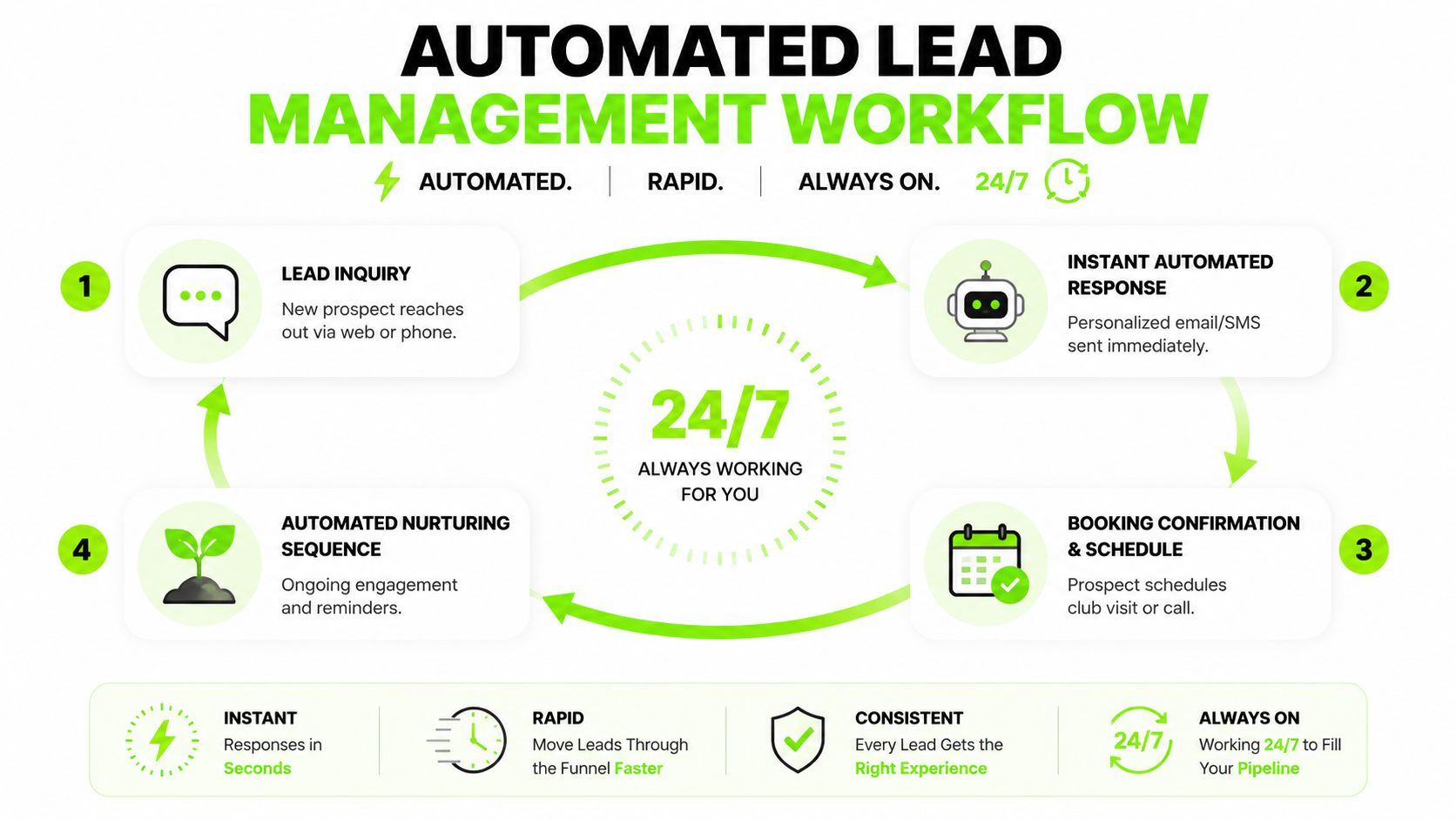
The fix is not asking staff to watch inboxes more closely. The fix is building an automated response and booking system that works every time.
Step one, acknowledge the enquiry immediately
The first message should go out as soon as the form is submitted. That message can be by email, SMS, or both, depending on the club's setup and consent basis.
It should do three jobs:
- confirm the enquiry has been received
- make the club sound organised and responsive
- direct the prospect to a next action rather than leaving the conversation open-ended
A weak autoresponder says, "Thanks, we'll be in touch." A stronger one says the right person will follow up and gives the prospect a simple booking route straight away.
Step two, log everything in one visible CRM
Every enquiry should create a contact record automatically. No copying from inbox to spreadsheet. No notes trapped in one staff member's head.
A workable CRM setup for golf club membership conversion needs to show:
- enquiry source
- membership interest
- current pipeline stage
- assigned owner
- last contact date
- next action
It enables clubs to operate with control instead of guesswork. If nobody can see where each lead stands, no one can manage conversion properly.
For clubs reviewing how to improve response speed specifically, this guide on speed to lead for golf clubs breaks down the operational side well.
Step three, offer direct booking instead of waiting for back-and-forth
This is the step many clubs still miss. They reply politely, but they make the golfer do the chasing.
The faster route is to include a booking link for a tour, membership call, or hosted visit. That removes friction and captures intent while it still exists.
A simple comparison makes the difference obvious:
| First response style | Likely outcome |
|---|---|
| "Let us know when suits" | Delay, back-and-forth, drop-off |
| "Choose a suitable visit time here" | Faster commitment, cleaner handover |
A lead doesn't need more information first. Often they need a clear next action.
Step four, automate reminders and internal prompts
Once the visit is booked, the system should keep moving without staff having to remember every touchpoint.
That usually includes:
- Prospect confirmation with date, time, and what to expect
- Reminder sequence to reduce no-shows
- Internal notification so staff know who's coming and why they enquired
- Post-visit trigger that starts the next follow-up path automatically
Automation ceases to be merely a convenience and transforms into a conversion tool.
Step five, keep the human touch in the right place
Automation should handle speed, timing, and consistency. Staff should handle context, conversation, and judgement.
That distinction matters. Clubs don't need robotic communication. They need a system that removes repetitive admin so staff can focus on the moments that require a person.
If you're refining message quality inside automated chat or response tools, guidance on optimizing AI chat output is useful because the same principle applies here. Good automated responses need clear prompts, relevant context, and tight wording.
One option clubs use for this is GolfRep, which combines lead capture, CRM visibility, and automated nurture so enquiries are acknowledged, tracked, and moved toward a booked visit within one system.
Engineering the Journey from Club Visit to Member
A club visit is not a courtesy walk-around. It's the point where interest either becomes commitment or drifts into a polite maybe.
Too many tours feel improvised. The prospect gets shown the clubhouse, maybe the first tee, and then receives a broad explanation of membership categories. That's informative, but it isn't a conversion process.
Run the visit like a consultation
The visit should reflect what matters to that prospect. A time-poor iGolfer wants to know how easy it is to play. A younger professional wants to know whether the club fits their lifestyle. A frequent visitor may be comparing annual cost against current spend.
That means the staff member leading the visit needs context before the prospect arrives. If the CRM has captured why they enquired, what membership type interests them, and how they found the club, the conversation becomes sharper.
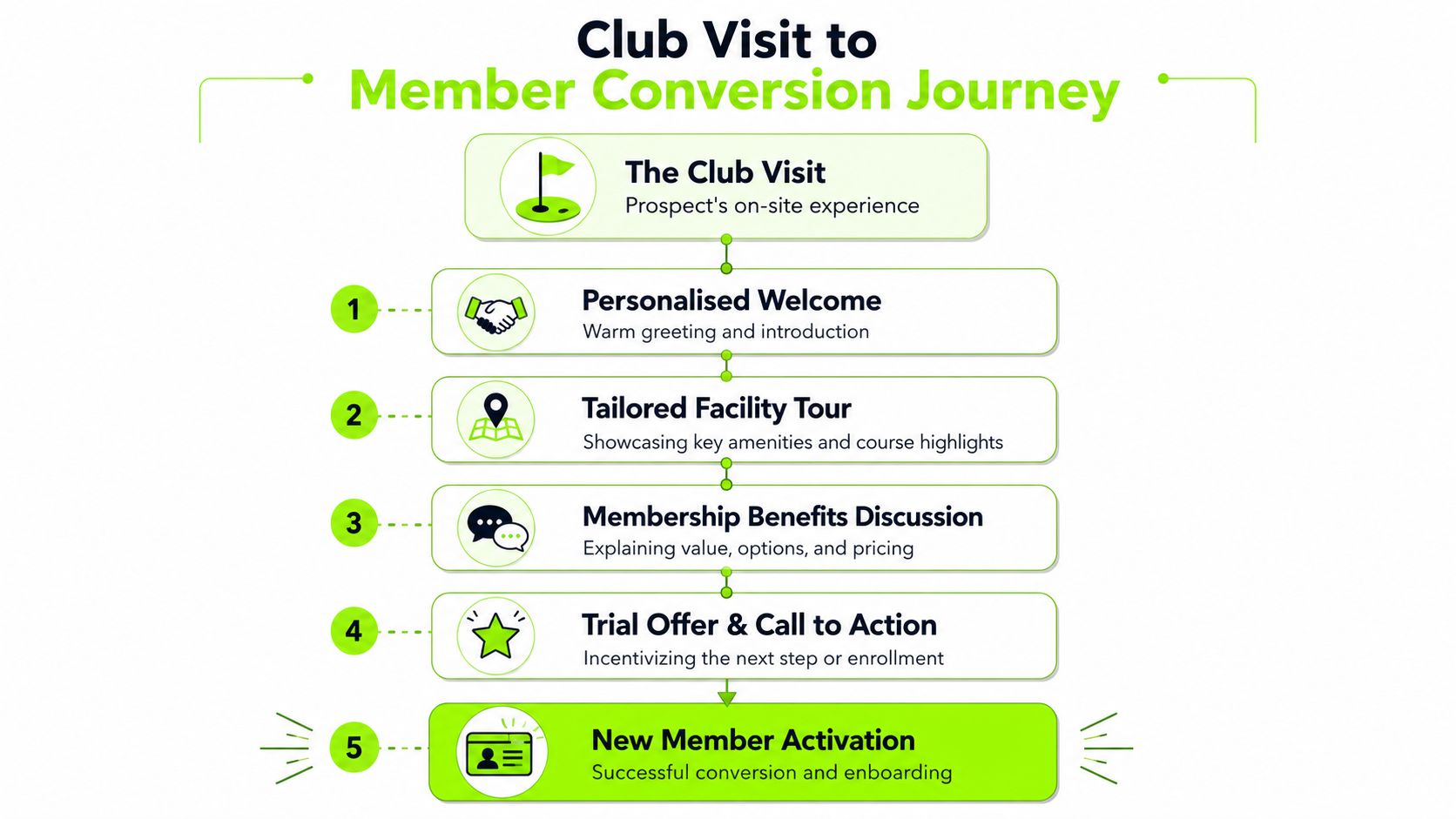
A strong visit usually includes:
- A personal welcome: not just a handover to whoever is free
- A personalized route: show the parts of the club that match the prospect's likely use
- A value conversation: explain the practical benefit of joining this club, not just the tariff
- A direct close: ask for the next step while interest is still high
Use pricing context carefully
Price shouldn't be handled defensively. It should be framed properly.
Member subscriptions at 26 UK clubs rose by an average of 4.8% in 2025, while visitor fees at the same clubs increased by 11.8%, according to UK Golf Guy's summer green fee review. That widening gap gives clubs a rational financial story for frequent players. If someone is already paying visitor rates repeatedly, membership isn't just a status decision. It can be the more sensible long-term choice.
The tour should answer one question clearly: why is joining this club better than continuing as an occasional payer?
That doesn't mean pushing price comparison on everyone. It means using it when the prospect's playing pattern makes it relevant.
Most joins happen after the visit, not during it
Some prospects will commit on the day. Many won't. That's normal.
The mistake is treating "I'll think about it" as the end of the sales process rather than the start of structured follow-up. Once the visit ends, the club should move into a CRM-led nurture path that reflects what happened in the conversation.
That follow-up can include:
| Follow-up type | Purpose |
|---|---|
| Thank-you message | Reinforces professionalism and recaps fit |
| Membership summary | Removes confusion around options |
| Relevant club content | Helps the prospect picture themselves as a member |
| Prompt to discuss next step | Brings the decision back into motion |
Follow-up should feel deliberate, not needy
A good nurture sequence doesn't nag. It reduces uncertainty.
If the prospect mentioned flexibility, send information that addresses playing access. If they were interested in social integration, show them how members take part in the club. If they stalled over timing, offer a clear route to revisit the conversation without pressure.
The clubs that convert well after visits don't rely on one generic thank-you email. They keep control of the process until the prospect either joins or clearly exits.
Measure and Optimise Your Membership Pipeline
Once the system is live, clubs need to stop managing membership growth by instinct. A pipeline only becomes reliable when someone can see where leads are stalling and act on it.
The wider market supports that discipline. Overall UK golf club membership is growing, with 86% of surveyed golfers being club members in 2025, but the proportion paying less than £1,000 annually is falling, according to Golfshake's review of golf club membership in 2025. In other words, demand exists, but clubs still need a sharper conversion process if they want to win members without defaulting to discounts.
Look at stage-by-stage movement
A central dashboard should show the journey from enquiry to join in plain terms. Not vanity metrics. Operational ones.
Focus on where leads are accumulating or dropping:
- Enquiries received but not contacted
- Contacted leads with no booked visit
- Booked visits that didn't attend
- Attended visits that didn't progress
- Pending prospects with no recent follow-up
CRM data changes management decisions. If many leads aren't reaching booked visit stage, the issue may sit in the first response or booking process. If visits are booked but not attended, reminders or scheduling may be weak. If tours happen but applications lag, the visit itself may need restructuring.
Use the data to fix one leak at a time
Trying to improve everything at once usually creates noise. Improve the weakest stage first.
A simple review rhythm works well:
- check response handling
- review visit booking patterns
- inspect attendance quality
- analyse post-visit follow-up outcomes
- adjust scripts, timing, or messaging based on what the data shows
For clubs building a more disciplined reporting view, this guide on golf club pipeline management is a useful operational reference.
A helpful parallel sits outside golf. This RepurposeYourContent B2B webinar guide shows how structured funnel stages create better follow-up decisions. The context is different, but the management principle is the same. You improve conversion by understanding where the decision process breaks.
What gets measured doesn't improve automatically. But it does become fixable.
The clubs that grow membership predictably aren't necessarily doing more marketing than everyone else. They're seeing the pipeline clearly, acting faster, and removing friction at each stage.
GolfRep helps UK golf clubs build a more predictable membership pipeline by combining lead generation, CRM visibility, and structured follow-up systems. If your club is generating interest but losing momentum after the enquiry, GolfRep is a practical place to start.
Ready to tap into our proven growth system?