Golf Club Membership Lead Generation: A 2026 Blueprint
Most advice on golf club membership lead generation points in the same direction. Run more ads, post more on social media, improve the website, get more enquiries.
That advice is incomplete.
At GolfRep, we see the same pattern repeatedly across UK clubs. Interest isn't always the limiting factor. The constraint lies in what happens after someone raises their hand. Clubs generate enquiries, then lose momentum through slow replies, scattered follow-up, unclear ownership, and no system for moving a prospect from first interest to booked visit.
The result is a conversion gap. Clubs believe they have a lead generation problem when they actually have a lead handling problem.
The Real Problem with Membership Growth
The most common assumption in club marketing is that more enquiries will solve membership growth. In practice, more enquiries often just expose a weak process.
Recent UK industry observations have highlighted exactly that problem. Clubs are generating record enquiries, yet conversion rates remain flat because the operational response after the enquiry is too slow and too loose. A lead responded to within one hour is five times more likely to convert than one waiting 24 hours, according to this industry note on the conversion gap.
That changes the conversation straight away. If your club takes hours or days to respond, the issue isn't audience size. It's response discipline.
Why more leads can make the problem worse
A club with no system usually handles enquiries like this:
- Website forms land in an inbox and wait for someone to notice them
- Facebook leads sit inside Meta until an admin logs in
- Phone calls aren't logged consistently so nobody can track what happened next
- Committee members assume someone else replied and no one owns the follow-up
- One call gets made and the prospect is treated as lost if they don't answer
None of that is a marketing problem. It's an operations problem.
Practical rule: If a club can't see every enquiry in one place and assign the next action immediately, it doesn't have a lead generation system. It has a collection of disconnected tasks.
Prospective members don't experience your internal constraints. They don't know the secretary was off-site, the pro shop was busy, or the membership inbox wasn't checked over the weekend. They only experience silence.
The conversion gap is where growth is won
The clubs that grow predictably don't just drive interest. They remove friction after the enquiry. They treat membership demand like a live pipeline, not admin.
That means:
- Capturing every lead instantly
- Responding immediately, even outside office hours
- Qualifying interest early
- Following up through a structured sequence rather than a single call
- Tracking whether enquiries become visits, and whether visits become members
For many clubs, the biggest gain isn't another campaign. It's fixing what happens in the first day after a prospect gets in touch.
GolfRep has written before about why most golf club marketing fails, and the pattern is usually the same. Clubs focus heavily on reach and not enough on conversion mechanics.
If you want better membership growth, start there.
Defining Your Ideal Member Profile
A lot of clubs still target "local golfers" as if that's specific enough. It isn't.
A strong membership pipeline starts with knowing who fits your club, price point, playing culture, and facilities. If you skip that step, your marketing fills with low-intent enquiries, poor-fit prospects, and conversations that go nowhere.
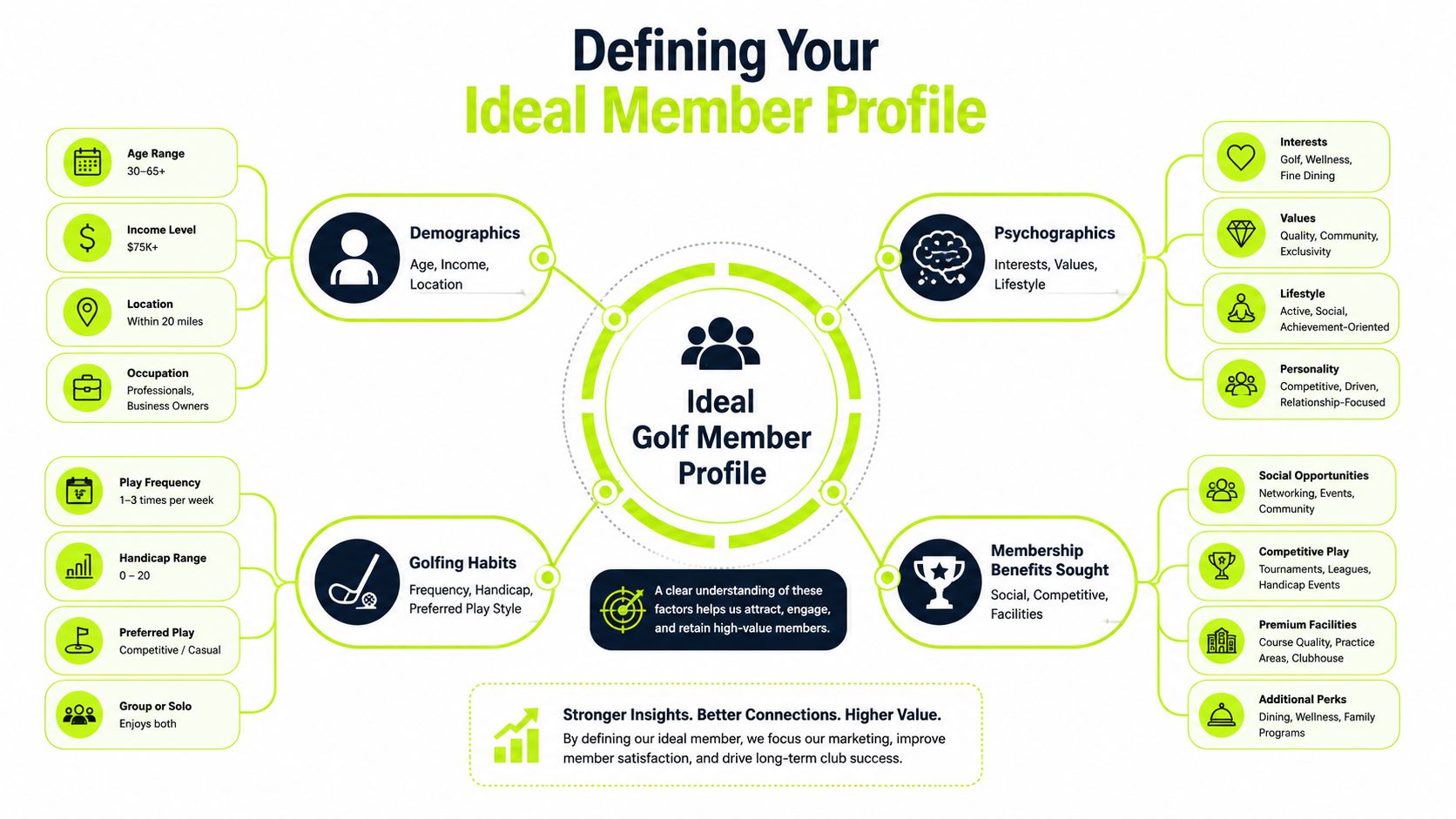
This visual is a useful way to understand:
Start with your best existing members
Don't begin with broad assumptions. Begin with evidence inside your own club.
Look at the members you most want to attract more of. Not just the newest members, but the ones who stay, engage, spend, bring guests, and fit the culture. Then work backwards.
Ask practical questions such as:
- Who joins and settles quickly
- Who uses the club regularly
- Who values competitions, social events, or practice facilities
- Who refers other members
- Which membership categories create the least friction in the sales process
That exercise usually reveals that the "ideal member" isn't one generic type. It may be two or three distinct profiles.
Build around fit, not just age and location
Demographics matter, but they don't tell the full story. A useful member profile includes four layers:
| Area | What to define |
|---|---|
| Demographics | Age range, household income, location, life stage |
| Psychographics | Values, leisure priorities, interest in community, competitiveness |
| Golfing habits | Playing frequency, current club status, handicap range, weekend or weekday preference |
| Benefits sought | Social life, course access, family use, status, coaching, flexibility |
A retired golfer looking for weekday play behaves very differently from a working professional who wants a strong Saturday roll-up and easy online booking. Both may live nearby. Only one may fit the offer you're promoting.
The clubs that convert well tend to know exactly who they're speaking to. Their messaging feels relevant because it is.
Local affordability shapes demand
Price sensitivity isn't uniform across the UK. GolfSupport's affordability analysis found that residents in Newcastle Upon Tyne need to work 41 hours and 36 minutes to afford a full membership, while residents in Southampton need to work 79 hours and 42 minutes.
That gap matters.
A club in a higher-cost local market can't rely on generic "join now" messaging and expect smooth conversion. The sales process has to handle affordability questions properly. That may mean clearer value communication, better qualification, or membership conversations that align with lifestyle and usage, not just headline price.
A practical way to define the profile
Use this working method:
- Audit current members and identify common traits among your strongest fits.
- Review your local catchment with affordability and travel convenience in mind.
- List the reasons people join your club, not the reasons the committee assumes they join.
- Match campaigns to profile so each advert, landing page, and follow-up reflects one clear audience.
- Filter poor-fit leads early through qualification questions instead of letting staff sort it out later.
A sharper profile makes everything else easier. Better ad targeting. Better website messaging. Better follow-up. Better show-up rates for club visits.
Attracting High-Value Leads Across Channels
Once the ideal member profile is clear, channel choice becomes far simpler. You stop asking which platform is "best" in the abstract and start asking which channel fits each part of the journey.
Most clubs need a blended approach, not a single tactic.
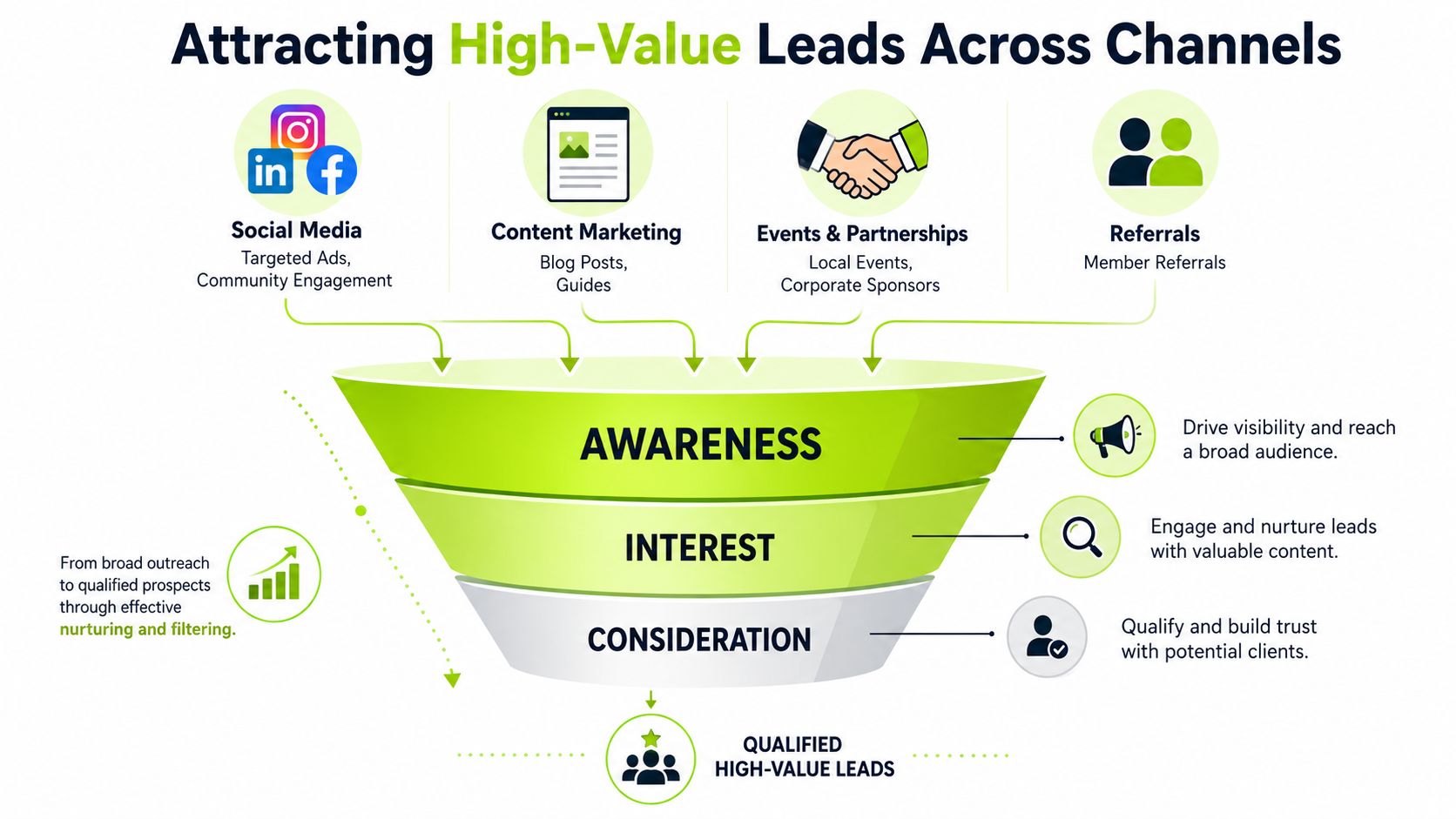
What each channel is actually for
Different channels do different jobs.
Meta ads are strong for creating demand among local golfers who may not be actively searching yet. They're useful for visual storytelling, lifestyle positioning, and capturing softer intent.
Google ads serve a different role. They capture people already looking for membership options, pricing, or clubs in a specific area. Those leads can be more direct, but they usually cost more.
Local discovery through search visibility and a clear website matters because many prospects still research before they enquire. If your club appears hard to find information on, unclear on membership, or weak on enquiry capture, paid traffic leaks away.
Referrals remain the highest-trust source. That's not theory. Capstone Hospitality notes that member referrals are the most effective activity for 53% of UK clubs, ahead of social media at 24% and general advertising at 38%.
Cost and trust need balancing
Budget decisions shouldn't be made on instinct alone. UK golf club marketing benchmark data puts average Facebook cost per lead at approximately £17.60, while Google cost per lead exceeds £55. The same benchmark argues that a dependable pipeline comes from blending local discovery, paid demand capture, and referral momentum.
That trade-off is important. Facebook usually gives cheaper lead volume. Google often brings more obvious intent. Referrals bring trust that paid media can't manufacture.
A workable channel mix often looks like this:
- Meta for reach and enquiry generation among matched local audiences
- Google for active demand capture when prospects are already evaluating options
- Website capture tools so visitors don't disappear without leaving details
- Referral automation so member advocacy becomes repeatable rather than accidental
For a broader view of list hygiene, capture quality, and process discipline, this guide to best practices for generating leads is worth reading alongside club-specific tactics.
The referral gap most clubs ignore
Clubs often say referrals matter, then leave them unmanaged.
That usually means no prompt, no timing, no messaging, and no CRM-triggered follow-up. Staff hope satisfied members will mention the club to a friend. Sometimes they do. Most of the time, nothing happens because there is no process.
The better approach is to build referral requests into the operating rhythm of the club. Ask after positive milestones. Route the contact into the same pipeline as paid leads. Follow up quickly. Treat the referral like a real opportunity, not a bonus.
GolfRep's view is that golf club membership lead generation works best when channels support each other rather than compete for credit. A prospect might first notice a club on Meta, later search on Google, visit the website, then finally enquire because a member mentioned the experience in person. That's why isolated reporting leads clubs to bad decisions.
For clubs weighing media spend and enquiry quality in more detail, our guide to golf club paid advertising looks at that balance in practical terms.
Implementing an Instant Lead Capture System
If a club only fixes one part of its membership pipeline, this should be it.
Leads are lost every day because they arrive in too many places and nobody responds fast enough. Website forms go to one inbox. Facebook leads stay inside Meta. Phone enquiries sit in a notebook. Walk-ins get discussed and forgotten. By the time someone tries to piece it together, the prospect has cooled off.
One pipeline, not five inboxes
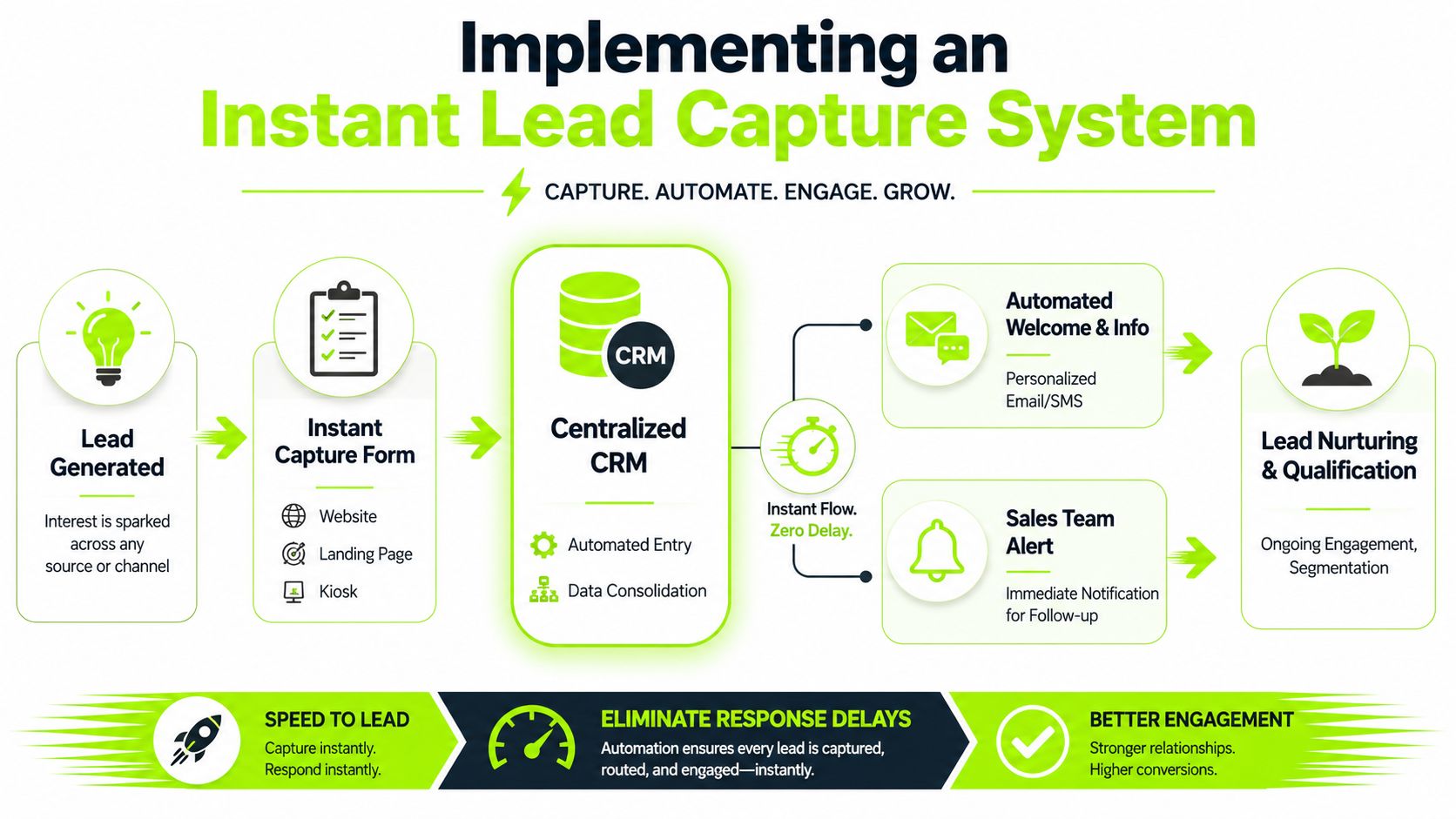
The first requirement is a centralised CRM. Every enquiry source should feed into one visible system.
That includes:
- Website forms
- Meta lead forms
- Google ad enquiries
- Phone calls
- Referral submissions
- Walk-ins recorded by staff
When clubs operate without that central view, they can't answer simple questions. How many membership enquiries came in this week? Who has been contacted? Who is waiting for a callback? Which prospects asked about a tour? Which ones went cold after the first touch?
At GolfRep, most clubs recognize their issue isn't traffic. It's lead visibility.
Speed changes outcomes
GolfRep's membership enquiries guidance makes the operational problem clear. The main challenge isn't enquiry volume. It's the speed and structure of the response, with success shaped by fast acknowledgement and clear ownership of the next action.
That means an effective lead capture system does more than store contact details. It triggers action immediately.
A useful setup should do four things the moment a lead arrives:
- Create the contact in the CRM
- Send an instant acknowledgement by email or SMS
- Ask a small number of qualifying questions
- Alert the right staff member to take ownership
Fast acknowledgement matters even when a full conversation can't happen immediately. Prospects want confirmation that the club has seen them and that someone will take the next step.
Qualification has to happen early
Not every enquiry is equal. Some prospects are ready to visit. Some are comparing a few clubs. Some are only asking for a price.
A simple qualification flow helps staff prioritise without adding friction. Good questions are practical. When are you looking to join? Are you currently a member elsewhere? What type of membership are you considering? Would you like to visit the club?
That early sorting helps the team respond appropriately. Hot prospects get direct contact and a push towards a visit. Earlier-stage leads enter a nurture path. Poor-fit leads don't consume hours of manual chasing.
Manual handling breaks under pressure
Plenty of clubs still rely on a person checking email, downloading lead files, forwarding screenshots, or writing names on paper. That might work for a trickle of enquiries. It fails the moment volume increases or timing gets awkward.
A reliable system is one that still works on a Friday evening, during a busy medal day, or when the usual contact is away.
A practical setup might use a dedicated CRM, connected web forms, automated email and SMS, and assigned staff tasks. GolfRep is one option clubs use for this because it captures enquiries from multiple sources, qualifies them, and triggers follow-up tasks inside one membership pipeline. The important point isn't the brand. It's the operating model.
What good lead capture looks like in practice
Use this as a simple checklist:
| Checkpoint | What should happen |
|---|---|
| Capture | Every enquiry enters one CRM automatically |
| Acknowledgement | The prospect receives an immediate reply |
| Qualification | Key questions identify fit and urgency |
| Ownership | One staff member is assigned the next action |
| Tracking | The club can see status, source, and follow-up history |
If any one of those steps is missing, leads slip between the cracks. Clubs often notice the loss later and call it poor marketing. It usually isn't. It's poor capture.
Nurturing Enquiries into Booked Club Visits
A membership enquiry is not the sale. In most cases, it isn't even the decision point.
The near-term objective is to get the prospect to visit the club. That visit gives staff a chance to handle objections properly, show the course and facilities, and let the prospect picture themselves as a member. The problem is that many clubs try once, get no answer, and move on.
That approach wastes demand.
Why one follow-up rarely works
Documented UK golf club case studies show that integrating ads with a 24/7 CRM automation system requires a structured 7–9 touchpoint nurture sequence to convert enquiries, with documented win rates of 66.83% and 3,127% return on ad spend when the system is implemented properly in context, as outlined in GolfRep's membership marketing case study breakdown.
The same source notes that clubs which follow up only once typically fail to convert, while a structured 7-day email sequence significantly transforms conversion rates.
What the nurture sequence should include
A good sequence isn't repetitive chasing. It should move the prospect forward with useful, relevant touchpoints.
A practical structure might look like this:
Immediate confirmation
Acknowledge the enquiry and explain what happens next.Short follow-up message
Invite the prospect to book a call or visit with a direct link or clear reply option.Personal call task
A staff member tries to make live contact at an appropriate time.Email showing the club experience
Focus on what membership feels like. Course access, competitions, community, practice, social side.Proof and reassurance
Share the type of information that reduces uncertainty, such as how visits work or what a membership conversation involves.Reminder with low friction
Offer simple next steps rather than asking the prospect to make a big decision immediately.Final reactivation touch
Check whether timing is the issue and keep the door open.
Membership rule: Don't try to close the membership in every message. Sell the visit first.
The message has to match the stage
Early messages should reduce uncertainty. Mid-sequence messages should build trust. Later messages should create a clean decision point.
That means the content needs variety. If every touchpoint says "just checking in", prospects tune out. If one message explains membership options, another highlights club culture, and another offers a straightforward booking link, the sequence feels guided rather than pushy.
A few practical ingredients help:
- Email for richer detail and visual storytelling
- SMS for quick reminders and direct response
- Staff tasks so personal contact happens at the right time
- Segment-based messaging depending on interest level or membership type
For a fuller breakdown of timing, messaging, and sequencing, our article on lead nurturing best practices goes deeper into the practical setup.
Consistency beats enthusiasm
Most clubs don't fail because staff don't care. They fail because follow-up depends on memory, availability, and good intentions.
A sequence removes that fragility. It gives every genuine enquiry a fair chance to convert into a booked visit, even when the office is busy and the day gets away from people.
That's what turns marketing effort into actual membership conversations.
Measuring and Optimising Your Growth Pipeline
Clubs often review marketing by looking at clicks, reach, or how busy social media felt that month. Those are weak signals.
A membership pipeline should be measured by movement. Did the lead come in? Did someone respond? Did the prospect book a visit? Did the visit convert into a member? Which channels contribute useful demand and which ones create admin without outcomes?
This is the dashboard mindset clubs need:
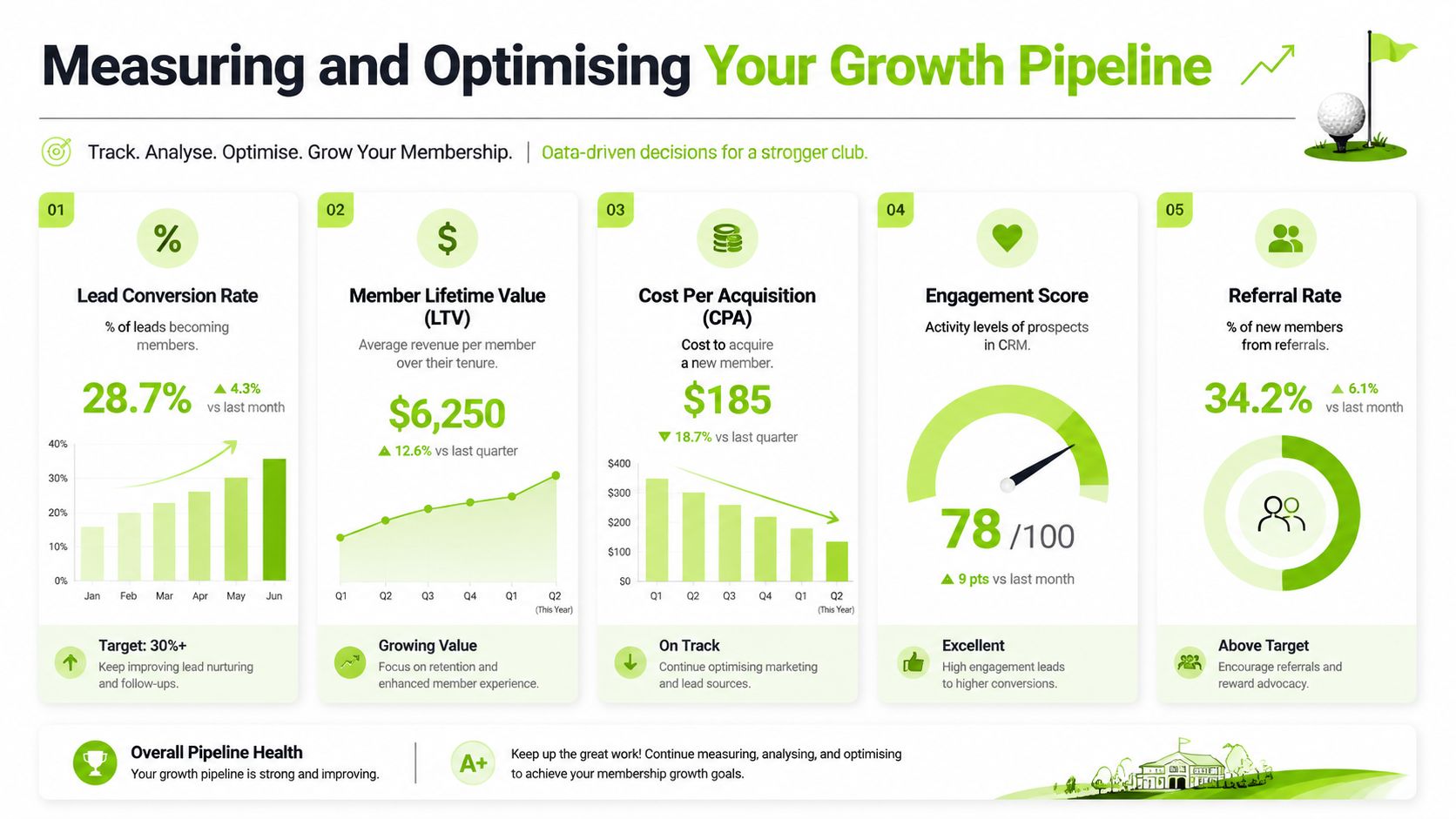
The numbers that matter most
A useful club reporting view should prioritise a small set of operational metrics:
| Metric | Why it matters |
|---|---|
| Cost per lead | Shows what each channel costs to generate an enquiry |
| Lead-to-visit rate | Reveals whether follow-up is strong enough to create real sales opportunities |
| Visit-to-member rate | Tests the quality of visits, qualification, and in-person sales process |
| Response time | Shows whether the club is treating enquiries as time-sensitive |
| Return on ad spend | Connects paid activity to actual commercial outcome |
If your team only knows lead volume, it can't diagnose where the pipeline breaks.
Use data to reallocate, not just report
Reporting isn't useful if it ends with a spreadsheet.
When a club has proper visibility, optimisation becomes practical. If Meta is producing efficient enquiries but poor visit rates, the issue may be qualification or message match. If Google leads cost more but convert better after a club tour, the higher cost may be justified. If referrals show stronger progression through the pipeline, that channel may deserve more operational attention even if it produces lower volume.
For clubs trying to sharpen social reporting specifically, these expert strategies for social ROI are useful because they push beyond surface engagement and focus on business outcomes.
Clubs make better decisions when they can see the full path from first enquiry to signed member, not just the first click.
Visibility changes behaviour
A centralised CRM helps because everyone can work from the same truth. Managers can see open leads. Staff can see pending tasks. Committees can review performance without guessing. Marketing stops being a black box and becomes a visible operating system.
That changes internal conversations. Instead of asking whether advertising "worked", clubs can ask where conversion slowed, which lead sources need better handling, and what process adjustment should happen next.
Golf club membership lead generation becomes more predictable when it's measured as a pipeline, not a campaign.
If your club wants a clearer membership pipeline, GolfRep helps build the operational side that most clubs miss: centralised lead capture, structured follow-up, and CRM visibility from first enquiry to sign-up.
Ready to tap into our proven growth system?