Golf Club Membership Promotion: A Playbook for Growth

Most advice on golf club membership promotion starts in the wrong place. It starts with ads, offers, and more visibility.
That sounds sensible, but it misses the operational reality inside most clubs. The bigger problem usually isn't a lack of enquiries. It's what happens after someone raises a hand.
At GolfRep, we see the same pattern repeatedly. A club runs a promotion, gets interest, then handles responses through a mix of inboxes, phone notes, spreadsheets, and memory. Good prospects wait too long. Follow-up depends on who is on shift. Committee members ask how many leads came in, but nobody can say which ones booked a visit, which ones went cold, or why.
That isn't a marketing problem. It's a conversion problem.
Why Most Membership Promotions Underperform
Golf club membership promotion underperforms when clubs treat lead generation as the finish line. It isn't. It's the start of a process, and for many clubs that process leaks badly.
The easiest way to understand it is as a bucket with holes in it. More water won't fix the bucket. More enquiries won't fix a weak response system.
England Golf reported that between 2024 and 2025, affiliated venues in England added 89,797 players, bringing total membership to 737,021, which is approximately 12.2% year-on-year growth according to England Golf's membership update. Demand is there. Interest is there. Clubs don't need to assume the market has disappeared.
The leak usually sits after the enquiry
A prospect fills in a form on Tuesday evening. The club replies on Thursday afternoon. Another prospect sends a Facebook message and never receives a proper answer because the admin team expects email enquiries, not DMs. A referral comes in through a member, but nobody records it centrally, so there is no structured follow-up and no accountability.
Those aren't rare mistakes. They're common operating habits.
Practical rule: If a club can't see every enquiry in one place, it can't manage conversion properly.
This is why broad campaign planning matters less than most clubs think, and process design matters more. A good offer still needs a good journey behind it. If you're mapping activity from promotion through to sign-up, a simple campaign strategy template can help teams organise channels, messaging, and hand-offs before money gets spent.
More leads can make weak systems worse
Clubs often ask for more enquiries when they haven't fixed visibility, response handling, or follow-up. That can increase waste. More volume going into a manual process just creates a bigger backlog.
A cleaner model is this:
- Capture centrally: Every website form, call-back request, referral, and message should feed into one system.
- Respond quickly: Prospects should receive an immediate acknowledgement and a clear next step.
- Track movement: Staff should know who is new, who is booked, who needs chasing, and who has gone quiet.
- Review outcomes: Committees should ask what converted, not just what arrived.
The clubs that grow steadily don't rely on memory and goodwill. They build process. That's why many marketing efforts fail long before the ad itself becomes the issue. The breakdown is often in the handover from interest to action, as discussed in more detail in this piece on why most golf club marketing fails.
Defining Your Ideal Member and Value Proposition
Before a club promotes anything, it needs to decide who the membership is intended for. Not in a vague sense. In a practical one.
A generic message such as "Join our club today" rarely does enough heavy lifting. It doesn't speak to time pressure, family use, flexibility, social life, or value. It asks the prospect to fill in the gaps.
Golfshake's 2025 findings showed that 71% of golfers said membership still offers good value for money, up from 69% the previous year, according to Golfshake's 2025 club membership survey coverage. That matters because it tells clubs something important. You don't always need to cut price. You need to explain value properly.
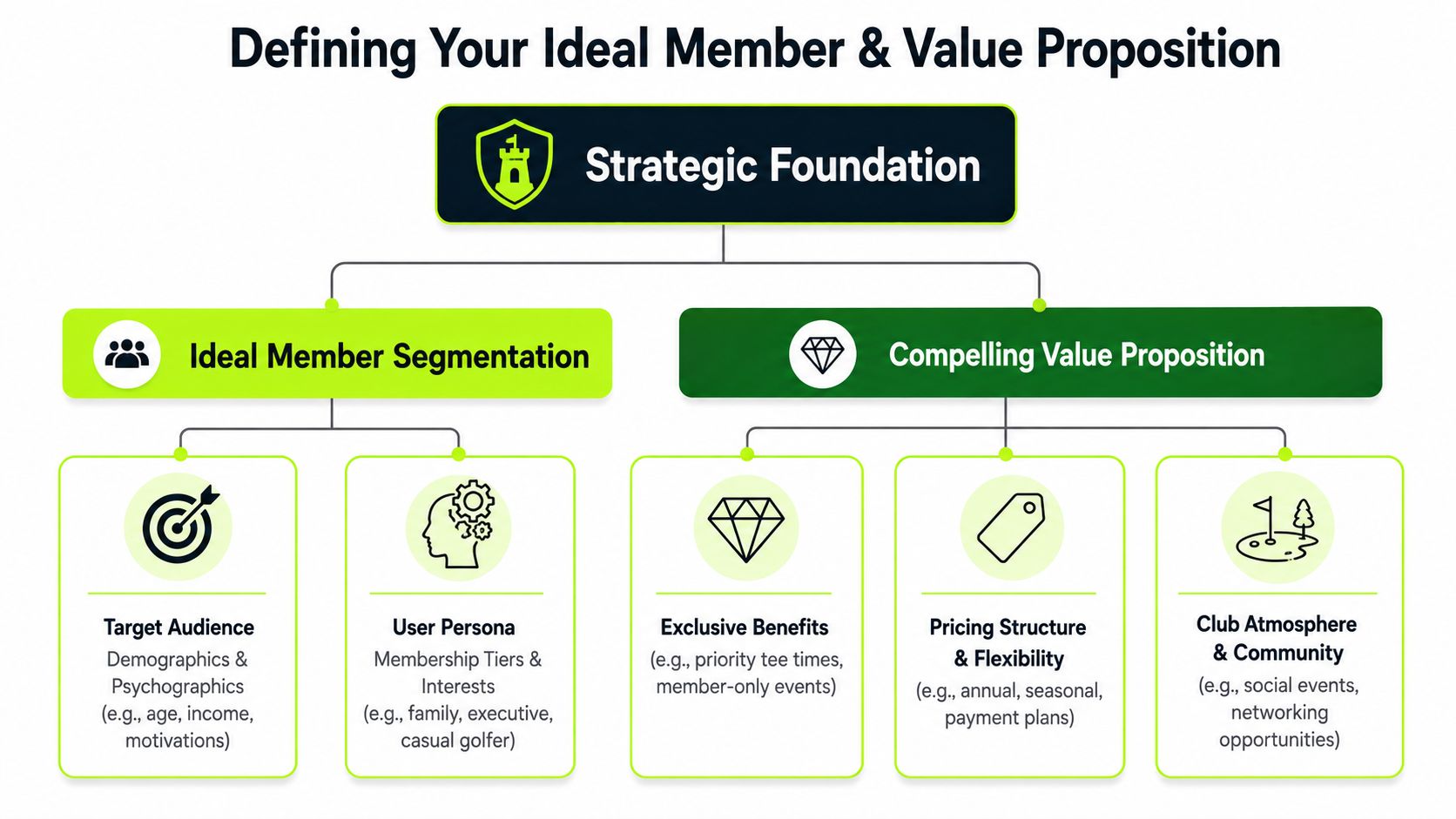
Here's the structure worth building around:
Start with member types, not broad demographics
Age alone isn't enough. A club should define members by what they need from the club and what would stop them joining.
A useful working list often includes:
- Busy professionals: They want smooth booking, convenient play windows, and a club that feels easy to use.
- Young families: They respond to community, family-friendly atmosphere, events, and flexibility.
- Active seniors: They often value regular play, social connection, and pricing structures that feel appropriate to life stage.
- Returning golfers: They need reassurance, welcome, and a route back into the game without feeling out of place.
One overlooked issue is senior pricing. Golf Support found that 18.4% of 244 reviewed clubs offered any senior-specific discounts or incentives, meaning over 80% did not, as noted in Golf Support's review of senior-inclusive pricing. Clubs don't need to race into discounting, but they should at least review whether current tiers reflect the members they say they want.
Replace generic offers with specific value
A weak value proposition sounds like this:
Membership available now. Great course. Friendly club. Enquire today.
That copy is common because it is easy to write. It is also easy to ignore.
A stronger version is more specific. It connects membership to the prospect's actual life. For example, a club might position itself around weekday access for flexible workers, family events that make the club useful beyond golf, or a smoother re-entry path for lapsed players.
| Generic promotion | Targeted promotion |
|---|---|
| Join our golf club | Flexible membership for golfers who want regular play and a sociable club environment |
| Great value membership | Membership built around access, community, and practical use of the club |
| Limited spaces available | Book a visit to see which membership route fits your schedule and playing habits |
Value isn't just the course
Most clubs undersell themselves by talking only about the course and subscription price. Prospects often want the full picture.
That usually includes:
- Club atmosphere: How welcoming the place feels on a normal day.
- Member life: Events, competitions, introductions, and social interaction.
- Flexibility: Payment approach, tier structure, and access model.
- Ease: How quickly someone can understand the options and take the next step.
A strong membership proposition reduces the amount of selling needed later, because the prospect already understands why the club fits them.
When clubs get this right, follow-up becomes easier. Staff stop improvising explanations on every call because the core offer is already clear.
Activating the Right Channels to Attract Enquiries
Channels matter, but not in the way most clubs think. A channel is just the door someone uses to enter. It is not the system.
Clubs usually spread enquiries across too many disconnected places. Some arrive through the website. Others come through calls, social messages, email, events, or a member introducing a friend. When those routes stay separate, the team loses visibility. The result is duplication, delay, and missed follow-up.
This is the channel mix most clubs should think about:

Referrals deserve more structure than they usually get
Hillier Hopkins reported that 64% of members' clubs use member referrals as their primary marketing activity, and 40% see referrals as the most successful method for generating new membership, ahead of social media's 21% success rate, according to the Hillier Hopkins Golf Clubs Report 2023-24.
That should change how clubs think about promotion. Referrals are not a side tactic. They're often the highest-intent lead source in the building.
The mistake is leaving them informal.
A better referral process looks like this:
Prompt members clearly
Ask for introductions at visible moments such as renewal communications, event confirmations, and clubhouse touchpoints.Capture referrals properly
Don't leave them in casual email chains or verbal notes at reception.Route them into the same follow-up system
Referred prospects still need consistent communication, booking prompts, and tracking.Measure booked visits, not just names passed over
A referral only matters when it moves.
Paid and organic channels work better when the hand-off is standardised
Search and paid social can generate interest from golfers already in market. Organic content helps clubs answer practical questions before somebody enquires. Email is useful for nurturing people who aren't ready to join immediately.
For clubs building that nurture layer, these effective email marketing strategies are a useful reference for segmentation and targeted follow-up thinking.
What matters more than the channel itself is that every route feeds one operating model. The prospect should experience the club as organised, responsive, and clear no matter where they started.
A simple operating view helps:
- Awareness sources: Paid social, search, local partnerships, club content
- Intent sources: Website forms, call requests, referral submissions, event bookings
- Conversion actions: Visit booked, trial arranged, membership discussion held
The channel creates the opportunity. The process determines whether the opportunity turns into a member.
Many clubs lose control in this situation. One person handles phone calls well. Another replies to email when time allows. Social messages get checked later. Instead of one pipeline, the club has several mini-pipelines with different standards. If you want a practical look at channel selection and campaign structure, this guide on the best way to advertise golf club membership is worth reviewing.
The Engine Room Your System for Conversion
A club does not need a complicated sales machine. It needs a reliable one.
The most common setup in golf is still manual. An enquiry lands in an inbox. Someone sees it when they can. They reply from their own email. If the prospect does not answer, follow-up depends on memory. If the staff member is off, the lead sits still. If the committee asks for an update, someone pieces together fragments from several places.
That model is fragile. It also feels normal because clubs have lived with it for years.
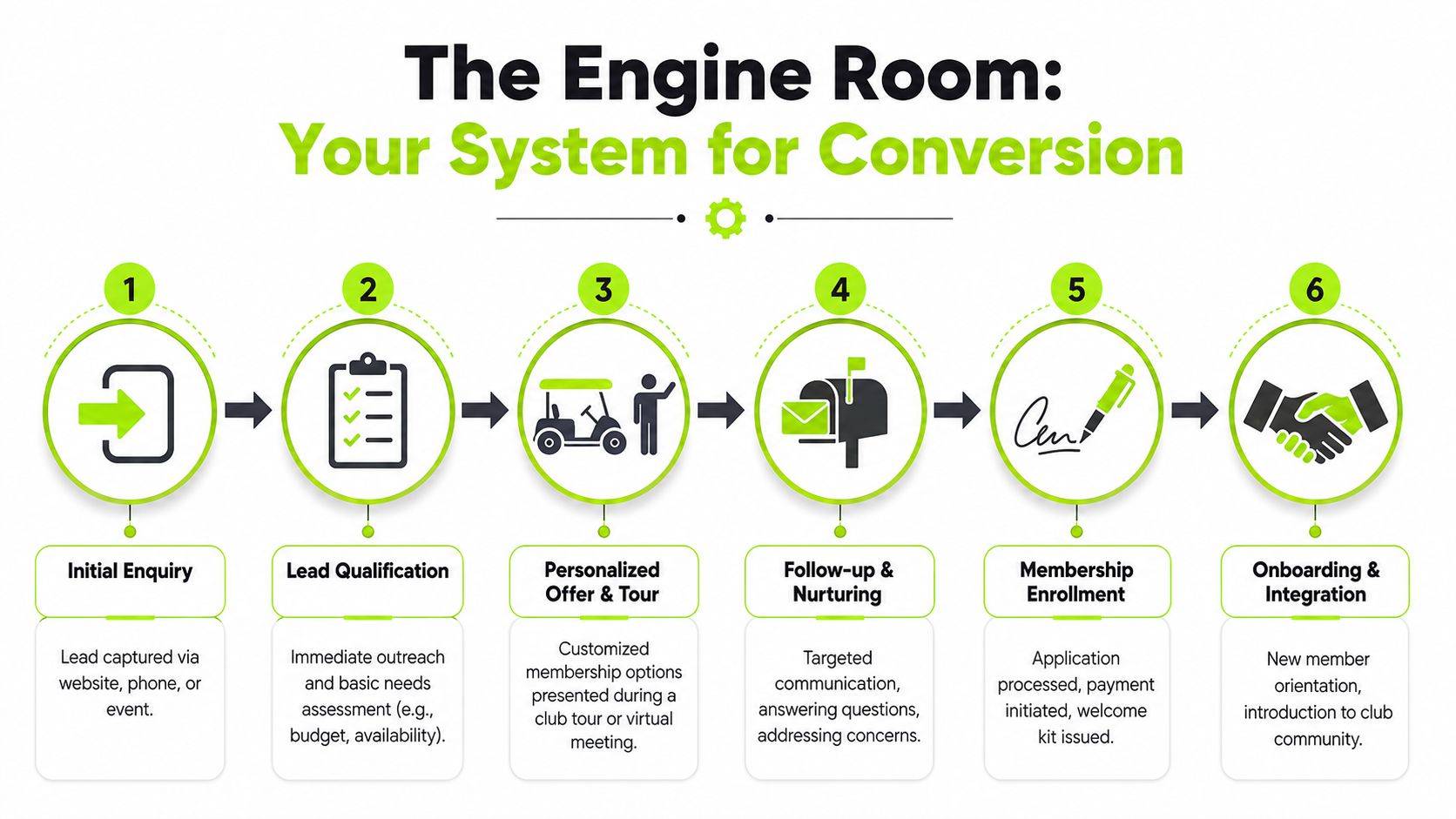
A stronger setup looks like this:
Centralise first
Every enquiry should land in a single CRM or enquiry management system. That includes form submissions, event sign-ups, referrals, call-back requests, and messages copied in from other channels.
Clubs lose people during handovers. If one staff member leaves early, another should still be able to see exactly what happened, what was promised, and what comes next.
A central record should show:
- Source of enquiry: Website, referral, event, social, phone
- Status: New, contacted, qualified, visit booked, proposal sent, won, lost
- Next action: Call, email, SMS, visit reminder, follow-up date
- Context: Budget signals, preferred membership route, playing habits
Respond immediately, even if the full reply comes later
Silence after an enquiry creates doubt. Prospects don't know whether the club has seen their message, whether anyone is dealing with it, or whether joining will be equally slow.
An instant acknowledgement doesn't need to be fancy. It needs to be clear.
A good immediate response should do three things:
- confirm the enquiry has been received
- explain what happens next
- offer a simple action such as booking a call or visit
That can be automated. The point isn't to replace staff. It's to make sure no lead sits unattended while staff get to work on the key conversation.
Qualify early without making it feel transactional
Not every enquiry is ready for the same follow-up. Some want a tour. Some are comparing costs. Some are price-sensitive and need the right membership route. Others are just exploring whether the club feels right.
Structured qualification proves helpful. In high-cost markets, that matters even more. Golf Support's affordability review found that residents in Southampton need to work 79 hours and 42 minutes to afford a full membership, according to the Golf Support affordability league table. Clubs in markets like that can't rely on price-led promotion alone. They need cleaner qualification and better conversion efficiency.
Operational reality: If membership carries a meaningful financial commitment, the club must guide the prospect through confidence, fit, and clarity.
Useful qualification points include preferred times to play, interest in social or family use, likely start date, and which membership options are relevant. This should feed staff with context before the first proper conversation.
Build follow-up that doesn't depend on memory
Most clubs lose leads in the gap between first contact and decision. The prospect meant to reply. Staff meant to chase. Nobody did.
That gap is where automation earns its place.
A simple nurture sequence can include:
- Immediate acknowledgement after enquiry
- Membership overview with relevant options
- Visit invitation with easy booking
- Reminder message if there is no action
- Post-visit follow-up answering common objections
- Final check-in before the lead is marked inactive
The sequence can use email, SMS, or task reminders for staff. What matters is consistency.
At GolfRep, this is the part clubs usually underestimate. The work isn't just generating the first click. It's building the CRM and follow-up structure that turns interest into booked visits and signed applications.
Staff time should go to warm conversations, not admin
Manual admin drains clubs. Staff copy details from inboxes, chase internally for updates, and rewrite the same replies repeatedly.
A system-led setup changes that. It lets staff spend time where they are most useful: speaking to qualified prospects, showing them around, handling objections, and making the club feel welcoming.
If your current process still depends on inbox checking and manual chasing, this guide to golf club inquiry management covers the operational fixes that matter most.
Measuring Success Beyond Initial Enquiries
Counting enquiries is easy. It is also one of the least useful ways to judge golf club membership promotion.
A club can produce plenty of interest and still have no reliable route to revenue. That becomes more serious when fees are high. Club Insure noted that 74% of UK golf club membership fees now exceed £1,000 per year, according to Club Insure's review of diversification and membership costs. At that level, clubs can't afford to treat every enquiry as equal or measure success by volume alone.
This is the reporting view worth building around:

The numbers that help you manage
The most useful metrics are the ones that show movement through the pipeline.
| Metric | Why it matters |
|---|---|
| Lead response time | Shows how quickly the club reacts to interest |
| Enquiry-to-visit rate | Reveals whether initial follow-up creates real engagement |
| Visit-to-member conversion rate | Indicates how effective the sales conversation and offer are |
| Cost per acquired member | Connects marketing spend to actual outcomes |
These metrics let a manager spot where the process breaks. If response time is strong but visits stay low, the issue may be the message or call to action. If visits happen but membership take-up is weak, the club may need to revisit presentation, qualification, or pricing clarity.
Vanity metrics hide the real issue
Website traffic, post engagement, and raw lead totals can all look encouraging while conversion remains poor.
That is why committees should ask sharper questions:
- Which source produces booked visits?
- How many qualified leads reached a real conversation?
- Where do prospects stall?
- How long does each stage take?
If a club only measures enquiries, it learns nothing about the part of the process where money is won or lost.
A decent CRM should make this visible without staff building reports by hand. Once the pipeline is tracked properly, the club can improve one weak stage at a time instead of guessing.
Building Your Sustainable Membership Pipeline
Most clubs don't need another short burst of golf club membership promotion. They need a reliable pipeline that keeps working after the campaign launch week has passed.
That means treating membership growth as an operational system, not a seasonal scramble. The clubs that create predictable results usually do a few things consistently. They define the right member clearly, present a value proposition that isn't built on panic discounting, capture every enquiry centrally, and run disciplined follow-up until the prospect either joins or drops out for a known reason.
Campaigns create spikes. Systems create continuity
A campaign can bring attention. It cannot compensate for weak internal handling.
A proper pipeline gives the club control over:
- Visibility: Every lead is seen and owned
- Consistency: Every prospect gets a proper response path
- Efficiency: Staff spend less time on avoidable admin
- Accountability: The club knows what converted and what did not
In such scenarios, committee-led clubs often feel the biggest relief. Once the process is visible, decisions become easier. Fewer debates get stuck around opinions because the club can see the pipeline in front of it.
Predictable growth comes from predictable handling
The underlying principle is simple. If the process is inconsistent, results will be inconsistent.
A sustainable setup doesn't need to feel corporate or impersonal. In fact, it usually helps clubs feel more human to prospects because responses are timely, information is clear, and staff are better prepared when conversations happen.
Clubs grow more steadily when they stop asking, "How do we get more leads?" and start asking, "What happens to every lead we already generate?"
That change in mindset is where durable membership growth begins.
If your club wants a clearer membership pipeline, GolfRep helps UK golf clubs put structure behind promotion by combining lead generation, CRM-led follow-up, and conversion tracking so enquiries don't disappear into manual processes.
Ready to tap into our proven growth system?