Speed To Lead for Golf Clubs: A Guide to Faster Member Conversion

Most golf clubs we speak to are fixated on one thing: getting more enquiries. From our experience as a growth partner to UK clubs, we've learned the real roadblock to growing your membership isn’t the number of leads you get. It's how quickly and effectively you handle them.
This is the core idea behind speed to lead for golf clubs. It is a simple concept. The faster you connect with a potential member after they enquire, the greater your chance of welcoming them to your club.
Your Membership Problem is Conversion, Not Enquiries

It's a familiar story. Membership sales have a quiet month, and the immediate assumption is that the marketing isn't delivering. This kicks off a frustrating cycle: you pour more money into advertising to drum up more leads, hoping that by sheer volume, a few more will eventually sign up.
This approach, however, completely misses the most critical moment in the entire journey: what happens right after a golfer shows interest. The path from that first enquiry to a signed membership form is where most clubs are unknowingly bleeding revenue. The problem isn't a lack of interest; it's a broken follow-up process.
The First Few Minutes Are Decisive
Picture this: a golfer is on your website and fills out your membership enquiry form. At that moment, their interest is at its peak. They are actively thinking about joining a club, which also means they're almost certainly looking at your local competitors at the exact same time.
Every minute you wait to respond, that initial excitement fades. A delay of just a few hours can be fatal. Life gets in the way, other priorities pop up, and your window of opportunity closes. This is what speed to lead is all about. Immediacy is everything.
A slow response doesn't just come across as poor service. It sends a powerful message that you do not value their interest. In a competitive market, that is a mistake you cannot afford to make.
The High Cost of a Slow Follow-Up
The financial impact from a sluggish or disorganised response system is huge. Every lead that goes cold represents a lost membership, all the associated secondary spend, and a missed chance to build a long-term relationship.
This is more critical than ever. Recent industry data shows that 18.3% of UK golf members are undecided about renewing their current membership, making them very open to timely and compelling offers from other clubs. You can see the full breakdown in the 2025 Golfshake survey about member renewals.
At GolfRep, we see firsthand that the challenge isn't generating leads; it's converting them. The answer isn't to keep increasing your ad spend. It's to build a structured system that ensures every single enquiry is handled with speed and professionalism. Once you fix the leaks in your follow-up, you create a predictable pipeline for growth without needing a bigger marketing budget. We go into more detail on this in our analysis on why golf club leads don't convert.
Laying the Groundwork for Your Speed-to-Lead System
Before you can start building a predictable pipeline of new members, you have to know where you're starting from. This means taking an honest look at your current process for handling new enquiries. We have seen it time and again: this simple audit often reveals significant but easily fixable gaps where valuable leads are slipping away.
Start by asking your team some direct questions. What is our actual average response time to a new website enquiry? Who, specifically, is responsible for that first follow-up? And how do we track an enquiry from the moment it lands to the point they either join the club or we mark them as lost?
The answers can be uncomfortable. You will likely find that enquiry response times are measured in hours, or even days, not minutes. You might discover that responsibility is vaguely "shared" by the team, which really means it is owned by no one. And as for tracking? It is probably a messy spreadsheet or, worse, just a pile of unread emails in a general inbox.
This is the reality for many clubs, but it's also your single biggest opportunity for improvement.
Define Your Golden Window
In today's market, your goal for responding to a new enquiry has to be under five minutes. This is not an arbitrary target. It's a non-negotiable benchmark if you're serious about growth.
That five-minute window is "golden" because it's when a prospect's interest is at its absolute peak. A fast response not only looks professional but also catches them right in that moment of intent, before they click over to check out your competitor down the road.
Hitting this kind of speed consistently is simply impossible through manual effort. Your staff take lunch breaks, go home in the evening, and get pulled into other urgent tasks. A system, on the other hand, works 24/7. The foundation of any good speed-to-lead strategy is built on reliable systems that take the place of inconsistent, manual work.
The goal isn't to make your team work harder; it's to give them a system that works smarter. It guarantees every prospect gets an immediate, professional acknowledgement, no matter when they get in touch.
The CRM: Your Central Hub
To stop leads from getting lost and create total lead visibility, your club needs one single source of truth for every enquiry. This is where a Customer Relationship Management (CRM) system comes in. It's time to ditch the separate inboxes and chaotic spreadsheets. A CRM centralises all your prospect information, communication history, and lead status in one organised place.
A properly set-up CRM gives you complete lead visibility. At any given moment, you can see:
- Who enquired and when: All contact details are captured along with the exact time of their enquiry.
- Their current status: Are they a brand-new lead? Have they been contacted? Is a tour booked, or have they gone cold?
- The complete communication history: Every email, text message, and note from a phone call is logged on their profile.
This centralisation is the first real step toward building an accountable process. It puts an end to the guesswork, replacing it with hard data. You can find out more about picking the right platform in our complete guide to a golf CRM system.
With a CRM as your foundation, you can start mapping out the ideal journey for a new lead. This involves defining the exact steps an enquiry should follow from the second someone hits 'submit' on your website form. You must clearly assign who is responsible for each stage, especially that crucial first human contact. Who gets the alert when a new enquiry arrives? Whose job is it to make the follow-up phone call?
By defining these steps and roles from the start, you create a dependable structure. This foundation is absolutely critical. It ensures no prospect can fall through the cracks again and sets the stage for the automation that will turn your enquiry flow into a predictable source of new members.
Using Automation to Nurture Leads Around the Clock
Once you have laid the groundwork with a central system, it's time to bring in smart automation. This is not about replacing the personal touch that makes a golf club special. It is about using technology to handle the immediate, repetitive tasks, which frees up your team to build real relationships with interested prospects.
When a potential member fills out your enquiry form, your CRM should activate instantly. The system can be set up to send a personalised email or SMS right away. This immediate acknowledgement does more than just confirm you have received their message; it makes a powerful first impression and shows a level of professionalism that stands out.
That first message is your golden opportunity to do more than just say, "Thanks for your enquiry."
Beyond the Generic 'Thank You'
An effective automated response should start the qualification process from the very first second. Instead of a bland, forgettable message, craft a note that asks a simple, relevant question. It is a small detail, but it makes a world of difference.
For instance, your automated email could ask:
- "Thanks for your interest in joining us. To help us send you the right information, are you primarily looking for a 7-day or a 5-day membership?"
- "We've received your enquiry. Are you an experienced golfer or new to the game?"
This approach achieves two crucial things. First, it shows you are already trying to help them. Second, it gives your team vital context before they pick up the phone, making their follow-up call far more targeted and productive. This is a core principle of effective golf club marketing automation.
The diagram below shows the first few steps in building this kind of structured, automated system for your club.
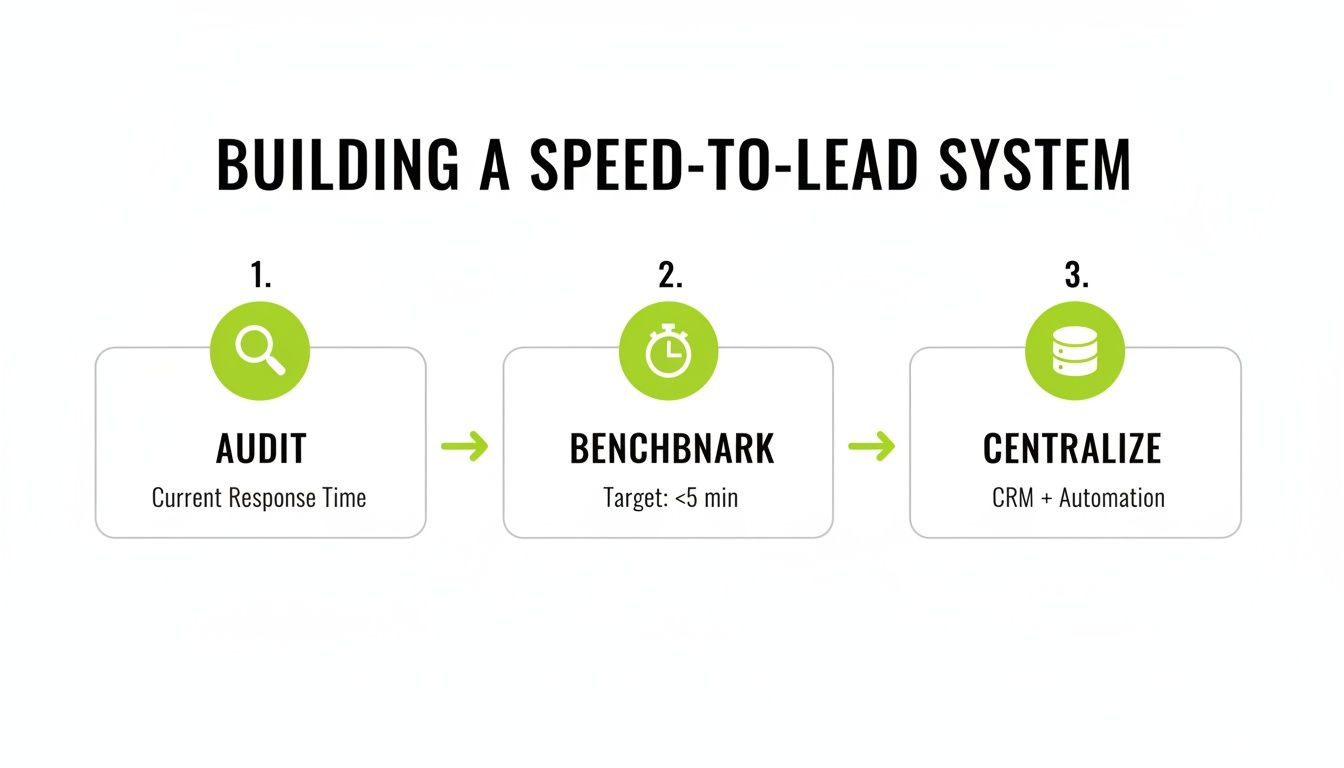
As you can see, before you can get the full benefit of automation, you have to audit your current process, benchmark your performance, and centralise your lead data.
Alerting Your Team for a Personal Follow-Up
Automation’s other vital job is internal. While your system is making that first contact, it should simultaneously be notifying the right person on your team that a new lead has arrived. A properly configured CRM can send an instant alert straight to your membership secretary or general manager via email or a mobile app.
This notification must include all the key details: the prospect’s name, contact information, the time they enquired, and any answers they gave to your qualifying questions. This ensures your team can make a quick, personal phone call, armed with all the context they need. The system provides the speed; your team delivers the human touch.
The goal of automation is to eliminate delays and administrative headaches. It ensures every lead gets immediate attention, 24/7, while organising and prioritising the best prospects so your staff can focus their time on meaningful conversations.
Manual vs Automated Enquiry Response
The impact of shifting from a traditional, manual process to an automated one is significant. We have seen it time and again with the clubs we work with. The table below illustrates the typical difference in performance.
| Metric | Manual Process (Typical Club) | Automated System (GolfRep Framework) |
|---|---|---|
| Initial Response Time | 4-48 hours | Under 5 minutes |
| Lead Contact Rate | 40-50% | 85-95% |
| Enquiry to Tour Rate | 15% | 40% |
| Staff Admin Time | 2-3 hours per day | < 30 minutes per day |
| Lead Qualification | Manual, inconsistent | Automated, instant |
This data is not theoretical. It reflects the real-world results of implementing a structured speed to lead system. By automating the initial stages, you not only improve the prospect experience but also free up significant staff time and dramatically increase conversion rates.
The modern golf demographic demands this kind of efficiency. UK clubs that ignore speed to lead are at risk of missing out on the 38% of new golfers under 35 who have recently taken up the sport. With 60% living within 20 minutes of their main club, these prospects expect an instant response. Slow, manual processes simply let too many potential members slip through the cracks.
This blend of an automated first response followed by a prompt human follow-up is what creates a predictable pipeline of new members. It guarantees no lead is left waiting and that your team’s valuable time is spent where it counts most: talking to qualified, engaged people who are genuinely interested in joining your club.
Defining Roles and Crafting Messages That Convert
You can have the most sophisticated lead-generation system in the world, but it is all for nothing without the right people and the right words. Putting a speed-to-lead strategy in place is as much about organising your team and what they say as it is about the technology behind it.
When roles are unclear, leads go cold. It is the classic, “Oh, I thought you were going to call them” scenario. To make this work, everyone needs to know their exact part in turning a curious website visitor into a prospective member. This clarity ensures a smooth handover from the initial automated message to the first human conversation, which is where the real connection begins.
Assigning Clear Roles and Responsibilities
One of the most common mistakes we see is making lead follow-up a shared, informal task. For this system to function correctly, every role has a specific purpose. Here is a simple, effective way to break down the responsibilities within a typical club structure:
- General Manager / Club Manager: Their job is oversight, not getting bogged down in daily calls. They should keep a close eye on the key performance indicators (KPIs) in the CRM, like average response time and lead-to-tour conversion rates. They own the success of the system as a whole.
- Membership Secretary / Sales Manager: This is your primary point of human contact. Once the instant automated message goes out, they are responsible for making that crucial first phone call. Their entire focus should be on building rapport, answering questions, and booking a tour of the club.
- Front Desk / Pro Shop Staff: While they aren't chasing online leads, this team provides vital support. They need to be trained to capture any walk-in or phone enquiries directly into the CRM. This stops potential members from ending up as a forgotten name on a scrap of paper.
This division of labour means that strategic thinking, personal engagement, and basic data entry are all handled by the right people. It creates a seamless journey for the prospect, from their first click to stepping onto your property.
Creating Messaging That Connects
How you communicate is just as important as how fast you do it. From that first automated text to the follow-up phone call, your tone should always be helpful and professional, never aggressive. You are not trying to close a sale on the first contact; you are building a relationship.
A great follow-up script does not sell a membership; it sells the next step. For most golf clubs, that next step should be an invitation for a personal tour of the facilities.
Here are a few templates you can adapt for your club.
Initial SMS Template (Automated)
This needs to go out instantly after someone fills out your online enquiry form.
- "Hi [First Name], thanks for your interest in [Your Club Name]. A member of our team will call you shortly to answer any questions. In the meantime, you can see our virtual tour here: [Link]. We look forward to speaking with you."
Initial Phone Call Script Outline
This call should be made by your Membership Secretary within 5-15 minutes of the enquiry.
- Introduction: "Hi, is that [First Name]? My name is [Your Name], calling from [Your Club Name]. You just put an enquiry in on our website about membership, and I wanted to reach out personally."
- Acknowledge and Ask: "I can see you were looking at our [7-Day/5-Day/etc.] options. What sparked your interest in joining a club at the moment?" This opens a conversation, not a sales pitch.
- Listen and Qualify: Pay close attention to their answer. Are they new to the area? Unhappy with their current club? A complete beginner? This information is gold.
- The Offer (Book a Tour): "The best way to see if we're the right fit for you is to pop down for a relaxed look around. I can show you the course, the clubhouse, and introduce you to a few people. Would you be free sometime this week?"
Email Nurture for Unresponsive Leads
If a prospect does not answer that first call, do not give up. They should automatically be entered into a simple, automated email sequence.
- "Hi [First Name], just following up on the membership enquiry you made yesterday. We'd love to show you what makes our club special. Are you free for a quick chat this week? You can book a call directly into my calendar here: [Link to Calendar]."
- "Hi [First Name], thought you might like to see a short video of our signature 12th hole. We're very proud of the condition of our course, which is looked after by our fantastic greenkeeping team. If you'd like to see it for yourself, please let me know."
By defining these roles and scripting these key moments, you give your team the confidence and the tools to turn initial interest into genuine relationships. This is how a speed-to-lead system for golf clubs moves from a good idea on paper to a practical, revenue-generating machine.
Measuring Success with the Right Performance Indicators

Putting a speed-to-lead system in place is a fantastic move, but the effort is wasted if you cannot prove it is working. For too long, we have seen clubs get bogged down in vanity metrics, like the total number of enquiries, which do not actually tell you anything about the health of your membership pipeline.
Real, sustainable growth comes from tracking the right key performance indicators (KPIs). These numbers give you a crystal-clear view of your conversion process, from a prospect’s first click all the way to their first Direct Debit payment. This is how you stop guessing and start making informed decisions that actually move the needle.
Average Lead Response Time
The first metric you absolutely have to get right is your Average Lead Response Time. This is simply how long it takes for someone on your team to make that first contact after a new enquiry comes in. It is the very foundation of your speed-to-lead strategy.
Why is this so critical? Because a prospect who fills out a form online is looking for an answer right now. Their interest is at its absolute peak. If you can get back to them in minutes, you catch them in that crucial moment. Wait an hour, and they have already moved on.
A modern CRM like HubSpot or Pipedrive will automatically log these timestamps for you. Your target here isn't just "fast", it's an average response time of under five minutes. Anything longer is handing potential members straight to your competition.
The success of your entire membership pipeline starts here. If your response time is slow, every subsequent conversion rate will suffer. It is the single most important metric to get right.
Lead-to-Tour Conversion Rate
Once you have nailed your response time, the next thing to watch is your Lead-to-Tour Conversion Rate. This number shows you what percentage of your qualified leads actually book and show up for a tour of the club.
This is where the rubber meets the road. This KPI reveals how effective your initial emails and calls truly are. It tells you whether your team is building rapport, answering questions confidently, and successfully selling the next logical step: a personal visit. If this rate is low, it is a red flag that your messaging is not resonating or your follow-up is not persistent enough.
You can easily track this in your CRM by shifting a lead’s status from "New Enquiry" to "Tour Booked". For a club with a solid follow-up process, a healthy benchmark is a Lead-to-Tour Conversion Rate of around 40%. This proves your initial engagement is strong enough to get genuinely interested people through the door.
Tour-to-Member Conversion Rate
Finally, we get to the ultimate measure of success: your Tour-to-Member Conversion Rate. This tracks the percentage of prospects who sign up and become a member after they have had a tour. This is the final test of your sales skills and, just as importantly, the quality of your club's facilities and atmosphere.
A high conversion rate here tells you two things: your team is brilliant at showing off the club's value, and the on-site experience lives up to the promises you made. If this number is stubbornly low, it might point to issues with the tour itself, your pricing structure, or how your team handles those closing conversations.
For instance, our work with Bidston Golf Club really highlighted the power of this. By meticulously tracking their pipeline from enquiry to tour and then to membership, they could pinpoint exactly where to focus their training and resources. This data-driven approach was the key to their impressive turnaround, creating a predictable flow of new members.
Tracking this is simple in a CRM; you just mark the lead as "Joined" or "Lost" after their visit. A strong Tour-to-Member Conversion Rate to aim for is over 50%. By keeping a close eye on these three core KPIs, you will build a clear, data-backed picture of your membership pipeline and create a true growth engine for your club.
Your Questions on Speed To Lead Answered
Whenever we walk club managers through a speed-to-lead strategy, they quickly see the 'why'. But then, naturally, the practical questions start. "How would this actually work for us?" It's a great question. Here are the most common ones we hear from clubs all over the UK, along with some straight-talking answers.
Is This System Too Complex for Our Small Team?
Quite the opposite, actually. A speed-to-lead system is a game-changer for lean teams and clubs that rely on a handful of dedicated staff or even volunteers. It's designed to make your team more efficient, not more burdened.
Think about it: the system handles the most repetitive, time-sapping tasks for you. No more manually checking the inbox at all hours. Every single enquiry gets a prompt, professional reply, even at 10 pm on a Saturday. The system then organises the hottest leads, so when your staff do step in, they are spending their valuable time having meaningful conversations with genuinely interested people. We specialise in setting these systems up to be incredibly simple to manage, with no technical wizardry needed from your team.
How Do We Avoid Automation Feeling Impersonal?
This is a big one, and it is a valid concern. For any club that prides itself on a personal touch, the word "automation" can feel a bit cold. But the goal here is to enhance the human connection, not replace it. It is about using technology to be impressively efficient upfront, which clears the way for a much warmer, more personal follow-up.
That first automated message is crafted to sound exactly like your club; it is not a generic template. It simply acknowledges the enquiry with a speed that prospects see as a premium, attentive service. From there, the system tees up your membership team for a brilliant follow-up call, giving them all the context they need on the prospect.
A speed-to-lead system blends the instant service people expect today with the high-touch, personal experience that defines a great club. It shows you are both prestigious and switched-on.
How Quickly Will We See Results?
The change in your enquiry process is instant. From day one, your average response time will plummet to under a minute, and you will finally have a complete, transparent view of every lead. No one will ever slip through the cracks again.
Within the first few weeks, you will start seeing better engagement, including higher email open rates and more replies. As for the results that really move the needle, like booked tours and new member sign-ups, most clubs see a definite, measurable uplift within 60 to 90 days.
The real power is cumulative. The system builds a predictable pipeline of potential members, and the longer it runs, the more data you collect to fine-tune your approach. This is not a quick fix; it is a long-term growth engine for your club.
At GolfRep, we don't just find leads; we build the systems that turn them into members. If you're ready to create a predictable growth pipeline for your club, see how our Growth System can help at https://www.golfrep.co.
Ready to tap into our proven growth system?